mirror of
https://github.com/block/buzz.git
synced 2026-08-18 06:50:31 +02:00
61ba9dfaa00852925058d1a024322fa53663a5bc
2028
Commits
| Author | SHA1 | Message | Date | |
|---|---|---|---|---|

|
61ba9dfaa0 |
refactor(voice): extract reusable Pocket primitives + Pocket voice settings (relands #2467 + #3208) (#3910)
Relands **#2467** (extract `buzz-voice` crate) and **#3208** (Pocket
voice settings) onto main, after #3266 and #3180 merged.
## Why a fresh PR
The repo is squash-only with delete-branch-on-merge. Squashing #3266
deleted `jtennant/pocket-tts-2026-04`, which was #2467's base — GitHub
auto-closed #2467 and it cannot be reopened. Squash merges also sever
ancestry, so GitHub's natural merge-base reports phantom conflicts for
the whole remaining stack.
## Content provenance
- Byte-identical to the blessed `jt/buzz-voice-refactor` branch
(`93029c577`, tree `6729e0eff` — reviewed by Dawn (#2467) and Max
(#3208) at exact heads) **except** the three files where #3180 and #3208
genuinely interact.
- Three-file resolution (union of both sides):
- `huddle/mod.rs` — #3180's pipeline re-exports + #3208's
`agent_tts_routing` imports.
- `huddle/state.rs` — `reset_preserving_generation` preserves both
`huddle_generation` (#3180) and `tts_enabled` (#3208); test sets merged
into one `tests` module.
- `desktop/src/testing/e2eBridge.ts` — both switch arms kept; no
duplicate case labels.
## Verification at
|
||
|
|
689617af7a |
docs: add VISION_REMOTE_AGENTS.md (#3924)
## What Adds `VISION_REMOTE_AGENTS.md` — the vision doc for remote agents, joining the VISION family (`VISION_AGENT.md`, `VISION_MESH.md`, `VISION_SOVEREIGN.md`, …). The one-line thesis: **the relay is the management plane** — an agent's identity, history, presence, and ordinary control all live on the relay, so the body (a pod today, anything tomorrow) is replaceable, and deployment never grows a second control plane. ## Provenance - Distilled from the remote-agents spec (`docs/remote-agents.md`, PR #3748); this doc stays deliberately generic where the spec is Kubernetes-specific. - Five review rounds in the #buzz-remote-agents channel; both reviewers (Wren: thesis/shape/scope, Dawn: truthfulness/minimalness/elegance) converged at 9/9/9, scored against spec head `b4f4ed1a6` with command-level receipts. - Final editorial pass by Tyler (opening line, vignette phrasing, closing tagline), applied live in-channel before this PR. Doc-only change — no code, no effect on #3748, which remains blocked solely on the Open Decisions A–I rulings. --------- Signed-off-by: npub1qyvc0c5kl4gqv2fd97fsk46tu378sqgy35vc83rvgfwne90sel7s0ed67d <011987e296fd5006292d2f930b574be47c7801048d1983c46c425d3c95f0cffd@buzz.block.builderlab.xyz> Signed-off-by: tlongwell-block <109685178+tlongwell-block@users.noreply.github.com> Co-authored-by: npub1qyvc0c5kl4gqv2fd97fsk46tu378sqgy35vc83rvgfwne90sel7s0ed67d <011987e296fd5006292d2f930b574be47c7801048d1983c46c425d3c95f0cffd@buzz.block.builderlab.xyz> |
||
|
|
4632c55041 |
feat(desktop): auto-enable huddle transcription for agents (#3180)
## Context Before this change, every huddle initialized with transcription off. Joining or adding an agent did not enable it, so the agent could not receive spoken conversation until a person clicked the transcript control. Starting a huddle from an agent DM could also omit that agent, and adding an agent who already belonged to the parent channel could attempt an unnecessary role change and show a warning. Agent detection uses authoritative huddle membership. A participant counts as an agent when the ephemeral membership identifies it with the `bot` role, or when the existing agent identity model identifies the participant in an agent DM. ## Summary Buzz now enables transcription once when the first authoritative agent is present. After that initial automatic action, explicit user control is authoritative: manual ON or OFF survives membership refreshes, reconnects, and UI remounts. Removing the last agent does not change the current transcription state. Agent-DM huddles enroll the agent automatically. Adding an agent who already belongs to the parent channel preserves the existing parent role and completes without a role-mutation warning. | Scenario | Before | With this change | | --- | --- | --- | | First authoritative agent joins or is hydrated | Transcription stays off | Transcription turns on once | | User explicitly turns transcription on or off | Manual control exists without an agent policy | The explicit choice suppresses later automatic changes | | Last agent leaves | No defined agent-presence behavior | The current transcription state remains unchanged | | Huddle starts from an agent DM | The agent can be omitted | The known agent is enrolled automatically | | Added agent already belongs to the parent channel | Buzz can attempt a role rewrite and warn | Existing parent membership and role are preserved | | Transcription is active | The control is not visually distinct | The control is highlighted and exposes `aria-pressed=true` | ## Changes - Derive agent presence from authoritative bot-role huddle membership and known agent-DM identity. - Apply the one-time auto-enable rule during create, join, membership hydration, reconnect, pipeline startup, and local agent addition. - Preserve explicit user state and use huddle-generation guards so stale asynchronous work cannot alter a replacement huddle. - Keep backend and React transcription state synchronized, with a visible and accessible active control. - Enroll known agent-DM participants and make parent-channel membership updates idempotent. - Cover hydration ordering, reconnects, remounts, explicit OFF, last-agent removal, DM enrollment, existing membership, and active styling. ## Related issue None found. ## Testing Manual validation in `pending-seed` confirmed the product contract: 1. Started a huddle from the owned, running Fizz agent DM. 2. Confirmed the authoritative roster contained the human and Fizz as an agent. 3. Confirmed transcription enabled without clicking the control: `Stop transcript`, `aria-pressed=true`, with the highlighted active background. 4. Turned transcription off and confirmed `Start transcript`, `aria-pressed=false` remained stable. 5. Removed Fizz while transcription was off and confirmed the state stayed off. 6. Left the huddle cleanly. ## Screenshots The same control has distinct active and inactive states. 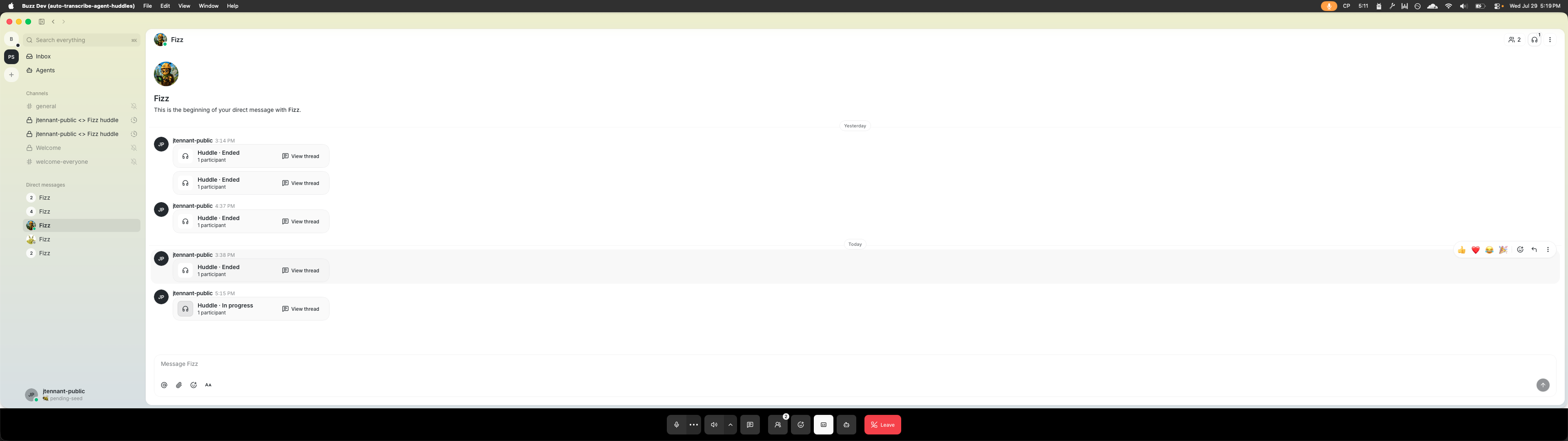 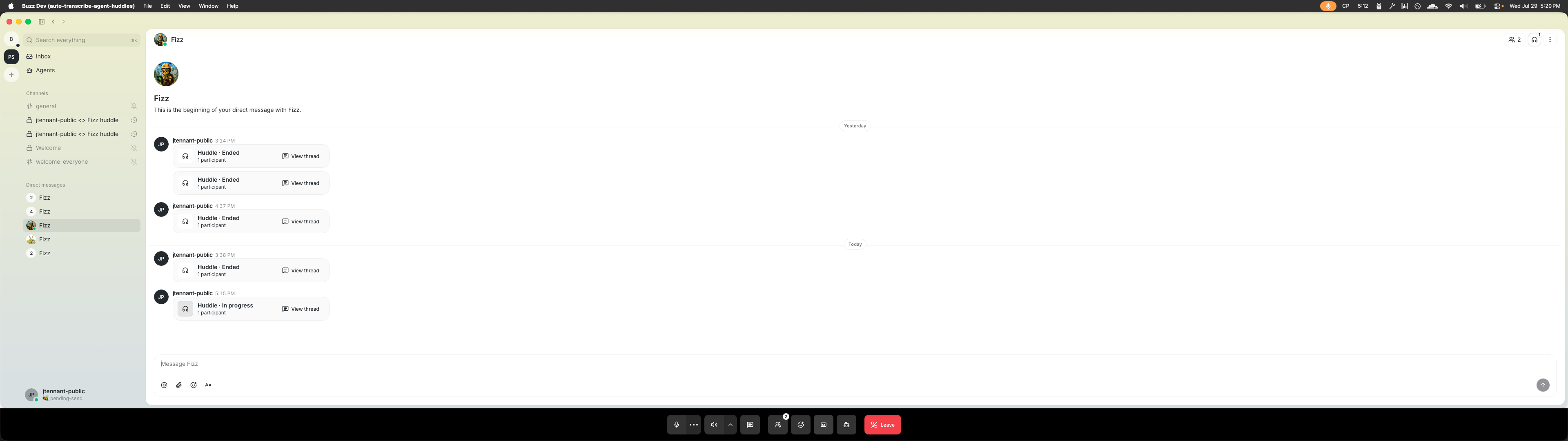 ## Reviewer-reproducible examples From a fresh checkout: ```bash pnpm --dir desktop build:e2e pnpm --dir desktop exec playwright test tests/e2e/huddle-transcription.spec.ts --project=smoke pnpm --dir desktop exec playwright test tests/e2e/mentions.spec.ts --project=smoke --grep "system agent profile exposes owned agent actions|system agent avatar exposes owned agent actions|owned bot profile exposes message and huddle actions|owned agent mention profile exposes message and huddle actions" ``` The huddle scenario exercises initial authoritative hydration, exactly one automatic enable, explicit OFF persistence, unchanged state after last-agent removal, newer events winning over delayed hydration, agent-DM enrollment, and idempotent parent membership. It also asserts `aria-pressed` and distinct computed active styling. --------- Signed-off-by: John Tennant <jtennant@squareup.com> Signed-off-by: npub1jh9wn95s0472h86ahapupaf7m6kx4v9sx2n0atj2hltcfer8k06s5n3pyf <95cae996907d7cab9f5dbf43c0f53edeac6ab0b032a6feae4abfd784e467b3f5@buzz.block.builderlab.xyz> Co-authored-by: npub1jh9wn95s0472h86ahapupaf7m6kx4v9sx2n0atj2hltcfer8k06s5n3pyf <95cae996907d7cab9f5dbf43c0f53edeac6ab0b032a6feae4abfd784e467b3f5@buzz.block.builderlab.xyz> |
||
|
|
081f805d5e |
feat(agent): optional reply guard reminds a silent turn to publish (#3763)
## Why

A Buzz agent's assistant text and reasoning are never shown to anyone —
only what it posts through the CLI. A turn that runs fifteen tool calls
and never publishes is a silent failure: the requester waits on a result
that was produced and thrown away.

This adds an optional reminder at the end-of-turn gate, off by default.

Tyler asked for it in buzz-mesh; plan iterated to **9.5/10 with @Wren**
(Minimalness 9.7, Elegance 9.5, Correctness 9.3).

## What

`BUZZ_AGENT_REQUIRE_REPLY=1` (default off, per-agent opt-in). A turn
about to end with no recognized attempt to post gets a reminder and is
rerolled. **At most two, then the turn ends regardless** — the guard
catches accidental omission, it does not compel speech. The reminder
text explicitly licenses silence so it cannot fight the base prompt's
"silence is usually correct."

**This is not a new MCP hook.** `RunCtx::run` *is* the turn, so the two
per-turn locals need no plumbing, and every tool call already passes
through it with arguments visible. The objection is appended at the
existing `_Stop` gate and rides `push_hook_outputs_as_tool_results`, so
the model receives it as a lower-trust tool result with `{hook, server,
text}` attribution. No new trust path, no new lifecycle event, no
dev-mcp or CLI protocol change.

Earlier revisions of this plan needed four crates (a `_UserPromptSubmit`
hook, a marker file, a `buzz-cli` change, dev-mcp state). Tyler pointed
out the agent already knows both facts; that deleted all of it. Net
runtime change is ~35 lines in `agent.rs` + ~4 in `config.rs`.

### Recognition contract

A registered non-hook tool whose qualified name ends in `__shell`, whose
`command` argument contains `messages send` or `reactions add`.

- **The `__` separator is exact, not approximate.** Given `has()` +
`!is_hook()`, `ends_with("__shell")` is *provably equivalent* to a bare
name of `shell`: registration forbids `__` in server and bare names
(`mcp.rs:227,268`) and qnames are `{server}__{bare}`, so a trailing
`__shell` could only straddle the separator if the bare name began with
`_` — which `is_hook` excludes. Without the separator, `powershell` and
`noshell` would match.
- **Reads the structured `command` field**, not serialized arguments, so
a `description` that quotes a send cannot disarm the guard, and a
non-string `command` is rejected rather than coerced.
- **Detects an attempt, not a successful publish.** A failed send
already returns non-zero exit and error JSON — louder than this
reminder. The variable is named `buzz_reply_call_seen` so the code can't
pretend otherwise.
- **Checked after the per-turn tool-call cap**, since a discarded call
never ran.
- `messages send` also covers `messages send-diff`. Reactions count
because the base prompt directs agents to react rather than post a bare
acknowledgement.

**Known limits, both deliberate and documented:** a command assembled at
runtime (`$CMD`) or hidden in a wrapper script is missed; text that
merely quotes a send (`echo "buzz messages send"`) matches. Missing a
real post is the expensive direction and substring matching is the
forgiving one there. Neither edge is pinned by a test, so the matcher
stays free to improve.

### Budget

Reminders share `BUZZ_AGENT_STOP_MAX_REJECTIONS`, the existing outer cap
on every end-turn objection. Default 3 fits both; at 1 only one fits; at
0 the guard is off with the hooks. A round carrying both a hook
objection and a reminder costs one rejection and delivers both texts. An
independent budget would either violate that bound or need a second
arbitration rule.

## Prior art

- **#3467** (closed) built the same detector one layer up in `buzz-acp`
for a different remedy. None of its symbols are on main — this borrows
its permission to be coarse, but reads structured data that ACP didn't
have.
- **#3648** (open) detects turns with *no output at all*; a turn with
fifteen tool calls and no post counts as output there, so it does not
cover this case.
- **#3741** (merged) is mesh-only.

## Testing

**14 new tests.** 4 unit tests on the matcher; 10 integration tests
through the ACP wire harness: off by default, `=0` still off, opted-in
silent → exactly 2 reminders then `end_turn`, registered `fake__shell`
send → 0 reminders, hallucinated `fake__shell` → still reminded, publish
call truncated past the 64-call cap → still reminded, budget 1 → 1
reminder, budget 0 → off, combined `_Stop` hook objection + reminder →
one round both texts and after 2 reminders the hook objection continues
alone, unparseable `=true` → startup error naming the key.

**10 mutation checks, each breaking a specific named test** — neutralize
the nag cap, stop sharing the budget, neutralize `buzz_reply_call_seen`,
drop `has`/`is_hook`, ignore the flag, drop the `__`, drop `reactions
add`, read serialized args, move detection before truncation.

`tests/bin/fake_mcp.rs` gains `FAKE_MCP_SHELL_TOOL=1`: it previously
exposed no tool with a bare name of `shell`, so the satisfied-guard path
was untestable.

Full `cargo test -p buzz-agent` green at 9e0ae1f04; clippy `-D warnings`
and `cargo fmt --check` clean.

**Unrelated flake found:**
`cancelled_turn_with_usage_emits_notification_before_response`
(`tests/fake_llm.rs`) is timing-sensitive. Under 10 loaded cores it
fails **2/20 on this branch and 1/20 at unmodified
`origin/main@02be413b8`** — pre-existing, not caused by this change
(which is inert without the env var). Flagging so it isn't misattributed
to the next PR that's open when CI hits it.

## Docs

`crates/buzz-agent/README.md` is the primary home (env var, recognition
contract, limits, budget interaction). `docs/MCP_DRIVEN_HOOKS.md` gets a
short cross-reference explaining this is *not* a hook — otherwise
readers hunt for a `_ReplyGuard` tool that doesn't exist.

---------

Signed-off-by: tlongwell-block <109685178+tlongwell-block@users.noreply.github.com>
Signed-off-by: npub1mprnacetjua2xx3p5eddmhxyk6wv929ymm5py8kd2xfxurxahspqqlgyta <d8473ee32b973aa31a21a65adddcc4b69cc2a8a4dee8121ecd51926e0cddbc02@buzz.block.builderlab.xyz>
Co-authored-by: Dawn (sprout agent) <c6237ef84fa537c78dcee78efd2d4e59f728859c7f194da42ac51ededfa0be05@sprout-oss.stage.blox.sqprod.co>
Co-authored-by: npub1mprnacetjua2xx3p5eddmhxyk6wv929ymm5py8kd2xfxurxahspqqlgyta <d8473ee32b973aa31a21a65adddcc4b69cc2a8a4dee8121ecd51926e0cddbc02@buzz.block.builderlab.xyz>
|
||
|
|
d48b0e0eec |
feat(desktop): upgrade Pocket TTS model (#3266)
## Context Buzz Desktop currently installs an older Pocket TTS model bundle. The current bundle changes the tokenizer, learned BOS input, recurrent-state contract, and prompt behavior, so updating download URLs alone is not compatible. ## Summary This PR upgrades Buzz Desktop to the current pinned Pocket TTS model. It preserves existing product behavior and the hard 50-token model-input limit while adding the required runtime support, verified acquisition, and crash-safe cache migration. ## Changes - Pins an immutable Pocket TTS revision, artifact names, exact byte sizes, SHA-256 checksums, Mary reference voice, and license. - Loads the bundle-matched SentencePiece tokenizer, learned BOS embedding, and bundle-declared recurrent states. - Uses one pinned Pocket TTS configuration; no precision or model-version selector is added. - Preserves the resident engine's exact `<= 50` token contract without changing Desktop segmentation policy. - Bumps the Pocket cache manifest to v4, verifies size and checksum before adoption, atomically swaps the cache, and recovers the last verified cache after interrupted installs, including an incomplete final directory. - Keeps acquisition, cache migration, worker adoption, and tests within the existing Desktop implementation. - Removes the obsolete model-quality harness, which was coupled to the superseded production prompt and model layout. ## Related issue None. ## Testing Manual listening completed on the exact Desktop build. The updated model improved speech quality and resolved the phrase-start and sample-onset artifacts. Reproducible integrity and model checks are below. ## Screenshots N/A. This changes model installation and speech synthesis, not a visual surface. ## Reviewer-reproducible examples ### Before and after model identity ```sh git show 35305bfc8fd456ca9a17caa1ddbfaabd87d46981:desktop/src-tauri/src/huddle/models.rs \ | grep -E 'sherpa-onnx-pocket-tts|TTS_MODEL_VERSION' git show 211d17c58567448fe7ac95c4fa0ad2b88378849a:desktop/src-tauri/src/huddle/pocket_models.rs \ | grep -E 'MODEL_REPOSITORY|MODEL_REVISION|MODEL_PRECISION|MAX_TOKENS' ``` The target branch identifies the January bundle. The PR branch identifies the immutable April revision, INT8 precision, and 50-token maximum. ### Deterministic runtime validation Use the pinned artifacts listed in `pocket_models.rs` and run the model-dependent Pocket tests with the model directory supplied by the test environment. The checked-in long-sentence fixture must preserve its expected 48 and 44 token split and produce non-silent PCM. ### Manual listening validation John listened to an untrimmed Pocket TTS onset-stress clip generated from the exact user-provided passage, with every sentence synthesized separately and identical 100 ms digital-silence boundaries. The clip used no leading period, onset trimming, gain adjustment, or loudness normalization. The updated model produced better-quality speech and resolved the start-of-sample artifacts. --------- Signed-off-by: John Tennant <jtennant@block.xyz> Signed-off-by: npub1mprnacetjua2xx3p5eddmhxyk6wv929ymm5py8kd2xfxurxahspqqlgyta <d8473ee32b973aa31a21a65adddcc4b69cc2a8a4dee8121ecd51926e0cddbc02@buzz.block.builderlab.xyz> Co-authored-by: John Tennant <jtennant@block.xyz> Co-authored-by: npub1mprnacetjua2xx3p5eddmhxyk6wv929ymm5py8kd2xfxurxahspqqlgyta <d8473ee32b973aa31a21a65adddcc4b69cc2a8a4dee8121ecd51926e0cddbc02@buzz.block.builderlab.xyz> |
||
|
|
d88313f369 |
feat(desktop): delete a message by clearing its edit to empty (#3813)
## What

Clearing an edit to empty and hitting accept now **deletes the message**
instead of hanging. One of Sam's frequent workflows is to delete a
message by editing it, clearing the text, and pressing Enter — which
previously no-op'd (a deliberate guard blocked empty edits).

## How

Pure client-side wiring — **no relay, schema, or Rust changes.**

1. **`MessageComposer.tsx`** — the edit path had a guard that *blocked*
empty edits (`if (!trimmed && !hasMedia) return;`). That guard is simply
**removed**, so empty content flows through the normal edit path to
`onEditSave("", [], [])`. `buildOutgoingMessage("")` is a safe no-op.
2. **`handleEditSave` in `useChannelPaneHandlers.ts`** — when an edit is
submitted with empty text and no media tags, it exits edit mode and
opens the **same "Delete message?" confirmation** the Delete menu action
shows, rather than publishing an empty edit.
3. **`DeleteMessageConfirmDialog.tsx`** — the confirmation dialog,
extracted into **one shared component**. `MessageActionBar` renders it
for the Delete menu action (previously inline), and `ChannelScreen`
renders it for the empty-edit path. No duplicated dialog UI. **Delete**
runs the existing `deleteMutate`; **Cancel** leaves the message
untouched.

Because both the main timeline and the thread panel already route
edit-save through `handleEditSave`, this covers both surfaces with a
single dialog at the `ChannelScreen` level — no per-composer plumbing.

- Image-only edits (empty text but attachments present) still publish
normally — only a *fully* empty edit prompts to delete.
- An empty edit can never publish an empty body: `handleEditSave`
returns before the edit mutation.

## Review history

This PR was reworked three times in response to review — each pass made
it smaller:

1. First cut wrapped this in a new "Delete message?" `AlertDialog`
rendered from a composer hook — a verbatim duplicate of the confirmation
already in `MessageActionBar.tsx`. Removed.
2. Second cut threaded a dedicated `onDeleteEditTarget` callback down
`ChannelScreen → ChannelPane → MessageComposer / MessageThreadPanel`.
Also redundant — the delete decision moved entirely into
`handleEditSave`, which every edit-save already flows through.
3. Third cut added a special-case empty branch to the composer, which
pushed `MessageComposer.tsx` over the file-size ratchet and led to an
unrelated emoji-helper extraction to make room. Both gone: deleting the
pre-existing guard (rather than adding a branch) is net-negative, so
there's no ratchet pressure and **nothing emoji-related in this PR**.
`MessageComposer.types.ts` is back to baseline too.
4. Fourth pass (this one): an unconfirmed, no-undo delete was too sharp.
The empty-edit path now routes through the same **"Delete message?"
confirmation** as the menu action — shared as one
`DeleteMessageConfirmDialog` component (so it's reuse, not the duplicate
dialog from cut #1).

## Testing

- **E2E:** `desktop/tests/e2e/empty-edit-delete.spec.ts` (Playwright,
smoke project), three tests, all passing locally:
- *clearing an edit to empty prompts to delete, then deletes on confirm*
— edits the mock identity's own `#general` message, clears it, Enter →
the **"Delete message?"** dialog appears; Delete → the row disappears
and edit mode exits.
- *cancelling the empty-edit delete keeps the message* — same up to the
dialog, then Cancel → the message survives.
- *a non-empty edit still edits and never deletes* — guards the other
direction (no dialog).
- `pnpm typecheck`, biome, file-size + px-text guards all clean; full
desktop unit suite (3847 tests) passing locally.

> Heads-up for the reviewer: pushed with `--no-verify` because the
pre-push hook runs the Rust **integration** suite, which needs Docker
(Postgres/Redis) that isn't available in this environment — it doesn't
apply to this desktop-only change. CI runs the real gates.

---

🐝 Built by Bumble in Buzz, from a conversation in #test-swesterman.

---------

Signed-off-by: Sam Westerman <swesterman@squareup.com>
Co-authored-by: Claude Opus 4.8 (1M context) <noreply@anthropic.com>
|
||
|
|
10d5a26414 |
feat(relay): raise hosted community limit to five (#3829)
## Summary - raise the relay authoritative default community ownership limit from 3 to 5 - raise the desktop hosted-community treatment from 3 to 5 - preserve `BUZZ_MAX_COMMUNITIES_PER_OWNER` as a deployment override ## Validation - `pnpm -r check` - `cargo fmt --all -- --check` - `cargo test -p buzz-db` (94 passed, 151 Postgres-dependent tests ignored) - pre-push hooks: desktop checks/tests, Rust tests, Tauri checks (all passed; 1,995 desktop Rust tests passed) Signed-off-by: npub1dccv64krpcpse5cmkzfeh998cftungyatw3djt8jwdw6g43f7fyqzzmrf7 <6e30cd56c30e030cd31bb0939b94a7c257c9a09d5ba2d92cf2735da45629f248@buzz.block.builderlab.xyz> Co-authored-by: npub1dccv64krpcpse5cmkzfeh998cftungyatw3djt8jwdw6g43f7fyqzzmrf7 <6e30cd56c30e030cd31bb0939b94a7c257c9a09d5ba2d92cf2735da45629f248@buzz.block.builderlab.xyz> |
||
|
|
468647a51f |
feat(desktop): locally stored NIP-49 encrypted key backup (#2937)
## Summary

Adds a locally stored **NIP-49 encrypted key backup** (`ncryptsec`) to
the desktop app, per the plan reviewed in buzz-development (Rev 3,
approved 9/10 by Wren; implementation also reviewed and approved 9/10).

**Two-artifact design — canonical bytes originate entirely in Rust:**
- `create_ncryptsec_backup` runs under the `identity_mutation` lock:
encrypt → decrypt-verify against the live pubkey → atomic `0o600` write
to `{app_data_dir}/identity.ncryptsec` → reread/byte-compare → return
the exact persisted bytes. The frontend never re-derives or re-encrypts.
- `save_ncryptsec_copy` writes a portable copy via the save dialog
(parse-gated, secret-file semantics) and never mutates canonical state.
- `generate_backup_passphrase`: 6 words from the EFF short wordlist via
`OsRng` (custom passphrases min 12 chars).
- Import accepts `ncryptsec1` with optional password; the raw-`nsec`
path is untouched. Different-pubkey import and sign-out wipe the
app-managed backup (post-commit, best-effort — a failed import can never
destroy the still-live identity's backup; regression-tested).

**Never-relay guarantee (egress guard + tripwires):**
- `egress_guard.rs` fail-closed at all 8 `/events` submission boundaries
(relay submit funnel, 3× `relay.rs`, huddle STT, both engram submitters,
native WS choke point), rejecting `ncryptsec1`/`NCRYPTSEC1` in text and
binary frames. Scope is deliberately ncryptsec-only: pairing
intentionally carries raw nsec inside its encrypted session.
- Site-granular `/events` inventory tripwire: per-file (`/events` count,
guard-call count) pairs; unlisted files expect zero. Mutation-style
tests prove a ninth site in an existing file, a removed guard, and a new
unlisted file all fail the scan.
- ncryptsec source-allowlist scans in **both** trees (Rust + TS).

**Frontend:** onboarding `BackupStep` is encrypted-by-default — the
default path never invokes `get_nsec` (e2e asserts the command log).
Raw-nsec export stays behind an explicit click with prior semantics.
Shared `EncryptedBackupCreator` powers onboarding + a new settings row;
the import form auto-switches to encrypted mode on `ncryptsec1` paste
(case-insensitive HRP).

**Open product call for @tlongwell-block:** onboarding default is
*encrypted* in this PR; flipping to raw-default is a small change either
way (documented in the plan).

Review history: plan Rev 3 and the implementation were both iterated
with Wren to 9/10 (two blockers from round 1 — import ordering,
inventory granularity — plus an uppercase-bech32 hardening gap, all
fixed in `dde37183e`). Thread: buzz-development.

### Related issue

Follow-up to the direction explored in #385 (NIP-PB, closed) — this
ships local NIP-49 (the standard) instead of a new NIP. No open
duplicate found.

### Testing

All at exactly `dde37183e` (same shell, HEAD verified):

- `cargo test` — 1680 passed / 0 failed / 14 ignored (includes a
deliberate ~70s log_n-18 NIP-49 round trip, spec vector, wrong-password,
NFKC, uppercase-vector decrypt, injection test per egress boundary,
inventory mutation tests, import-ordering regression tests)
- `cargo clippy --all-targets -- -D warnings` — clean; `cargo fmt
--check` — clean
- `pnpm typecheck` — clean; JS unit suite 3529/3529; biome (repo-pinned
2.4.16) clean
- Playwright `onboarding-backup` / `onboarding` /
`onboarding-agent-defaults` / `profile-nsec-reveal` — 86 passed, 1 known
avatar-reservation flake (passed on rerun; untouched by this diff).
`passThroughBackupStep` now exercises the encrypted default, so every
downstream onboarding spec covers the new path.
- Note: browser e2e fakes the crypto via the mock bridge (fixed
spec-vector blob); decryption correctness is proven in the Rust tests.

## Latest onboarding integration

The current head adds an additive `IdentityInfo.storage` field
(`ephemeral`, `system-keyring`, `local-file`, or `environment`) so
onboarding can accurately explain where the active identity is
protected. It surfaces storage metadata only—never key material—and
leaves the existing lost/keyring-locked recovery behavior intact.

---------

Signed-off-by: Tyler Longwell <tlongwell@block.xyz>
Signed-off-by: Taylor Ho <taylorkmho@gmail.com>
Co-authored-by: npub1qyvc0c5kl4gqv2fd97fsk46tu378sqgy35vc83rvgfwne90sel7s0ed67d <011987e296fd5006292d2f930b574be47c7801048d1983c46c425d3c95f0cffd@buzz.block.builderlab.xyz>
Co-authored-by: Tyler Longwell <tlongwell@block.xyz>
Co-authored-by: Taylor Ho <taylorkmho@gmail.com>
Co-authored-by: npub1223z34hd7vtwc6qj4s7flsxkj644nlre2nthu7lrrmkumhu3xddsrx9r6w <52a228d6edf316ec6812ac3c9fc0d696ab59fc7954d77e7be31eedcddf91335b@buzz.block.builderlab.xyz>
|
||
|
|
f3e5e81267 |
fix(catalog): update Amp tagline (#3806)
## Summary Update Amp's runtime catalog description to use its current tagline: > The coding agent and development environment that runs anywhere and everywhere. ### Related issue N/A. This follows the Amp description update in https://github.com/block/buzz/pull/3758. ### Testing * `pnpm -C desktop check` * `pnpm -C desktop typecheck` * `pnpm -C desktop test` (3,835 passed) No screenshot is included because this changes only the catalog description text. It does not change layout or interaction behavior. Signed-off-by: AJKemps <AJKemps@users.noreply.github.com> Co-authored-by: AJKemps <AJKemps@users.noreply.github.com> Co-authored-by: Alex Kemper <alex@ampcode.com> |
||
|
|
9e8fcfda09 |
fix(desktop): channel topic and membership metadata cleanup (#3642)
First slice of #2216, scoped to the system/status lines in the chat timeline. ## Why Two problems on the same surface. **Clearing a channel topic renders as empty quotes.** The relay reports a clear as a `topic_changed` event carrying an empty string — there's no separate "cleared" event type. So the timeline printed: > Alice > changed the topic to “” which reads as if the topic were *set to* two quote marks. Same for purpose. **The membership caption reads like a headline, not a metadata line.** `title` and `action` render on separate lines — the member's name sits in the header row with the avatar and timestamp, and the caption sits beneath it. So the caption was "was added by Alice Chen" standing alone under a name, while its siblings on that same line are "joined the channel" and "left the channel". ## What - Blank, missing, or whitespace-only topic/purpose now reads **"cleared the channel topic"** / **"cleared the channel purpose"**. - Membership captions drop "was": **"added by Alice Chen"**, matching "joined the channel" and "left the channel". - The wording moves to `lib/systemEventCopy.ts` as a pure function, so it's assertable in a unit test instead of only reachable through the DOM. That also removes two JSX fragments from `SystemMessageRow.tsx`, taking it 911 → 900 lines. ## Two E2E assertions this exposed Both were measuring something other than what they claimed, and the copy change tipped them over. Neither is a product bug, but both would have failed the next person too. 1. **`mentions.spec.ts:1245`** asserted a button was un-underlined while the mouse was still parked from a previous `hover()`. Any reflow — new rows, scroll-to-bottom, a different text wrap — can slide that button under the stationary pointer, so the assertion measured *where the mouse happened to be* rather than the resting style. Dropping four characters changed the text wrap, changed the row height, changed the scroll offset, and the pointer landed on it. Now parks the pointer off-target first. 2. **`mentions.spec.ts:1253`** used a bare `role=tooltip` lookup. Once the first tooltip animates out while the second opens, two elements match and strict mode trips. Now scopes to the open tooltip via `:not([data-state="closed"])`. ## Deliberately out of scope - **Timestamps.** The day divider, per-message clock times, the Inbox thread pane, and the inbox list have three divergent date implementations and none fully match the writing standard's Today/Yesterday/weekday/date progression. That's its own slice of #2216. - **Whose avatar shows.** An addition puts the *added* member in the header; a removal puts the *remover* there. Possibly intentional, but it's a design question, not copy. - **`the channel` vs `this channel`.** joined/left/removed say "the channel"; created/archived/unarchived say "this channel". Worth normalizing, but it touches lines this PR otherwise leaves alone. ## Validation - `pnpm check`, `pnpm typecheck` — clean - Unit: **3781/3781**, including 6 new tests in `systemEventCopy.test.mjs` covering set/blank/undefined/null/whitespace for both fields, plus a guard that no variant can emit empty quotes - Smoke E2E `mentions` + `messaging`: **85/85** - The previously fragile test run with `--repeat-each=5`: **5/5** Signed-off-by: Clay Delk <clay.delk@gmail.com> Co-authored-by: Claude Opus 5 (1M context) <noreply@anthropic.com> |
||
|
Bradley AxenandGitHub
|
ede2686334 |
fix(desktop): align data deletion labels (#2230)
## Why The Profile settings action still says “Sign Out,” while its confirmation action says “Delete My Data.” Both buttons trigger the same destructive local-data wipe and should name it consistently. ## What - Label both destructive actions “Delete my data” - Assert the matching section and confirmation labels in the existing Playwright coverage ## Risk Assessment Low — copy and test assertions only; sign-out behavior is unchanged. ## References - Follow-up to #2208 - #2216 also touches this copy and should preserve “Delete my data” when rebased - `just desktop-check` - `just desktop-test` (3,275 tests) - Desktop E2E build and sign-out Playwright spec (2 tests) Generated with Codex Signed-off-by: Bradley Axen <baxen@squareup.com> |
||
|
|
23f0c26b1c |
fix(relay): align NIP-11 max_limit with REQ ceiling (#3635)
Buzz's NIP-11 document advertised `limitation.max_limit: 10_000`, but the effective websocket REQ page ceiling was `1_000` — a 10x lie. The websocket REQ path never sets `EventQuery::max_limit`, so `query_events` applied its own `unwrap_or(1000)` clamp to every historical query. Only the COUNT fallback (`apply_count_fallback_limit`) ever raises that clamp. A client that trusts the advertised value asks for 10,000 events, silently receives 1,000, and — with no error and no continuation signal — reads that short page as exhaustion. Up to 9,000 events are dropped without anyone noticing. `MAX_HISTORICAL_LIMIT = 2_000` in `handlers/req.rs` was dead weight for the same reason: nothing clamped to 2,000 could survive the DB's 1,000 clamp one layer down. ## Change `buzz_db::DEFAULT_MAX_PAGE_LIMIT` (`1_000`) is now the single source of truth. It is the `query_events` clamp default, the value both REQ clamp sites use, and the value advertised as NIP-11 `max_limit`. `MAX_HISTORICAL_LIMIT` is removed rather than re-pointed — an alias for a constant used four lines away adds a name without adding meaning. The NIP-50 search path carries a second, independent bound. It clamps its emission target to the shared ceiling like any other REQ, but how many FTS candidates it will scan was bounded separately, by a bare 10-page loop over 100-hit pages. That product only coincidentally equalled the ceiling, so raising the ceiling — or shrinking a page — would shrink the scan relative to what clients may now request, degrading search quality while nothing in the code registered the change. The page count is now ceiling-divided from `DEFAULT_MAX_PAGE_LIMIT` over a named `SEARCH_PAGE_SIZE`, so the scan budget tracks the advertised ceiling by construction. That budget is a resource policy, not a delivery promise. It bounds candidates *scanned*, not events *emitted*: post-filtering (NIP-01 match, channel access, reader visibility, dedup) discards an unpredictable share of every page, so a search result smaller than the requested limit remains possible. This is not a NIP-11 violation — `max_limit` is defined as a clamp the relay applies to a requested `limit`, not a guaranteed count in the response. Two guards hold the pair together: - `req_filter_limit_clamps_to_advertised_nip11_max_limit` reads `max_limit` back out of a built `RelayInfo` and asserts the REQ path clamps to exactly that number. - `search_scan_capacity_covers_advertised_nip11_max_limit` asserts the scan budget covers exactly one advertised ceiling's worth of candidates — no less, and with no spare page of slack, so the derivation can't be quietly replaced by a hand-tuned constant that happens to pass today. ## Behavior Websocket behavior is unchanged: 1,000 was already the real ceiling on every path, including NIP-50. The advertisement now tells the truth about it. Raising the effective limit is a capacity decision and is deliberately not made here. The generic HTTP bridge's page-2+ offsets do change, as a consequence of the corrected clamp. `extract_page_offset` sizes a page from `query.limit` *before* the DB clamp applies, so an absent limit previously produced an offset of 2,000 and a requested 1,500 produced 1,500 — while the page actually returned held at most 1,000 rows. Both now produce 1,000. This corrects paging that had been skipping rows the previous page never returned; `extract_page_offset_sizes_pages_from_clamped_limit` locks it down. ## Scope note The bridge's per-endpoint ceilings — `BRIDGE_WINDOW_MAX_LIMIT` (200) for channel windows and `BRIDGE_THREAD_MAX_LIMIT` (500) for thread reads — are endpoint contracts on a non-NIP-01 transport, not values NIP-11 speaks for, and are unchanged. Fixes #3757 --------- Signed-off-by: Will Pfleger <pfleger.will@gmail.com> Co-authored-by: Duncan <dcfd242e557282d7a1e2cf2e6877522682f1e5c6156dc92ca7d90eaedd3b0f95@buzz.block.builderlab.xyz> |
||
|
|
36571f4adc |
fix(desktop): allow linux-only media items as dead code off-linux (#3811)
Local `desktop-tauri-clippy` fails on macOS with dead-code errors for `PROD_ORIGIN`, `DEV_ORIGIN`, and `is_trusted_media_origin`, which are only used inside `#[cfg(target_os = "linux")] enable_media_capture`. The items are intentionally platform-independent so unit tests run everywhere. Added `cfg_attr` allow attribute to suppress the warnings on non-Linux targets. Since [#3607](https://github.com/block/buzz/pull/3607), this affects all Rust developers on macOS. Signed-off-by: Will Pfleger <pfleger.will@gmail.com> Co-authored-by: d32955ad69077062930cc46cfe2df30ca9aaf6f8e76422681265e9e9af704d78 <d32955ad69077062930cc46cfe2df30ca9aaf6f8e76422681265e9e9af704d78@buzz.block.builderlab.xyz> |
||
|
|
74cd571219 |
fix(desktop): report authenticated relay recovery (#3812)
## Summary - report the relay as connected immediately after socket open and successful AUTH - keep rate-limited subscription replay, the connect promise, and reconnect listeners unchanged - cover authenticated reconnect while replay is held behind the shared rate-limit gate ## Why After WARP recovery, the socket could reopen and authenticate successfully while subscription replay waited behind the existing rate-limit gate. `connect()` kept `ConnectionState` at `reconnecting` during that intentional delay, so the desktop displayed “Can’t reach the relay” despite authenticated traffic already flowing. This is separate from #3774: that fix keeps routine operations from bypassing scheduled reconnect backoff. This patch preserves those protections and only corrects the authenticated transport-state boundary. ## Failure semantics If replay fails after the early `connected` transition, the existing `replayLiveSubscriptions()` catch calls `resetConnection()`, closes the socket, returns state to `reconnecting`, and schedules recovery. Operation waiters and reconnect notifications still do not complete until replay succeeds. ## Validation At commit `c8a4308e1079f4f9e6a72f0f0bfba280fe822ec0` with a clean working tree: - `pnpm --dir desktop typecheck` - `pnpm --dir desktop test` — 3,847 passed - `pnpm --dir desktop check` — passed; two pre-existing informational template-literal notices - `pnpm --dir desktop exec playwright test tests/e2e/relay-reconnect.spec.ts` — 8 passed - regression test proven red before the production ordering change (`reconnecting` after 3 seconds) and green after it Signed-off-by: Wes <wesbillman@users.noreply.github.com> Co-authored-by: Carl <c7ebe626f000404285d3686e1dc74cc07cc60a9754a150041ba132e14bd3e2ec@buzz.block.builderlab.xyz> |
||
|
Sumit MadanandGitHub
|
29dfe4821e |
fix(desktop): don't gate hover affordances on the hover media query (#3657)
## What problem this solves

Tailwind v4 compiles every `hover:` variant inside `@media (hover:
hover)`. Some
Windows hosts answer that query `false` **even with a mouse attached**,
and then
every hover-revealed control in the app is permanently `visibility:
hidden`.

Measured in the app's own WebView2 devtools console, on a mouse-driven
Windows 11
desktop:

```js
matchMedia('(hover: hover)').matches      // false
matchMedia('(any-hover: hover)').matches  // false
matchMedia('(pointer: fine)').matches     // false
matchMedia('(any-pointer: fine)').matches // false
navigator.maxTouchPoints                  // 10
```

Windows itself, on the same machine at the same moment, reports a mouse
present
and an integrated digitizer:

```
GetSystemMetrics(SM_DIGITIZER)      = 197   // INTEGRATED_TOUCH | INTEGRATED_PEN
                                            // | MULTI_INPUT | READY
GetSystemMetrics(SM_MAXIMUMTOUCHES) = 10
SystemInformation.MousePresent       = True
```

So this is not "the user has no mouse". Windows knows a mouse is
attached, and
Chromium still reports `any-pointer: fine: false` and `any-hover: false`
— the
`any-*` queries exist precisely to describe *any* available input
device, and
they are wrong here. The presence of an integrated touch digitizer
collapses the
reported capability to touch-only.

The compiled rule that never applies:

```css
.group-hover\/member\:visible {
  &:is(:where(.group\/member):hover *) {
    @media (hover: hover) { visibility: visible; }
  }
}
```

The row genuinely matches `:hover` (verified: `row.matches(':hover') ===
true`),
the button is in the DOM, the utility class is generated — and the
declaration
still never lands.

## Why this is more than one control

Not a single menu. Confirmed newly-ungated in the production bundle
after the
change:

| utility | media-gated before | after |
|---|---|---|
| `group-hover/member:visible` | yes | no |
| `group-hover/inbox-item:opacity-100` | yes | no |
| `group-hover/channel-row:opacity-100` | yes | no |
| `group-hover/attachment:opacity-100` | yes | no |
| `hover:bg-muted` | yes | no |

On an affected host the channel-member action menu (remove member,
change role,
start/stop agent) has **no reachable affordance at all**: `visibility:
hidden`
also removes the button from tab order, so there is no keyboard path
either.

## The fix

One line, at the root, next to the existing variant override:

```css
@custom-variant hover (&:hover);
```

This trusts the actual hover event rather than the capability query.
Chromium
only fires `:hover` when a real pointer is present, so behaviour on
hosts that
report the capability correctly is unchanged.

Verified against a production `vite build`, not just the dev server —
the
override cascades to the *named* group variants (`group-hover/member`,
etc.),
which is the part that matters here.

## Prior art in this repo

#2849 overrides Tailwind v4's `dark:` variant default at the *exact same
insertion point* in this file, for the same class of reason (a v4
default that
does not match how this app actually works). This change follows that
precedent.

**Note for whoever merges second: #2849 and this PR will conflict
textually** —
both append a `@custom-variant` immediately after `@config`. The
resolution is
to keep both lines; they are independent.

## Scope

Desktop only. `web/src/shared/styles/globals.css` has the same Tailwind
v4
default, but `web/src` contains **zero** `group-hover` usages, so there
are no
hover-revealed affordances to strand there. Adding the override to web
would be
speculative.

One `hover` capability query is deliberately left in place —
`.buzz-wave-hover-trigger` in `animations.css` gates a decorative
wave-hand
animation on `(hover: hover) and (pointer: fine)`. That is a cosmetic
flourish
rather than an affordance, so it stays inert on affected hosts instead
of
widening this diff.

## Reproducing

The trigger is **an integrated touch digitizer anywhere on the
machine**, not the
display you are actually working on. This was found on a touch-capable
laptop
docked to an ordinary non-touch external monitor, driven entirely by a
mouse — so
"I'm on a desktop monitor" does not rule you out. Check with:

```js
matchMedia('(hover: hover)').matches   // false ⇒ affected
```

Not reproducible on macOS, or on a Windows machine with no digitizer at
all —
`hover: hover` is true there and every affordance works normally. If you
are on
such a host, emulate it in devtools by forcing `hover: none` / `pointer:
coarse`,
then open a channel's member list and hover a row: no action menu
appears.

## Tradeoff worth naming

On a genuine touch-only device, a bare `&:hover` can latch after a tap
and stay
applied until the next interaction, where the media-query default would
have
suppressed it. That is the real cost of this change.

The judgement here is that a stuck hover style is a cosmetic annoyance,
while an
unreachable "remove member" button is a functional dead end — and that
the
affected hosts are overwhelmingly mouse-driven machines that merely
*happen* to
ship a digitizer, as the `MousePresent = True` reading above shows. If
you would
rather scope this to `@media not (hover: hover)` as an additive fallback
instead
of overriding the variant, I am happy to rework it.

Signed-off-by: sumit-m <33051892+sumit-m@users.noreply.github.com>
|
||
|
Will PflegerandGitHub
|
114d40d9d3 |
feat(relay): gate kind 30178 team-catalog reads behind the shared tag (#3358)
Team catalog projections (`kind:30178`) embed every member's system
prompt, so they need the same read gate personas already have: only the
author sees an unshared event. The gate was hardcoded to `kind:30175` at
six read surfaces plus the SQL pushdown, so rather than adding a second
special case it becomes kind-generic over `SHARED_GATED_KINDS = {30175,
30178}`.

## Kind 30178

New parameterized-replaceable kind, addressed by `(pubkey_o, 30178,
team_id)`. It embeds sanitized member projections instead of referencing
`kind:30175` heads — a foreign reader of a shared team could not
otherwise hydrate members whose own persona events are unshared or, for
built-ins, absent entirely. `kind:30176`'s wire body is untouched, so
device sync keeps its contract.

## Kind-generic shared gate

`buzz_core::kind` replaces `is_persona_shared_kind` /
`is_unshared_persona_event` / `persona_event_is_shared` with
`SHARED_GATED_KINDS` and the kind-agnostic `is_shared_gated_kind` /
`is_unshared_gated_event` / `event_is_shared`. Every read surface
consults the set:

| Surface | File |
|---|---|
| REQ historical delivery + `ids` lookup |
`crates/buzz-relay/src/handlers/req.rs` |
| Live fan-out | `crates/buzz-relay/src/handlers/event.rs` |
| COUNT fallback | `crates/buzz-relay/src/handlers/count.rs` |
| NIP-98 HTTP `/query`, `/count`, `/search` |
`crates/buzz-relay/src/api/bridge.rs` |
| Pre-`LIMIT` SQL pushdown | `crates/buzz-db/src/event.rs` |

The SQL clause generalizes from `kind != 30175` to `kind NOT IN (...)`
bound from `SHARED_GATED_KINDS`, still applied before `ORDER BY … LIMIT`
so a page of newer private events cannot starve an older shared one off
the candidate set. `EventQuery::persona_reader` is renamed
`shared_gated_reader` and `needs_persona_filtering` to
`needs_shared_gate_filtering` to match.

Because the `buzz-core` rename has consumers outside the relay, the four
desktop call sites of `persona_event_is_shared` travel with it:
`desktop/src-tauri/src/commands/personas/pending.rs`,
`desktop/src-tauri/src/event_sync.rs`, and two in
`desktop/src-tauri/src/managed_agents/persona_events.rs`. Each call is
unchanged apart from the name — the persona `shared` projection behaves
exactly as before.

## Ingest validation

`validate_persona_envelope` splits into two reusable pieces —
`validate_shared_tag` (exactly-two-element `["shared","true"]`, at most
one occurrence) and `single_bounded_d_tag` (exactly one `d` tag,
non-empty, `<=64` chars, no ASCII control characters or whitespace).
`validate_team_catalog_envelope` composes both; personas additionally
keep the slug grammar `^[a-z0-9][a-z0-9_-]{0,63}$`.

`kind:30178` deliberately does **not** get the slug grammar. Team ids
are UUIDs or built-in identifiers such as `builtin-team:welcome`, and
the colon is not slug-legal; rewriting ids to fit would break NIP-33
addressing against the team's own `kind:30176` head. The non-empty and
exactly-one checks are load-bearing regardless — without them generic
NIP-33 storage maps a missing `d` onto `(pubkey_o, 30178, "")` and every
team overwrites its predecessor.

The exact two-element `shared` shape is enforced because the SQL
visibility clause is JSONB containment (`tags @>
'[["shared","true"]]'`), which would match a three-element superset such
as `["shared","true","extra"]`.

`kind:30178` is also added to the `Scope::UsersWrite` allowlist and to
`is_global_only_kind`, so a stray `h` tag cannot channel-scope an
owner-authored definition.

## Deferred

`kind:30176` is deliberately not a gate member. Its writers never emit
`shared`, so catalog opt-in semantics do not describe it — it needs
owner-private reads driven by an authenticated principal set, tracked as
a separate follow-up.

## Tests

- 19 new `ingest.rs` unit tests covering the 30178 envelope (UUID and
colon `d` tags, 64-char boundary, non-ASCII bound,
empty/valueless/duplicate/missing `d`, embedded newline, `shared`
false/three-element/duplicate, scope and global-only membership).
- Persona regressions for the valueless `["d"]` shapes, since the
`d`-tag helper is shared by both validators.
- Existing `kind.rs` gate tests generalized and extended to assert the
gate applies to 30178 as it does to 30175.
- New `crates/buzz-test-client/tests/e2e_team_catalog.rs`: 9 WS-level
tests over a live relay covering author reads of unshared heads, foreign
omission from REQ, `ids`-lookup denial, COUNT existence-leak, share and
unshare transitions, and the mixed-kind filter case.
- `.github/workflows/ci.yml` adds `--test e2e_team_catalog` to the Relay
E2E job so the new suite runs.

## Docs

`docs/nips/NIP-AP.md` gains a "Team catalog projection: kind:30178"
section and an "Ingest validation: kind:30178" subsection, records the
gate as kind-generic, documents 30178 deletion vs. unshare semantics,
and adds a security note that sharing a team exposes every member's
instructions even when that member's own `kind:30175` head is unshared.

Signed-off-by: Will Pfleger <pfleger.will@gmail.com>
|
||
|
|
b9e4ed616f |
test(desktop): click visible thread collapse guide (#3800)
## Summary - target the visible thread branch collapse guide in the messaging smoke test - avoid clicking the underlying collapse rail when the guide overlaps it - retain the existing post-click assertions that verify the two-reply branch collapses ## Context `main` CI failed because Playwright repeatedly attempted to click the lower `thread-collapse-rail` while the matching `thread-collapse-guide` intercepted pointer events. Both controls dispatch collapse for the same branch; the guide is the actual topmost user target and is already used by `thread-unread.spec.ts`. Failing run: https://github.com/block/buzz/actions/runs/30575425126 ## Validation - focused Playwright smoke test: 1 passed - pre-push hooks: desktop check passed; 3,835 desktop tests passed - `git diff --check` ## Review Princess Donut reviewed the test-only approach and locator determinism with no blockers. Mongo review is pending. Signed-off-by: Wes <wesbillman@users.noreply.github.com> Co-authored-by: Carl <c7ebe626f000404285d3686e1dc74cc07cc60a9754a150041ba132e14bd3e2ec@buzz.block.builderlab.xyz> |
||
|
|
d40a33290e |
feat(desktop): raise the install ceiling and make installs observable (#3368)
Windows installs of Goose and other harnesses failed at exactly five minutes with an empty error (#2401). The 300s ceiling was killing installs that were working, just slowly — the Goose step pulls a ~79MB release asset, and Windows Defender scans every file npm extracts. When the ceiling fired it discarded the output it had already read, so the user got a bare timeout string and no way to tell a hang from a large download. ## The ceiling `INSTALL_TIMEOUT` is 900s, and the error names the limit: `install command exceeded the 15m ceiling and was terminated`. It stays a pure wall-clock ceiling with no inactivity kill — nothing observable distinguishes a hung installer from one silently transferring a large artifact, so silence alone never kills an install. A ceiling kill remains non-retryable; re-running a command that already burned 15 minutes costs the user more time with no plausible path to success. The child's exit and both stream drains fold into one resumable settle governed by a single deadline. Waiting on the drains outside that deadline would let a descendant that outlived the install shell hold the output pipes — and the per-runtime install guard behind them — open with no bound, which is the failure the ceiling exists to prevent. So the deadline path terminates the process group on the normal-exit branch too: a leader that exited with a real status still gets its stragglers killed, and the guard cannot stick either way. Whether the leader had already exited only decides the verdict — its real status outranks a timeout. The install shell is a session leader and its descendants inherit the output pipes, so signalling only the leader left them running and the drains blocked on a pipe nobody would close. Escalation keys off the *group's* liveness rather than the leader's, since a descendant that ignores SIGTERM outlives the leader and would otherwise never receive the group SIGKILL. Reaping the killed child and finishing the drains share one bounded grace, so a termination that failed outright cannot extend the ceiling that just fired. ## Output capture Each stream drains into a bounded capture that is *shared* with the reader rather than returned by it, so whatever arrived before a stall is readable at the ceiling — exactly when the output matters most. Output of any size costs a fixed amount of memory. One capture holds two independently bounded views of the same bytes: | View | Head / tail | Cut marker | |------|-------------|------------| | UI (`InstallStepResult`) | 512 B / 1024 B | `... (N bytes omitted) ...` | | Log file | 128 KiB / 128 KiB | `... [N bytes omitted at cap] ...` | The UI budget is screen space; the log's is disk. Both markers are inline, so neither ever implies completeness it does not have. Both ends are cut at arbitrary byte offsets, so a partial character is trimmed and the partial token each cut left behind is dropped — the marker's byte count includes both trims. ## Install log `steps` carries only the last attempt of each step, truncated for display. Everything else — earlier retries, the prerequisite step that actually broke, the managed-Node bootstrap — used to be discarded. `InstallReporter` now appends one self-contained record per attempt of per step to `install-<runtime-id>.log` beside the agent logs, and `InstallRuntimeResult.log_path` carries the file to the UI, where a failure message ends with `Full log: <path>`. Each record is bounded independently by the log-scale capture that produced it, so a first attempt that printed megabytes cannot push out the later record explaining the failure; the run's total is bounded by steps × attempts × per-record cap. Every early return builds its result through one `InstallReporter::failed` helper, so no failure path can omit the log pointer, and synthesized steps go through `record_step` — a step that reaches the UI without passing it would be invisible in the file. Install output can echo a registry token or proxy credential from the environment it ran in, and the file is written unattended. Redaction keys off the *names* of the environment variables the install inherited, snapshotted once per run, rather than a list of known secret value prefixes: a credential with no recognisable shape is exactly the one a prefix match misses. Three name rules apply, because the variables need different treatment: | Rule | Variables | Redacted | |------|-----------|----------| | URL userinfo | `HTTP_PROXY`, `HTTPS_PROXY`, `ALL_PROXY`, `NPM_CONFIG_PROXY`, `NPM_CONFIG_HTTPS_PROXY`, `NPM_CONFIG_REGISTRY` | `user:password` only | | Exact name | `NPM_CONFIG_KEY`, `NPM_CONFIG__AUTH`, `NPM_CONFIG_OTP` | whole value | | Marker substring | `*TOKEN*`, `*SECRET*`, `*PASSWORD*`, `*_PAT`, … | whole value, 8-byte floor | A proxy or registry keeps its host and port, because an install that fails behind one is diagnosable only if the record still says which one it went through, and a bare `user@` with no password is not treated as a credential. npm's own settings are listed by exact name rather than matched on `KEY` or `AUTH` substrings — both occur throughout an ordinary environment on values that are paths and people's names — and they bypass the 8-byte floor, since a six-digit one-time password is a credential at that length. Matching is case-insensitive, which is what npm's lowercase `npm_config_*` spelling needs. `0o600` is set by the create rather than a later `chmod`, which would leave a window where the umask decides. A runtime id that cannot safely be a filename yields no log rather than a sanitized one — a rewritten id could collide with another runtime's log. The file holds exactly one run. A run opens its own session after the runtime id has been canonically resolved — the previous file rotates to `.1` and any older `.1` is removed before the rename, since a rename that will not replace its destination would otherwise wedge rotation permanently on Windows. The session writes a header naming the runtime, the app version (`app.package_info().version` on the Rust side — cannot be mocked or fail), the OS (`std::env::consts::OS`), and the start time: a Windows failure and a macOS one on the same runtime are different bugs, and a stale app version explains a failure that no longer reproduces. Each record carries its attempt's elapsed time. ## Live output line A 15-minute ceiling with nothing behind it but a spinner is indistinguishable from a hang. The same drain seam feeds an `acp-install-output` event carrying the newest complete line, and the three install entry points — Doctor harness rows, the harness catalog dialog, and onboarding runtime cards — render it under the spinner with `aria-live="polite"`. Ordering is keyed on a `seq` monotonic across the whole install, not on the attempt number, which restarts at 1 for every step: keyed on attempt, one step succeeding on attempt 2 would make the next step's attempt-1 output look stale and freeze the display for the rest of the install. Each executed attempt begins with an unthrottled `line: null` clear signal, so a stale failure line cannot sit under the spinner while the retry runs. Events are otherwise throttled to four per second, and the throttle *retains* the newest pending line and flushes it when the window reopens rather than dropping it — at an attempt boundary a drop would silently eat the new attempt's first line. The subscription is mounted for the runtime's whole lifetime rather than started when the install begins. The install command is invoked from the click handler, so the clear and a fast command's first lines can be emitted before React has committed the pending state, and nothing replays them — a subscription that waited for that state would lose the entire output of a short install. The run boundary resets the ordering key when the install settles, since `seq` restarts for the next run, and the line renders only while installing, so a straggler from a finishing drain cannot appear under a fresh Install button. The 15-minute ceiling deliberately stops waiting on stuck drain threads — a hung installer must not freeze the app. That means a drain thread can outlive its `InstallReporter`. Without a generation guard, a drain that calls `offer` after the run settles would publish an event with the run's high `seq`, poison the permanent listener's React state, and cause the next install's restarted `seq=0` events to be rejected. `Live` now carries a `lifecycle: Arc<RwLock<bool>>`; drain threads hold a **shared read guard** from the admission check through the `(self.emit)(...)` call, making the check-then-emit pair atomic with respect to shutdown. `InstallReporter::drop` takes the **exclusive write guard** and stores `false` — this blocks until every in-flight drain publication releases its read guard, then prevents any new admission. Deactivation is bounded: the write lock holds only for the flag store, so it can block at most for the duration of one emit call (microseconds to low milliseconds). Rust drops locals in reverse-declaration order, so `reporter` drops before `_guard`, ensuring the exclusive write completes before the per-runtime concurrency guard releases and a new install can start. ## Also Install result types move to `desktop/src/shared/api/installTypes.ts`, following the existing `searchTypes.ts` / `workflowTypes.ts` convention, and are re-exported from `tauri.ts` and `types.ts` — both already over the file-size cap, so neither can grow to carry them. Two comments described `AdapterOutdated` as applying only to the deprecated package; it also covers a version below the supported floor. Report: #2401 --------- Signed-off-by: Will Pfleger <pfleger.will@gmail.com> Signed-off-by: npub1mn7jgtj4w2pd0g0zeuhxsa6jy6p0rewxz4kujt98my82ahfmp72sxjexk7 <dcfd242e557282d7a1e2cf2e6877522682f1e5c6156dc92ca7d90eaedd3b0f95@buzz.block.builderlab.xyz> Co-authored-by: npub1mn7jgtj4w2pd0g0zeuhxsa6jy6p0rewxz4kujt98my82ahfmp72sxjexk7 <dcfd242e557282d7a1e2cf2e6877522682f1e5c6156dc92ca7d90eaedd3b0f95@buzz.block.builderlab.xyz> |
||
|
MatthewandGitHub
|
dba97eecd9 |
fix(db): isolate usage metrics advisory-lock test on scratch DB (#3670)
## What Problem This Solves `test_usage_metrics_lock_has_single_owner_and_releases_on_drop` hardcodes the **production** advisory lock key (`0x4255_5A5A_4D45_5452`) on the shared `TEST_DATABASE_URL`. Postgres advisory locks are per-database, so any live `buzz-relay` pointed at the same DB holds that key and the test fails (or races the relay tick). Diagnosis time was burned during #3268 verification, including near-misses on live dev relays. Fixes #3619. ## Why This Change Was Made Preferred fix from the issue: run the test on a private scratch DB via existing `create_scratch_db` / `drop_scratch_db` (same pattern as replica-routing fixtures). Keep the production lock key so the test still documents the real constant, without colliding with a running relay. ## User Impact - Local `cargo test -p buzz-db -- --ignored` no longer fails when a dev relay is running against the shared test DB - Safer: no temptation to `pg_terminate_backend` a live relay to "fix" the test ## Evidence - Code review of fixture isolation - Pattern matches existing `create_scratch_db` usage in this file - Test remains `#[ignore = "requires Postgres"]` (same as before) ## Related - Issue: #3619 - None found among open PRs for this exact fix Signed-off-by: NanoRisk6 <aidashtherapy@gmail.com> |
||
|
fenner888andGitHub
|
1b3ff96a57 |
Add Devin as a preset ACP harness (#3225)
## Summary - Add Devin to the built-in preset harness catalog using the official native ACP invocation: `devin acp`. - Link setup guidance to Cognition's official Devin CLI documentation. - Render a bundled, attributed Devin mark on a white canvas through Buzz's existing runtime-icon system. - Keep preset capability metadata in the Rust catalog; no duplicate TypeScript runtime table or React runtime checks. - Move the existing preset catalog and its focused tests into a Rust submodule without changing existing preset behavior, keeping the touched files within the repository's file-size limit. ### Related issue Follow-up to the generic BYOH harness work in #2773. ### Scope This is the small preset/data-entry follow-up described in the #2773 discussion. It uses the generic preset readiness contract and does not add Devin-specific authentication probing, permission bypasses, model switching, cloud handoff, or cloud Devin capability claims. The preset supplies: - ID: `devin` - Executable: `devin` - Arguments: `acp` - Installation guidance: https://docs.devin.ai/cli ### Testing Local verification was rerun at the final PR head, `7bb9aa6e862a47a5062b5b8234fdb5ce2aae6c1d`. - Focused Rust preset tests: 7 passed - Desktop JavaScript tests: 3,768 passed - Desktop lint, formatting, file-size, and text guards: passed - Full Tauri test suite: 1,851 passed, 14 ignored - Root Rust unit-test groups: passed - Web production build: passed - Mobile format, analyze, and test suites: passed - Full repository `just ci`: passed The branch also merges cleanly with the current Block `main`. The upstream fork-triggered CI workflow is awaiting maintainer approval; DCO, Semgrep OSS, and zizmor are passing. The bundled SVG was rendered and visually inspected in both its source dimensions and a 512px preview. The cross-language preset-logo guard verifies that the Devin mapping exists and the asset is present on disk. Signed-off-by: Mark Fenner <markfenner57@yahoo.com> |
||
|
|
4d47aa8345 |
feat(desktop): improve agent activity header ui (#3321)
**Category:** improvement **User Impact:** Activity feeds now clearly identify the agent and keep update recency visible even when channel names are long. **Problem:** The activity header led with a generic label, making it hard to tell which agent was in view, while channel scope and recency competed for limited horizontal space. Long channel names could hide the update timestamp entirely. **Solution:** Lead with the resolved agent avatar and name, then place mode and scope in a truncating metadata region with recency pinned at the right edge. This preserves the compact two-line header while keeping the most important identity and freshness signals legible. <details> <summary>File changes</summary> **desktop/src/features/channels/ui/AgentSessionThreadPanel.tsx** Reorganizes the activity header around the agent identity, reuses the existing resolved profile avatar and label helpers, and separates scope truncation from the always-visible recency label. **desktop/tests/e2e/activity-scope-label-screenshots.spec.ts** Expands activity-header coverage across channel-scoped, all-channel, raw, long-name, and narrow layouts, including measured truncation and recency visibility. </details> ## Reproduction steps 1. Open an agent's activity feed from a channel. 2. Confirm the agent avatar and name lead the header. 3. Open a feed scoped to a channel with a long name and resize the panel narrowly. 4. Confirm the mode and channel scope truncate while the recency label remains visible at the right edge. 5. Toggle Raw mode and open an all-channel feed to confirm the same hierarchy and truncation behavior. ## Screenshots | Long channel | Narrow layout | |---|---| | <img width="380" height="671" alt="image" src="https://github.com/user-attachments/assets/19682aac-9938-41ed-8c27-fe59bf8b7535" /> | <img width="371" height="771" alt="image" src="https://github.com/user-attachments/assets/92a6fc05-c9ba-4c11-a18c-22b5225d8b9a" /> | | Raw mode | All channels | |---|---| | <img width="380" height="671" alt="image" src="https://github.com/user-attachments/assets/c8135600-e3c9-4644-8350-fa5f6b2d3aaa" /> | <img width="380" height="671" alt="image" src="https://github.com/user-attachments/assets/bac73a6a-4ed5-42d6-98cc-039a75c48ef3" /> | --------- Signed-off-by: Taylor Ho <taylorkmho@gmail.com> Co-authored-by: npub1223z34hd7vtwc6qj4s7flsxkj644nlre2nthu7lrrmkumhu3xddsrx9r6w <52a228d6edf316ec6812ac3c9fc0d696ab59fc7954d77e7be31eedcddf91335b@buzz.block.builderlab.xyz> |
||
|
|
bf139e8d0b |
perf(presence): reduce heartbeat frequency (#3783)
## Summary - send desktop presence heartbeats every 60 seconds instead of every 30 seconds - extend presence TTL from 90 to 180 seconds to preserve the existing three-heartbeat expiry window - add mutation-sensitive tests that pin the one-minute / three-window timing contract - update presence documentation to match This halves steady-state **desktop** presence `SET` + `PUBLISH` traffic while retaining tolerance for two missed heartbeats. Mobile already uses a 60-second heartbeat, so the fleet-wide reduction depends on desktop's share of connected clients. ## Rollout order Deploy the relay TTL increase before shipping the desktop heartbeat change. Old desktop + new relay is safe; new desktop + old relay leaves only a 90-second TTL on a 60-second cadence and can flap after one missed heartbeat. ## Verification At initial live-test commit `00816e233b187bc5ba12c667d675ed050a8cc1c9`: - isolated clean-room relay built from the exact SHA against fresh Postgres, Redis, and MinIO - live Redis `MONITOR` observed kind-20001 writes as `SET ... EX 180`, global `PUBLISH`, and clean-disconnect / explicit-offline `DEL` - normal workflows passed: channel create/update/archive/unarchive; message send/get/reply/thread/search; archived-channel write rejection and resumed write after unarchive At follow-up commit `bf38a8c5c96f196ff8ee46e48d4141ee7811f186`: - `pnpm -C desktop test` — 3829 passed - `pnpm -C desktop typecheck` - `cargo test -p buzz-pubsub` — 24 passed, 11 Redis-dependent tests ignored - mutation probes fail when the server TTL changes to `999999` or the desktop heartbeat changes back to 30 seconds - `git diff --check` The pre-push suite's relevant checks passed, but its unrelated Tauri clippy step fails on current `origin/main`: `desktop/src-tauri/src/linux_media.rs` has three dead-code warnings on macOS. This PR does not modify that file, so the branch was pushed after independently running the suites above. ## Buzz context Originating channel: `buzz-redis-cluster-mode` (`f4e36d32-afdb-447f-8c87-ab003e069d18`) --------- Signed-off-by: npub1t2tgm7d8f995uqvmnm8h88sg3wnpp9a5xysjf6dg3tjmgt3ltulqdp8ehr <5a968df9a7494b4e019b9ecf739e088ba61097b4312124e9a88ae5b42e3f5f3e@buzz.block.builderlab.xyz> Co-authored-by: npub1t2tgm7d8f995uqvmnm8h88sg3wnpp9a5xysjf6dg3tjmgt3ltulqdp8ehr <5a968df9a7494b4e019b9ecf739e088ba61097b4312124e9a88ae5b42e3f5f3e@buzz.block.builderlab.xyz> |
||
|
klopez4212andGitHub
|
6e419b9f1c |
Tighten continuation message rows (#3724)
## Summary - use uniform 4px top and bottom padding for continuation rows - keep continuation timestamps top-aligned and remove the thread-only minimum-height gutter - raise continuation hover actions by 12px - align virtualized row estimates with the compact layout ## Validation - `pnpm test` (3,782 tests via pre-push) - `pnpm check` - desktop snapshots ## Screenshots ### Mention-chip continuation 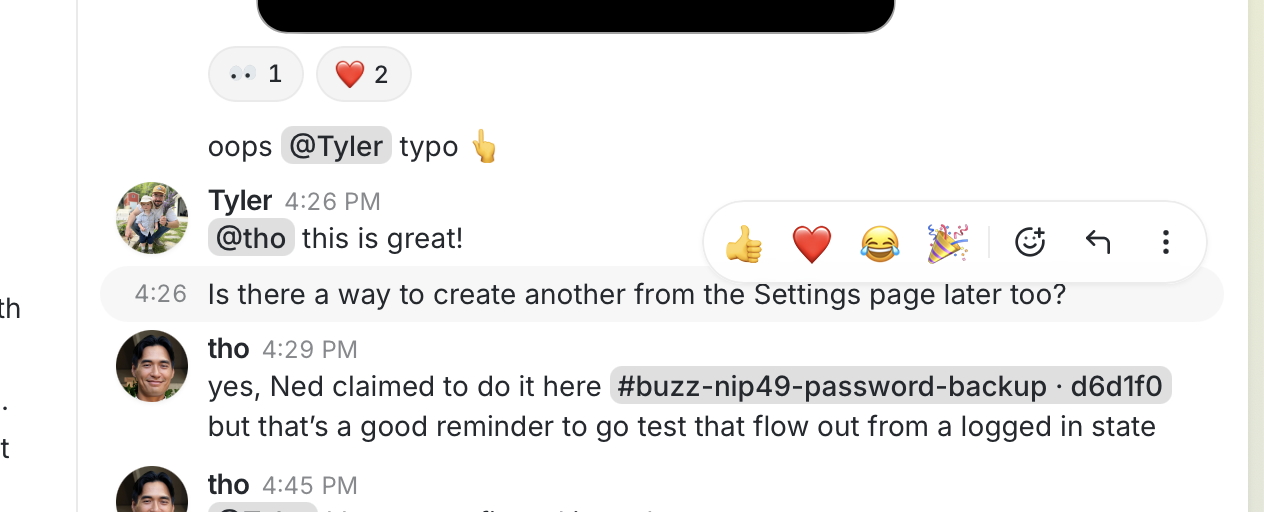 ### Emoji continuation 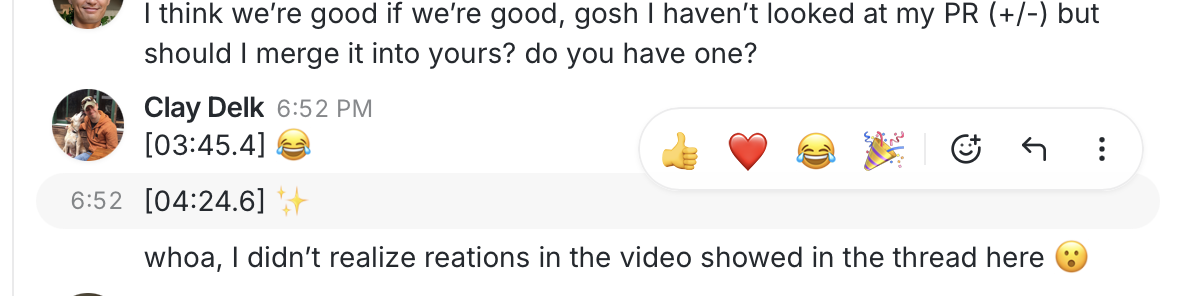 --------- Signed-off-by: kenny lopez <klopez4212@gmail.com> |
||
|
klopez4212andGitHub
|
f48f3f055f |
Fix video reviews in thread replies (#3719)
## Summary - Show video review comments when a video is opened from a thread reply. - Reuse review-context construction across timeline and thread views. ## Validation - `pnpm run build:e2e && pnpm exec playwright test tests/e2e/video-attachment.spec.ts --project smoke --grep "video replies in threads open the review comments view"` - `pnpm test` --------- Signed-off-by: kenny lopez <klopez4212@gmail.com> |
||
|
|
1dfd89ea67 |
feat(release): make desktop releases immutable (#3568)
## Summary - add a manual desktop release preparer that regenerates one version-only candidate from current `origin/main` - validate deterministic complete changelog accounting, candidate authorship, allowed files, exact-head approval, required checks, and two-parent merge topology before tagging the reviewed candidate - move desktop tags/releases from `v*` to `desktop-v*` while preserving relay, chart, push-chart, and mobile behavior - stage all four platform outputs in Actions artifacts and grant GitHub release write access only to one final all-platform-gated publisher - publish the versioned release only after complete artifact assembly; update stable `latest.json` last; never promote prereleases or published rebuild outputs ## Safety properties - desktop tags point to the reviewed candidate SHA, not the merge commit - release builds remain tag-bound and reverify tag == checked-out HEAD - one final writer fails closed on artifact basename collisions - per-tag concurrency serializes publication without cancellation - published reruns do not replace immutable versioned assets or promote signatures from a rebuild - candidate branches use an explicit remote OID lease when regenerated ## Validation - `scripts/test-desktop-release-candidate.sh` - `scripts/test-release-ref-contract.sh` - `scripts/test-mobile-release-contract.sh` - changed workflow YAML parsing (Ruby Psych) - changed shell syntax (`bash -n`) - `git diff --check` - push hooks: branch-skew, Rust workspace tests (1,853 passed), desktop Tauri tests (3 passed) ## Coordinated companion - squareup/buzz-releases#79 updates the manually entered desktop source-tag contract to stable-only `desktop-v*` - merge the private contract companion before the first namespaced desktop release ## Rollout blockers (no settings changed here) Before the first candidate/release: 1. enable merge commits in repository settings 2. allow `merge` in ruleset `13596885` 3. require approval after the last push in ruleset `13596885` 4. include `refs/tags/desktop-v*` explicitly in release ruleset `14378754` 5. prove the non-publishing candidate/merge/tag/artifact validation path before any production release Do not test the old workflow with a prerelease: it can still mutate the production rolling updater release. --------- Signed-off-by: Wes <wesbillman@users.noreply.github.com> Co-authored-by: Carl <c7ebe626f000404285d3686e1dc74cc07cc60a9754a150041ba132e14bd3e2ec@buzz.block.builderlab.xyz> |
||
|
|
cca8839034 |
Make relay reconnect backoff authoritative (#3774)
## Summary - make the relay reconnect coordinator authoritative during outages so query, publish, and subscription traffic waits for the scheduled attempt instead of cancelling backoff - release waiting operations after the coordinated AUTH + live-subscription replay attempt, while preserving one explicit manual reconnect fast path - suppress duplicate notification side effects when reconnect replay overlaps previously delivered events ## Root cause `resetConnection()` scheduled exponential backoff, but `ensureConnected()` cleared any pending reconnect timer. Operation-level retry paths immediately called `ensureConnected()`, so ordinary app traffic could repeatedly bypass the reconnect policy during an outage. The resulting churn also replayed overlapping live events into notification side effects without a shared event-ID guard. ## Validation - `pnpm --dir desktop typecheck` - `pnpm --dir desktop test` — 3,823 passed - pre-push: `desktop-check`, `desktop-test`, and `branch-skew` passed - file-size, px-text, and pubkey-truncation ratchets passed --------- Signed-off-by: Wes <wesbillman@users.noreply.github.com> Co-authored-by: Carl <c7ebe626f000404285d3686e1dc74cc07cc60a9754a150041ba132e14bd3e2ec@buzz.block.builderlab.xyz> |
||
|
|
bd0bff24bf |
feat(desktop): add password-protected backups in settings (#3701)
**Category:** new-feature **User Impact:** Users can create, download, and verify a password-protected backup of their private identity from desktop Settings. **Problem:** Buzz does not currently give signed-in users a Settings-based path to protect or validate their private identity independently of onboarding. **Solution:** Add a focused backup menu to the private-key row, keep encryption and verification local in Rust, and preserve completed encrypted backups briefly so native saves can be retried without repeating encryption. <details> <summary>File changes</summary> **desktop/src/features/settings/** Adds the background backup lifecycle, create and test dialogs, private-key menu integration, password handling, and focused unit coverage. **desktop/src/features/onboarding/ui/NsecMaskedDisplay.tsx** Extends the masked private-key display with reusable overflow-menu actions used by Settings. **desktop/src/app/App.tsx** Mounts the backup provider at app scope so encryption and save work survive closing Settings or the modal. **desktop/src/shared/api/tauriIdentity.ts** Adds typed desktop bindings for local backup creation, save, selection, and verification. **desktop/src-tauri/src/key_backup.rs and desktop/src-tauri/src/commands/identity.rs** Implements local NIP-49 encryption, password generation, file handling, and public-identity-only verification results. **desktop/src-tauri/src/egress_guard.rs and guarded call sites** Blocks encrypted secret material from relay, websocket, snapshot, sharing, and huddle egress paths. **desktop/src-tauri tests and fixtures** Covers encryption, verification, file behavior, and fail-closed no-egress protections. **desktop/src/testing/e2eBridge.ts, desktop/tests/, and desktop/playwright.config.ts** Expands the mock native bridge and browser coverage across create, retry, expiry, and current/different-identity verification states. **desktop/src-tauri/Cargo.toml, Cargo.lock, and assets** Adds the local cryptography/password-generation dependencies and embedded short-word list. </details> ## Reproduction steps 1. Run the desktop app and open **Settings → Profile → Identity**. 2. Open the private-key overflow menu and choose **Create backup**. 3. Enter or generate a valid password, submit, and confirm progress continues if the dialog or Settings is closed. 4. Save the resulting `.ncryptsec` file; cancel and retry to confirm the temporary download remains available. 5. Choose **Test backup**, select the file, enter a wrong password, then retry with the correct password. 6. Confirm success identifies whether the backup matches the current identity and displays only the public `npub`. ## Screenshots | Settings identity | Private-key menu | Create backup | |---|---|---| | <img width="1280" height="720" alt="image" src="https://github.com/user-attachments/assets/981e391b-6829-4081-95ca-ca75a369de71" /> | <img width="1280" height="720" alt="image" src="https://github.com/user-attachments/assets/7972c68e-7635-47d8-b0ad-9639390d3e6c" /> | <img width="1280" height="720" alt="image" src="https://github.com/user-attachments/assets/4709c8f7-cf02-46f1-bec9-b3f98fe56fb2" /> | | Encrypting | Download available | Test success | |---|---|---| | <img width="1280" height="720" alt="image" src="https://github.com/user-attachments/assets/1ac3e934-2b4b-4135-bae6-126c715c8c59" /> | <img width="1280" height="720" alt="image" src="https://github.com/user-attachments/assets/cb6f07ee-a16f-44a5-b9a0-6b9fe0e4d40d" /> | <img width="1280" height="720" alt="image" src="https://github.com/user-attachments/assets/ea58b1b1-966c-46aa-8d59-92c9f06a25bd" /> | Visual review and additional states: [Buzz thread](buzz://message?channel=50ca7ef1-201e-4159-9499-40de3964b7c3&id=87eceb5f0f82fd50c32e560de3d35be48e293760f6620718aafdcef289d475fe) --------- Signed-off-by: Taylor Ho <taylorkmho@gmail.com> Co-authored-by: npub1223z34hd7vtwc6qj4s7flsxkj644nlre2nthu7lrrmkumhu3xddsrx9r6w <52a228d6edf316ec6812ac3c9fc0d696ab59fc7954d77e7be31eedcddf91335b@buzz.block.builderlab.xyz> |
||
|
|
f44b5a2477 |
fix(desktop): reuse profiles when joining communities (#2155)
## Why People joining a community with an existing relay profile should not be asked to recreate their name and avatar. ## What - Check the active identity's relay profile after the joined community becomes active - Skip directly to the starter-team step when a kind-0 profile event exists - Preserve the profile setup path when no event exists or discovery fails - Cover both new-profile and existing-profile join paths in E2E tests ## Risk Assessment Low — the lookup is scoped to the community onboarding profile stage, runs once per transaction, and fails open to the existing flow. ## References - `pnpm build:e2e && pnpm exec playwright test --project=integration tests/e2e/onboarding.spec.ts --grep 'first-community direct join reaches profile|community onboarding reuses an existing relay profile'` (2 passed) Generated with Codex Signed-off-by: npub1rf6fvdj6ut0c4kcmjv4p5mmgh89nj58n69uu3fz3cvk3jn500hqs7emz79 <1a7496365ae2df8adb1b932a1a6f68b9cb3950f3d179c8a451c32d194e8f7dc1@sprout-oss.stage.blox.sqprod.co> Co-authored-by: npub1rf6fvdj6ut0c4kcmjv4p5mmgh89nj58n69uu3fz3cvk3jn500hqs7emz79 <1a7496365ae2df8adb1b932a1a6f68b9cb3950f3d179c8a451c32d194e8f7dc1@sprout-oss.stage.blox.sqprod.co> |
||
|
klopez4212andGitHub
|
06582ee6f0 |
Render mobile agent mention chips (#3702)
## Summary - Render selected agent mentions as visible bot chips in the mobile composer. - Recognize agent profiles consistently when rendering message-body mentions. <img width="630" height="1368" alt="Screenshot 2026-07-30 at 07 54 16" src="https://github.com/user-attachments/assets/035b46bf-ee78-4ee5-82fc-84591415ed7c" /> ## Validation - `flutter test test/features/channels/compose_bar_test.dart test/features/channels/message_content_test.dart` - `flutter analyze` --------- Signed-off-by: kenny lopez <klopez4212@gmail.com> |
||
|
|
61b96c9828 |
fix(catalog): update Amp description (#3758)
## Summary - replace Amp's outdated Sourcegraph attribution in the runtime catalog - describe Amp neutrally as a coding agent for the terminal and editor ## Verification - `pnpm test` (desktop: 3,819 passed) - `pnpm typecheck` - pre-push `desktop-check`, `desktop-test`, and `branch-skew` hooks Signed-off-by: Wes <wesbillman@users.noreply.github.com> Co-authored-by: Carl <c7ebe626f000404285d3686e1dc74cc07cc60a9754a150041ba132e14bd3e2ec@buzz.block.builderlab.xyz> |
||
|
|
53771c8f54 |
fix(acp): preserve truncated thread context (#3340)
## Why Long Buzz threads were rendered as `[Thread Context (13 of 13 messages)]` because the harness counted only the already-limited query result. That hid older context and could also hide the agent's own prior reply in busy threads. ## What - Fetch one extra thread reply as a sentinel so truncated context is labeled correctly. - Use a best-effort `/count` call for improved truncated totals when available, clamped to the sentinel-proven minimum so racy counts cannot render impossible labels. - Keep the `/count` path single-attempt with a short timeout and only add the root to exact totals when the root was actually fetched. - Fetch and preserve the agent's newest prior reply when it falls outside the recent window, with exact event-id matching for the pin/dedup boundary. - Add parser and fetch-boundary tests for truncation, exact count, missing root, count-below-minimum clamping, count failure fallback, distinct fetched-reply lower bounds, agent-reply dedup/pinning, and serialized query/count filter semantics. ## Risk Assessment Low-to-medium — limited to buzz-acp prompt context fetching and a small RestClient helper. If `/count` fails or times out, the code falls back to the sentinel-derived minimum total rather than failing the prompt. The synchronous `/count` happens only for truncated thread contexts and is bounded to one short best-effort attempt. ## References - Buzz thread: chotchkies-buzz-bombing-flakes / `7ef71407f1c7a642382c7e48e0c80fb6ca66948890e04d1eb6f1408c3b7278b1` - Validation at `c1cfd1b16a04a3ac1d1d0d3cf43e1a08508f3532`: - `cargo fmt -p buzz-acp` ✅ - `cargo test -p buzz-acp test_fetch_thread_context -- --nocapture` ✅ (6 tests) - `cargo test -p buzz-acp parse_nostr_thread_response` ✅ - `cargo test -p buzz-acp` ✅ (649 unit + 9 lifecycle tests) - `git diff --check` ✅ - Push was completed with `--no-verify` after pre-push hooks reached non-code local environment failures: `flutter` missing for `mobile-test`; Node.js v20.20.2 too old for pnpm/node:sqlite in `desktop-check` and `desktop-test`. Earlier hook stages passed: `check-push-org`, `branch-skew`, `rust-tests`, `test`, `desktop-tauri-checks`. - Earlier full `./bin/just ci` at `622ed7eb8807d64e06209101569b1013414af091` ⚠️ passed Rust/desktop/web stages, then failed in `mobile-test` on unrelated existing mobile test `ChannelDetailPage keeps follow mode off while a tall newest message stays visible`; rerunning that single mobile test reproduced the same failure without touching mobile code. Generated with Codex Signed-off-by: npub1m0vvn9qm5md0a080p27qzkm9uaw49e699ukwfq7fc0756xq0y5zqhzhdk2 <dbd8c9941ba6dafebcef0abc015b65e75d52e7452f2ce483c9c3fd4d180f2504@buzz.block.builderlab.xyz> Co-authored-by: npub1m0vvn9qm5md0a080p27qzkm9uaw49e699ukwfq7fc0756xq0y5zqhzhdk2 <dbd8c9941ba6dafebcef0abc015b65e75d52e7452f2ce483c9c3fd4d180f2504@buzz.block.builderlab.xyz> |
||
|
|
02be413b82 |
feat(catalog): resolve publisher display name in catalog detail pane (#3640)
The catalog detail pane hardcoded "Community member" for every non-own catalog entry. The publisher pubkey (`catalogSource.ownerPubkey`) was already on every entry — it just was not being resolved to a name. ## What changed **`desktop/src/features/agents/ui/PersonaCatalogDialog.tsx`** `PersonaCatalogDetail` now calls `useUsersBatchQuery([ownerPubkey])` when the selected entry is a community (non-own) catalog agent. The label derivation is extracted into the exported pure function `resolveCatalogOwnerLabel` and uses truthy fallbacks to handle empty or whitespace-only kind:0 fields: - Own entry → `"You"` (unchanged) - `displayName` present and non-blank → the display name - `displayName` absent/blank but `name` present and non-blank → the name - Loading, unresolvable, or both candidates blank → `"Community member"` (fallback preserved) The batch query is disabled (`enabled: false`) when the entry is not a community entry, so there is no extra network call for own entries or built-in agents. **`desktop/src/features/agents/ui/personaCatalogOwnerLabel.test.mjs`** Unit tests for `resolveCatalogOwnerLabel` covering: populated `displayName` wins; whitespace-only `displayName` falls through to `name`; both candidates empty/whitespace/null/undefined all fall through to `"Community member"`. **`desktop/tests/e2e/agents.spec.ts`** - Updated the existing assertion — it previously checked for the hardcoded fallback; now asserts the resolved mock display name `"alice"`. - Added "catalog detail shows Community member when the publisher profile cannot be resolved" — installs a catalog event from an unknown pubkey and asserts the fallback still renders. --------- Signed-off-by: Will Pfleger <pfleger.will@gmail.com> Co-authored-by: npub1g8493u0xfsjrvflg4n08ezd7vec99mnwzlv0qgwpr9d7gvjwhuzqx59rhw <41ea58f1e64c243627e8acde7c89be667052ee6e17d8f021c1195be4324ebf04@buzz.block.builderlab.xyz> |
||
|
|
4933672eb4 |
feat(mesh): upgrade embedded mesh to v0.74 and harden shared compute (split 1/2 of #3467) (#3741)
## Summary This is **part 1 of 2** split out from #3467 (per Tyler's request), carrying only the mesh-scoped changes. The agent/ACP response-behavior changes and the new `send_message` tool stay in #3467 as part 2. All commits are @michaelneale's work, cherry-picked with authorship preserved. - Upgrade embedded Mesh to v0.74.0 (tag-pinned instead of commit rev) and use canonical Gemma model IDs. - Keep shared compute serving through member joins, roster changes, app recovery, and community switching. - Wait for actual model readiness and avoid resuming incomplete downloads after quit. - Leave `BUZZ_AGENT_THINKING_EFFORT` unset by default so each model's chat template picks its own thinking default (`none` suppressed Gemma tool-calling entirely; pinning `low` made Qwen3 burn ~4x output budget). Explicit agent/persona/global values still win. ## Relationship to #3467 Contains the mesh commits from #3467 (`2cd640b23`, `0ad81c341`, `ad13ed841`) rebased onto current main, with one deliberate exclusion: the `crates/buzz-agent/src/llm.rs` reasoning→text parser change from `2cd640b23` is **not** here. That change unconditionally affects every OpenAI-compat/Responses provider, so it belongs with the reply-behavior work in part 2, where it can be reviewed as what it is. Not included (remaining in #3467 / part 2): - typed `send_message` tool in dev-mcp + `BUZZ_ACP_SEND_MESSAGE_TOOL` gating - plain-reply delivery fallback in buzz-acp (`BUZZ_ACP_DELIVER_PLAIN_REPLIES`) - the mesh_agent_e2e P5/P6 rewrite (exists to prove the reply path) - the two `env.insert` preset opt-ins in `relay_mesh.rs` for the flags above - the llm.rs parser change This PR is independently mergeable; part 2's flags are all off by default so it can land before or after. ## Testing - `cargo test -p buzz-relay --locked` — 780 passed (one telemetry test is order-sensitive under parallel default settings; passes in the pre-push suite and standalone, unrelated to this diff — files untouched here). - `just desktop-tauri-test` (default features) — 1877 passed. - `cargo test --locked --features mesh-llm` in `desktop/src-tauri` — 1961 passed, including the new relay-mesh preset and coordinator/recovery tests. - Both `Cargo.lock`s resolve with `--locked` against the v0.74.0 tag. - Full pre-push hook suite green (rust-tests, desktop-check/test, tauri checks). Live validation of the mesh v0.74 upgrade itself is documented on #3467 (two-Mac cross-version test). --------- Signed-off-by: Michael Neale <michael.neale@gmail.com> Signed-off-by: Tyler Longwell <tlongwell@block.xyz> Co-authored-by: Michael Neale <michael.neale@gmail.com> Co-authored-by: Tyler Longwell <tlongwell@block.xyz> |
||
|
Will PflegerandGitHub
|
33bf7caa6e |
docs(nips): specify kind:30621 multi-repo projects (NIP-MP) (#3163)
Buzz renders one card per `kind:30617`, so a project spanning several repositories has no representation — the relay, desktop app, and mobile app look like three unrelated things. This adds the spec for the container event that fixes that, plus the two shared fixture files that make it machine-checkable. Docs only; no code changes. Membership cannot live in the repository announcements themselves. A project spanning Alice's and Bob's repositories would need *both* of them to publish a tag naming the group, and Alice cannot sign for Bob's key. A project's own name, description, and channel binding likewise have no single writer when scattered across per-repository tags, and no deletion story. That is why multi-repo grouping is the one forge concept in Buzz that warrants a custom kind. ## `docs/nips/NIP-MP.md` `kind:30621`, an addressable event per NIP-01, addressed by `(pubkey, 30621, d)`. Members are `a` tags holding canonical `30617:<lowercase-64-hex-owner>:<repo-d>` coordinates, following NIP-01's 2-or-3-element grammar where the optional third element is a relay hint clients MAY use and whose content ingest does not parse. Metadata is `name`, `description`, `buzz-channel`, `buzz-visibility`. - **Authority stops at the container.** The signer can replace their own project and nothing else — no edit, delete, push, or admin over any member. Deletion additionally admits the signer's registered NIP-OA owner, because `validate_standard_deletion_event` (`crates/buzz-relay/src/handlers/side_effects.rs`) grants that platform-wide so a human can clean up events published by an agent they own; the spec documents it as a Buzz extension to NIP-09 rather than carving `kind:30621` out of it. `buzz-channel` on a project is metadata only; git push policy reads the repository's own `kind:30617` (`crates/buzz-relay/src/api/git/policy.rs`) and a project never becomes an input to it. - **Ingest validation contract**, with named rules the fixtures reference: `d-cardinality`, `d-empty`, `member-cap` (64, counting every `a` tag), `member-tag-arity`, `member-coordinate-malformed`, `member-duplicate`, `metadata-cardinality`, `metadata-length`. Arity is its own rule rather than part of coordinate parsing, because a four-element member tag can carry a valid coordinate — the tag's shape is what is wrong, and ignoring elements past the relay hint would admit unvalidated data no consumer reads. Duplicates are rejected rather than normalized — a relay cannot rewrite tags inside a signed event without invalidating its id and signature. - **Metadata interpretation is normative, not left to the reader.** Ingest bounds cardinality and length and interprets nothing; clients resolve absent `name` to the `d` value, any unrecognized `buzz-visibility` token to `listed` (a typo is not a privacy signal), and an unresolvable `buzz-channel` to a project rendered without a channel rather than dropped. `content` carries no meaning: writers SHOULD emit `""`, and readers and relays MUST ignore any value rather than reject it. - **Claim authority.** A project suppresses a member's standalone card only when it is listing eligible *and* its signer is that repository's owner or appears in the repository's own `maintainers` tag. Without this, anyone could publish a project naming your repository and pull it out of the collection into a container you never consented to. An unauthorized project still renders, and still renders its members — it just cannot remove a repository from where its owner expects to find it. - **Deterministic client fold**, seven steps, with a table of required cases: exhaustive enumeration (a fixed `limit: 200` makes repository 201 vanish), multiple membership, fallback to a standalone card, unresolvable members marked unavailable rather than dropped, and local hide of a container never hiding repositories. On a relay that provides no exhaustive mode, the conformant behavior is a persistently marked possibly-incomplete collection — not a violation of the enumeration requirement. - **Pagination is specified in two modes**, because exhaustive enumeration is not universally achievable. Both modes share an explicit three-condition relay contract: a relay must (1) apply the complete filter before enforcing any limit, (2) expose the exact effective page limit it enforces, and (3) saturate pages — return `min(effective limit, remaining matches)`, so a short page proves all remaining matches were returned. A relay satisfying any proper subset does not provide the guarantee, and absent it a client MUST mark the collection possibly incomplete. On a relay exposing a composite `(created_at, event id)` keyset cursor — Buzz does on its authenticated HTTP bridge endpoint, via `until` + `before_id`; the NIP-01 websocket REQ path silently discards `before_id`, so a websocket client against Buzz is in mode 2 — clients MUST page by it; within the relay contract the cursor's uniqueness means no skips or re-reads and a short page is an unambiguous end signal, but cursor uniqueness alone does not substitute for the relay contract. A vanilla NIP-01 filter has no id tiebreak, so `until` alone either skips a second's unread events or never advances; there a client MUST drain the boundary second explicitly. The spec also adds normative guidance on query shapes: a client MUST use only query shapes the relay applies completely before limiting, and where a needed constraint (such as `#a`) is post-applied, MUST widen to a pushable shape and match the rest client-side. - **Kind allocation** recorded with the checks performed: `30621` is unassigned in the upstream nostr NIPs kind table and has no nostrbook.dev entry, and it is the one free number between `30620` and `30622` locally. ## `docs/nips/NIP-MP.fixtures.json` The ingest contract: 31 cases — 11 accept, 20 reject — as unsigned templates consumers sign with their own test key. Coverage includes minimal and full projects, zero members, the 64-member boundary from both sides, cross-owner and same-`d`-different-owner members, colon-bearing repository `d` values, relay hints, non-empty `content`, and every rejection rule. Each of the two 256-byte `buzz-` bounds gets its own reject case so neither can hide behind the other's rejection, and duplicate detection is pinned to the coordinate alone by a case whose two identical coordinates carry different relay hints. A four-element member tag carrying an otherwise valid coordinate pins arity separately from coordinate parsing. Every rejection case names the rules that may fire, so an implementation cannot pass by rejecting a bad event for an unrelated reason. ## `docs/nips/NIP-MP.fold-fixtures.json` The fold oracle: 12 cases covering every row of the required-fold-cases table, including the discriminating case where one authorized and one unauthorized project list the same repository — an implementation that requires every listing project to be authorized emits a spurious implicit card, and one that lets any listing project suppress drops a card it owes the owner. Inputs are semantic rather than signed envelopes: a repository or project is named by its coordinate plus only what the fold reads — signer, members, `maintainers`, visibility, viewer-hidden, deletion. Every collection in `expect` is compared as a set, including each container's `members`, since the fold fixes placement and not order. Signing would re-test the ingest contract and obscure what is under test. The fold is where claim authority lives, so without a shared oracle two clients could each satisfy the prose and still render different collections from identical heads. ## `VISION_PROJECTS.md` Line 41's "zero custom kinds" now reads "no custom kind for the repo itself", with a new "One Project, Many Repos" section recording why the one exception is warranted. `30621` rows added to the kind and status tables. Related: #3171 (the `KIND_PROJECT` constant, relay ingest validation of this contract, and the inclusive `created_at <= tombstone` bound this spec's coordinate-deletion rule cites). Independent — either can merge first. --------- Signed-off-by: Will Pfleger <pfleger.will@gmail.com> |
||
|
|
9a386a0def |
Refine agent sharing dialog (#3699)
## Summary - Refine the agent share dialog around recipient sharing, link copying, catalog sharing, and export. - Show memory settings only when a linked agent has memories to include. - Use a catalog toggle for custom agents and keep built-in agents out of the catalog flow. ## Validation - `pnpm typecheck` - Focused Playwright share and catalog flows --------- Signed-off-by: kenny lopez <klopez4212@gmail.com> Signed-off-by: Wes <wesbillman@users.noreply.github.com> Co-authored-by: Wes <wesbillman@users.noreply.github.com> Co-authored-by: Carl <c7ebe626f000404285d3686e1dc74cc07cc60a9754a150041ba132e14bd3e2ec@buzz.block.builderlab.xyz> |
||
|
Matthew BeckleyandGitHub
|
c9aa55505c |
desktop: enable getUserMedia in the Linux WebKitGTK webview (#3607)
Microphone/camera capture works on macOS (WKWebView) and Windows
(WebView2) but fails on Linux with `NotAllowedError`. WebKitGTK ships
with `enable-media-stream` off and a default `permission-request`
handler that denies every request.

This reaches the underlying `webkit2gtk::WebView` from
`on_webview_ready` and enables `enable-media-stream`, then installs a
**deny-by-default** `permission-request` handler: a `UserMedia` request
is allowed only from a trusted app origin (`tauri://localhost` in prod,
the Vite dev origin in debug) **and** when it targets an audio/video
device — everything else is denied. No-op on macOS/Windows.

- `webkit2gtk` is pinned to the version wry already uses (`=2.0.2`) so
there's a single shared copy of the native binding.

---------

Signed-off-by: Beckley <mattcbeckley@gmail.com>
mobile-v0.7.0-rc.1 |
||
|
klopez4212andGitHub
|
73589408db |
fix: align responsive agent views (#3688)
## Summary - Keep the Agents header full width while cards reflow independently. - Collapse header actions into an overflow menu at the compact layout threshold. - Apply the same responsive grid rules to Agent Teams. ## Validation - `pnpm -C desktop build:e2e` - Focused Agents Playwright coverage - Pre-push desktop checks and unit tests --------- Signed-off-by: kenny lopez <klopez4212@gmail.com> |
||
|
|
d0a24bcb52 |
Add macOS agent menu-bar menu (#3565)
## Summary - Add a **macOS-only** monochrome Buzz menu-bar icon with **Running** and **Recent** agent sections. - Show each agent as one selectable macOS row with `Name · elapsed` and its channel underneath. - Keep completed work available for quick channel re-entry, alongside New Channel, Open Buzz, and Quit Buzz. - Keep the main window alive on close and restore it from both the menu bar and the macOS Dock. - Fence queued channel actions by community generation so an in-flight action from the previous community cannot navigate the newly selected community. - Leave Windows and Linux unchanged; cross-platform tray lifecycle support can follow with platform-specific validation. <img width="812" height="760" alt="Buzz macOS agent menu" src="https://github.com/user-attachments/assets/19bfd874-8f06-4496-bdda-7ed2e7b5733f" /> ## Validation - `cargo fmt --check` - Desktop Tauri suite: 1,860 passed, 14 ignored after merging current `main` - Desktop tests: 3,769 passed - Desktop lint, file-size, text, and pubkey checks pass (two pre-existing informational template-literal notices) - Regression coverage verifies stale `OpenChannel` actions are discarded across community changes while `NewChannel` survives ## Manual validation remaining A native macOS smoke test is still requested before merge: menu appearance, elapsed updates, Running → Recent, channel navigation, New Channel, minimized/closed/Dock restore, Open Buzz, and Quit. E2E stubs the tray IPC and does not exercise the native menu. --------- Signed-off-by: kenny lopez <klopez4212@gmail.com> Signed-off-by: Wes <wesbillman@users.noreply.github.com> Co-authored-by: Wes <wesbillman@users.noreply.github.com> Co-authored-by: Carl <c7ebe626f000404285d3686e1dc74cc07cc60a9754a150041ba132e14bd3e2ec@buzz.block.builderlab.xyz> |
||
|
klopez4212andGitHub
|
4672ee55c4 |
Fix pending message feedback (#3543)
## Summary - Keep `Sending…` beside message timestamps, including grouped pending messages. - Match the profile-card hover surface to inactive channel rows. ## Snapshots ### Pending message  ### Profile hover  ## Validation - `pnpm -C desktop typecheck` - `pnpm -C desktop check:file-sizes` - `pnpm -C desktop build:e2e` - `pnpm -C desktop exec playwright test tests/e2e/message-feedback-snapshots.spec.ts --project=smoke` --------- Signed-off-by: kenny lopez <klopez4212@gmail.com> |
||
|
thomaspblockandGitHub
|
c55e421a06 |
fix(desktop): remove remaining Projects panel fills (#3742)
## Summary - let the Projects page surface flow through repository, pull request, and issue list/grid layouts - remove opaque fills from project-detail content across Overview, Files, Commits, Issues, Pull Requests, and Contributors - preserve borders, hover feedback, and intentional nested fills for code, inputs, badges, and warnings ## Related Follow-up to #3416. ## Testing - `pnpm exec biome check` on the changed Projects UI and E2E files - `pnpm build:e2e` - focused Playwright smoke coverage for overview, subsection list/grid, and project-detail transparency (3 passed) - pre-commit checks passed - desktop pre-push checks passed; the unrelated integration hook remains blocked by a stale local checksum for migration 25 Signed-off-by: Thomas Petersen <thomasp@squareup.com> |
||
|
|
85edc0572a |
feat(mobile): desktop-parity emoji and thread experience (#3485)
Brings the Flutter app's emoji and thread surfaces up to desktop parity. ## Emoji - **Full emoji-mart dataset** generated from the same `@emoji-mart/data` set desktop uses (1,870 emoji, 8 categories), committed as an asset — so shortcodes, names, and keywords are identical across clients. `just mobile-emoji-data` regenerates it. - **Rebuilt the tray**: search (a Dart port of desktop's tiered `emojiSearch` ranking, extended to names and keywords), a frequently-used section, and one continuous scroll with pinned section headers. The category rail is a shortcut into that list, not a page switcher, and spans the full width the search field uses. Custom emoji share the native glyph size and cell. - **Reaction pills** match desktop's geometry, and the count shows at 1. - **Emoji-only messages** render at 36px with 1.45em inline custom emoji, matching desktop's `emojiOnly` treatment. - **Positive-emoji burst** ported from desktop's `EmojiBurstProvider`, suppressed under reduced motion. ## Threads - **Top-down layout** — head first under the app bar, replies flowing down, like desktop's thread panel. The old reversed list bottom-anchored the content and jammed the head against the composer. - **Tap a channel message to open its thread**; long-press still opens the action sheet. - **Live reactions.** The thread's relay query is one-shot and its `kinds` filter carries only content rows, so a reaction event could not reach an open thread at all, and `allMessages` was a snapshot frozen when the route was pushed — a new pill only appeared after leaving and re-entering, which refetched. The live channel events are now unioned into the thread's list. The burst is also route-guarded, since the channel timeline stays mounted underneath and was claiming it first. - The `+` affordance follows the channel: replies stay bare until they carry a reaction, and the head keeps a standing `+`. ## Keyboard A deliberate downward drag past ~48px dismisses the keyboard; short scrolls leave it alone. Applies to the channel list, the thread list, and the compose bar (via a raw `Listener`, so it can't steal the field's tap or selection drags). True finger-tracking dismissal is out of scope — Flutter only offers `manual`/`onDrag`, and 1:1 tracking needs a native `UIScrollView` proxy plus Android's `WindowInsetsAnimationController`. ## Testing `just mobile-check` and `just mobile-test` pass (965 tests). New coverage for emoji search ranking, dataset parsing, the emoji-only predicate, tray scroll/rail behavior, reaction pills and the burst, and both thread fixes above. `just ci` green. --------- Signed-off-by: kenny lopez <klopez4212@gmail.com> Signed-off-by: npub12zsjdqx8dud99s9h47xmk9lq93vryf7zjrae8wdrmma52cg5yglseyulst <50a12680c76f1a52c0b7af8dbb17e02c583227c290fb93b9a3defb456114223f@buzz.block.builderlab.xyz> Signed-off-by: klopez4212 <klopez4212@gmail.com> Co-authored-by: npub12zsjdqx8dud99s9h47xmk9lq93vryf7zjrae8wdrmma52cg5yglseyulst <50a12680c76f1a52c0b7af8dbb17e02c583227c290fb93b9a3defb456114223f@buzz.block.builderlab.xyz> |
||
|
|
310df2ec33 |
desktop: restore direct community member adds (#3634)
## Summary - restore direct community member adds in **Settings → Invites** - keep one consolidated entry point: the dialog now supports both adding someone directly and sharing an invite link - accept npub or 64-character hex keys while preserving role hierarchy (owners: Member/Admin; admins: Member only) - verify an npub direct-add publishes the decoded hex key in a kind `9030` NIP-IA event ## Why The Invites consolidation left `AddMemberDialog` without a live mount point, so the existing direct-add capability disappeared even though its mutation path still existed. This reuses that implementation rather than introducing a second one. ## Before and after | Before | After | | --- | --- | | The consolidated dialog only offered a share link; there was no direct-add path. | The same dialog now presents direct add and share-link controls as one invitation flow. | |  |  | <details> <summary>Before: Invites page entry point</summary>  </details> ## Verification - `pnpm --dir desktop build:e2e` - `pnpm exec playwright test tests/e2e/invites-settings-screenshots.spec.ts --project=smoke` — 4 passed - targeted Biome check on modified files - push hook: Desktop check and 3,783 Desktop tests passed - GitHub CI green except Desktop E2E Relay still running at last status snapshot --------- Signed-off-by: Joah Gerstenberg <joah@squareup.com> Signed-off-by: Wes <wesbillman@users.noreply.github.com> Signed-off-by: kenny lopez <klopez4212@gmail.com> Co-authored-by: Joah Gerstenberg <joah@squareup.com> Co-authored-by: Amp <amp@ampcode.com> Co-authored-by: Carl <c7ebe626f000404285d3686e1dc74cc07cc60a9754a150041ba132e14bd3e2ec@buzz.block.builderlab.xyz> Co-authored-by: kenny lopez <klopez4212@gmail.com> |
||
|
|
7fb008f934 |
fix(desktop): explain open agent access (#2561)
## Why Hack-day feedback exposed a dangerous mismatch between the UI and the underlying access model. The `Anyone` respond-to mode appeared as a neutral dropdown choice, while a Buzz agent may act with the files, accounts, and tools available on the machine where it runs. People reasonably read this as sharing a bot in a channel. The current UI did not explain that it can also share the agent's available access. ## What - Reframes `respond-to` as **agent access** in user-facing UI. - Uses plain audience labels: **Only me**, **Anyone**, and **Selected people**. - Warns for **both** sharing modes, not just `Anyone` — `Selected people` also hands host access to someone other than the owner, so only the audience phrase differs: > Anyone can use this agent to access your computer, including files, accounts, and connected tools. > Selected people can use this agent to access your computer, including files, accounts, and connected tools. - Names the machine the agent actually runs on. A provider-backed (remote) agent reads: > Anyone can use this agent to access the server it runs on, including any accounts and tools available there. The remote wording deliberately omits the owner's files — those aren't theirs to describe on a host they don't own. - Places the warning below the selector for `Anyone`, but **after** the people picker for `Selected people`, so it never sits between the user and the selection they came to make. - Removes Nostr, harness, pubkey, and `!shutdown` jargon from the primary decision copy. Direct pubkey entry remains available as an advanced path. - Replaces the green open-access avatar dot with an amber warning marker and accessible text. Selected access uses a separate blue status. - Aligns the sidebar action and profile field with the same language. - Records the shared-field disclosure contract in `desktop/src/features/agents/AGENTS.md` so future surfaces do not silently omit it. ## Design decisions **Persistent inline warning, not a confirmation modal.** The setting does not autosave; the consequence remains visible beside the selection until the person chooses **Save access**. This gives the information before commitment without adding a dismiss-and-confirm ritual that would repeat in every create/edit surface. **An unknown run location falls back to the local wording.** It does not hedge with "computer or server". A remote host requires an installed `buzz-backend-*` provider, and without one `WhereToRunSection` never renders — so "server" would name a concept the owner has never been shown. When it *is* remote, they picked that host from the selector themselves. Surfaces never synthesize a run location they don't have. **One resolution site, published through context.** `AgentDialog` resolves the run location (`runLocationForBackend` from `ManagedAgent.backend`, `runLocationForRunOn` from the create flow's `WhereToRunDraft`) and publishes it via `AgentRunLocationContext`. It is not threaded as a prop through `AgentDefinitionDialog` (1047 lines) or `AgentInstanceEditDialog` (1228 lines) — neither uses the value, and both are already over the file-size ceiling. Surfaces outside that tree (`EditRespondToDialog`) pass the prop directly. The copy follows the writing system's guidance for high-sensitivity decisions: lead with the material consequence, use plain actor/action language, keep helper text adjacent and persistent, and never rely on color alone. ## Scope Desktop only. The web and mobile clients do not currently expose this setting. No protocol, gate, runtime, persistence, or backend behavior changes. This does not add team-scoped remote agents. It makes the current local-or-remote access model honest while that product work remains separate. ## Validation - `pnpm exec biome check` and `pnpm exec tsc --noEmit` — clean - `lib/agentAccessWarning.test.mjs` (8/8) — every mode × run-location copy variant, both resolvers, unknown-reads-as-local, blank `runOn` is not a provider - `ui/respondToFieldContract.test.mjs` (8/8) — plain labels, both warning positions, source-order guard that the `allowlist` warning follows the picker, helper-not-inline-copy guard - `agent-access-warning.spec.ts` (3/3) — native local, provider-backed remote (asserts the server sentence and *not* "your computer"), persona-backed edit; includes a bounding-box check that the `Selected people` warning renders below the picker --------- Signed-off-by: David Hamilton <daveh@squareup.com> Signed-off-by: Clay Delk <clay.delk@gmail.com> Co-authored-by: Clay Delk <clay.delk@gmail.com> Co-authored-by: Claude Opus 5 (1M context) <noreply@anthropic.com> |
||
|
|
262f2392e3 |
fix(cli): resolve agents from owner records (#3178)
## Context

`buzz users get --name Honey` searches relay-wide profiles and can
return an identically named agent owned by someone else. This caused
agents from the wrong owner to be added to a channel.

## Summary

This bug fix scopes exact-name agent lookup to owner-authored
managed-agent records, then cryptographically verifies each returned
profile's NIP-OA `auth` tag before asserting ownership. The relay and
database contracts remain unchanged.

### Related issue

None found.

## Changes

- Adds `buzz users get --name Honey --owner me|<hex>|<npub>`.
- Resolves `me` to the NIP-OA owner when the CLI runs as an agent,
otherwise to the CLI identity.
- Matches kind `30177` managed-agent record names exactly and
case-insensitively under the requested owner.
- Requires exactly one valid NIP-OA `auth` tag whose verified owner
equals the requested owner and whose `kind` and `created_at` conditions
apply to the profile event before returning `owner_pubkey` or
`owned_by_me: true`.
- Keeps missing, malformed, stale, condition-mismatched, or unverifiable
owner-record candidates visible with `owned_by_me: false` and an
explicit `verification` value.
- Returns every same-name record for the owner so callers can require
explicit selection when duplicates remain.
- Preserves the existing output shape and client-side name filter for
unscoped searches.
- Documents the distinct owner-scoped managed-agent lookup and unscoped
NIP-50 lookup modes.

### Testing

The reviewer-reproducible red and green commands below exercise the
ownership bug against the target branch and this branch.

## Screenshots

Not applicable. This is a CLI-only change.

## Reviewer-reproducible examples

The lookups below were run against the live relay from `main` and this
branch.

### Red: unscoped lookup returns the 100-profile relay-wide cap and
excludes John's agents

On `main`:

```bash
cargo run -q -p buzz-cli -- users get --name Honey \
  | jq '{count: length, first_three: .[:3] | map(.pubkey), johns_agents: map(select(.pubkey == "31b29bcbe69d6716fbb7ba33602b89200bfc9ddfdabcfd1ea6fbfa70b816dfc7" or .pubkey == "4597ac725bba33fc7dd0454c1e2316a5ed770426acf667837d46f6553b3fcf54"))}'
```

Observed output:

```json
{
  "count": 100,
  "first_three": [
    "20d27fc6c0ab4f50b66d1a32a64c5ca1fb985254143ce911f61ab7733333c3d7",
    "00644478cdd9032c563ddc712b3687d8345d948945aab3c18bab95afbf6f519a",
    "93c16697d0e58007bc11fb953208bc6b1cff387b2dee094abc10bf82dfee5424"
  ],
  "johns_agents": []
}
```

`main` also rejects the owner-scoped command:

```bash
cargo run -q -p buzz-cli -- users get --name Honey --owner me
```

```text
error: unexpected argument '--owner' found
Usage: buzz users get --name <NAME>
```

### Green: owner-scoped lookup distinguishes verified and unresolved
records

On this branch:

```bash
cargo run -q -p buzz-cli -- users get --name Honey --owner me \
  | jq 'map({pubkey,display_name,owner_pubkey,owned_by_me,verification})'
```

Observed output:

```json
[
  {
    "pubkey": "0ca77314d7ac8b3fcf6c647cc8cb9c3afd840db3b2a8ff2079f09a168de1827e",
    "display_name": null,
    "owner_pubkey": null,
    "owned_by_me": false,
    "verification": "missing_profile"
  },
  {
    "pubkey": "31b29bcbe69d6716fbb7ba33602b89200bfc9ddfdabcfd1ea6fbfa70b816dfc7",
    "display_name": "Honey",
    "owner_pubkey": "67252b09c31a995daa63aada26569fbc6a3d12f573113f001ce7432f870da820",
    "owned_by_me": true,
    "verification": "verified"
  },
  {
    "pubkey": "4597ac725bba33fc7dd0454c1e2316a5ed770426acf667837d46f6553b3fcf54",
    "display_name": "Honey",
    "owner_pubkey": "67252b09c31a995daa63aada26569fbc6a3d12f573113f001ce7432f870da820",
    "owned_by_me": true,
    "verification": "verified"
  }
]
```

Only the two profiles with valid NIP-OA proofs assert ownership. The
owner-authored record whose profile is absent remains visible but cannot
be selected as verified ownership.

---------

Signed-off-by: npub1qye6rec0htgg3np8yt6plpyyg8cyffaq66emt3kmk05eylckkzhq0hnf2k <0133a1e70fbad088cc2722f41f848441f044a7a0d6b3b5c6dbb3e9927f16b0ae@buzz.block.builderlab.xyz>
Co-authored-by: npub1qye6rec0htgg3np8yt6plpyyg8cyffaq66emt3kmk05eylckkzhq0hnf2k <0133a1e70fbad088cc2722f41f848441f044a7a0d6b3b5c6dbb3e9927f16b0ae@buzz.block.builderlab.xyz>
|
||
|
thomaspblockandGitHub
|
3b8567a05d |
fix(desktop): remove Projects overview card fills (#3416)
## Summary The Projects overview now lets the page surface flow through its metrics and activity cards instead of stacking filled panels. Borders and hover feedback remain, preserving grouping and interaction cues without the heavy nested background. ### Related issue None found. ### Testing - `pnpm exec biome check src/features/projects/ui/ProjectsOverviewPanel.tsx src/features/projects/ui/ProjectsActivityFeed.tsx tests/e2e/project-pr-review.spec.ts` - `pnpm build:e2e` - Focused Playwright smoke test: `project overview does not paint a background behind its cards` (passed) - Relevant desktop pre-push checks passed; the unrelated integration gate was blocked by a stale local checksum for migration 25 Signed-off-by: Thomas Petersen <thomasp@squareup.com> |
||
|
|
63496cc1d4 |
feat(replica): portable heartbeat-token fence with snapshot-local reader routing (#3268)
## Summary

Expands read-replica usage on the relay per the Rev 2 design (thread
39d1e174 in #buzz-read-only-replica-usage): replaces the
Aurora-incompatible WAL-LSN read-side fence observation with a portable
**heartbeat token**, makes the freshness proof **snapshot-local to the
serving reader session**, and adds a default-off bounded-staleness gate
for head fetches.

### Probe (writer side, unchanged ordering)
The ordered writer scan is kept verbatim — `S = clock_timestamp()` →
masked-visibility `pg_stat_activity` oldest-xact scan — and now ends by
committing a heartbeat token **last** on the same pinned connection
(single-row `UPDATE replica_heartbeat ... RETURNING token, epoch`,
migration `0026`). The single-row update serializes all pods' probes, so
tokens are globally commit-ordered; the three-bucket completeness
argument carries over unchanged. Ring retains `(token, committed_at,
fence_wall)`; epoch change resets the ring; a same-epoch token
regression (restore adversary) clears the ring **and rotates the epoch
on the writer** so pre-rewind readers fail the epoch check. Cadence 1s.

### Routing (snapshot-local proof)
Every routed read opens `BEGIN ISOLATION LEVEL REPEATABLE READ, READ
ONLY` on a reader session and observes the heartbeat as the
transaction's **first statement** — the proof's snapshot is exactly the
snapshot the page, participants batch, and bridge aux closure read from
(`ReadSession` carries the open transaction; drop = rollback).
Fail-closed everywhere: begin failure, missing heartbeat row, epoch
mismatch, token below the ring, over-budget entry → writer.

- **Predicate B (cursor pages, default-on):** same completeness math as
the existing fence — cursor timestamp must be ≤ the proved wall; thread
candidate-terminal and above-wall pages re-run on the writer.
- **Predicate A (head fetches, default-OFF):** gated by
`BUZZ_REPLICA_HEAD_MAX_AGE_SECS` (0 = off, clamped to fence staleness).
Bounded-stale head semantics are an explicit product decision — **do not
enable anywhere without Tyler's backdated-event-semantics acceptance.**

### Observability
`buzz_db_route_decision{path, decision, reason}` across all five paths,
`buzz_db_replica_heartbeat_age_seconds` gauge, and per-decision debug
logs carrying the proved token plus backend identity: `addr:port pid=N`,
prefixed with `aurora_db_instance_identifier()` when the endpoint
supports it (probed once per process on an autocommit checkout; SQLSTATE
42883 caches a definitive false; identity is evidence, never a routing
gate).

## Review & verification

- **Wren:** full review 9/9/9 at `5f81b10e5`; identity delta re-review
approved at exact head `fedb46368` (90/90 unit, clippy `-D warnings`,
fmt independently reproduced).
- **Max:** local E2E **PASS** at `5f81b10e5` — isolated PG17 writer +
two streaming standbys behind HAProxy; paused-reader legs split exactly
as designed (6 replica/fresh + 6 writer/stale), recovery clean, RR
snapshot hardening observed in runtime logs. Evidence:
`WORK_LOGS/2026-07-28_REPLICA_HEARTBEAT_REPLACEMENT_SHA_E2E.md`.
- **My gates at head (same shell):** buzz-db 90 unit + 143
Postgres-gated green (scratch DBs); buzz-relay 767/768 — lone red is the
pre-existing `mesh_demo` flake, red on base; clippy `-D warnings` + fmt
clean.
- Key regression tests:
`routed_request_holds_one_snapshot_across_page_and_aux`
(mutation-verified both directions), same-epoch rotation,
capability-probe negative, head-gate truth table, divergent-fixture
routing suite.

## Post-merge plan

Merge publishes the immutable `sha-*` main image → bb-public PR pins it
→ ArgoCD sync → Max runs the production cursor-routing canary on Aurora
(positive identity branch proven live). Head gate stays off. Client
`since`-widening ships separately.

---

## Update — full read routing (Rev 6, commit `9fa3c9c0b`)

Extends routing to the remaining read seams per
`PLANS/REPLICA_FULL_READ_ROUTING_DESIGN.md` Rev 6 (thread cf5deba4 in
#buzz-read-only-replica-usage).

### New routed seams — ALL deploy-default dark
The new seams (`query_events_routed`, `query_events_routed_bounded`,
`count_events_routed`, `get_events_by_ids_routed`,
`query_feed_{mentions,needs_action,activity}_routed`) are
**Bounded-only** and gated on `BUZZ_REPLICA_READ_MAX_AGE_MS`: unset ⇒
every new seam records `writer/disabled` and merging is a no-op. COUNT
and feed/by-ids never take the covered arm (deletion visibility: covered
bounds insert-completeness only). **Note:** the pre-existing cursor
paths (channel windows, thread pages) are *not* gated by this env var —
they route at B=0 today and that status quo is unchanged.

### Reader pool (D4/D5)
- Lazy pool (`connect_lazy`, `min_connections(0)`): reader-down at boot
can't crash the relay; a warn-only boot ping is the only boot-time
visibility, and it primes the Aurora identity capability cache. Priming
is an optimization only — the routed path itself spends a single acquire
budget regardless (see the single-checkout fix below), because a boot
ping that *fails* is correlated with exactly the reader-unavailable case
the budget bound exists for.
- `READER_ACQUIRE_TIMEOUT` = 150ms; a miss fails closed to the writer
with reason **`reader_acquire_timeout`** — named for the mechanism, not
a diagnosis. The budget includes cold connects and sqlx's `size` counts
in-flight dials, so this metric alone does not distinguish contention
from slow connection establishment (see `proved_reader` doc-comment for
the runbook guidance; the pool gauges are 10s samples and are for
capacity planning).
- `BUZZ_DB_READ_POOL_SIZE` sizes the reader independently (invalid/0
inherits writer sizing); `read_pool_stats().max` reports the reader's
own ceiling.

### Community isolation (formal-model question)
Isolation is structural — an explicit `community_id = $n` predicate
compiled into every query builder; no RLS, no session-GUC tenant state
(zero `CREATE POLICY` across migrations). The `_on` variants reuse the
exact same builders with only the executor swapped. Proven by a
seven-seam two-community divergent-fixture test
(`routed_reads_are_confined_to_the_requested_community`),
mutation-tested by Dawn: all four single-predicate stubs killed; the
mention-join feeds are defended in depth (three independent predicates)
so only complete removal leaks there.

### Accepted limitation
D6: client-side staleness on bounded reads (up to `_MS`) is accepted
product behavior when the gate is enabled; gate stays off at merge.

## Update — single acquire budget per routed read (commit `dd26caa9f`)

Max found (and Dawn independently reproduced, 302–330ms measured) that
the boot-unavailable cold path spent **two** stacked
`READER_ACQUIRE_TIMEOUT` budgets: the Aurora capability probe did its
own `pool.acquire()` before `begin_with` acquired again. Fixed by
acquiring **once** per routed read — the capability probe runs on the
held connection (`reader_aurora_capability_on`) and the read-only
`REPEATABLE READ` transaction begins on that same connection
(`Transaction::begin` accepts a `PoolConnection` at `'static` via sqlx's
`MaybePoolConnection`). Reason codes unchanged; capability still never
negatively cached. Measured routed fallback: ~150ms (one budget).

Ships with a PG-gated regression fixture
(`routed_fallback_spends_one_acquire_budget_when_aurora_cache_is_cold`,
authored by Dawn): size-1 reader saturated, capability cache asserted
cold, routes through `count_events_routed`, asserts writer answer +
one-budget elapsed + `writer/reader_acquire_timeout` label
(mutation-tested: `pool_busy` and `reader_validation_error` mutants both
killed). It fails at 330ms on the previous commit and passes on this
one.

### Verification at `dd26caa9f` (pinned toolchain rustc 1.95.0 via repo
`bin/`; ambient rustc 1.89 fails sqlx resolution — always prepend
`bin/`)
- buzz-db: 94 unit + **150/151** PG-gated serial (`--test-threads=1`;
suite is not parallel-safe against one Postgres). The 1 red is
`test_usage_metrics_lock_has_single_owner_and_releases_on_drop` — a
**pre-existing** same-key-same-database advisory-lock collision with any
live relay pointed at the shared `buzz` DB (the relay re-arms
`USAGE_METRICS_LOCK_KEY` on a 300s tick). It passes on a private scratch
DB with the relay still running — verified this run. Remedy is a scratch
`TEST_DATABASE_URL`, **not** terminating lock holders: inspect
`pg_locks`/`pg_stat_activity` and resolve the owning process first; an
idle advisory holder may be a live dev relay. Pre-existing, not a #3268
blocker — filed as #3619.
- buzz-relay: 773/773; clippy `-D warnings` + fmt clean. (`mesh_demo`
echo test is a known pre-existing Redis-dependent flake — Dawn confirmed
it fails identically on the base commit, untouched by this PR.)
- Dawn: independent re-verification at `dd26caa9f` — byte-identical diff
application confirmed, suite reproduced, and fixture proven to still
discriminate (fails at 320ms with only the production fix reverted).
Gate clear. Max: independent rig pass at `dd26caa9f` — 94/94 unit,
**15/15 routing/fallback matrix** (cursor behavior, default-dark seams,
seven-seam confinement, one-snapshot, dead-reader/no-URL fallback,
hard-delete fail-closed, reader max), 773/773 relay, private-DB lock
control. Gate clear; recommends merge + staged bb-block rollout
(no-reader-URL no-op → cursor-only → observe `buzz_db_route_decision` →
conservative nonzero `BUZZ_REPLICA_READ_MAX_AGE_MS`; rollback is
config-only).

## Known gap — CI does not run the PG-backed fixtures (#3622)

Dawn found post-sign-off (confirmed by Max and Eva at `dd26caa9f`):
**every Postgres-backed fixture in this PR is `#[ignore]`d and no CI job
selects it.** `Unit Tests` runs `cargo nextest run -p buzz-db --lib`
(`Justfile:279-285`, ignored tests excluded); the only `--run-ignored
ignored-only` invocations (`ci.yml:690`, `:702`) filter to
`relay_invite::tests`. So the one-budget regression, the seven-seam
isolation fixture, and the fence/floor-guard/fallback tests have zero
automated execution — the verification record above is exhaustive but
manual, at this exact SHA.

Not introduced by this PR (the `#[ignore]` + narrow-filter pattern
predates it; 34 ignored tests total) and not a merge blocker: all new
seams are dark until `BUZZ_REPLICA_READ_MAX_AGE_MS` is set. But it
changes the rollout gate — **do not set a nonzero
`BUZZ_REPLICA_READ_MAX_AGE_MS` in bb-block until CI enforces these
fixtures.** Filed as #3622 (explicit CI selection against the existing
backend-integration Postgres archive; ordering note: #3619 must land
first or be excluded, since widening the filter would select the
colliding usage-metrics lock test).
## Live redteam results (Max, real Helm + PG17 streaming replication at
`dd26caa9f`) — #3643, #3644

Max deployed this exact SHA via the repo chart against a physical
writer/standby pair and attacked it. **The PR's fenced routing passed
every fault**: healthy baseline routes proven on the real standby;
paused WAL replay moved head/cursor reads to `writer/stale`; B=0 moved
routed reads to `writer/disabled`; reader-URL removal rolled back
cleanly.

The redteam also found a **pre-existing** production risk this PR does
not create and does not fix: NIP-50 search builds its own eager,
unfenced pool straight from `READ_DATABASE_URL` (`main.rs:389-402`,
introduced by #2084, present in the deployed bb-block `sha-dd222a5` and
bb-public `sha-22be8bb` images, and both production ESOs already
template `READ_DATABASE_URL`). Measured: ~30s search stall on reader
loss, acknowledged-but-unsearchable writes under replica lag (unaffected
by `BUZZ_REPLICA_READ_MAX_AGE_MS`), fatal eager connect blocking pod
startup when the reader is down, and `replica=true` FTS even at B=0.
Filed as **#3643** (fix: pin FTS to the writer, or fence it like the
routed seams) with **#3644** for the writer-pointing-reader-URL
telemetry gap. Aurora's cluster-ro writer-fallback DNS softens the
outage modes in prod but not the lag mode.

**Revised ladder consequence:** step 2 ("add `READ_DATABASE_URL`, budget
unset") is NOT a no-op with today's binary — it hands FTS an unfenced
replica pool. Rollout order is now: merge (still a true no-op —
bb-block/bb-public already run the unfenced-FTS code and this PR only
adds dark seams) → fix #3643 → CI enforcement #3622 → then reader URL +
budget per the original ladder, re-running Max's three deployment tests
(reader-down latency, reader-down cold boot, paused-replay
read-your-own-write search).
## Activation gate (consolidated) — merge is clear; ALL of the below
precede any nonzero `BUZZ_REPLICA_READ_MAX_AGE_MS`

Six independent verification passes at `dd26caa9f` (Dawn ×2 incl.
byte-level + defang check, Max matrix + live Helm redteam, Wren full
CRUD regression + greenfield 0026 + 151/151 PG, Eva). Every induced
fault was either handled correctly by this PR's machinery or traced to
pre-existing main code. Remaining work gates **activation, not merge**:

1. **#3643** — unfenced NIP-50 FTS pool (pre-existing #2084; live in
prod today; also explains the blackhole search hang Wren observed — the
routed path was measured bounded at 151-152ms against a silent endpoint,
sqlx `inner.rs:252-255`).
2. **#3651** — reader `statement_timeout`: statements after acquire are
unbounded; mid-transaction blackhole reproduced hanging ≥15s (Dawn).
Small fix via `.after_connect` on the reader pool.
3. **#3622** — CI enforcement of the PG fixtures (with #3619 ordering).
4. **Recovery-conflict cancellation live test** — standby cancels a
routed read mid-snapshot → complete writer page, never partial (#3651's
fix also bounds the cancellation-never-arrives shape).
5. **DDL replication lag test** — migration on writer + paused replay +
budget on → fallback, not client-visible SQL errors.
6. **Reader-tx soak** — 30-60min mixed load; no idle-in-tx accumulation
on the standby.

Then Max's three deployment tests (reader-down latency, reader-down cold
boot, paused-replay read-your-own-write search) re-run on the fixed
binary before the first nonzero budget on bb-block.

---------

Signed-off-by: Tyler Longwell <tlongwell@block.xyz>
Signed-off-by: npub1qyvc0c5kl4gqv2fd97fsk46tu378sqgy35vc83rvgfwne90sel7s0ed67d <011987e296fd5006292d2f930b574be47c7801048d1983c46c425d3c95f0cffd@buzz.block.builderlab.xyz>
Co-authored-by: npub1qyvc0c5kl4gqv2fd97fsk46tu378sqgy35vc83rvgfwne90sel7s0ed67d <011987e296fd5006292d2f930b574be47c7801048d1983c46c425d3c95f0cffd@buzz.block.builderlab.xyz>
Co-authored-by: Tyler Longwell <tlongwell@block.xyz>
|
||
|
|
788b3c002b |
fix(git): channel binding tooling + author remediation for unbound repos (#3626)
Closes #3527. Repos announced via vanilla NIP-34 (kind:30617 without a `buzz-channel` tag) 404 forever: the SEC-005 read gate requires a channel-membership ACL, and nothing tells the author why or how to fix it. Per the ruling in the originating thread, this ships **bind/rebind tooling plus a narrow author-only remediation carve-out** — the shelved owner-circle approach is intentionally absent. ## Relay - **`api/git/binding.rs` (new):** shared tri-state binding resolver — `Bound(uuid)` / `NotBound` / `Broken`. First-tag, fail-closed: a malformed `buzz-channel` tag is `Broken`, never conflated with "no tag". Both gates use it. - **Read gate (`transport.rs`):** a **never-bound** repo read by **its own announcement author** still returns 404 (status byte-identical to the generic denial) but the body carries remediation: `run: buzz repos bind --id <repo> --channel <channel-uuid> — …`. This leaks nothing — the author announced the repo, and only the author can rebind (30617 is keyed by `(author, d)`). `Broken` bindings stay generic-denial for everyone, including the author (revocation shape). Bound-to-nonexistent-channel stays generic (phase 1; ingest validation is phase 2). - **Push gate (`policy.rs`):** unbound denial now returns `GIT_NO_CHANNEL_BINDING_BODY`. A deploy-skew test pins that the body carries both the new token (`no_channel_binding`) and the legacy phrase (`"no channel binding"`) so already-shipped desktops keep matching. **(Review r1, blocker 2)** `Broken` no longer collapses into "unbound": it denies 403 `invalid channel binding` for *everyone — including the announcement owner —* **before** the owner short-circuit, matching the read gate's fail-closed posture. The remediation token stays NotBound-only. - **`ingest.rs`:** side-effect failure `warn!` → `error!` — prod runs `RUST_LOG=error`, so these failures were invisible during triage. ## Contract - **`buzz-core/git_perms.rs`:** `GIT_NO_CHANNEL_BINDING_TOKEN` / `GIT_NO_CHANNEL_BINDING_BODY` consts as the declared cross-component contract; relay tests and desktop matcher both build on them. ## CLI - **`buzz repos bind --id <repo> --channel <uuid>`** — rebinds an existing announcement, preserving other tags. - **(Review r1, blocker 1)** **`--channel` on `buzz repos create`** — optional; injects exactly one shape-validated `buzz-channel` tag at creation via a pure `build_create_announcement` builder, so the primary create command stops producing repos the relay 404s. UUID existence/membership stays the relay's authority at git-access time (same TOCTOU posture as `repos bind`). Overlaps with #3594 (open, head 6bbe38459) — happy to reconcile whichever lands first; this branch also carries the bind path and tag preservation. ## Desktop - **Rust:** new `commands/project_git_merge_error.rs` (extracted from `project_git_workflow.rs` to respect the 1000-line ratchet); maps the token to a structured `no_channel_binding` error carrying the bind command. - **TS:** new `features/projects/lib/projectBranchErrors.ts` + tests — dual matcher (new token AND legacy spaced phrase); `ProjectBranchDialogs.tsx` uses it. ## Tests / verification (at head |
||
|
|
7012d86d52 |
feat: configure S3 URL addressing style (#3400)
## Summary - add one strict `BUZZ_S3_ADDRESSING_STYLE=path|virtual` setting shared by media and Git/CAS storage - preserve path-style defaults for bundled Compose/Helm MinIO while supporting Railway's virtual-hosted bucket contract - fail startup on invalid or non-Unicode values before dependency connection, and validate the Helm value with the same two choices - document operator mappings and why endpoint and bucket remain separate for routing and SigV4 signing ## Best-practice rationale AWS documents both URL forms and favors virtual-hosted addressing for S3, while compatibility endpoints such as the bundled MinIO deployment can require path style. `rust-s3` defaults to virtual/subdomain addressing and provides `with_path_style()` for the explicit compatibility case. Some providers buckets only support as virtual-hosted bucket styles. This PR therefore uses one explicit, provider-neutral switch rather than endpoint heuristics or fallback behavior, while retaining `path` as Buzz's backward-compatible default. Sources: - https://docs.aws.amazon.com/AmazonS3/latest/userguide/VirtualHosting.html - https://docs.rs/rust-s3/0.37.0/s3/bucket/struct.Bucket.html - https://docs.railway.com/storage-buckets#url-style - https://github.com/minio/minio/blob/master/docs/config/README.md#domain ## Validation - `cargo fmt --all` - `cargo check --workspace --all-targets` - targeted `buzz-media` and `buzz-relay` parsing/client-construction tests for defaults, strict errors, and both URL styles - Helm unittest: 45/45 passed - Compose config/render validation passed - local MinIO path-mode relay startup passed the Git A3 conformance probe and became ready - unreachable object storage failed startup and readiness never opened - push hooks completed the broader Rust and desktop suites successfully --------- Signed-off-by: npub122y0pqkertljmedu303rl0aqrj3w8pvu43t6jxm6875lzg6f2pwqegc3xc <5288f082d91aff2de5bc8be23fbfa01ca2e3859cac57a91b7a3fa9f12349505c@buzz.block.builderlab.xyz> Signed-off-by: Kalvin Chau <kalvin@block.xyz> Co-authored-by: npub122y0pqkertljmedu303rl0aqrj3w8pvu43t6jxm6875lzg6f2pwqegc3xc <5288f082d91aff2de5bc8be23fbfa01ca2e3859cac57a91b7a3fa9f12349505c@buzz.block.builderlab.xyz> |
||
|
|
ab55fee818 |
feat: add first-class OpenRouter provider support (#1975)
## Summary

First-class `Provider::OpenRouter` support joining the existing
anthropic/openai/databricks providers. Reuses the Chat Completions path
with targeted mutations for OpenRouter's routing contract.

**Core (`crates/buzz-agent`):**
- `Provider::OpenRouter` enum variant with `OPENROUTER_API_KEY`,
`BUZZ_AGENT_MODEL` → `OPENROUTER_MODEL` fallback, `OPENROUTER_BASE_URL`
env convention
- Body mutator: `reasoning: {effort}` when effort is configured, and
`max_completion_tokens` translated to OpenRouter's `max_tokens`
spelling; no `provider.require_parameters` filter (it routes only to
endpoints advertising every parameter in the body, which hard-404s a
valid model id); summaries get neither. `openai_body` is always called
with `effort=None` on the OpenRouter path — the `reasoning` object is
added by the mutator directly, so `reasoning_effort` is structurally
absent.
- Attribution headers: `HTTP-Referer: https://github.com/block/buzz`,
`X-OpenRouter-Title: Buzz`
- Error-inside-200 check in shared `parse_openai` (`finish_reason ==
"error"`)
- 401 auth handling: static API keys (`refresh_now` returns the same
token) fail terminal immediately with one wire request; PKCE/minting
sources get one retry with the fresh token.
- Status+`error_type` retry matrix (4-arm collapsed form): 429 (honor
`Retry-After`), 502 (retry), 503/`provider_overloaded` (honor
`Retry-After`), everything else including untyped 503 (bounded retries →
actionable routing message). 499 included matching shared `post()`
(#2175) for turn-timeout stall surfacing. Terminal failures wrapped in
`terminal_llm_error` for duration+attempt-count context.
- `anthropic/*` `cache_control` injection (model-gated, mixed-content
safe)
- Provider-agnostic `reasoning_details` opaque round-trip on
`HistoryItem::Assistant` for tool-call continuations — captured verbatim
in `parse_openai_with_reasoning_details`, replayed verbatim in
`openai_body`, byte-accounting charged. `provider_extra` passthrough
from `make_tool_call` composes independently.

**Desktop:**
- Readiness arms checking `OPENROUTER_API_KEY` + `OPENROUTER_MODEL`
- Model discovery via `{OPENROUTER_BASE_URL}/models` filtered on
`supported_parameters` contains `tools`
- Picker entry, credential config, effort table 3-file sync

**`desktop/src/features/agents/AGENTS.md`: no rules changed** — the
scoped rule requiring an explicit note is satisfied here.

Implements the gate-cleared plan from
`PLANS/OPENROUTER_PROVIDER_PLAN.md` (rev 3).

Signed-off-by: Will Pfleger <pfleger.will@gmail.com>
Co-authored-by: npub1mn7jgtj4w2pd0g0zeuhxsa6jy6p0rewxz4kujt98my82ahfmp72sxjexk7 <dcfd242e557282d7a1e2cf2e6877522682f1e5c6156dc92ca7d90eaedd3b0f95@buzz.block.builderlab.xyz>
|
||
|
|
f95fdc1a10 |
feat(agent,acp): wire provider total_tokens through NIP-AM publish chain (#3593)
## What Wires genuine provider-reported `total_tokens` through the full buzz-agent → buzz-acp publish chain so kind-44200 events carry real per-turn and cumulative totals for OpenAI-backed models, while preserving all existing behaviour for Anthropic and external harnesses (goose, claude-code). ## Why Live prod data showed 0 of 1,934 archived reports carry `totalTokens`. Both hardcoded `total_tokens: None` in `pool.rs` and the absent field in `buzz-agent`'s parser are root causes. This is the backend half of a two-track fix; the display-fallback half lands in [#2035](https://github.com/block/buzz/pull/2035). ## Changes **`crates/buzz-agent/src/types.rs`** - Added `total_tokens: Option<u64>` to `LlmResponse` with an explicit doc comment that NIP-AM forbids deriving it. - Added `TurnTotalState` enum (`Unseen | Exact(u64) | Unknown`) with `fold()` and `exact_value()` — the tri-state accumulator that distinguishes not-yet-observed from permanently poisoned. **`crates/buzz-agent/src/llm.rs`** - `parse_responses` and `parse_openai`: read `usage.total_tokens` from OpenAI Chat Completions (including Databricks routes) and the Responses API via `sum_usage`. - Anthropic: explicit `total_tokens: None` — no genuine total available; NIP-AM forbids summing categories. **`crates/buzz-agent/src/agent.rs`** - Added `turn_total_state: &'a mut TurnTotalState` to `RunCtx`. - Fold `response.total_tokens` into the accumulator after each usage-bearing response; non-usage-bearing responses (keepalive/stream frames) do not poison. **`crates/buzz-agent/src/lib.rs`** - Added `accumulated_total_state: TurnTotalState` to `Session` (default `Unseen`). - Per-turn state passed to `RunCtx`, folded into session cumulative after each turn. - Emits `accumulatedTotalTokens` in `usage_update` only when cumulative is `Exact(n)`. **`crates/buzz-acp/src/usage.rs`** - Added `accumulated_total_tokens: Option<u64>` (serde default) to `UsageUpdatePayload` — optional for goose compat. - Added `last_total: Option<u64>` to `SessionState`. - Added `turn_total_tokens` and `cumulative_total_tokens` to `TurnUsage` (field-local — never affect `delta_reliable`). - Derive turn-total delta only when prev and current are both `Some` and monotonic; absence, decrease, or no baseline leaves only the total delta null without touching input/output reliability. **`crates/buzz-acp/src/pool.rs`** - Replaced both hardcoded `total_tokens: None` in `publish_agent_turn_metric` with `usage.turn_total_tokens` and `usage.cumulative_total_tokens`. ## Tests 20 new tests across the four touched files: | File | Tests | |------|-------| | `types.rs` | `TurnTotalState` fold, accumulation, exact_value, default (7 tests) | | `llm.rs` | Chat present/absent, Responses present/absent, Anthropic always-None (5 tests) | | `usage.rs` | First turn no baseline, second-turn delta, cumulative decrease (field-local), current absent, goose-shaped deserialization, baseline absent (6 tests) | | `pool.rs` | Exact turn+cumulative mapping, null totals never derived (2 tests) | `cargo test -p buzz-acp -p buzz-agent` — all passing, 0 failures. ## Scope Boundary: `crates/buzz-agent/**` + `crates/buzz-acp/**` only. Desktop unchanged. `costUsd` explicitly out of scope. Related: [#2035](https://github.com/block/buzz/pull/2035) --------- Signed-off-by: Will Pfleger <pfleger.will@gmail.com> Co-authored-by: npub1g8493u0xfsjrvflg4n08ezd7vec99mnwzlv0qgwpr9d7gvjwhuzqx59rhw <41ea58f1e64c243627e8acde7c89be667052ee6e17d8f021c1195be4324ebf04@buzz.block.builderlab.xyz> |








