 e9ca7d4036
* feat(gateway): delegation detail-fidelity — details survive hand-off, both directions

Details thinned out at every delegation hop: a PM child task mapped to no
parent criterion was legal (coverage only surfaced at submit_up, after the
whole wave ran — a 12-subtask docs tree grew through 8 review rounds that
way, one child titled 'docs page and route wrapper' shipping only the
page), and QA could pass work on a gestalt read (a 4-scene video brief
shipped 3 scenes past every gate because the features existed only in
prose). Three chokepoint gates:

- delegate (down): every child must declare covers_parent_criteria
  resolving against the parent's real acceptance criteria — no mapping or
  an unresolvable ref rejects naming every offending child and the valid
  criteria; the success envelope carries parent_ac_coverage
  {covered, uncovered} so a wave-planning PM sees remaining gaps in the
  same turn. Full coverage stays enforced at submit_up (waves stay legal).
- pass_review (up): mandatory criteria_verified — one {criterion,
  evidence} entry per task AC, matched by the findings ledger's
  id-or-exact-text matcher, evidence soup-checked and capped; rejects
  naming the unverified criteria; entries render deterministically into
  qa_notes as '[AC] <criterion> — verified: <evidence>' lines. The old
  count-only ac_verdicts gate is superseded (arg kept for back-compat).
- video briefs (structured detail at origination): an enumerable feature
  list (release highlights, or input_props.highlights carried onto a
  reject re-author) becomes its own scene acceptance criterion, bounded to
  the AC caps; a re-author without highlights carries the
  feedback-addressed criterion instead.

Extracted findings.py's criterion matcher into shared unmatched_criteria /
uncovered_acceptance_criteria instead of duplicating it; criteria_verified
joins the WAF free-text exclusion set like findings/issues.

* fix(gateway): break the block/unblock wedge — four hardening fixes from the live PM loop

A cell task looped fe-pm/main-pm block/unblock for hours (10 cycles, 43
spawns): a transient GitHub API error resolving CI became an unwaivable
blocker finding whose own fix text said no code change was required, the
submit freshness guard then demanded a commit no finding called for,
escalate_up auto-blocked, and main-pm's correct recovery plan 422'd on
the approach length cap, degrading it to a bare unblock. Four fixes:

- pr_pass CI-unresolvable refusal is now explicitly transient-worded:
  retry pr_pass shortly, do NOT pr_fail over a CI-status lookup error —
  a platform blip is not a code finding
- submit freshness guard grants ONE unchanged-head resubmission per
  head sha when the findings ledger has zero open rows (all addressed
  without code changes) — stamped via the resubmit_unchanged_head
  marker so the same head can never loop a second time
- unblock carries a flip breaker: block_flip_count marker, and at the
  third flip a one-shot CEO notification flags the task as structurally
  wedged (unblock itself still succeeds — the breaker signals, it does
  not wedge recovery)
- i_will_plan's approach cap truncates at 800 chars instead of
  rejecting — an over-detailed plan must never cost the PM its turn

---------

Co-authored-by: Renn F <rennf93@users.noreply.github.com>
RoboCo
AI Agents Company - A virtual organization of 25 AI agents + 1 human CEO, designed to operate as a complete software development workforce.
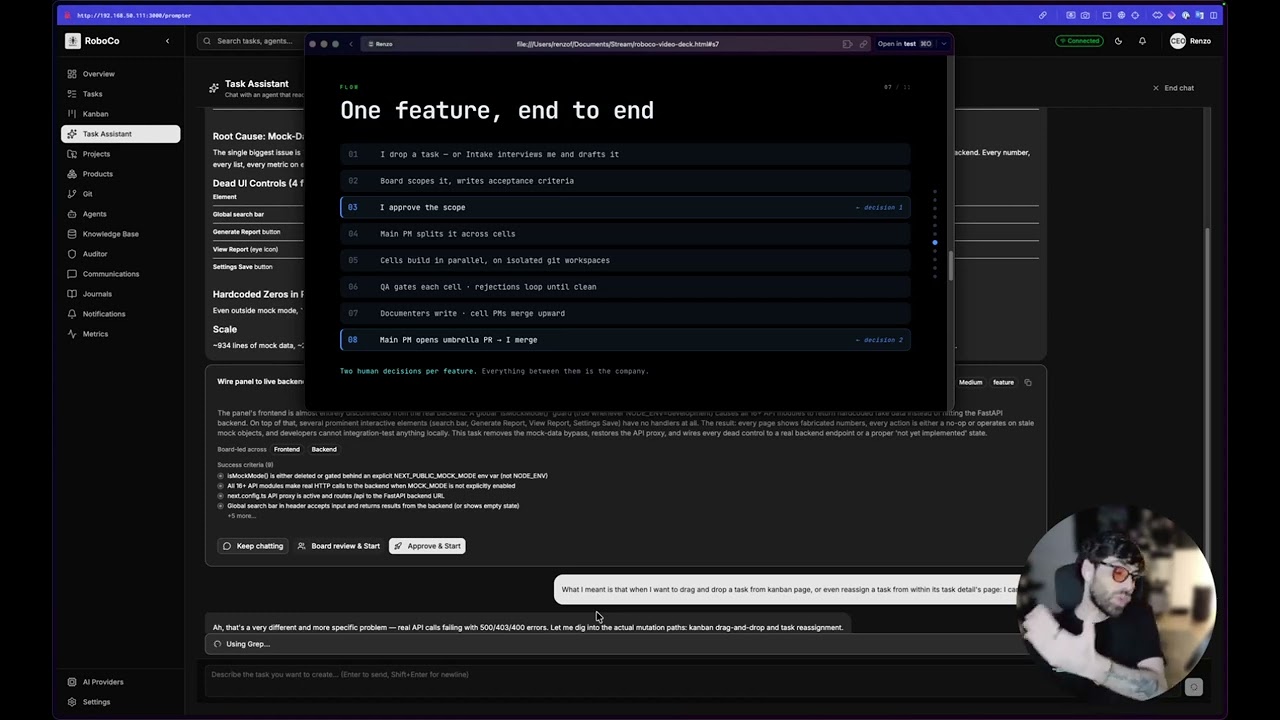
▶ Watch the 26-min intro what it is, a walkthrough, and how to use it |
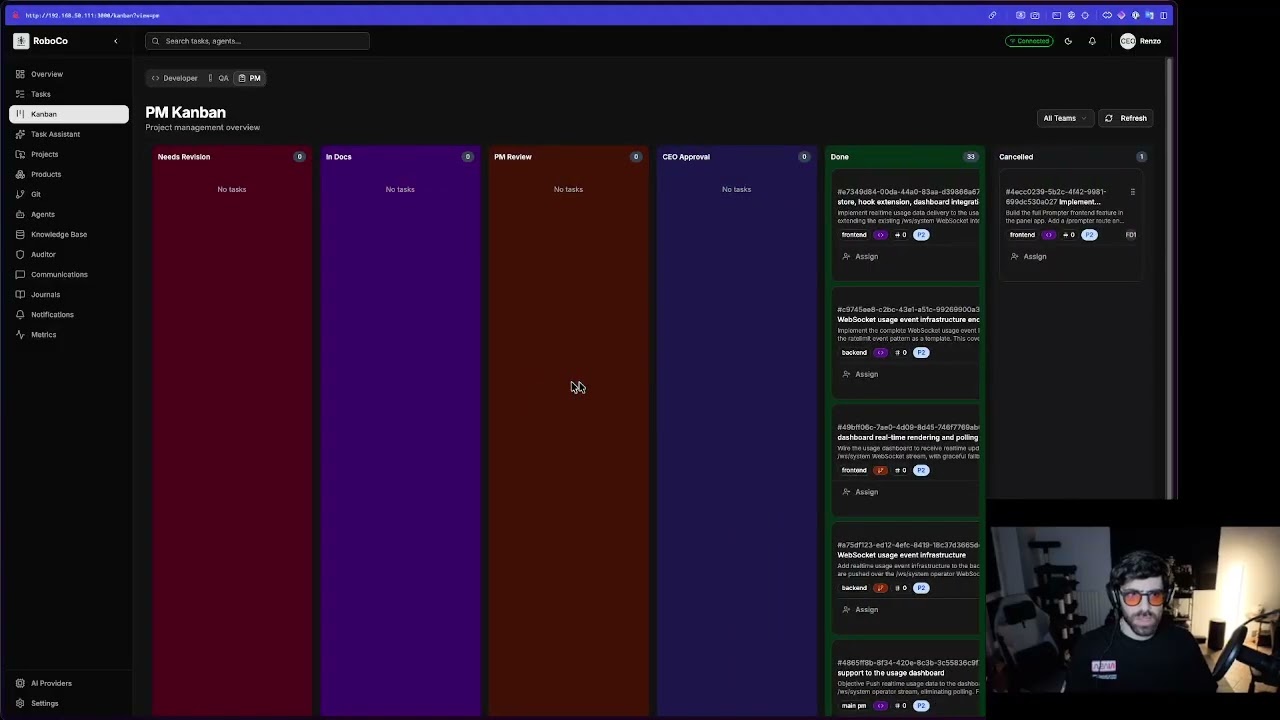
▶ Watch the 2.5-hour build session a conversation → a shipped feature |
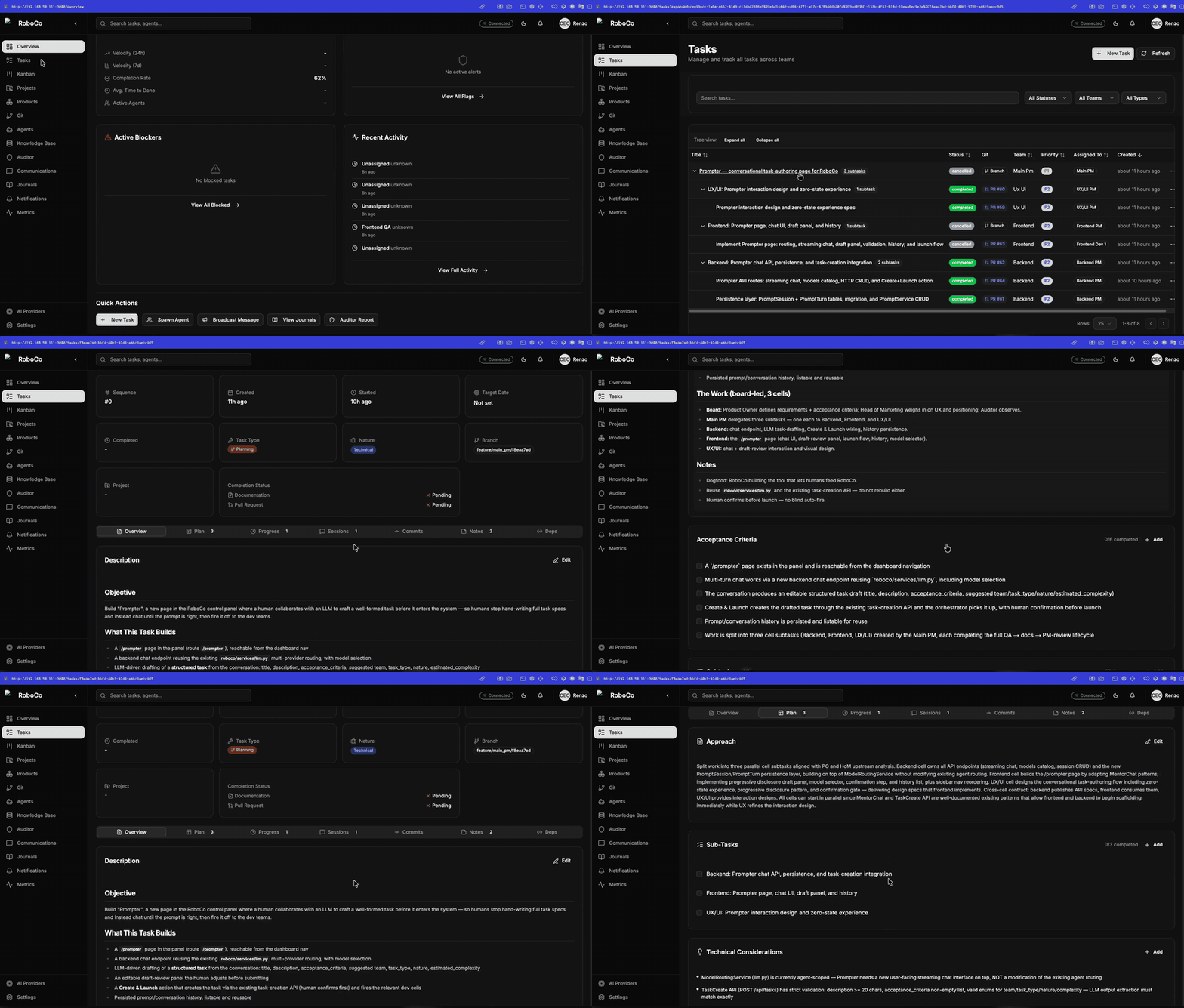
Watch the full 2:33 walkthrough (.mp4) →
Warning
RoboCo is early-stage, work-in-progress software (v0). It's under active development, runs in a homelab, and will have rough edges, breaking changes, and bugs. It is not production-ready and the API/database schema are not stable yet. Treat it as a working prototype to explore and build on — please don't expose it to the public internet as-is. Issues and PRs very welcome.
Tip
📚 Full documentation: docs.roboco.tech — install & first run, the company model, a page-by-page panel reference, model providers, the optional subsystems, deployment, and the API.
Overview
RoboCo implements a structured organizational hierarchy with formal communication protocols, task management, and quality controls. The system enables a single human (CEO) to orchestrate complex multi-project development at scale.
CEO (You, the human)
    │
    ├── Intake (on-demand interviewer: chats only with you to draft a task)
    ├── Secretary (on-demand chief-of-staff: reads company state, runs gated directives)
    ├── PR Reviewer (read-only main reviewer: inbound external/fork + internal PRs, and the root→master in-path gate)
    │
    └── Board (3 agents)
         ├── Product Owner
         ├── Head of Marketing
         └── Auditor (silent observer, reports to you)
              │
              └── Main PM (coordinates all cells)
                   │
                   ├── Backend Cell (6 agents: 2 Devs, 1 QA, 1 PM, 1 Documenter, 1 PR Reviewer)
                   ├── Frontend Cell (6 agents: 2 Devs, 1 QA, 1 PM, 1 Documenter, 1 PR Reviewer)
                   └── UX/UI Cell (6 agents: 2 Devs, 1 QA, 1 PM, 1 Documenter, 1 PR Reviewer)
The 25 agents = Intake + Secretary + PR Reviewer + the Board (3) + Main PM + the three 6-agent cells (18). Agents run on Anthropic Claude by default, or on xAI Grok (the official grok CLI on a SuperGrok subscription) — see the provider note under Configuration.
How it works
You hand a task to the company; it runs through a real build → review → document → merge pipeline and comes back to you to approve.
One full loop, put simply:
- You give the Board a task — they review it. The Product Owner and Head of Marketing turn your ask into requirements and acceptance criteria.
- You approve — the Main PM starts the work. A notification asks for your Approve & Start decision; approve, and the Main PM breaks it into per-cell subtasks.
- Each cell's PM delegates, supports, and triages its developers (UX/UI, Frontend, Backend).
- Developers build it, QA verifies and gates it, Documenters keep the books.
- Cell PMs merge their PRs into the Main PM's branch.
- The Main PM opens the final PR and notifies you "It's done!" — you approve and merge, or send it back for rework. (Only you ever merge to
master.)
— Full circle —
See the full walkthrough, with screenshots →
Or watch the full panel walkthrough (video) →
Project Structure
roboco/
├── roboco/                      # Main Python package
│   ├── api/                     # FastAPI routes & schemas
│   │   ├── routes/              # API endpoints (tasks, git, agents, etc.)
│   │   └── schemas/             # Pydantic request/response models
│   ├── services/                # Business logic services
│   │   ├── task.py              # Task lifecycle management
│   │   ├── workspace.py         # Multi-agent workspace management
│   │   ├── messaging.py         # Agent communication
│   │   └── optimal.py           # RAG/Knowledge base (in-house pgvector)
│   ├── models/                  # Pydantic domain models
│   ├── db/                      # SQLAlchemy ORM & session
│   ├── enforcement/             # Task lifecycle state machine
│   ├── runtime/                 # Orchestrator for agent spawning
│   ├── agents/                  # Agent base classes
│   ├── mcp/                     # MCP server implementations
│   └── config.py                # Application configuration
├── agents/
│   └── prompts/                 # Agent system prompts (roles, teams, identities)
├── docs/
│   ├── rag/                     # Agent knowledge base (indexed into RAG)
│   └── map/                     # Exhaustive codebase map (agent-facing)
├── alembic/                     # Database migrations
├── CLAUDE.md                    # Claude Code guidance
├── docker-compose.yml           # Full stack, built from source
└── docker-compose.registry.yml  # Full stack, pulled from the image registry
Running RoboCo
You need Docker + Docker Compose and a Claude Code auth directory on the host (~/.claude, mounted into the orchestrator so agents can reach the model). Copy .env.example to .env and set at least ROBOCO_ENCRYPTION_KEY and ROBOCO_AGENT_AUTH_SECRET (that file shows how to generate each). However you start it, the whole company is reachable at one origin: http://localhost:3000.
Optional — run agents on xAI Grok instead of Claude. RoboCo can spawn agents on xAI's official grok CLI authenticated by a SuperGrok subscription (no metered API key). Run grok login once on the host and point ROBOCO_HOST_GROK_DIR at the resulting ~/.grok so it mounts into Grok agents; the orchestrator keeps the ~6h token refreshed for you. See the Grok block in .env.example (ROBOCO_HOST_GROK_DIR, ROBOCO_GROK_AGENT_IMAGE, ROBOCO_GROK_CLI_MODEL, ROBOCO_GROK_REASONING_EFFORT).
Option 1 — Run the pre-built images (quickest)
Every release publishes all RoboCo images to both the GitHub Container Registry and Docker Hub, so you can run the full stack without building anything. Use the registry compose:
git clone https://github.com/rennf93/roboco.git && cd roboco
cp .env.example .env                                   # then edit in your secrets
docker compose -f docker-compose.registry.yml pull
docker compose -f docker-compose.registry.yml up -d
Choose the registry and version with two env vars (defaults shown):
ROBOCO_REGISTRY=ghcr.io/rennf93   # or docker.io/renzof93
ROBOCO_VERSION=latest             # or a pinned release, e.g. 0.15.0
The orchestrator spawns the matching pre-built agent images on demand — no build toolchain or source compile on your host.
Option 2 — Build from source
The same full stack, built locally from the Dockerfiles instead of pulled:
git clone https://github.com/rennf93/roboco.git && cd roboco
cp .env.example .env              # then edit in your secrets
docker compose up -d              # builds images on first run, then starts everything
Option 3 — Local development (no full stack)
For hacking on the code itself, run only the backing services in Docker and the API on your host. RoboCo's own code requires Python 3.13+ (uv will fetch it if needed):
uv sync
docker compose up -d postgres redis ollama   # backing services only
uv run alembic upgrade head                   # migrate the database
uv run python -m roboco.cli                   # API + orchestrator

# Or just the API without the orchestrator:
uv run uvicorn roboco.api.app:app --reload --host 0.0.0.0 --port 8000
Configuration
Key environment variables (see roboco/config.py for all options):
# API Server
ROBOCO_HOST=0.0.0.0
ROBOCO_PORT=8000

# Database
ROBOCO_DATABASE_HOST=localhost
ROBOCO_DATABASE_PORT=5432
ROBOCO_DATABASE_NAME=roboco

# Workspaces (Multi-Agent Git)
ROBOCO_WORKSPACES_ROOT=/data/workspaces
ROBOCO_WORKSPACE_AUTO_CLONE=true

# RAG/LLM
ROBOCO_LOCAL_LLM_BASE_URL=http://roboco-ollama:11434/v1
ROBOCO_LOCAL_LLM_MODEL=glm-5.2:cloud

# Feature flags (default-off unless noted; toggle from Settings → Feature Flags)
ROBOCO_CONVENTIONS_ENABLED=false        # per-project architectural conventions standard
ROBOCO_TOOLCHAIN_MATCH_ENABLED=false    # build each target project under its own Python
ROBOCO_OVERLOAD_BREAK_ENABLED=true      # park a provider on a persistent model-API overload
ROBOCO_DOCS_SYNC_ENABLED=false          # docs-divergence sync (release → docs-update task). Default-off; when on, a successful release publish originates one bounded, deduped docs-update task against the roboco-website project.
ROBOCO_DOCS_SYNC_MAX_OPEN_TASKS=3       # rolling cap on concurrently-open docs-sync tasks
ROBOCO_DOCS_SYNC_MAX_PER_CYCLE=1        # max docs-sync tasks originated per publish invocation

# Auditor scheduled sweeps (default 6 hours; 0 disables)
ROBOCO_AUDIT_INTERVAL_SECONDS=21600
Multi-Agent Workspace Structure
Each agent gets their own git clone for parallel development:
{ROBOCO_WORKSPACES_ROOT}/
└── {project-slug}/
    └── {team}/
        └── {agent-slug}/
            └── [git repository]

Example:
/data/workspaces/roboco/backend/be-dev-1/
/data/workspaces/roboco/backend/be-dev-2/
Task Lifecycle
backlog → pending → claimed → in_progress → verifying → awaiting_qa
    ↓                              ↓              ↓           ↓
cancelled                      blocked      needs_revision   awaiting_documentation
                               paused                              ↓
                                                           awaiting_pm_review
                                                                   ↓
                                                           awaiting_ceo_approval
                                                                   ↓
                                                              completed
Assembled, PR-bearing tasks pass through one extra stage — the in-path PR-review gate — before the PM merges:
in_progress → awaiting_pr_review → awaiting_pm_review
   (submit_up /      (pr_pass)
    submit_root)     (pr_fail → needs_revision)
The cell PM's submit_up (cell→root PR) and the Main PM's submit_root (root→master PR) open the assembled PR and enter the gate; a PR reviewer pr_passes it on to the PM merge or pr_fails it back. Leaf dev tasks (reviewed by QA) and branchless coordination roots skip the gate.
API Endpoints
Domain routes are mounted under /api:
| Route Group | Description |
|---|---|
/api/tasks |
Task CRUD, lifecycle, claiming |
/api/agents |
Agent management |
/api/git |
Git operations (status, commit, push, PR) |
/api/sessions |
Communication sessions |
/api/messages |
Agent messages |
/api/projects |
Project (repo) management |
/api/work-sessions |
Git work session tracking |
/api/optimal |
RAG/Knowledge base queries |
/api/journals |
Agent journals/reflections |
/api/orchestrator/status |
Orchestrator / dispatcher status |
The agent gateway verbs are served separately under /api/v1/flow/{role}/{verb} (intent verbs) and /api/v1/do (content tools) — see the Agent Gateway.
Development
# Install dev dependencies
uv sync --all-extras

# Run tests
uv run pytest

# Format and lint
uv run ruff format .
uv run ruff check .
uv run mypy roboco/

# Type checking
uv run mypy roboco/
Core Principles
- Everything is a task - All work is tracked and documented
- No work without a task - Create task record first
- No task without acceptance criteria - How do we know it's done?
- No closure without documentation - Future agents need context
- Communication is constant - Stream reasoning, log everything
- The Auditor sees all - Quality monitored silently
- CEO approves major changes - Human-in-the-loop for critical decisions
Technology Stack
| Layer | Technology |
|---|---|
| API Framework | FastAPI |
| Database | PostgreSQL + SQLAlchemy (async) |
| Vector Store | PostgreSQL + pgvector (in-house engine) |
| Cache/Queue | Redis |
| RAG Engine | in-house (asyncpg + pgvector, hybrid retrieval) |
| Embeddings | qwen3-embedding:0.6b (Ollama) |
| Local LLM | Ollama (glm-5.2:cloud) |
| Cloud LLM | Claude API (Anthropic) + xAI Grok (official grok CLI, SuperGrok subscription) |
| Package Manager | uv |
Status
Core Infrastructure (Complete)
- Data models (Pydantic)
- Database ORM (SQLAlchemy async)
- Task lifecycle state machine
- Multi-agent workspace management
- Agent prompts (25 agents)
- Messaging API
- Task API with full lifecycle
- Git operations API
- RAG/Knowledge base (in-house pgvector engine)
- Agent orchestrator
- CEO approval workflow
- Pluggable agent providers (Claude Code + xAI Grok on the official
grokCLI) - Inbound PR review (read-only PR-reviewer + CEO supersede/dismiss queue)
- Self-healing CI loop for RoboCo's own repo (default-off, CEO-gated)
- Business Goals tab with a live Company Scorecard (delivery, spend-vs-budget, lead time)
In Progress
- Frontend panel (vendored under
panel/, served through nginx on :3000) - Full agent autonomy testing
Security
Important
Do not expose RoboCo to the public internet as-is. It is designed to run on a trusted private network (homelab / LAN).
Agent authentication. Requests identify the caller with X-Agent-Id / X-Agent-Role headers. The orchestrator issues each spawned agent an HMAC token (X-Agent-Token, signed with ROBOCO_AGENT_AUTH_SECRET) that binds its id, role and team. Token enforcement is gated by ROBOCO_AGENT_AUTH_REQUIRED:
ROBOCO_AGENT_AUTH_REQUIREDunset/false (default): header-trust mode — the role headers are accepted without a token, so any client that can reach the API may claim any role (includingceo). The API logs a warning at startup in this mode. Acceptable only on a trusted network.ROBOCO_AGENT_AUTH_REQUIRED=true: every request must carry a valid token; an agent cannot spoof another agent's role. The control panel keeps working because nginx — the only trusted hop between the browser and the API — injects the CEO token (X-Agent-Token) on/apiand/ws, so the browser never holds the signing secret. Generate that token withmake panel-tokenand set it asROBOCO_PANEL_AGENT_TOKENin.envbefore enabling secure mode.
WebSocket streams. Token enforcement is currently REST-only. The /ws/* endpoints authenticate by agent_id query param at most and do not yet validate X-Agent-Token, even in secure mode — nginx injects the token so the panel works, but a direct WebSocket connection that bypasses nginx is not rejected. In particular the operator stream /ws/system (rate-limit lifecycle + token-usage snapshots for the dashboard) is unauthenticated. These streams are read-only — no control surface, secrets, or task content — but treat the orchestrator port as trusted-network-only until WebSocket auth lands.
Secrets (the Fernet ROBOCO_ENCRYPTION_KEY, GitHub PATs) live encrypted in the database and in gitignored env files — never in the repo. Per-project git tokens are Fernet-encrypted at rest and never returned by the API.
License
Copyright (c) 2026 Renzo Franceschini
RoboCo is licensed under the GNU Affero General Public License v3.0 (AGPL-3.0). See LICENSE for the full text.
The AGPL's network-use clause (section 13) means that if you run a modified version of RoboCo as a network service, you must make your modified source available to its users. This keeps the project open while preventing closed, hosted re-distributions.
Contributing
Contributions are welcome. All contributors must sign the Contributor License Agreement (CLA.md) — this is automated on your first pull request. See CONTRIBUTING.md for the workflow and why the CLA exists.