 Renn F
d7aee91b39
Renn F
d7aee91b39
OptimalService.search / query (via _aggregate_citations) ran each index's
plugin.search() sequentially, and every plugin.search re-ran HyDE + embed — so an
N-index query made N LLM+embed round-trips in series (~28s across all indexes,
even though the SQL is fast). Embed the query ONCE
(BaseIndexPlugin.compute_query_embedding) and run every index's vector search
concurrently against that single embedding (search_with_embedding +
asyncio.gather). The search/query signatures and return contract are unchanged;
behavior is identical, just ~Nx fewer embed calls and parallel fetch.

Adds a regression test asserting one embed + per-index fan-out.
RoboCo
AI Agents Company - A virtual organization of 20 AI agents + 1 human CEO, designed to operate as a complete software development workforce.
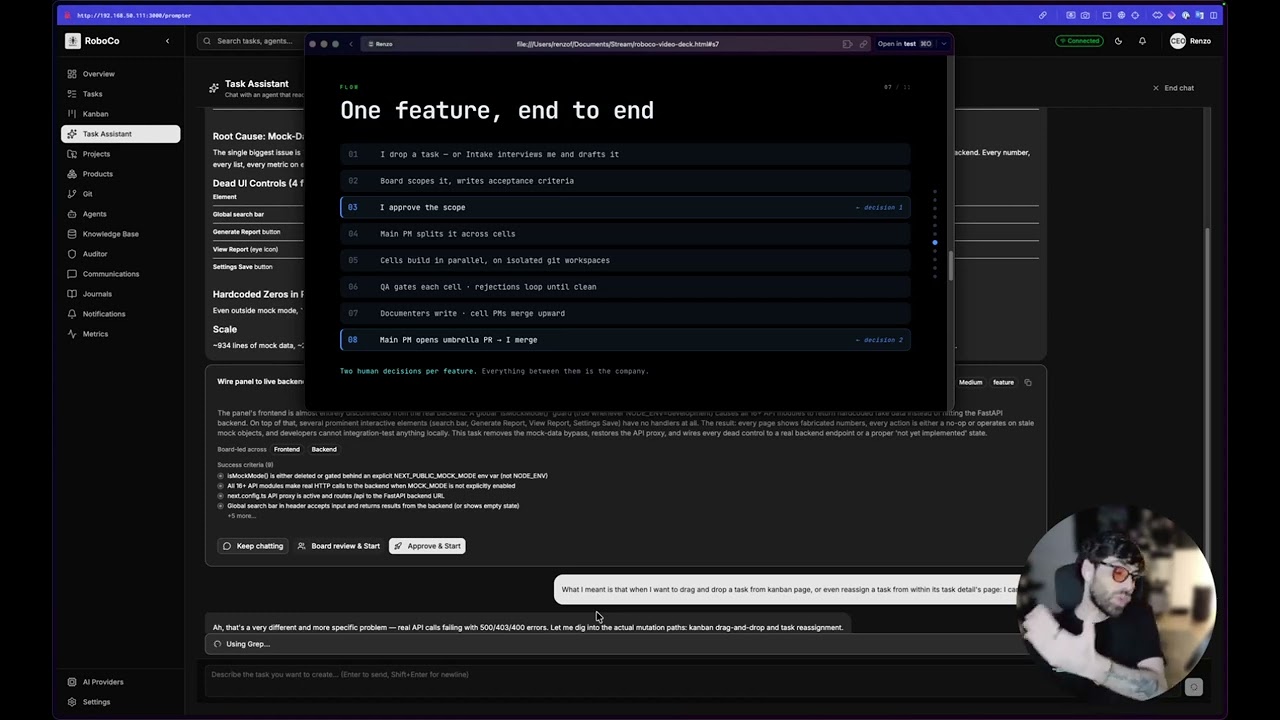
▶ Watch the 26-min intro on YouTube — what it is, a walkthrough, and how to use it

Watch the full 2:33 walkthrough (.mp4) →
Warning
RoboCo is early-stage, work-in-progress software (v0). It's under active development, runs in a homelab, and will have rough edges, breaking changes, and bugs. It is not production-ready and the API/database schema are not stable yet. Treat it as a working prototype to explore and build on — please don't expose it to the public internet as-is. Issues and PRs very welcome.
Overview
RoboCo implements a structured organizational hierarchy with formal communication protocols, task management, and quality controls. The system enables a single human (CEO) to orchestrate complex multi-project development at scale.
CEO (You, the human)
    │
    ├── Intake (on-demand interviewer: chats only with you to draft a task)
    │
    └── Board (3 agents)
         ├── Product Owner
         ├── Head of Marketing
         └── Auditor (silent observer, reports to you)
              │
              └── Main PM (coordinates all cells)
                   │
                   ├── Backend Cell (5 agents: 2 Devs, 1 QA, 1 PM, 1 Documenter)
                   ├── Frontend Cell (5 agents: 2 Devs, 1 QA, 1 PM, 1 Documenter)
                   └── UX/UI Cell (5 agents: 2 Devs, 1 QA, 1 PM, 1 Documenter)
How it works
You hand a task to the company; it runs through a real build → review → document → merge pipeline and comes back to you to approve.
One full loop, put simply:
- You give the Board a task — they review it. The Product Owner and Head of Marketing turn your ask into requirements and acceptance criteria.
- You approve — the Main PM starts the work. A notification asks for your Approve & Start decision; approve, and the Main PM breaks it into per-cell subtasks.
- Each cell's PM delegates, supports, and triages its developers (UX/UI, Frontend, Backend).
- Developers build it, QA verifies and gates it, Documenters keep the books.
- Cell PMs merge their PRs into the Main PM's branch.
- The Main PM opens the final PR and notifies you "It's done!" — you approve
and merge, or send it back for rework. (Only you ever merge to
master.)
— Full circle —
See the full walkthrough, with screenshots →
Or watch the full panel walkthrough (video) →
Project Structure
roboco/
├── roboco/                      # Main Python package
│   ├── api/                     # FastAPI routes & schemas
│   │   ├── routes/              # API endpoints (tasks, git, agents, etc.)
│   │   └── schemas/             # Pydantic request/response models
│   ├── services/                # Business logic services
│   │   ├── task.py              # Task lifecycle management
│   │   ├── workspace.py         # Multi-agent workspace management
│   │   ├── messaging.py         # Agent communication
│   │   └── optimal_brain/       # RAG/Knowledge base (in-house pgvector)
│   ├── models/                  # Pydantic domain models
│   ├── db/                      # SQLAlchemy ORM & migrations
│   ├── enforcement/             # Task lifecycle state machine
│   ├── runtime/                 # Orchestrator for agent spawning
│   ├── agents/                  # Agent base classes
│   ├── mcp/                     # MCP server implementations
│   └── config.py                # Application configuration
├── agents/
│   └── prompts/                 # Agent system prompts (roles, teams, identities)
├── docs/
│   ├── how-to.md               # Visual walkthrough of the workflow
│   └── rag/                     # Agent knowledge base (indexed into RAG)
├── alembic/                     # Database migrations
├── CLAUDE.md                    # Claude Code guidance
└── docker-compose.yml           # Local development stack
Quick Start
# Install dependencies
uv sync

# Start PostgreSQL and Redis (Docker)
docker compose up -d

# Run database migrations
uv run alembic upgrade head

# Start the API server
uv run python -m roboco.cli

# Or just the API without orchestrator
uv run uvicorn roboco.api.app:app --reload --host 0.0.0.0 --port 8000
Configuration
Key environment variables (see roboco/config.py for all options):
# API Server
ROBOCO_HOST=0.0.0.0
ROBOCO_PORT=8000

# Database
ROBOCO_DATABASE_HOST=localhost
ROBOCO_DATABASE_PORT=5432
ROBOCO_DATABASE_NAME=roboco

# Workspaces (Multi-Agent Git)
ROBOCO_WORKSPACES_ROOT=/data/workspaces
ROBOCO_WORKSPACE_AUTO_CLONE=true

# RAG/LLM
ROBOCO_LOCAL_LLM_BASE_URL=http://roboco-ollama:11434/v1
ROBOCO_LOCAL_LLM_MODEL=glm-5:cloud
Multi-Agent Workspace Structure
Each agent gets their own git clone for parallel development:
{ROBOCO_WORKSPACES_ROOT}/
└── {project-slug}/
    └── {team}/
        └── {agent-slug}/
            └── [git repository]

Example:
/data/workspaces/roboco/backend/be-dev-1/
/data/workspaces/roboco/backend/be-dev-2/
Task Lifecycle
backlog → pending → claimed → in_progress → verifying → awaiting_qa
    ↓                              ↓              ↓           ↓
cancelled                      blocked      needs_revision   awaiting_documentation
                               paused                              ↓
                                                           awaiting_pm_review
                                                                   ↓
                                                           awaiting_ceo_approval
                                                                   ↓
                                                              completed
API Endpoints
Domain routes are mounted under /api:
| Route Group | Description |
|---|---|
/api/tasks |
Task CRUD, lifecycle, claiming |
/api/agents |
Agent management |
/api/git |
Git operations (status, commit, push, PR) |
/api/sessions |
Communication sessions |
/api/messages |
Agent messages |
/api/projects |
Project (repo) management |
/api/work-sessions |
Git work session tracking |
/api/optimal |
RAG/Knowledge base queries |
/api/journals |
Agent journals/reflections |
/api/orchestrator/status |
Orchestrator / dispatcher status |
The agent gateway verbs are served separately under /api/v1/flow/{role}/{verb}
(intent verbs) and /api/v1/do (content tools) — see the Agent Gateway.
Development
# Install dev dependencies
uv sync --all-extras

# Run tests
uv run pytest

# Format and lint
uv run ruff format .
uv run ruff check .
uv run mypy roboco/

# Type checking
uv run mypy roboco/
Core Principles
- Everything is a task - All work is tracked and documented
- No work without a task - Create task record first
- No task without acceptance criteria - How do we know it's done?
- No closure without documentation - Future agents need context
- Communication is constant - Stream reasoning, log everything
- The Auditor sees all - Quality monitored silently
- CEO approves major changes - Human-in-the-loop for critical decisions
Technology Stack
| Layer | Technology |
|---|---|
| API Framework | FastAPI |
| Database | PostgreSQL + SQLAlchemy (async) |
| Vector Store | PostgreSQL + pgvector (in-house engine) |
| Cache/Queue | Redis |
| RAG Engine | in-house (asyncpg + pgvector, HyDE) |
| Embeddings | qwen3-embedding:0.6b (Ollama) |
| Local LLM | Ollama (glm-5:cloud) |
| Cloud LLM | Claude API (Anthropic) |
| Package Manager | uv |
Status
Core Infrastructure (Complete)
- Data models (Pydantic)
- Database ORM (SQLAlchemy async)
- Task lifecycle state machine
- Multi-agent workspace management
- Agent prompts (20 agents)
- Messaging API
- Task API with full lifecycle
- Git operations API
- RAG/Knowledge base (in-house pgvector engine)
- Agent orchestrator
- CEO approval workflow
In Progress
- Frontend panel (vendored under
panel/, served through nginx on :3000) - Full agent autonomy testing
Security
Important
Do not expose RoboCo to the public internet as-is. It is designed to run on a trusted private network (homelab / LAN).
Agent authentication. Requests identify the caller with X-Agent-Id /
X-Agent-Role headers. The orchestrator issues each spawned agent an HMAC token
(X-Agent-Token, signed with ROBOCO_AGENT_AUTH_SECRET) that binds its id, role
and team. Token enforcement is gated by ROBOCO_AGENT_AUTH_REQUIRED:
ROBOCO_AGENT_AUTH_REQUIREDunset/false (default): header-trust mode — the role headers are accepted without a token, so any client that can reach the API may claim any role (includingceo). The API logs a warning at startup in this mode. Acceptable only on a trusted network.ROBOCO_AGENT_AUTH_REQUIRED=true: every request must carry a valid token; an agent cannot spoof another agent's role. The control panel keeps working because nginx — the only trusted hop between the browser and the API — injects the CEO token (X-Agent-Token) on/apiand/ws, so the browser never holds the signing secret. Generate that token withmake panel-tokenand set it asROBOCO_PANEL_AGENT_TOKENin.envbefore enabling secure mode.
Secrets (the Fernet ROBOCO_ENCRYPTION_KEY, GitHub PATs) live encrypted in
the database and in gitignored env files — never in the repo. Per-project git
tokens are Fernet-encrypted at rest and never returned by the API.
License
Copyright (c) 2026 Renzo Franceschini
RoboCo is licensed under the GNU Affero General Public License v3.0
(AGPL-3.0). See LICENSE for the full text.
The AGPL's network-use clause (section 13) means that if you run a modified version of RoboCo as a network service, you must make your modified source available to its users. This keeps the project open while preventing closed, hosted re-distributions.
Contributing
Contributions are welcome. All contributors must sign the Contributor License
Agreement (CLA.md) — this is automated on your first pull
request. See CONTRIBUTING.md for the workflow and why
the CLA exists.