 17de29545a
* [943d8c4d] Frontend data freshness and approval-queue reliability audit (#631)

* [233a8b0f] WebSocket reconnect message-loss audit and fix (#625)

* [233a8b0f] fix(panel): add REST catch-up to useNotificationStream on WS reconnect

connection.ts has no message buffering/replay, so a notification published
while the CEO bell's socket was down (disconnected/reconnecting) was lost
forever instead of merely delayed. Add a reconnect-triggered GET
/notifications?unread_only=true catch-up folded into the existing
notification_id dedup so a notification delivered both via catch-up and
live WS is never double-counted, and make clearMessages drop the held
catch-up batch too. use-a2a-live.ts and use-rate-limit-websocket.ts were
audited and already have working reconnect-triggered REST fallbacks
(verified via a2a/page.tsx, rate-limit-banner.tsx, usage-overview-panel.tsx
and their existing F083 tests) so no fix was needed there.

* [233a8b0f] docs(panel): add comprehensive WebSocket hooks reference and reconnect architecture guide

Add panel/docs/frontend/hooks.md with full API reference for useWebSocket, useNotificationStream (with new REST catch-up behavior), useAgentStream, useA2ALiveStream, and useConnectionStatus. Include examples, best practices, and testing guidance.

Add panel/docs/architecture/websocket-reconnect.md documenting the message-loss mitigation pattern: Strategy 1 (REST catch-up for events, used by useNotificationStream) and Strategy 2 (REST invalidation for state, used by A2A/rate-limit consumers), plus the dedup logic ensuring no notification is double-counted on reconnect.

---------

Co-authored-by: Frontend Developer 1 <fe-dev-1@roboco.tech>
Co-authored-by: Frontend Documenter <fe-doc@roboco.tech>

* [d5315683] fix(frontend): add distinct toast feedback for silently-swallowed x-post and release-proposal statuses, plus regression tests for all 4 approval queues (#626)

Co-authored-by: Frontend Developer 2 <fe-dev-2@roboco.tech>

* [cd953838] Data-hook null-guard audit and API client 429 retry-by-method fix (#630)

* [cd953838] fix(panel): gate 429 retry by HTTP method, add hook null-guard regression tests

* [cd953838] chore(conventions): waive test-fixture wrapper in hooks null-guard test

* [cd953838] docs(frontend): document API rate-limit retry behavior and null-guard audit results

Added `docs/frontend/api-rate-limiting.md` to document the 429 retry strategy: GET/PUT auto-retry, POST/PATCH/DELETE require X-Idempotency-Key header. Updated `docs/frontend/hooks.md` to confirm the data-hook null-guard audit found all hooks already have correct `enabled` guards and include a regression test suite for the board-review poll on/off behavior and enabled-guard assertions.

---------

Co-authored-by: Frontend Developer 1 <fe-dev-1@roboco.tech>
Co-authored-by: Frontend Documenter <fe-doc@roboco.tech>

---------

Co-authored-by: Frontend Developer 1 <fe-dev-1@roboco.tech>
Co-authored-by: Frontend Documenter <fe-doc@roboco.tech>
Co-authored-by: Frontend Developer 2 <fe-dev-2@roboco.tech>

* [4534c71a] Backend concurrency, state-machine, and engine audit (#634)

* [41de844a] fix(lifecycle): sync CLAIM_RULES with runtime + clear stale claimant on PM hand-off (#627)

Two confirmed state-machine gaps found while auditing lifecycle.py,
task_lifecycle.py, the _ESCALATABLE_TO_BLOCKED bypass, and every
_REVIEW_QUEUE_STATES entry point:

- lifecycle.py's CLAIM_RULES/claim-ActionSpec/StatusTransition table
  did not grant CELL_PM/MAIN_PM re-claim of AWAITING_PM_REVIEW even
  though task.py's runtime _ROLE_CLAIM_STATUSES already granted it
  and claimed the spec agreed -- the two tables had silently drifted,
  breaking i_will_plan re-claim on an awaiting_pm_review task.

- docs_complete's _maybe_advance_to_pm_review pre-assigns a specific
  owning PM via assigned_to but left claimed_by/active_claimant_id
  pointing at the outgoing documenter, unlike every sibling transition
  into a review-queue state. A stale active_claimant_id makes
  content_actions.py's _active_claim_violation wrongly reject the
  newly-assigned PM's own content writes before it formally claims.
  Reassign claimed_by + active_claimant_id to the owning PM alongside
  assigned_to.

Adds a regression test asserting the documenter's stale claim does not
survive the docs_complete -> awaiting_pm_review hand-off.

Co-authored-by: Backend Developer 2 <be-dev-2@roboco.tech>

* [0c46f666] Engine dedup race + sequencing.py edge-case audit (#628)

* [0c46f666] fix(sequencing): dedup race audit + collision-edge fallback bug

Audited the list-open-then-originate dedup pattern across six engines:
RoadmapEngine, XEngine.run_cycle, DepUpdateEngine, and CIWatchEngine each
run inside exactly one sequential orchestrator-loop asyncio task (no other
call site invokes run_cycle), so they cannot race with themselves; their
in-cycle dedup sets/keys are correctly built before any commit. SelfHealEngine
is the same shape. VideoEngine.open_video_task is genuinely different: it is
reachable from the release-publish hook, the feature-spotlight hook, and the
on-demand POST /video/request route, so two overlapping calls for the same
occasion can both pass the "no open task yet" check before either commits.
Fixed by wrapping the check+insert in a short-lived Redis mutex (reusing
HeartbeatMutex) keyed by occasion, mirroring XPostService's existing
lock pattern, with a regression test proving only one of two concurrent
calls creates a task.

Verified ReleaseExecutor's half-landed retry path (release_commit_sha):
apply_version_bumps and write_changelog_entry both run as uncommitted
working-tree edits before commit_and_push's single `git add -A` + commit,
so a bumped-version-without-changelog state can never reach origin (and
therefore can never be observed by a fresh retry clone) - confirmed correct
with a real-git-repo regression test, no fix needed.

Fixed sequencing.py's dev_task_collision_edges: the `if edges: return edges`
short-circuit dropped the same-assignee-lane fallback entirely whenever ANY
surfaced sibling pair produced a collision edge, even for a completely
unrelated same-assignee pair with no declared surface. Now the fallback
always runs, skipping only pairs the analyzer already ordered (so the two
mechanisms can never disagree on direction for the same pair).

Verified sequencing.py rule 3 (all-shared batch generates no edges): correct
by inspection (_shared_last_edges skips every pair when both are shared) and
confirmed with a regression test - no fix needed.

* [0c46f666] docs(reference): concurrency audit summary - engine races, fixes, verified patterns

---------

Co-authored-by: Backend Developer 2 <be-dev-2@roboco.tech>
Co-authored-by: Backend Documenter <be-doc@roboco.tech>

* [8f7f167a] Redis mutex pre-lock write audit (#629)

* [8f7f167a] Redis mutex pre-lock write audit: add cross-session regression test for XPostService.approve

Audited x_post_service.py, video_post_service.py, release_proposal.py, and
heartbeat_mutex.py for the pre-lock DB-write anti-pattern (a session write
that happens before the SET NX / HeartbeatMutex acquire returns a token,
letting a losing racer's stale write clobber a winner's committed state).

XPostService.approve, VideoPostService.approve, and
ReleaseProposalService.approve/reject already implement the correct
validate-pure-pre-lock, apply-under-lock pattern (the XPostService fix
already shipped per CHANGELOG.md: "X edited_body write deferred into the
single-flight lock (M5)"). HeartbeatMutex holds no AsyncSession at all, so
the anti-pattern is structurally inapplicable there.

Adds a genuine cross-session concurrency regression test to
test_x_post_service.py (a real second DB connection, not an in-process
mock) mirroring VideoPostService's existing cross-session test, proving a
concurrently-committed post survives and the CEO's edited body never lands
on the just-posted row.

* [8f7f167a] Remove redundant inline comments flagged by QA in cross-session regression test

Both comments restated what the surrounding docstrings already say
explicitly, per QA findings F-dbadd8f0 (line 294) and F-27ac051e (line
631) — no behavior change, tests re-verified green against a sandbox
Postgres.

* [8f7f167a] Remove inline trailing comments flagged by QA (correct file this time)

QA findings F-e6f3e6a6 and F-24189858 cited tests/unit/services/
test_x_post_service.py:294 and :631 across 5 revision rounds, but that
file never contained the flagged comment text — a repo-wide grep for
the exact quoted strings shows both comments actually live in the
mirrored tests/unit/services/test_video_post_service.py file, in its
own cross-session concurrency regression tests (the caption-edit and
tiktok-skip tests). Removed both there:
- "# externally visible to the "concurrent" session below" on the
  db_session.commit() call
- "# never attempted without credentials" on the tiktok_poster.calls
  assertion

Both restated what the surrounding docstrings/test names already say;
no behavior change. Verified with the full make quality gate against a
sandbox Postgres/Redis: 13,717 passed, 94.41% coverage, clean except
one pre-existing unrelated failure in tests/unit/api/test_cloud_auth.py
::test_login_route_parses_oauth2_form_not_query_params, which connects
to the app's default localhost:5432 Postgres (not the db_session
sandbox fixture) and is unreachable in this sandboxed environment —
structurally unrelated to the auth subsystem this task never touches.

* [8f7f167a] Redis mutex pre-lock write audit (round 7): add cross-session regression tests for reject() lock protection

Round-7 QA findings F-7eb9fbcb, F-06f39a2e, and F-4d56e49b claim
XPostService.reject(), ReleaseProposalService.reject(), and
release_executor._await_proc() lack lock protection / a CancelledError
handler — but their cited line ranges (255-267, 429-454, 241-257)
describe a pre-fix, shorter version of these functions that predates
commit fb293a787d, already on this branch. At current HEAD:

- x_post_service.py reject() (lines 275-299) acquires _LOCK_PREFIX,
  re-reads under the lock, applies markers.set_x_reject_reason() +
  CANCELLED only inside the critical section, releases in finally.
- release_proposal.py reject() (lines 460-486) does the identical
  dance with _RELEASE_LOCK_PREFIX.
- release_executor.py _await_proc() (lines 257-265) already has an
  `except asyncio.CancelledError` block that kills + reaps the child
  and re-raises, mirroring the TimeoutError handler, with an existing
  dedicated regression test
  (test_await_proc_kills_child_on_outer_cancellation).

The one genuine gap: neither reject() path had a cross-session
(real second DB connection, not an in-process mock) regression test
proving the in-lock re-read catches a concurrent approve/publish that
completes mid-lock-wait — only approve() had one. Added
test_reject_concurrent_approve_completes_during_lock_wait to both
test_x_post_service.py and test_release_proposal_status_guards.py,
mirroring the existing approve() cross-session test: a second engine
commits COMPLETED between reject's pre-lock read and lock acquisition,
and the test asserts the CANCELLED write / reject-reason marker never
lands on the just-completed row.

No production code changed — verified via 103 targeted tests green
against a sandbox Postgres/Redis, plus `make -o sync gate` clean.

* [8f7f167a] Regenerate stale lifecycle artifacts (restore auditor waive_finding)

foundation-check was the only failing gate: the committed lifecycle artifacts
were missing the auditor's waive_finding verb that the lifecycle source
defines, so make quality regenerated them and failed on the diff — nothing to
do with the mutex fix (which passes ruff/mypy/tests/coverage/bandit clean).
make lifecycle restores the drift; this is what the 8 revision rounds kept
missing.

---------

Co-authored-by: Backend Developer 1 <be-dev-1@roboco.tech>
Co-authored-by: Renn F <rennf93@users.noreply.github.com>

* [d615f2e3] fix(tests): sync stale CLAIM_RULES pinning assertions with lifecycle.py (#635)

test_claim_rules_match_pre_gateway_table still asserted the pre-audit
two-member frozenset for CELL_PM/MAIN_PM claim rules. CLAIM_RULES in
lifecycle.py already grants both roles claim rights on
Status.AWAITING_PM_REVIEW (added by the state-machine exhaustiveness
audit) so a PM can re-claim its own review-queue task after a respawn.
Updated both assertions to include AWAITING_PM_REVIEW, matching the
actual dict. Grepped the repo for sibling stale copies of the old
literal; found none beyond this test.

Co-authored-by: Backend Developer 1 <be-dev-1@roboco.tech>

* [3c4e7a35] fix(quality-gate): reflow CONCURRENCY_AUDIT.md and stub occasion lock in video tests (#636)

Root cause: PR #634's CI failed at the markdown-reflow check (make quality
Makefile:285) on CONCURRENCY_AUDIT.md — a hard-wrapped audit doc left over
from the merged "Engine dedup race + sequencing.py edge-case audit" unit
(PR #628). Fixed with `make reflow-docs` (the exact remedy the CI output
itself named).

Running the full local `make quality` (with a sandbox Postgres/Redis to
get past DB-gated skips) surfaced a second real regression from that same
PR #628 unit: it added a Redis-backed HeartbeatMutex occasion lock to
VideoEngine.open_video_task, but two pre-existing test files
(tests/unit/runtime/test_video_render_loop.py and
tests/integration/test_video_routes.py) call open_video_task without
stubbing that lock, so they failed closed against the suite's
deliberately-unreachable test Redis (_no_live_redis). Fixed by applying
the same lock-stub pattern tests/unit/services/test_video_engine.py
already uses for its own occasion-lock tests: an autouse HeartbeatMutex
stand-in fixture in test_video_render_loop.py, and wrapping the two
route-level video-request tests in test_video_routes.py with the file's
existing _LOCKED patch pair (already used by every other lock-dependent
test in that file).

The one remaining local failure,
test_cloud_auth.py::test_login_route_parses_oauth2_form_not_query_params,
is a pre-existing environment gap unrelated to this branch: it needs a
real Postgres reachable at localhost:5432 (which .github/workflows/ci.yml
provides as a service container) but this dev sandbox has no such binding
— confirmed unrelated to any of the four merged audit units.

make quality now passes clean: 13729 passed, 0 regressions, 94.49% coverage.

Co-authored-by: Backend Developer 1 <be-dev-1@roboco.tech>

* [ddc8121f] regenerate lifecycle artifacts for awaiting_pm_review claim rules and waive_finding intent (#637)

Co-authored-by: Backend Developer 1 <be-dev-1@roboco.tech>

---------

Co-authored-by: Backend Developer 2 <be-dev-2@roboco.tech>
Co-authored-by: Backend Documenter <be-doc@roboco.tech>
Co-authored-by: Backend Developer 1 <be-dev-1@roboco.tech>
Co-authored-by: Renn F <rennf93@users.noreply.github.com>

* fix(sequencing): drop lane-fallback edges that would cycle against analyzer edges

The dev-task collision fallback unioned the analyzer's authoritative edges
with same-assignee lane edges, deduping only the direct pair. A lane chain
through an unsurfaced middle sibling could still contradict an analyzer edge
transitively (the shared-last migration order inverts plain priority order),
closing a 3-cycle that made add_dependency raise ConflictError and wedged
every later delegate to that parent. Fallback edges are now accepted only
when they can't close a cycle against the edges already kept; a regression
test reproduces the exact scenario.

Also strip pre-merge cruft: remove the root CONCURRENCY_AUDIT.md working
report, delete the near-duplicate websocket-reconnect.md doc, fix the stale
a2a/page.tsx doc citation, correct the api-rate-limiting doc to state
idempotency-key retry is unimplemented, and fix two lifecycle.py comments
that referenced a guard function which never existed.

---------

Co-authored-by: Frontend Developer 1 <fe-dev-1@roboco.tech>
Co-authored-by: Frontend Documenter <fe-doc@roboco.tech>
Co-authored-by: Frontend Developer 2 <fe-dev-2@roboco.tech>
Co-authored-by: Backend Developer 2 <be-dev-2@roboco.tech>
Co-authored-by: Backend Documenter <be-doc@roboco.tech>
Co-authored-by: Backend Developer 1 <be-dev-1@roboco.tech>
Co-authored-by: Renn F <rennf93@users.noreply.github.com>
RoboCo
AI Agents Company - A virtual organization of 25 AI agents + 1 human CEO, designed to operate as a complete software development workforce.
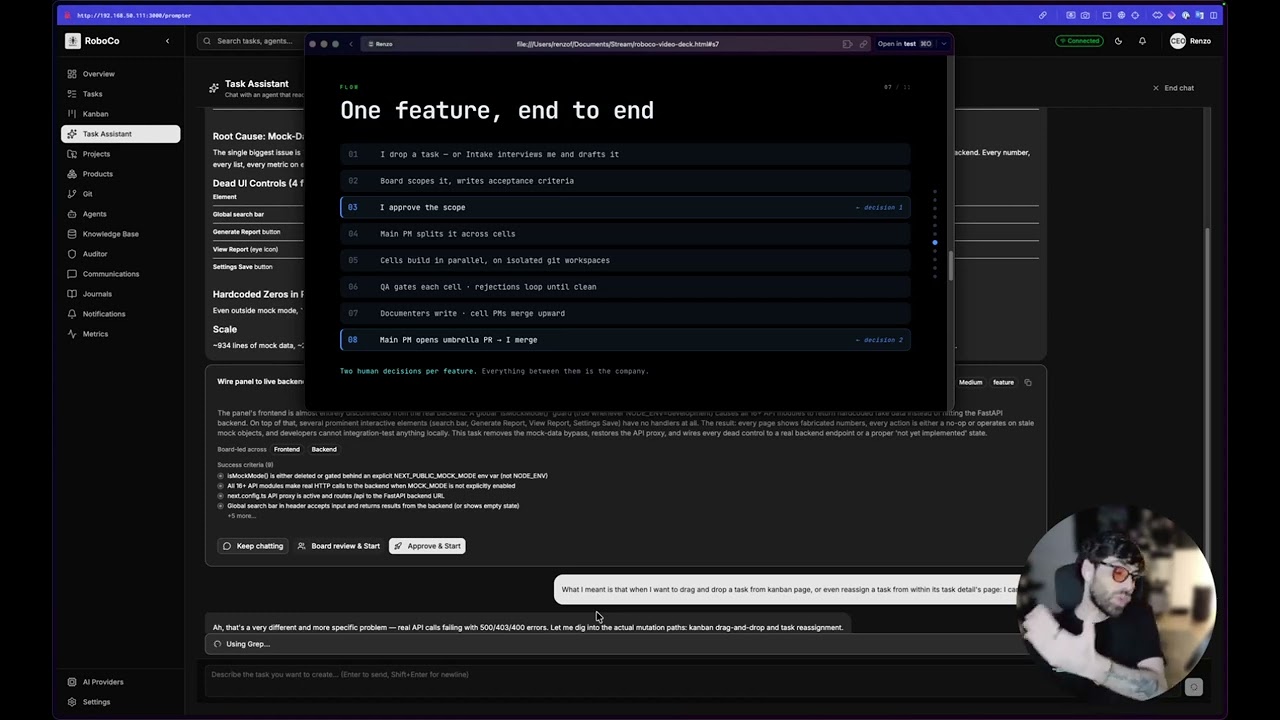
▶ Watch the 26-min intro what it is, a walkthrough, and how to use it |
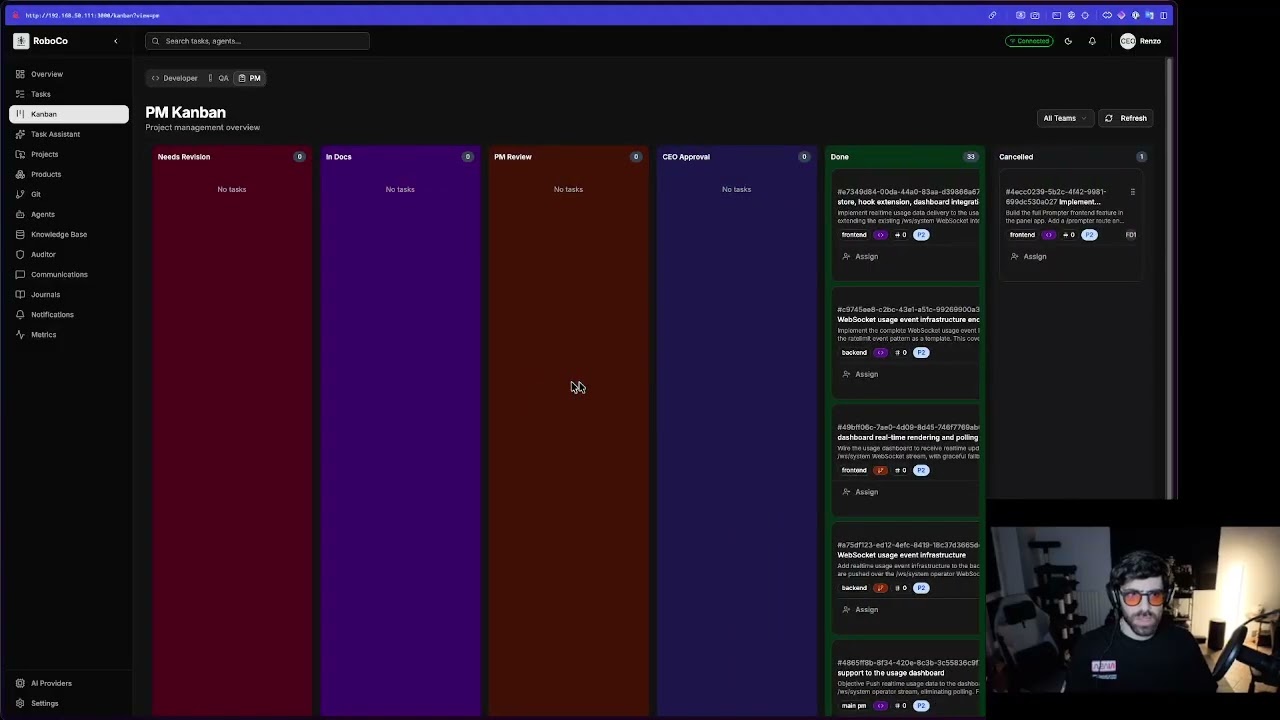
▶ Watch the 2.5-hour build session a conversation → a shipped feature |
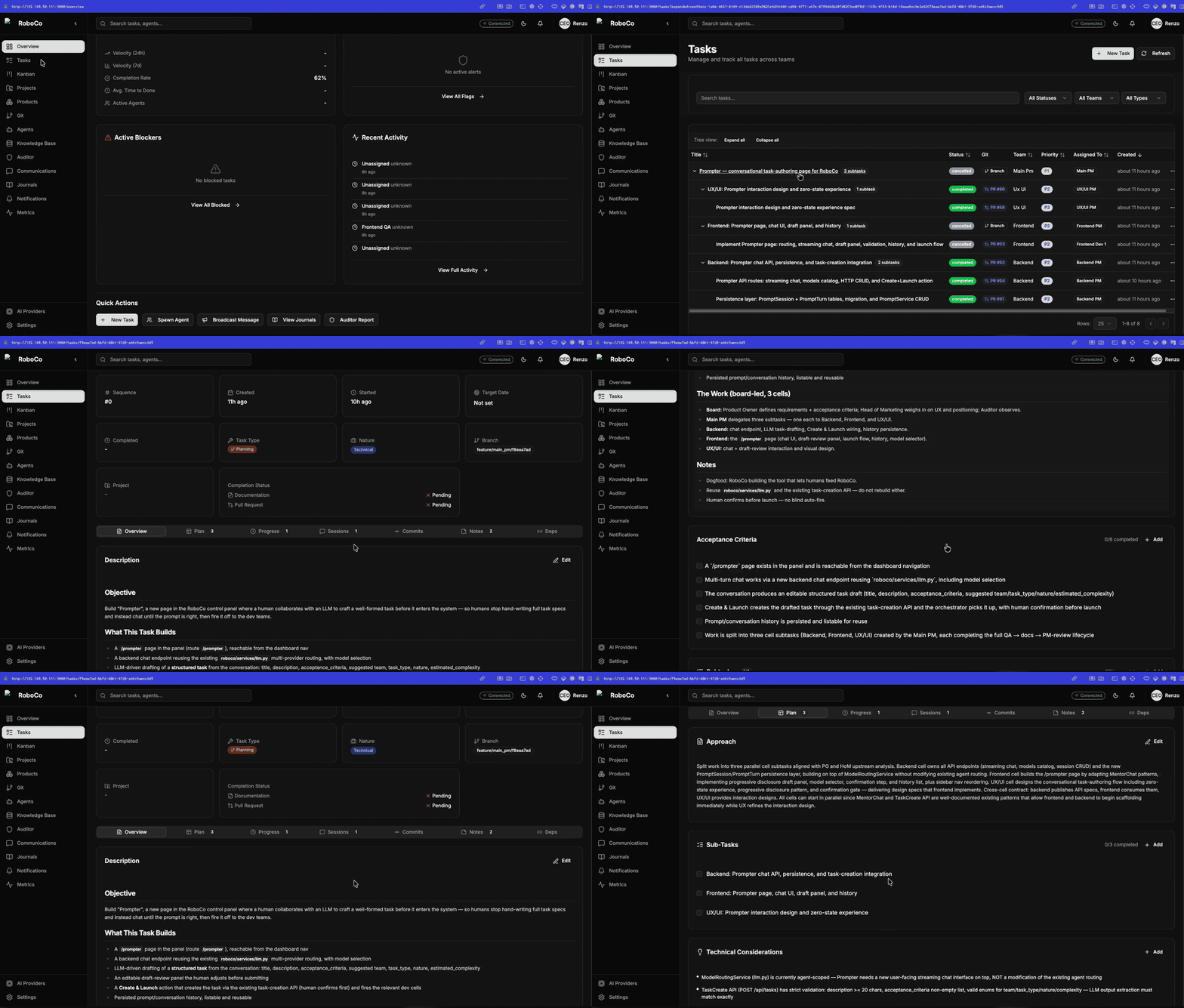
Watch the full 2:33 walkthrough (.mp4) →
Warning
RoboCo is early-stage, work-in-progress software (v0). It's under active development, runs in a homelab, and will have rough edges, breaking changes, and bugs. It is not production-ready and the API/database schema are not stable yet. Treat it as a working prototype to explore and build on — please don't expose it to the public internet as-is. Issues and PRs very welcome.
Tip
📚 Full documentation: docs.roboco.tech — install & first run, the company model, a page-by-page panel reference, model providers, the optional subsystems, deployment, and the API.
Overview
RoboCo implements a structured organizational hierarchy with formal communication protocols, task management, and quality controls. The system enables a single human (CEO) to orchestrate complex multi-project development at scale.
CEO (You, the human)
    │
    ├── Intake (on-demand interviewer: chats only with you to draft a task)
    ├── Secretary (on-demand chief-of-staff: reads company state, runs gated directives)
    ├── PR Reviewer (read-only main reviewer: inbound external/fork + internal PRs, and the root→master in-path gate)
    │
    └── Board (3 agents)
         ├── Product Owner
         ├── Head of Marketing
         └── Auditor (silent observer, reports to you)
              │
              └── Main PM (coordinates all cells)
                   │
                   ├── Backend Cell (6 agents: 2 Devs, 1 QA, 1 PM, 1 Documenter, 1 PR Reviewer)
                   ├── Frontend Cell (6 agents: 2 Devs, 1 QA, 1 PM, 1 Documenter, 1 PR Reviewer)
                   └── UX/UI Cell (6 agents: 2 Devs, 1 QA, 1 PM, 1 Documenter, 1 PR Reviewer)
The 25 agents = Intake + Secretary + PR Reviewer + the Board (3) + Main PM + the three 6-agent cells (18). Agents run on Anthropic Claude by default, or on xAI Grok (the official grok CLI on a SuperGrok subscription) — see the provider note under Configuration.
How it works
You hand a task to the company; it runs through a real build → review → document → merge pipeline and comes back to you to approve.
One full loop, put simply:
- You give the Board a task — they review it. The Product Owner and Head of Marketing turn your ask into requirements and acceptance criteria.
- You approve — the Main PM starts the work. A notification asks for your Approve & Start decision; approve, and the Main PM breaks it into per-cell subtasks.
- Each cell's PM delegates, supports, and triages its developers (UX/UI, Frontend, Backend).
- Developers build it, QA verifies and gates it, Documenters keep the books.
- Cell PMs merge their PRs into the Main PM's branch.
- The Main PM opens the final PR and notifies you "It's done!" — you approve and merge, or send it back for rework. (Only you ever merge to
master.)
— Full circle —
See the full walkthrough, with screenshots →
Or watch the full panel walkthrough (video) →
Project Structure
roboco/
├── roboco/                      # Main Python package
│   ├── api/                     # FastAPI routes & schemas
│   │   ├── routes/              # API endpoints (tasks, git, agents, etc.)
│   │   └── schemas/             # Pydantic request/response models
│   ├── services/                # Business logic services
│   │   ├── task.py              # Task lifecycle management
│   │   ├── workspace.py         # Multi-agent workspace management
│   │   ├── messaging.py         # Agent communication
│   │   └── optimal.py           # RAG/Knowledge base (in-house pgvector)
│   ├── models/                  # Pydantic domain models
│   ├── db/                      # SQLAlchemy ORM & session
│   ├── enforcement/             # Task lifecycle state machine
│   ├── runtime/                 # Orchestrator for agent spawning
│   ├── agents/                  # Agent base classes
│   ├── mcp/                     # MCP server implementations
│   └── config.py                # Application configuration
├── agents/
│   └── prompts/                 # Agent system prompts (roles, teams, identities)
├── docs/
│   ├── rag/                     # Agent knowledge base (indexed into RAG)
│   └── map/                     # Exhaustive codebase map (agent-facing)
├── alembic/                     # Database migrations
├── CLAUDE.md                    # Claude Code guidance
├── docker-compose.yml           # Full stack, built from source
└── docker-compose.registry.yml  # Full stack, pulled from the image registry
Running RoboCo
You need Docker + Docker Compose and a Claude Code auth directory on the host (~/.claude, mounted into the orchestrator so agents can reach the model). Copy .env.example to .env and set at least ROBOCO_ENCRYPTION_KEY and ROBOCO_AGENT_AUTH_SECRET (that file shows how to generate each). However you start it, the whole company is reachable at one origin: http://localhost:3000.
Optional — run agents on xAI Grok instead of Claude. RoboCo can spawn agents on xAI's official grok CLI authenticated by a SuperGrok subscription (no metered API key). Run grok login once on the host and point ROBOCO_HOST_GROK_DIR at the resulting ~/.grok so it mounts into Grok agents; the orchestrator keeps the ~6h token refreshed for you. See the Grok block in .env.example (ROBOCO_HOST_GROK_DIR, ROBOCO_GROK_AGENT_IMAGE, ROBOCO_GROK_CLI_MODEL, ROBOCO_GROK_REASONING_EFFORT).
Option 1 — Run the pre-built images (quickest)
Every release publishes all RoboCo images to both the GitHub Container Registry and Docker Hub, so you can run the full stack without building anything. Use the registry compose:
git clone https://github.com/rennf93/roboco.git && cd roboco
cp .env.example .env                                   # then edit in your secrets
docker compose -f docker-compose.registry.yml pull
docker compose -f docker-compose.registry.yml up -d
Choose the registry and version with two env vars (defaults shown):
ROBOCO_REGISTRY=ghcr.io/rennf93   # or docker.io/renzof93
ROBOCO_VERSION=latest             # or a pinned release, e.g. 0.15.0
The orchestrator spawns the matching pre-built agent images on demand — no build toolchain or source compile on your host.
Option 2 — Build from source
The same full stack, built locally from the Dockerfiles instead of pulled:
git clone https://github.com/rennf93/roboco.git && cd roboco
cp .env.example .env              # then edit in your secrets
docker compose up -d              # builds images on first run, then starts everything
Option 3 — Local development (no full stack)
For hacking on the code itself, run only the backing services in Docker and the API on your host. RoboCo's own code requires Python 3.13+ (uv will fetch it if needed):
uv sync
docker compose up -d postgres redis ollama   # backing services only
uv run alembic upgrade head                   # migrate the database
uv run python -m roboco.cli                   # API + orchestrator

# Or just the API without the orchestrator:
uv run uvicorn roboco.api.app:app --reload --host 0.0.0.0 --port 8000
Configuration
Key environment variables (see roboco/config.py for all options):
# API Server
ROBOCO_HOST=0.0.0.0
ROBOCO_PORT=8000

# Database
ROBOCO_DATABASE_HOST=localhost
ROBOCO_DATABASE_PORT=5432
ROBOCO_DATABASE_NAME=roboco

# Workspaces (Multi-Agent Git)
ROBOCO_WORKSPACES_ROOT=/data/workspaces
ROBOCO_WORKSPACE_AUTO_CLONE=true

# RAG/LLM
ROBOCO_LOCAL_LLM_BASE_URL=http://roboco-ollama:11434/v1
ROBOCO_LOCAL_LLM_MODEL=glm-5.2:cloud

# Feature flags (default-off unless noted; toggle from Settings → Feature Flags)
ROBOCO_CONVENTIONS_ENABLED=false        # per-project architectural conventions standard
ROBOCO_TOOLCHAIN_MATCH_ENABLED=false    # build each target project under its own Python
ROBOCO_OVERLOAD_BREAK_ENABLED=true      # park a provider on a persistent model-API overload
ROBOCO_DOCS_SYNC_ENABLED=false          # docs-divergence sync (release → docs-update task). Default-off; when on, a successful release publish originates one bounded, deduped docs-update task against the roboco-website project.
ROBOCO_DOCS_SYNC_MAX_OPEN_TASKS=3       # rolling cap on concurrently-open docs-sync tasks
ROBOCO_DOCS_SYNC_MAX_PER_CYCLE=1        # max docs-sync tasks originated per publish invocation

# Auditor scheduled sweeps (default 6 hours; 0 disables)
ROBOCO_AUDIT_INTERVAL_SECONDS=21600
Multi-Agent Workspace Structure
Each agent gets their own git clone for parallel development:
{ROBOCO_WORKSPACES_ROOT}/
└── {project-slug}/
    └── {team}/
        └── {agent-slug}/
            └── [git repository]

Example:
/data/workspaces/roboco/backend/be-dev-1/
/data/workspaces/roboco/backend/be-dev-2/
Task Lifecycle
backlog → pending → claimed → in_progress → verifying → awaiting_qa
    ↓                              ↓              ↓           ↓
cancelled                      blocked      needs_revision   awaiting_documentation
                               paused                              ↓
                                                           awaiting_pm_review
                                                                   ↓
                                                           awaiting_ceo_approval
                                                                   ↓
                                                              completed
Assembled, PR-bearing tasks pass through one extra stage — the in-path PR-review gate — before the PM merges:
in_progress → awaiting_pr_review → awaiting_pm_review
   (submit_up /      (pr_pass)
    submit_root)     (pr_fail → needs_revision)
The cell PM's submit_up (cell→root PR) and the Main PM's submit_root (root→master PR) open the assembled PR and enter the gate; a PR reviewer pr_passes it on to the PM merge or pr_fails it back. Leaf dev tasks (reviewed by QA) and branchless coordination roots skip the gate.
API Endpoints
Domain routes are mounted under /api:
| Route Group | Description |
|---|---|
/api/tasks |
Task CRUD, lifecycle, claiming |
/api/agents |
Agent management |
/api/git |
Git operations (status, commit, push, PR) |
/api/sessions |
Communication sessions |
/api/messages |
Agent messages |
/api/projects |
Project (repo) management |
/api/work-sessions |
Git work session tracking |
/api/optimal |
RAG/Knowledge base queries |
/api/journals |
Agent journals/reflections |
/api/orchestrator/status |
Orchestrator / dispatcher status |
The agent gateway verbs are served separately under /api/v1/flow/{role}/{verb} (intent verbs) and /api/v1/do (content tools) — see the Agent Gateway.
Development
# Install dev dependencies
uv sync --all-extras

# Run tests
uv run pytest

# Format and lint
uv run ruff format .
uv run ruff check .
uv run mypy roboco/

# Type checking
uv run mypy roboco/
Core Principles
- Everything is a task - All work is tracked and documented
- No work without a task - Create task record first
- No task without acceptance criteria - How do we know it's done?
- No closure without documentation - Future agents need context
- Communication is constant - Stream reasoning, log everything
- The Auditor sees all - Quality monitored silently
- CEO approves major changes - Human-in-the-loop for critical decisions
Technology Stack
| Layer | Technology |
|---|---|
| API Framework | FastAPI |
| Database | PostgreSQL + SQLAlchemy (async) |
| Vector Store | PostgreSQL + pgvector (in-house engine) |
| Cache/Queue | Redis |
| RAG Engine | in-house (asyncpg + pgvector, hybrid retrieval) |
| Embeddings | qwen3-embedding:0.6b (Ollama) |
| Local LLM | Ollama (glm-5.2:cloud) |
| Cloud LLM | Claude API (Anthropic) + xAI Grok (official grok CLI, SuperGrok subscription) |
| Package Manager | uv |
Status
Core Infrastructure (Complete)
- Data models (Pydantic)
- Database ORM (SQLAlchemy async)
- Task lifecycle state machine
- Multi-agent workspace management
- Agent prompts (25 agents)
- Messaging API
- Task API with full lifecycle
- Git operations API
- RAG/Knowledge base (in-house pgvector engine)
- Agent orchestrator
- CEO approval workflow
- Pluggable agent providers (Claude Code + xAI Grok on the official
grokCLI) - Inbound PR review (read-only PR-reviewer + CEO supersede/dismiss queue)
- Self-healing CI loop for RoboCo's own repo (default-off, CEO-gated)
- Business Goals tab with a live Company Scorecard (delivery, spend-vs-budget, lead time)
In Progress
- Frontend panel (vendored under
panel/, served through nginx on :3000) - Full agent autonomy testing
Security
Important
Do not expose RoboCo to the public internet as-is. It is designed to run on a trusted private network (homelab / LAN).
Agent authentication. Requests identify the caller with X-Agent-Id / X-Agent-Role headers. The orchestrator issues each spawned agent an HMAC token (X-Agent-Token, signed with ROBOCO_AGENT_AUTH_SECRET) that binds its id, role and team. Token enforcement is gated by ROBOCO_AGENT_AUTH_REQUIRED:
ROBOCO_AGENT_AUTH_REQUIREDunset/false (default): header-trust mode — the role headers are accepted without a token, so any client that can reach the API may claim any role (includingceo). The API logs a warning at startup in this mode. Acceptable only on a trusted network.ROBOCO_AGENT_AUTH_REQUIRED=true: every request must carry a valid token; an agent cannot spoof another agent's role. The control panel keeps working because nginx — the only trusted hop between the browser and the API — injects the CEO token (X-Agent-Token) on/apiand/ws, so the browser never holds the signing secret. Generate that token withmake panel-tokenand set it asROBOCO_PANEL_AGENT_TOKENin.envbefore enabling secure mode.
WebSocket streams. Token enforcement is currently REST-only. The /ws/* endpoints authenticate by agent_id query param at most and do not yet validate X-Agent-Token, even in secure mode — nginx injects the token so the panel works, but a direct WebSocket connection that bypasses nginx is not rejected. In particular the operator stream /ws/system (rate-limit lifecycle + token-usage snapshots for the dashboard) is unauthenticated. These streams are read-only — no control surface, secrets, or task content — but treat the orchestrator port as trusted-network-only until WebSocket auth lands.
Secrets (the Fernet ROBOCO_ENCRYPTION_KEY, GitHub PATs) live encrypted in the database and in gitignored env files — never in the repo. Per-project git tokens are Fernet-encrypted at rest and never returned by the API.
License
Copyright (c) 2026 Renzo Franceschini
RoboCo is licensed under the GNU Affero General Public License v3.0 (AGPL-3.0). See LICENSE for the full text.
The AGPL's network-use clause (section 13) means that if you run a modified version of RoboCo as a network service, you must make your modified source available to its users. This keeps the project open while preventing closed, hosted re-distributions.
Contributing
Contributions are welcome. All contributors must sign the Contributor License Agreement (CLA.md) — this is automated on your first pull request. See CONTRIBUTING.md for the workflow and why the CLA exists.