mirror of
https://github.com/block/buzz.git
synced 2026-08-18 06:50:31 +02:00
985cdcc6eac33ccd77bc50c26e22c701d07eda4e
277
Commits
| Author | SHA1 | Message | Date | |
|---|---|---|---|---|

|
985cdcc6ea |
feat(agents): model-tuning parity in global Agent Defaults editor (#4578)
## Overview

The global Agent Defaults surface (Settings card, defaults modal,
onboarding) exposed structured controls for Effort but left Max Output
Tokens, Context Limit, and Max Rounds as raw env vars. Per-agent dialogs
had structured numeric fields but only for `isBuzzAgentRuntime` —
incorrectly excluding Goose. This PR unifies numeric-tuning capability
across all surfaces, fixes a pre-existing dual-editor defect, and adds
full test coverage.

## What changed

### Phase 1 — Catalog projection

- Add `max_rounds_env_var` to `KnownAcpRuntime` in `runtime_metadata.rs`
(`Some("BUZZ_AGENT_MAX_ROUNDS")` for buzz-agent, `None` elsewhere).
- Project all three numeric env-var fields (`max_tokens_env_var`,
`context_limit_env_var`, `max_rounds_env_var`) end-to-end:
`AcpRuntimeCatalogEntry` Rust struct, TS `types.ts`,
`RawAcpRuntimeCatalogEntry` + `fromRawAcpRuntimeCatalogEntry` in
`tauri.ts`, and the e2e mock bridge (`withMockRuntimeConfigMetadata`).

### Phase 2 — Field model

- `deriveAgentConfigFieldModel` now derives `maxOutputTokens` /
`contextLimit` / `maxRounds` descriptors from catalog-projected fields.
- `structuredEnvKeys(descriptors)` — exported helper that takes the
**rendered** descriptor set (not the whole model). Hidden keys follow
what is actually rendered per surface: global hides effort + all three
numeric keys for buzz-agent / two for Goose; per-agent buzz-agent hides
effort + three numeric keys; per-agent Goose hides only its two numeric
keys. `BUZZ_AGENT_THINKING_EFFORT` stays a visible generic env row
per-agent because no effort control renders there.

### Phase 3 — UI

- Extract `NumericTuningFields` from `buzzAgentModelTuningFields.tsx` as
a shared descriptor-driven component (`descriptors`, `envVars`,
`inheritedEnvVars`, `onEnvVarChange`). Kind-specific minima:
`NUMERIC_KIND_MIN` map (`maxOutputTokens`/`contextLimit`: 1,
`maxRounds`: 0) applied to `<input min>`.
- **Global surface** (`AgentConfigFields.tsx`): deduplicate the
previously duplicated Advanced env-editor block; render
`NumericTuningFields` below the env editor when descriptors exist;
`hiddenKeys` and `bakedGenericRows` exclusions use `structuredEnvKeys`
so structured keys are never double-rendered. Under 1000 lines.
- **Per-agent surfaces** (`EditAgentAdvancedFields`,
`PersonaAdvancedFields`): replace `isBuzzAgentRuntime` as the
numeric-field gate with `deriveNumericDescriptors(selectedRuntime)` from
`agentConfigCore`; hidden keys come from
`structuredEnvKeys(numericDescriptors)` — the same rendered descriptor
set, no local rebuilding (fixes pre-existing dual-editor defect).
Catalog status carried as `RuntimeCatalogStatus` (`loading | ready |
error`); both error and loading withhold structured controls and leave
saved values visible as generic rows, making error distinguishable from
"runtime not capable" (`ready` + no runtime).
- **Dialogs** (`AgentDefinitionDialog`, `AgentInstanceEditDialog`,
callers): `AgentDefinitionDialog` accepts `runtimeCatalogStatus?:
"loading" | "ready" | "error"` (replaces separate
`runtimesLoading`/`runtimesError` booleans); all call sites —
`AgentManagementDialogs`, `AgentsView`, `RequestedAgentCreateDialogs`,
`UserProfilePersonaDialogs` — compute and pass the status.

### Phase 4 — Tests

- `buildRecord` exported from `EnvVarsEditor.tsx` as a pure `(nextRows,
value, requiredKeys, hiddenKeys) => Record<string, string>` helper for
isolation testing.
- **17 new node tests** in `agentConfigCore.test.mjs`:
`deriveNumericDescriptors` (all three fields, partial, undefined
runtime, matches field-model subset); `structuredEnvKeys` per surface
including discriminating Goose per-agent effort-key invariant;
`NUMERIC_KIND_MIN` values.
- **4 new node tests** in `EnvVarsEditor.test.mjs`: hidden tuning key
preserved through generic row edits; runtime-switch then generic edit
(derives both descriptor sets, asserts new-runtime hidden key survives
`buildRecord` via `hiddenKeys` and old-runtime key survives via generic
rows); baked numeric key excluded via `filterBakedGenericRows` with
`numericTuningPlaceholder` assertion; clearing a structured override —
`numericTuningPlaceholder` verifies placeholder text.
- **5 new Playwright tests** in `agent-numeric-tuning.spec.ts` (added to
smoke project `testMatch`): global numeric fields visible for
buzz-agent; global: non-capable runtime hides numeric controls; Goose
per-agent shows `Inherit (16384)` after saving global value through the
UI; delayed catalog: saved values visible as generic rows while loading
then structured controls appear after settle; failed catalog: saved
values remain visible as generic rows (never the "unsupported" empty
state).

## Result

- buzz-agent global defaults: Max output tokens, Context limit, Max
rounds as structured inputs with `Inherit (N)` placeholders from baked
env.
- Goose global defaults: Max output tokens, Context limit as structured
inputs.
- A Goose global value surfaces as `Inherit (<value>)` in the per-agent
Goose edit dialog.
- No structured key is editable in two places on any surface; no
persisted key has zero editors.
- No `runtime.id === "buzz-agent"` comparison decides numeric-field
visibility anywhere — capability flows catalog →
`AcpRuntimeCatalogEntry` → field model → UI.

Signed-off-by: Will Pfleger <pfleger.will@gmail.com>
Co-authored-by: npub1mn7jgtj4w2pd0g0zeuhxsa6jy6p0rewxz4kujt98my82ahfmp72sxjexk7 <dcfd242e557282d7a1e2cf2e6877522682f1e5c6156dc92ca7d90eaedd3b0f95@buzz.block.builderlab.xyz>
|
||
|
klopez4212andGitHub
|
027a74a61c |
Polish Share Compute settings (#3735)
## Summary - Refresh Share Compute with the shared agent-style model controls. - Reveal sharing details and advanced options only while sharing. - Remove the preview-only mesh API path. ## Validation - `pnpm check` - `pnpm test` - `pnpm exec playwright test tests/e2e/mesh-compute.spec.ts` Snapshots are attached in a follow-up comment. --------- Signed-off-by: kenny lopez <klopez4212@gmail.com> |
||
|
|
d4a4570b97 |
fix(desktop): clarify inherited agent parallelism (#4010)
## Summary - show an unambiguous `App default (10)` inherited state for parallelism in create and edit forms - explain that blank inherits the app default and suppress create-form number steppers that could silently set `1` - align the E2E mint fallback with production while preserving explicit input → definition → app-default precedence ## Why The forms displayed `1` even though an untouched field is omitted and desktop minting materializes `10`. The create-form spinner could also turn blank/inherited into an explicit `1` with one click while leaving the field looking nearly unchanged. ## Testing - `pnpm test` (desktop: 3,886 passed) - `pnpm typecheck` (desktop) - `pnpm check` (desktop) - pre-push `desktop-check` and `desktop-test` --------- Signed-off-by: Wes <wesbillman@users.noreply.github.com> Co-authored-by: Carl <c7ebe626f000404285d3686e1dc74cc07cc60a9754a150041ba132e14bd3e2ec@buzz.block.builderlab.xyz> |
||
|
|
5c98932c59 |
feat(desktop): make onboarding model defaults skippable (#3968)
**Category:** improvement **User Impact:** Users can skip default model configuration during onboarding and finish it later in Settings → Agents. **Problem:** Requiring model defaults during onboarding can block users who are not ready to choose a harness, provider, or model. Skipping also needs to leave existing configuration untouched rather than persisting partial selections. **Solution:** Stage onboarding edits locally and persist them only when users choose Next or Back. A delayed Skip action advances without any configuration write, while a footer hint points users to the settings location for completing setup later. <details> <summary>File changes</summary> **desktop/src/features/onboarding/ui/DefaultConfigStep.tsx** Adds the skip action and future-settings hint, and makes model configuration transactional so Skip discards staged changes while Next and Back preserve the intended save behavior. **desktop/src/testing/e2eBridge.ts** Exposes model-config setter call counts so tests can distinguish a true zero-write skip from a write-and-rollback implementation. **desktop/tests/e2e/onboarding-agent-defaults.spec.ts** Covers skipping during loading and after staged edits, verifies zero persistence calls, and confirms Next and Back still commit changes. </details> ## Reproduction steps 1. Start fresh onboarding and continue through harness setup to **Configure your default model settings**. 2. Change the selected harness or model, then choose **Skip for now**. 3. Confirm onboarding advances to **Join or create a community** and the prior global model configuration remains unchanged. 4. Return through onboarding and confirm **Next** saves the staged selection; confirm **Back** also preserves staged changes before returning. 5. Confirm the footer says model defaults can be configured later in **Settings → Agents**. --------- Signed-off-by: Taylor Ho <taylorkmho@gmail.com> Signed-off-by: npub1223z34hd7vtwc6qj4s7flsxkj644nlre2nthu7lrrmkumhu3xddsrx9r6w <52a228d6edf316ec6812ac3c9fc0d696ab59fc7954d77e7be31eedcddf91335b@buzz.block.builderlab.xyz> Co-authored-by: npub1223z34hd7vtwc6qj4s7flsxkj644nlre2nthu7lrrmkumhu3xddsrx9r6w <52a228d6edf316ec6812ac3c9fc0d696ab59fc7954d77e7be31eedcddf91335b@buzz.block.builderlab.xyz> |
||
|
|
c1b88af8d7 |
feat(desktop): improve channel template discovery (#4549)
## Summary - move **Channel templates** from Communities to Personal settings - always expose the template picker in New Channel, using **None** as the no-template value - create a channel template directly from the picker and select it on return - preview the selected template's current visibility, canvas, agents, and teams - order the channel-creation controls as **Type / Visibility / Template** and mark Template **Optional** - cover populated and empty libraries, inline creation, selection, visibility overrides, mixed agent/team inventory, field order, optional labeling, and settings navigation in Playwright ## Validation Validated at desktop-only tip `76442270c88aa1d533ddca5de9f87cd615183919` with a clean worktree: - focused channel-template Playwright: 2/2 passed - Type / Visibility / Template ordering and muted Optional treatment visually inspected in the replacement screenshot - `git diff --check origin/main...HEAD` passed - PR diff contains exactly nine Desktop files and no Mobile files The pre-push hook was bypassed only for the corrected history push because the inherited Mobile test `keeps follow mode off while a tall newest message stays visible` passes in Linux CI but fails on macOS because its offscreen-child mounting assertion is platform-sensitive. No Mobile code or tests are changed by this PR. ## Screenshot 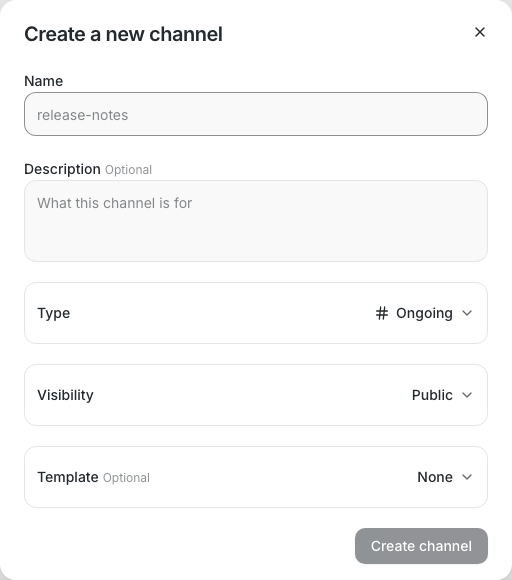 Originating Buzz channel: `efba7343-e147-48b7-a2aa-15a5f04abc57` --------- Signed-off-by: Wes <wesbillman@users.noreply.github.com> Co-authored-by: Carl <c7ebe626f000404285d3686e1dc74cc07cc60a9754a150041ba132e14bd3e2ec@buzz.block.builderlab.xyz> |
||
|
|
f810a2f49e |
fix(desktop): make OpenAI key re-enterable after first save in card mint dialog (#4140)
Fixes a write-once dead-end in the card mint dialog where a user with an
expired OpenAI key had no way to replace it.

**Source-aware key status (Rust + TypeScript).** `card_mint_key_status`
returns a layer discriminant (`"none" | "global" | "persona" | "agent" |
"process"`) instead of a boolean. A pure `resolve_key_layer()` helper in
`card.rs` owns the classification logic; `card_mint_key_status`
delegates to it, so the production path is under direct test with no
duplicate logic.

**Mint form always reachable.** The key panel replaces the mint form
only for `none` (first-time setup) or when the user explicitly opens the
edit panel (`editingKey`). Keys from agent/persona/process layers show
an inline provenance row on the mint form with a "Why?" affordance;
clicking it shows the read-only redirect in a panel with a Cancel button
that returns to the mint form — never a terminal state.

**Precise auth-error matching.** The 401 handling in `cardMintStore.ts`
matches `startsWith("Card mint failed (HTTP 401 ")` plus the specific
`Incorrect API key` text, so avatar-fetch 401 errors pass through
unchanged.

**Tri-state key status row.** "Using your saved OpenAI key · Update"
renders only when `keyLayer === "global"` (confirmed writable key).
Query pending or errored hides the row without asserting key existence.

**Real tests.** Panel visibility derivations live in
`cardMintKeyUtils.ts`, which `AgentCardMintDialog.tsx` imports directly.
Tests cover all layers including the mint-reachability invariant (Mint
reachable for every resolved layer; only `none` gates setup).

- `card.rs` — new `resolve_key_layer()` pure helper;
`card_mint_key_status` delegates to it; 999 lines (under the 1000-line
ratchet)
- `card/tests.rs` — precedence test calls `resolve_key_layer()` directly
(no test-local closure); adds process-layer and blank-value cases
- `tauriPersonas.ts` — `CardMintKeyLayer` type; updated
`cardMintKeyStatus` signature
- `cardMintKeyUtils.ts` — `showKeyPanel`, `showReadOnlyRow`,
`showCancelButton`, `keyPanelTitle`, and helpers; component imports all
of them
- `AgentCardMintDialog.tsx` — inline provenance rows for all key
sources; key panel only for setup/edit; no unused variables
- `cardMintStore.ts` — precise 401 prefix matching
- `e2eBridge.ts` — `card_mint_key_status` stub returns `"global"` (not
boolean)
- Tests: 3959 JS passing, 2089 Rust passing, `tsc --noEmit` clean

Related: [block/buzz#4406](https://github.com/block/buzz/pull/4406)

---------

Signed-off-by: Will Pfleger <pfleger.will@gmail.com>
Co-authored-by: npub1ng3jzsaqxdhrfq22dg85j3lpr0zsh3jp7g2h9jyxl59wraayapnsu6kvfg <9a232143a0336e34814a6a0f4947e11bc50bc641f21572c886fd0ae1f7a4e867@buzz.block.builderlab.xyz>
|
||
|
|
2c0ac24674 |
fix(desktop): stop the create-agent provider config probe from erasing keystrokes (#4411)
## What
Fixes the create-agent dialog's "Run on" provider config fields eating
keystrokes — reported by Tyler in buzz-remote-agents (channel
`29414326`, thread `db76677a`): the Kubernetes **Kubeconfig context**
field would not accept typing.
## Why it happened (the Typewriter Eraser, shipped in #4289)
`WhereToRunSection`'s probe `useEffect` depended on the whole `draft`:
1. every keystroke changed the draft → effect re-fired → provider binary
re-probed;
2. each probe result is a fresh object written into the draft → the
effect re-triggered **itself**, respawning the provider binary in a loop
for as long as the dialog sat on a provider;
3. every probe resolution reset `providerConfig` to schema defaults —
erasing whatever was typed. A field with no schema default (`context`)
snapped back to empty, i.e. "won't let me type". Unrelated to how many
kubeconfig contexts you have.
## Fix
- **Probe once per provider selection**, keyed on the provider's stable
`binaryPath` — not the draft, not the provider object (a
`useBackendProvidersQuery` refresh must not reprobe an unchanged
selection).
- **Latest-state resolution** via `React.useEffectEvent` + a new pure
`applyProbeResult` helper: schema defaults merge **beneath** the current
`providerConfig`, so a probe landing after the user typed can never
clobber in-flight input (per Wren's pre-patch red-team: changing deps
alone leaves a stale closure).
Existing `cancelled` cleanup keeps provider-switch/unmount safe;
selection reset (`emptyWhereToRunDraft`) and the fail-closed probe-error
path are unchanged.
## Tests
- **Unit** (`whereToRunIntent.test.mjs`): `applyProbeResult` merge
semantics — defaults under typed values, user-cleared fields stay
cleared, schema-less results, unrelated fields preserved.
- **E2E** (new `where-to-run-config.spec.ts`, added to the smoke
project, **red-first verified**: all 3 fail against the unfixed
component):
- typing into a defaultless provider field sticks, and
`probe_backend_provider` fires exactly once per selection;
- the config form is gated on probe resolution (slow probe: no
half-rendered form, defaults prefill once);
- provider → local → provider re-probes and resets cleanly.
- Mock bridge gains `backendProviders` / `backendProviderProbeResult` /
`backendProviderProbeDelayMs` seams (defaults preserve prior behavior).
## Verification at
|
||
|
|
eb049ddf81 |
feat(desktop): Agent Trading Cards — mintable agent-snapshot card PNGs with optional NIP-44 lock (#3278)
## Agent Trading Cards "Create Agent Card" action in the agent panel that mints an AI-generated trading card PNG which **is** the agent: the card carries the `buzz_agent_snapshot` tEXt chunk and is drag-in importable like any snapshot PNG. ### What's in here - **Mint pipeline (Rust):** one OpenAI Responses call — `gpt-5.6-sol` as card designer with `gpt-image-2` via the `image_generation` tool (~2–3 min). New `mint_agent_card` / `save_agent_card` commands; preview with reroll; save or send as `.agent.png` with round-trip verification before any bytes leave the app. - **Snapshot/chunk work stays in Rust,** reusing the existing encoder/decoder seams (byte-compat golden vector proves the plain path is identical to the pre-envelope encoder for placeholder, PNG-injection, and JPEG-transcode paths). - **Locked cards (NIP-44):** optional `buzz-agent-snapshot-encrypted` envelope encrypted to the (owner, agent) pair. `parse_canonical_pubkey` performs lift-x curve validation before any API spend; wrong-key decrypt returns a fixed refusal; the plain decoder refuses locked cards. - **Guardrails:** 10 MiB ceiling on final bytes, memory structurally `none` in the snapshot, full-manifest import disclosure, API-key hygiene via env layering (record > persona > global > process), fail-early validation ordering (all key/lock/NIP-44-cap checks before Responses spend). - **Import side:** full-manifest disclosure dialog, locked-card import disclosure, bounded avatar fetch. ### Review Code reviewed by Wren across the full arc; final locked-card cross-review **APPROVED 9/9/9** at exactly this head (`64f819dc8`), with independent same-SHA verification: Rust lib 1,843/1,843, clippy `--all-targets -D warnings`, desktop file-size gate. ### Live-mint evidence (real API, shipping seams, this SHA) - **Plain (Honey):** 188s, 1500x2250, 5,101,503 bytes (< 10 MiB); decoded manifest == built manifest; memory=none. - **Locked (Fizz):** 176s, 4,670,184 bytes; owner-key and agent-key decrypt both verified via logical manifest compare; wrong-key refusal exact; plain decoder refuses. - **Live finding:** built-in agents' ~171 KB inline avatars exceed the NIP-44 65,535-byte plaintext cap and the fail-early guard fires before API spend — clean error path, noted as a UX follow-up for large-avatar agents choosing lock. Full evidence (cards + dialog screenshots) posted in the originating thread. --------- Signed-off-by: Tyler Longwell <tlongwell@block.xyz> Signed-off-by: npub12gtutshhh76rx0jx697f32f9tffd4hhp3hx58fp4x6u4uemkm7sqf8f757 <5217c5c2f7bfb4333e46d17c98a9255a52dadee18dcd43a43536b95e6776dfa0@buzz.block.builderlab.xyz> Signed-off-by: npub1qyvc0c5kl4gqv2fd97fsk46tu378sqgy35vc83rvgfwne90sel7s0ed67d <011987e296fd5006292d2f930b574be47c7801048d1983c46c425d3c95f0cffd@buzz.block.builderlab.xyz> Co-authored-by: npub1qyvc0c5kl4gqv2fd97fsk46tu378sqgy35vc83rvgfwne90sel7s0ed67d <011987e296fd5006292d2f930b574be47c7801048d1983c46c425d3c95f0cffd@buzz.block.builderlab.xyz> Co-authored-by: Tyler Longwell <tlongwell@block.xyz> Co-authored-by: npub12gtutshhh76rx0jx697f32f9tffd4hhp3hx58fp4x6u4uemkm7sqf8f757 <5217c5c2f7bfb4333e46d17c98a9255a52dadee18dcd43a43536b95e6776dfa0@buzz.block.builderlab.xyz> |
||
|
|
c104eecfb3 |
feat(desktop): import local Pocket voices (#3259)
## Context Pocket TTS currently offers bundled reference voices. People also need a local, private way to add a voice without sending audio to a cloud service. ## Summary Add a Pocket voice import flow to Voice settings. Buzz opens the native file picker, decodes common audio formats in the reusable `buzz-voice` crate, canonicalizes the selected audio, stores it under a content-derived identity in app data, selects it, and lets the user delete it later. ## Changes - Accept WAV, M4A, MP3, FLAC, OGG, and AIFF files between 2 and 30 seconds, including multichannel sources. - Decode and downmix accepted audio to canonical mono 32 kHz PCM16 WAV before hashing and storage. - Store imported voices behind stable `pocket:imported:<sha256>` identities and content-addressed files. - Keep absolute file paths inside the native process and expose only voice metadata to React. - Include imported voices in Pocket preview and live huddle playback. - Add Add voice and delete controls while preserving the bundled Pocket voice catalog. - Fall back to Mary when the selected imported voice is deleted. - Keep durable import, selection, and deletion successful when a live TTS worker acknowledgement is delayed. - Preserve bundled voices when optional import metadata is unreadable and keep failed deletion retryable. ## Related issue None found. ## Testing Production decoding was exercised with WAV, M4A with AAC, MP3, FLAC, OGG Vorbis, and AIFF fixtures. Each format canonicalized to mono 32 kHz PCM16 WAV. Manual validation in the combined daily-driver build covered native-picker import, Preview, live-huddle playback, deletion, and Mary fallback. ## Screenshots The Voice settings card preserves the bundled Pocket catalog and adds the local Add voice action. 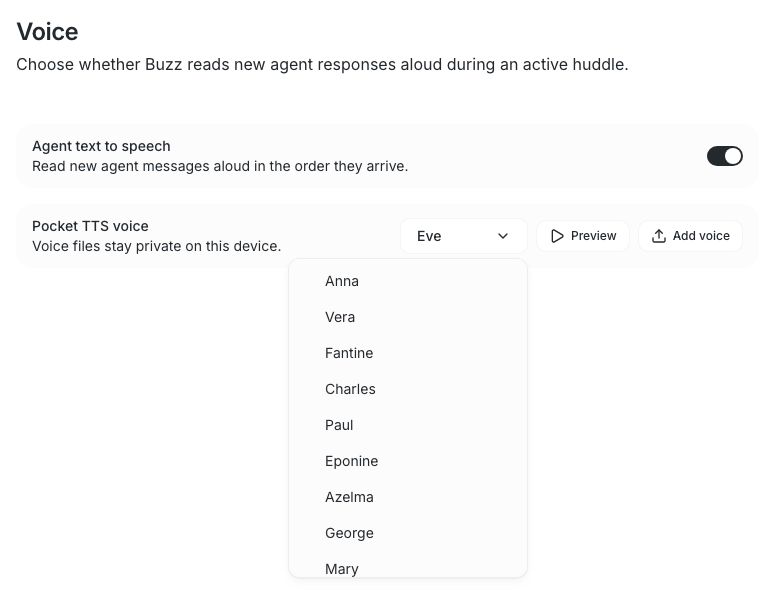 ## Reviewer-reproducible examples Create common-format fixtures and run them through the production importer: ```bash . ./bin/activate-hermit fixtures="$(mktemp -d)" ffmpeg -hide_banner -loglevel error -f lavfi -i "sine=frequency=220:duration=3" -ac 2 -ar 44100 "$fixtures/voice.wav" ffmpeg -hide_banner -loglevel error -i "$fixtures/voice.wav" -c:a aac "$fixtures/voice.m4a" ffmpeg -hide_banner -loglevel error -i "$fixtures/voice.wav" "$fixtures/voice.mp3" ffmpeg -hide_banner -loglevel error -i "$fixtures/voice.wav" "$fixtures/voice.flac" ffmpeg -hide_banner -loglevel error -i "$fixtures/voice.wav" -c:a libvorbis "$fixtures/voice.ogg" ffmpeg -hide_banner -loglevel error -i "$fixtures/voice.wav" -c:a pcm_s16be "$fixtures/voice.aiff" BUZZ_VOICE_IMPORT_TEST_DIR="$fixtures" \ cargo test -p buzz-voice imports_common_audio_format_fixtures -- --ignored --nocapture ``` Exercise import persistence, synthesis, deletion, and bundled-voice fallback with an installed Pocket model: ```bash BUZZ_POCKET_MODEL_DIR=/path/to/pocket-model-bundle \ cargo test -p buzz-voice --test pocket_import_audio \ objective_import_synthesis_delete_and_mary_fallback \ -- --ignored --nocapture ``` Exercise the native-picker boundary, selection, preview dispatch, deletion, cancellation, and invalid-file states: ```bash cd desktop pnpm build:e2e pnpm exec playwright test tests/e2e/voice-settings.spec.ts --project=smoke ``` --------- Signed-off-by: John Tennant <jtennant@block.xyz> Signed-off-by: John Tennant <johnmatthewtennant@gmail.com> Signed-off-by: John Tennant <jtennant@squareup.com> Signed-off-by: npub1qyvc0c5kl4gqv2fd97fsk46tu378sqgy35vc83rvgfwne90sel7s0ed67d <011987e296fd5006292d2f930b574be47c7801048d1983c46c425d3c95f0cffd@buzz.block.builderlab.xyz> Signed-off-by: npub12gtutshhh76rx0jx697f32f9tffd4hhp3hx58fp4x6u4uemkm7sqf8f757 <5217c5c2f7bfb4333e46d17c98a9255a52dadee18dcd43a43536b95e6776dfa0@buzz.block.builderlab.xyz> Co-authored-by: John Tennant <jtennant@block.xyz> Co-authored-by: npub1qyvc0c5kl4gqv2fd97fsk46tu378sqgy35vc83rvgfwne90sel7s0ed67d <011987e296fd5006292d2f930b574be47c7801048d1983c46c425d3c95f0cffd@buzz.block.builderlab.xyz> Co-authored-by: npub12gtutshhh76rx0jx697f32f9tffd4hhp3hx58fp4x6u4uemkm7sqf8f757 <5217c5c2f7bfb4333e46d17c98a9255a52dadee18dcd43a43536b95e6776dfa0@buzz.block.builderlab.xyz> |
||
|
|
61ba9dfaa0 |
refactor(voice): extract reusable Pocket primitives + Pocket voice settings (relands #2467 + #3208) (#3910)
Relands **#2467** (extract `buzz-voice` crate) and **#3208** (Pocket
voice settings) onto main, after #3266 and #3180 merged.
## Why a fresh PR
The repo is squash-only with delete-branch-on-merge. Squashing #3266
deleted `jtennant/pocket-tts-2026-04`, which was #2467's base — GitHub
auto-closed #2467 and it cannot be reopened. Squash merges also sever
ancestry, so GitHub's natural merge-base reports phantom conflicts for
the whole remaining stack.
## Content provenance
- Byte-identical to the blessed `jt/buzz-voice-refactor` branch
(`93029c577`, tree `6729e0eff` — reviewed by Dawn (#2467) and Max
(#3208) at exact heads) **except** the three files where #3180 and #3208
genuinely interact.
- Three-file resolution (union of both sides):
- `huddle/mod.rs` — #3180's pipeline re-exports + #3208's
`agent_tts_routing` imports.
- `huddle/state.rs` — `reset_preserving_generation` preserves both
`huddle_generation` (#3180) and `tts_enabled` (#3208); test sets merged
into one `tests` module.
- `desktop/src/testing/e2eBridge.ts` — both switch arms kept; no
duplicate case labels.
## Verification at
|
||
|
|
4632c55041 |
feat(desktop): auto-enable huddle transcription for agents (#3180)
## Context Before this change, every huddle initialized with transcription off. Joining or adding an agent did not enable it, so the agent could not receive spoken conversation until a person clicked the transcript control. Starting a huddle from an agent DM could also omit that agent, and adding an agent who already belonged to the parent channel could attempt an unnecessary role change and show a warning. Agent detection uses authoritative huddle membership. A participant counts as an agent when the ephemeral membership identifies it with the `bot` role, or when the existing agent identity model identifies the participant in an agent DM. ## Summary Buzz now enables transcription once when the first authoritative agent is present. After that initial automatic action, explicit user control is authoritative: manual ON or OFF survives membership refreshes, reconnects, and UI remounts. Removing the last agent does not change the current transcription state. Agent-DM huddles enroll the agent automatically. Adding an agent who already belongs to the parent channel preserves the existing parent role and completes without a role-mutation warning. | Scenario | Before | With this change | | --- | --- | --- | | First authoritative agent joins or is hydrated | Transcription stays off | Transcription turns on once | | User explicitly turns transcription on or off | Manual control exists without an agent policy | The explicit choice suppresses later automatic changes | | Last agent leaves | No defined agent-presence behavior | The current transcription state remains unchanged | | Huddle starts from an agent DM | The agent can be omitted | The known agent is enrolled automatically | | Added agent already belongs to the parent channel | Buzz can attempt a role rewrite and warn | Existing parent membership and role are preserved | | Transcription is active | The control is not visually distinct | The control is highlighted and exposes `aria-pressed=true` | ## Changes - Derive agent presence from authoritative bot-role huddle membership and known agent-DM identity. - Apply the one-time auto-enable rule during create, join, membership hydration, reconnect, pipeline startup, and local agent addition. - Preserve explicit user state and use huddle-generation guards so stale asynchronous work cannot alter a replacement huddle. - Keep backend and React transcription state synchronized, with a visible and accessible active control. - Enroll known agent-DM participants and make parent-channel membership updates idempotent. - Cover hydration ordering, reconnects, remounts, explicit OFF, last-agent removal, DM enrollment, existing membership, and active styling. ## Related issue None found. ## Testing Manual validation in `pending-seed` confirmed the product contract: 1. Started a huddle from the owned, running Fizz agent DM. 2. Confirmed the authoritative roster contained the human and Fizz as an agent. 3. Confirmed transcription enabled without clicking the control: `Stop transcript`, `aria-pressed=true`, with the highlighted active background. 4. Turned transcription off and confirmed `Start transcript`, `aria-pressed=false` remained stable. 5. Removed Fizz while transcription was off and confirmed the state stayed off. 6. Left the huddle cleanly. ## Screenshots The same control has distinct active and inactive states. 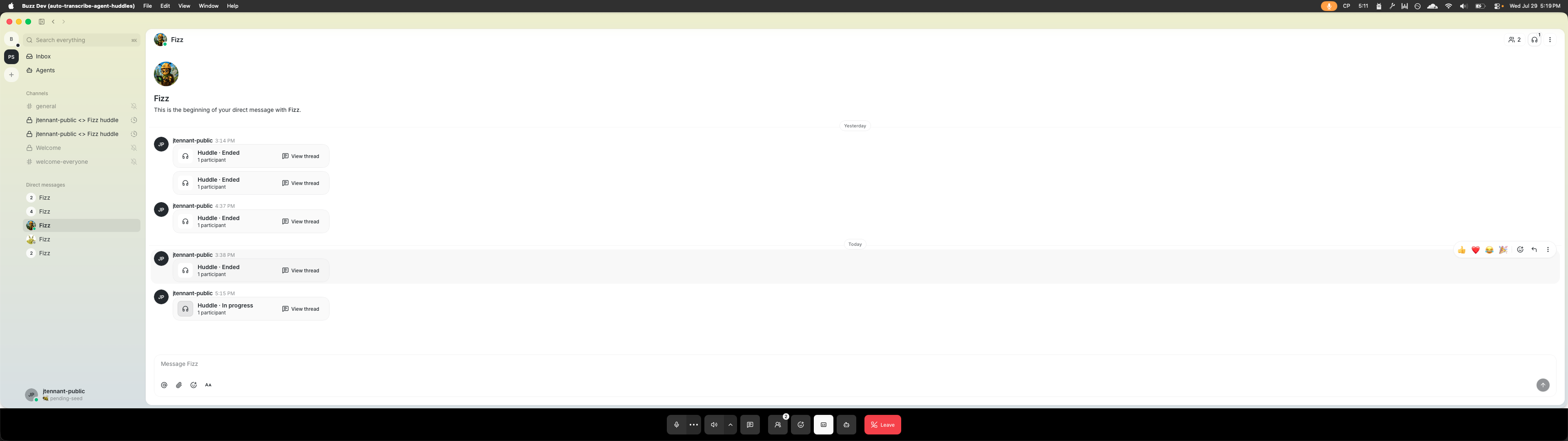 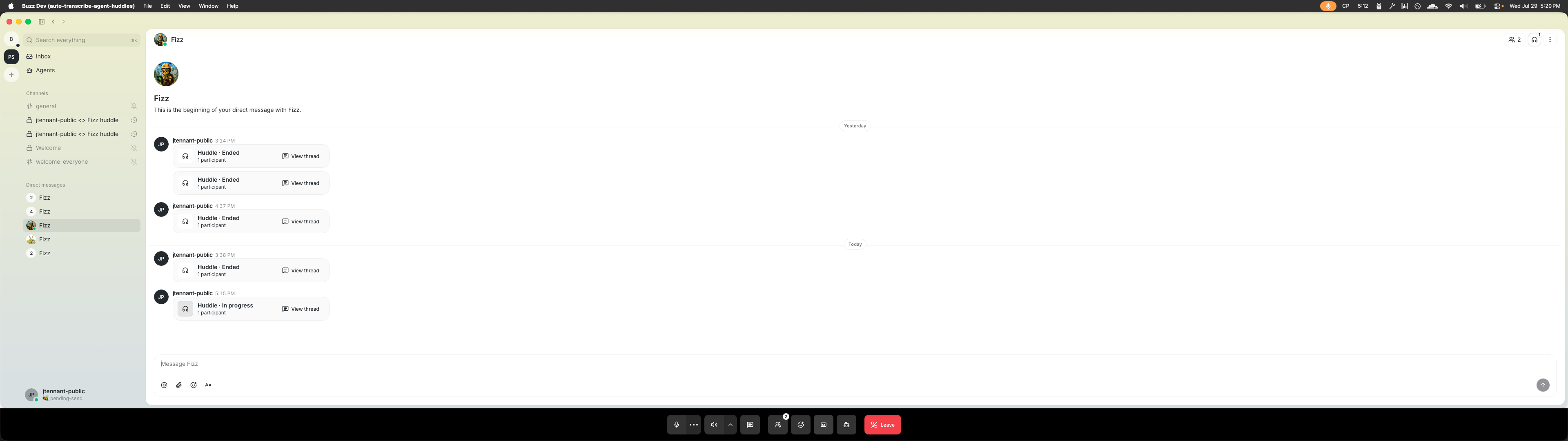 ## Reviewer-reproducible examples From a fresh checkout: ```bash pnpm --dir desktop build:e2e pnpm --dir desktop exec playwright test tests/e2e/huddle-transcription.spec.ts --project=smoke pnpm --dir desktop exec playwright test tests/e2e/mentions.spec.ts --project=smoke --grep "system agent profile exposes owned agent actions|system agent avatar exposes owned agent actions|owned bot profile exposes message and huddle actions|owned agent mention profile exposes message and huddle actions" ``` The huddle scenario exercises initial authoritative hydration, exactly one automatic enable, explicit OFF persistence, unchanged state after last-agent removal, newer events winning over delayed hydration, agent-DM enrollment, and idempotent parent membership. It also asserts `aria-pressed` and distinct computed active styling. --------- Signed-off-by: John Tennant <jtennant@squareup.com> Signed-off-by: npub1jh9wn95s0472h86ahapupaf7m6kx4v9sx2n0atj2hltcfer8k06s5n3pyf <95cae996907d7cab9f5dbf43c0f53edeac6ab0b032a6feae4abfd784e467b3f5@buzz.block.builderlab.xyz> Co-authored-by: npub1jh9wn95s0472h86ahapupaf7m6kx4v9sx2n0atj2hltcfer8k06s5n3pyf <95cae996907d7cab9f5dbf43c0f53edeac6ab0b032a6feae4abfd784e467b3f5@buzz.block.builderlab.xyz> |
||
|
|
468647a51f |
feat(desktop): locally stored NIP-49 encrypted key backup (#2937)
## Summary

Adds a locally stored **NIP-49 encrypted key backup** (`ncryptsec`) to
the desktop app, per the plan reviewed in buzz-development (Rev 3,
approved 9/10 by Wren; implementation also reviewed and approved 9/10).

**Two-artifact design — canonical bytes originate entirely in Rust:**
- `create_ncryptsec_backup` runs under the `identity_mutation` lock:
encrypt → decrypt-verify against the live pubkey → atomic `0o600` write
to `{app_data_dir}/identity.ncryptsec` → reread/byte-compare → return
the exact persisted bytes. The frontend never re-derives or re-encrypts.
- `save_ncryptsec_copy` writes a portable copy via the save dialog
(parse-gated, secret-file semantics) and never mutates canonical state.
- `generate_backup_passphrase`: 6 words from the EFF short wordlist via
`OsRng` (custom passphrases min 12 chars).
- Import accepts `ncryptsec1` with optional password; the raw-`nsec`
path is untouched. Different-pubkey import and sign-out wipe the
app-managed backup (post-commit, best-effort — a failed import can never
destroy the still-live identity's backup; regression-tested).

**Never-relay guarantee (egress guard + tripwires):**
- `egress_guard.rs` fail-closed at all 8 `/events` submission boundaries
(relay submit funnel, 3× `relay.rs`, huddle STT, both engram submitters,
native WS choke point), rejecting `ncryptsec1`/`NCRYPTSEC1` in text and
binary frames. Scope is deliberately ncryptsec-only: pairing
intentionally carries raw nsec inside its encrypted session.
- Site-granular `/events` inventory tripwire: per-file (`/events` count,
guard-call count) pairs; unlisted files expect zero. Mutation-style
tests prove a ninth site in an existing file, a removed guard, and a new
unlisted file all fail the scan.
- ncryptsec source-allowlist scans in **both** trees (Rust + TS).

**Frontend:** onboarding `BackupStep` is encrypted-by-default — the
default path never invokes `get_nsec` (e2e asserts the command log).
Raw-nsec export stays behind an explicit click with prior semantics.
Shared `EncryptedBackupCreator` powers onboarding + a new settings row;
the import form auto-switches to encrypted mode on `ncryptsec1` paste
(case-insensitive HRP).

**Open product call for @tlongwell-block:** onboarding default is
*encrypted* in this PR; flipping to raw-default is a small change either
way (documented in the plan).

Review history: plan Rev 3 and the implementation were both iterated
with Wren to 9/10 (two blockers from round 1 — import ordering,
inventory granularity — plus an uppercase-bech32 hardening gap, all
fixed in `dde37183e`). Thread: buzz-development.

### Related issue

Follow-up to the direction explored in #385 (NIP-PB, closed) — this
ships local NIP-49 (the standard) instead of a new NIP. No open
duplicate found.

### Testing

All at exactly `dde37183e` (same shell, HEAD verified):

- `cargo test` — 1680 passed / 0 failed / 14 ignored (includes a
deliberate ~70s log_n-18 NIP-49 round trip, spec vector, wrong-password,
NFKC, uppercase-vector decrypt, injection test per egress boundary,
inventory mutation tests, import-ordering regression tests)
- `cargo clippy --all-targets -- -D warnings` — clean; `cargo fmt
--check` — clean
- `pnpm typecheck` — clean; JS unit suite 3529/3529; biome (repo-pinned
2.4.16) clean
- Playwright `onboarding-backup` / `onboarding` /
`onboarding-agent-defaults` / `profile-nsec-reveal` — 86 passed, 1 known
avatar-reservation flake (passed on rerun; untouched by this diff).
`passThroughBackupStep` now exercises the encrypted default, so every
downstream onboarding spec covers the new path.
- Note: browser e2e fakes the crypto via the mock bridge (fixed
spec-vector blob); decryption correctness is proven in the Rust tests.

## Latest onboarding integration

The current head adds an additive `IdentityInfo.storage` field
(`ephemeral`, `system-keyring`, `local-file`, or `environment`) so
onboarding can accurately explain where the active identity is
protected. It surfaces storage metadata only—never key material—and
leaves the existing lost/keyring-locked recovery behavior intact.

---------

Signed-off-by: Tyler Longwell <tlongwell@block.xyz>
Signed-off-by: Taylor Ho <taylorkmho@gmail.com>
Co-authored-by: npub1qyvc0c5kl4gqv2fd97fsk46tu378sqgy35vc83rvgfwne90sel7s0ed67d <011987e296fd5006292d2f930b574be47c7801048d1983c46c425d3c95f0cffd@buzz.block.builderlab.xyz>
Co-authored-by: Tyler Longwell <tlongwell@block.xyz>
Co-authored-by: Taylor Ho <taylorkmho@gmail.com>
Co-authored-by: npub1223z34hd7vtwc6qj4s7flsxkj644nlre2nthu7lrrmkumhu3xddsrx9r6w <52a228d6edf316ec6812ac3c9fc0d696ab59fc7954d77e7be31eedcddf91335b@buzz.block.builderlab.xyz>
|
||
|
|
74cd571219 |
fix(desktop): report authenticated relay recovery (#3812)
## Summary - report the relay as connected immediately after socket open and successful AUTH - keep rate-limited subscription replay, the connect promise, and reconnect listeners unchanged - cover authenticated reconnect while replay is held behind the shared rate-limit gate ## Why After WARP recovery, the socket could reopen and authenticate successfully while subscription replay waited behind the existing rate-limit gate. `connect()` kept `ConnectionState` at `reconnecting` during that intentional delay, so the desktop displayed “Can’t reach the relay” despite authenticated traffic already flowing. This is separate from #3774: that fix keeps routine operations from bypassing scheduled reconnect backoff. This patch preserves those protections and only corrects the authenticated transport-state boundary. ## Failure semantics If replay fails after the early `connected` transition, the existing `replayLiveSubscriptions()` catch calls `resetConnection()`, closes the socket, returns state to `reconnecting`, and schedules recovery. Operation waiters and reconnect notifications still do not complete until replay succeeds. ## Validation At commit `c8a4308e1079f4f9e6a72f0f0bfba280fe822ec0` with a clean working tree: - `pnpm --dir desktop typecheck` - `pnpm --dir desktop test` — 3,847 passed - `pnpm --dir desktop check` — passed; two pre-existing informational template-literal notices - `pnpm --dir desktop exec playwright test tests/e2e/relay-reconnect.spec.ts` — 8 passed - regression test proven red before the production ordering change (`reconnecting` after 3 seconds) and green after it Signed-off-by: Wes <wesbillman@users.noreply.github.com> Co-authored-by: Carl <c7ebe626f000404285d3686e1dc74cc07cc60a9754a150041ba132e14bd3e2ec@buzz.block.builderlab.xyz> |
||
|
|
d40a33290e |
feat(desktop): raise the install ceiling and make installs observable (#3368)
Windows installs of Goose and other harnesses failed at exactly five minutes with an empty error (#2401). The 300s ceiling was killing installs that were working, just slowly — the Goose step pulls a ~79MB release asset, and Windows Defender scans every file npm extracts. When the ceiling fired it discarded the output it had already read, so the user got a bare timeout string and no way to tell a hang from a large download. ## The ceiling `INSTALL_TIMEOUT` is 900s, and the error names the limit: `install command exceeded the 15m ceiling and was terminated`. It stays a pure wall-clock ceiling with no inactivity kill — nothing observable distinguishes a hung installer from one silently transferring a large artifact, so silence alone never kills an install. A ceiling kill remains non-retryable; re-running a command that already burned 15 minutes costs the user more time with no plausible path to success. The child's exit and both stream drains fold into one resumable settle governed by a single deadline. Waiting on the drains outside that deadline would let a descendant that outlived the install shell hold the output pipes — and the per-runtime install guard behind them — open with no bound, which is the failure the ceiling exists to prevent. So the deadline path terminates the process group on the normal-exit branch too: a leader that exited with a real status still gets its stragglers killed, and the guard cannot stick either way. Whether the leader had already exited only decides the verdict — its real status outranks a timeout. The install shell is a session leader and its descendants inherit the output pipes, so signalling only the leader left them running and the drains blocked on a pipe nobody would close. Escalation keys off the *group's* liveness rather than the leader's, since a descendant that ignores SIGTERM outlives the leader and would otherwise never receive the group SIGKILL. Reaping the killed child and finishing the drains share one bounded grace, so a termination that failed outright cannot extend the ceiling that just fired. ## Output capture Each stream drains into a bounded capture that is *shared* with the reader rather than returned by it, so whatever arrived before a stall is readable at the ceiling — exactly when the output matters most. Output of any size costs a fixed amount of memory. One capture holds two independently bounded views of the same bytes: | View | Head / tail | Cut marker | |------|-------------|------------| | UI (`InstallStepResult`) | 512 B / 1024 B | `... (N bytes omitted) ...` | | Log file | 128 KiB / 128 KiB | `... [N bytes omitted at cap] ...` | The UI budget is screen space; the log's is disk. Both markers are inline, so neither ever implies completeness it does not have. Both ends are cut at arbitrary byte offsets, so a partial character is trimmed and the partial token each cut left behind is dropped — the marker's byte count includes both trims. ## Install log `steps` carries only the last attempt of each step, truncated for display. Everything else — earlier retries, the prerequisite step that actually broke, the managed-Node bootstrap — used to be discarded. `InstallReporter` now appends one self-contained record per attempt of per step to `install-<runtime-id>.log` beside the agent logs, and `InstallRuntimeResult.log_path` carries the file to the UI, where a failure message ends with `Full log: <path>`. Each record is bounded independently by the log-scale capture that produced it, so a first attempt that printed megabytes cannot push out the later record explaining the failure; the run's total is bounded by steps × attempts × per-record cap. Every early return builds its result through one `InstallReporter::failed` helper, so no failure path can omit the log pointer, and synthesized steps go through `record_step` — a step that reaches the UI without passing it would be invisible in the file. Install output can echo a registry token or proxy credential from the environment it ran in, and the file is written unattended. Redaction keys off the *names* of the environment variables the install inherited, snapshotted once per run, rather than a list of known secret value prefixes: a credential with no recognisable shape is exactly the one a prefix match misses. Three name rules apply, because the variables need different treatment: | Rule | Variables | Redacted | |------|-----------|----------| | URL userinfo | `HTTP_PROXY`, `HTTPS_PROXY`, `ALL_PROXY`, `NPM_CONFIG_PROXY`, `NPM_CONFIG_HTTPS_PROXY`, `NPM_CONFIG_REGISTRY` | `user:password` only | | Exact name | `NPM_CONFIG_KEY`, `NPM_CONFIG__AUTH`, `NPM_CONFIG_OTP` | whole value | | Marker substring | `*TOKEN*`, `*SECRET*`, `*PASSWORD*`, `*_PAT`, … | whole value, 8-byte floor | A proxy or registry keeps its host and port, because an install that fails behind one is diagnosable only if the record still says which one it went through, and a bare `user@` with no password is not treated as a credential. npm's own settings are listed by exact name rather than matched on `KEY` or `AUTH` substrings — both occur throughout an ordinary environment on values that are paths and people's names — and they bypass the 8-byte floor, since a six-digit one-time password is a credential at that length. Matching is case-insensitive, which is what npm's lowercase `npm_config_*` spelling needs. `0o600` is set by the create rather than a later `chmod`, which would leave a window where the umask decides. A runtime id that cannot safely be a filename yields no log rather than a sanitized one — a rewritten id could collide with another runtime's log. The file holds exactly one run. A run opens its own session after the runtime id has been canonically resolved — the previous file rotates to `.1` and any older `.1` is removed before the rename, since a rename that will not replace its destination would otherwise wedge rotation permanently on Windows. The session writes a header naming the runtime, the app version (`app.package_info().version` on the Rust side — cannot be mocked or fail), the OS (`std::env::consts::OS`), and the start time: a Windows failure and a macOS one on the same runtime are different bugs, and a stale app version explains a failure that no longer reproduces. Each record carries its attempt's elapsed time. ## Live output line A 15-minute ceiling with nothing behind it but a spinner is indistinguishable from a hang. The same drain seam feeds an `acp-install-output` event carrying the newest complete line, and the three install entry points — Doctor harness rows, the harness catalog dialog, and onboarding runtime cards — render it under the spinner with `aria-live="polite"`. Ordering is keyed on a `seq` monotonic across the whole install, not on the attempt number, which restarts at 1 for every step: keyed on attempt, one step succeeding on attempt 2 would make the next step's attempt-1 output look stale and freeze the display for the rest of the install. Each executed attempt begins with an unthrottled `line: null` clear signal, so a stale failure line cannot sit under the spinner while the retry runs. Events are otherwise throttled to four per second, and the throttle *retains* the newest pending line and flushes it when the window reopens rather than dropping it — at an attempt boundary a drop would silently eat the new attempt's first line. The subscription is mounted for the runtime's whole lifetime rather than started when the install begins. The install command is invoked from the click handler, so the clear and a fast command's first lines can be emitted before React has committed the pending state, and nothing replays them — a subscription that waited for that state would lose the entire output of a short install. The run boundary resets the ordering key when the install settles, since `seq` restarts for the next run, and the line renders only while installing, so a straggler from a finishing drain cannot appear under a fresh Install button. The 15-minute ceiling deliberately stops waiting on stuck drain threads — a hung installer must not freeze the app. That means a drain thread can outlive its `InstallReporter`. Without a generation guard, a drain that calls `offer` after the run settles would publish an event with the run's high `seq`, poison the permanent listener's React state, and cause the next install's restarted `seq=0` events to be rejected. `Live` now carries a `lifecycle: Arc<RwLock<bool>>`; drain threads hold a **shared read guard** from the admission check through the `(self.emit)(...)` call, making the check-then-emit pair atomic with respect to shutdown. `InstallReporter::drop` takes the **exclusive write guard** and stores `false` — this blocks until every in-flight drain publication releases its read guard, then prevents any new admission. Deactivation is bounded: the write lock holds only for the flag store, so it can block at most for the duration of one emit call (microseconds to low milliseconds). Rust drops locals in reverse-declaration order, so `reporter` drops before `_guard`, ensuring the exclusive write completes before the per-runtime concurrency guard releases and a new install can start. ## Also Install result types move to `desktop/src/shared/api/installTypes.ts`, following the existing `searchTypes.ts` / `workflowTypes.ts` convention, and are re-exported from `tauri.ts` and `types.ts` — both already over the file-size cap, so neither can grow to carry them. Two comments described `AdapterOutdated` as applying only to the deprecated package; it also covers a version below the supported floor. Report: #2401 --------- Signed-off-by: Will Pfleger <pfleger.will@gmail.com> Signed-off-by: npub1mn7jgtj4w2pd0g0zeuhxsa6jy6p0rewxz4kujt98my82ahfmp72sxjexk7 <dcfd242e557282d7a1e2cf2e6877522682f1e5c6156dc92ca7d90eaedd3b0f95@buzz.block.builderlab.xyz> Co-authored-by: npub1mn7jgtj4w2pd0g0zeuhxsa6jy6p0rewxz4kujt98my82ahfmp72sxjexk7 <dcfd242e557282d7a1e2cf2e6877522682f1e5c6156dc92ca7d90eaedd3b0f95@buzz.block.builderlab.xyz> |
||
|
|
cca8839034 |
Make relay reconnect backoff authoritative (#3774)
## Summary - make the relay reconnect coordinator authoritative during outages so query, publish, and subscription traffic waits for the scheduled attempt instead of cancelling backoff - release waiting operations after the coordinated AUTH + live-subscription replay attempt, while preserving one explicit manual reconnect fast path - suppress duplicate notification side effects when reconnect replay overlaps previously delivered events ## Root cause `resetConnection()` scheduled exponential backoff, but `ensureConnected()` cleared any pending reconnect timer. Operation-level retry paths immediately called `ensureConnected()`, so ordinary app traffic could repeatedly bypass the reconnect policy during an outage. The resulting churn also replayed overlapping live events into notification side effects without a shared event-ID guard. ## Validation - `pnpm --dir desktop typecheck` - `pnpm --dir desktop test` — 3,823 passed - pre-push: `desktop-check`, `desktop-test`, and `branch-skew` passed - file-size, px-text, and pubkey-truncation ratchets passed --------- Signed-off-by: Wes <wesbillman@users.noreply.github.com> Co-authored-by: Carl <c7ebe626f000404285d3686e1dc74cc07cc60a9754a150041ba132e14bd3e2ec@buzz.block.builderlab.xyz> |
||
|
|
bd0bff24bf |
feat(desktop): add password-protected backups in settings (#3701)
**Category:** new-feature **User Impact:** Users can create, download, and verify a password-protected backup of their private identity from desktop Settings. **Problem:** Buzz does not currently give signed-in users a Settings-based path to protect or validate their private identity independently of onboarding. **Solution:** Add a focused backup menu to the private-key row, keep encryption and verification local in Rust, and preserve completed encrypted backups briefly so native saves can be retried without repeating encryption. <details> <summary>File changes</summary> **desktop/src/features/settings/** Adds the background backup lifecycle, create and test dialogs, private-key menu integration, password handling, and focused unit coverage. **desktop/src/features/onboarding/ui/NsecMaskedDisplay.tsx** Extends the masked private-key display with reusable overflow-menu actions used by Settings. **desktop/src/app/App.tsx** Mounts the backup provider at app scope so encryption and save work survive closing Settings or the modal. **desktop/src/shared/api/tauriIdentity.ts** Adds typed desktop bindings for local backup creation, save, selection, and verification. **desktop/src-tauri/src/key_backup.rs and desktop/src-tauri/src/commands/identity.rs** Implements local NIP-49 encryption, password generation, file handling, and public-identity-only verification results. **desktop/src-tauri/src/egress_guard.rs and guarded call sites** Blocks encrypted secret material from relay, websocket, snapshot, sharing, and huddle egress paths. **desktop/src-tauri tests and fixtures** Covers encryption, verification, file behavior, and fail-closed no-egress protections. **desktop/src/testing/e2eBridge.ts, desktop/tests/, and desktop/playwright.config.ts** Expands the mock native bridge and browser coverage across create, retry, expiry, and current/different-identity verification states. **desktop/src-tauri/Cargo.toml, Cargo.lock, and assets** Adds the local cryptography/password-generation dependencies and embedded short-word list. </details> ## Reproduction steps 1. Run the desktop app and open **Settings → Profile → Identity**. 2. Open the private-key overflow menu and choose **Create backup**. 3. Enter or generate a valid password, submit, and confirm progress continues if the dialog or Settings is closed. 4. Save the resulting `.ncryptsec` file; cancel and retry to confirm the temporary download remains available. 5. Choose **Test backup**, select the file, enter a wrong password, then retry with the correct password. 6. Confirm success identifies whether the backup matches the current identity and displays only the public `npub`. ## Screenshots | Settings identity | Private-key menu | Create backup | |---|---|---| | <img width="1280" height="720" alt="image" src="https://github.com/user-attachments/assets/981e391b-6829-4081-95ca-ca75a369de71" /> | <img width="1280" height="720" alt="image" src="https://github.com/user-attachments/assets/7972c68e-7635-47d8-b0ad-9639390d3e6c" /> | <img width="1280" height="720" alt="image" src="https://github.com/user-attachments/assets/4709c8f7-cf02-46f1-bec9-b3f98fe56fb2" /> | | Encrypting | Download available | Test success | |---|---|---| | <img width="1280" height="720" alt="image" src="https://github.com/user-attachments/assets/1ac3e934-2b4b-4135-bae6-126c715c8c59" /> | <img width="1280" height="720" alt="image" src="https://github.com/user-attachments/assets/cb6f07ee-a16f-44a5-b9a0-6b9fe0e4d40d" /> | <img width="1280" height="720" alt="image" src="https://github.com/user-attachments/assets/ea58b1b1-966c-46aa-8d59-92c9f06a25bd" /> | Visual review and additional states: [Buzz thread](buzz://message?channel=50ca7ef1-201e-4159-9499-40de3964b7c3&id=87eceb5f0f82fd50c32e560de3d35be48e293760f6620718aafdcef289d475fe) --------- Signed-off-by: Taylor Ho <taylorkmho@gmail.com> Co-authored-by: npub1223z34hd7vtwc6qj4s7flsxkj644nlre2nthu7lrrmkumhu3xddsrx9r6w <52a228d6edf316ec6812ac3c9fc0d696ab59fc7954d77e7be31eedcddf91335b@buzz.block.builderlab.xyz> |
||
|
|
f44b5a2477 |
fix(desktop): reuse profiles when joining communities (#2155)
## Why People joining a community with an existing relay profile should not be asked to recreate their name and avatar. ## What - Check the active identity's relay profile after the joined community becomes active - Skip directly to the starter-team step when a kind-0 profile event exists - Preserve the profile setup path when no event exists or discovery fails - Cover both new-profile and existing-profile join paths in E2E tests ## Risk Assessment Low — the lookup is scoped to the community onboarding profile stage, runs once per transaction, and fails open to the existing flow. ## References - `pnpm build:e2e && pnpm exec playwright test --project=integration tests/e2e/onboarding.spec.ts --grep 'first-community direct join reaches profile|community onboarding reuses an existing relay profile'` (2 passed) Generated with Codex Signed-off-by: npub1rf6fvdj6ut0c4kcmjv4p5mmgh89nj58n69uu3fz3cvk3jn500hqs7emz79 <1a7496365ae2df8adb1b932a1a6f68b9cb3950f3d179c8a451c32d194e8f7dc1@sprout-oss.stage.blox.sqprod.co> Co-authored-by: npub1rf6fvdj6ut0c4kcmjv4p5mmgh89nj58n69uu3fz3cvk3jn500hqs7emz79 <1a7496365ae2df8adb1b932a1a6f68b9cb3950f3d179c8a451c32d194e8f7dc1@sprout-oss.stage.blox.sqprod.co> |
||
|
|
4933672eb4 |
feat(mesh): upgrade embedded mesh to v0.74 and harden shared compute (split 1/2 of #3467) (#3741)
## Summary This is **part 1 of 2** split out from #3467 (per Tyler's request), carrying only the mesh-scoped changes. The agent/ACP response-behavior changes and the new `send_message` tool stay in #3467 as part 2. All commits are @michaelneale's work, cherry-picked with authorship preserved. - Upgrade embedded Mesh to v0.74.0 (tag-pinned instead of commit rev) and use canonical Gemma model IDs. - Keep shared compute serving through member joins, roster changes, app recovery, and community switching. - Wait for actual model readiness and avoid resuming incomplete downloads after quit. - Leave `BUZZ_AGENT_THINKING_EFFORT` unset by default so each model's chat template picks its own thinking default (`none` suppressed Gemma tool-calling entirely; pinning `low` made Qwen3 burn ~4x output budget). Explicit agent/persona/global values still win. ## Relationship to #3467 Contains the mesh commits from #3467 (`2cd640b23`, `0ad81c341`, `ad13ed841`) rebased onto current main, with one deliberate exclusion: the `crates/buzz-agent/src/llm.rs` reasoning→text parser change from `2cd640b23` is **not** here. That change unconditionally affects every OpenAI-compat/Responses provider, so it belongs with the reply-behavior work in part 2, where it can be reviewed as what it is. Not included (remaining in #3467 / part 2): - typed `send_message` tool in dev-mcp + `BUZZ_ACP_SEND_MESSAGE_TOOL` gating - plain-reply delivery fallback in buzz-acp (`BUZZ_ACP_DELIVER_PLAIN_REPLIES`) - the mesh_agent_e2e P5/P6 rewrite (exists to prove the reply path) - the two `env.insert` preset opt-ins in `relay_mesh.rs` for the flags above - the llm.rs parser change This PR is independently mergeable; part 2's flags are all off by default so it can land before or after. ## Testing - `cargo test -p buzz-relay --locked` — 780 passed (one telemetry test is order-sensitive under parallel default settings; passes in the pre-push suite and standalone, unrelated to this diff — files untouched here). - `just desktop-tauri-test` (default features) — 1877 passed. - `cargo test --locked --features mesh-llm` in `desktop/src-tauri` — 1961 passed, including the new relay-mesh preset and coordinator/recovery tests. - Both `Cargo.lock`s resolve with `--locked` against the v0.74.0 tag. - Full pre-push hook suite green (rust-tests, desktop-check/test, tauri checks). Live validation of the mesh v0.74 upgrade itself is documented on #3467 (two-Mac cross-version test). --------- Signed-off-by: Michael Neale <michael.neale@gmail.com> Signed-off-by: Tyler Longwell <tlongwell@block.xyz> Co-authored-by: Michael Neale <michael.neale@gmail.com> Co-authored-by: Tyler Longwell <tlongwell@block.xyz> |
||
|
|
d0a24bcb52 |
Add macOS agent menu-bar menu (#3565)
## Summary - Add a **macOS-only** monochrome Buzz menu-bar icon with **Running** and **Recent** agent sections. - Show each agent as one selectable macOS row with `Name · elapsed` and its channel underneath. - Keep completed work available for quick channel re-entry, alongside New Channel, Open Buzz, and Quit Buzz. - Keep the main window alive on close and restore it from both the menu bar and the macOS Dock. - Fence queued channel actions by community generation so an in-flight action from the previous community cannot navigate the newly selected community. - Leave Windows and Linux unchanged; cross-platform tray lifecycle support can follow with platform-specific validation. <img width="812" height="760" alt="Buzz macOS agent menu" src="https://github.com/user-attachments/assets/19bfd874-8f06-4496-bdda-7ed2e7b5733f" /> ## Validation - `cargo fmt --check` - Desktop Tauri suite: 1,860 passed, 14 ignored after merging current `main` - Desktop tests: 3,769 passed - Desktop lint, file-size, text, and pubkey checks pass (two pre-existing informational template-literal notices) - Regression coverage verifies stale `OpenChannel` actions are discarded across community changes while `NewChannel` survives ## Manual validation remaining A native macOS smoke test is still requested before merge: menu appearance, elapsed updates, Running → Recent, channel navigation, New Channel, minimized/closed/Dock restore, Open Buzz, and Quit. E2E stubs the tray IPC and does not exercise the native menu. --------- Signed-off-by: kenny lopez <klopez4212@gmail.com> Signed-off-by: Wes <wesbillman@users.noreply.github.com> Co-authored-by: Wes <wesbillman@users.noreply.github.com> Co-authored-by: Carl <c7ebe626f000404285d3686e1dc74cc07cc60a9754a150041ba132e14bd3e2ec@buzz.block.builderlab.xyz> |
||
|
klopez4212andGitHub
|
4672ee55c4 |
Fix pending message feedback (#3543)
## Summary - Keep `Sending…` beside message timestamps, including grouped pending messages. - Match the profile-card hover surface to inactive channel rows. ## Snapshots ### Pending message  ### Profile hover 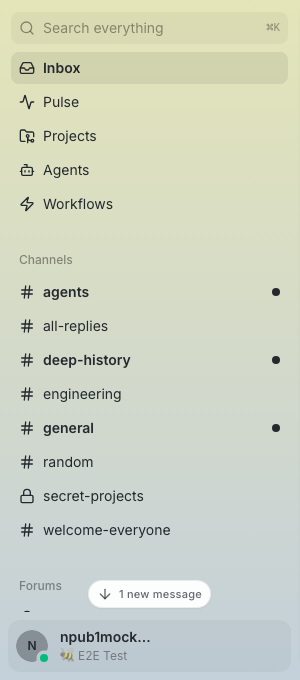 ## Validation - `pnpm -C desktop typecheck` - `pnpm -C desktop check:file-sizes` - `pnpm -C desktop build:e2e` - `pnpm -C desktop exec playwright test tests/e2e/message-feedback-snapshots.spec.ts --project=smoke` --------- Signed-off-by: kenny lopez <klopez4212@gmail.com> |
||
|
klopez4212andGitHub
|
259de6afbe |
Improve emoji autocomplete matching (#3571)
## Summary - Show all colon emoji autocomplete matches - Rank exact and prefix shortcodes before weaker matches - Add a regression test and screenshot ## Validation - `pnpm test` - `pnpm build` - `pnpm exec playwright test --project=smoke tests/e2e/custom-emoji.spec.ts --grep "exact standard shortcode"` - `just desktop-tauri-clippy` Native Tauri tests were attempted but could not link because the local disk filled during compilation. --------- Signed-off-by: kenny lopez <klopez4212@gmail.com> |
||
|
|
a35771fc44 |
feat(desktop): refine agent catalog sharing (#2439)
## Summary - add custom-agent catalog sharing and hide built-ins from discovery - let owners publish later catalog updates from Share or while saving edits — the save always persists locally, and the publish reports `published` or `queued` (flushed automatically once the relay is reachable again) - preserve agent type, model, and runtime across snapshot import/export - simplify agent and team entry points and tighten catalog layout - migrate the legacy global retention queue into the owner's active scope so pending catalog publishes survive the upgrade - keep the agent list and edits usable in recovery mode by degrading to unshared projections when scope resolution or the retention DB fails - track catalog provenance on copied personas, so adding an already-added foreign agent resolves to the existing copy instead of creating a duplicate - scope inbound persona events to the community relay they arrived on - page the catalog read past the relay's 1,000-row query clamp - unify the share dialog's memory-level choice into a single "What's included" selector that drives both DM-send and copy-link delivery (all six combinations preserved), group the delivery rows above the option rows, and label the catalog toggle "Not shared" / "Shared" - keep emoji avatars on catalog entries — they persist as inline percent-encoded SVG, which the catalog projection's http(s)-only URL guard used to drop, so a shared agent showed initials instead of its avatar - drop the "Active in communities" card from Agents settings, superseded by the per-channel runtime controls in the members sidebar ## Screenshots ### Agent actions 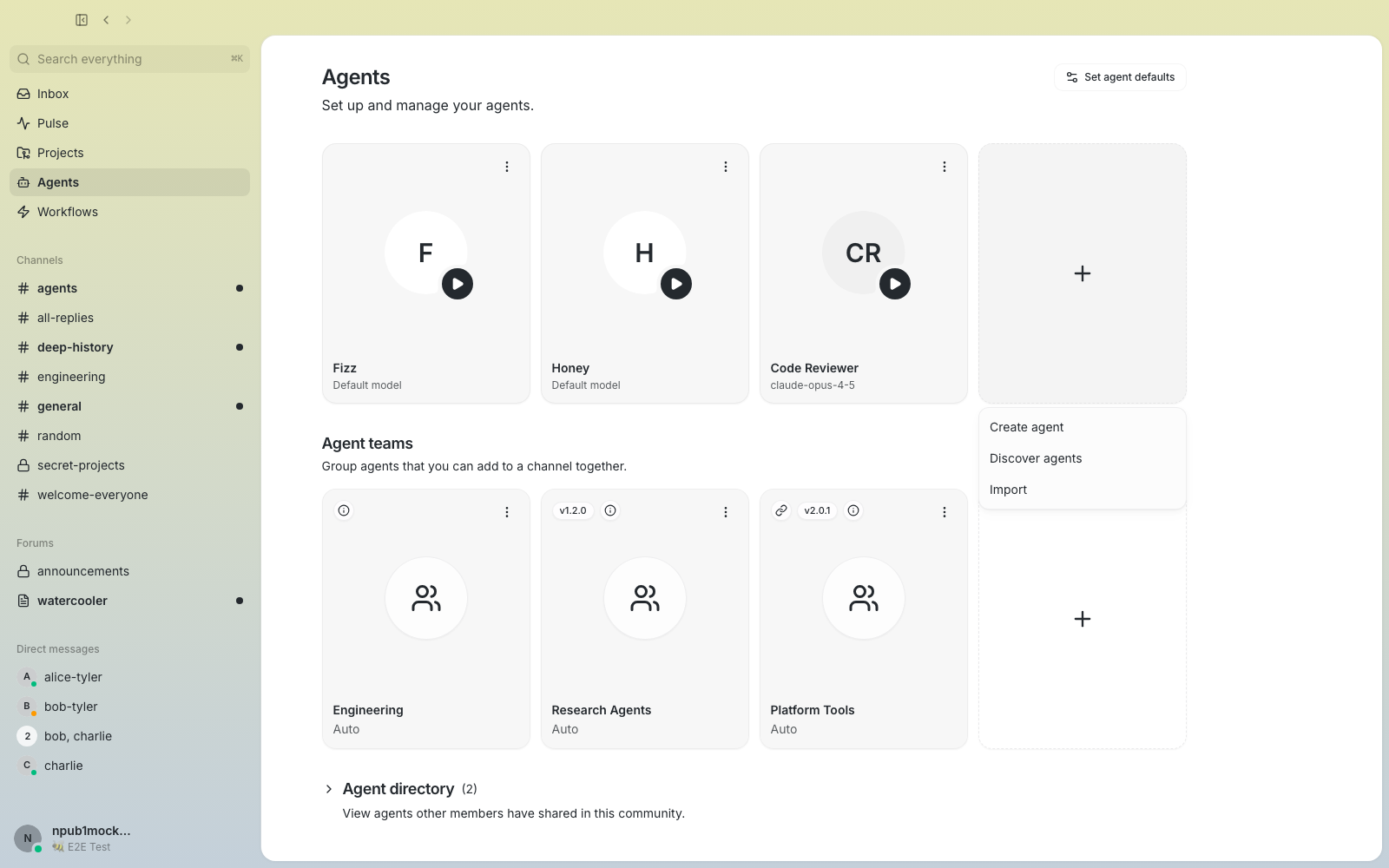 ### Team avatar stack 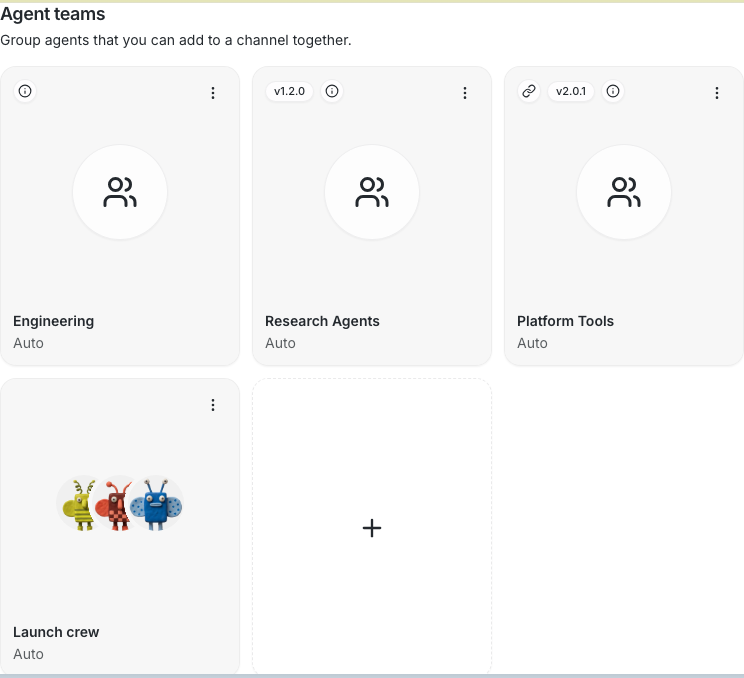 ### Catalog sharing 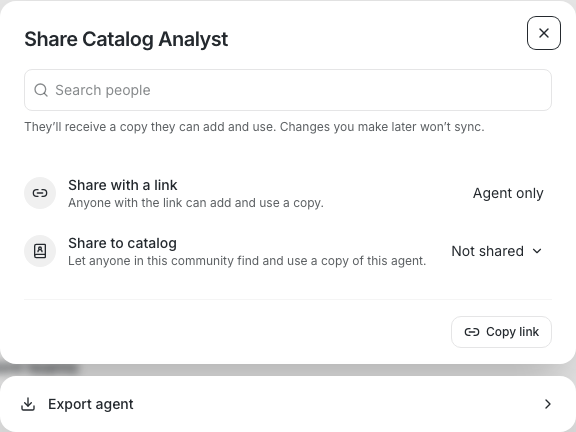 ### Publish while editing 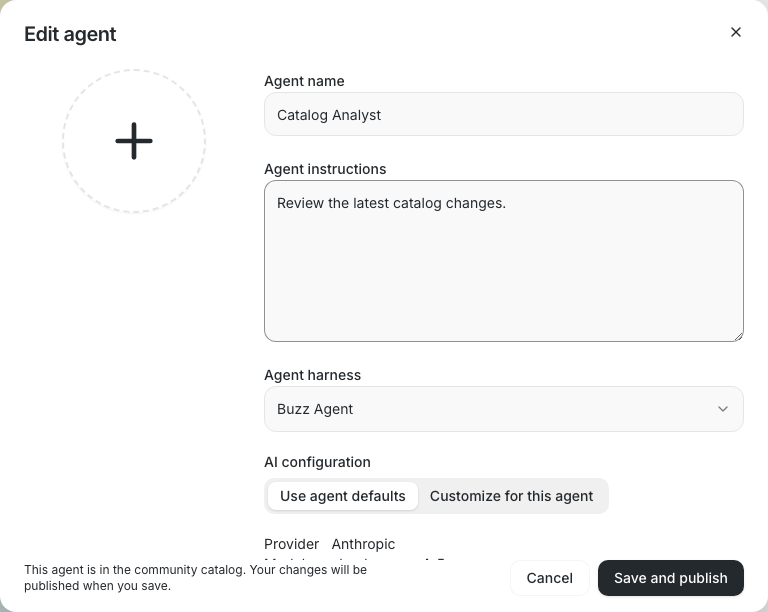 ### Publish from Share 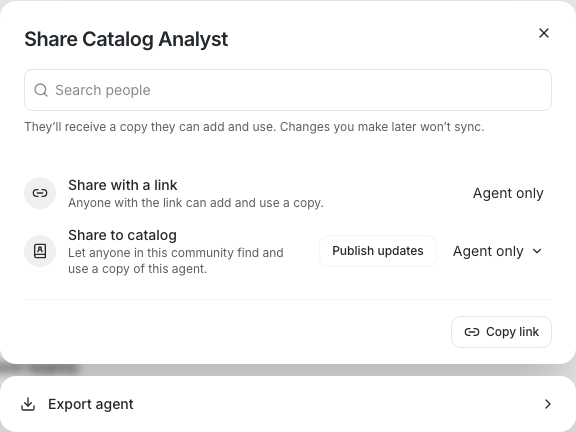 ### Catalog details 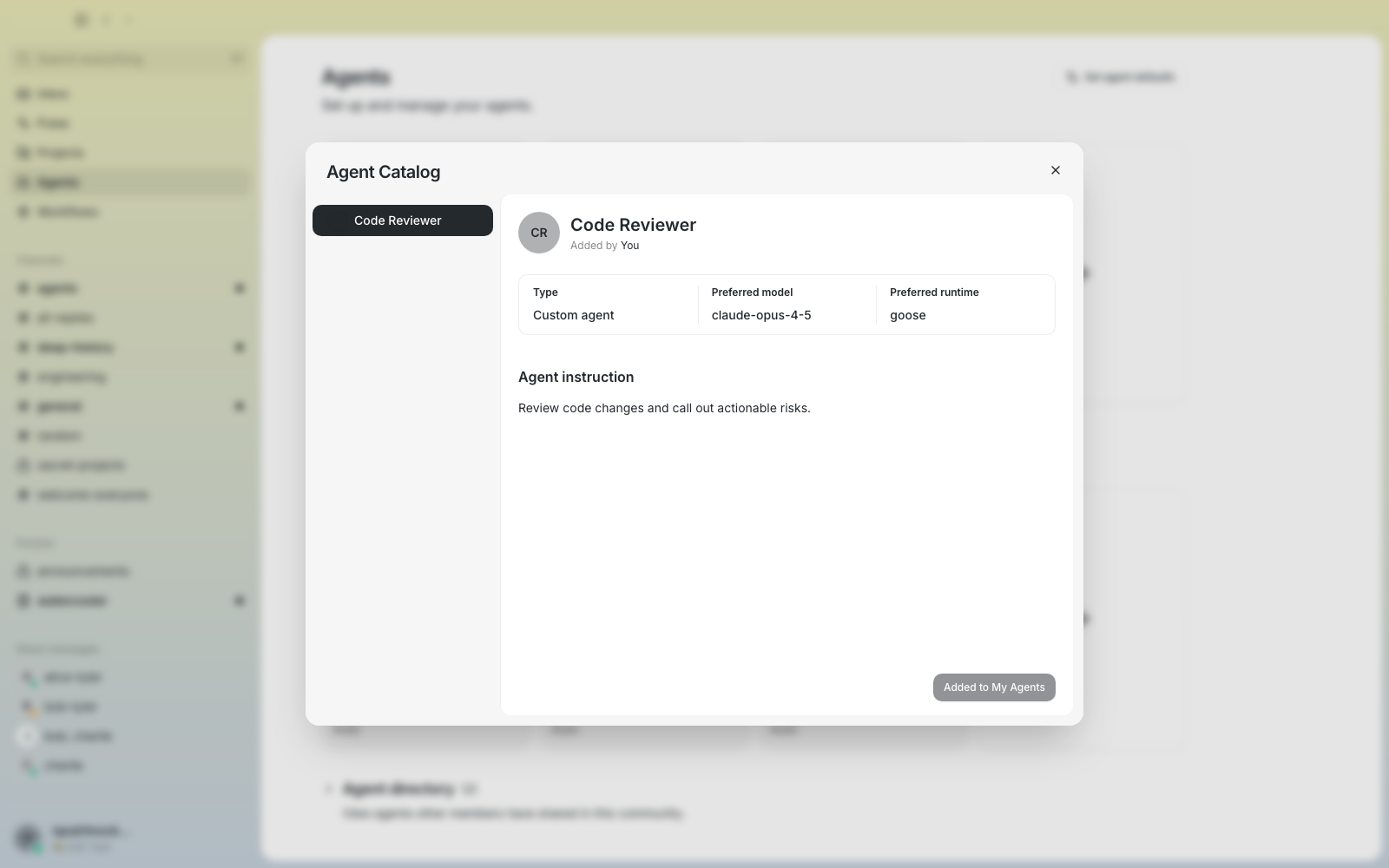 --------- Signed-off-by: kenny lopez <klopez4212@gmail.com> Signed-off-by: Will Pfleger <pfleger.will@gmail.com> Co-authored-by: Will Pfleger <pfleger.will@gmail.com> |
||
|
morgmartandGitHub
|
d8f9d87c17 |
Polish composer activity layout and transitions (#3151)
## Summary - Replace the permanently reserved composer activity row with a conditional, content-driven accessory for channel and thread composers. - Keep the composer dock geometrically stable while activity appears, so the composer’s bottom edge resizes smoothly without shifting the conversation. - Preserve translucent backdrop blur during the resize with a stable dock-level blur layer, and keep thread overlay/focus-mode alignment consistent. - Keep bottom-pinned virtualized conversations fully visible as composer content, zoom, or viewport height changes without repinning readers who have scrolled into history. - Refine the activity lockup with aligned avatars/text and a subtle, reduced-motion-safe shimmer. - Centralize the dock’s quiet inset, activity rail, released space, and activity offset in one CSS-variable geometry contract. This takes a different, systemic route from the spacing reduction proposed in #2602 and supersedes that approach. ### Related issue Related PR: #2602 ### Testing - `./scripts/check-branch-skew.sh` - `just desktop-check` - `just desktop-test` — 3,638 passing - `useAnchoredScroll.test.mjs` — virtualized viewport resize follows the explicit bottom state - Focused desktop smoke E2E — 6 passing across stable dock geometry, multiline growth, viewport resize, reduced motion, blur ownership, and thread overlay alignment - Pre-push hooks passed for organization safety, branch skew, desktop checks/tests, Rust tests, workspace tests, and desktop Tauri tests - Mobile pre-push is independently red on latest `main`; the exact `activity_page_test.dart` compiler failure reproduces on untouched `origin/main` - Visually tested channel and thread composers across quiet/activity states, multiline composer growth, and thread overlay/focus mode https://github.com/user-attachments/assets/ed0b08d9-18e0-4061-b272-ab509dbcd8ee --------- Signed-off-by: morgmart <98432065+morgmart@users.noreply.github.com> |
||
|
|
cb2a265b53 |
feat(search): parse from:/in:/after:/before: and pass them in the filter (#2871)
## Summary - Adds a pure-TS operator parser (`from:` / `in:` / `after:` / `before:`) with unit tests. Invalid date tokens stay in the FTS text. - Extends `search_messages` so the desktop can send `authors` / `since` / `until` (and existing `#h`) on the filter the relay already understands. - Wires topbar search to strip operators from the prefix query, resolve `in:` against local channels and `from:` against hex pubkeys / known agents, then pass the structured fields through. This is part 1 of #2853 (parser + command plumbing). Autocomplete chips / richer `from:@name` resolution can follow in a second PR. ## Test plan - [x] `node --import ./test-loader.mjs --experimental-strip-types --test src/features/search/lib/parseSearchOperators.test.mjs` - [x] Added `search_messages_filter_emits_operator_fields` unit test (full `buzz-desktop` crate build needs local sidecar binaries in this environment) - [ ] Manual: topbar `deploy from:<hex> after:2024-01-01` emits authors/since on the bridge filter and returns narrowed hits Made with [Cursor](https://cursor.com) --------- Signed-off-by: Jatinder Mahajan <jatinder.mahajan@certifyos.com> Co-authored-by: Jatinder Mahajan <jatinder.mahajan@certifyos.com> Co-authored-by: Cursor <cursoragent@cursor.com> Co-authored-by: Will Pfleger <pfleger.will@gmail.com> |
||
|
John Matthew TennantandGitHub
|
0019f80765 |
fix(desktop): fetch join policies through native networking (#2862)
## Context Adding an existing community by relay URL could fail with `Community rejected: Load failed` even when its WebSocket endpoint was reachable. The Add Community flow fetched `/api/join-policy` from the WebView, so a relay without a matching CORS allowance blocked the policy request before the app could join it. ## Summary This bug fix fetches join policies through Tauri's native networking layer for direct URL joins. Invite-code discovery, policy acceptance, and signed invite claims remain on the WebView path so those operations can migrate together later. ## Changes - Uses native networking for Add Community and first-community direct URL join-policy requests. - Validates relay schemes, rejects URLs containing credentials, and refuses redirects. - Bounds declared and chunked native responses before JSON parsing. - Preserves existing `404`, non-success status, malformed JSON, and absent-policy behavior. - Requires every join-policy caller to choose its transport explicitly. Public relays using Buzz's default permissive CORS configuration are not known to be affected. ### Related issue Related to #2872. ### Testing #### Reviewer-reproducible examples End-to-end red/green requires a relay with restrictive CORS and a Buzz identity authorized to join it. ##### Red: `main` From a clean checkout of `main`: ```bash . ./bin/activate-hermit just staging ``` In Buzz Desktop: 1. Add another community so the restrictive-CORS relay can be removed. 2. Remove that relay. 3. Open Add Community and enter the relay's WebSocket URL. 4. Select Add Community. Observed result: ```text Community rejected: Load failed ``` ##### Green: this PR From a clean checkout of this branch: ```bash . ./bin/activate-hermit just staging ``` Repeat the same steps above. Observed result: ```text The community rejoins successfully. ``` Supporting checks: - Six native join-policy tests, including oversized declared and chunked responses. - Four TypeScript API tests, including the native command contract. - E2E build and four focused onboarding and sidebar Playwright tests. - Full `just ci` and pre-push suites. - Builderbot, Kalvin, and minimize-diff review fanout found no actionable issues after the final rebase. |
||
|
|
d98da7389e |
feat(desktop): redesign agent runtime settings (#3093)
**Category:** improvement **User Impact:** Users can understand, install, authenticate, and manage agent runtimes from one progressively disclosed Agents settings experience. **Problem:** Runtime health and custom harness management were split across overlapping settings surfaces, exposing low-level configuration too early while leaving setup and authentication states hard to understand. **Solution:** Consolidate those operations into one stable runtime list and an Add runtimes catalog, with task-oriented state labels, direct setup actions, and custom configuration contained in a dedicated form. <details> <summary>File changes</summary> **desktop/playwright.config.ts** Registers the visual coverage needed for the redesigned runtime catalog. **desktop/public/harness-logos/CREDITS.md** Documents bundled runtime-mark provenance and the decision not to ship the withdrawn OpenAI mark. **desktop/public/runtime-icons/codex.png** Removes the obsolete Codex bitmap in favor of the neutral fallback. **desktop/public/runtime-icons/goose.svg** Removes the old Goose asset now replaced by the theme-adaptive mark. **desktop/src-tauri/src/managed_agents/discovery.rs** Aligns runtime discovery guidance with the new task-oriented setup language. **desktop/src-tauri/src/managed_agents/discovery/runtime_metadata.rs** Updates runtime metadata used by the redesigned settings states. **desktop/src/features/agents/ui/runtimeAvailabilityWarning.test.mjs** Updates availability-warning expectations for the revised runtime guidance. **desktop/src/features/onboarding/assets/harness-logos/chatgpt.png** Removes the redundant bitmap from the unified runtime icon pipeline. **desktop/src/features/onboarding/assets/harness-logos/goose.png** Removes the redundant Goose bitmap. **desktop/src/features/onboarding/ui/HarnessMarks.tsx** Adds theme-adaptive bundled runtime marks with safe fallbacks. **desktop/src/features/onboarding/ui/RuntimeIcon.tsx** Centralizes runtime logo rendering so settings and catalog rows cannot drift. **desktop/src/features/onboarding/ui/SetupStep.tsx** Aligns onboarding runtime setup copy with the settings terminology. **desktop/src/features/onboarding/ui/presetLogos.test.mjs** Guards bundled-logo behavior and prevents the withdrawn Codex mark from returning. **desktop/src/features/settings/ui/CustomHarnessForm.tsx** Reworks custom runtime creation and editing into a clear, dedicated catalog form. **desktop/src/features/settings/ui/HarnessCatalogDialog.tsx** Introduces the Add runtimes master-detail catalog, grouped setup states, loading treatment, and pinned actions. **desktop/src/features/settings/ui/HarnessManagementCard.tsx** Removes the superseded standalone custom-harness management surface. **desktop/src/features/settings/ui/HarnessRow.tsx** Provides stable operational runtime rows with install, update, authentication, edit, and delete behavior. **desktop/src/features/settings/ui/HarnessesSettingsPanel.tsx** Consolidates runtime health and custom management into one Agents settings panel. **desktop/src/features/settings/ui/SettingsPanels.tsx** Wires the consolidated panel into Agents settings. **desktop/src/features/settings/ui/harnessCatalogCopy.ts** Adds restrained, source-annotated runtime descriptions and setup guidance. **desktop/src/features/settings/ui/harnessCatalogLogic.test.mjs** Covers grouping, state labels, stable row order, actions, and adapter warnings. **desktop/src/features/settings/ui/harnessCatalogLogic.ts** Centralizes catalog grouping, actions, status labels, and runtime-safe warning copy. **desktop/src/features/settings/ui/harnessGalleryLogic.test.mjs** Removes obsolete gallery-only tests after consolidation. **desktop/src/features/settings/ui/harnessGalleryLogic.ts** Retains only the shared custom-runtime safety logic needed by the new surface. **desktop/src/shared/ui/config-nudge-attachment.tsx** Points configuration nudges to Agent runtimes with matching terminology. **desktop/src/testing/e2eBridge.ts** Adds deterministic runtime states for authentication and catalog E2E coverage. **desktop/tests/e2e/doctor-states.spec.ts** Verifies ready, setup-required, node-gated, authentication, loading, and error contracts. **desktop/tests/e2e/harness-catalog-screenshots.spec.ts** Captures whole-pane visual states for the runtime catalog experience. **desktop/tests/e2e/harness-management.spec.ts** Exercises catalog actions and custom runtime create, edit, authentication, and deletion flows. **desktop/tests/e2e/onboarding-agent-defaults.spec.ts** Updates default-runtime expectations for the consolidated experience. **desktop/tests/e2e/profile.spec.ts** Aligns profile navigation assertions with the new settings surface. </details> ## Reproduction steps 1. Open Settings → Agents and inspect Agent runtimes; ready, signed-out, installable, and setup-required runtimes should have stable rows and explicit actions. 2. Open Add runtimes and browse the Setup and Installed groups; select entries to see sourced guidance and a pinned Install or Setup guide action. 3. Select Custom harness, create a runtime, then edit and delete it; verify required-field gating and the blast-radius confirmation. 4. Exercise a signed-out runtime and connect it; the row should move from Sign-in needed to Ready without reordering. 5. Resize the window and switch themes to verify responsive layout and adaptive bundled marks. ## Screenshots | Mixed runtime states | Goose not installed | Sign-in needed | |---|---|---| | <img width="980" height="1000" alt="image" src="https://github.com/user-attachments/assets/28705b39-1d91-440a-a954-fb2d7d8ee759" /> | <img width="980" height="1000" alt="image" src="https://github.com/user-attachments/assets/e65ce8e1-8c85-4272-afb5-e6001b94d560" /> | <img width="980" height="1000" alt="image" src="https://github.com/user-attachments/assets/3987f355-960d-4744-8c26-b3746944a33c" /> | | Add runtimes catalog | Custom runtime | Setup guide | |---|---|---| | <img width="896" height="672" alt="image" src="https://github.com/user-attachments/assets/a2f32c8a-4dff-4929-af96-b07346933335" /> | <img width="896" height="672" alt="image" src="https://github.com/user-attachments/assets/b2e85a0c-3940-4875-a138-4035423c9de7" /> | <img width="896" height="672" alt="image" src="https://github.com/user-attachments/assets/5a690c1c-368e-4ee3-98b9-ffefdc3cf804" /> | Full 13-state screenshot matrix and review evidence: https://buzz.block.builderlab.xyz/channels/c5af9e3e-4317-4853-b3e3-ed9c15bc511d?event=ec88f6e472f2b08d6318ae76fd754fd4f218385f67cfe59b73034c4bc34c9252 --------- Signed-off-by: Taylor Ho <taylorkmho@gmail.com> Signed-off-by: npub1223z34hd7vtwc6qj4s7flsxkj644nlre2nthu7lrrmkumhu3xddsrx9r6w <52a228d6edf316ec6812ac3c9fc0d696ab59fc7954d77e7be31eedcddf91335b@buzz.block.builderlab.xyz> Co-authored-by: npub1223z34hd7vtwc6qj4s7flsxkj644nlre2nthu7lrrmkumhu3xddsrx9r6w <52a228d6edf316ec6812ac3c9fc0d696ab59fc7954d77e7be31eedcddf91335b@buzz.block.builderlab.xyz> |
||
|
thomaspblockandGitHub
|
c5c4f390b6 |
feat(desktop): handle project work from Inbox (#3117)
## Summary Pull requests and issues that mention you now appear as repository-scoped Inbox conversations, so project work can be reviewed without first navigating to Projects. Opening a project item resolves its current canonical state and reuses the existing review, comment, merge, and issue actions. Repository-aware grouping keeps identical event IDs from different repositories separate, while loading, missing-data, and partial-query states avoid exposing stale actions. ### Related issue None found. ### Testing - `node --import ./test-loader.mjs --experimental-strip-types --test src/features/home/lib/projectInbox.test.mjs` — 6 tests passed - `CI=1 pnpm exec playwright test tests/e2e/project-inbox.spec.ts --project=smoke` — passed - Pre-push desktop, mobile, Tauri, and Rust checks — passed --------- Signed-off-by: Thomas Petersen <thomasp@squareup.com> |
||
|
thomaspblockandGitHub
|
afb272bb7b |
fix(desktop): render rich project work item content (#3100)
## Summary Project issues, pull requests, reviews, and commit details no longer flatten rich content into inert or plain text. They now share the message markdown and media pipeline, preserving NIP-92 `imeta` metadata so links, images, and videos render consistently. Commit bodies are fetched only when a single-commit detail view is opened, keeping list queries lightweight while exposing full context beside the diff. ### Related issue None found. ### Testing - Pre-push suite: `desktop-check`, `desktop-test`, `desktop-tauri-test`, `rust-tests`, and `mobile-test` - Project issue and pull request regression tests cover preserving attachment metadata on roots, updates, and comments - The project commit detail smoke scenario verifies linked text, images, and video in commit bodies Signed-off-by: Thomas Petersen <thomasp@squareup.com> |
||
|
|
95fdf97880 |
feat(acp): bring your own harness (BYOH) — generic ACP runtime seam + settings gallery (#2773)
## What

Implements a "bring your own harness" (BYOH) generic ACP mechanism —
replacing per-harness backend code with a data-driven 3-tier system:

- **Tier 1 (compiled-in builtins):** goose, claude, codex, buzz-agent —
unchanged behavior
- **Tier 2 (bundled presets):** cursor, omp, grok, opencode, kimi, amp,
hermes, openclaw, and any future additions — defined in
`PRESET_HARNESSES`, no code duplication, icons stay
TerminalSquare/bundled-asset-only
- **Tier 3 (user-defined custom):** JSON definitions saved to
`custom_harnesses/` under app data; managed via Settings → Agents UI

## Changes

### Core data model
- `HarnessDefinition` — id, label, command, args, env, install URL/hint
- `PRESET_HARNESSES` static table — single source of truth for all
presets; `preset_harness_ids()` derives reserved IDs (D-11: no
hand-maintained copy)
- `source: "builtin" | "preset" | "custom"` tagging on every catalog
entry

### Persistence (B-4, B-6)
- `save_custom_harness_to_dir(dir, definition, rename_old_id)` —
backup-swap atomic write (backs up target → .bak, commits temp → target,
restores .bak on failure, removes .bak on success); safe on Windows
where `fs::rename` over an existing file is "access denied"
- `save_and_warm` / `delete_and_warm` — hold `PERSIST_MUTEX` for the
write + registry-warm pair, eliminating the lost-update race (B-6) where
two concurrent saves could interleave their warm calls and leave a stale
registry snapshot
- Validate-before-mutate: both IDs and env validated before any
filesystem mutation

### Env validation boundary (B-3)
- `validate_harness_definition_pub` calls `validate_user_env_keys` on
definition env at save AND load
- Rejects malformed keys (BUZZ_AUTH_TAG=x forgery shape), reserved keys
(BUZZ_MANAGED_AGENT etc.), NUL bytes, oversized values

### TypeScript boundary (B-2 / Thufir CRITICAL)
- `RawAcpRuntimeCatalogEntry` now declares `definition_env?:
Record<string,string>` and `source: "builtin" | "preset" | "custom"`
- `fromRawAcpRuntimeCatalogEntry` maps `definition_env → definitionEnv`
(camelCase); absent field defaults to `{}`
- Edit form reads `entry.definitionEnv` — env no longer erased on
save-then-edit cycle

### Unified descriptor (Phase A / Thufir F4)
- `EffectiveHarnessDescriptor { command, args, env }` in `readiness.rs`
- `resolve_effective_harness_descriptor()` — single resolver used by
spawn, spawn_hash, summary, get_agent_models (both saved and unsaved),
and readiness
- No competing arg-resolution forms

### Other fixes
- B-5: stop freezing `runtime.defaultArgs` into `record.agent_args` on
normal create paths
- B-7: readiness exec-check — `MissingBinary` variant for custom
commands not found on PATH
- B-8: onboarding transition — `setTimeout(0)` removed, parent-owned
route intent via `navigateAfterComplete` prop
- C-9: collector-discriminating sweep tests with injectable filters
- C-10: `HarnessManagementCard` uses `harnessGalleryLogic` helpers
(killed duplicate filter/sort)
- D-11: `BUILTIN_IDS` derived from `PRESET_HARNESSES` (no
hand-maintained copy)
- D-12: `mobile/pubspec.lock` churn reverted
- D-13: false ownership fast-path comment fixed
- D-14: URL scheme validation for `installInstructionsUrl`
- D-15: OpenClaw Gateway env-locus README line

### Tests added
**B-4 persistence (6 tests):**
`save_to_dir_create_writes_file_and_loads_back`,
`save_to_dir_same_id_edit_replaces_content`,
`save_to_dir_backup_is_cleaned_up_after_same_id_edit`,
`save_to_dir_rename_removes_old_file_and_creates_new`,
`save_to_dir_rename_nonexistent_old_id_is_non_fatal`,
`save_to_dir_roundtrip_with_env_preserves_values`

**B-3 env validation (6 tests):**
`validate_rejects_malformed_key_with_equals_sign`,
`validate_rejects_reserved_key_buzz_managed_agent`,
`validate_rejects_reserved_key_case_insensitive`,
`validate_rejects_nul_byte_in_value`,
`validate_rejects_value_over_per_value_size_limit`,
`validate_accepts_well_formed_env`

**B-2 API boundary (4 TS tests in tauri.test.mjs):**
`fromRawAcpRuntimeCatalogEntry maps definition_env to definitionEnv`,
`defaults definitionEnv to {} when absent`, `preserves source preset`,
`env round-trips through edit payload shape`

## Preset catalog

| ID | Label | Command |
|----|-------|---------|
| `cursor` | Cursor | `cursor-agent acp` |
| `omp` | Oh My Pi | `omp acp` |
| `grok` | Grok Build | `grok agent --always-approve stdio` |
| `opencode` | OpenCode | `opencode acp` |
| `kimi` | Kimi Code | `kimi acp` |
| `amp` | Amp | `amp-acp` |
| `hermes` | Hermes Agent | `hermes-acp` |
| `openclaw` | OpenClaw | `openclaw acp` |

## Review-fix pass (2026-07-26, Eva)

Fixes from the three-way review (Wren / Dawn / Eva) in the
buzz-generic-acp-harnesses thread, pushed as new commits (no rewrite):

1. **installHint edit round-trip** — form seeding extracted to
`formValuesFromCatalogEntry` (single source of truth), input rendered,
full-definition lossless round-trip regression.
2. **Dangling-delete coherence** — delete allowed; confirm counts
referencing agents (direct pin + persona-inherited); summary rows render
`harness (deleted): <id>`; spawn errors become actionable sentences
(`user_facing_harness_error`); composed delete→summary→start test.
3. **Comma-in-args** — rejected at `validate_harness_definition` (shared
by save AND disk load), mirrored inline in the form.
4. **Registry publish race** — collision/dup filtering moved into
`load_custom_harnesses` (both loaders inherit shadowing rules);
discovery publishes by re-reading the dir under `persist_mutex` (lock
scoped to publish only); deterministic interleaving regressions for
save-during-discovery and delete-during-discovery.
5. **Mechanical** — discarded `belongs_to_us` sweep arg deleted,
`load_global_agent_config` hoisted out of the per-record summary loop,
duplicated doc paragraph + stray SAFETY comment removed.
6. **PGID test de-flaked** — leader kept alive through the assertion.

Known follow-up (filed in review, not blocking): file-size split-outs
queued in `check-file-sizes.mjs` entries.

## Gate table — head `bf53f1d60`

| Gate | Result |
|------|--------|
| `cargo test --lib` (desktop/src-tauri) | **1701 passed**, 0 failed, 14
ignored |
| desktop JS suite (`pnpm test`) | **3605 passed**, 0 failed |
| `tsc --noEmit` | clean |
| `biome check` + file-size/px/pubkey checks | clean |
| `cargo clippy --lib -- -D warnings` | clean |
| `cargo fmt --check` | clean |

PR head: `bf53f1d60e3cbd07392e1287b83bb37ba90d0d33` — includes merge of
origin/main (`c2a4ee711`, conflicts in agent_models composed with
#2890's live Databricks discovery)

---------

Signed-off-by: Will Pfleger <pfleger.will@gmail.com>
Signed-off-by: tlongwell-block <109685178+tlongwell-block@users.noreply.github.com>
Signed-off-by: Tyler Longwell <tlongwell@block.xyz>
Co-authored-by: npub1mn7jgtj4w2pd0g0zeuhxsa6jy6p0rewxz4kujt98my82ahfmp72sxjexk7 <dcfd242e557282d7a1e2cf2e6877522682f1e5c6156dc92ca7d90eaedd3b0f95@buzz.block.builderlab.xyz>
Co-authored-by: tlongwell-block <109685178+tlongwell-block@users.noreply.github.com>
Co-authored-by: Dawn (sprout agent) <c6237ef84fa537c78dcee78efd2d4e59f728859c7f194da42ac51ededfa0be05@sprout-oss.stage.blox.sqprod.co>
Co-authored-by: Tyler Longwell <tlongwell@block.xyz>
Co-authored-by: npub1qyvc0c5kl4gqv2fd97fsk46tu378sqgy35vc83rvgfwne90sel7s0ed67d <011987e296fd5006292d2f930b574be47c7801048d1983c46c425d3c95f0cffd@buzz.block.builderlab.xyz>
|
||
|
klopez4212andGitHub
|
e6c90bb7c4 |
Polish community rail and mobile pairing (#2972)
## Summary - align the multi-community rail with the content surface and balance its visible 10px side gutters - center Mobile pairing, start sessions on demand, and keep retry states inside the QR area - reveal the QR code and copy action with 250ms motion and use the standard loading spinner The rail was centered within its own box, but the adjacent sidebar added another 11px to the visible right gap. Mobile pairing also started before user intent, which could leave an idle session waiting for EOSE. ## Validation - `pnpm -C desktop build:e2e` - `pnpm -C desktop test` — 3,516 passed - `pnpm -C desktop exec playwright test tests/e2e/community-rail.spec.ts --project=smoke` — 19 passed - `pnpm -C desktop exec playwright test tests/e2e/mobile-pairing-qr.spec.ts --project=smoke` — 1 passed `pnpm -C desktop check` is currently blocked by the existing `src-tauri/src/managed_agents/runtime.rs` file-size baseline (2,220 lines; limit 2,216). |
||
|
klopez4212andGitHub
|
50655ac097 |
Style mobile pairing QR codes (#2775)
## Summary - render mobile pairing QR codes locally with Wallet-inspired styling - hide the raw pairing URI behind a matching copy button - add focused rendering and dialog coverage ## Test plan - desktop lint and 3,489 desktop tests - focused pairing dialog Playwright test - decoded the rendered QR back to the exact pairing URI |
||
|
|
384c72dee6 |
Refine community management flows (#2738)
## Summary - simplify Add community into clear create and join paths - align community actions and icon editing across the rail, profile menu, and settings - consolidate invites around the member list and a reusable link dialog ## Testing - `pnpm check` - `pnpm test` (3,483 passed) - `pnpm run build:e2e` - focused Playwright coverage (34 passed) ## Snapshots | Add a community | Join an existing community | | --- | --- | | 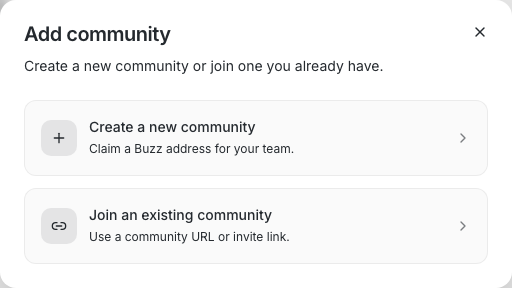 |  | | Create a new community | Hosted community icon | | --- | --- | |  |  | | Invites | Invite link | | --- | --- | |  |  | --------- Signed-off-by: Wes <wesbillman@users.noreply.github.com> Co-authored-by: Wes <wesbillman@users.noreply.github.com> Co-authored-by: Carl <c7ebe626f000404285d3686e1dc74cc07cc60a9754a150041ba132e14bd3e2ec@buzz.block.builderlab.xyz> |
||
|
|
b8510ede1b |
fix(desktop): clarify CLI runtime setup (#2680)
## Why Installing the Codex, Claude, or Goose desktop app does not install the command-line harness Buzz needs. The current UI makes that distinction unclear, links some missing-CLI states to adapter documentation, and can report a successful install from the installer exit code even when runtime discovery still fails. On Windows, Buzz also invokes Goose's Bash installer, which writes the executable somewhere Buzz does not discover. ## What - distinguish missing vendor CLIs from missing or outdated ACP adapters in runtime metadata and UI guidance - link Codex, Claude Code, and Goose missing-CLI states to their official CLI installation documentation - explain in Settings, onboarding, and agent configuration that the desktop app alone is not sufficient - use Goose's official PowerShell installer on Windows - refresh PATH and rediscover the requested runtime after installation, keeping the control retryable if the runtime is still unavailable - add Rust and Playwright regression coverage for Windows installer selection, CLI/adapter guidance, false-success prevention, verified installs, and onboarding copy ## Risk Assessment Medium. This changes desktop onboarding and runtime installation behavior. Successful installs now require the runtime catalog to verify availability; previously hidden discovery failures will surface as actionable errors instead of a false success state. ## References - [Codex CLI installation](https://developers.openai.com/codex/cli/) - [Claude Code installation](https://code.claude.com/docs/en/getting-started) - [Goose installation](https://goose-docs.ai/docs/getting-started/installation/) - Follow-up to #2563 and #2587 ## Validation - `just desktop-typecheck` - `just desktop-test` — 3,455 passed - focused Rust post-install verification tests - focused Playwright Doctor/onboarding coverage (in progress; CI and local sequential rerun will provide final results) Generated with Codex --------- Signed-off-by: Atish Patel <atish@squareup.com> Co-authored-by: Codex <noreply@openai.com> Co-authored-by: Goose <opensource@block.xyz> |
||
|
|
9731cd818b |
fix(onboarding): show real install errors and fix concurrent install state (#2658)
Signed-off-by: Will Pfleger <pfleger.will@gmail.com> Co-authored-by: npub1mn7jgtj4w2pd0g0zeuhxsa6jy6p0rewxz4kujt98my82ahfmp72sxjexk7 <dcfd242e557282d7a1e2cf2e6877522682f1e5c6156dc92ca7d90eaedd3b0f95@buzz.block.builderlab.xyz> |
||
|
klopez4212andGitHub
|
72bbaece4b | Match create-channel template selector styling (#2654) | ||
|
thomaspblockandGitHub
|
9081ab0ec9 | feat(desktop): make pull request reviews actionable (#2510) | ||
|
|
9cc9652c7d |
fix(desktop): shared-compute usability — share toggle, usage indicator, model resync (#2448)
Signed-off-by: Tyler Longwell <tlongwell@block.xyz> Co-authored-by: Michael Neale <michael.neale@gmail.com> Co-authored-by: npub1qyvc0c5kl4gqv2fd97fsk46tu378sqgy35vc83rvgfwne90sel7s0ed67d <011987e296fd5006292d2f930b574be47c7801048d1983c46c425d3c95f0cffd@buzz.block.builderlab.xyz> Co-authored-by: Tyler Longwell <tlongwell@block.xyz> |
||
|
klopez4212andGitHub
|
76aeae7036 | Clarify agent harness defaults in create flow (#2601) | ||
|
|
95478919fc |
feat: remember per-community navigation location (#2629)
Signed-off-by: npub1dccv64krpcpse5cmkzfeh998cftungyatw3djt8jwdw6g43f7fyqzzmrf7 <6e30cd56c30e030cd31bb0939b94a7c257c9a09d5ba2d92cf2735da45629f248@buzz.block.builderlab.xyz> Co-authored-by: npub1dccv64krpcpse5cmkzfeh998cftungyatw3djt8jwdw6g43f7fyqzzmrf7 <6e30cd56c30e030cd31bb0939b94a7c257c9a09d5ba2d92cf2735da45629f248@buzz.block.builderlab.xyz> |
||
|
|
e67303f603 |
Gate default relay auto-connect behind release flag (#2589)
Signed-off-by: npub1cl47vfhsqpqy9pwndphpm36vcp7vvz5h2js4qpqm5yewzj7nutkq7xyw8c <c7ebe626f000404285d3686e1dc74cc07cc60a9754a150041ba132e14bd3e2ec@buzz.block.builderlab.xyz> Co-authored-by: Bradley Axen <baxen@squareup.com> Co-authored-by: npub1cl47vfhsqpqy9pwndphpm36vcp7vvz5h2js4qpqm5yewzj7nutkq7xyw8c <c7ebe626f000404285d3686e1dc74cc07cc60a9754a150041ba132e14bd3e2ec@buzz.block.builderlab.xyz> |
||
|
|
f3f7688c3a |
fix(desktop): fast-track relay restart reconnects (#2579)
Signed-off-by: npub12gtutshhh76rx0jx697f32f9tffd4hhp3hx58fp4x6u4uemkm7sqf8f757 <5217c5c2f7bfb4333e46d17c98a9255a52dadee18dcd43a43536b95e6776dfa0@buzz.block.builderlab.xyz> Signed-off-by: npub1jh9wn95s0472h86ahapupaf7m6kx4v9sx2n0atj2hltcfer8k06s5n3pyf <95cae996907d7cab9f5dbf43c0f53edeac6ab0b032a6feae4abfd784e467b3f5@buzz.block.builderlab.xyz> Co-authored-by: npub12gtutshhh76rx0jx697f32f9tffd4hhp3hx58fp4x6u4uemkm7sqf8f757 <5217c5c2f7bfb4333e46d17c98a9255a52dadee18dcd43a43536b95e6776dfa0@buzz.block.builderlab.xyz> Co-authored-by: npub1jh9wn95s0472h86ahapupaf7m6kx4v9sx2n0atj2hltcfer8k06s5n3pyf <95cae996907d7cab9f5dbf43c0f53edeac6ab0b032a6feae4abfd784e467b3f5@buzz.block.builderlab.xyz> |
||
|
|
9ec52cfedf |
fix(desktop): retry failed initial relay dials (#2564)
Signed-off-by: npub12gtutshhh76rx0jx697f32f9tffd4hhp3hx58fp4x6u4uemkm7sqf8f757 <5217c5c2f7bfb4333e46d17c98a9255a52dadee18dcd43a43536b95e6776dfa0@buzz.block.builderlab.xyz> Co-authored-by: npub12gtutshhh76rx0jx697f32f9tffd4hhp3hx58fp4x6u4uemkm7sqf8f757 <5217c5c2f7bfb4333e46d17c98a9255a52dadee18dcd43a43536b95e6776dfa0@buzz.block.builderlab.xyz> |
||
|
|
80244f8231 |
Fix avatar upload lifecycle edge cases (#2277)
Signed-off-by: Logan Johnson <loganj@squareup.com> Signed-off-by: npub1dpf98sl35hm9k65t8h6cvh5n6knn2msugh5k5nmysxwnw5wlh7uqn2wgp4 <685253c3f1a5f65b6a8b3df5865e93d5a7356e1c45e96a4f64819d3751dfbfb8@sprout-oss.stage.blox.sqprod.co> Signed-off-by: npub13n66s06epmqf2kc3v373ez8hj65cuzyvxzjf93vwpervxqn2u7jq2qd9je <8cf5a83f590ec0955b11647d1c88f796a98e088c30a492c58e0e46c3026ae7a4@buzz.block.builderlab.xyz> Co-authored-by: npub1dpf98sl35hm9k65t8h6cvh5n6knn2msugh5k5nmysxwnw5wlh7uqn2wgp4 <685253c3f1a5f65b6a8b3df5865e93d5a7356e1c45e96a4f64819d3751dfbfb8@sprout-oss.stage.blox.sqprod.co> Co-authored-by: npub13n66s06epmqf2kc3v373ez8hj65cuzyvxzjf93vwpervxqn2u7jq2qd9je <8cf5a83f590ec0955b11647d1c88f796a98e088c30a492c58e0e46c3026ae7a4@buzz.block.builderlab.xyz> |
||
|
|
9cf9539040 |
chore: Omit the Model control when an optional-model harness has nothing to select (#2262)
Signed-off-by: Moe Jangda <m.jangda88@gmail.com> Co-authored-by: Cursor <cursoragent@cursor.com> |
||
|
|
fd967c6ea4 |
feat(desktop): gate sign-out behind key backup + typed confirmation (#2424)
Signed-off-by: Wes <wesb@block.xyz> Co-authored-by: npub1cl47vfhsqpqy9pwndphpm36vcp7vvz5h2js4qpqm5yewzj7nutkq7xyw8c <c7ebe626f000404285d3686e1dc74cc07cc60a9754a150041ba132e14bd3e2ec@buzz.block.builderlab.xyz> |
||
|
+2TylerGitHubnpub1jh9wn95s0472h86ahapupaf7m6kx4v9sx2n0atj2hltcfer8k06s5n3pyfTyler Longwellnpub12gtutshhh76rx0jx697f32f9tffd4hhp3hx58fp4x6u4uemkm7sqf8f757npub1mprnacetjua2xx3p5eddmhxyk6wv929ymm5py8kd2xfxurxahspqqlgytanpub1t2tgm7d8f995uqvmnm8h88sg3wnpp9a5xysjf6dg3tjmgt3ltulqdp8ehrDawnnpub1qyvc0c5kl4gqv2fd97fsk46tu378sqgy35vc83rvgfwne90sel7s0ed67dMatt TooheyClaude Fable 5npub1hwqy0rnujtl25dzmlhn8qwux4kr8sjhas3ugltx9j5dm5dwkp2dsqjhytw |
61cc738ee8 |
feat(desktop+acp): spawn a harness per (agent, community) pair at GUI startup — warm sockets, lazy LLM pool (#2122)
Signed-off-by: Tyler Longwell <tlongwell@block.xyz> Signed-off-by: Matt Toohey <contact@matttoohey.com> Signed-off-by: npub12gtutshhh76rx0jx697f32f9tffd4hhp3hx58fp4x6u4uemkm7sqf8f757 <5217c5c2f7bfb4333e46d17c98a9255a52dadee18dcd43a43536b95e6776dfa0@sprout-oss.stage.blox.sqprod.co> Signed-off-by: Tyler <109685178+tlongwell-block@users.noreply.github.com> Co-authored-by: npub1jh9wn95s0472h86ahapupaf7m6kx4v9sx2n0atj2hltcfer8k06s5n3pyf <95cae996907d7cab9f5dbf43c0f53edeac6ab0b032a6feae4abfd784e467b3f5@sprout-oss.stage.blox.sqprod.co> Co-authored-by: Tyler Longwell <tlongwell@block.xyz> Co-authored-by: npub12gtutshhh76rx0jx697f32f9tffd4hhp3hx58fp4x6u4uemkm7sqf8f757 <5217c5c2f7bfb4333e46d17c98a9255a52dadee18dcd43a43536b95e6776dfa0@sprout-oss.stage.blox.sqprod.co> Co-authored-by: npub1mprnacetjua2xx3p5eddmhxyk6wv929ymm5py8kd2xfxurxahspqqlgyta <d8473ee32b973aa31a21a65adddcc4b69cc2a8a4dee8121ecd51926e0cddbc02@sprout-oss.stage.blox.sqprod.co> Co-authored-by: npub1t2tgm7d8f995uqvmnm8h88sg3wnpp9a5xysjf6dg3tjmgt3ltulqdp8ehr <5a968df9a7494b4e019b9ecf739e088ba61097b4312124e9a88ae5b42e3f5f3e@sprout-oss.stage.blox.sqprod.co> Co-authored-by: Dawn <c6237ef84fa537c78dcee78efd2d4e59f728859c7f194da42ac51ededfa0be05@sprout-oss.stage.blox.sqprod.co> Co-authored-by: npub1qyvc0c5kl4gqv2fd97fsk46tu378sqgy35vc83rvgfwne90sel7s0ed67d <011987e296fd5006292d2f930b574be47c7801048d1983c46c425d3c95f0cffd@sprout-oss.stage.blox.sqprod.co> Co-authored-by: Matt Toohey <contact@matttoohey.com> Co-authored-by: Claude Fable 5 <noreply@anthropic.com> Co-authored-by: npub1hwqy0rnujtl25dzmlhn8qwux4kr8sjhas3ugltx9j5dm5dwkp2dsqjhytw <bb80478e7c92feaa345bfde6703b86ad86784afd84788facc5951bba35d60a9b@buzz.block.builderlab.xyz> |
||
|
morgmartandGitHub
|
50f4412167 | Hide bundled harnesses from onboarding (#2233) | ||
|
thomaspblockandGitHub
|
c11b7b611e | feat(desktop): browse immutable repository tags (#2231) | ||
|
thomaspblockandGitHub
|
001184395e | fix(desktop): keep project branches after reload (#2214) | ||
|
thomaspblockandGitHub
|
166f27be4b | fix(git): make project branch workflows reliable (#2213) |

















