mirror of
https://github.com/block/buzz.git
synced 2026-08-18 06:50:31 +02:00
985cdcc6eac33ccd77bc50c26e22c701d07eda4e
2086
Commits
| Author | SHA1 | Message | Date | |
|---|---|---|---|---|

|
985cdcc6ea |
feat(agents): model-tuning parity in global Agent Defaults editor (#4578)
## Overview

The global Agent Defaults surface (Settings card, defaults modal,
onboarding) exposed structured controls for Effort but left Max Output
Tokens, Context Limit, and Max Rounds as raw env vars. Per-agent dialogs
had structured numeric fields but only for `isBuzzAgentRuntime` —
incorrectly excluding Goose. This PR unifies numeric-tuning capability
across all surfaces, fixes a pre-existing dual-editor defect, and adds
full test coverage.

## What changed

### Phase 1 — Catalog projection

- Add `max_rounds_env_var` to `KnownAcpRuntime` in `runtime_metadata.rs`
(`Some("BUZZ_AGENT_MAX_ROUNDS")` for buzz-agent, `None` elsewhere).
- Project all three numeric env-var fields (`max_tokens_env_var`,
`context_limit_env_var`, `max_rounds_env_var`) end-to-end:
`AcpRuntimeCatalogEntry` Rust struct, TS `types.ts`,
`RawAcpRuntimeCatalogEntry` + `fromRawAcpRuntimeCatalogEntry` in
`tauri.ts`, and the e2e mock bridge (`withMockRuntimeConfigMetadata`).

### Phase 2 — Field model

- `deriveAgentConfigFieldModel` now derives `maxOutputTokens` /
`contextLimit` / `maxRounds` descriptors from catalog-projected fields.
- `structuredEnvKeys(descriptors)` — exported helper that takes the
**rendered** descriptor set (not the whole model). Hidden keys follow
what is actually rendered per surface: global hides effort + all three
numeric keys for buzz-agent / two for Goose; per-agent buzz-agent hides
effort + three numeric keys; per-agent Goose hides only its two numeric
keys. `BUZZ_AGENT_THINKING_EFFORT` stays a visible generic env row
per-agent because no effort control renders there.

### Phase 3 — UI

- Extract `NumericTuningFields` from `buzzAgentModelTuningFields.tsx` as
a shared descriptor-driven component (`descriptors`, `envVars`,
`inheritedEnvVars`, `onEnvVarChange`). Kind-specific minima:
`NUMERIC_KIND_MIN` map (`maxOutputTokens`/`contextLimit`: 1,
`maxRounds`: 0) applied to `<input min>`.
- **Global surface** (`AgentConfigFields.tsx`): deduplicate the
previously duplicated Advanced env-editor block; render
`NumericTuningFields` below the env editor when descriptors exist;
`hiddenKeys` and `bakedGenericRows` exclusions use `structuredEnvKeys`
so structured keys are never double-rendered. Under 1000 lines.
- **Per-agent surfaces** (`EditAgentAdvancedFields`,
`PersonaAdvancedFields`): replace `isBuzzAgentRuntime` as the
numeric-field gate with `deriveNumericDescriptors(selectedRuntime)` from
`agentConfigCore`; hidden keys come from
`structuredEnvKeys(numericDescriptors)` — the same rendered descriptor
set, no local rebuilding (fixes pre-existing dual-editor defect).
Catalog status carried as `RuntimeCatalogStatus` (`loading | ready |
error`); both error and loading withhold structured controls and leave
saved values visible as generic rows, making error distinguishable from
"runtime not capable" (`ready` + no runtime).
- **Dialogs** (`AgentDefinitionDialog`, `AgentInstanceEditDialog`,
callers): `AgentDefinitionDialog` accepts `runtimeCatalogStatus?:
"loading" | "ready" | "error"` (replaces separate
`runtimesLoading`/`runtimesError` booleans); all call sites —
`AgentManagementDialogs`, `AgentsView`, `RequestedAgentCreateDialogs`,
`UserProfilePersonaDialogs` — compute and pass the status.

### Phase 4 — Tests

- `buildRecord` exported from `EnvVarsEditor.tsx` as a pure `(nextRows,
value, requiredKeys, hiddenKeys) => Record<string, string>` helper for
isolation testing.
- **17 new node tests** in `agentConfigCore.test.mjs`:
`deriveNumericDescriptors` (all three fields, partial, undefined
runtime, matches field-model subset); `structuredEnvKeys` per surface
including discriminating Goose per-agent effort-key invariant;
`NUMERIC_KIND_MIN` values.
- **4 new node tests** in `EnvVarsEditor.test.mjs`: hidden tuning key
preserved through generic row edits; runtime-switch then generic edit
(derives both descriptor sets, asserts new-runtime hidden key survives
`buildRecord` via `hiddenKeys` and old-runtime key survives via generic
rows); baked numeric key excluded via `filterBakedGenericRows` with
`numericTuningPlaceholder` assertion; clearing a structured override —
`numericTuningPlaceholder` verifies placeholder text.
- **5 new Playwright tests** in `agent-numeric-tuning.spec.ts` (added to
smoke project `testMatch`): global numeric fields visible for
buzz-agent; global: non-capable runtime hides numeric controls; Goose
per-agent shows `Inherit (16384)` after saving global value through the
UI; delayed catalog: saved values visible as generic rows while loading
then structured controls appear after settle; failed catalog: saved
values remain visible as generic rows (never the "unsupported" empty
state).

## Result

- buzz-agent global defaults: Max output tokens, Context limit, Max
rounds as structured inputs with `Inherit (N)` placeholders from baked
env.
- Goose global defaults: Max output tokens, Context limit as structured
inputs.
- A Goose global value surfaces as `Inherit (<value>)` in the per-agent
Goose edit dialog.
- No structured key is editable in two places on any surface; no
persisted key has zero editors.
- No `runtime.id === "buzz-agent"` comparison decides numeric-field
visibility anywhere — capability flows catalog →
`AcpRuntimeCatalogEntry` → field model → UI.

Signed-off-by: Will Pfleger <pfleger.will@gmail.com>
Co-authored-by: npub1mn7jgtj4w2pd0g0zeuhxsa6jy6p0rewxz4kujt98my82ahfmp72sxjexk7 <dcfd242e557282d7a1e2cf2e6877522682f1e5c6156dc92ca7d90eaedd3b0f95@buzz.block.builderlab.xyz>
|
||
|
klopez4212andGitHub
|
027a74a61c |
Polish Share Compute settings (#3735)
## Summary - Refresh Share Compute with the shared agent-style model controls. - Reveal sharing details and advanced options only while sharing. - Remove the preview-only mesh API path. ## Validation - `pnpm check` - `pnpm test` - `pnpm exec playwright test tests/e2e/mesh-compute.spec.ts` Snapshots are attached in a follow-up comment. --------- Signed-off-by: kenny lopez <klopez4212@gmail.com> |
||
|
|
7981597848 |
fix(reactions): wrap long popover names (#3834)
**Category:** fix **User Impact:** Long custom emoji names now stay contained inside reaction popovers and remain fully readable. **Problem:** An unbroken custom emoji name could force a reaction popover beyond its intended maximum width and overflow the message view. **Solution:** Give the reaction popover a definite 288px width and allow the complete emoji name to wrap within it without truncation or ellipsis. Short names retain the same content and interaction behavior. <details> <summary>File changes</summary> **desktop/src/features/messages/ui/MessageReactions.tsx** Bounds the reaction popover width and allows long names to break across lines while preserving the full shortcode. **desktop/tests/e2e/reaction-names.spec.ts** Covers fixed width, full text preservation, and wrapping for the maximum supported colon-wrapped reaction name, with deterministic seeded Picsum visual fixtures and explicit image-load waits. </details> ## Reproduction Steps 1. Open a message with a custom emoji reaction whose name is 64 characters. 2. Hover or focus the reaction pill to open its details popover. 3. Confirm the popover remains 288px wide and the complete name wraps within it without ellipsis. 4. Open a short-name reaction and confirm its popover remains readable and unchanged in behavior. ## Screenshots | Before | After | | --- | --- | | 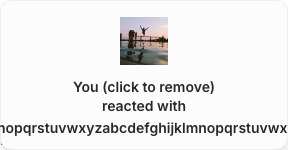 | 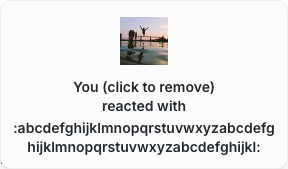 | **Short-name regression check** 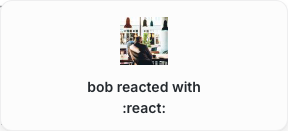 ## Verification - `pnpm test` in `desktop`: 3,858 passed - Focused reaction-name E2E with seeded Picsum captures: 2 passed - Desktop checks and commit hooks passed Originating Buzz channel: `f2ec9671-d78e-4cde-894c-9f4c458c7f1f` --------- Signed-off-by: Taylor Ho <taylorkmho@gmail.com> Co-authored-by: npub1223z34hd7vtwc6qj4s7flsxkj644nlre2nthu7lrrmkumhu3xddsrx9r6w <52a228d6edf316ec6812ac3c9fc0d696ab59fc7954d77e7be31eedcddf91335b@buzz.block.builderlab.xyz> |
||
|
|
d4a4570b97 |
fix(desktop): clarify inherited agent parallelism (#4010)
## Summary - show an unambiguous `App default (10)` inherited state for parallelism in create and edit forms - explain that blank inherits the app default and suppress create-form number steppers that could silently set `1` - align the E2E mint fallback with production while preserving explicit input → definition → app-default precedence ## Why The forms displayed `1` even though an untouched field is omitted and desktop minting materializes `10`. The create-form spinner could also turn blank/inherited into an explicit `1` with one click while leaving the field looking nearly unchanged. ## Testing - `pnpm test` (desktop: 3,886 passed) - `pnpm typecheck` (desktop) - `pnpm check` (desktop) - pre-push `desktop-check` and `desktop-test` --------- Signed-off-by: Wes <wesbillman@users.noreply.github.com> Co-authored-by: Carl <c7ebe626f000404285d3686e1dc74cc07cc60a9754a150041ba132e14bd3e2ec@buzz.block.builderlab.xyz> |
||
|
|
5c98932c59 |
feat(desktop): make onboarding model defaults skippable (#3968)
**Category:** improvement **User Impact:** Users can skip default model configuration during onboarding and finish it later in Settings → Agents. **Problem:** Requiring model defaults during onboarding can block users who are not ready to choose a harness, provider, or model. Skipping also needs to leave existing configuration untouched rather than persisting partial selections. **Solution:** Stage onboarding edits locally and persist them only when users choose Next or Back. A delayed Skip action advances without any configuration write, while a footer hint points users to the settings location for completing setup later. <details> <summary>File changes</summary> **desktop/src/features/onboarding/ui/DefaultConfigStep.tsx** Adds the skip action and future-settings hint, and makes model configuration transactional so Skip discards staged changes while Next and Back preserve the intended save behavior. **desktop/src/testing/e2eBridge.ts** Exposes model-config setter call counts so tests can distinguish a true zero-write skip from a write-and-rollback implementation. **desktop/tests/e2e/onboarding-agent-defaults.spec.ts** Covers skipping during loading and after staged edits, verifies zero persistence calls, and confirms Next and Back still commit changes. </details> ## Reproduction steps 1. Start fresh onboarding and continue through harness setup to **Configure your default model settings**. 2. Change the selected harness or model, then choose **Skip for now**. 3. Confirm onboarding advances to **Join or create a community** and the prior global model configuration remains unchanged. 4. Return through onboarding and confirm **Next** saves the staged selection; confirm **Back** also preserves staged changes before returning. 5. Confirm the footer says model defaults can be configured later in **Settings → Agents**. --------- Signed-off-by: Taylor Ho <taylorkmho@gmail.com> Signed-off-by: npub1223z34hd7vtwc6qj4s7flsxkj644nlre2nthu7lrrmkumhu3xddsrx9r6w <52a228d6edf316ec6812ac3c9fc0d696ab59fc7954d77e7be31eedcddf91335b@buzz.block.builderlab.xyz> Co-authored-by: npub1223z34hd7vtwc6qj4s7flsxkj644nlre2nthu7lrrmkumhu3xddsrx9r6w <52a228d6edf316ec6812ac3c9fc0d696ab59fc7954d77e7be31eedcddf91335b@buzz.block.builderlab.xyz> |
||
|
|
e1f6da7c42 |
ci: add guarded desktop release cache prewarm (#4575)
## Summary Gate 1 only for desktop release caching: - replaces canary `rust-cache` use with explicit exact-key `actions/cache/restore` + `save` - computes keys after `cargo update --workspace`, including platform, target, Rust toolchain, Cargo manifests/locks, profile/features, and native-toolchain inputs - normalizes only the desktop package version so a trusted `main` canary can warm an otherwise identical release tag - excludes Tauri bundle directories, so installers and signed artifacts are never cached - adds a restore-only `cache-proof-*` tag workflow that fails unless tag scope sees the exact default-branch cache - adds contract tests that enforce no release-workflow cache change in Gate 1 `release.yml` is intentionally unchanged. A cache miss remains the current cold canary build; the release path cannot be affected by merging this PR. ## Validation - `scripts/test-desktop-release-cache-key.sh` - `scripts/test-desktop-release-cache-workflow.sh` - `scripts/test-release-ref-contract.sh` - Ruby YAML parse of all four changed workflows - `git diff --check` - pre-push `branch-skew` ## Post-merge proof plan 1. Run each canary cold on trusted `main`, recording cache size/save time and fresh artifact inventory. 2. Run each canary warm, requiring the exact-key hit and recording restore/build time. 3. Create a disposable `cache-proof-*` tag at that same trusted `main` SHA and dispatch **Desktop release cache tag-scope proof** from the tag. 4. Do not begin Gate 2 or modify `release.yml` unless the exact tag-scope restore succeeds and cache transfer economics are favorable. --------- Signed-off-by: Wes <wesbillman@users.noreply.github.com> Co-authored-by: Carl <c7ebe626f000404285d3686e1dc74cc07cc60a9754a150041ba132e14bd3e2ec@buzz.block.builderlab.xyz> |
||
|
|
ce56e34411 |
fix(mobile): recover stale relay sessions (#4372)
### Summary Fixes [this issue](buzz://message?channel=e62570dd-33ad-42c5-b92b-75f2689f9694&id=b726c366abfe62429ee3cdcd34d0c0fb98c33c3ea053480585bed71745412b56): > I often don’t see my bot responses until after I post. they’re usually time stamped correctly so I think it’s just a refresh issue? ### What changed? Buzz Mobile now reconnects relay sessions after the app has remained backgrounded beyond the existing 5-second grace period, even when the session still reports a stale `connected` state. This makes resume recovery independent of whether iOS runs the grace timer before or after delivering `resumed`. Reconnection is now based on elapsed background time rather than a direct socket-health probe. - If the app was backgrounded for at least the 5-second grace period, the socket is presumed dead and the session reconnects regardless of reported status. - If it was backgrounded for less than that, a reported `connected` status is still trusted. In the sub-5-second window the socket is either genuinely alive, which is the common case for a momentary background, or it is dead and the client ping detects it within the two-interval worst case described below. That is now a degraded-latency path, not a silent-forever path. The mobile relay socket now uses `IOWebSocketChannel.connect` with a 30-second `pingInterval`. An unanswered ping closes the Dart socket through the existing disconnect and reconnect path. Detection takes up to two ping intervals, so about 60 seconds worst case, not 30. One interval of idleness elapses and a ping is sent, then a second interval elapses with no pong and the socket closes. Any inbound pong restarts the first stage, so the clock measures idleness rather than running on a fixed cadence. ### Why? Buzz iOS can sometimes stop showing new bot or agent responses after a phone has been locked for 5 to 10 minutes. When the user later posts a message, the missing responses can appear all at once. iOS may suspend Buzz before the short delayed cleanup that would normally close its connection has a chance to run. Before this change, Buzz trusted the resulting stale healthy status on resume and skipped reconnecting, so the missing responses stayed hidden until a later post exposed the dead connection. A state-machine test with a stubbed connection reproduced this reported pattern and showed that it matches this failure mode: the failed post triggered a reconnect that fetched the missing messages. The same test also checked the other candidate explanation, the bug tracked in [#3053](https://github.com/block/buzz/pull/3053), where the relay has closed the app's subscription. That state does not produce the pattern. Posting succeeds and the user's own message appears, but nothing looks for the missed messages, so they stay hidden. The test confirmed that the missed messages were still available to fetch in that state, so the missing step was a trigger to fetch them. This was not an end-to-end reproduction on an iOS device or a live relay. The new resume check covers the normal lock and unlock path. If the app was backgrounded for less than the 5-second grace period, it still trusts a connection marked as healthy. A dead connection in that window is instead detected by the ping check, which can take up to about 60 seconds but prevents the app from remaining silently stuck. The ping only runs while iOS is running the app, so it does not detect a connection that died during suspension; the resume check owns the lock and unlock path. A pre-existing path also runs the same resume handling when network connectivity returns while the app is already in the foreground. Because the app was not backgrounded, this change does not alter that path, which still trusts a connection marked as healthy and relies on the slower ping check. Recovery from a subscription that the relay explicitly closes remains in [#3053](https://github.com/block/buzz/pull/3053), and the two changes overlap in one file. Changes to how missed messages are backfilled or replayed are out of scope. ### How is it tested? Full mobile suite at base and head. Both runs have the same known macOS-host-only failure in `ChannelDetailPage keeps follow mode off while a tall newest message stays visible` at line 1053: - Base: 1,021 passed, 1 skipped, 1 failed - Head: 1,025 passed, 1 skipped, 1 failed Added tests: - [`relay_session_test.dart`](https://github.com/block/buzz/tree/main/mobile/test/shared/relay/relay_session_test.dart): long-background resume reconnect and within-grace control - [`relay_socket_liveness_test.dart`](https://github.com/block/buzz/tree/main/mobile/test/shared/relay/relay_socket_liveness_test.dart): silent-peer disconnect and idle-but-healthy control Mutation checks confirm that removing elapsed-background resume recovery fails with one socket instead of two, and removing `pingInterval` leaves the silent peer connected. Restored production code passes both mutations' regression tests and the healthy idle control. Signed-off-by: Tom Brow <tomb@block.xyz> Co-authored-by: npub1tquskdu6yc4h8l7xxtceculxw600grekeq0xg2ukqfrwl7vrzg3quz3gmp <58390b379a262b73ffc632f19c73e6769ef40f36c81e642b960246eff9831222@buzz.block.builderlab.xyz> |
||
|
|
651f637275 |
chore(release): release Buzz Desktop version 0.5.4 (#4562)
## Buzz Desktop release v0.5.4

- **Frozen main:** `6de85fe31d781122756aecf954bae7d357a56b9a`
- **Reviewed candidate:** `5836cb8f0af478ed3ee3bc6464a20fa4cc91303f`
- **Previous desktop release:** `desktop-v0.5.3`
- **Proposed immutable tag:** `desktop-v0.5.4`

This PR must be **squash merged** only after the Desktop Release
Candidate check passes. The branch must remain based directly on current
`main`; stale base, payload drift, incomplete notes, or an unauthorized
merge produce no tag.

The checked-in changelog accounts for every non-merge commit in the
release range. Publication remains bound to the immutable candidate tag.

Signed-off-by: Wes <wesbillman@users.noreply.github.com>
Co-authored-by: Release Automation <release-automation@users.noreply.github.com>
mobile-v0.8.0-rc.1 desktop-v0.5.4 |
||
|
|
6de85fe31d |
test(mobile): assert follow boundary semantics (#4559)
## Summary - replace a platform-dependent mounted-`RichText` assertion with the production follow-mode boundary predicate - retain the jump-to-latest assertion as the visible consequence of follow mode remaining off - leave production behavior and desktop PR #4549 unchanged ## Why `ScrollablePositionedList` may keep an offscreen item mounted within cache extent on macOS while Linux does not. Mounting therefore does not establish whether reversed-list item 0 is at the latest boundary. The replacement reads the list's public `itemPositionsNotifier` and applies the same `index == 0 && abs(itemLeadingEdge) < 0.01` contract used by `message_list.dart`. ## Validation At commit `bc88617e61d8e9edf8fea832baa8d918163ee212` on macOS with repo Flutter 3.41.7: - `cd mobile && ../bin/flutter test` — 1088 passed, 1 skipped - `cd mobile && ../bin/flutter analyze` — no issues - pre-push `mobile-test` and `branch-skew` hooks — passed Signed-off-by: Wes <wesbillman@users.noreply.github.com> Co-authored-by: Carl <c7ebe626f000404285d3686e1dc74cc07cc60a9754a150041ba132e14bd3e2ec@buzz.block.builderlab.xyz> |
||
|
|
44fa1e8e3a |
docs(release): align desktop handoff instructions (#3988)
## Summary - document exact-head trusted approval as the only desktop tagging authorization - explicitly require `desktop_ref=desktop-v<version>` for the internal desktop handoff - replace the stale `squareup/sprout-releases` repository name with `squareup/buzz-releases` ## Audit coverage Compared `block/buzz` release documentation and automation with `squareup/buzz-releases` `main` (`5b09e5c5d71c80a0849a33458f4e45695df515d7`), including its README, agent guide, Buildkite field hint, desktop validator, release validation tests, and protected updater promotion instructions. ## Validation - `bash scripts/test-release-ref-contract.sh` - `git diff --check origin/main...HEAD` Signed-off-by: Wes <wesbillman@users.noreply.github.com> Co-authored-by: Carl <c7ebe626f000404285d3686e1dc74cc07cc60a9754a150041ba132e14bd3e2ec@buzz.block.builderlab.xyz> |
||
|
|
09c86c56e5 |
fix: report agent usage per provider round, not once per turn (#4545)
## The bug buzz-agent emitted its `usage_update` notification in exactly one place: after `ctx.run()` returned. Until that moment a turn's token counters lived only in the prompt task's stack frame. **A turn killed mid-flight reported nothing at all** — the provider had already billed every round it completed, and no consumer ever saw any of it. That is not a corner case for anything that ends a turn on a clock. It is the normal case for a long-horizon benchmark run that relaunches its agent between phases. ## How big Measured against a provider's own billing ledger over one run's window: | | provider ledger | what we recorded | |---|---|---| | the relaunched lead seat | $485 / 348M tok | $98.99 / 90.3M tok | | the two seats that were not relaunched | $29.90 / 856M | $25.81 / 765M — reconciles | 97% of that run's usage rows came back all zeros, against 1–4% for comparable runs that never relaunch. In one 450-phase trial exactly 7 phases recorded any usage — and each of those carries 177k–437k input tokens, a whole session's worth landing in the one phase that happened to end gracefully. Worth being precise about what was *not* wrong, since both were plausible and both were checked: - **Not pricing.** The rates were verified against the provider's endpoints API and match what we charge. - **Not a truncation bug.** The usage files were intact and internally consistent. The tokens were never captured in the first place. ## The fix The run loop now emits a session-cumulative `usage_update` after every usage-bearing provider response, so an interrupted turn has reported everything but its single in-flight request. - **Emitting more than once per turn is already part of the contract.** buzz-acp's `UsageTracker` advances its committed baseline only at publish time, and goose behaves the same way — which is why the tracker was written to tolerate it. - **The turn-start session baseline is snapshotted into `RunCtx`** so the mid-turn figure stays *session*-cumulative. A turn-local number would be discarded by a high-water-mark consumer and lose the turn entirely; there is a test for exactly that. - **Snapshot by value, not a session handle.** The loop reports once per round, and taking the sessions lock on each would serialise concurrent sessions behind one another's provider round-trips. Nothing else advances those counters while the turn holds `busy`, so it cannot go stale. - **One shared `wire::usage_update_payload`** for both call sites, so the mid-turn and end-of-turn shapes cannot drift. A drift there would present as tokens silently vanishing, which is the failure this reporting exists to prevent. ## Why not a SIGTERM handler That was the obvious shape and it does not work. At signal time the counters are not sitting anywhere a handler could reach — they are in the turn's stack frame, and the value the handler would need has not been folded into the session yet. Making usage durable *during* the turn is what actually fixes it; once it is, a handler adds nothing beyond the in-flight request, whose cost is unknown until its response lands. ## Tests - `usage_is_reported_after_each_round_not_only_at_turn_end` — two rounds; asserts the **first** notification carries round 1's counts alone, proving it went out before round 2 returned. - `mid_turn_usage_includes_earlier_turns` — a mid-turn report must be session-cumulative, not turn-local. buzz-agent 18/18 on the `fake_llm` suite, 382 unit. `cargo fmt` / `clippy` / `cargo check --workspace --all-targets` clean. ## Scope Agent-side only, against `main`. The matching harness change — settling usage on the timeout path, which was skipped on the reasoning that an incomplete turn has nothing to flush — is **#4553**, against the benchmark branch, since that harness does not exist on `main`. 🤖 Generated with [Claude Code](https://claude.com/claude-code) Signed-off-by: Atish Patel <atish@squareup.com> Co-authored-by: Claude Code <noreply@anthropic.com> |
||
|
|
80315ac1a6 |
fix(desktop): harden Windows installs against Defender block and orphaned Node (#4382)
This PR fixes two Windows-specific install failures: Windows Defender blocking the bare `irm|iex` PowerShell install command, and managed Node shims pointing at a version-bumped (now-absent) Node directory. The Defender block (Trojan:Win32/Commando.A!ml) fires before PowerShell runs and is not clearable via Allow. The Node orphaning means shims in the managed npm prefix resolve but fail at runtime with 'node not recognized' because they reference the deleted old Node path. - Replace all three Windows CLI install commands (Goose, Claude, Codex) with a two-step shape — `Invoke-RestMethod` to a named temp file, then execute — to eliminate the dropper signature; a new `windows_install_command!` macro in `discovery/windows_install.rs` generates all three strings at compile time so the shape cannot drift between runtimes - `$ErrorActionPreference='Stop'` aborts on download failure instead of falling through to a missing-file exit-0; `exit $LASTEXITCODE` propagates the vendor script's own exit code - Add `probe_node(executable, expected_version, timeout)` as a bounded seam: stdout goes to a temp file (not a pipe) so no exit path can block on an inherited handle; the child runs in its own process group on Unix so an unconditional group SIGKILL on every exit path terminates all descendants; on Windows `taskkill /T /F` provides the same tree-wide cleanup; `managed_node_runtime_ready()` is a thin wrapper that resolves the managed Node path and calls the seam - Add `resolve_adapter_path()` in `managed_node.rs`: resolves the candidate first, then calls `should_invalidate_adapter()` — a pure predicate that returns `true` only when the resolved path is under `buzz_managed_npm_bin_dir()` AND the managed Node runtime is orphaned; external adapters outside the managed prefix are always preserved Note: CI cannot reproduce the Defender block (no live Defender ML classifier). Proof of fix is structural — the command shape no longer matches the dropper signature. Canary validation on a real Windows machine with Defender enabled is the definitive check. --------- Signed-off-by: Will Pfleger <pfleger.will@gmail.com> Co-authored-by: npub1mn7jgtj4w2pd0g0zeuhxsa6jy6p0rewxz4kujt98my82ahfmp72sxjexk7 <dcfd242e557282d7a1e2cf2e6877522682f1e5c6156dc92ca7d90eaedd3b0f95@buzz.block.builderlab.xyz> |
||
|
|
c1b88af8d7 |
feat(desktop): improve channel template discovery (#4549)
## Summary - move **Channel templates** from Communities to Personal settings - always expose the template picker in New Channel, using **None** as the no-template value - create a channel template directly from the picker and select it on return - preview the selected template's current visibility, canvas, agents, and teams - order the channel-creation controls as **Type / Visibility / Template** and mark Template **Optional** - cover populated and empty libraries, inline creation, selection, visibility overrides, mixed agent/team inventory, field order, optional labeling, and settings navigation in Playwright ## Validation Validated at desktop-only tip `76442270c88aa1d533ddca5de9f87cd615183919` with a clean worktree: - focused channel-template Playwright: 2/2 passed - Type / Visibility / Template ordering and muted Optional treatment visually inspected in the replacement screenshot - `git diff --check origin/main...HEAD` passed - PR diff contains exactly nine Desktop files and no Mobile files The pre-push hook was bypassed only for the corrected history push because the inherited Mobile test `keeps follow mode off while a tall newest message stays visible` passes in Linux CI but fails on macOS because its offscreen-child mounting assertion is platform-sensitive. No Mobile code or tests are changed by this PR. ## Screenshot 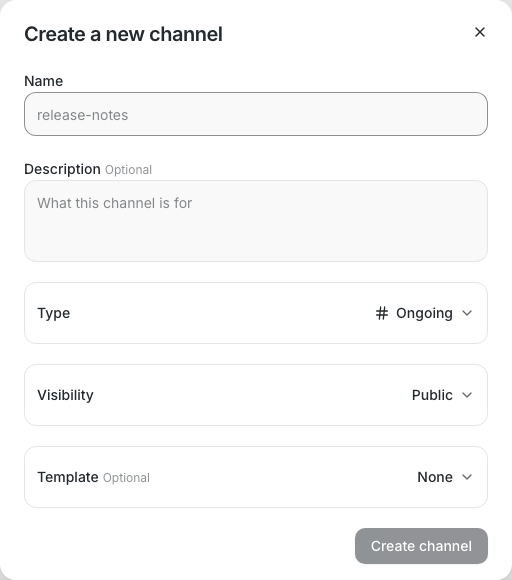 Originating Buzz channel: `efba7343-e147-48b7-a2aa-15a5f04abc57` --------- Signed-off-by: Wes <wesbillman@users.noreply.github.com> Co-authored-by: Carl <c7ebe626f000404285d3686e1dc74cc07cc60a9754a150041ba132e14bd3e2ec@buzz.block.builderlab.xyz> |
||
|
|
01c80aa9b3 |
fix(desktop): save key backups to authorized path (#4022)
**Category:** fix **User Impact:** Users can save password-protected identity backups directly to protected macOS folders such as Downloads. **Problem:** Signed macOS builds could not save a portable `.ncryptsec` backup to Downloads because the atomic writer created an unauthorized sibling temporary file. This surfaced as an “Operation not permitted” error after the user completed backup creation. **Solution:** Portable exports now write only to the exact path authorized by the native Save panel, sync and verify the saved bytes, and refuse to truncate an existing backup. Buzz’s app-managed backup retains its atomic writer and durability guarantees. <details> <summary>File changes</summary> **desktop/src-tauri/src/commands/export_util.rs** Clarifies that secret exports use a dedicated writer compatible with native Save-panel authorization. **desktop/src-tauri/src/commands/identity.rs** Routes portable NIP-49 exports through the Save-panel-compatible writer while preserving canonical app state. **desktop/src-tauri/src/key_backup.rs** Adds an exclusive-create portable writer with owner-only permissions, disk sync, byte verification, and cleanup on failure. Keeps the existing atomic writer for app-managed backups. **desktop/src-tauri/src/key_backup_tests.rs** Covers portable export permissions, absence of sibling files, and preservation of existing backups. </details> ## Reproduction steps 1. Install a signed macOS build containing this change. 2. Open **Settings → Profile → Private key → Create backup** and complete backup creation. 3. Save a fresh `identity.ncryptsec` file into `~/Downloads` and confirm Buzz reports success. 4. Open and verify the saved backup with its password. 5. Repeat the save using an existing filename and confirm Buzz preserves the existing file and asks for a new filename. ## Verification - Full desktop Tauri suite: 2,049 passed, 14 ignored - Diagnostic suite: 3 passed - Focused backup coverage: 30 passed - Tauri clippy (`--all-targets -D warnings`), Rust formatting, and `git diff --check`: passed - Push hooks: org safety, branch skew, and desktop Tauri checks passed Signed-production Downloads smoke remains required after merge because the signing workflow is restricted to `main`. Signed-off-by: Taylor Ho <taylorkmho@gmail.com> Co-authored-by: npub1223z34hd7vtwc6qj4s7flsxkj644nlre2nthu7lrrmkumhu3xddsrx9r6w <52a228d6edf316ec6812ac3c9fc0d696ab59fc7954d77e7be31eedcddf91335b@buzz.block.builderlab.xyz> |
||
|
klopez4212andGitHub
|
b0c6d6f744 |
Add channel activity hover menu (#3935)
## Summary - show relevant unread threads and active agents when hovering a channel - keep channel-level unread emphasis separate from thread activity dots - make activity rows navigate to the thread and remove demo-only data ## Test plan - `just ci` (all stages passed except the final duplicate native check, which ran out of disk after its earlier clippy pass) - `cd desktop && pnpm exec playwright test tests/e2e/channel-activity-popover.spec.ts --project=smoke` --------- Signed-off-by: kenny lopez <klopez4212@gmail.com> |
||
|
|
f865c0054b |
feat(desktop): show saved Run on settings when editing an agent (#4539)
## What When editing an agent, show where it runs. The edit dialog previously showed nothing about the backend; the "Where to run" section only existed in the create flow. This adds a read-only **Run on** section to `AgentInstanceEditDialog`: - **Local agents:** "This computer". - **Provider agents (e.g. Kubernetes):** the provider id plus its saved config rows — context, namespace, image, resources, etc. — with labels humanized from the stored keys and rows in provider-schema order (locators first, request/limit pairs adjacent, alphabetical spillover for unknown providers). - Copy states these are the settings **saved at creation** and that the run location can't be changed afterwards (a new agent is required). ## Design decisions (from thread review with @Wren + @Sami) - **No provider probe on edit.** `info` is executable work, and its schema reflects the plugin *today* (including a freshly generated random namespace default) — not what this agent was deployed with. The stored record is the only honest source. - **Saved settings, not effective settings.** Optional fields a record omits (e.g. `service_account`) are defaulted by the provider at deploy time; we render only what was persisted and never synthesize today's defaults. - **Safe rendering of opaque provider config.** Values render as safe scalars only; arrays/objects degrade to a summary row (React throws on object children — a hand-edited record must not crash the dialog). Falsy-but-present values (`0`, `false`) render honestly. Secret-shaped keys are redacted using the same word-split heuristic as the create-time `validate_provider_config` gate — one definition of "looks like a secret". The gate already blocks such keys on every app write path; display-side redaction is screenshot hygiene and covers hand-edited records. - **`backendAgentId` intentionally excluded:** deploy-time runtime state written on start, not saved creation intent. - **Read-only, no form state.** The backend is immutable post-create (`UpdateManagedAgentRequest` has no backend field), so the section renders straight from `agent.backend` with no reset effect. - `ADVANCED_FIELDS_MOTION_TRANSITION` was duplicated in both agent dialogs; hoisted to `agentConfigOptions` (also keeps the edit dialog inside the file-size ratchet). ## Testing - Unit contract for `summarizeRunOn` (9 tests): scalar honesty incl. `0`/`false`, structured-value fallback, secret redaction fail-safe, preferred ordering with spillover, key humanization. - Playwright spec (4 tests, registered in the smoke project): kubernetes agent with the exact eight-key record a real create flow persisted, local agent, blox agent (`workstation_name`), and redacted secret-shaped keys from a hypothetical future provider. - `pnpm typecheck`, `pnpm check`, full `pnpm test` (3937 pass) green at this head. - Live screenshots posted in the originating Buzz thread. --------- Signed-off-by: Tyler <109685178+tlongwell-block@users.noreply.github.com> Co-authored-by: npub1qyvc0c5kl4gqv2fd97fsk46tu378sqgy35vc83rvgfwne90sel7s0ed67d <011987e296fd5006292d2f930b574be47c7801048d1983c46c425d3c95f0cffd@buzz.block.builderlab.xyz> |
||
|
|
5e0efb0bb9 |
fix(desktop): disambiguate provider API key labels and annotate mint key (#4406)
Two different credentials were presented under the same name throughout the app. The top-level credential field for non-Anthropic providers (OpenAI, OpenAI-compatible, OpenRouter) was labeled "OpenAI API Key" via a hardcoded binary ternary repeated in three dialogs. The card-minting key (`OPENAI_API_KEY`) and the runtime credential (`OPENAI_COMPAT_API_KEY`) have independent endpoint namespaces and consumers (`OPENAI_COMPAT_BASE_URL`/`OPENAI_COMPAT_API_KEY` for runtime, `OPENAI_BASE_URL`/`OPENAI_API_KEY` for minting) and must remain separate — either may require a different credential. This PR makes them impossible to confuse in the UI. ## Changes **Provider-accurate labels from the credential table.** `PROVIDER_CREDENTIAL_CONFIG` entries now carry an `apiKeyLabel` paired with `secretEnvVar` as a discriminated union (both present or neither — a future provider cannot ship a secret field with no label). `getProviderApiKeyLabel(providerId)` is the single source of truth. The three hardcoded ternaries in `AgentConfigFields`, `AgentInstanceEditDialog`, and `AgentDefinitionDialog` are replaced by this helper. Labels: `openai` → "OpenAI Runtime API Key", `openai-compat` → "OpenAI-compatible Runtime API Key", `openrouter` → "OpenRouter API Key" (was incorrectly "OpenAI API Key"), `anthropic` → "Anthropic API Key" (unchanged). **Field names its backing env var.** `PersonaProviderApiKeyField` renders the env var name as a monospace hint beneath the label with `aria-describedby` wiring. All three call sites pass their `secretEnvVar`. A user who sees `OPENAI_API_KEY` in the mint dialog can now confirm at a glance that the credential field shows `OPENAI_COMPAT_API_KEY` — a different key. **Signpost visible at the decision point.** `CARD_MINT_KEY_ANNOTATIONS` is exported from `agentConfigOptions.tsx` (single source) and passed as `keyAnnotations` to all three generic env editors: both `EnvVarsEditor` branches in Agent Defaults, `EditAgentAdvancedFields`, and `PersonaAdvancedFields`. `CardMintKeyCue` — a new small component — renders an always-visible muted cue beneath the Advanced toggle when `OPENAI_API_KEY` is present in global env (Advanced is collapsed by default, so the per-row annotation is invisible until the cue guides the user to open it). **Model discovery error copy.** The `OPENAI_COMPAT_API_KEY required` message now reads "Enter an OpenAI runtime API key (OPENAI_COMPAT_API_KEY) to load OpenAI models." — naming the env var explicitly so it cannot be confused with the mint key. ## Tests - `getProviderApiKeyLabel` helper: pinned correct label per provider including the new distinct labels for `openai` and `openai-compat` - `PersonaProviderApiKeyField` render: semantic label present; env-var hint rendered when `envVarName` provided; `aria-describedby` wired to hint id; hint and describedby absent when prop omitted - `EnvVarsEditor` render: annotation appears exactly once on the matching row; absent for non-matching rows - `personaModelDiscoveryStatus`: pinned new copy naming `OPENAI_COMPAT_API_KEY` explicitly - Playwright: stale `"OpenAI API Key"` selectors updated; new `card-mint-key-cue-visible-and-annotation-in-advanced` test covers Will's exact path (databricks_v2 global provider + saved `OPENAI_API_KEY` → cue visible before opening Advanced → annotation present after opening) ## File sizes (post-format) | File | Lines | |------|-------| | `AgentConfigFields.tsx` | 994 (≤ 996) | | `AgentInstanceEditDialog.tsx` | 1228 (≤ 1228) | | `AgentDefinitionDialog.tsx` | 1045 (≤ 1047) | Related: [#4140](https://github.com/block/buzz/pull/4140) --------- Signed-off-by: Will Pfleger <pfleger.will@gmail.com> Co-authored-by: npub1ng3jzsaqxdhrfq22dg85j3lpr0zsh3jp7g2h9jyxl59wraayapnsu6kvfg <9a232143a0336e34814a6a0f4947e11bc50bc641f21572c886fd0ae1f7a4e867@buzz.block.builderlab.xyz> |
||
|
|
f810a2f49e |
fix(desktop): make OpenAI key re-enterable after first save in card mint dialog (#4140)
Fixes a write-once dead-end in the card mint dialog where a user with an
expired OpenAI key had no way to replace it.

**Source-aware key status (Rust + TypeScript).** `card_mint_key_status`
returns a layer discriminant (`"none" | "global" | "persona" | "agent" |
"process"`) instead of a boolean. A pure `resolve_key_layer()` helper in
`card.rs` owns the classification logic; `card_mint_key_status`
delegates to it, so the production path is under direct test with no
duplicate logic.

**Mint form always reachable.** The key panel replaces the mint form
only for `none` (first-time setup) or when the user explicitly opens the
edit panel (`editingKey`). Keys from agent/persona/process layers show
an inline provenance row on the mint form with a "Why?" affordance;
clicking it shows the read-only redirect in a panel with a Cancel button
that returns to the mint form — never a terminal state.

**Precise auth-error matching.** The 401 handling in `cardMintStore.ts`
matches `startsWith("Card mint failed (HTTP 401 ")` plus the specific
`Incorrect API key` text, so avatar-fetch 401 errors pass through
unchanged.

**Tri-state key status row.** "Using your saved OpenAI key · Update"
renders only when `keyLayer === "global"` (confirmed writable key).
Query pending or errored hides the row without asserting key existence.

**Real tests.** Panel visibility derivations live in
`cardMintKeyUtils.ts`, which `AgentCardMintDialog.tsx` imports directly.
Tests cover all layers including the mint-reachability invariant (Mint
reachable for every resolved layer; only `none` gates setup).

- `card.rs` — new `resolve_key_layer()` pure helper;
`card_mint_key_status` delegates to it; 999 lines (under the 1000-line
ratchet)
- `card/tests.rs` — precedence test calls `resolve_key_layer()` directly
(no test-local closure); adds process-layer and blank-value cases
- `tauriPersonas.ts` — `CardMintKeyLayer` type; updated
`cardMintKeyStatus` signature
- `cardMintKeyUtils.ts` — `showKeyPanel`, `showReadOnlyRow`,
`showCancelButton`, `keyPanelTitle`, and helpers; component imports all
of them
- `AgentCardMintDialog.tsx` — inline provenance rows for all key
sources; key panel only for setup/edit; no unused variables
- `cardMintStore.ts` — precise 401 prefix matching
- `e2eBridge.ts` — `card_mint_key_status` stub returns `"global"` (not
boolean)
- Tests: 3959 JS passing, 2089 Rust passing, `tsc --noEmit` clean

Related: [block/buzz#4406](https://github.com/block/buzz/pull/4406)

---------

Signed-off-by: Will Pfleger <pfleger.will@gmail.com>
Co-authored-by: npub1ng3jzsaqxdhrfq22dg85j3lpr0zsh3jp7g2h9jyxl59wraayapnsu6kvfg <9a232143a0336e34814a6a0f4947e11bc50bc641f21572c886fd0ae1f7a4e867@buzz.block.builderlab.xyz>
|
||
|
|
be95a8a986 |
fix(config-bridge): add harness-definition env tier and fix equal-value model override (#3580)
All seven normalized config fields resolve through sanitized
`InheritedConfigTiers` passed wholesale to `read_config_surface`. The
reader's precedence tiers now match spawn's Layer 2b exactly — including
harness-definition env — and the equal-value model-override regression
is fixed.

## Changes

**`config_bridge/types.rs`** — add `InheritedConfigTiers`: persona env,
global env, harness definition env, structured model/provider/prompt for
both tiers. Add `HarnessDefault` `ConfigOrigin` variant for
harness-definition env values.

**`commands/agent_config.rs`** — `build_inherited_tiers` now resolves
the harness definition env using the same lookup path as spawn
(`record.runtime` → `persona.runtime` → empty string) and applies
`sanitize_inherited_env` to it. `resolve_config_surface` is unchanged in
shape — tiers passed to the reader now include `definition_env`.

**`config_bridge/reader.rs`** — `env_candidates` extended to 4-element
return (record, persona, global, definition). All five field builders
that use env candidates now include the definition-env slot below global
env and above the structured block, matching spawn Layer 2b. Magic
`configured[..6]` slice replaced with `configured[..configured.len()-1]`
(named split: all non-file candidates). Equal-value model-override arm
falls through to the normal resolve path instead of early-returning
`RuntimeOverride`, so the panel shows the baseline origin (e.g.
`BuzzExplicit`) rather than a spurious "Live override" label for a no-op
switch.

**`config_bridge/reader_tests_ext.rs`** — three new Layer 2b tests:
definition env beats structured persona model, global env beats
definition env, reserved-key-absent fallthrough.

**`commands/agent_config_tests.rs`** —
`genuine_explicit_live_switch_to_same_model_yields_clean_field` updated
to assert `origin == BuzzExplicit` (not `RuntimeOverride`); wrapped in
`with_no_goose_config` for hermeticity. New
`reserved_key_in_definition_env_shaped_map_is_stripped_by_sanitize` test
pins the shared sanitization contract.

**`AgentConfigPanel.tsx` / `types.ts`** — `HarnessDefault` origin
variant wired end-to-end: TS union type and provenance sentence
("Inherited from harness definition").

---------

Signed-off-by: Will Pfleger <pfleger.will@gmail.com>
Co-authored-by: npub1mn7jgtj4w2pd0g0zeuhxsa6jy6p0rewxz4kujt98my82ahfmp72sxjexk7 <dcfd242e557282d7a1e2cf2e6877522682f1e5c6156dc92ca7d90eaedd3b0f95@buzz.block.builderlab.xyz>
|
||
|
klopez4212andGitHub
|
857e63c4dd |
Polish mobile composer and messaging UI (#3918)
## Summary

- Refine the mobile composer with compact and expanded states, shared
footer fades, haptics, reliable keyboard dismissal, and full-width
camera and photo surfaces.
- Standardize popovers, filters, and section menus with consistent type,
strokes, radii, spacing, icons, and destructive styling.
- Align message presentation with desktop through consistent system
rows, typing and loading feedback, emoji placement, and predictable
photo viewing.

## Validation

- `just mobile-check`
- `just mobile-test` — 1,037 passed, 1 skipped
- Tested on Pixel 10 and a connected iPhone

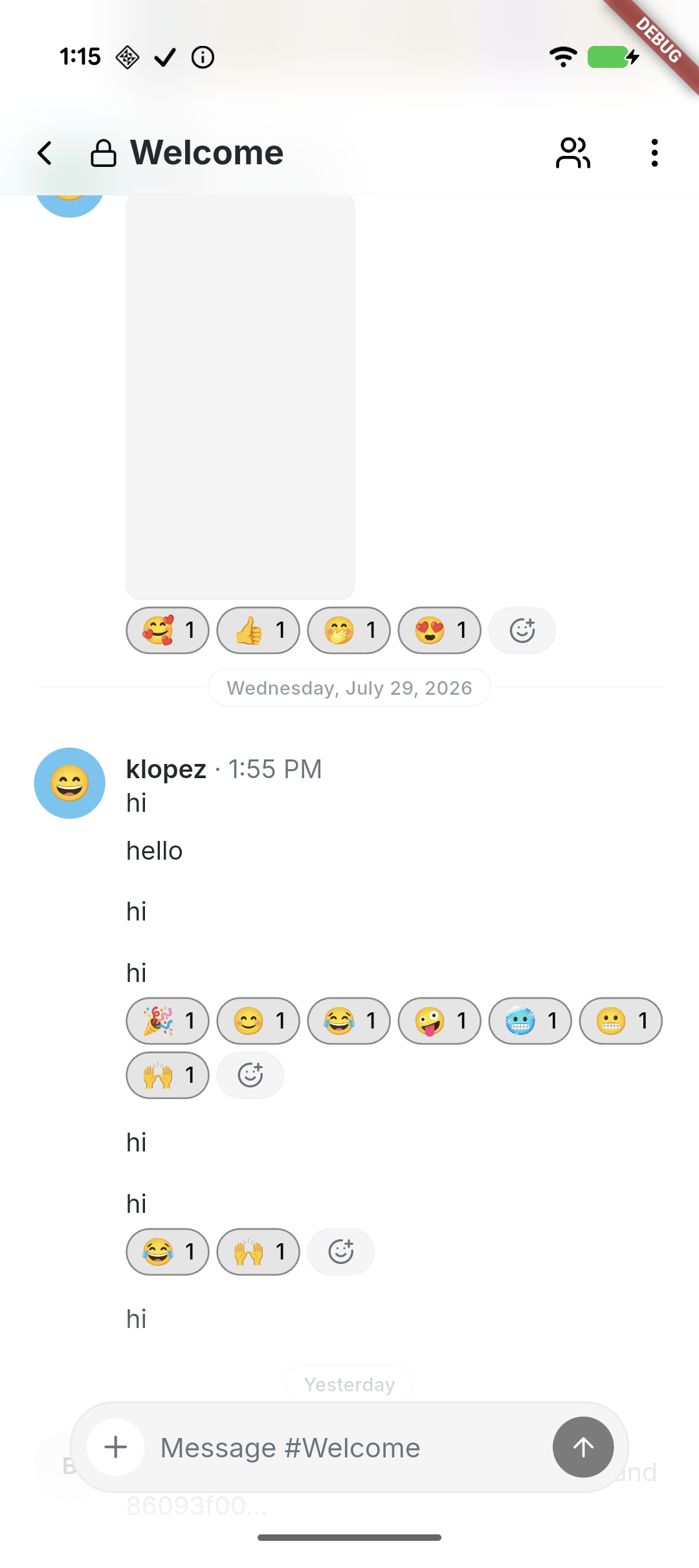
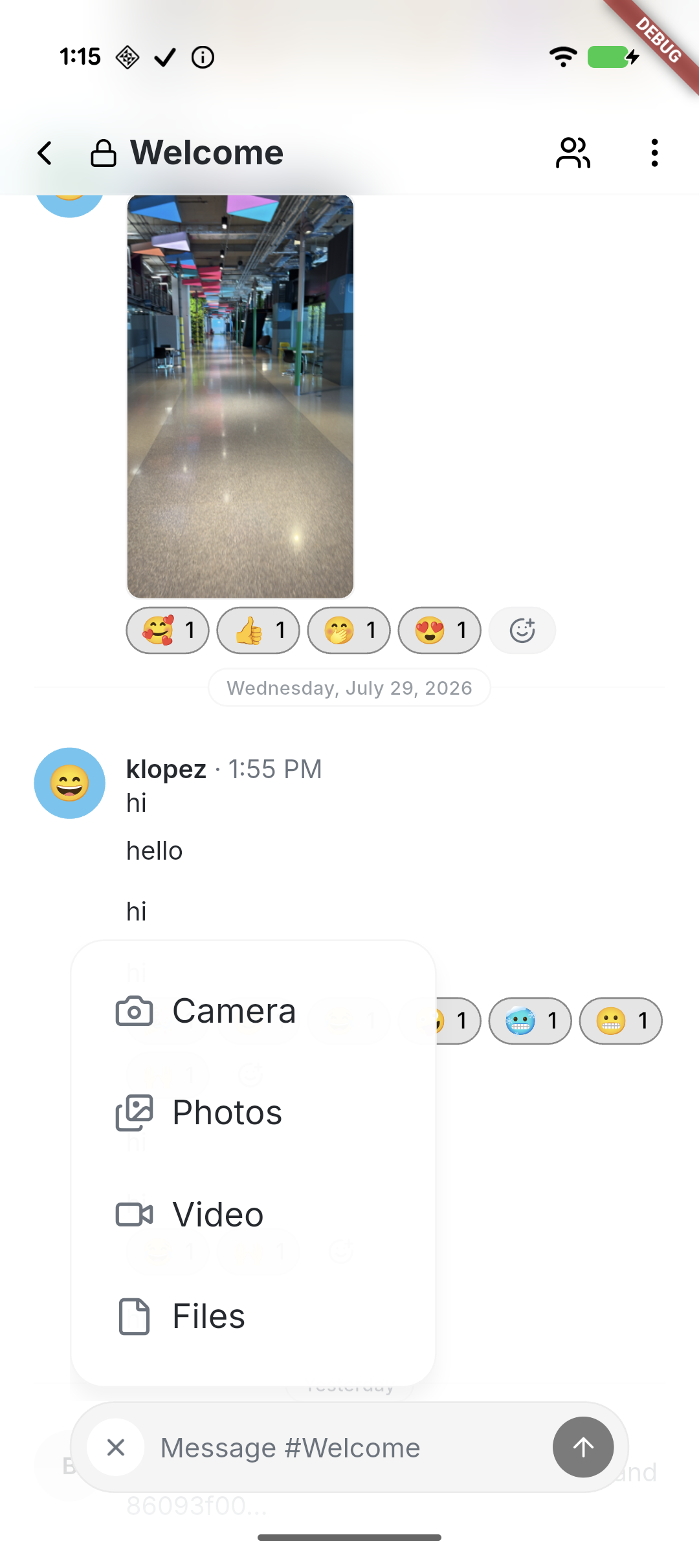
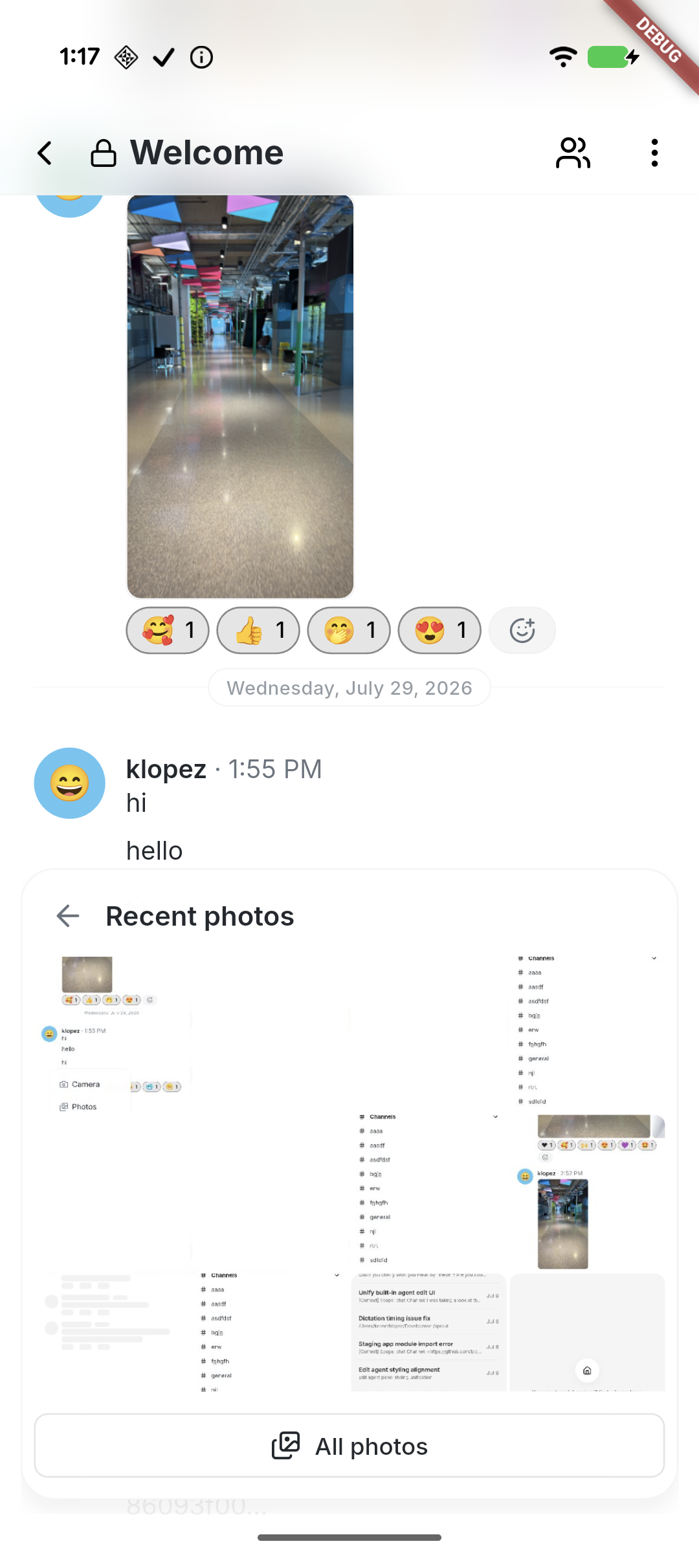
## Snapshots

<table>
  <tr>
    <td align="center">Compact composer</td>
    <td align="center">Attachment menu</td>
    <td align="center">Recent photos</td>
  </tr>
  <tr>
<td><img
src="https://raw.githubusercontent.com/block/buzz/9732022cb13bb39ce797c4faaa714fe4c924955f/pr-3918--01-compact-composer.png"
width="260" /></td>
<td><img
src="https://raw.githubusercontent.com/block/buzz/9732022cb13bb39ce797c4faaa714fe4c924955f/pr-3918--02-attachment-menu.png"
width="260" /></td>
<td><img
src="https://raw.githubusercontent.com/block/buzz/9732022cb13bb39ce797c4faaa714fe4c924955f/pr-3918--03-photo-surface.png"
width="260" /></td>
  </tr>
</table>

---------

Signed-off-by: kenny lopez <klopez4212@gmail.com>
|
||
|
|
83a285f1b1 |
ci(linux): enable mesh-llm feature in Linux release and canary builds (#4524)
## Summary Official Linux desktop packages (`.deb` / AppImage) are built without `--features mesh-llm`, so they ship the `mesh_llm_stubs` backend and Settings → Compute always fails with `mesh-llm feature not enabled`. This PR adds the feature flag to the two Linux build commands: - `release.yml` → `release-linux` job - `linux-canary.yml` → canary build That's the whole diff — 2 lines. Fixes #3788 (Linux); see also #3841 (dup with UI-gating PR #3914) and the Windows twin #2836/#3223. ## Why no native prebuild step (unlike the macOS job) The macOS job carries Metal llama prebuild/cache steps from #798. Linux doesn't need an equivalent: - `mesh-llm-host-runtime` is compiled with `dynamic-native-runtime` and installs the recommended runtime on first use (verified by sha256 checksum over HTTPS; upstream's signature verification path is not yet implemented — default policy is `RequireChecksum`, per `mesh-llm-runtime-install/src/lib.rs`) (`desktop/src-tauri/src/mesh_llm/mod.rs` — `initialize_mesh_native_runtime`), so release builds work on clean machines without bundling llama.cpp. - Upstream publishes Linux x86_64/aarch64 runtime bundles for the pinned `v0.74.0` line, and `scripts/ensure-mesh-native-runtime.sh` already maps `meshllm-native-runtime-linux-x86_64-cpu` / `linux-aarch64-cpu` for local/e2e use. - The unmerged branch `micn/mesh-node-download` (`96f29417a`) treats even the macOS prebuild steps as removable dead weight for the same reason. ## Background The omission is historical drift, not a decision: Linux packaging predates the mesh feature flag (#693), mesh became opt-in for build-cost/reliability reasons (#823, #1183), and #1221 re-enabled it for releases by editing only the macOS build line. `release-linux` and the later `linux-canary` copy were never revisited. The mesh shutdown hard-exit/relaunch path is gated `all(mesh-llm, target_os = "macos")` because ggml/Metal destructors abort on macOS; ordinary mesh shutdown (`shutdown_mesh_runtime`) is cross-platform, so Linux falls through to the generic path. ## Validation - [x] `./bin/cargo check --manifest-path desktop/src-tauri/Cargo.toml --features mesh-llm` green at base `2c0ac2467` (feature graph compiles at the pinned v0.74.0 line) - [ ] Linux canary run with this change: AppImage/.deb build succeeds and binary contains real `mesh_llm` symbols (not `mesh_llm_stubs`) - [ ] Installed package: cold-start → Settings → Compute → runtime download → serve → clean shutdown The last two need a Linux run/host. **Note (from review):** `linux-canary.yml` is `workflow_dispatch`-only and its `Require main` step rejects non-main refs, so the canary cannot run on this branch pre-merge — and `.github/workflows/**` matches no ci.yml paths-filter, so this PR's own CI does not exercise the changed lines. Validation sequencing is therefore merge → dispatch linux-canary on main → live-package pass, with a trivial 2-line revert as the escape hatch. Signed-off-by: npub1qyvc0c5kl4gqv2fd97fsk46tu378sqgy35vc83rvgfwne90sel7s0ed67d <011987e296fd5006292d2f930b574be47c7801048d1983c46c425d3c95f0cffd@buzz.block.builderlab.xyz> Co-authored-by: npub1qyvc0c5kl4gqv2fd97fsk46tu378sqgy35vc83rvgfwne90sel7s0ed67d <011987e296fd5006292d2f930b574be47c7801048d1983c46c425d3c95f0cffd@buzz.block.builderlab.xyz> |
||
|
|
2c0ac24674 |
fix(desktop): stop the create-agent provider config probe from erasing keystrokes (#4411)
## What
Fixes the create-agent dialog's "Run on" provider config fields eating
keystrokes — reported by Tyler in buzz-remote-agents (channel
`29414326`, thread `db76677a`): the Kubernetes **Kubeconfig context**
field would not accept typing.
## Why it happened (the Typewriter Eraser, shipped in #4289)
`WhereToRunSection`'s probe `useEffect` depended on the whole `draft`:
1. every keystroke changed the draft → effect re-fired → provider binary
re-probed;
2. each probe result is a fresh object written into the draft → the
effect re-triggered **itself**, respawning the provider binary in a loop
for as long as the dialog sat on a provider;
3. every probe resolution reset `providerConfig` to schema defaults —
erasing whatever was typed. A field with no schema default (`context`)
snapped back to empty, i.e. "won't let me type". Unrelated to how many
kubeconfig contexts you have.
## Fix
- **Probe once per provider selection**, keyed on the provider's stable
`binaryPath` — not the draft, not the provider object (a
`useBackendProvidersQuery` refresh must not reprobe an unchanged
selection).
- **Latest-state resolution** via `React.useEffectEvent` + a new pure
`applyProbeResult` helper: schema defaults merge **beneath** the current
`providerConfig`, so a probe landing after the user typed can never
clobber in-flight input (per Wren's pre-patch red-team: changing deps
alone leaves a stale closure).
Existing `cancelled` cleanup keeps provider-switch/unmount safe;
selection reset (`emptyWhereToRunDraft`) and the fail-closed probe-error
path are unchanged.
## Tests
- **Unit** (`whereToRunIntent.test.mjs`): `applyProbeResult` merge
semantics — defaults under typed values, user-cleared fields stay
cleared, schema-less results, unrelated fields preserved.
- **E2E** (new `where-to-run-config.spec.ts`, added to the smoke
project, **red-first verified**: all 3 fail against the unfixed
component):
- typing into a defaultless provider field sticks, and
`probe_backend_provider` fires exactly once per selection;
- the config form is gated on probe resolution (slow probe: no
half-rendered form, defaults prefill once);
- provider → local → provider re-probes and resets cleanly.
- Mock bridge gains `backendProviders` / `backendProviderProbeResult` /
`backendProviderProbeDelayMs` seams (defaults preserve prior behavior).
## Verification at
|
||
|
|
a5dbdf5e61 |
fix(mobile): recover and pace live subscriptions (#3053)
### What changed? Mobile now recovers live subscriptions after retryable or rate-limited relay `CLOSED` responses. It ports the existing desktop model: classify terminal versus retryable closures, honor retry hints through a session-owned rate-limit gate, retry with bounded backoff, and replay visible-channel subscriptions first in bounded batches. Channel refreshes also retain unchanged live subscriptions instead of clearing and recreating them. This is desktop parity, not a new relay policy. ### Why? On reconnect or resume, mobile replayed its retained live subscriptions while `channelsProvider` independently cleared and recreated roughly the same set, alongside unread catch-up and open-channel requests. The relay allows 50 REQs per 5 seconds, so users in many channels could predictably exceed the budget. In live reproduction, 55 subscriptions produced 9 rate-limit closures, 60 produced 18, and 80 produced 36. Mobile then treated every live `CLOSED` as terminal, removed the affected subscription, and never restored it. Channel updates could remain dead until a later session reconstruction. This is the primary causal chain behind [BOT-1449](https://linear.app/squareup/issue/BOT-1449/buzz-mobile-posted-messages-dont-appear-until-leavingre-entering-the). Desktop already handles this as normal transient pressure by classifying closures, gating and backing off retries, pacing reconnect replay, and retaining unchanged subscriptions. This change brings mobile to the same recovery model while removing the avoidable request burst. ### How is it tested? Full mobile suite: 721 passed, 1 skipped. Analyzer and formatting checks pass. Required CI checks pass. Added and updated tests cover `CLOSED` classification, retry hints, rate-limit gating, bounded retry and reset behavior, terminal failures, timer cleanup, history gating, visible-first batched replay, and retention of unchanged subscriptions. --------- Signed-off-by: Tom Brow <tomb@block.xyz> Co-authored-by: npub1tquskdu6yc4h8l7xxtceculxw600grekeq0xg2ukqfrwl7vrzg3quz3gmp <58390b379a262b73ffc632f19c73e6769ef40f36c81e642b960246eff9831222@buzz.block.builderlab.xyz> Co-authored-by: Codex <noreply@openai.com> Co-authored-by: npub1tu6ed4gf70jg7pvk8uhttlprexznhzpg74am2d3seqd3ececzgusy8hzac <5f3596d509f3e48f05963f2eb5fc23c9853b8828f57bb53630c81b1ce3381239@buzz.block.builderlab.xyz> Co-authored-by: npub1w85l93z2dyetvaev42kvmgv3r5qsgc7rutrvgpqshqefj4sydqqskwstfm <71e9f2c44a6932b6772caaaccda1911d010463c3e2c6c40410b8329956046801@buzz.block.builderlab.xyz> |
||
|
|
7ff5fc3189 |
feat(acp): deliver system prompt via _meta.systemPrompt for claude-agent-acp (#4395)
`claude-agent-acp` (since v0.6.0 / PR #91) accepts `_meta.systemPrompt: {append: text}` on `session/new` to append to the adapter's native preset while keeping its tool-use prompt intact — the same non-standard extension pattern as `_session/steering` was before it was standardised. ## What changes **Rust (`crates/buzz-acp/`)** - Adds `SystemPromptTransport` enum to `acp.rs`: `Field(&str)` (ACP protocol v2, unchanged) vs `ClaudeMeta(&str)` (new `_meta.systemPrompt: {append: text}`). When both `ClaudeMeta` and `session_title` are present the two `_meta` members are merged into one object so neither clobbers the other. - Gates on exact adapter identity `@agentclientprotocol/claude-agent-acp` in `pool.rs`: `session_new_system_prompt()` routes that name to `ClaudeMeta` regardless of reported `protocolVersion` (CC declares v1). `has_system_prompt_support()` gains the same name check so user-message `[Base]`/`[System]` framing is suppressed for CC sessions. - All other paths — goose post-hoc method, protocol-v2 `Field`, legacy user-message framing — are byte-identical to before. **Desktop (`desktop/src/features/agents/ui/`)** - `agentSessionTranscript.ts`: the `session/new` extractor now checks `params._meta.systemPrompt.append` as a fallback when bare `params.systemPrompt` is absent. Bare field takes precedence. Net line count stays at 1173 (ratchet limit). - `agentSessionTranscript.test.mjs`: two new tests — one verifying the `_meta` transport produces the identical standalone card (same five sections, same `turnId: null`, same placement before the first turn) as the bare-field transport; one proving bare field wins when both transports are present. ## Gate claim `@agentclientprotocol/claude-agent-acp` implies `_meta.systemPrompt` support because the feature landed in v0.6.0 (Oct 2025, commit `ea796f3`) before the `@zed-industries/claude-code-acp` → `@agentclientprotocol/claude-agent-acp` package rename (Mar 2026, commit `b409782`). The new name is therefore a reliable capability gate; the old name falls through to the protocol-version gate (status quo, no regression). ## Tests - Rust: Claude append serialization; `_meta` coexistence with `sessionTitle`; protocol-v2 bare field byte-identical; codex/old-zed omission; claude-name support/suppression gate; old `@zed-industries` name falls through to protocol-version gate. - Desktop: `_meta` transport → identical standalone card; bare field wins over `_meta` when both present. ## Pre-existing failures `just mobile-check` and `just mobile-test` fail identically on clean `origin/main` (5 `compose_bar` / `channels_page` tests + 3 Flutter lint warnings) — not caused by this change. All other `just ci` jobs are green. Signed-off-by: Will Pfleger <pfleger.will@gmail.com> Co-authored-by: npub1mn7jgtj4w2pd0g0zeuhxsa6jy6p0rewxz4kujt98my82ahfmp72sxjexk7 <dcfd242e557282d7a1e2cf2e6877522682f1e5c6156dc92ca7d90eaedd3b0f95@buzz.block.builderlab.xyz> |
||
|
|
318fbf896e |
fix(security): bump nostr crates for RUSTSEC-2026-0225..0232 + default sprig image to published digest (#4392)
## What Two changes, both fallout/follow-up from #4289 landing: ### 1. Fix the Security job failing on main (lockfile-only) Eight RUSTSEC advisories published today against the nostr stack turned `cargo-deny check` advisories red on main ([failing run](https://github.com/block/buzz/actions/runs/30761611723/job/91533106673)). Not introduced by #4289 — the advisories landed upstream and any push to main today would have tripped them. - **RUSTSEC-2026-0225..0230** → `nostr` 0.44.6 → **0.44.7** (Debug output exposing NIP-46/NIP-60 credentials; wallet parsers accepting unauthenticated events; NIP-44/NIP-04/NIP-98 resource exhaustion; NIP-50 empty-filter panic) - **RUSTSEC-2026-0231..0232** → `nostr-relay-pool` 0.44.2 (root) / 0.44.1 (tauri) → **0.44.3** (auth-challenge memory exhaustion; processing of unverified relay events) Both workspace lockfiles bumped (`Cargo.lock`, `desktop/src-tauri/Cargo.lock`). No manifest changes. ### 2. Default the desktop GUI's sprig image to the published `ghcr.io/block/buzz-sprig` The first main-push after #4289 published the image publicly (package created 18:44Z, visibility `public`). The `config_schema()`'s `image` property now carries a `default`: ``` ghcr.io/block/buzz-sprig:sha-6530b58@sha256:17facfc7608d8ddb33bc056c9aaba1098f4ef6abe5655702fbfd7584d1f74d76 ``` **Why tag+digest, not tag:** the backend deliberately rejects tag-only references — the pod runs with the agent's nsec and tags are mutable pointers (`image.rs` §Image). The tag+digest form keeps the human-traceable `sha-6530b58` while the digest does the pinning; `image::parse` already normalizes it to the tagless canonical form, so create-intent fingerprints are identical to the bare-digest spelling. The digest is the **multi-arch manifest-list digest** (amd64+arm64), resolved via `docker buildx imagetools inspect`. **This is a UI prefill, not a baked fallback:** `image` stays in the schema's `required` list, an empty value still fails closed with a named field, and the desktop submits the value explicitly in `provider_config` (the `WhereToRunSection` probe seeds `providerConfig` from schema defaults) — so deploy fingerprints never depend on compiled-in provider state, and the spec's §K8s pod-reconciliation concern about baked-default divergence is not engaged. Module prose that said "no published image exists yet" is updated to match reality. No desktop code changes needed: the form already prefills from `properties[*].default` and submits seeded defaults. ## Testing - `cargo-deny check` at head: **advisories ok, bans ok, licenses ok, sources ok** (was: advisories FAILED) - `cargo test -p buzz-backend-kubernetes`: **158 passed** (154 lib + 4 wire), including new `schema_default_image_round_trips_through_parse` pinning the constant + its normalization, and the wire `info` test now asserting the default is present in the provider's real stdout response - Live provider probe: `{"op":"info"}` against the built binary returns the default in `config_schema.properties.image.default` with `required` unchanged (`["namespace","image"]`) - Full workspace test suite via pre-push hook: green (earlier direct `cargo test --workspace` run: sole failure was `api::mesh_demo::demo_join_forwarded_arm_round_trips_echo`, the documented pre-existing main flake — unrelated, fails on base) - Image existence verified against GHCR: `docker buildx imagetools inspect ghcr.io/block/buzz-sprig:sha-6530b58` resolves to the pinned manifest-list digest with linux/amd64 + linux/arm64 manifests --------- Signed-off-by: npub1qyvc0c5kl4gqv2fd97fsk46tu378sqgy35vc83rvgfwne90sel7s0ed67d <011987e296fd5006292d2f930b574be47c7801048d1983c46c425d3c95f0cffd@buzz.block.builderlab.xyz> Co-authored-by: npub1qyvc0c5kl4gqv2fd97fsk46tu378sqgy35vc83rvgfwne90sel7s0ed67d <011987e296fd5006292d2f930b574be47c7801048d1983c46c425d3c95f0cffd@buzz.block.builderlab.xyz> |
||
|
|
f86cfc7369 |
fix(desktop): back/forward via keyboard chords, mouse X1/X2 buttons, and swipe gestures (#3778)
## Problem Two related gaps in global back/forward navigation. Fixes #3775. 1. The keyboard shortcuts almost never fire in real use — users fall back to clicking the toolbar chevrons and assume the shortcuts don't exist. 2. On macOS, mouse back/forward buttons (X1/X2) and horizontal swipe gestures do nothing, although they navigate in every browser and in Slack. **Duplicate check:** searched open PRs and issues — none found beyond #3775 (filed alongside this fix). #3078 / #3377 are next/previous-*channel* navigation, a different feature. ## Root causes **Keyboard:** `useBackForwardControls`'s keydown handler bailed whenever the event target was editable — but `useComposerAutofocus` deliberately focuses the message composer (a ProseMirror contenteditable) on mount and on every channel switch. In steady state focus almost always lives in the composer, so the chords were silently swallowed. Invisible to CI because `navigation.spec.ts` only ever clicked the `global-back` / `global-forward` buttons, never pressed the keys. **Mouse/swipe:** on macOS, WKWebView never delivers X1/X2 button events or swipe gestures to the page (Safari handles them natively in the app layer, not in page JS), and Buzz had no native handler. ## Fix ### Keyboard chords (web layer) Match the existing platform chord regardless of the event target and drop the editable-target guard: - `⌘[` / `⌘]` have no text-editing semantics in macOS text fields, and the TipTap/StarterKit editor config binds no `Mod-[` / `Mod-]` shortcuts (checked `useRichTextEditor.ts` — list indentation is Tab/Shift-Tab). - `preventDefault()` keeps the chord out of the editor — asserted in the e2e test. This matches browsers and Slack, where back/forward chords work while a text field is focused. Chord matching is extracted into a pure helper, `app/navigation/backForwardChords.ts`, so it can be unit tested; behavior (bindings, modifier exclusivity, `code`-based matching for non-US layouts) is unchanged. ### macOS mouse buttons and swipe gestures (native layer) An NSEvent local monitor in `mouse_nav.rs` catches what the webview can't see and emits a `mouse-nav` Tauri event to the main window (`emit_to`, so navigation stays scoped if multi-window ever lands) that the frontend acts on. Two AppKit event shapes map to navigation: - `otherMouseUp` with button 3/4 — mice whose X1/X2 buttons arrive as plain button events. These are swallowed after emitting so nothing downstream double-handles them. - `swipe` with a horizontal delta — AppKit's page-swipe gesture (`swipeWithEvent:`): `deltaX > 0` back, `deltaX < 0` forward. Sent by mouse drivers that synthesize a page-swipe gesture for the back/forward buttons instead of button-3/4 events (the hardware this was verified on). Stock Apple trackpad and Magic Mouse swipes arrive as phased scroll-wheel events instead, which this PR does not handle — that path (`ScrollWheel` + `trackSwipeEventWithOptions:`, which also needs scroll-edge detection) is deferred to a follow-up. Swipes are passed through (swallowing mid-gesture events could confuse AppKit gesture tracking). The swipe path was verified end to end on hardware whose back/forward buttons emit only swipe gestures, never button-3/4 events — an instrumented event monitor confirmed the events arrive as `NSEventType::Swipe` with `deltaX ±1`, and navigation worked after mapping them. ## Tests - **13 unit tests** for the web-side chord matcher (`backForwardChords.test.mjs`): supported chords, modifier exclusivity, `code` fallback, and preservation of line-editing shortcuts. - **6 Rust unit tests** for the native mapping helpers (`mouse_nav.rs`): button 3/4 directions, other buttons ignored, swipe delta sign → direction, zero-delta (gesture-begin) ignored. - **e2e regression case** in `navigation.spec.ts`: presses the platform chord *while the composer is focused* — the missing coverage. Verified it fails against the pre-fix implementation and passes with the fix. - Full desktop unit suite: 3832/3832 pass. Full Rust suite (`cargo test`, buzz-desktop): 1888 passed / 0 failed. `pnpm typecheck`, `biome check`, `pnpm check`, `cargo fmt --check`, `cargo clippy`: clean (no new warnings). - Full Playwright e2e: 958 passed; 6 failures are relay-infrastructure tests (live relay seeding / relay state seam) that fail identically without this change — `navigation.spec.ts` is fully green. ## Manual test 1. Open a channel, then another (composer autofocuses on each switch). 2. `⌘[` — returns to the previous channel; `⌘]` — forward again. Typing `[` / `]` in the composer inserts normally. 3. Mouse back/forward buttons navigate the same way, from anywhere in the window (verified on macOS on hardware using both event shapes). ## Update — 2026-07-31 Removed the redundant DOM mouse-button handler after verifying it was unnecessary. The native macOS path remains unchanged and was revalidated manually. --------- Signed-off-by: npub1yvnq5equak5errqpku8stskushny9wsvt0fc2ywcpwt79yslwaqswe7tse <23260a641ceda9918c01b70f05c2dc85e642ba0c5bd38511d80b97e2921f7741@buzz.block.builderlab.xyz> Signed-off-by: Matheus Iser <matheusiser@squareup.com> Signed-off-by: Will Pfleger <pfleger.will@gmail.com> Co-authored-by: npub1yvnq5equak5errqpku8stskushny9wsvt0fc2ywcpwt79yslwaqswe7tse <23260a641ceda9918c01b70f05c2dc85e642ba0c5bd38511d80b97e2921f7741@buzz.block.builderlab.xyz> Co-authored-by: npub1mn7jgtj4w2pd0g0zeuhxsa6jy6p0rewxz4kujt98my82ahfmp72sxjexk7 <dcfd242e557282d7a1e2cf2e6877522682f1e5c6156dc92ca7d90eaedd3b0f95@buzz.block.builderlab.xyz> Co-authored-by: Will Pfleger <pfleger.will@gmail.com> |
||
|
TylerGitHubnpub1mprnacetjua2xx3p5eddmhxyk6wv929ymm5py8kd2xfxurxahspqqlgytanpub17jjz49l9jjmhhk7cac63j8yt9z555n9cw8vk7v5jz4vzw4ppld5qgj57ccnpub1qyvc0c5kl4gqv2fd97fsk46tu378sqgy35vc83rvgfwne90sel7s0ed67dDawnnpub1jh9wn95s0472h86ahapupaf7m6kx4v9sx2n0atj2hltcfer8k06s5n3pyfnpub1t2tgm7d8f995uqvmnm8h88sg3wnpp9a5xysjf6dg3tjmgt3ltulqdp8ehr |
6530b58a61 |
feat(k8s): Kubernetes backend plugin + desktop deploy path (#4289)
# Kubernetes backend plugin (crates/buzz-backend-kubernetes) + desktop deploy path Implements docs/remote-agents.md (merged @ |
||
|
Tal WeissandGitHub
|
fc598f5f8d |
fix(git): allow deleting the default branch (#4297)
Tal here, human. Trying to help. This bug bugged me... ## Summary A repository's first branch becomes its symbolic `HEAD`, and Git's bare-repository default rejects deleting that branch even when another branch survives. This change: - sets `receive.denyDeleteCurrent=ignore` only for the ephemeral `git receive-pack` process - preserves the existing server-side `core.hooksPath` override and authorization hook - lets the existing CAS publication logic select a surviving branch as the next manifest `HEAD` - adds regression coverage using a real stateless `git receive-pack` request and a manifest HEAD-selection test This lets users replace an accidental default branch without deleting the object-storage manifest pointer. ### Related issue Fixes #3572 ### Testing - `cargo test -p buzz-relay api::git::` (128 passed, 5 ignored) - `just ci` - live E2E roundtrip against a release relay with PostgreSQL, Redis, and MinIO: - created a repository through signed Nostr events - verified authorized pushes and rejected unauthorized clone/push - pushed a surviving `master` branch - deleted the active `main` branch over authenticated Smart HTTP - freshly cloned the repository and verified `master` became HEAD, `origin/main` was absent, and repository content remained intact Signed-off-by: Tal Weiss <major.tal@gmail.com> |
||
|
|
b7bb15122e |
feat(projects): add buzz projects CLI commands (NIP-MP kind:30621) (#4020)
Implements the `buzz projects` command group — the NIP-MP Phase 2 write path for kind:30621 multi-repo projects. The relay accepted kind:30621 in #3171; this adds the two-layer Rust builder in `buzz-sdk` and the seven CLI commands. ## What this adds ### `crates/buzz-sdk/src/builders.rs` — two-layer builder **Layer A (protocol):** - `validate_project_envelope(tags, content)` — 8 NIP-MP rules in relay order: `d`-cardinality, `d`-empty/length, member-cap (≤64 `a` tags, checked before per-tag parse), member-tag-arity (2–3 elements), member-coordinate grammar (first-two-colons split, literal `30617`, lowercase 64-hex owner, non-empty remainder), member-duplicate (coordinate only, hint ignored), singleton metadata cardinality, byte bounds (`name` ≤256 / `description` ≤2048 / `buzz-channel` ≤256 / `buzz-visibility` ≤256). - `build_project_with_tags(content, tags)` — raw Layer A builder; RMW mutations path. - `ProjectMemberCoord` — `30617:<owner-hex>:<repo-d>` + optional opaque relay hint; equality/Hash by coordinate only. **Layer B (writer policy):** - `build_project(slug, name, description, members, channel, visibility)` — constructs `d` tag, enforces UUID channel and `listed|unlisted` visibility, forces empty content; composes onto Layer A. This is the `create` path. **Shared:** - `build_delete_addressable(kind, pubkey, d)` — generic NIP-09 kind:5 coordinate delete; `build_workflow_delete` now delegates to this. - All 31 `NIP-MP.fixtures.json` cases exercised through `build_project_with_tags`; count assertion guards against omissions. ### `crates/buzz-cli/` — seven commands ``` buzz projects create <slug> --repo <coord> [--name] [--description] [--channel <uuid>] [--visibility listed|unlisted] buzz projects get <slug> [--owner <pubkey>] buzz projects list [--owner <pubkey>] [--limit <n>] buzz projects add-repo <slug> --repo <coord> [--repo <coord>]... buzz projects remove-repo <slug> --repo <coord> [--repo <coord>]... buzz projects update <slug> [--name|--clear-name] [--description|--clear-description] [--channel <uuid>|--clear-channel] [--visibility listed|unlisted|--clear-visibility] buzz projects delete <slug> ``` Command semantics: - **`create`**: all local validation (slug, repos, channel, visibility, name length) fires before the collision preflight — invalid input returns `Usage` without a network call. Routes through Layer B (`build_project`). - **`update`**: at least one setter/clearer required — enforced by a clap `ArgGroup` with `required(true).multiple(true)`, with a runtime backstop for programmatic callers; setter + own clearer are mutually exclusive per clap conflicts. - **`add-repo`/`remove-repo`**: coordinate expansion and dedup fire before head fetch — malformed or duplicate `--repo` values return `Usage` without touching the relay. - **`delete`**: head-based tombstone at `created_at = head + 1`; post-submit re-query verifies tombstone landed. - All mutations: strip `auth`, re-validate full envelope through Layer A; `created_at` advances from observed head, never wall-clock. - Relay hints on existing member tags preserved verbatim through RMW. ## Limitations (recorded, not in scope) - **No relay-hint authoring**: `--repo` carries a coordinate only; existing hinted `a` tags survive RMW unchanged. - **Signer-self delete only**: NIP-OA owner-delete extension not exposed; `delete` targets the signer's own coordinate. - **Deletion durability**: watermark carry-over applies; `delete` is best-effort against a later-arriving replacement. ## Live round-trip 21-step transcript executed against a relay built from `origin/main` `b1b283cd4`, covering create, get, multi-field update (name + description + channel in one call), channel set/clear, add-repo, remove-repo, delete (tombstone verified at `head+1`, repeated delete → `NotFound`). Delta transcript confirmed multi-field update, channel set/clear, no-op add-repo → `Conflict` exit 5, empty update and setter+own-clearer both rejected at parse time. Duplicate create → `Conflict`. Cross-owner `add-repo` with full coordinate exercised. --------- Signed-off-by: Will Pfleger <pfleger.will@gmail.com> Co-authored-by: npub1mn7jgtj4w2pd0g0zeuhxsa6jy6p0rewxz4kujt98my82ahfmp72sxjexk7 <dcfd242e557282d7a1e2cf2e6877522682f1e5c6156dc92ca7d90eaedd3b0f95@buzz.block.builderlab.xyz> |
||
|
|
28ae6cd217 |
docs: formal spec for remote agents and their management (#3748)
## What A formal specification for remote agents and their management — `docs/remote-agents.md` — in the style of `docs/git-on-object-storage.md`: stated system model, named invariants, explicit trust boundaries, provider conformance checklist, and an implementation-correspondence table. Requested by Tyler in the buzz-remote-agents design thread; co-designed with Dawn and Wren (review pending). ## Structure - **System model** — five principals (Desktop / Provider / Substrate / Agent / Relay) and the design axiom **M1: no management channel** — everything the desktop knows about a live remote agent flows through the relay. - **Five invariants** with enforcement mechanism and stated boundary: - I1 identity fail-closed, I2 no secrets in configuration, I3 presence-is-status, I4 at-most-one-live-instance, I5 bounded lifetime. - **Provider protocol** — discovery, `info`/`deploy` wire contract, untrusted-output rules, the reserved-key rule, and the **deploy state machine** (Running → no-op). - **Auto-stop** — `--exit-after-inactivity` / `BUZZ_ACP_EXIT_AFTER_INACTIVITY`, default off, definition of "inactive", and why it must not share a name with the three existing timeout concepts. - **The Kubernetes binding** — `buzz-backend-kubernetes`: kubeconfig-only auth, random-default namespace via schema `default`, the sprig image, pod shape (bare Pod, `terminationGracePeriodSeconds: 60`, 32-hex label / full-pubkey annotation), secrets, GC, config budget. - **Known defects** at `c1bca1b56` (Windows `.exe` id pollution; provider env inheritance vs kubeconfig exec plugins). - **Open decisions A–E** marked inline and consolidated, awaiting owner ruling. ## Notes for review Docs-only. Every code claim was verified against the tree (correspondence table maps each spec concept to its file/function). The spec deliberately documents two desktop bugs as Known Defects rather than fixing them here — fixes are follow-up PRs. --------- Signed-off-by: npub1qyvc0c5kl4gqv2fd97fsk46tu378sqgy35vc83rvgfwne90sel7s0ed67d <011987e296fd5006292d2f930b574be47c7801048d1983c46c425d3c95f0cffd@buzz.block.builderlab.xyz> Co-authored-by: npub1qyvc0c5kl4gqv2fd97fsk46tu378sqgy35vc83rvgfwne90sel7s0ed67d <011987e296fd5006292d2f930b574be47c7801048d1983c46c425d3c95f0cffd@buzz.block.builderlab.xyz> |
||
|
|
89bf03c05d |
fix(nip-oa): accept raw Nostr tag form in parse_json_array (#4203)
## What `BUZZ_AUTH_TAG` stored in the **raw Nostr tag form** `[auth,hex,,hex]` (unquoted, comma-delimited — how an `auth` tag serializes inside a Nostr event and how `.env` files commonly store it) was rejected by the CLI: ``` BUZZ_AUTH_TAG is malformed: invalid JSON: expected value at line 1 column 2 ``` …and even when the CLI *could* parse it, it forwarded the raw string as the `x-auth-tag` header, so the relay's `verify_auth_tag` (which expects JSON) rejected it with `403 relay_membership_required`. Two commits close both gaps. ## Commits ### 1. `fix(nip-oa): accept raw Nostr tag form in parse_json_array` `parse_json_array` (`crates/buzz-sdk/src/nip_oa.rs`) only accepted well-formed JSON arrays. Added a fallback: when strict JSON parsing fails *and* the trimmed input is bracket-delimited, split on `,` and treat each field as a string (empty field `,,` → empty string, matching `["auth","hex","","hex"]`). All consumers (`parse_auth_tag`, `verify_auth_tag`, the CLI, `buzz-acp`) benefit from one change at the lowest layer. ### 2. `fix(cli): canonicalize BUZZ_AUTH_TAG to JSON before sending x-auth-tag header` The CLI stored the raw input string and sent it verbatim as the `x-auth-tag` header (`client.rs:618`). Added `canonicalize_auth_tag` in `buzz-sdk`: parse either form, re-serialize to canonical JSON. The CLI now canonicalizes before storing as `auth_tag_json`, so the header is always valid JSON regardless of input form. Together: local parse + wire canonicalization means the raw form works end-to-end. ## Why The raw form `[auth,hex,,hex]` is exactly how an `auth` tag serializes inside a Nostr event. That shape leaks into `.env` files and shell variables because there's no canonical "stored form" outside an event. The SDK + CLI should accept it rather than push quoting/conversion logic onto every consumer (harnesses, agent shells, external tools). ## Security Both changes are purely syntactic — they only change how a 4-element string array is extracted and containerized. All downstream validation is unchanged: - `parse_auth_tag`: still checks exactly 4 elements, `"auth"` label, 64-char lowercase-hex pubkey, 128-char signature. - `verify_auth_tag`: still reconstructs the preimage and verifies the BIP-340 Schnorr signature against the owner pubkey. No new attack surface — a malformed or forged tag is still rejected at the same validation points. ## Tests 4 new tests in `nip_oa::tests`: - `test_parse_auth_tag_raw_nostr_form` — raw form with conditions + empty conditions - `test_parse_auth_tag_raw_form_with_whitespace` — raw form with surrounding whitespace - `test_canonicalize_auth_tag_raw_to_json` — raw→JSON and JSON→JSON normalization All 25 `nip_oa` tests pass (21 existing + 4 new). `cargo fmt --check` and `cargo clippy -p buzz-sdk -p buzz-cli` clean. ## Verification Confirmed end-to-end against a live community relay (`wss://hermesagent.communities.buzz.xyz`): - **Before:** raw `BUZZ_AUTH_TAG` → CLI parse error, or `403 relay_membership_required` if somehow parsed. - **After:** raw `BUZZ_AUTH_TAG` → CLI parses it, canonicalizes to JSON for the header, relay accepts via NIP-OA owner delegation, `buzz channels members` returns the full roster. ## Context Originated from a community investigation where agent-side relay access was failing because the harness-exported `BUZZ_AUTH_TAG` (raw Nostr form) was rejected by the CLI (expecting JSON). This removes the impedance mismatch at the source. --------- Signed-off-by: amanning3390 <adam.manning@pro-serveinc.com> Signed-off-by: Tyler <109685178+tlongwell-block@users.noreply.github.com> Signed-off-by: npub1qyvc0c5kl4gqv2fd97fsk46tu378sqgy35vc83rvgfwne90sel7s0ed67d <011987e296fd5006292d2f930b574be47c7801048d1983c46c425d3c95f0cffd@buzz.block.builderlab.xyz> Co-authored-by: npub1qyvc0c5kl4gqv2fd97fsk46tu378sqgy35vc83rvgfwne90sel7s0ed67d <011987e296fd5006292d2f930b574be47c7801048d1983c46c425d3c95f0cffd@buzz.block.builderlab.xyz> Co-authored-by: Tyler <109685178+tlongwell-block@users.noreply.github.com> |
||
|
|
ac4fa13b8e |
perf(relay): serve relay-membership checks from the read replica (#4124)
## Summary Route `Db::is_relay_member` — the membership check that runs on every authenticated HTTP request and WS AUTH — through the standard `route_read` machinery on the bounded arm, instead of adding a bespoke cache (replaces #3844). - `crates/buzz-db/src/relay_members.rs`: add `is_relay_member_on(&mut PgConnection, ...)` executor seam; the pool version delegates to it. - `crates/buzz-db/src/lib.rs`: `Db::is_relay_member` now routes via `route_read("relay_membership", RoutePredicate::Bounded)` — replica only on a proved fresh session, writer on any route rejection, writer re-run on replica query error. Exactly the shape of every other routed read. This is the one permission read served from the replica, by explicit product decision (Tyler accepted ≤1s bounded staleness on reads we choose): the fleet-wide fence guarantee (`BUZZ_REPLICA_READ_MAX_AGE_MS`, deploy target 1s) is an order of magnitude tighter than the 10s TTL proposed in #3844 and needs no invalidation machinery. Staleness is symmetric for admits and revokes. `BUZZ_REPLICA_READ_MAX_AGE_MS` unset = writer-only = kill switch. It is not precedent for routing other permission reads. ## Validation At this exact commit (`git rev-parse HEAD` confirmed in the same shell, rustc 1.95): - `cargo test -p buzz-db` — 94 passed, 0 failed - PG-gated suite single-threaded — **151 passed, 2 failed**; the 2 failures are the per-owner-limit tests broken on main by #3829 (limit 3→5, tests still seed 3) — they fail identically at base `19d57b0d4` in a pristine control checkout; separate trivial fix to follow - New PG-gated test `is_relay_member_is_bounded_routed_and_fails_closed` — divergent writer/replica fixtures prove: budget unset ⇒ writer; budget set + fresh proof ⇒ replica; over-budget entry ⇒ writer - clippy `-D warnings` + fmt clean; pre-push hooks green (desktop check/test, rust tests, tauri checks) - **Live-local pass** (TESTING.md, release binary, `BUZZ_REQUIRE_RELAY_MEMBERSHIP=true`, fresh DB): - writer-only (no `READ_DATABASE_URL`): member accepted, outsider 403 `relay_membership_required`; metrics `route_decision{path="relay_membership",decision="writer",reason="disabled"}` - replica configured + `BUZZ_REPLICA_READ_MAX_AGE_MS=1000`: member accepted / outsider denied via `decision="replica",reason="fresh"`; admit visible to the routed check within ~1.2s; revoke enforced within ~1.2s - reader outage mid-flight (TCP proxy killed): member send still succeeds in <200ms via `decision="writer",reason="reader_acquire_timeout"`; outsider still denied — fails closed, no availability loss Reviewed by Wren: 9/10 minimalness, 9/10 elegance, 9.5/10 correctness at this SHA. Supersedes the 10s-cache approach in PR 3844, which should be closed unmerged once this lands. Signed-off-by: Tyler <109685178+tlongwell-block@users.noreply.github.com> Co-authored-by: npub1qyvc0c5kl4gqv2fd97fsk46tu378sqgy35vc83rvgfwne90sel7s0ed67d <011987e296fd5006292d2f930b574be47c7801048d1983c46c425d3c95f0cffd@buzz.block.builderlab.xyz> |
||
|
|
9d6726e5b3 |
chore(deps): bump nostr-relay-pool for RUSTSEC-2026-0224 (#4139)
Bump `nostr-relay-pool` from 0.44.1 to 0.44.2 to clear [RUSTSEC-2026-0224](https://rustsec.org/advisories/RUSTSEC-2026-0224), which addresses verification-cache poisoning that could let forged Nostr events bypass signature validation on redelivery. The dependency is transitive through `nostr-sdk`; this PR updates only the corresponding package version and checksum in `Cargo.lock`. The advisory currently marks every open PR red until this fix merges. - `cargo test -p buzz-sdk -p buzz-cli` passes: 271 + 241 tests - `cargo deny check advisories` passes - `just fmt-check` passes Signed-off-by: Will Pfleger <pfleger.will@gmail.com> Co-authored-by: npub16v54tttfqacx9ycvc3k0ut0npj564ahcuajzy6qjvh57ntmsf4uq4806j2 <d32955ad69077062930cc46cfe2df30ca9aaf6f8e76422681265e9e9af704d78@buzz.block.builderlab.xyz> |
||
|
|
756dd7f65d |
docs(nostr): document #h requirement for live reaction subscriptions (#3487)
## What this fixes

`fan_out_scoped` (`crates/buzz-relay/src/subscription.rs:278-394`)
enforces a deliberate, symmetric scoping invariant — documented in the
code itself:

> Global subscriptions (channel_id = None) do NOT receive channel-scoped
events. Channel-scoped subscriptions do NOT receive global events.

The relay derives a reaction's stored channel from its `#e` target at
ingest — client-supplied `#h` is ignored for channel determination
(`NOSTR.md:50` documents this for *writing*). The consequence for
*reading* is that every reaction is a channel-scoped event, so a live
subscription `{"kinds":[7]}` without `#h` is a global subscription and
**silently receives no reactions at all** — no error, no CLOSED, just
nothing. The working form is `{"kinds":[7],"#h":["<channel-uuid>"]}`,
and it works regardless of how the reaction was signed: explicit `h`
tags on the event are matched directly, and tagless reactions match via
the stored channel fallback (`crates/buzz-core/src/filter.rs:78-91` —
fallback applies only when the event has no `h` tags; explicit tags are
authoritative).

`NOSTR.md` already documents this exact pitfall for group-metadata
events:

> **Note:** Channel-scoped storage means live global subscriptions
(`{kinds:[39000]}`) won't receive these via fan-out.
(`NOSTR.md:124-126`)

…but has no equivalent note for reactions, which is the case a
bot/integration author is far more likely to hit: any client that wants
to observe approvals/reactions live (workflow reaction-triggers make
this a first-class pattern in Buzz) will naturally try a kinds-only REQ
first and conclude reactions are broken. We lost real debugging time to
exactly this while building a headless integration
(https://github.com/OriginTrail/buzz-dkg-integration); the behavior is
by design, only the docs are missing.

## What this PR changes

Docs only (`NOSTR.md`): a subscribe-to-reactions example in "Sending
Messages", plus one note mirroring the existing 39000 note. No code
changes.

## How to verify

- Behavior: with the relay running, open a live REQ `{"kinds":[7]}` (no
`#h`) and react to a channel message from another client → nothing is
delivered; re-subscribe with `{"kinds":[7],"#h":["<channel-uuid>"]}` →
the reaction arrives.
- Claims against code (verified at `485d03a`): scoping invariant
`crates/buzz-relay/src/subscription.rs:386-393`; channel derivation
`derive_reaction_channel()` in
`crates/buzz-relay/src/handlers/ingest.rs`; `#h` fallback
`crates/buzz-core/src/filter.rs:78-91` and its test
`h_tag_fallback_uses_stored_channel_id`.

Duplicate search: no existing issue/PR found for `reactions
subscription`, `fan-out kinds` (searched 2026-07-29). DCO signed-off.

---------

Signed-off-by: Žiga Drev <ziga.drev@gmail.com>
Signed-off-by: npub1jh9wn95s0472h86ahapupaf7m6kx4v9sx2n0atj2hltcfer8k06s5n3pyf <95cae996907d7cab9f5dbf43c0f53edeac6ab0b032a6feae4abfd784e467b3f5@buzz.block.builderlab.xyz>
Co-authored-by: Žiga Drev <ziga.drev@gmail.com>
Co-authored-by: Claude Opus 4.8 <noreply@anthropic.com>
Co-authored-by: npub1jh9wn95s0472h86ahapupaf7m6kx4v9sx2n0atj2hltcfer8k06s5n3pyf <95cae996907d7cab9f5dbf43c0f53edeac6ab0b032a6feae4abfd784e467b3f5@buzz.block.builderlab.xyz>
|
||
|
|
36cf932ff0 |
docs(chart): fix ArgoCD example for native OCI sources (full artifact repoURL + path) (#3426)
## Problem `examples/argocd-app.yaml` uses the split form: ```yaml repoURL: oci://ghcr.io/block/buzz/charts chart: buzz targetRevision: 0.1.0 ``` On ArgoCD >= 3.0 (native OCI sources), the `chart` field is **ignored** for `oci://` repoURLs, so ArgoCD tries to pull the `charts` path itself and fails with `403 … repository:block/buzz/charts:pull denied` — a misleading error that reads like an auth problem. Additionally, spec validation rejects the Application without a `path` (`spec.source.repoURL and either spec.source.path or spec.source.chart are required`), since `chart` isn't recognized for OCI. Hit both on ArgoCD 3.4.4 following the example verbatim. ## Fix Use the full chart artifact path as `repoURL`, add `path: "."`, bump the pinned example version to the latest published chart (0.1.6), and leave a comment explaining both traps: ```yaml repoURL: oci://ghcr.io/block/buzz/charts/buzz path: . targetRevision: 0.1.6 ``` Verified working in production (ArgoCD 3.4.4, anonymous GHCR pull, chart 0.1.6). Related open PRs/issues: none found. --------- Signed-off-by: Kampe <blindside328@gmail.com> Signed-off-by: npub1t2tgm7d8f995uqvmnm8h88sg3wnpp9a5xysjf6dg3tjmgt3ltulqdp8ehr <5a968df9a7494b4e019b9ecf739e088ba61097b4312124e9a88ae5b42e3f5f3e@buzz.block.builderlab.xyz> Co-authored-by: Kampe <blindside328@gmail.com> Co-authored-by: npub1t2tgm7d8f995uqvmnm8h88sg3wnpp9a5xysjf6dg3tjmgt3ltulqdp8ehr <5a968df9a7494b4e019b9ecf739e088ba61097b4312124e9a88ae5b42e3f5f3e@buzz.block.builderlab.xyz> |
||
|
|
8d5afb6067 |
docs(readme): clarify which release asset to download per platform (#3481)
## Summary The "I just want to try the app" section names platforms generically (macOS `.dmg`, Linux `.AppImage` / `.deb`, Windows `.exe`), but the release publishes five assets, including two separate macOS builds. A first-time user on a Mac has no way to tell whether they need `aarch64` or `x64`, and nothing sets expectations for the SmartScreen warning on the unsigned Windows build. This replaces that sentence with a platform-to-filename table, a one-line note on how to check which Mac you have, and a note that the Windows build is unsigned and what the warning looks like. Filenames use `<version>` rather than `0.5.0` so the table doesn't go stale each release. ### Related issue None found. Searched open issues and PRs for README/download/install topics. ### Testing Docs-only change, no code paths touched. Verified the table and paragraph breaks render correctly in GitHub's markdown preview. --------- Signed-off-by: Dan Sheehan <dannysheehan90@gmail.com> Signed-off-by: npub12gtutshhh76rx0jx697f32f9tffd4hhp3hx58fp4x6u4uemkm7sqf8f757 <5217c5c2f7bfb4333e46d17c98a9255a52dadee18dcd43a43536b95e6776dfa0@buzz.block.builderlab.xyz> Co-authored-by: npub12gtutshhh76rx0jx697f32f9tffd4hhp3hx58fp4x6u4uemkm7sqf8f757 <5217c5c2f7bfb4333e46d17c98a9255a52dadee18dcd43a43536b95e6776dfa0@buzz.block.builderlab.xyz> |
||
|
|
5765fc74b7 |
fix(relay): allow open relays to set their NIP-11 workspace icon (kind:9033) (#3998)
## Problem The desktop deliberately shows the workspace icon editor on open relays (#2640, gate: `canEditIcon` in `desktop/src/features/communities/ui/EditCommunityDialog.tsx`) and defers to the relay-side kind:9033 check — which required an admin/owner row in `relay_members`. For a community with **no admin/owner row at all** (the `ensure_configured_community` path, which never writes an owner), every 9033 was refused and the icon was permanently unsettable. **Correction from review (thanks @Dawn):** the original version of this PR claimed nobody holds a role on an open relay. That's false — `main.rs` bootstraps `RELAY_OWNER_PUBKEY` as owner regardless of `BUZZ_REQUIRE_RELAY_MEMBERSHIP`, so a production open relay like bb-block *does* have an owner row, and the old gate was refusing everyone except that owner. The first revision of this diff would have silently widened that owner-only control to any NIP-42-authenticated sender. ## Fix — steward-wins `may_set_workspace_profile(sender_role, membership_enforced, community_has_steward)`: | Relay mode | Community has admin/owner row? | Who may set the icon | |---|---|---| | Closed (`require_relay_membership=true`) | any | admin or owner (unchanged) | | Open | yes (e.g. bb-block) | admin or owner (unchanged posture) | | Open | no (genuinely rosterless) | any NIP-42-authenticated sender | - New DB helper `has_admin_or_owner(community)` (`crates/buzz-db/src/relay_members.rs`); the call site only queries it on open relays. - The rosterless admit logs a `warn!` with the sender pubkey — 9033 writes no audit row and publishes no announcement event (unlike 9030/9031), so this is the only durable attribution. - Kinds 9030–9032, NIP-42 auth, `AdminUsers` scope, ban gate, and icon validation are all untouched. - Doc comment fixed: cited nonexistent `canEditCommunityProfile`; real symbol is `canEditIcon`. ## Test coverage — closing the mutation gap Dawn's mutation testing showed the original unit tests pinned only the helper's truth table: inverting the flag at the call site or deleting the gate entirely survived the full suite. - Unit tests now cover the 3-arg truth table (closed steward-independent, open-with-steward stays steward-only, rosterless-open admits). - Two `#[ignore]`d Postgres integration tests drive `handle_relay_admin_event` with a real `AppState` (open rosterless admit → steward appears → roleless refused again; closed relay member refused). Wired into the Backend Integration CI job as a dedicated nextest step. - **Both of Dawn's mutants verified killed** at this head: flag inversion fails 1 unit test; gate deletion fails both integration tests (`Ok(())` where `Rejected` expected). ## CI wrinkle found and fixed: pre-existing schema drift The first Backend Integration run of the new 9033 tests failed with `column "icon" of relation "communities" does not exist` — migration `0003_community_icon.sql` added the column, but `schema/schema.sql` (the desired-state file that CI job applies via pgschema) was never updated. Pre-existing drift, invisible until a test in that job actually wrote the column. Fixed in `297148f62` (3-line addition to `schema/schema.sql`). ## Receipts (at `1b4b52db8` code / `297148f62` head) - `cargo test -p buzz-relay`: 835 pass, 1 fail — `api::mesh_demo::tests::demo_join_forwarded_arm_round_trips_echo`, pre-existing (fails identically at the old base and on clean main); `telemetry::trace_context_lookup_does_not_enable_callsites` is a known order-dependent flake, passes in isolation. - `cargo test -p buzz-db`: 94 pass. - Both ignored integration tests pass live against local Postgres. - `cargo fmt --all -- --check`: clean. - Live-local pass per TESTING.md at this head (release build, relay on :3199, real WS + NIP-42 via nak): - open rosterless: roleless key sets icon → NIP-11 serves it; `warn!` with sender pubkey in the relay log - open + owner row inserted: fresh roleless key refused ("must be admin or owner"); owner sets icon - closed relay (owner bootstrapped, `BUZZ_RELAY_PRIVATE_KEY` set): plain member refused, owner sets icon, `javascript:` URL rejected, empty icon clears (NIP-11 → null) --------- Signed-off-by: npub1qyvc0c5kl4gqv2fd97fsk46tu378sqgy35vc83rvgfwne90sel7s0ed67d <011987e296fd5006292d2f930b574be47c7801048d1983c46c425d3c95f0cffd@buzz.block.builderlab.xyz> Co-authored-by: npub1qyvc0c5kl4gqv2fd97fsk46tu378sqgy35vc83rvgfwne90sel7s0ed67d <011987e296fd5006292d2f930b574be47c7801048d1983c46c425d3c95f0cffd@buzz.block.builderlab.xyz> |
||
|
TanskyandGitHub
|
3d7712cc36 |
docs: note that addressable channel events scope by d, not h (#4103)
The channel scoping note in `AGENTS.md` reads as universal: > **Channel scoping**: Channels use `h` tags (NIP-29 group tag), not `e` tags. > Filters and queries must scope to `h` tags when operating within a channel. It holds for events inside a channel, but not for the addressable events that describe one. kind:39000, kind:39001 and kind:39002 carry the channel id in their `d` tag, which is what `get_channels` already reads. Taking the existing wording at face value while working on kind:39002 produces an empty result rather than an error, since those events do carry `h` tags in other flows, so the mistake is quiet and costs a debugging cycle. Came up while working on #4023. Four lines, no behaviour change. Signed-off-by: Szymon Tanski <szymontanski8@gmail.com> |
||
|
|
909a3b2c31 |
docs: fix stale kind count, quick-start numbering, and empty Further Reading (#2613)
## Problem Three small documentation defects, each verified against the code at |
||
|
|
8e81afa431 |
fix(desktop): keep thread-open affordance in archived channels (#4012)
## Problem

Threaded replies "disappeared" from archived Buzz channels: the **"N
replies →"** summary row and the huddle-started **"View thread"** button
vanished, so existing threads were unreachable from the channel
timeline. The thread data was intact — this was a UI gate, not data
loss.

## Root cause

A single `onReply` prop drove two distinct affordances:
- the **compose** affordances (hover "Reply" button, inline reply
target), and
- the **view** affordances ("N replies →" summary row, huddle "View
thread").

`ChannelPane` nulls `onReply` on archived channels to keep them
read-only. That correctly hid composing — but also hid the view
affordances, since they keyed off the same prop.

## Fix

Two independent props, one per concern:

- **`onReply`** drives the compose affordances and is gated on
`archivedAt` — nulled on archived channels, so no new replies can be
started.
- **`onOpenThread`** drives the view affordances and is passed
regardless of archived state, threaded `ChannelPane → MessageTimeline →
TimelineMessageList → MessageRow`.

Opening a thread on an archived channel is read-only: the thread panel's
composer is independently gated via `isComposerDisabled` (includes
`archivedAt !== null`, `ChannelPane.tsx:318`).

### Before
<img width="811" height="794" alt="Screenshot 2026-07-31 at 20 26 00"
src="https://github.com/user-attachments/assets/670d9db4-30da-4c6d-97dc-275b5dbebca8"
/>

### After
<img width="873" height="791" alt="Screenshot 2026-07-31 at 20 28 04"
src="https://github.com/user-attachments/assets/88525231-2539-4eb3-8117-8e58a0cb3855"
/>

## Validation

- `pnpm typecheck` clean
- biome lint clean on touched files
- full `pnpm test` suite green (3885 tests)
- pre-push `branch-skew` / `desktop-check` / `desktop-test` hooks passed

Signed-off-by: Trey Wood <treyw@squareup.com>
Co-authored-by: npub14h0tw3uj7jm77qfxcwn6um2s5h55l0klrt2w9srzp3m3yvjc0mpsjsuk6e <addeb74792f4b7ef0126c3a7ae6d50a5e94fbedf1ad4e2c0620c771232587ec3@buzz.block.builderlab.xyz>
|
||
|
|
19d57b0d46 |
docs: add one-click Railway deploy for a hosted relay (#2733)
Adds a **"I want my own hosted relay"** path to *Getting started* with a one-click Railway deploy button. Buzz today asks anyone who wants a real relay to take the build-from-source route. This gives non-developers a hosted option: the template provisions the relay plus Postgres, Redis, and media storage, runs migrations, and generates the owner identity on first boot — no configuration. The listing is flagged **community-maintained, not an official Block build**, so there's no implied ownership. Happy to adjust wording, placement, or drop the button and keep just a link if you'd prefer. Template deploys green end-to-end; the owner key is surfaced as a paste-ready `nsec1…` in the deploy logs, and one deployment can host multiple communities by hostname. _Note: this supersedes the stale #984 — that template modeled a since-removed Typesense service and didn't run migrations._ ### Checklist `README.md` only, +8 −0 — no source files touched, so the build/test items don't apply. - [x] `just ci` passes (fmt + clippy + unit tests + mobile) — n/a, no code changed - [x] Integration tests pass (`just test`) — n/a, no code changed - [x] New public APIs / tools / endpoints are documented — none added - [x] No new `unwrap()` in production code paths - [x] No new `unsafe` blocks ### How to verify Click the button in the rendered README. The template stands up the relay with Postgres, Redis and media storage wired, runs migrations, and prints the owner key once in the deploy logs. Walkthrough with screenshots: https://hmseeb.github.io/buzz-railway --------- Signed-off-by: Haseeb Azhar <hsbazr@gmail.com> Co-authored-by: Tyler <109685178+tlongwell-block@users.noreply.github.com> |
||
|
|
3ade48d503 |
fix(desktop): point Oh My Pi preset at omp.sh (#3516)
## Summary Points the Oh My Pi preset at the `omp.sh` installation page instead of the GitHub repository. The project serves its current installer from `omp.sh/install.sh`. ### Related issue Extracted from the maintainer request in #3111. I found no matching open pull request in a final duplicate check. ### Testing `https://omp.sh/` returned HTTP 200 with the installation page. `https://omp.sh/install.sh` resolved to the current installer and returned HTTP 200. `cargo test --manifest-path desktop/src-tauri/Cargo.toml preset_entry -- --nocapture` passed 5 tests. `just ci` passed. This changes metadata only, so screenshots do not apply. Signed-off-by: Shreyash Vengurlekar <262980978+kiranmagic7@users.noreply.github.com> Co-authored-by: Shreyash Vengurlekar <262980978+kiranmagic7@users.noreply.github.com> |
||
|
|
fa1a5b1a79 |
fix(mesh): stop restarting a busy or loading shared-compute node (#3909)
## Problem Sharing compute with a large model (e.g. `gemma-4-26B`) put the desktop app into a **restart loop**: toggle Share → app appears to "download" / stall → the whole app restarts → repeat. Small models (E4B) were unaffected, which made it look model-specific and flaky. It is not model-specific and not flaky. It is a **false-positive liveness check**. ## Root cause (proven by black-box measurement) A `serve` node's OpenAI ingress (`:9337`) serializes **all** HTTP — including the `/v1/models` liveness probe — behind the current in-flight inference. It is *also* HTTP-unresponsive during model load and package-layer download. In every one of those phases the node is alive and progressing, but it cannot answer an HTTP probe. Measured on a standalone `gemma-4-26B` node (randomized ~30k-token prompt, cache-miss): | during one ~30s inference | result | |---|---| | concurrent `GET /v1/models` | **27.0s**, then 200 | | concurrent small `/chat/completions` | **28.8s**, then 200 | | `tcp_connect(:9337)` throughout | **~0ms** | Both HTTP calls simply queued behind the turn; TCP kept accepting instantly. A probe with any timeout shorter than the turn reads the node as dead. Buzz then acted on that false "dead" reading in two places, **both restart paths added in #2823**: 1. **Ingress watchdog** — after 2 consecutive `/v1/models` timeouts, evicts the node; for a serve node eviction means `app.request_restart()`. Two dead probes landing inside a prefill window → restart loop. 2. **Start / restore paths** — on a `wait_for_mesh_inference` timeout, `stop()` the node and (fresh start) `request_restart()` the app "to guarantee cleanup" — even though the node was still loading weights or downloading layers. This is the exact line in the incident log: `started node failed inference readiness … Buzz is restarting`. ## Fix Treat a **bound TCP port as alive**. Death has exactly one unambiguous signal: a *closed* port. - **Watchdog** (`recovery.rs`): only `PortClosed` may evict. A bound-but-HTTP-unresponsive `Unhealthy` port is never evicted, at any probe streak or urgency. Closed-port eviction is unchanged. - **Start / restore** (`commands/mesh_llm.rs`): install the runtime **before** probing readiness (so it is always tracked by `AppState` and can never be orphaned — which is what the restart was guarding against), and on a readiness timeout **leave it warming up** instead of stopping/restarting. Launch-restoration stays disarmed until real inference is confirmed, so a genuinely broken start is retried next launch rather than silently disabling Share Compute. ### What this deliberately does *not* do Detecting a node that is bound-but-internally-wedged needs a liveness signal that bypasses the inference lock. There is none today, so this fix cannot distinguish "wedged" from "busy" and errs toward not restarting. That gap is a mesh-llm bug, filed upstream: **Mesh-LLM/mesh-llm#1126** (lock-free `/live`+`/ready` on the ingress). A follow-up here can consume it once it lands. ## Tests - Watchdog never evicts a bound/busy port at any probe streak or urgency (the regression). - Closed-port eviction still fires (dead listener still reclaimed). - Black-box: a listener that accepts TCP then stalls HTTP classifies as `Unhealthy`, not `PortClosed`. - **Mutation-proven**: reverting the eviction rule to the old count-based logic fails the busy-node test. `cargo test` (desktop, `--features mesh-llm`) green, fmt + clippy clean. ## Not covered here The intermittent nature means I could not force the live loop deterministically on a warm machine; the proof is the measured serialization + the mutation-proven unit/black-box tests. Live behaviour (app no longer restarts while a 26B node loads/serves) still merits a manual check before merge. --------- Signed-off-by: Michael Neale <michael.neale@gmail.com> Co-authored-by: Michael Neale <michael.neale@gmail.com> |
||
|
John Matthew TennantandGitHub
|
45314fc504 |
fix(desktop): preserve first huddle speech (#3962)
## Context

On the first huddle after launching Buzz Desktop, a live agent reply can
arrive after agent membership is known but before the initial
TTS-enabled state has loaded. The subscription previously released
buffered messages at the membership boundary, so that first reply was
evaluated while speech was still disabled and was silently skipped.
Later replies worked, and later huddles usually worked because the state
was already warm.

## Summary

Hold initial live agent replies until both authoritative agent
membership and the initial TTS state are known. This preserves the first
eligible reply after a cold app launch without changing live-only
routing, ordering, or fail-closed behavior.

## Changes

- Replace the membership-only startup gate with a two-signal readiness
gate for membership and TTS state.
- Release buffered live messages in arrival order only after both
signals resolve.
- Drop buffered messages if either initial lookup fails.
- Add a deterministic regression for the observed ordering: membership
resolves first, TTS enables second, and the first reply is spoken.

## Related issue

None found.

## Testing

Manual validation in the daily-driver build confirmed that the first
agent reply is spoken in the first huddle after a fresh app launch.

The regression scenario was also run against both revisions:

```text
main: FAIL — actual spoken replies: []; expected: ["first agent reply"]
PR:   PASS — 10 passed, 0 failed
```

## Screenshots

N/A, nonvisual speech behavior.

## Reviewer-reproducible examples

1. Quit Buzz Desktop completely.
2. Reopen it with Pocket TTS enabled.
3. Start the first huddle of the session with a running agent.
4. Send a prompt that produces a spoken agent reply immediately after
the huddle starts.
5. Confirm the first reply is spoken, not only the second reply.
6. Stop the huddle, start another one, and confirm subsequent huddles
retain the same behavior.

For a deterministic red/green check, run the same
membership-before-TTS-state ordering from `desktop/`.

On `main`:

```bash
node --import ./test-loader.mjs --experimental-strip-types --input-type=module -e '
import assert from "node:assert/strict";
import { createInitialMembershipGate, createOrderedSpeaker } from "./src/features/huddle/lib/ttsLiveMessages.ts";
const spoken = [];
const speaker = createOrderedSpeaker(async text => spoken.push(text), error => { throw error; }, false);
const gate = createInitialMembershipGate(text => speaker.enqueue(text, 1));
gate.push("first agent reply");
gate.succeed();
speaker.setEnabled(true);
await new Promise(resolve => setTimeout(resolve, 0));
console.log("spoken:", JSON.stringify(spoken));
assert.deepEqual(spoken, ["first agent reply"]);
'
```

Observed failure:

```text
spoken: []
AssertionError: Expected values to be strictly deep-equal
```

On this PR branch:

```bash
node --import ./test-loader.mjs --experimental-strip-types --input-type=module -e '
import assert from "node:assert/strict";
import { createInitialTtsReadinessGate, createOrderedSpeaker } from "./src/features/huddle/lib/ttsLiveMessages.ts";
const spoken = [];
const speaker = createOrderedSpeaker(async text => spoken.push(text), error => { throw error; }, false);
const gate = createInitialTtsReadinessGate(text => speaker.enqueue(text, 1));
gate.push("first agent reply");
gate.markMembershipKnown();
speaker.setEnabled(true);
gate.markTtsStateKnown();
await new Promise(resolve => setTimeout(resolve, 0));
console.log("spoken:", JSON.stringify(spoken));
assert.deepEqual(spoken, ["first agent reply"]);
'
```

Observed output:

```text
spoken: ["first agent reply"]
```

---------

Signed-off-by: John Tennant <jtennant@squareup.com>
|
||
|
|
eb049ddf81 |
feat(desktop): Agent Trading Cards — mintable agent-snapshot card PNGs with optional NIP-44 lock (#3278)
## Agent Trading Cards "Create Agent Card" action in the agent panel that mints an AI-generated trading card PNG which **is** the agent: the card carries the `buzz_agent_snapshot` tEXt chunk and is drag-in importable like any snapshot PNG. ### What's in here - **Mint pipeline (Rust):** one OpenAI Responses call — `gpt-5.6-sol` as card designer with `gpt-image-2` via the `image_generation` tool (~2–3 min). New `mint_agent_card` / `save_agent_card` commands; preview with reroll; save or send as `.agent.png` with round-trip verification before any bytes leave the app. - **Snapshot/chunk work stays in Rust,** reusing the existing encoder/decoder seams (byte-compat golden vector proves the plain path is identical to the pre-envelope encoder for placeholder, PNG-injection, and JPEG-transcode paths). - **Locked cards (NIP-44):** optional `buzz-agent-snapshot-encrypted` envelope encrypted to the (owner, agent) pair. `parse_canonical_pubkey` performs lift-x curve validation before any API spend; wrong-key decrypt returns a fixed refusal; the plain decoder refuses locked cards. - **Guardrails:** 10 MiB ceiling on final bytes, memory structurally `none` in the snapshot, full-manifest import disclosure, API-key hygiene via env layering (record > persona > global > process), fail-early validation ordering (all key/lock/NIP-44-cap checks before Responses spend). - **Import side:** full-manifest disclosure dialog, locked-card import disclosure, bounded avatar fetch. ### Review Code reviewed by Wren across the full arc; final locked-card cross-review **APPROVED 9/9/9** at exactly this head (`64f819dc8`), with independent same-SHA verification: Rust lib 1,843/1,843, clippy `--all-targets -D warnings`, desktop file-size gate. ### Live-mint evidence (real API, shipping seams, this SHA) - **Plain (Honey):** 188s, 1500x2250, 5,101,503 bytes (< 10 MiB); decoded manifest == built manifest; memory=none. - **Locked (Fizz):** 176s, 4,670,184 bytes; owner-key and agent-key decrypt both verified via logical manifest compare; wrong-key refusal exact; plain decoder refuses. - **Live finding:** built-in agents' ~171 KB inline avatars exceed the NIP-44 65,535-byte plaintext cap and the fail-early guard fires before API spend — clean error path, noted as a UX follow-up for large-avatar agents choosing lock. Full evidence (cards + dialog screenshots) posted in the originating thread. --------- Signed-off-by: Tyler Longwell <tlongwell@block.xyz> Signed-off-by: npub12gtutshhh76rx0jx697f32f9tffd4hhp3hx58fp4x6u4uemkm7sqf8f757 <5217c5c2f7bfb4333e46d17c98a9255a52dadee18dcd43a43536b95e6776dfa0@buzz.block.builderlab.xyz> Signed-off-by: npub1qyvc0c5kl4gqv2fd97fsk46tu378sqgy35vc83rvgfwne90sel7s0ed67d <011987e296fd5006292d2f930b574be47c7801048d1983c46c425d3c95f0cffd@buzz.block.builderlab.xyz> Co-authored-by: npub1qyvc0c5kl4gqv2fd97fsk46tu378sqgy35vc83rvgfwne90sel7s0ed67d <011987e296fd5006292d2f930b574be47c7801048d1983c46c425d3c95f0cffd@buzz.block.builderlab.xyz> Co-authored-by: Tyler Longwell <tlongwell@block.xyz> Co-authored-by: npub12gtutshhh76rx0jx697f32f9tffd4hhp3hx58fp4x6u4uemkm7sqf8f757 <5217c5c2f7bfb4333e46d17c98a9255a52dadee18dcd43a43536b95e6776dfa0@buzz.block.builderlab.xyz> |
||
|
|
b1b283cd4c |
fix(buzz-acp): thread cache-read tokens into NIP-AM kind:44200 events (#3999)
## Problem `buzz-agent` measures and sends `accumulatedCachedInputTokens` on the wire (`usage.rs:93`). `buzz-acp` deserializes it correctly — but then drops it: `TurnUsage` had no cache field, and `build_turn_metric_counts` hardcoded `cache_read_tokens: None` and `cache_write_tokens: None` into both `turn` and `cumulative` `TokenCounts`. Every kind:44200 event published permanently lacked data the harness measured. The archive is append-only — this is unrecoverable data loss per turn, every turn, until fixed. NIP-AM already specifies the fields (`cacheReadTokens` / `cacheWriteTokens` inside `turn` and `cumulative`). This is a pure threading fix. ## Changes **`crates/buzz-acp/src/usage.rs`** - `SessionState` gains `last_cached_input: u64` to track the committed cache-read baseline. - `TurnUsage` gains `turn_cache_read_tokens: Option<u64>` (field-local; `None` when no baseline or counter decreased) and `cumulative_cache_read_tokens: u64` (always present; zero when no cache hits reported). - `record()` computes the cache-read delta with field-local taint semantics: a decrease in the cumulative counter nulls only `turn_cache_read_tokens` — it does not flip `delta_reliable` or invalidate `turn_input_tokens`/`turn_output_tokens`. Identical to the `accumulatedTotalTokens` pattern already present. - `take()` and the setup-notification branch both advance `last_cached_input` in the committed baseline. **`crates/buzz-acp/src/pool.rs`** - `build_turn_metric_counts` wires `turn_cache_read_tokens` into `turn.cache_read_tokens` (when `delta_reliable`) and `Some(cumulative_cache_read_tokens)` into `cumulative.cache_read_tokens`. - `cache_write_tokens` remains `None` on both counts with an explanatory comment: buzz-agent does not emit a write-side count on the wire today. - Six existing `TurnUsage` struct literals in tests updated with the two new fields. ## Tests **`usage.rs` — new cache-read section (5 tests):** - `cache_read_first_turn_produces_none_turn_delta_and_passes_cumulative_through` — no baseline → delta None, cumulative passes through - `cache_read_second_turn_delta_computed_correctly` — delta = current − previous - `cache_read_decrease_nulls_turn_cache_but_leaves_delta_reliable` — field-local taint: decrease nulls cache delta only, input/output stay reliable - `cache_read_zero_payload_after_baseline_produces_zero_delta` — zero on both sides → `Some(0)`, not `None` - `cache_read_threads_through_setup_notification_baseline` — setup notification baseline correctly seeds the cache counter **`pool.rs` — new acceptance test (1 test):** - `test_build_turn_metric_counts_cache_read_tokens_thread_through` — wire-parses a buzz-agent payload with nonzero `accumulatedCachedInputTokens`, runs two turns through the tracker and `build_turn_metric_counts`, and asserts nonzero `cacheReadTokens` in cumulative + correct per-turn delta in `turn`; also asserts `cache_write_tokens` is `None` throughout ## Quality gates at tip `c6405eb43f532572e3b7775e0dee826dc9cb3f82` | Gate | Result | |---|---| | `cargo test -p buzz-acp` | **655/655**, 0 failed | | `cargo clippy -p buzz-acp --all-targets -- -D warnings` | clean | | `cargo fmt --check` | clean | Note: the pre-push hook `mobile-test` gate fails on `origin/main` before this branch (Flutter test in `channels_page_test.dart` / `compose_bar_test.dart` — verified independently). My changes touch only `crates/buzz-acp/src/`; the mobile failure is unrelated and pre-existing. --------- Signed-off-by: Will Pfleger <pfleger.will@gmail.com> Co-authored-by: npub1g8493u0xfsjrvflg4n08ezd7vec99mnwzlv0qgwpr9d7gvjwhuzqx59rhw <41ea58f1e64c243627e8acde7c89be667052ee6e17d8f021c1195be4324ebf04@buzz.block.builderlab.xyz> |
||
|
|
cb9701cd30 |
feat(relay): accept kind:30621 multi-repo projects at ingest (#3171)
Buzz renders one card per `kind:30617`, so a project spanning several repositories has no representation. [NIP-MP](https://github.com/block/buzz/pull/3163) defines `kind:30621` as an addressable container holding a group's name, description, channel binding, and member coordinates. This adds the kind to `buzz-core` and its structural validation to the relay ingest path. ## Event shape ```json { "kind": 30621, "tags": [ ["d", "platform"], ["name", "Platform"], ["description", "Relay, desktop, and mobile."], ["a", "30617:<owner-a-hex>:buzz"], ["a", "30617:<owner-b-hex>:buzz-infra"], ["buzz-channel", "<channel-uuid>"], ["buzz-visibility", "listed"] ] } ``` ## Validation at ingest | Rule | Behavior | |------|----------| | `d` tag | exactly one, non-empty (length already bounded by the generic `D_TAG_MAX_LEN` check) | | member `a` tag arity | exactly 2 or 3 elements per NIP-01's `a` tag grammar; a 4th element has no defined meaning and is rejected | | member `a` tag coordinate | must parse as `30617:<lowercase-64-hex-owner>:<non-empty-d>` | | duplicate members | rejected on exact string match of the canonical coordinate | | member cap | 64, counted over raw `a` tags | | metadata cardinality | at most one each of `name`, `description`, `buzz-channel`, `buzz-visibility` | | metadata length | `name` ≤ 256 bytes, `description` ≤ 2048 bytes, `buzz-channel` ≤ 256 bytes, `buzz-visibility` ≤ 256 bytes | | zero members | valid | | unknown tags | ignored | Rejection order is normative so a client can predict which rule fires: `d`-cardinality → `d`-empty → member-cap → member-arity → coordinate parse → member-duplicate → metadata cardinality → metadata length. ## Design notes **No membership authorization.** Members are `a` tags, so one project may name repositories owned by different pubkeys — the entire point of the kind. That is safe because membership grants nothing: push policy reads a repository's own `kind:30617` (`api/git/policy.rs`) and never a project. `buzz-channel` is a metadata reference, not a routing directive, so projects are classified global-only. **Owner-only editing is free.** NIP-33 addressing keys replacement on `(pubkey, kind, d)`, so one signer can never overwrite another's project. No relay-side permission check exists or is needed, and `test_project_same_d_under_two_authors_are_independent` pins it. **Duplicates are rejected, not deduped.** A relay cannot rewrite tags inside a signed event without invalidating its id and signature, so the alternative to rejection is a stored duplicate-member head that every consumer must apply a first-wins rule to. **The cap is checked before the duplicate set is built.** Counting raw `a` tags rather than distinct coordinates means an event naming one coordinate thousands of times is refused on count, instead of being bounded only by the relay frame limit. **No side-effect handler.** Generic NIP-33 replacement and generic NIP-09 coordinate soft-delete already cover replacement and deletion; `kind:30621` needs no entry in `is_side_effect_kind`. ## Generic NIP-09 fix carried along `soft_delete_by_coordinate` (`crates/buzz-db/src/event.rs`) previously deleted the live coordinate head regardless of the tombstone's own `created_at`, so a delayed or replayed `a`-tag deletion signed between two versions destroyed the newer replacement. NIP-09 scopes an `a`-tag deletion to versions at or before the deletion request, so the `UPDATE` now carries `created_at <= $5` and `handle_a_tag_deletion` threads the deletion event's `created_at` through. The bug predates `kind:30621` and affected every parameterized-replaceable kind on the generic path — `kind:30617` repository announcements included — so the fix lands there rather than as a project special case. `events.created_at` is immutable per row, so the predicate guarantees a tombstone can never erase a version newer than itself; the UPDATE re-evaluates its WHERE clause after any lock wait. Under READ COMMITTED, a same-coordinate replacement racing the deletion may cause the deletion to evaluate before the new head lands, returning `Ok(false)` — but that outcome is state-identical to the deletion having arrived first, a valid Nostr ordering Nostr never fixes. The return value feeds only a debug log. No coordinate-level lock is needed. ## Coverage 32 unit tests in `crates/buzz-relay/src/handlers/ingest.rs` pin the envelope contract (accept: minimal, cross-owner, zero-member, same repo `d` under two owners, colon-bearing repo `d`, cap boundary, unknown tags, relay hint on member `a` tag, max-length metadata, stranger-owned member, uninterpreted metadata values, non-empty content; reject: every rule above plus valueless `d`/`a` tags). A fixture-driven test (`project_envelope_validates_all_shared_fixtures`) runs every case in the shared `NIP-MP.fixtures.json` oracle (11 accept + 20 reject) against `validate_project_envelope`, so any future change that breaks a case turns the test suite red. 6 `#[ignore]`d e2e tests in `crates/buzz-test-client/tests/e2e_project.rs` cover behavior that only exists past storage — coordinate round-trip, newer-wins replacement, two authors sharing a `d`, an `a`-tag tombstone that removes the project while leaving referenced `kind:30617`s intact, and a tombstone timestamped between V1 and V2 that must leave V2 live. The negative e2e case asserts on the rejection message so a refusal for an unrelated reason cannot satisfy it; that is what proves the validator is reachable from the live write path rather than merely correct in isolation. The new e2e binary is wired into the Relay E2E job. The timestamp predicate is additionally pinned at the storage layer by `coordinate_delete_spares_head_newer_than_the_deletion` in `crates/buzz-db/src/lib.rs`, which asserts both directions: a stale tombstone deletes nothing and leaves the newer head readable, and a tombstone at the head's own timestamp still deletes it. This test is wired into the Backend Integration job. Related: #3163 (the NIP-MP spec and shared conformance fixtures). Independent — either can merge first. --------- Signed-off-by: Will Pfleger <pfleger.will@gmail.com> Co-authored-by: npub1mn7jgtj4w2pd0g0zeuhxsa6jy6p0rewxz4kujt98my82ahfmp72sxjexk7 <dcfd242e557282d7a1e2cf2e6877522682f1e5c6156dc92ca7d90eaedd3b0f95@buzz.block.builderlab.xyz> |
||
|
|
e5e5bac2a9 |
fix(release): preserve main in desktop PR body (#3979)
## Summary - escape the Markdown backticks around `main` in the desktop release PR body - prevent the shell from executing `main` as command substitution - lock the heredoc contract into the release-ref test ## Verification - `scripts/test-release-ref-contract.sh` - `bash -n scripts/prepare-desktop-release.sh scripts/test-release-ref-contract.sh` - `git diff --check origin/main...HEAD` This is a follow-up to the cosmetic PR-body issue observed on #3972. It does not modify that frozen release candidate. Signed-off-by: Wes <wesbillman@users.noreply.github.com> Co-authored-by: Carl <c7ebe626f000404285d3686e1dc74cc07cc60a9754a150041ba132e14bd3e2ec@buzz.block.builderlab.xyz> |
||
|
|
3a96acea09 |
chore(release): release Buzz Desktop version 0.5.3 (#3972)
## Buzz Desktop release v0.5.3

- **Frozen main:** `54c8ef30a9bb9c59a4415a8a7ee84c7c5454b48a`
- **Reviewed candidate:** `d0c06978bbf494ded6fe1a55d69d810ae9b65863`
- **Previous desktop release:** `v0.5.2`
- **Proposed immutable tag:** `desktop-v0.5.3`

This PR must be **squash merged** only after the Desktop Release
Candidate check passes. The branch must remain based directly on current
; stale base, payload drift, incomplete notes, or an unauthorized merge
produce no tag.

The checked-in changelog accounts for every non-merge commit in the
release range. Publication remains bound to the immutable candidate tag.

Signed-off-by: Wes <wesbillman@users.noreply.github.com>
Co-authored-by: Release Automation <release-automation@users.noreply.github.com>
desktop-v0.5.3 |
||
|
|
54c8ef30a9 |
fix(release): require exact-head approval for desktop tags (#3973)
## Summary - require an exact-head trusted approval before desktop auto-tagging - remove rule-suite authorization that `GITHUB_TOKEN` cannot access - pin review pagination to `page=1` and test the deployed `gh` control flow ## Why The previous verifier unconditionally queried repository rule-suite endpoints with `github.token`. Those endpoints require Administration: read, which Actions `GITHUB_TOKEN` cannot receive. Its paginated list request also duplicated page one when no explicit page was supplied. This deliberately removes admin-bypass authorization rather than introducing a second credential during release recovery. Desktop release PRs must now have GitHub's overall `APPROVED` decision and a MEMBER/OWNER/COLLABORATOR approval attached to the exact candidate SHA. ## Validation - `scripts/test-desktop-release-authorization.sh` - `scripts/test-release-ref-contract.sh` - `bash -n scripts/verify-desktop-release-merge.sh scripts/verify-desktop-release-authorization.sh scripts/test-desktop-release-authorization.sh scripts/test-release-ref-contract.sh` - `git diff --check origin/main...HEAD` The new flow test uses a stub `gh` executable, asserts the exact `page=1` request, fails any rule-suite API call, and rejects stale-SHA, untrusted-author, changes-requested review, and non-approved aggregate-decision cases. Signed-off-by: Wes <wesbillman@users.noreply.github.com> Co-authored-by: Carl <c7ebe626f000404285d3686e1dc74cc07cc60a9754a150041ba132e14bd3e2ec@buzz.block.builderlab.xyz> |