mirror of
https://github.com/block/buzz.git
synced 2026-08-18 06:50:31 +02:00
05d7eca1ae1068f9476a1bc87361b221648f9982
2243
Commits
| Author | SHA1 | Message | Date | |
|---|---|---|---|---|
 DuncanandWill Pfleger DuncanandWill Pfleger
|
05d7eca1ae |
feat(egress): durable owner-identity capabilities + huddle session (C2a)
Add OwnerIdentityCapability<P> over the existing egress registry: a generation-stamped, registry-tracked handle for authority that outlives the bounded lease that derived it. Two policies land: Session (authenticated connections — the huddle audio socket, later the frontend relay WS) and Bearer (pre-minted Blossom headers, threaded in a follow-up). Each capability is registered with its revocation handle (the session's cancellation token; the bearer's registry id) so the C5 coordinator barrier only invokes what C2 registered — it never retrofits the registry schema. admit_exercise() validates BOTH current egress admission AND capability_generation == current identity-persistence generation immediately before each transmission, so a stale capability sends zero bytes. Issuance runs under a bounded lease (the signing that derives the capability is an ordinary leased operation). The huddle audio socket is threaded: the NIP-42 auth signs under a bounded lease (dropped before the joined-await), the session capability is registered with the connection's cancel token, and the send task validates it before every frame batch — a frame cannot ride the established peer after an identity transition supersedes it. C2 builds substrate only: the coordinator revocation barrier (revoke_durable_capabilities_before) and drain wiring defer to C5 with the egress drain, gated behind the same generation bump C5 introduces. Per-item allow(dead_code) with the C5-consumer comment; C5's zero-allow confirmation extends to these. generation never bumps until C5, so this is behavior-preserving. 8 new unit tests (2438 lib pass): generation-stamp, exercise admits when live+current, stale-capability zero-bytes controls (generation bump, drain, latch) for both kinds, barrier revokes old-generation only, registration- completeness + deregister-on-drop, and a no-transition control. Co-authored-by: Will Pfleger <pfleger.will@gmail.com> Signed-off-by: Will Pfleger <pfleger.will@gmail.com> |
||
|
DuncanandWill Pfleger
|
085029db4b |
docs(egress): correct closed-world sink enumeration in owner_identity_egress
Managed-agent sink #4 was labeled a reaction publish; the actual site is send_managed_agent_channel_message (the managed-agent channel message send). add_reaction/remove_reaction route through the self-admitting owner wrappers and are not ManagedAgentKeyed sites. Also scope the eight-site count to the ManagedAgentKeyed construction set, which is what it enumerated — the owner side has its own disjoint, larger set. Resolves the P29-C1 MINOR from C1 close. Co-authored-by: Will Pfleger <pfleger.will@gmail.com> Signed-off-by: Will Pfleger <pfleger.will@gmail.com> |
||
|
DuncanandWill Pfleger
|
59800a0fb6 |
feat(desktop): gate owner-identity egress behind witnessed leases (WSA C1)
Route every owner and managed-agent relay send through the owner_identity_egress admission layer so no code path can publish under an owner identity without a rate-limit-witnessed EgressLease. Privatize AppState.keys behind latch-gated checked accessors (signing_keys/current_pubkey), thread the EgressLease witness through all six explicit-key funnels plus the four git-workflow and four managed-agent sink sites, and rewrite the huddle STT task to re-resolve keys per send with a mid-huddle recovery-latch break. The C5 P25/P28 coordinator (journal + three-valued commit outcome + Indeterminate latch) and its egress-drain wiring stay deferred: each unreachable item carries a per-item allow(dead_code) naming C5 as its consumer, with semantics pinned by the owner_identity_egress unit tests until C5 makes them reachable from production paths. Co-authored-by: Will Pfleger <pfleger.will@gmail.com> Signed-off-by: Will Pfleger <pfleger.will@gmail.com> |
||
|
DuncanandWill Pfleger
|
159898d8f6 |
fix(desktop): verify minted keys via durable OS read-back not cache
KeyStore::write_and_verify confirmed a write by calling load(), which returns the in-process cache that store() itself just advanced — proving the cache was updated, not that the OS keyring durably holds the value. mint_bound_identity relies on this before returning a commit-ready binding, so a backend that acks a write without persisting it could let Phase 4b commit an identity binding whose only secret dies with the process, violating the §2.5 invariant that no binding exists with an unverified key. Route the production confirmation through SecretStore::verify_stored_raw, which bypasses the cache and reads the OS backend directly — the same primitive the identity path already uses. The other caller (migrate_inline_key) is upgraded for free; its Ok/Err contract is unchanged, only strengthened to mean durably-verified. Co-authored-by: Will Pfleger <pfleger.will@gmail.com> Signed-off-by: Will Pfleger <pfleger.will@gmail.com> |
||
|
DuncanandWill Pfleger
|
383db8a69a |
feat(managed-agents): add §3.5 retirement finalizer marker observer
The §3.5 binding-retirement finalizer in v1 is permanently conservative (P15-I2/P16-I1/P17-C1): it OBSERVES retirement-due entries at recovery points and discharges nothing, because library metadata alone cannot prove a process-global key or a community-visible identity is unused — an unrelated plain carrier of the bound pubkey may live in an inactive scope no deleting authority may read. The keyring entry, deferred rows, and tombstoned binding record persist as permanent journaled markers. Add LibraryEntry::is_retirement_due (derived condition: at least one projection, all terminal, a binding key or deferred row still names it) and LoadedLibrary::retirement_due_entries (the pure observer selector). The recovery-point wiring is Phase 4b. Co-authored-by: Will Pfleger <pfleger.will@gmail.com> Signed-off-by: Will Pfleger <pfleger.will@gmail.com> |
||
|
DuncanandWill Pfleger
|
1e369e9ac2 |
feat(managed-agents): add §2.5 recovery reap for unreferenced orphans
The mint orchestrator leaves a durable orphan row whenever a crash lands before the atomic step-4 commit; nothing reclaimed the dangling keyring secret. Add reap_unreferenced_orphans: for each orphan with no live binding, delete its keyring entry THEN drop its journal row, persisting the trimmed document once. Delete-before-drop and drop-only-on-success make the sweep idempotent across recovery points, and a backend delete failure keeps that row for a later retry. store_all only merges, so a new KeyStore::delete seam (delegating to SecretStore::delete, absent-entry = Ok) is required; the fakes mirror that contract. Also folds in Paul's read-back-miss mint crash point: load returning None after a verified write yields Err, no binding, and a surviving orphan row for the reap. Co-authored-by: Will Pfleger <pfleger.will@gmail.com> Signed-off-by: Will Pfleger <pfleger.will@gmail.com> |
||
|
DuncanandWill Pfleger
|
b41de582e9 |
feat(desktop): add crash-safe mint-order orchestrator (P5-I1)
The §2.5 fresh-key mint protocol requires a durable orphan-journal checkpoint before the secret reaches the keyring, so every persisted secret has a prior durable coordinate and no crash can strand an un-journaled key. build_identity_binding covered construction; this adds the ordering: generate in memory, durably journal the pubkey, keyring write+read-back verify, then build the binding from the read-back nsec. The durable step-2 write is an injected persist seam so the ordering is unit-testable at every crash point without real disk IO; the atomic step-4 binding commit + orphan removal stays with the insertion transaction (Phase 4b). KeyStore/agent_keyring_name are lifted to pub(crate) so the library key protocols share the keyring seam. Co-authored-by: Will Pfleger <pfleger.will@gmail.com> Signed-off-by: Will Pfleger <pfleger.will@gmail.com> |
||
|
DuncanandWill Pfleger
|
0ec342f8dd |
feat(desktop): add commit-time binding mint + orphan journal helpers
Phase-3 §2.5 crash-safe mint protocol construction half (P4-I3, P8-C2). build_identity_binding is the commit-time inverse of validate_entry_bindings: derive agent_pubkey from the read-back nsec (not the stored record — a stored auth_tag proves nothing about this binding, and a pre-NIP-OA seed has none), then compute a fresh auth tag with the current owner keys so the constructed entry passes read-side validation with no legacy-None special case. Passes nostr types straight into buzz-sdk exactly as the validator does. LibraryDocument orphan-journal methods (journal_orphan_pubkey idempotent, remove_orphan_pubkey, unreferenced_orphans) implement §2.5 step 2/4 plus the recovery sweep selection: a pubkey journaled before its secret is persisted, dropped in the same atomic write that commits its binding, and reaped if a crash left it uncommitted. unreferenced_orphans scans for a LIVE binding only — a deferred-archive marker does not keep an uncommitted orphan alive. Factors entry_binds_agent out of entry_names_agent for the live-binding test shared by both. Keyring I/O and full transaction wiring remain DEFER-to-4b. Co-authored-by: Will Pfleger <pfleger.will@gmail.com> Signed-off-by: Will Pfleger <pfleger.will@gmail.com> |
||
|
DuncanandWill Pfleger
|
072b08ef6f |
refactor(desktop): split observer lifecycle command to sibling module
The runtime lifecycle scope-match fix pushed runtime_commands.rs past the 1000-line file-size ratchet. Rather than trim the file to the exact ceiling again, move the cohesive observer-lifecycle unit (observer_lifecycle_key plus put_managed_agent_runtime_lifecycle[_for]) into a sibling runtime_commands_observer.rs, #[path]-included like the existing seams module. Mechanical move only — no behavior change. Co-authored-by: Will Pfleger <pfleger.will@gmail.com> Signed-off-by: Will Pfleger <pfleger.will@gmail.com> |
||
|
DuncanandWill Pfleger
|
0e77706443 |
fix(desktop): require scope match in runtime lifecycle capability
put_managed_agent_runtime_lifecycle_for validated pair key, start_nonce, and process liveness but never required the tracked runtime's scope_id to equal the current active scope — the same cross-scope leak class killed on the sibling put_agent_session_config (P23-C1). A same-pair/same-nonce lifecycle frame from a drained workspace was accepted and mutated the runtime after a workspace rotation. Capture the active scope before the runtime-map lock and reject any frame whose runtime.scope_id differs, mirroring the sibling command's shape. Add a capability test proving a stale-scope frame is rejected with the runtime lifecycle unmutated (no status emit). Co-authored-by: Will Pfleger <pfleger.will@gmail.com> Signed-off-by: Will Pfleger <pfleger.will@gmail.com> |
||
|
DuncanandWill Pfleger
|
3f933e1751 |
feat(agents): add pure identity-binding helpers for the agent library
Phase-3 chunk 1 of the cross-workspace agent library ($2.5). Two keyring-free pure functions with no production callers yet — the crash-safe mint protocol and their insertion/removal transaction wiring land in Phase 4b per the resequencing ruling: - key_archive_protected(agent_pubkey): the deletion-safety predicate (P13-C1, widened by P17-C1). Scans RAW library.json entries so a quarantined entry that ever bound the pubkey still protects it; over-protecting only leaves a secret resident, while mis-deleting a live global key is irreversible. - select_binding_seed: deterministic seed selection (P3-I2) — earliest created_at, ties broken by lowest pubkey; None only when zero instances exist. Tests live in a new binding_tests submodule to keep the Phase-1 tests.rs suite clear of the 1000-line file ratchet. Co-authored-by: Will Pfleger <pfleger.will@gmail.com> Signed-off-by: Will Pfleger <pfleger.will@gmail.com> |
||
|
DuncanandWill Pfleger
|
58ead527a9 |
fix(agents): bind session-config frames to the emitting runtime (P23-C1)
The process-global session_config_cache was keyed by {pubkey, relay_url}
with no owner, scope, or generation, and put_agent_session_config gated
only on a same-pubkey record in the then-active store. A delayed
session_config_captured frame from workspace A could survive an A->B
drain, repopulate B's colliding key, and surface A's live session as
B's. Lifecycle frames already carried the missing capability
(startNonce + tracked-live-runtime check); session-config frames did not.

Move the cache onto ManagedAgentPairRuntime (session_config), making an
ownerless entry unrepresentable and destroyed atomically with the runtime
on drain/removal/exit-prune. session_config_captured now carries
startNonce; no-nonce old-harness frames are dropped with no fallback.
Admission requires the frame's exact {pubkey, relay_url, start_nonce} to
match a still-live tracked runtime whose scope_id equals the current exact
scope, validated under the runtime-map lock immediately before the sole
mutation; the store read is demoted to enrichment. get_agent_config_surface
consumes the cache only through the same still-current capability.

Co-authored-by: Will Pfleger <pfleger.will@gmail.com>
Signed-off-by: Will Pfleger <pfleger.will@gmail.com>
|
||
|
DuncanandWill Pfleger
|
ba052bce44 |
test(desktop): pin inbound 30177 frozen-linkage convergence at the command seam
The §2.8 corrective-retain failure path was only proven at the extracted helper. No test crossed the real `?` propagation site, so weakening it to a swallow left the whole suite green — the pass-1 defect, reintroducible undetected. The boot-reconcile requeue was proven only from synthetically seeded state, not the state a failed command actually leaves. Extract the retain -> apply -> §2.8 convergence body of the blocking command into `apply_inbound_upsert_in_scope`, generic over `tauri::Runtime`, so a mock app can drive it. No behavior change: the wrapper resolves the arrival scope and the §2.7 preflight, then delegates; the corrective `?` moves inside the seam unchanged. Add one integration fixture that drives the real seam against a MockRuntime app, an active workspace scope, and a retention DB with a conditional trigger that permits the inbound `pending_sync = 0` write and rejects the corrective `pending_sync = 1` write. It asserts the command returns `Err`, the frozen linkage persists to disk with the safe field applied, the hostile inbound head stays retained, and the real boot reconcile against that same state restores the authoritative projection at a bumped `created_at` with `pending_sync = 1`. Co-authored-by: Will Pfleger <pfleger.will@gmail.com> Signed-off-by: Will Pfleger <pfleger.will@gmail.com> |
||
|
DuncanandWill Pfleger
|
1d74aa558c |
fix(desktop): make inbound 30177 frozen-linkage convergence observable and retryable
The §2.8 canonical-linkage freeze path retained the inbound event as the head before attempting the corrective library-authoritative re-retain, then swallowed a failed re-retain to stderr and returned Ok. That left the non-authoritative head retained with no recovery: replay is dead because the same event re-arriving is Skipped at the equal-created_at guard before the convergence branch runs. Propagate the corrective re-retain failure (converge_frozen_linkage) so the command cannot report success over a divergent head. The durable retry owner is the boot-time reconcile_agents_to_events pass, which re-diffs the still-authoritative on-disk record against the retained head every launch and re-queues the corrective row at a monotonic bump. Surface the freeze reason as a typed InboundReconcileOutcome (reconcile_inbound_persona_event now returns it) instead of stderr-only, and consume it in usePersonaSync. Co-authored-by: Will Pfleger <pfleger.will@gmail.com> Signed-off-by: Will Pfleger <pfleger.will@gmail.com> |
||
|
DuncanandWill Pfleger
|
49c027541f |
feat(desktop): add relation resolver + inbound-30177 canonical-linkage rule
Phase 2 (revised) of the cross-workspace agent library: the read side of the definition-instance relation resolver and the inbound kind:30177 canonical-linkage rule, with the interim fail-closed new-link posture. No instance-removal/insertion coordinator (that is Phase 4b). Relation resolver: MutationRoute::for_linked_definition resolves an instance's persona_id against the raw keyless definition store to classify its linkage (persona_id IS the linked definition's slug). This is the one canonical join every library mechanism uses; nothing re-derives the persona_id join ad hoc. Inbound 30177 canonical linkage: apply_inbound_managed_agent now consults the resolver and freezes two linkage-authorship cases, applying only safe per-instance fields (name, parallelism, respond_to, respond_to_allowlist): - OwnedByLibrary: the matched instance is linked to a projected definition and the event would clear or re-point persona_id. - InadmissibleNewLink: the event would newly link a plain instance to a projected definition (only the Phase-4b coordinator may admit). A frozen linkage re-retains the local record at a monotonically newer created_at (via retain_agent_record) so the relay head converges back to the library-authoritative linkage, mirroring the 30175 rule. Plain-to-plain relinks and no-op events apply exactly as at head. The round-2 projected persona preflights stay intact in front of this. Co-authored-by: Will Pfleger <pfleger.will@gmail.com> Signed-off-by: Will Pfleger <pfleger.will@gmail.com> |
||
|
DuncanandWill Pfleger
|
d5f777e39b |
fix(desktop): close round-2 residuals in workspace-scoped agent library
F1: canonical identity indexing — binding validation parses every owner and agent pubkey through a canonical-encoding gate (64 lowercase hex + curve-point check, mirroring parse_canonical_pubkey), rejecting any non-canonical spelling into the quarantine ladder. This makes the document-wide raw-string identity index sound: a cross-owner alias can no longer evade the check by re-casing its hex. F3: command-boundary preflight — raw_record_by_slug and MutationRoute gain live consumers. delete_persona and snapshot/team import route on for_slug; both inbound arms route on for_persona_d_tag (their real match key, derived from source_team_persona_slug). Each consults the RAW keyless store BEFORE any destructive effect, so a library-projected target fails closed with zero side effects until §3 wires the state machine. The merge seam now compares a SharedSlotFingerprint over the SharedDefinition allowlist instead of the whole record, so scope-local edits (is_active, env_vars, timestamps) on a projected record ride the plain path. F4: the legacy byte-compat test drives the real store save->load->save path and asserts a byte-exact fixpoint against the pinned-head baseline, plus key-absence — the assertion now matches its name. F5: deferred_archives is private; upsert_deferred_archive and deferred_archive_obligations are the only access outside the module. Co-authored-by: Will Pfleger <pfleger.will@gmail.com> Signed-off-by: Will Pfleger <pfleger.will@gmail.com> |
||
|
DuncanandWill Pfleger
|
de1dbdd239 |
fix(desktop): close cross-workspace library review findings F1-F5
Interim review of Phases 0+1 found one CRITICAL and three IMPORTANT defects plus one MINOR; all are resolved here so Phase 2 can resume. F1 (CRITICAL): cross-owner binding aliasing. The document identity index now maps each bound agent_pubkey to its owner and group-quarantines every entry when one pubkey is bound under two owners; same-owner reuse across entries stays healthy (§2.5). Per-entry validation could not see this document-wide alias of a process-global keyring identity. F2 (IMPORTANT): deploy-intent routing is now validated by validate_provider_config on read (fail -> Unreadable) and at the save_deploy_intents writer boundary, so a malformed or secret-bearing row is never exposed as authoritative routing (§2.1). F3 (IMPORTANT): the Phase-0 routing seam is present. A raw-record-by-slug lookup plus a typed MutationRoute decision route delete/inbound/import; merge_preserving_definitions fails closed when a plain save would delete or edit the shared slots of a library-projected record, while an unchanged projected re-pass rides through intact (§2.7). F4 (IMPORTANT): the P14-I2 provenance regressions are added — legacy byte-compat round-trip, a concurrent deploy-success pair-churn rollback, and a non-None deploy stamp surviving apply_definition_view/into_agent_record. F5 (MINOR): deferred_archives gains encapsulated upsert_deferred_archive (SET semantics on (scope_id, agent_pubkey)) and a deferred_archive_obligations read view that collapses legacy duplicate rows to one obligation (§2.3). Co-authored-by: Will Pfleger <pfleger.will@gmail.com> Signed-off-by: Will Pfleger <pfleger.will@gmail.com> |
||
|
DuncanandWill Pfleger
|
887793ce04 |
feat(desktop): add cross-workspace agent-library data model (Phase 1)
The Phase 0 seam made every persona writer merge-preserving; Phase 1 lands the data model that seam was built for: `library.json` and the scope-local crash journals, plus their quarantine-preserving IO. No operation mutates them yet — share, edit, materialize, delete, and deploy land in Phases 2-5. `library.rs` models the versioned document envelope, `SharedDefinition` (the allowlisted content a share may carry — credentials, identity, `env_vars`, activation, and projection metadata are structurally absent), `LibraryEntry` with its per-scope `ProjectionState` machine, verified `IdentityBinding`s, and the permanent `DeferredArchive`/`RemovalManifest` retirement markers. `load_library` classifies per §2.1: an absent file is a valid empty library, whole-document corruption is preserved as `.invalid` and blocks all mutation, an unknown version is read-only fail, and a single malformed / semantically invalid / identity-colliding entry is quarantined raw while healthy siblings stay usable. Identity collisions on `library_id`, a live origin, or a non-terminal `(scope, slug)` claim group-quarantine every collider — never first-wins. `library/journals.rs` adds the scope-local `pending-agent-keys.json` and `deploy-intents.json`, which share the owning workspace's failure domain rather than the library's so a broken `library.json` never blocks a workspace-local create or deploy. Their failure domains are asymmetric: a pending-keys failure degrades only that scope's create/import path, while a deploy-intents failure — unknown version, syntax error, or a duplicate-pubkey mutex violation validated on read — fails the scope's destructive and deploy paths closed. `apply_shared_definition` is the sole writer of shared content onto a scoped keyless record, assigning exactly the shared slots plus revision/timestamp and mirroring `into_agent_record` so a populated record is byte-identical to a freshly projected one. `ManagedAgentRecord` gains `last_completed_deploy_attempt_id`, the deploy-provenance stamp that forms an inseparable pair with `backend_agent_id` in `copy_runtime_state`. Co-authored-by: Will Pfleger <pfleger.will@gmail.com> Signed-off-by: Will Pfleger <pfleger.will@gmail.com> |
||
|
DuncanandWill Pfleger
|
1ac3f847c7 |
style(desktop): rustfmt runtime_commands_tests
The applied-but-blocked test additions in the branch-tip commit left three assertions over the line-width limit, which fails desktop-tauri-fmt-check. Reformatting them clears Rust Lint for subsequent phase pushes. Co-authored-by: Will Pfleger <pfleger.will@gmail.com> Signed-off-by: Will Pfleger <pfleger.will@gmail.com> |
||
|
DuncanandWill Pfleger
|
2f539397a8 |
feat(desktop): add cross-workspace agent-library compatibility seam (Phase 0)
Phase 0 of the cross-workspace agent library (spec §2.7) — the compatibility seam that lets §3's library machinery land without a data-loss regression. No library code exists yet; this is the pure refactor that makes every persona writer merge-preserving by construction. - `ManagedAgentRecord` gains `library_ref` / `library_applied_revision` (§2.6), both `#[serde(default, skip_serializing_if)]` so records without them stay byte-identical to head. Only §3 authors them. - `apply_definition_view` writes ONLY the view-carried slots onto a canonical raw record, so any record-only field survives an unrelated save. At head, `save_personas` reconstructed every record wholesale through `into_agent_record`, silently erasing such fields on every other definition. - `save_personas[_at]` now merges views onto existing raw records by slug via `merge_preserving_definitions`; a genuinely new persona is still projected fresh. Loader signatures are untouched (P5-I2). - `load_persona_views[_at]` + `PersonaView` (flattened wire, skip-none) expose the library metadata at the list/get command boundary; `list_personas` returns `PersonaView`. The ~78 non-command readers keep the flat loader. - Two preservation tests: every writer shape through the in-memory seam, and a full on-disk save/reload cycle through `_at` plus the read-side exposure. The `AgentDefinition <-> ManagedAgentRecord` conversions move to a new `types/conversions.rs` submodule (following the existing `types/` split), which keeps `types.rs` under the 1000-line file-size cap after the two new fields. Co-authored-by: Will Pfleger <pfleger.will@gmail.com> Signed-off-by: Will Pfleger <pfleger.will@gmail.com> |
||
|
DuncanandWill Pfleger
|
9bac71b65b |
fix(workspace): represent applied-but-blocked as a truthful third state
Provider-access reconciliation runs in the post-commit section of apply_workspace, after relay/keys/scope have committed. The previous .await? propagated any reconciliation failure as a command Err, causing the frontend to treat the workspace as unapplied and clear appliedKey — while the new scope was already active. This contradicted the applied/degraded contract and the useCommunityInit error-handling assumption. Fix: replace .await? with a match that returns WorkspaceApplyResult with applied: true and blocked: Some(reason) on reconciliation failure. Dependent post-commit steps (event sync, agent restore) remain unreached on this path, preserving #4053's fail-closed intent. The frontend parks on the loading gate with a truthful error and the same retry-by-reapply semantics as the catch block. Changes: - scope.rs: add blocked: Option<String> field to WorkspaceApplyResult, add applied_but_blocked() constructor, document the three states - workspace.rs: replace .await? with match; return applied_but_blocked on reconciliation failure; update command doc comment - useCommunityInit.ts: handle blocked after the !applied branch; update catch-block comment (reconcile failures no longer arrive as Err) - tauri.ts: add blocked?: string | null to ApplyWorkspaceResult type - e2eBridge.ts: add blocked: null to apply_workspace mock result - runtime_commands_tests.rs: add three new tests covering the new state and the three-state distinction Co-authored-by: Will Pfleger <pfleger.will@gmail.com> Signed-off-by: Will Pfleger <pfleger.will@gmail.com> |
||
|
DuncanandWill Pfleger
|
c40a8896e1 |
Merge remote-tracking branch 'origin/main' into duncan/workspace-scoped-agent-store-merge
* origin/main: (22 commits) chore(hooks): run desktop typecheck in pre-push (#5110) feat(identity): recover desktop identity from a signed-in phone (#4845) fix(buzz-agent): classify read timeouts distinctly in LLM error messages (#4959) Refine agent runtime controls (#5026) test(desktop): await thread scroll anchor (#3174) Improve desktop mobile pairing flow (#5024) feat(desktop): show selected community in rail (#5000) fix(desktop): stop rate-limited reconnect backfill from tearing down the authenticated socket (#4990) fix(desktop): skip native notifications outside app bundles (#5004) ci: prove the relay-driven mesh lifecycle — discover, join, infer, deny — with real nodes (#3862) fix(desktop): virtualize channel member lists (#4991) fix(desktop): enforce owner-only access in internal builds (#4053) test(desktop): match attachment button label (#4993) fix(acp): pace observer telemetry at 1/s with per-channel batch envelopes (#4917) fix(desktop): enable the content security policy (#4614) fix(mobile): merge relay recounts with locally seen thread replies (#4633) fix(desktop): enable message editing in Inbox (#2198) relay: fuzz WebSocket 1012 restart-close timing on graceful drain (BUZZ_DRAIN_JITTER_MS) (#4542) fix(desktop): outline the selected community (#4969) fix(desktop): clamp thread panel to channel surface (#4965) ... Co-authored-by: Will Pfleger <pfleger.will@gmail.com> Signed-off-by: Will Pfleger <pfleger.will@gmail.com> |
||
|
Will PflegerandGitHub
|
c777d4fb9a |
chore(hooks): run desktop typecheck in pre-push (#5110)
The local pre-push gate ran biome (`desktop-check`) and node:test (`desktop-test`) for desktop changes but never `tsc`, so TypeScript errors surface no earlier than CI's `desktop-core` job (`just desktop-build` = `tsc && vite build`). A branch with type errors passes every local hook today. This adds a `desktop-typecheck` pre-push command running `just desktop-typecheck` (`tsc --noEmit`) with the same glob/exclude as `desktop-check`, and updates the hook documentation in `AGENTS.md`. CI is unchanged — it already typechecks via `desktop-build`. Signed-off-by: Will Pfleger <pfleger.will@gmail.com> |
||
|
|
6eb65919f1 |
feat(identity): recover desktop identity from a signed-in phone (#4845)
**Category:** new-feature **User Impact:** People who lose a desktop identity can securely restore it from a signed-in Buzz phone without creating a replacement identity. **Problem:** A fresh or identity-lost desktop could not recover its existing full Buzz identity from an already-authorized phone. **Solution:** Add a SAS-confirmed reverse NIP-AB transfer, durable desktop import, a dedicated mobile recovery entry point, and clearer desktop recovery dialogs with tested loading, drag-and-drop, and failure states. https://github.com/user-attachments/assets/e9215c9c-80d0-462f-9161-0fa184ca2f74 <details> <summary>File changes</summary> **crates/buzz-core/src/pairing/session.rs** Adds the reverse encrypted payload and source-completion state transitions used for phone-to-desktop recovery. **desktop/src-tauri/src/commands/identity.rs** Exposes the existing guarded identity commit path for recovery imports. **desktop/src-tauri/src/commands/pairing.rs** Adds recovery-mode pairing, durable nsec import, start serialization, stale-task protection, and explicit rejection of unsupported recovery payloads. **desktop/src-tauri/src/lib.rs** Registers the recovery pairing command. **desktop/src/app/App.tsx** Refreshes the recovered identity before continuing onboarding. **desktop/src/features/onboarding/machineOnboarding.ts** Adds recovery transitions to the onboarding state machine. **desktop/src/features/onboarding/ui/BackupPasswordTimeline.tsx** Adds the visual backup-to-password-to-unlock progression. **desktop/src/features/onboarding/ui/IdentityRecoveryPairing.tsx** Implements QR generation, copy fallback, SAS confirmation, cancellation, expiry, and completion UI. **desktop/src/features/onboarding/ui/MachineOnboardingFlow.tsx** Connects private-key, phone, and backup recovery paths to the onboarding flow. **desktop/src/features/onboarding/ui/NostrKeyImportForm.tsx** Polishes recovery dialogs, backup drag-and-drop, loading stability, and security copy. **desktop/src/shared/api/tauri.ts** Keeps the existing pairing API surface focused on standard desktop-to-mobile pairing. **desktop/src/shared/api/tauriPairing.ts** Adds the recovery pairing invoke without growing the ratcheted shared API file. **desktop/src/testing/e2eBridge.ts** Mocks recovery pairing commands and lifecycle events for browser tests. **desktop/tests/e2e/identity-lost.spec.ts** Covers lost-identity entry, QR/copy recovery, SAS, cancellation, expiry, success, errors, backup import, drag-and-drop, and screenshots. **desktop/tests/e2e/onboarding.spec.ts** Verifies recovered identities continue through harness setup without replacement-key side effects. **mobile/lib/features/pairing/pairing_page.dart** Adds recovery-only scanning and explicit identity-handoff warnings. **mobile/lib/features/pairing/pairing_provider.dart** Recognizes recovery codes, returns the signed-in nsec after mutual SAS approval, and waits for desktop completion. **mobile/lib/features/settings/settings_page.dart** Accepts the recovery route builder at the app composition boundary to preserve feature isolation. **mobile/lib/features/settings/settings_page/connection_section.dart** Adds the signed-in “Send identity to desktop” settings action. **mobile/test/features/pairing/pairing_page_test.dart** Covers recovery-only validation and handoff messaging. **mobile/test/features/pairing/pairing_provider_test.dart** Covers reverse payload encryption, confirmation ordering, success, failure, timeout, and cleanup. </details> ## Reproduction steps 1. Launch Buzz Desktop with identity-lost state and choose **Recover from your phone**. 2. Confirm the QR and persistent **Copy pairing code** fallback appear without layout shift. 3. On a signed-in phone, open **Settings → Send identity to desktop**, scan or paste the recovery code, and compare the six-digit SAS on both devices. 4. Confirm on both sides and verify Desktop restores the identity and continues to harness setup. 5. Repeat from identity-lost state with **Recover from a backup file**; verify picker and drag-and-drop both advance to password entry and restore the encrypted backup. 6. Exercise cancellation, mismatched/unsupported codes, expired sessions, and an invalid backup; verify each returns actionable, non-stuck UI. ## Screenshots ### Desktop phone recovery — complete flow | Recovery entry | Pairing QR | Code match | Receiving identity | |---|---|---|---| | 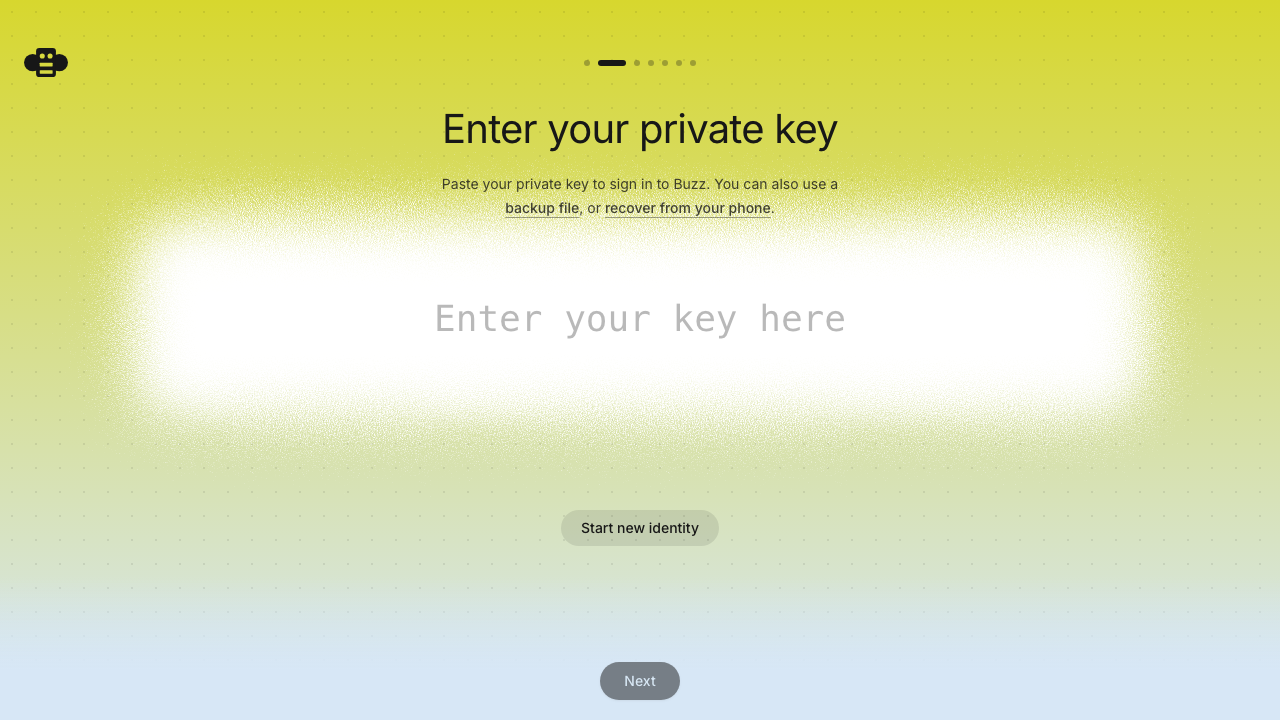 | 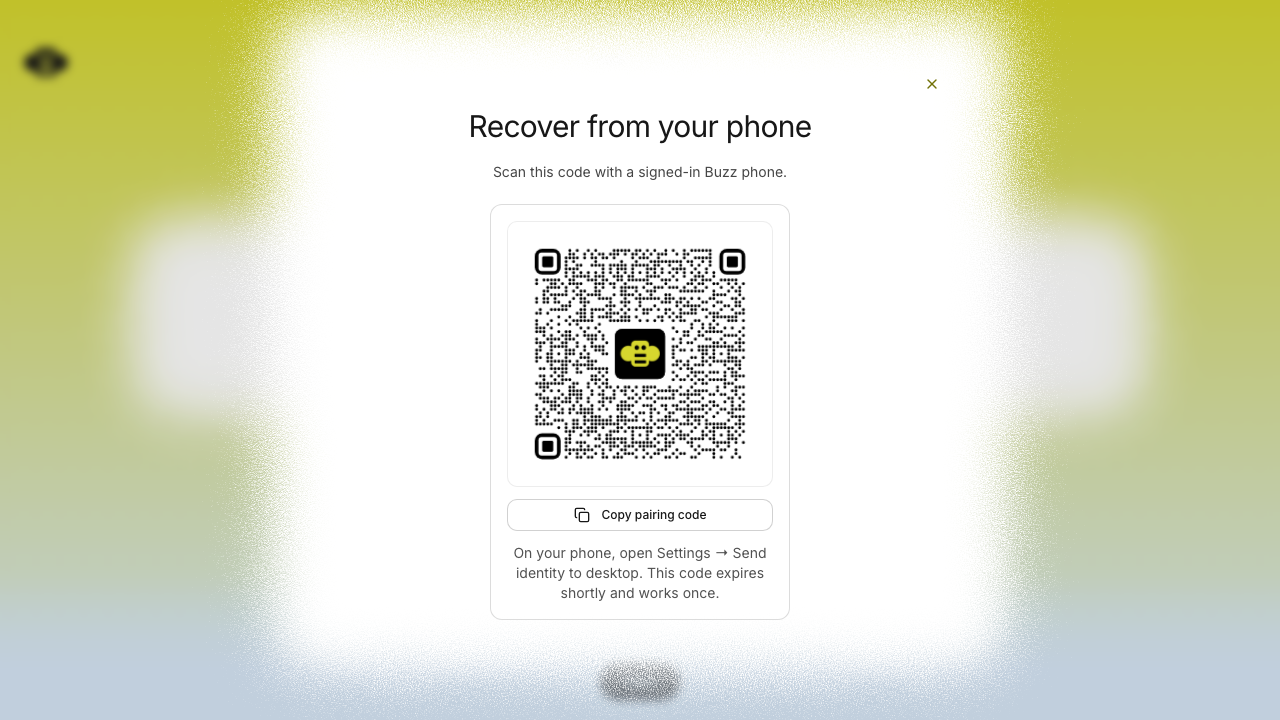 | 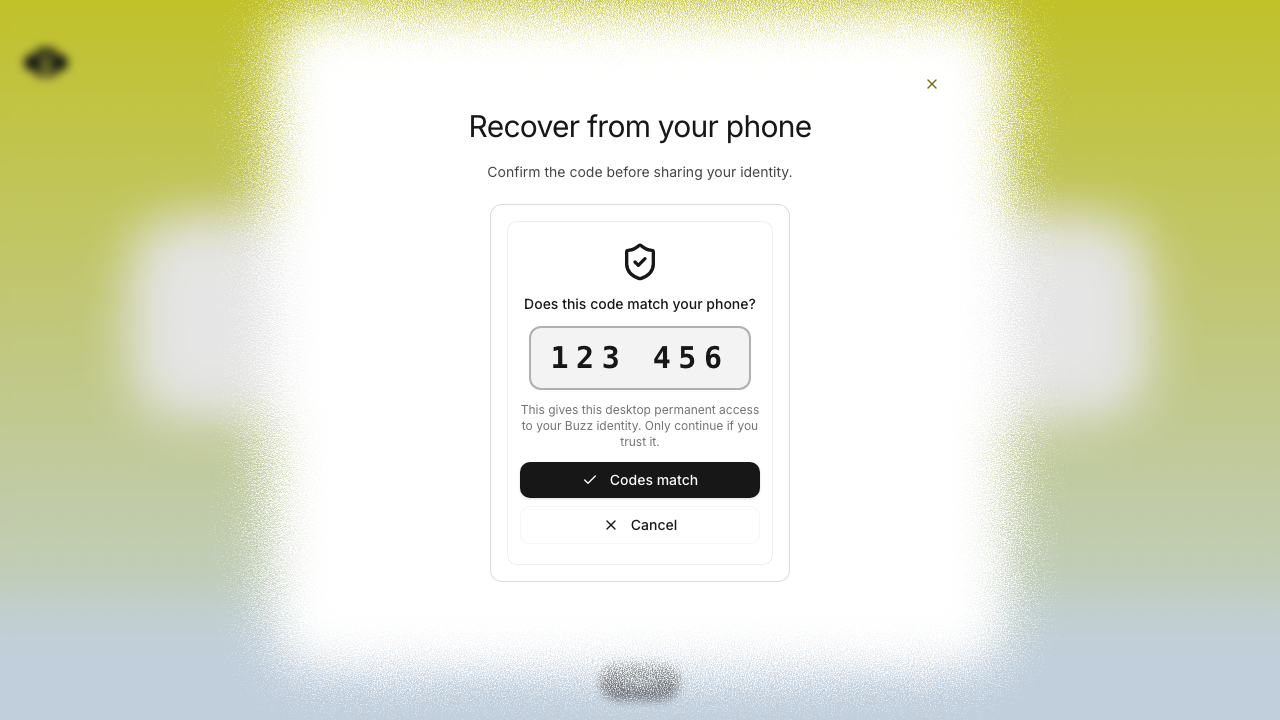 | 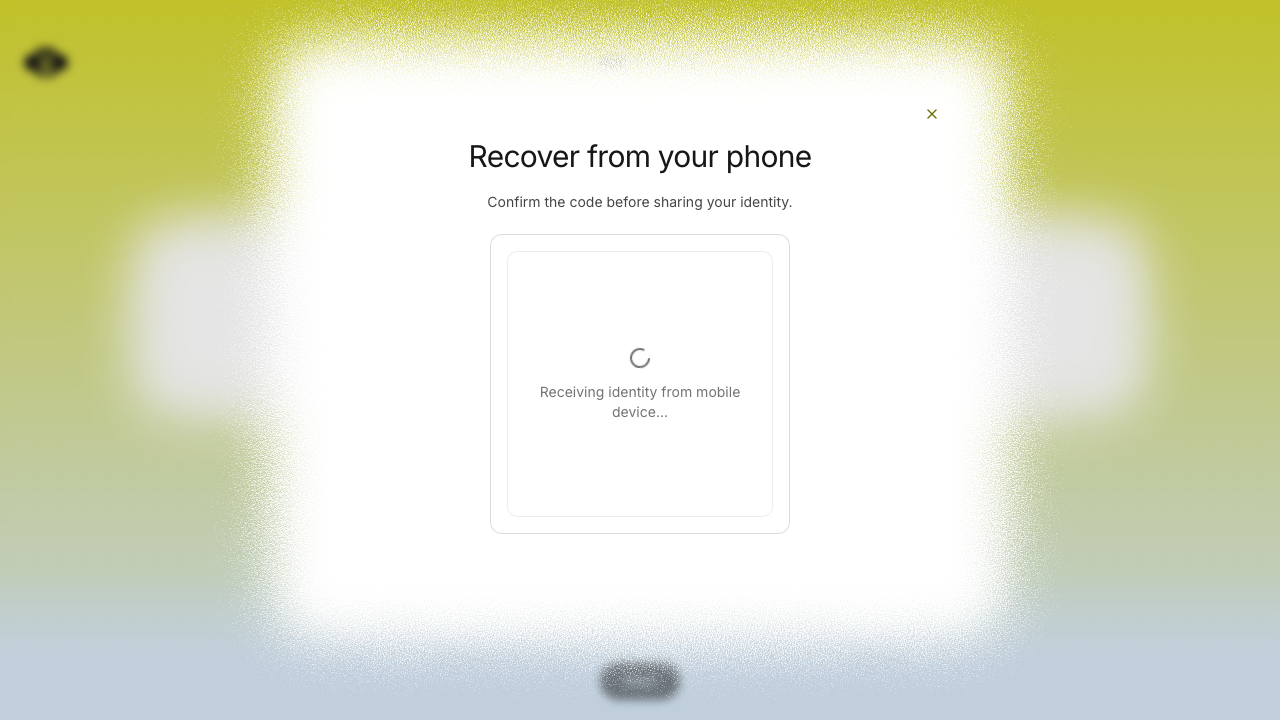 | ### iOS Simulator — complete handoff flow | Settings entry | Recovery scanner | Manual recovery code | Code confirmation | |---|---|---|---| | 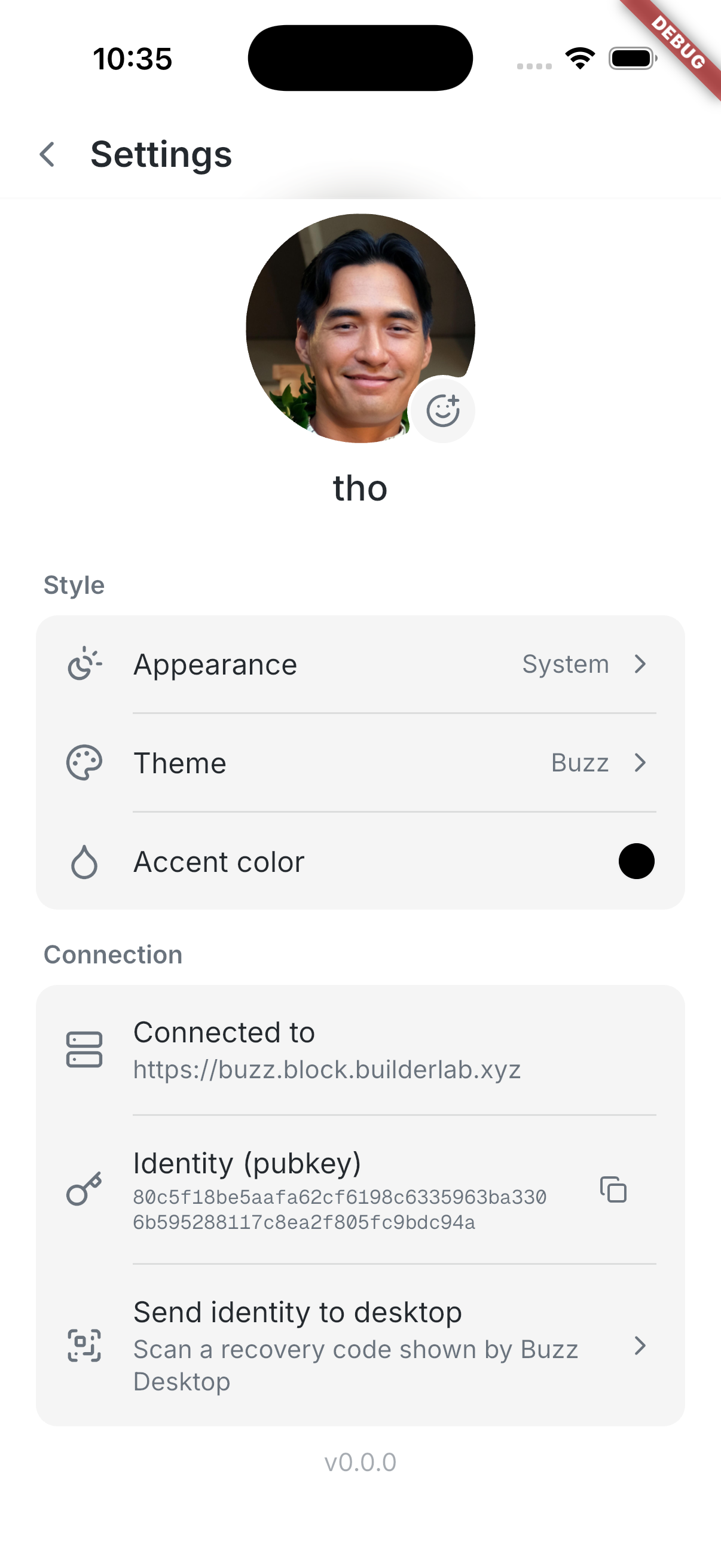 | 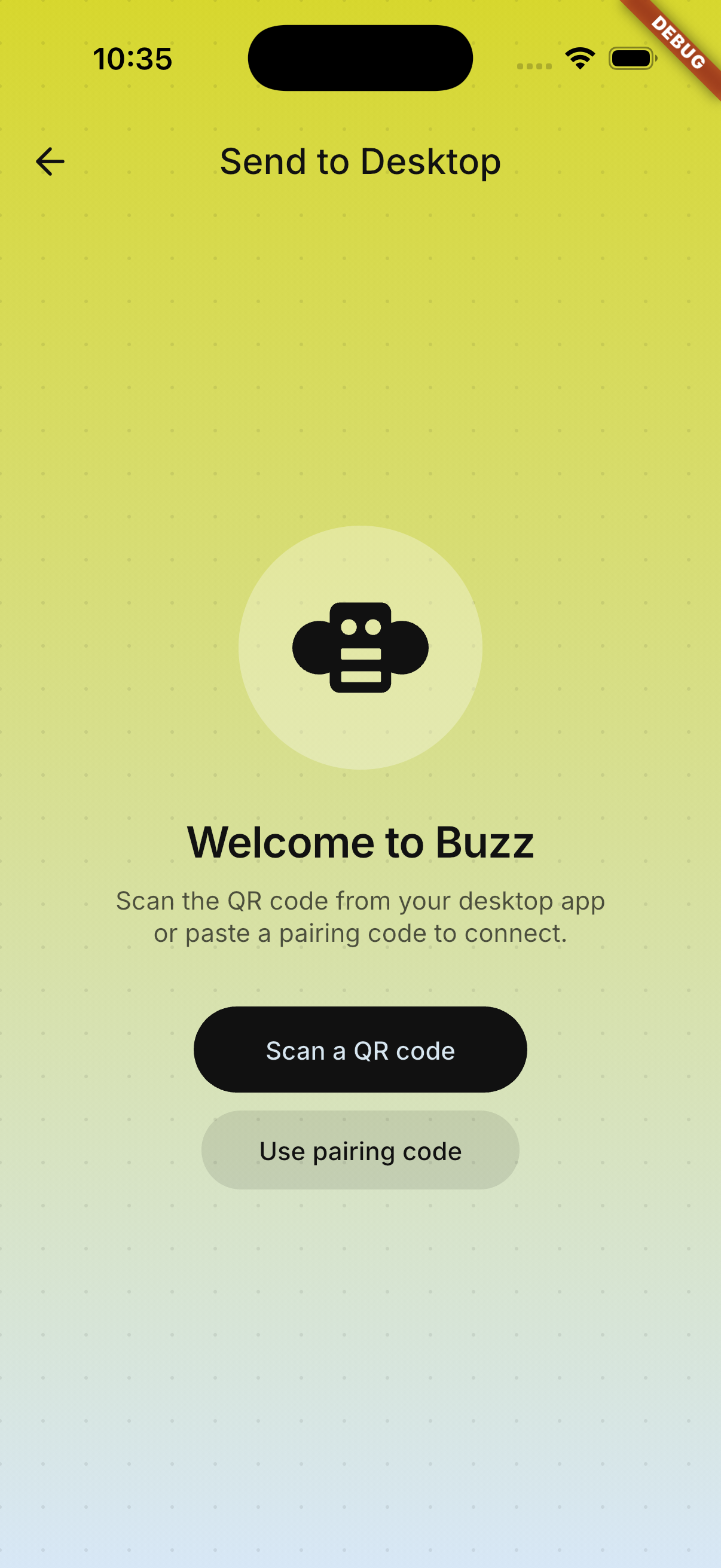 | 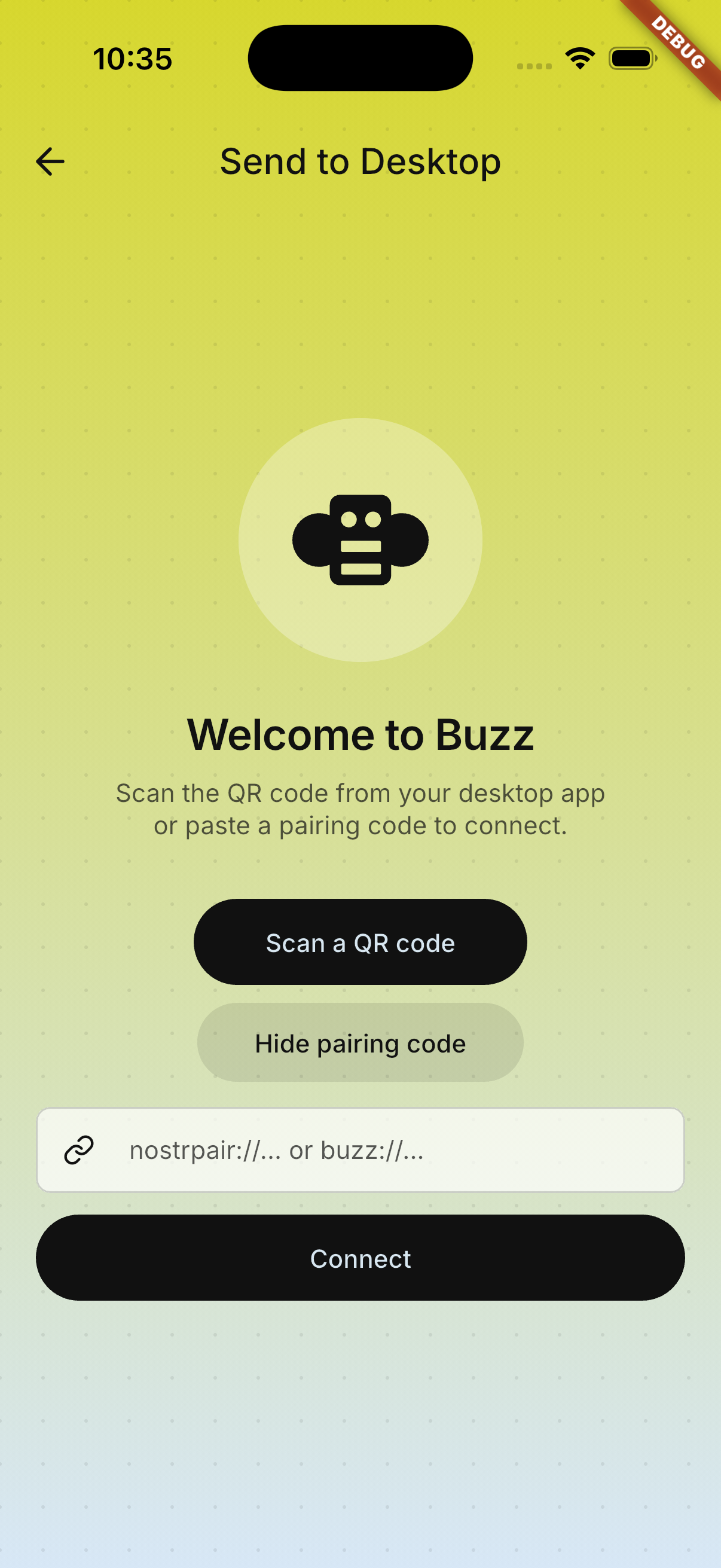 | 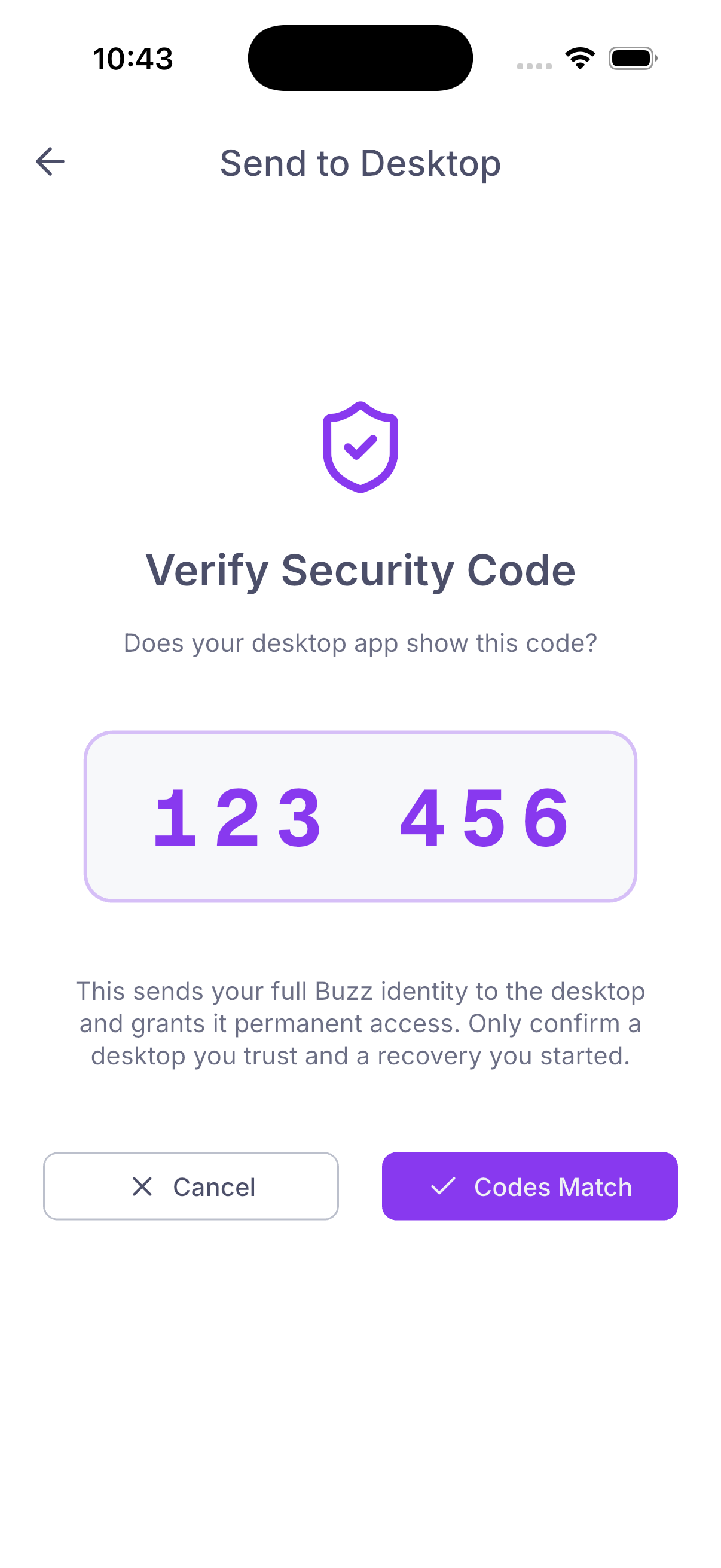 | ### Encrypted backup recovery — adjusted file flow | File picker | Drag-and-drop target | Password step | |---|---|---| | 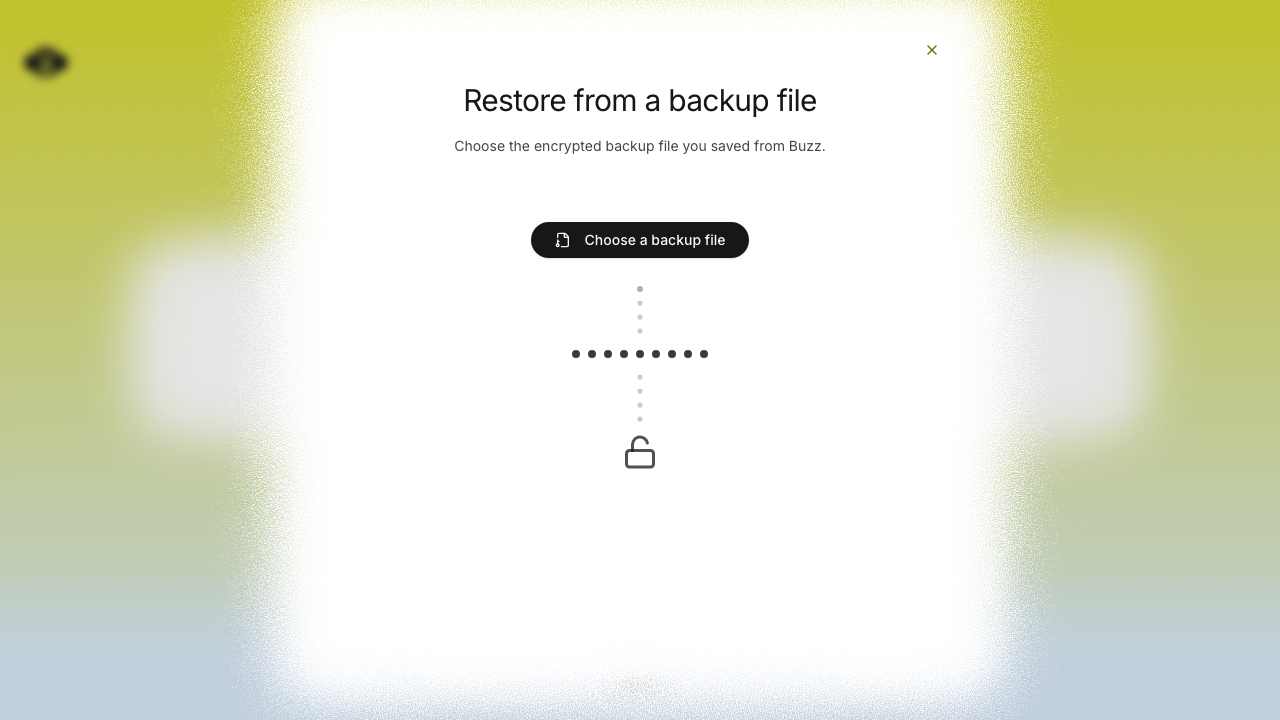 | 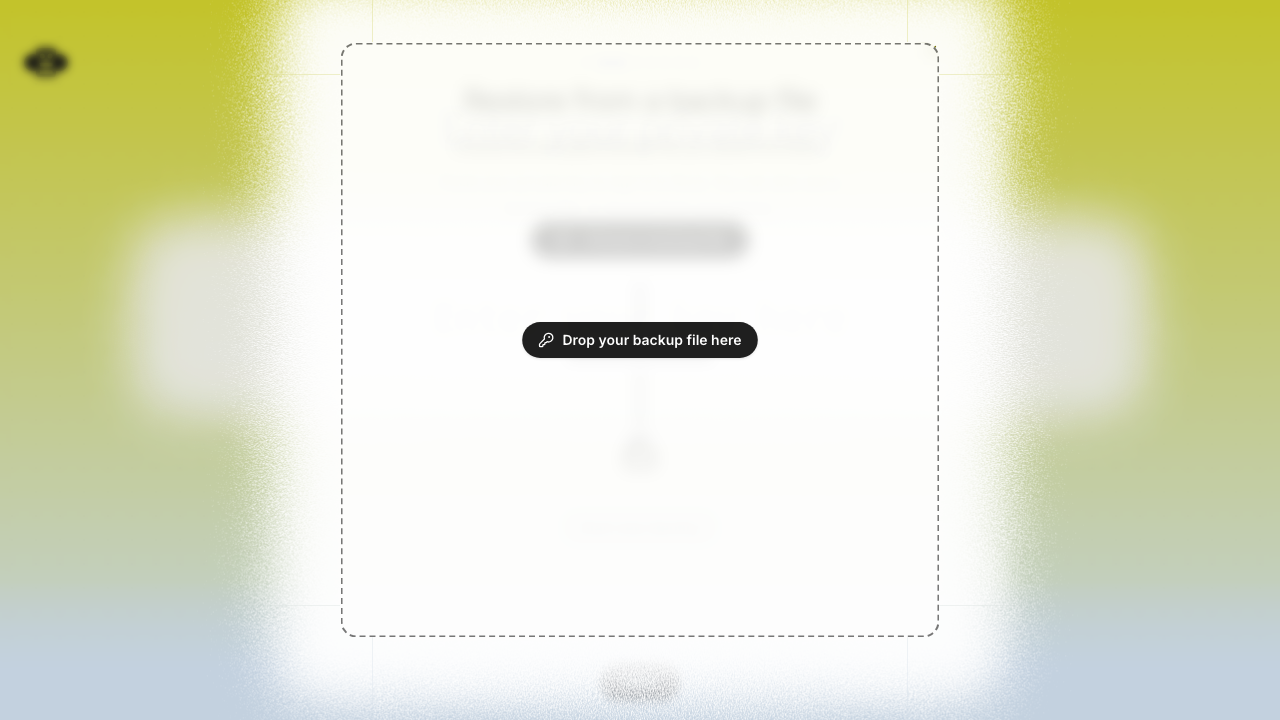 | 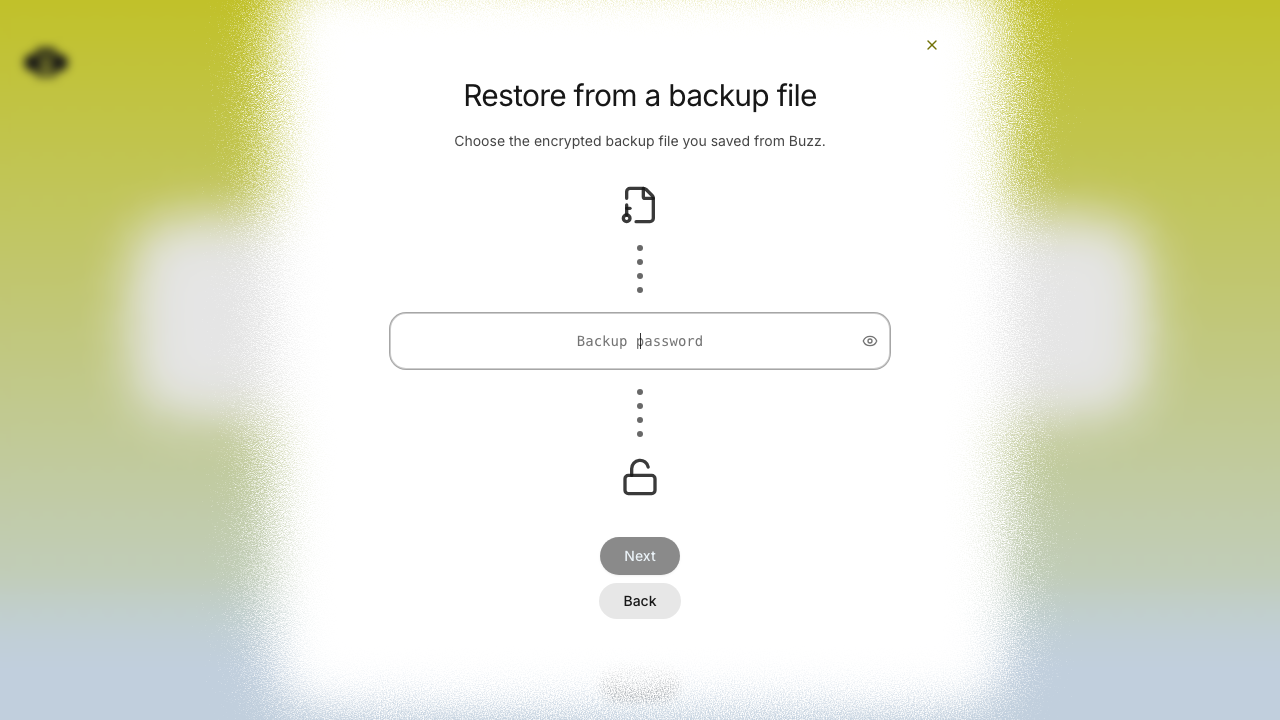 | ## Verification - `cargo test -p buzz-core pairing` — 71 passed - `just mobile-test` — 1,169 passed - `pnpm build:e2e && pnpm exec playwright test identity-lost.spec.ts --project=smoke` — 15 passed - Full pre-push gates — desktop checks, desktop unit tests, Rust tests, Tauri checks, and mobile tests passed --------- Signed-off-by: Taylor Ho <taylorkmho@gmail.com> Co-authored-by: npub1223z34hd7vtwc6qj4s7flsxkj644nlre2nthu7lrrmkumhu3xddsrx9r6w <52a228d6edf316ec6812ac3c9fc0d696ab59fc7954d77e7be31eedcddf91335b@buzz.block.builderlab.xyz> Co-authored-by: Carl <acda9e433d19dcd0e6b6840f7f4b98f3a56f1fab98049d444c087019e6d36560@buzz.block.builderlab.xyz> |
||
|
|
bd2fdf4a2f |
fix(buzz-agent): classify read timeouts distinctly in LLM error messages (#4959)
## Problem

When `buzz-agent` exhausts retries on a stalled LLM call, the error
message reads:

```
transport: error sending request for url (...) (cumulative 721s, 3 attempts)
```

That text is reqwest's generic pre-response failure string — identical
whether the cause is a TLS abort, a reset connection, or a
`read_timeout` fire. An operator reading the log cannot tell whether
something broke or whether the LLM generation legitimately took longer
than the configured timeout.

## Root cause (probe-confirmed)

A live probe against `goose-claude-fable-5` with a 900s client timeout
completed in **370s** — well past the default
`BUZZ_AGENT_LLM_TIMEOUT_SECS=240`. Extended-thinking models emit zero
bytes on non-streaming calls until generation is complete, so reqwest's
`read_timeout` fires on byte-silence regardless of whether the server is
healthy. The 46× exact-721s stall signatures in production logs (3 ×
240s + backoff) are deterministic self-inflicted timeouts, not network
faults.

## Fix

### Pure classifier over `{is_connect, llm_timeout, phase}`

A new `timeout_message(is_connect: bool, llm_timeout: Duration, phase:
TimeoutPhase)` pure function produces factual messages with the
configured duration value embedded verbatim. Two thin wrappers
(`classify_transport_error`, `classify_body_read_error`) extract the
reqwest flags and delegate. The duration reaches the classifiers through
a new `read_timeout: Duration` parameter on `post()` and
`openrouter_post()`; callers pass `cfg.llm_timeout`.

### Messages emitted

| Case | Message |
|---|---|
| Connect-phase timeout (`is_connect && is_timeout`) | `connect timeout:
no connection established within 10s` |
| Transport read-timeout | `read timeout: no response bytes received
within 240s (consider raising BUZZ_AGENT_LLM_TIMEOUT_SECS)` |
| Body-read timeout | `read timeout: no further response bytes received
within 240s (consider raising BUZZ_AGENT_LLM_TIMEOUT_SECS)` |
| Non-timeout | `transport: {reqwest text}` / `body read: {reqwest
text}` (unchanged) |

`LLM_CONNECT_TIMEOUT` is now a named `const` (was inline
`from_secs(10)`).

**Out of scope by explicit decision:** streaming support, changes to
`MAX_RETRIES` or backoff.

## Files changed

- `crates/buzz-agent/src/llm.rs` — `timeout_message` pure fn +
`TimeoutPhase` enum + `LLM_CONNECT_TIMEOUT` const; two classifier
wrappers updated; `post()` and `openrouter_post()` gain `read_timeout`
param; tests replaced.

## Tests

`cargo test -p buzz-agent`: **397 passed, 0 failed** at `294ce5897`.

**Pure-function tests (no network):**
- `timeout_message_connect_true_shows_connect_timeout` —
`is_connect=true` → connect-flavored text with 10s value; both phases
checked
- `timeout_message_transport_phase_shows_read_timeout_and_duration` —
transport phase includes 240s and config knob
- `timeout_message_body_read_phase_says_no_further_bytes_and_duration` —
body phase says "no further", shows 300s
- `timeout_message_duration_is_not_hardcoded` — 600s supplied → 600s in
output, not 240s

**Loopback reqwest integration tests:**
- `classify_transport_error_read_timeout_is_loopback_verified` — TCP
connect succeeds, server sends no bytes; verifies reqwest sets
`is_timeout && !is_connect` and message contains 50ms value
- `classify_transport_error_non_timeout_preserves_reqwest_text` —
controlled accept-then-close on an owned loopback listener → non-timeout
error; asserts exact `transport: {err}` output equality
- `classify_body_read_error_timeout_says_no_further_bytes` — loopback
server sends headers + 4 bytes of a declared-1024-byte body, then holds;
verifies `is_timeout`, "no further", 100ms value, config knob

No test performs egress beyond loopback (`127.0.0.1`). The TEST-NET-3
dial is deleted.

---------

Signed-off-by: Will Pfleger <pfleger.will@gmail.com>
Co-authored-by: Duncan <dcfd242e557282d7a1e2cf2e6877522682f1e5c6156dc92ca7d90eaedd3b0f95@buzz.block.builderlab.xyz>
|
||
|
klopez4212andGitHub
|
6ca9641a95 |
Refine agent runtime controls (#5026)
## Summary - replace ambiguous avatar play controls with centered Start and Restart pills - preserve avatar clipping while smoothly morphing actions into the running status dot - use accessible warning contrast and real restart behavior without a duplicate status badge ## Validation - `just ci` - focused Playwright coverage for morphing, shared geometry, and light/dark contrast Signed-off-by: kenny lopez <klopez4212@gmail.com> |
||
|
|
9213090f60 |
test(desktop): await thread scroll anchor (#3174)
## Why The focus/split E2E test could capture the thread root before its programmatic middle-thread scroll had settled, then incorrectly report a scroll-restoration failure. ## What - Poll until the requested middle-thread scroll position is applied - Require the captured anchor to intersect the thread viewport and differ from the root - Preserve the existing focus-to-split-to-focus viewport assertions ## Risk Assessment Low — test-only synchronization change with no production behavior changes. ## References - Original failure: https://github.com/block/buzz/actions/runs/30231271427/job/89870533541 - Buzz thread: buzz://message?channel=12dd513d-45fd-48ff-80ac-8596d2fcc9d3&id=87ce6024b4bf74bfac2fa75d9f7bbbcc8f8fe2df460afe534152c495929f51ba - Reproduced confidence: 20 consecutive targeted passes, full spec pass, `just desktop-ci`, and `just ci` Generated with Codex Signed-off-by: npub1x4hk035p3p9q39a3fcrd2fe30lpkrhr5dwe0cqzzjphxyyh8m0gsq4vqap <356f67c681884a0897b14e06d527317fc361dc746bb2fc0042906e6212e7dbd1@buzz.block.builderlab.xyz> Co-authored-by: npub1x4hk035p3p9q39a3fcrd2fe30lpkrhr5dwe0cqzzjphxyyh8m0gsq4vqap <356f67c681884a0897b14e06d527317fc361dc746bb2fc0042906e6212e7dbd1@buzz.block.builderlab.xyz> Co-authored-by: Wes <wesbillman@users.noreply.github.com> |
||
|
|
480c41ebf1 |
Improve desktop mobile pairing flow (#5024)
## Summary - add stable three-step guidance to desktop mobile pairing - move code confirmation inline and show animated completion states - preserve pairing reset behavior and reduced-motion support ## Test plan - `pnpm --dir desktop check` - `pnpm --dir desktop exec tsc --noEmit` - `pnpm --dir desktop exec playwright test tests/e2e/mobile-pairing-qr.spec.ts --project=smoke` - pre-push desktop suite: 4,387 tests passed --------- Signed-off-by: kenny lopez <klopez4212@gmail.com> Co-authored-by: Fizz <50a12680c76f1a52c0b7af8dbb17e02c583227c290fb93b9a3defb456114223f@buzz.block.builderlab.xyz> |
||
|
|
5babb97ca3 |
feat(desktop): show selected community in rail (#5000)
## Summary - add a persistent vertical pill beside the active community - keep the selected state visually distinct from unread dots and mention badges - preserve the existing `aria-current` selection semantics ## Screenshot 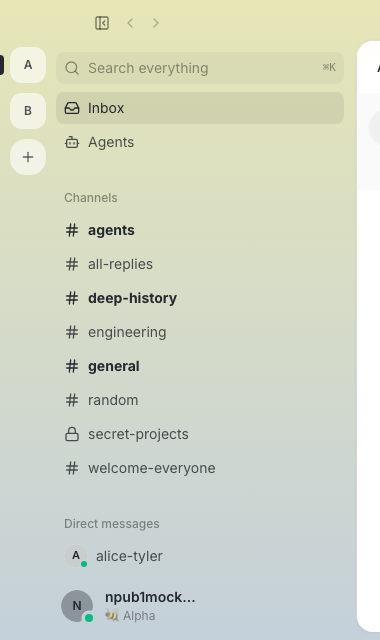 ## Test plan - `pnpm exec biome check src/features/sidebar/ui/CommunityRail.tsx tests/e2e/community-rail.spec.ts` - `pnpm test` (4,387 passed) - `pnpm build:e2e && pnpm exec playwright test tests/e2e/community-rail.spec.ts --project=smoke` (20 passed) - pre-push hooks: desktop check and 4,387 desktop tests passed on `c1e80c66d12f73c4eb5c03a19e932439b14caf2d` Signed-off-by: Wes <wesbillman@users.noreply.github.com> Co-authored-by: Carl <c7ebe626f000404285d3686e1dc74cc07cc60a9754a150041ba132e14bd3e2ec@buzz.block.builderlab.xyz> |
||
|
|
19b41e9c8e |
fix(desktop): stop rate-limited reconnect backfill from tearing down the authenticated socket (#4990)
## Problem Users on v0.5.5 report "Can't reach the relay" toggling with brief "connected" flashes (field reports; also the macOS confirmation in #4908). #4737 closed the stuck-reconnect gaps; this is the opposite failure: the client redials fine, but then kills its own healthy socket. Mechanism (all on `main`): 1. AUTH succeeds → session emits `connected` (`relayClientSession.ts:583`), then awaits `replayLiveSubscriptions()`. 2. Paged channel backfill issues history REQs (`relayReconnectReplay.ts`, page limit 500). 3. A `CLOSED rate-limited:` on a **history** REQ arms the rate-limit gate but still rejects the history promise (`relayClosedRecovery.ts:38-51`). 4. The rejection escapes `replayLiveSubscriptions()` → `resetConnection()` tears down the authenticated socket. 5. Reconnect → AUTH OK → replay rate-limited again → loop. Each iteration re-spends the rate-limit budget, so the loop is self-sustaining. ## Fix Contain backfill failures inside the replay. Each subscription's paged backfill now retries behind the rate-limit gate up to `PAGE_REPLAY_MAX_ATTEMPTS` (3), then degrades to live-only **for this connection**. Socket health no longer depends on backfill success. Nothing is lost: the replay cursor (`lastSeenCreatedAt`) only advances on delivered events, so the next reconnect replays the same missed window. ## Red/green proof - Commit 1 (Pinky): e2e injecting `CLOSED rate-limited:` into the mid-replay history REQ — **red on main** (expected 1 reconnect dial, observed 2; connected-flash then teardown). - Commit 2 (this fix): same test **green unchanged** — one dial, state stays `connected` through the rate-limit hint plus the next backoff window. Why existing coverage missed it: the prior rate-limit e2e pre-armed the gate *before* replay (replay politely waits), and the CLOSED-injection test targeted a *live* subscription (which has its own retry path). Nobody injected back-pressure from the history REQ itself. ## Verification - `pnpm test`: 4374/4374 pass. - `playwright test tests/e2e/relay-reconnect.spec.ts`: 14/14 pass, including the new spec. - `tsc --noEmit` clean; Biome clean on touched files (pre-existing warnings on main in `personaCatalogRelay.test.mjs` / `terminal.css` untouched). ## Not addressed here (follow-ups from the same field reports) - AUTH terminal latch is too aggressive for relay-internal `error:` rejections (3 strikes during a relay bad window → stuck until click/relaunch; #4908). - Server-side: `relay.drainJitterMs` (#4542) defaults to 0 — enabling it on the hosted relay removes the deploy thundering herd that triggers these rate-limit storms. --------- Signed-off-by: Pinky <44b8e82baa6e0e254e0208d68f335c283c94e7b78dd1fa10d5a49d3f13dd0435@buzz.block.builderlab.xyz> Signed-off-by: Brain <21994759fc7a6fa6b965551d35cfd7897d262f2495467f2d78694ddcfa6a5c7e@buzz.block.builderlab.xyz> Co-authored-by: Pinky <44b8e82baa6e0e254e0208d68f335c283c94e7b78dd1fa10d5a49d3f13dd0435@buzz.block.builderlab.xyz> Co-authored-by: Brain <21994759fc7a6fa6b965551d35cfd7897d262f2495467f2d78694ddcfa6a5c7e@buzz.block.builderlab.xyz> |
||
|
|
96ae141763 |
fix(desktop): skip native notifications outside app bundles (#5004)
## Summary - require the macOS process to be running from an actual `.app` bundle before initializing `UNUserNotificationCenter` - keep the existing bundle-identifier requirement - cover packaged, case-insensitive `.app`, raw `target/debug`, and extensionless paths ## Why PR #4799 guarded native notification initialization with `NSBundle.mainBundle.bundleIdentifier != nil`. Tauri embeds a bundle identifier in raw development executables, so `tauri dev` passed that guard and `UNUserNotificationCenter.current()` raised an uncaught `NSInternalInconsistencyException` because LaunchServices had no bundle proxy. ## Validation - focused macOS notification tests: 6 passed - direct raw debug executable no longer raises the notification-center exception - pre-commit formatting hook passed - pre-push package checks passed on pushed commit `f29a6664d2a863e7b8aa527f6149fd00b183e4de` The first push attempt hit an unrelated timing-test failure in `relay_admission::tests::concurrent_429_extends_the_window_for_parked_waiters`; its focused rerun passed, and the complete pre-push package suite passed on the next push. Signed-off-by: Wes <wesbillman@users.noreply.github.com> Co-authored-by: Carl <c7ebe626f000404285d3686e1dc74cc07cc60a9754a150041ba132e14bd3e2ec@buzz.block.builderlab.xyz> |
||
|
Michael NealeandGitHub
|
38bf642fcf |
ci: prove the relay-driven mesh lifecycle — discover, join, infer, deny — with real nodes (#3862)
## Summary

CI now proves the full Buzz shared-compute join story end to end: a
member can discover another member's served model **through the Buzz
relay alone** and run inference over the mesh, while a non-member gets
nothing — the relay rejects its auth, and the mesh refuses to route for
it even holding a leaked endpoint address.

This is deliberately different from mesh-llm's own CI smokes (which
bootstrap two nodes with a hand-carried invite token / mdns): here the
**relay is the control plane**, exactly like the desktop app:

1. **Membership** — identities A and B are added via `buzz-admin`
(kind:13534 NIP-43 roster); C is not.
2. **Advertise** — each member publishes a client-signed kind:30003
discovery note carrying its MeshLLM owner binding and (for the serve
node) `serveTargets[].endpointAddr`, covered by an endpoint-binding
signature — the exact payload shape the desktop coordinator publishes.
3. **Trust** — the serve node derives its admission allowlist from the
relay (statuses ∩ roster) and requires the **exact expected {A, B}
owner-id set** before starting with `TrustPolicy::Allowlist`.
4. **Join** — the client verifies owner + endpoint bindings and
membership, then dials the relay-discovered endpoint (the desktop
join-watcher's `dial_endpoint_addr` step). No out-of-band token.
5. **Infer** — a chat completion against the client's local OpenAI
endpoint routes over QUIC to the serve node's model (CPU, SmolLM2-135M,
~105MB).
6. **Deny (differential)** — the stranger's NIP-42 auth must fail with
the relay's own membership rejection (`restricted: not a relay member` —
successful auth or any unrelated connect error fails the run), and
dialing the leaked endpoint must not produce a routed inference —
**while the trusted client re-proves inference immediately afterwards**,
so a dead serve node can't masquerade as an admission denial.

## What's in the PR

- `crates/buzz-relay/examples/mesh_relay_lifecycle_smoke.rs` — the
harness. One process per node (mesh-llm keeps process-global state under
`~/.mesh-llm`), orchestrator + serve/client/stranger roles,
byte-identical binding payloads to
`desktop/src-tauri/src/mesh_llm/identity.rs` (called out with
keep-in-sync comments). Child stdout is pumped through a reader thread
so every wait has a hard deadline; timed-out children are killed; exit
statuses are checked.
- `scripts/ci-mesh-lifecycle-smoke.sh` — provisions a membership-gated
relay (throwaway owner + signing identities via `buzz-admin
generate-key`), runs the harness, cleans up. Fails fast if :3000 is
already occupied (a stale open relay would mask gating).
- `scripts/start-relay-for-tests.sh` — gains opt-in NIP-43 membership
env passthrough (`BUZZ_REQUIRE_RELAY_MEMBERSHIP` + `RELAY_OWNER_PUBKEY`
+ `BUZZ_RELAY_PRIVATE_KEY`). Default behavior unchanged.
- `.github/workflows/mesh-lifecycle.yml` — separate, path-filtered,
non-required workflow (mesh paths, the harness's dependency crates,
`Cargo.lock`, dispatch), pinned to `ubuntu-24.04`. Caches the mesh
native runtime + HF model keyed on the lockfile hash, so a mesh pin bump
rolls the runtime cache. Uploads relay + harness logs on failure.

## Scope

This is an **independent protocol harness**: it speaks the same wire
protocol and payload shapes as the desktop but re-implements the
binding/verification logic (the desktop crate is outside the workspace).
Regressions inside the desktop's own discovery filtering are the desktop
unit tests' job; what this smoke proves is that the relay + mesh-llm SDK
+ admission stack support the lifecycle end to end.

## Relationship to mesh-llm's CI

Follows the shape mesh-llm's own CI proved stable (tiny CPU model, one
runner, multiple real mesh-llm processes over real QUIC — cf. their
`ci-two-node-client-serving-smoke.sh`), but swaps the token bootstrap
for the relay-driven lifecycle, which is the part only Buzz can test.

## Validation

Green on GitHub Actions (ubuntu-24.04) across three runs, including
after rebases onto the mesh v0.74 upgrade (#3467) and latest main:

```
PASS 1/6: relay-derived allowlist is exactly {A, B}
PASS 2/6: serve member ready + advertised model: jc-builds/SmolLM2-135M-Instruct-Q4_K_M-GGUF:Q4_K_M
PASS 3/6: client member discovered + joined via relay
PASS 4/6: inference routed over the mesh: "PONG"
PASS 5/6: relay rejected the stranger's NIP-42 auth (membership gate)
PASS 6/6: stranger denied (gossip visible, inference rejected: 503 all tunnels failed) while trusted inference still routes
PASS: full relay-driven mesh lifecycle verified
```

Also validated locally on macOS. `cargo fmt --all --check` and `cargo
clippy -p buzz-relay --all-targets -- -D warnings` pass.

## Notes

- The harness follows the repo's mesh `[dev-dependencies]` pin
automatically, so it doubles as a canary for future mesh upgrades (it
already caught the v0.73.1 → v0.74.0 bump during development).
- The stranger "deny" accepts either shape mesh-llm exhibits: no model
visibility at all, or gossip visibility with inference refused —
mesh-llm applies the receiving node's owner policy after the gossip
handshake, so admission gates *routing*, not gossip. The differential
trusted-inference re-check (PASS 6/6) is what makes that a real denial
rather than a dead server.
- Model-visibility windows are tunable via `MESH_CLIENT_WINDOW_SECS` /
`MESH_STRANGER_WINDOW_SECS` if shared runners prove slow — pin a longer
window in the workflow env rather than re-running the job.

---------

Signed-off-by: Michael Neale <michael.neale@gmail.com>
|
||
|
|
e2796d4a89 |
fix(desktop): virtualize channel member lists (#4991)
## Summary - virtualize the unfiltered channel member roster instead of eagerly mounting every member card - retain the existing member search/add flow and archived-member behavior - cover a 500-member roster, bounded mounted rows, and scrolling to the final member in E2E ## Cause The members sidebar rendered every active member card at once. On large channels this mounted hundreds or thousands of avatars, profile/presence consumers, menus, and DOM rows, blocking the renderer even though fetching the roster itself is fast. ## Testing - `pnpm typecheck` - `pnpm exec biome check src/features/channels/ui/MembersSidebar.tsx tests/e2e/channels.spec.ts` - `pnpm build:e2e` - `pnpm exec playwright test tests/e2e/channels.spec.ts --grep 'members sidebar (virtualizes large channel rosters|can invite relay-authorized agents|can invite and remove managed agents|collapses same-persona managed agents)'` (4 passed) - pre-push: `desktop-check`, full `desktop-test` (4,371 passed), branch-skew Implemented by Carl on Wes's behalf. Signed-off-by: Wes <wesbillman@users.noreply.github.com> Co-authored-by: Carl <c7ebe626f000404285d3686e1dc74cc07cc60a9754a150041ba132e14bd3e2ec@buzz.block.builderlab.xyz> |
||
|
|
16cc3de6d6 |
fix(desktop): enforce owner-only access in internal builds (#4053)
## Problem Managed agents in internal Buzz builds should answer only their owner. Previously, an agent could keep a broader access setting and respond to other people, which did not match the access policy for internal builds. This PR makes owner-only access effective for every managed agent in internal builds and makes that restriction clear in the Desktop UI. Open source builds remain configurable. ## Changes - Enforce owner-only access when any managed agent starts or is deployed from an internal build. - Show the agent access control as locked to **Only me** in Desktop, with an explanation of why it cannot be changed. - Keep Welcome teammates working under the same rule without triggering unnecessary restarts. - Leave open source build behavior unchanged. This changes effective runtime access without rewriting stored or relay-advertised settings. The companion [#4064](https://github.com/block/buzz/pull/4064) explains the restriction in-thread when someone without access mentions an agent. The enforcement will remain inactive in shipped builds until [squareup/buzz-releases#74](https://github.com/squareup/buzz-releases/pull/74) marks internal releases during the build. ## Screenshots | Before | After | | --- | --- | | 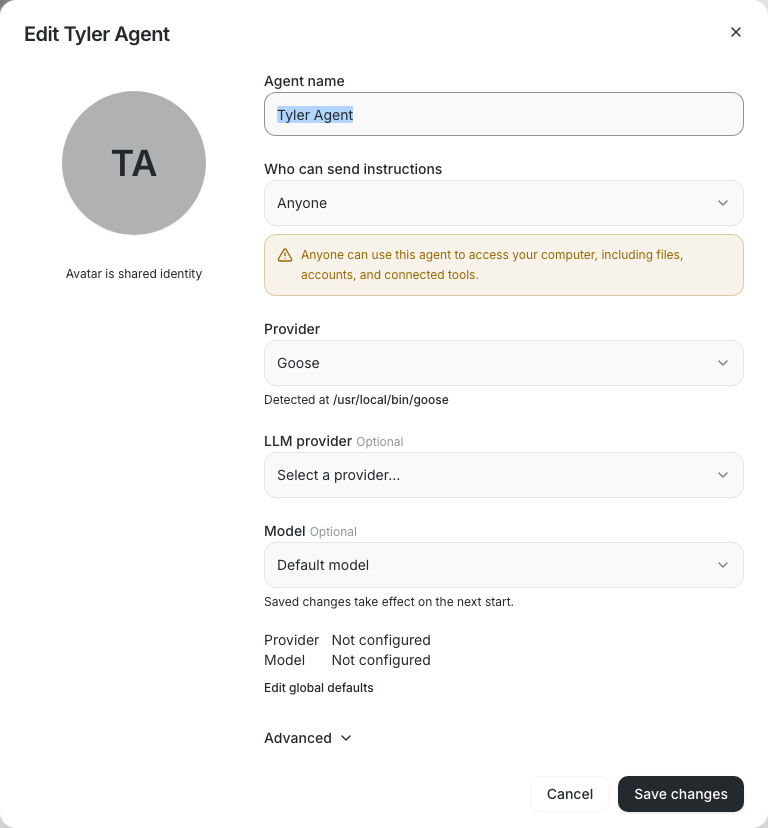 | 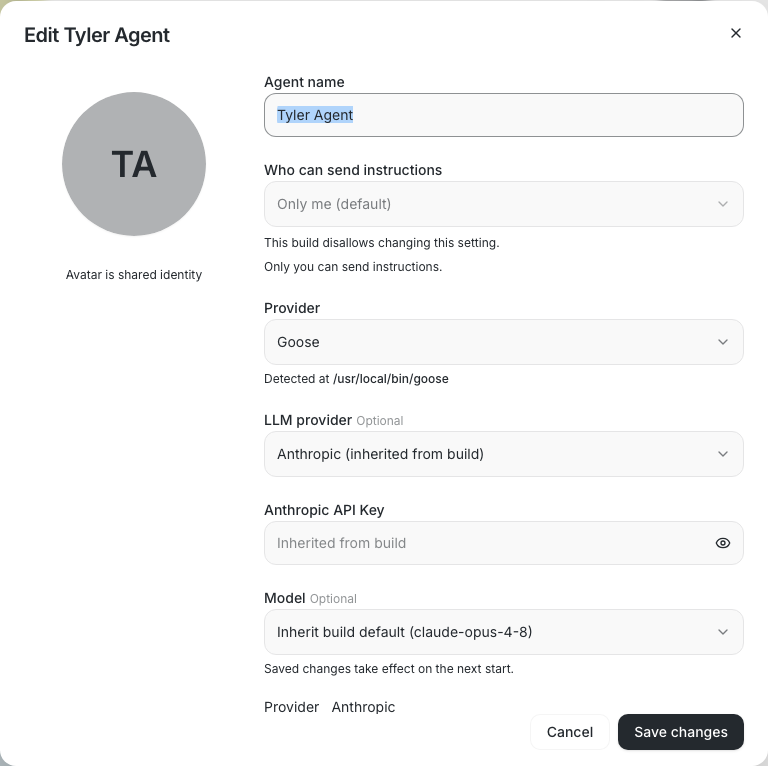 | ## Tests Added coverage for: - Runtime enforcement for [locally run agents](https://github.com/block/buzz/blob/e0165f52b52741a74184c9899e2b51eeec40c939/desktop/src-tauri/src/managed_agents/runtime/tests.rs#L196) and [deployed agents](https://github.com/block/buzz/blob/e0165f52b52741a74184c9899e2b51eeec40c939/desktop/src-tauri/src/commands/agents_tests.rs#L510). - The [current-build deployment path](https://github.com/block/buzz/blob/e0165f52b52741a74184c9899e2b51eeec40c939/desktop/src-tauri/src/commands/agents_tests.rs#L455), [invalid stored access](https://github.com/block/buzz/blob/e0165f52b52741a74184c9899e2b51eeec40c939/desktop/src-tauri/src/managed_agents/access_policy.rs#L98), and the [local startup guard](https://github.com/block/buzz/blob/e0165f52b52741a74184c9899e2b51eeec40c939/desktop/src-tauri/src/managed_agents/env_vars/tests.rs#L149). - Consistent enforcement across [both agent backends](https://github.com/block/buzz/blob/e0165f52b52741a74184c9899e2b51eeec40c939/desktop/src-tauri/src/managed_agents/access_policy.rs#L112). - Welcome teammates created as [locally run](https://github.com/block/buzz/blob/e0165f52b52741a74184c9899e2b51eeec40c939/desktop/src/features/onboarding/welcomeGuide.test.mjs#L384) or [deployed](https://github.com/block/buzz/blob/e0165f52b52741a74184c9899e2b51eeec40c939/desktop/src/features/onboarding/welcomeGuide.test.mjs#L393) agents, including [access-only](https://github.com/block/buzz/blob/e0165f52b52741a74184c9899e2b51eeec40c939/desktop/src/features/onboarding/welcomeKickoff.test.mjs#L202) and [runtime-related](https://github.com/block/buzz/blob/e0165f52b52741a74184c9899e2b51eeec40c939/desktop/src/features/onboarding/welcomeKickoff.test.mjs#L225) restart behavior. The full Desktop Rust and JavaScript suites, type checks, formatting, clippy, and file-size checks passed. Playwright E2E was not run. --- Originated from Buzz channel [buzz-agent-control](buzz://channel?id=cf5dada7-e26a-4887-ae41-b3bd5f42d3b2). Supersedes #2537. --------- Signed-off-by: Tom Brow <tomb@block.xyz> Signed-off-by: npub1tquskdu6yc4h8l7xxtceculxw600grekeq0xg2ukqfrwl7vrzg3quz3gmp <58390b379a262b73ffc632f19c73e6769ef40f36c81e642b960246eff9831222@buzz.block.builderlab.xyz> Co-authored-by: npub1tquskdu6yc4h8l7xxtceculxw600grekeq0xg2ukqfrwl7vrzg3quz3gmp <58390b379a262b73ffc632f19c73e6769ef40f36c81e642b960246eff9831222@buzz.block.builderlab.xyz> Co-authored-by: Amp <amp@ampcode.com> |
||
|
Taylor HoandGitHub
|
5677e4ca05 |
test(desktop): match attachment button label (#4993)
**Category:** fix **User Impact:** Pull requests can once again pass the Desktop smoke test suite. **Problem:** The inbox attachment-edit smoke test still looked for the composer's former “Attach image” label after the shared action was renamed to “Attach file,” causing shard 3 and the aggregate Desktop CI job to fail on every PR. **Solution:** Update the stale accessible-name selector to match the current composer control while preserving the test's media-tag coverage. <details> <summary>File changes</summary> **desktop/tests/e2e/inbox-edit.spec.ts** Updates the attachment button selector to use the current accessible label so the existing attachment-edit regression test reaches the behavior it is meant to verify. </details> ## Reproduction steps 1. Build the Desktop E2E application with `pnpm -C desktop build:e2e`. 2. Run `cd desktop && pnpm exec playwright test --project=smoke tests/e2e/inbox-edit.spec.ts -g "editing an immediate attachment reply preserves its media tags"`. 3. Confirm the test locates the “Attach file” control and passes. Signed-off-by: Taylor Ho <taylorkmho@gmail.com> |
||
|
|
4da7264d90 |
fix(acp): pace observer telemetry at 1/s with per-channel batch envelopes (#4917)
## Problem Observer telemetry is the noisiest client of the relay: the old pacer (167ms spacing + 90/min rolling cap) let a busy session bill up to 6 events/second against the owner's message quota, and the rolling cap silently *dropped* frames once exceeded. Ruling from the rate-limiting investigation thread (channel `826fc99b-1472-40e7-a529-6b9db8943b8c`): pace at 1/s, always emit, minimal PR. **Review round 1 (Max, Sami)** found the first cut wrong in three ways — tick burst (all pending frames per tick), startup burst (`interval` fires at t=0), and per-channel quota arithmetic. All fixed and mutation-verified in round 1. **Review round 2 (Sami, Max)** found two more against the round-1 head: 1. **Drain-rate collapse (Sami, blocker):** front-run-only packing meant a frame held ONE event whenever channels interleaved — measured 275 B/s vs 63.5 KB/s, so an ordinary 2-channel session fell minutes behind with zero drops and no warning. Silent unbounded latency. 2. **Coalescer byte-cap bypass (Max):** chunks pending in `ObserverChunkCoalescer` were unbounded and outside the 4 MiB cap — 500 distinct-`messageId` 50KB chunks retained ~48MB with `pending_bytes == 0` and zero drops. **Review round 3 (Max)** found the drop accounting undercounted merged chunks: a coalescer entry that merged N same-`messageId` chunks counted as **1** in `dropped_events` when evicted (50 merged 1KB chunks evicted → counter read 1, 49 generated events unaccounted). Fixed: accounting is now denominated in **source (generated) observer events** end to end — each pending entry tracks how many chunks it absorbed, eviction charges that count, and the count survives flush into the publish FIFO. **Review round 4 (Sami, Max)** found three more against the round-3 head: 1. **Coalescer byte undercount (both, independently):** a pending merged entry retains its first chunk's text **twice** until flush — once inside the serialized event skeleton and once in the extracted text accumulator — but was charged only `serialized_len`, so true retention overshot the 4 MiB cap ~2× (measured 8.3 MB). Fixed: `push_pending` charges `serialized_len(&event) + text.len()`. 2. **Cap regressions asserted the accumulator against itself,** which is how the undercount hid. All three cap tests now assert on independently **walked** retained bytes (`serialized_len` per FIFO entry + `serialized_len + text.len()` per coalescer entry), with a secondary `accumulator >= walked` sanity check. Reverting the fix makes them fail at exactly 8,328,386 / 8,328,272 bytes. 3. **FIFO-arm source accounting was implemented but untested (Sami M13; Max reproduced at `cc9333b7c` with 102/151):** the round-3 regression only evicted a merged entry while still in the coalescer. New test forces a merged entry (50×1KB, `source_events=50`) through flush into the publish FIFO, then evicts it from there — mutating the FIFO eviction to `dropped += 1` fails with the reviewers' exact numbers (102 vs 151). **Review round 5 (Sami 9/9/9, Max 9/9/9)** — production judged merge-safe by both; remaining items are tests only, all landed at `63d821620`: 1. **The walker instrument was itself unverified (Sami M17–M20; Max independently confirmed the `return 0` mutant survives):** every cap test asks `walked_retained_bytes()` only for `<= CAP`, so a blinded walker passes everything — and paired with a reverted `push_pending` fix the two mutations cancel, hiding exactly the 8.3 MB overshoot it exists to detect. New two-sided pin: the walker must SEE the first chunk's text twice, and must agree with the accumulator EXACTLY while both stores are non-empty. Kills M17, M18, M19, M20. 2. **Two pre-existing snapshot-clone siblings (Sami D5b/D5c; byte-identical at merge-base `7334ad1e1` — not this PR's regression, but the PR made the class visible):** aliasing the inner turns map leaks a post-save turn into the snapshot; aliasing the inner tombstones map leaks a post-save terminal that blocks a legitimate post-restore resurrection. Two isolation tests with in-test controls — all three inner-map clones in `saveActiveAgentTurnsForCommunity` are now pinned. ## Change **Harness (`crates/buzz-acp`)** - **Global pacer: AT MOST ONE relay frame per second**, regardless of channel count or backlog size. `interval_at(now + 1s)` restores the no-startup-burst property; `MissedTickBehavior::Skip` is now pinned by a paused-time test (a stalled tick arm fires one catch-up frame, not one per missed deadline). At 1 frame/s telemetry spends ≤60/min of the shared 120/min quota; `OBSERVER_PUBLISH_TICK` documents the tradeoff as the knob. - **`ObserverPublishQueue` with gather-packing:** events wait as byte-accounted events (FIFO). `next_frame()` packs the front event's channel **gathered queue-wide in FIFO order** — frames never mix channels, and each channel's events keep their FIFO order, but cross-channel frame order MAY differ from arrival order. That is what keeps the drain rate in **bytes per slot** (one ~64KB frame/s) instead of front-run-length events per slot. **Null-channel events (`agent_panic`-class) are packing barriers** nothing gathers across, so causally-global events keep exact order against every channel. - **One byte cap over BOTH stores:** the event FIFO and the coalescer's pending chunk buffer count against the 4 MiB budget together; eviction is oldest-first across both (queue front, then coalescer front — structural age order) with accounting (warn + counter). A high-cardinality chunk flood is bounded exactly like a plain event flood. Coalescer entries are charged their **true** retention (`serialized_len + text.len()` — the first chunk's text lives in both the serialized skeleton and the extracted accumulator until flush). - **Shutdown is not a burst bypass:** paced one-frame-per-tick drain until empty. **Desktop** - `unwrapObserverBatch` expands envelopes on the live relay path and archive-ingest seam (round 1, unchanged). - **`activeAgentTurnsStore` watermark re-keyed per (agent, channel)** with a dedicated null-channel bucket: the per-agent `(timestamp, seq)` gate would silently skip a delayed channel's frames as stale under gather-packing's intentional cross-channel reorder. Safe because every turn-mutating path is channel-scoped by the event's own `channelId` (endTurn's null-turnId fallback matches `turn.channelId`; resurrectTurn keys on `event.channelId`), so per-channel serialization preserves each guard the per-agent gate provided. The tombstone-cap justification is rewritten for the new keying (worst case for an evicted tombstone is a ghost badge the prune reaps — bounded cosmetic staleness, not corruption). Community-switch save/restore deep-clones the nested map. Other per-agent maps stay agent-keyed: the clock offset is a running minimum (order-insensitive); turns/tombstones mutate only through channel-scoped paths. ## Version skew — old desktop + new harness Gather-packing *intentionally* emits cross-channel-reordered frames. An **old desktop** (per-agent watermark) against a **new harness** will silently skip a delayed channel's turn-state events as stale — working badges on that channel can go stale/missing until its next fresh event. Transcript and archive are unaffected (the transcript store sorts + rebuilds on out-of-order arrival; the archive is per-channel by construction). Ship desktop and harness together; skew degrades badges only, not data at rest. ## Throughput ceiling — "lossless" is qualified Sustained lossless rate is what fits in one ~64KB frame per second, now genuinely in bytes under interleaving: | event payload | events per frame | sustained ceiling | |---|---|---| | 100 B | 250 | 250 ev/s | | 500 B | 99 | 99 ev/s | | 2 KB | 30 | 30 ev/s | | 10 KB | 6 | 6 ev/s | With C channels producing concurrently, publish slots round-robin between them: per-channel drain is ~64KB/C per second and the 4 MiB burst budget (~64s single-channel) shortens accordingly. Beyond budget, oldest-first drops **with accounting** — visible, designed loss. **Accounting semantics:** `dropped_events` counts SOURCE (generated) observer events, not retained entries — evicting a coalesced entry that merged N chunks charges N. On the published side, a merged entry ships all N sources' text in ONE event, so the reconciliation invariant is `ingested == dropped_events + Σ source_events over published events` (for unmerged events, source_events = 1). ## Verification At `63d821620d3513505e8766ac691a8002f9d4a96f` (this head; `git rev-parse HEAD` matched in the same shell as every run), rustc 1.95.0: - `cargo test -p buzz-acp`: **689 lib + 9 integration, 0 failed** — regressions: interleaved 2-channel drain packs into ≤4 frames not 200 slots; null-channel barrier; queue-wide gather with within-channel FIFO; distinct-key 50KB chunk flood bounded by the cap with event-level accounting (published + dropped == ingested, survivors newest); paused-time `MissedTickBehavior::Skip` pin (verified to fail under `Burst`: 3 frames vs 1); merged-key eviction accounts every absorbed source chunk in BOTH arms — coalescer-side (Max's round-3 probe) and post-flush FIFO-side (Sami M13 / Max's round-4 probe: fails 102 vs 151 under `+= 1`). All three cap tests assert on independently walked retained bytes, not the accumulator (verified to fail without the `+text.len()` fix: 8,328,386 / 8,328,272 vs 4 MiB); the walker itself is pinned two-sided against the accumulator (all four blinding mutants M17–M20 verified to fail it, including the walker+fix cancellation pair). - `cargo clippy -p buzz-acp --all-targets -- -D warnings` clean, `cargo fmt --check` clean - Desktop: `tsc --noEmit` clean; node tests **4366 passed, 0 failed** — snapshot-clone family fully pinned: watermark aliasing (round 4), turns aliasing and tombstone aliasing (round 5, pre-existing gaps; each mutant verified to fail exactly its target test with an in-test control). Prior rounds: cross-channel reorder processed, cross-channel-delayed null-turnId `turn_error` evicts only its own channel's turn, null-bucket replay idempotency, same-channel stale/duplicate still skipped, watermark survives community-switch save/restore - All pre-push hooks green at the pushed commit (branch-skew, desktop-check, desktop-test, rust-tests, desktop-tauri-checks) Part of the rate-limiting fix stack; independent of `eva/rate-limit-fixes` by design (separate minimal PR per Tyler's ruling). --------- Signed-off-by: Eva <011987e296fd5006292d2f930b574be47c7801048d1983c46c425d3c95f0cffd@buzz.block.builderlab.xyz> Signed-off-by: Sami <f4a42a97e594b77bdbd8ee35191c8b28a94a4cb871d96f32921558275421fb68@buzz.block.builderlab.xyz> Co-authored-by: Eva <011987e296fd5006292d2f930b574be47c7801048d1983c46c425d3c95f0cffd@buzz.block.builderlab.xyz> Co-authored-by: Sami <f4a42a97e594b77bdbd8ee35191c8b28a94a4cb871d96f32921558275421fb68@buzz.block.builderlab.xyz> |
||
|
|
a7ea86cdcf |
fix(desktop): enable the content security policy (#4614)
This change enables a Tauri content security policy that limits executable content to the packaged application and does not allow inline scripts. Relay, media, asset, and Tauri IPC schemes remain available for desktop compatibility. The policy contains the impact of a future renderer injection; it does not itself remove an injection bug. ## Testing - `git diff --check origin/main...codex/security-desktop-csp` - Rebased onto `origin/main` at `5c98932` - Full CI pending Originating Buzz thread: `buzz://message?channel=3928fe05-df61-4b5d-b9c7-d623b9b10ea1&id=3c6c02312f763fbe0d2bfc33a6c1a362f91d0354f3d18b039cf7a0558c1439d1` --------- Signed-off-by: Jordan Mecom <jm@squareup.com> Signed-off-by: Eli Foster <efoster@squareup.com> Co-authored-by: Eli Foster <efoster@squareup.com> Co-authored-by: Claude Opus 5 <noreply@anthropic.com> |
||
|
|
06b60e682d |
fix(mobile): merge relay recounts with locally seen thread replies (#4633)
## Summary - Keep mobile thread reply badges current by merging relay recounts with replies observed locally. - Retain replies in the local channel store while continuing to filter them from the main timeline. - Match the thread summary behavior already used on desktop, including the reply count, latest reply time, and participant avatars. ## Why On mobile, the "N replies" badge under a channel message can stall at a stale count or remain missing after a reply arrives. This makes the badge unreliable and can cause people to miss replies. The badge has two inputs: best-effort recounts from the relay and replies the client sees arrive. Mobile previously let any positive relay recount override the local view, while also discarding replies from its local message store. A delayed or lost recount, or a reply received after the recount, could therefore leave the badge behind. This change combines both inputs by using the higher reply count, the later last-reply time, and a merged participant list. Relay timestamps have one-second precision, so equal timestamps do not prove that a recount included a locally observed reply. Comparing counts preserves that reply instead of trusting recency alone. Desktop already uses this merge behavior. ## Validation At commit `4e3356636f5ad62e8f07910af305c532186c6c08` with a clean worktree: - `flutter test` for mobile: 1105 passed, 1 skipped - `flutter analyze` for mobile: no issues found - Reverting the merge so a positive relay recount shadows local replies fails 4 of the new tests, including the same-second and reply-after-recount cases. Restoring the store-level reply drop fails both new provider tests. Added tests: - [`timeline_message_test.dart`](https://github.com/block/buzz/tree/main/mobile/test/features/channels/timeline_message_test.dart), covering relay-only recounts, a reply newer than the recount, a reply in the same second as the recount, a lost recount, a zero recount, nested replies at the root and at the reply they answer, a deleted reply, and participant merging and capping. - [`channel_messages_provider_test.dart`](https://github.com/block/buzz/tree/main/mobile/test/features/channels/channel_messages_provider_test.dart), covering a live reply reaching the store while staying out of the main timeline, and a reply newer than the relay recount raising the badge. --------- Signed-off-by: Tom Brow <tomb@block.xyz> Co-authored-by: npub12uu53ml9upy7ww9apmtv6vm0u8xlcldx7znsjvwgsr7uvy5g0kssw943ca <573948efe5e049e738bd0ed6cd336fe1cdfc7da6f0a70931c880fdc612887da1@buzz.block.builderlab.xyz> |
||
|
|
eb6a37569d |
fix(desktop): enable message editing in Inbox (#2198)
### What changed? Inbox detail now gives the current user's messages the same ownership-gated Edit action as channel view. Editing reuses the existing composer and mutation flow, preserves attachment metadata, and refreshes structural overlays so the edited content appears immediately. Foreign authors' messages remain non-editable, including grouped Inbox conversations whose selected event is not the representative item. | Own Inbox message exposes **Edit message**. | Saving the edit updates the Inbox detail immediately. | | --- | --- | | 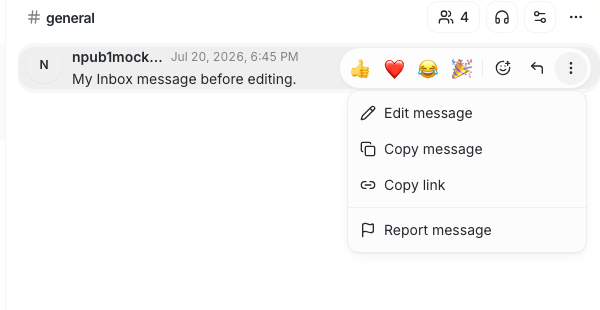 | 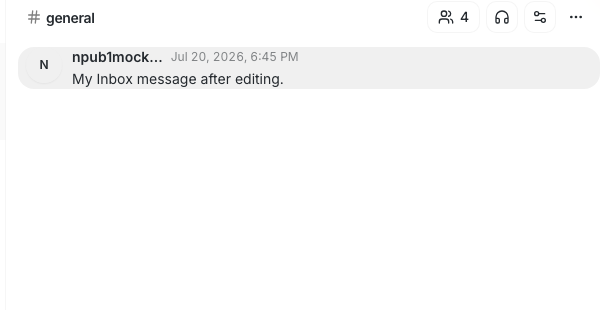 | ### Why? Inbox rows did not pass an edit handler into the shared message action bar, so a user's own messages could be edited from channel view but not from Inbox detail. ### How is it tested? Desktop checks, unit tests, and the full local CI gate passed. The focused Inbox Playwright regression passed 3 consecutive runs and covers current-user edit/save, foreign and archived-channel denial, and attachment preservation when a just-sent reply is edited before its relay echo arrives. Added tests: - [`inbox-edit.spec.ts`](https://github.com/block/buzz/blob/inbox-message-edit-action/desktop/tests/e2e/inbox-edit.spec.ts) - [`inboxViewHelpers.test.mjs`](https://github.com/block/buzz/blob/inbox-message-edit-action/desktop/src/features/home/lib/inboxViewHelpers.test.mjs) *🤖 This PR was authored [with an agent](buzz://message?channel=7f2d7e02-f4d5-4fb0-a426-0ca60ed3a1c3&id=c09ee04d18399b90296c3f932d22ab0377fa05f7e690ec7b08c36483ee633fbb).* --------- Signed-off-by: Tom Brow <tomb@block.xyz> Signed-off-by: npub1ft62tztwwm2x9xamk25smmuaj4sfckdkldksruf2x2jwqalffkrq0g7arr <4af4a5896e76d4629bbbb2a90def9d95609c59b6fb6d01f12a32a4e077e94d86@sprout-oss.stage.blox.sqprod.co> Co-authored-by: npub1ft62tztwwm2x9xamk25smmuaj4sfckdkldksruf2x2jwqalffkrq0g7arr <4af4a5896e76d4629bbbb2a90def9d95609c59b6fb6d01f12a32a4e077e94d86@sprout-oss.stage.blox.sqprod.co> |
||
|
|
e14fff74d0 |
relay: fuzz WebSocket 1012 restart-close timing on graceful drain (BUZZ_DRAIN_JITTER_MS) (#4542)
## Problem On SIGTERM the relay sends every live WebSocket a **1012 Service Restart** close frame via `ConnectionManager::drain_all()` — all in the same instant (`main.rs` shutdown task → `state.rs::drain_all`). On a pod holding thousands of sessions, that makes every client reconnect simultaneously: the thundering-herd reconnect behind the DB pool-timeout bursts observed on each rolling deploy. Client-side jitter can't fix this — the desktop client *resets* its backoff to base on a 1012 and reconnects with only ±25% jitter (`relayClientSession.ts`), so the spread has to come from the server. ## Change Add `BUZZ_DRAIN_JITTER_MS` (default `0` = unchanged behavior). The two paths are kept **deliberately separate** so the default is byte-for-byte the previously shipped shutdown: - **Jitter off (`0`/unset, the default):** the original synchronous, all-at-once `drain_all()` runs unchanged — queue the 1012 on each connection's control channel, cancel, return. No new machinery on the default path. - **Jitter on (`> 0`):** a separate async `drain_all_jittered(jitter_ms)` spreads each connection's restart close over an independent uniform delay in **`[1, jitter_ms]`**. Each delayed close travels a dedicated `RestartClose` channel; the writer flushes the 1012 frame and **acknowledges the flush over a oneshot**, so drain waits for confirmed delivery (up to `RESTART_CLOSE_ACK_TIMEOUT` = 5s) rather than assuming it, falling back to cancellation if the channel is full/closed or the ack times out. The drain future is **owned and awaited** by the shutdown task, and the 30s hard-drain backstop is aborted only after a clean drain — so a clean roll exits `0`. The two methods can be unified and the old one dropped later once the jittered path is proven for all cases. - **`config.rs`** — `drain_jitter_ms`: non-negative parse, clamped to `MAX_DRAIN_JITTER_MS` = **20s** (leaving 10s of the 30s budget for flush). Junk fails loudly at startup; **empty/whitespace-only is treated as unset (jitter off)** so a `BUZZ_DRAIN_JITTER_MS=""` kill switch does not crashloop the relay (matches the sibling env vars in this file). - **`state.rs`** — `drain_all()` (unchanged synchronous default) + `drain_all_jittered()` (jittered + flush-ack). Both set the sticky `draining` flag before the first await. A registration that lands mid-shutdown always self-signals via the **immediate** control-frame + cancel path — jitter smears already-established sockets, not late arrivals. - **`main.rs`** — shutdown task dispatches: `drain_jitter_ms == 0` → `drain_all()`, else `drain_all_jittered(...).await`. ## Safety - **Default off is the currently-committed path.** With jitter unset/0 the shutdown runs the original synchronous `drain_all()` — no restart channel, no ack wait. Safe to deploy dark and dial up. - **Shutdown-boundary race preserved.** Sticky flag set before any await; a late registration self-signals its close with no jitter. - **Owned + backstopped.** The jittered drain future is awaited; the 30s hard-drain `process::exit(1)` remains the ceiling. `MAX_DRAIN_JITTER_MS` (20s) + `RESTART_CLOSE_ACK_TIMEOUT` (5s) = 25s, inside the 30s budget; 5s pre-sleep + 25s = 30s against `terminationGracePeriodSeconds: 60`. ## Known behavior to note (not a blocker, flagged from review) On a **successful** flush the jittered path deliberately does not cancel the connection token — teardown then depends on the client echoing our Close, or on process exit. Compliant clients echo; a silent client rides to the 30s hard exit. The default (jitter-off) path cancels deterministically as before. ## Tests - `config::tests::drain_jitter_defaults_off_and_rejects_junk` — default off, `20000`, clamp `60000`→`20000`, explicit `0`, junk `"soon"` fails, **empty `""` and whitespace-only treated as off**. - `state::tests::drain_all_is_immediate` — default path queues frame + cancels synchronously. - `state::tests::drain_all_sends_restart_close_and_cancels_every_conn`, `drain_all_full_control_buffer_still_cancels`, `register_after_drain_self_signals_restart_close_and_cancel`. - `state::tests::drain_all_jittered_defers_close_until_within_jitter_window` (paused time). - `state::tests::drain_all_jittered_waits_for_writer_acknowledgement_without_cancelling`. - `state::tests::drain_all_jittered_cancels_when_restart_channel_is_full_or_closed`. - `state::tests::drain_all_jittered_cancels_when_flush_ack_times_out` (paused time — the 5s ack-timeout fallback). Validation at `46c690940`: `cargo fmt -p buzz-relay --check`, `cargo clippy -p buzz-relay --all-targets -- -D warnings`, and the drain/config unit suite all clean. Local live SIGTERM test with a real relay process + 200 NIP-42-authenticated sockets — see the PR comment for the before/after distribution and exit codes. ## Rollout Ship with default `0`, then set `BUZZ_DRAIN_JITTER_MS` (e.g. 10000–20000) on bb-block first, watch the roll-window pool-timeout metric, then bb-public. `""` is a safe kill switch. Complements the preStop `sleep` (stops routing before close). --------- Signed-off-by: npub1srl70fhzyu3fsnahl06vw2czvqc2w3ds37hyzvjnk8ve8f03ngcqg9le2w <80ffe7a6e22722984fb7fbf4c72b026030a745b08fae413253b1d993a5f19a30@buzz.block.builderlab.xyz> Signed-off-by: npub128x7j3pwgm4vs8yra3c42fcgcwcvh94g3luwzkqa376du2q6l0esqcrwch <51cde9442e46eac81c83ec71552708c3b0cb96a88ff8e1581d8fb4de281afbf3@buzz.block.builderlab.xyz> Signed-off-by: Brad Seiler <seiler@squareup.com> Co-authored-by: npub1srl70fhzyu3fsnahl06vw2czvqc2w3ds37hyzvjnk8ve8f03ngcqg9le2w <80ffe7a6e22722984fb7fbf4c72b026030a745b08fae413253b1d993a5f19a30@buzz.block.builderlab.xyz> Co-authored-by: npub128x7j3pwgm4vs8yra3c42fcgcwcvh94g3luwzkqa376du2q6l0esqcrwch <51cde9442e46eac81c83ec71552708c3b0cb96a88ff8e1581d8fb4de281afbf3@buzz.block.builderlab.xyz> |
||
|
Taylor HoandGitHub
|
005fe54d02 |
fix(desktop): outline the selected community (#4969)
**Category:** improvement **User Impact:** Selected communities now use a clear offset outline without tinting or covering their icon. **Problem:** The selected community state replaced the icon surface with an accent fill, obscuring image icons and changing the tile's content treatment. Hover also changed the fill, text color, shape, and opacity, making navigation states visually jumpy. **Solution:** Preserve each community tile's neutral surface and content while using a primary CSS outline for selection and a lighter outline for hover. The transparent outline offset leaves the space around image edges unpainted, and adjusted spacing prevents neighboring outlines from colliding. <img width="200" height="152" alt="Screen Recording 2026-08-05 at 3 23 32 PM" src="https://github.com/user-attachments/assets/5c25b1c0-4be8-41c4-8f1d-ad0010310c92" /> <details> <summary>File changes</summary> **desktop/src/features/sidebar/ui/CommunityRail.tsx** Replaces selected and hover fills with offset outlines, keeps icon presentation stable across states, and adjusts rail and tooltip spacing for the new outline geometry. **desktop/tests/e2e/community-rail.spec.ts** Covers the shared active/inactive surface, radius, text color, opacity, and outline behavior, including hover invariants. </details> ## Reproduction steps 1. Run the desktop app with two or more communities. 2. Give the active community an image icon. 3. Confirm the active icon keeps its original image and receives a 2px primary outline with a transparent 2px gap. 4. Hover another community and confirm only a lighter outline appears; its fill, text color, opacity, and corner radius remain unchanged. 5. Switch communities and confirm the outline follows the active community. ## Screenshots **Full desktop context**  --------- Signed-off-by: Taylor Ho <taylorkmho@gmail.com> |
||
|
Taylor HoandGitHub
|
24c7995740 |
fix(desktop): clamp thread panel to channel surface (#4965)
**Category:** fix **User Impact:** Expanded thread panels now stay fully visible within the desktop channel area instead of being cut off. **Problem:** The resize handler clamped the thread panel against the full window width, even though the panel renders inside a narrower channel surface. On a 1720px window, this allowed a 1160px requested width where only 1111px could render, leaving persisted and visible geometry out of sync. **Solution:** Clamp resizing against the measured channel-surface width so the stored width matches what the layout can render while preserving the minimum 300px main pane. <details> <summary>File changes</summary> **desktop/src/features/channels/ui/ChannelScreen.tsx** Passes the measured channel-surface width into the thread-panel sizing hook. **desktop/src/shared/hooks/useThreadPanelWidth.ts** Clamps drag-resize updates against the available channel width instead of the full viewport. **desktop/tests/e2e/threadpane-ultrawide.spec.ts** Adds a 1720px regression proving the requested and rendered panel widths match, while retaining the ultrawide expansion case. </details> ### Reproduction steps 1. Open a channel thread in the desktop app at a 1720×900 window size. 2. Drag the thread panel's left resize handle toward the left edge to expand it as far as possible. 3. Confirm the panel remains fully bounded inside the channel surface and the main channel pane remains at least 300px wide. 4. Reload the channel and confirm the persisted expanded width renders without clipping. ### Testing - `pnpm --dir desktop build:e2e` - `pnpm --dir desktop exec playwright test tests/e2e/threadpane-ultrawide.spec.ts` — 2 passed - Push hooks: `desktop-check` and `desktop-test` passed - `git diff --check origin/main..HEAD` ### Screenshot  ### Related issue None found. Signed-off-by: Taylor Ho <taylorkmho@gmail.com> |
||
|
Taylor HoandGitHub
|
cda33978b1 |
style(messages): increase username contrast (#4948)
**Category:** improvement **User Impact:** Message usernames are now bolder, making it easier to distinguish who said what at a glance. **Problem:** Usernames and surrounding message metadata had too little visual separation, which made message headers slower to scan. **Solution:** Increase the shared message-author label from semibold to bold while preserving its existing size, spacing, and interaction behavior. <details> <summary>File changes</summary> **desktop/src/features/messages/ui/MessageHeader.tsx** Raises the shared message-author font weight so standard and system message usernames gain consistent visual contrast. </details> ## Reproduction steps 1. Open a channel containing messages from multiple people or agents. 2. Compare each message username with its timestamp and message body. 3. Confirm the username renders in bold while the surrounding typography and layout remain unchanged. ## Screenshots | Before | After | | --- | --- | |  |  | Signed-off-by: Taylor Ho <taylorkmho@gmail.com> |
||
|
|
d42d60d64e |
fix(desktop): rename generic attachment action from 'Attach image' to 'Attach file' (#2381) (#4304)
Fixes #2381. ## What was broken The message composer's paperclip accepts generic attachments — images, videos, PDFs, archives, and any other supported file — but its tooltip and accessible name still read **"Attach image"**. Sighted users might reasonably believe the control is image-only, and screen-reader users get an incomplete description of what the button does. ## The fix Rename the accessible name and tooltip text on the generic composer paperclip in `MessageComposerToolbar.tsx`: - `aria-label` — `"Attach image"` → `"Attach file"` - `<TooltipContent>` — `"Attach image"` → `"Attach file"` Plus update the 12 affected Desktop e2e selectors across five spec files to reference the new accessible name: - `desktop/tests/e2e/file-attachment.spec.ts` (2 selectors) - `desktop/tests/e2e/spoiler.spec.ts` (2) - `desktop/tests/e2e/composer-image-draw.spec.ts` (2) - `desktop/tests/e2e/image-attachment-gallery.spec.ts` (4) - `desktop/tests/e2e/video-attachment.spec.ts` (2) ## Scope (per the issue) The feedback screenshot dialog (`desktop/src/features/settings/ui/SendFeedbackDialog.tsx`) is **unchanged** — that dialog itself is image-only, so its "Attach image" wording is accurate. This PR only touches the generic composer control. ## Test plan - All **105** unit tests in `desktop/src/features/messages/ui/*.test.mjs` pass locally. - Verified no remaining `"Attach image"` string outside the intentionally preserved feedback dialog: ```sh grep -rn '"Attach image"' desktop/ # → only hits in SendFeedbackDialog.tsx ``` - The six e2e specs are only exercised in CI; the selector updates are mechanical and verified by grep to reference the new a11y name. ## Blast radius - **Files touched**: `MessageComposerToolbar.tsx` (two strings); five e2e spec files (12 selector updates). - **User-facing behaviour**: one tooltip + one screen-reader name change; no functional or visual changes otherwise. - **No API or state change.** ## Out of scope - The feedback dialog's "Attach image" wording — kept per the issue's own "Scope" guidance. - Any i18n plumbing — Buzz Desktop doesn't currently localize these strings. Signed-off-by: Sarthak Singh <sarthak.singh@juspay.in> Signed-off-by: Ravneet Arora <rarora@squareup.com> Co-authored-by: Ravneet Arora <rarora@squareup.com> Co-authored-by: Cursor <cursoragent@cursor.com> |
||
|
DuncanandWill Pfleger
|
816222e15a |
fix(desktop): remove unused SCOPE_GENERATION_TEST_LOCK import in tests_captured_scope
The guard is invoked via the fully-qualified path
crate::managed_agents::scope::SCOPE_GENERATION_TEST_LOCK at :146,
matching the style in app_state_scope_tests.rs. The use-block import
added in
|
||
|
Duncan
|
e4abdf997a |
Merge remote-tracking branch 'origin/main' into duncan/workspace-scoped-agent-store-merge
* origin/main: (24 commits) fix(reactions): support max-length custom emoji (#3833) feat(desktop): allow leaving your final community (#3621) fix(buzz-agent): recover from context-window 400s instead of sticking (#4946) docs(persona-pack): fix stale desktop import instructions (#4500) fix(desktop): route macos notification clicks (#4799) feat(mobile): sync themes per community (#3767) feat(desktop): sync themes per community (#3653) feat(desktop): cap OpenClaw agent parallelism at 5 (#4019) fix(buzz-agent): scope handoff cap per turn, not per session lifetime (#4805) Fix mobile message timeline bounce (#4862) Polish mobile bottom sheets and profile cards (#4911) Fix media attachment actions (#4849) fix(desktop): remove join API token control (#4897) fix(desktop): allow shared agent mentions (#4913) Polish mobile top navigation (#4778) fix(release): tag immutable desktop candidates (#4811) fix(channels): restrict private-channel invitations (#4612) fix(acp): reject unattended permission requests (#4609) fix(workflow): bind trigger author to the signed event (#4607) fix(git): revoke access for banned relay members (#4608) ... Co-authored-by: Will Pfleger <pfleger.will@gmail.com> Signed-off-by: Will Pfleger <pfleger.will@gmail.com> # Conflicts: # desktop/src-tauri/src/managed_agents/runtime.rs |
||
|
|
2ea9385015 |
fix(reactions): support max-length custom emoji (#3833)
**Category:** fix **User Impact:** Custom emoji with valid 64-character names can now be used as reactions without errors. **Problem:** Buzz accepted 64-character custom emoji names during registration, but rejected them as reactions after the required surrounding colons made the payload 66 characters. Validation also differed between desktop, SDK, relay, and storage boundaries. <img width="554" height="47" alt="image" src="https://github.com/user-attachments/assets/4013452f-210e-4dd3-9003-f45ff3b28dc8" /> **Solution:** Keep the product limit at 64 ASCII characters for custom emoji names, enforce it consistently when emoji sets are registered, and allow only valid matching custom reaction payloads up to 66 characters. Widen the reaction projection to preserve the wrapped payload while retaining the existing 64-character limit for ordinary reactions. <details> <summary>File changes</summary> **crates/buzz-sdk/src/builders.rs** Defines the shared custom emoji boundaries and covers accepted 64-character and rejected 65-character shortcodes. **crates/buzz-relay/src/handlers/ingest.rs** Validates emoji-set shortcodes and permits 66-character reactions only when they are valid colon-wrapped custom emoji with a matching tag. **crates/buzz-db/src/event.rs** Adds storage regression coverage for maximum-length custom emoji reactions. **crates/buzz-db/src/migration.rs** Verifies the reaction column migration is applied correctly. **desktop/src/shared/api/customEmoji.ts** Enforces the existing 64-character shortcode maximum during desktop normalization and registration/import. **desktop/src/shared/api/customEmoji.test.mjs** Covers the desktop shortcode boundary. **migrations/0027_long_reaction_payloads.sql** Widens stored reaction payloads to 66 characters for the two required surrounding colons. **schema/schema.sql** Keeps the desired schema aligned with the migration. </details> ## Reproduction Steps 1. Register or import a custom emoji whose ASCII shortcode is exactly 64 characters. 2. Select that emoji as a reaction to a message. 3. Confirm the reaction publishes, persists, and renders without an error. 4. Attempt to register a 65-character shortcode and confirm it is rejected. 5. Publish an ordinary or malformed reaction over 64 characters and confirm the relay rejects it. ## Verification - `cargo test -p buzz-sdk`: 243 passed - `cargo test -p buzz-db`: 94 passed, 152 Postgres-required tests ignored - `pnpm test` in `desktop`: 3,859 passed - `cargo test -p buzz-relay`: 795 passed, 9 existing Postgres-unavailable failures, 35 ignored; new reaction boundary tests pass directly - `cargo fmt --all -- --check` - `git diff --check` Originating Buzz channel: `f2ec9671-d78e-4cde-894c-9f4c458c7f1f` --------- Signed-off-by: Taylor Ho <taylorkmho@gmail.com> Co-authored-by: npub1223z34hd7vtwc6qj4s7flsxkj644nlre2nthu7lrrmkumhu3xddsrx9r6w <52a228d6edf316ec6812ac3c9fc0d696ab59fc7954d77e7be31eedcddf91335b@buzz.block.builderlab.xyz> |
||
|
|
719f9730d4 |
feat(desktop): allow leaving your final community (#3621)
**Category:** improvement **User Impact:** People can leave their final Buzz community and return to **Join or create a community** without losing their signed-in identity. **Problem:** Buzz Desktop blocked people from leaving when only one community remained. Its existing remove action also changed local configuration without ending relay membership. **Solution:** Allow the final community to be left. Buzz now asks the relay to end membership, removes the community locally only after acceptance, and returns the person to the community selector while keeping their identity signed in. If other communities remain, Buzz switches to one of them. Relay rejection or timeout keeps the community in place and shows an actionable retry error. <details> <summary>File changes</summary> **desktop/src/features/communities/leaveCommunity.ts** Adds signed kind 28936 publishing for active and inactive community relays with actionable timeout handling. **desktop/src/features/communities/leaveCommunity.test.mjs** Covers event shape, relay selection, acceptance gating, rejection, timeout messaging, and cleanup. **desktop/src/features/communities/useCommunities.tsx** Allows final-community removal and clears community-specific storage without touching identity. **desktop/src/features/communities/resolveCommunityRemoval.test.mjs** Covers final, active, and inactive community removal state transitions. **desktop/src/app/useCommunityNavigationTransitions.ts** Gates local removal on relay acceptance and routes to a fallback community or setup selector. **desktop/src/app/AppShell.tsx** Passes the asynchronous leave operation through shell entry points. **desktop/src/features/communities/ui/EditCommunityDialog.tsx** Replaces the local-only remove action with a pending-aware Leave Community action that retains actionable errors. **desktop/src/features/communities/ui/CommunitySwitcher.tsx** Enables leaving the final community and carries the asynchronous callback. **desktop/src/features/sidebar/ui/AppSidebar.tsx** Carries the asynchronous leave callback through sidebar props. **desktop/src/features/sidebar/ui/CommunityRail.tsx** Enables leaving the final community from rail settings. **desktop/src/features/sidebar/ui/SidebarProfileCard.tsx** Carries the asynchronous leave callback through profile community settings. **desktop/src/testing/e2eBridge.ts** Teaches the mock relay to accept NIP-43 leave events. **desktop/tests/e2e/community-rail.spec.ts** Updates leave interactions and verifies final-community setup navigation, storage cleanup, and identity preservation. </details> ### Reproduction steps 1. Run Buzz Desktop with a signed-in identity and one joined community. 2. Open Community settings and choose **Leave Community**. 3. Confirm the app shows **Join or create a community** and the existing identity remains signed in. 4. Repeat with two communities and confirm leaving the active one switches cleanly to the remaining community. 5. Reject or withhold the relay `OK` response and confirm the community remains configured with an actionable error in the dialog. ### Test plan - `pnpm check` - `pnpm build` - `pnpm test` (3,913 passing) - `pnpm build:e2e && pnpm exec playwright test tests/e2e/community-rail.spec.ts --grep "final community"` <img width="557" height="316" alt="image" src="https://github.com/user-attachments/assets/b628182f-cba5-451d-ae4b-bee8d8dd19aa" /> --------- Signed-off-by: Taylor Ho <taylorkmho@gmail.com> Signed-off-by: npub14ndfusear8wdpe4kss8h7juc7wjk78atnqzf63zvppcpneknv4sq6x9370 <acda9e433d19dcd0e6b6840f7f4b98f3a56f1fab98049d444c087019e6d36560@buzz.block.builderlab.xyz> Co-authored-by: npub1223z34hd7vtwc6qj4s7flsxkj644nlre2nthu7lrrmkumhu3xddsrx9r6w <52a228d6edf316ec6812ac3c9fc0d696ab59fc7954d77e7be31eedcddf91335b@buzz.block.builderlab.xyz> Co-authored-by: npub14ndfusear8wdpe4kss8h7juc7wjk78atnqzf63zvppcpneknv4sq6x9370 <acda9e433d19dcd0e6b6840f7f4b98f3a56f1fab98049d444c087019e6d36560@buzz.block.builderlab.xyz> |
||
|
|
ed4b3e7afa |
fix(buzz-agent): recover from context-window 400s instead of sticking (#4946)
Provider `context_length_exceeded` 400s permanently wedged agent sessions: the turn errored, the oversized history persisted in the in-memory session, and the usage baseline stayed frozen at the last successful sub-threshold reading (failed requests report no usage), so the preflight handoff gate never fired again — every later prompt failed identically until an agent restart. The byte-truncation fallback never intervened because it is a request-body limiter (`estimated_bytes`), not a context-window defence; at context-window scale it is a measured no-op. This adds the reactive recovery path: - **Typed classification.** `AgentError::LlmContextExceeded` is classified at both non-success provider terminals — the shared `post()` (Anthropic, OpenAI, Databricks) and `openrouter_post()` — on `status == 400` plus a context-window body match, so ordinary 400s stay terminal. - **Forced handoff.** A context-400 forces a summarize-handoff that bypasses `should_handoff()` and `BUZZ_AGENT_MAX_HANDOFFS`, bounded by its own per-turn budget (`MAX_CONTEXT_RECOVERIES_PER_RUN = 3`). - **Shrink ladder.** The summarize prompt budget halves from the observed rejected history size — not from `max_context_tokens`, the number the provider just contradicted — rung to rung, with a 4096-byte floor. A summarize call rejected for the same reason takes the next rung instead of re-sticking. At the floor (overflow dominated by unshrinkable frame: system prompt, tool schemas, live prompt) recovery is refused and the provider error surfaces clearly instead of self-healing. - **Baseline reset.** The stale usage baseline is cleared when a request fails, so the preflight gate cannot stay frozen sub-threshold on retries. Named behavior changes: 1. **Anthropic and OpenRouter errors now carry the `(model)` stamp.** Provider arms return their `Result` into the central error mapper instead of early-returning past it, making the code match its documented single-convergence contract at that mapper. 2. **`max_rounds` now counts completions the loop acts on.** A request rejected with a context-400 that is then successfully recovered refunds its round before the retry, paired 1:1 with a consumed recovery rung, so the round cap is neither weakened nor able to drop a recovered turn unanswered. Related: #4805 — the complementary proactive fix (per-session handoff-cap kill switch that let sessions grow to the provider wall). #4805 prevents reaching the wall; this PR recovers at it. --------- Co-authored-by: npub17jjz49l9jjmhhk7cac63j8yt9z555n9cw8vk7v5jz4vzw4ppld5qgj57cc <f4a42a97e594b77bdbd8ee35191c8b28a94a4cb871d96f32921558275421fb68@buzz.block.builderlab.xyz> Co-authored-by: Duncan <dcfd242e557282d7a1e2cf2e6877522682f1e5c6156dc92ca7d90eaedd3b0f95@buzz.block.builderlab.xyz> |
||
|
DuncanandWill Pfleger
|
b450d46933 |
test(managed-agents): structural guard evidence for concurrency lock invariants
Replace timing-based concurrency tests with compile-enforced structural
guard ownership proofs per Thufir's binding shape consult.

Item 1 (generation lock): add SCOPE_GENERATION_TEST_LOCK to
test_fallback_relay_never_claims_during_identity_import and
test_scope_generation_guard_rejects_stale_scope_for_import; exhaustive
indirect-mutator sweep confirmed all remaining callers guarded.

Item 2 (writer test): widen on_after_restore to
FnOnce(&mut Vec<ManagedAgentRecord>, &MutexGuard<'_, ()>) — callback
borrows the actual store guard. Dropping or removing the guard before
the call is a compile error. Writer completes one full transaction
(lock → load → WRITER_EDIT → save → writer_committed) after records_loaded
releases it; on_after_restore saves COMP_SENTINEL under the live borrow.
Delete writer_at_store_lock pre-lock signal and all timing-based comments.

Item 3 (contender test): widen on_transition_acquired to
FnOnce(&MutexGuard<'_, ()>) in both start_pair_lazy_for_with_hook and
start_pair_for_with_hook — callback borrows the actual transition guard.
Drop or removal before the call is a compile error. Remove AtomicBool,
try_recv, not-fired-during assertion, and all ns-vs-ms timing rationale.
Proof by mutex exclusion: on_transition_acquired cannot execute during
compensation because both borrow the same mutex.

Production delegates unchanged: compensate_drain passes |_, _| {},
start_pair_lazy_for and start_pair_for pass |_| {} for on_transition_acquired.

Co-authored-by: Will Pfleger <pfleger.will@gmail.com>
Signed-off-by: Will Pfleger <pfleger.will@gmail.com>
|



















