 istos
727354487b
istos
727354487b
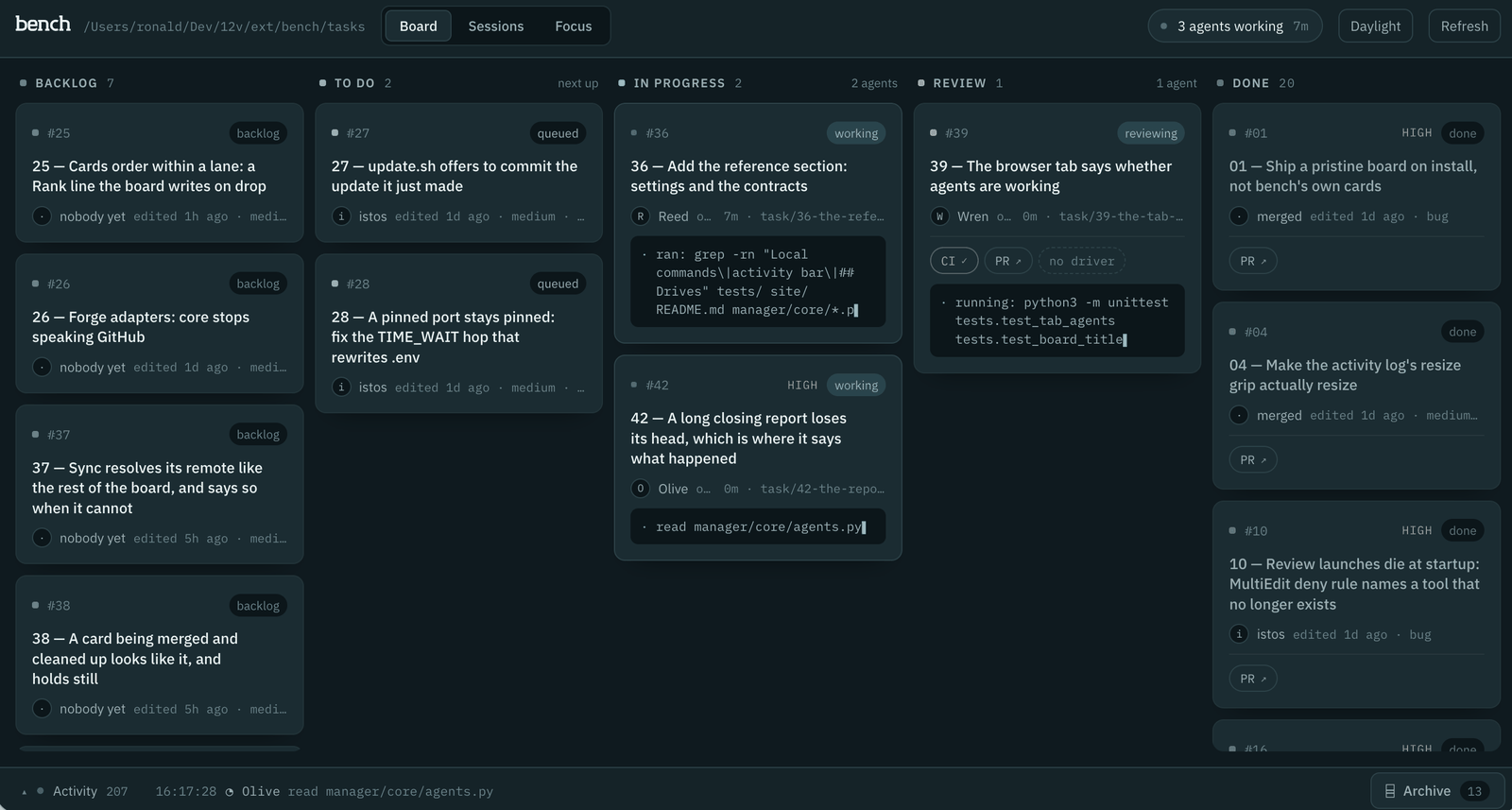
A link to bench.12vectors.com under the opening paragraph, and the board
screenshot beneath it — the fastest way to say what this is.

The image is an absolute raw.githubusercontent URL rather than a repo
path, for two reasons. README.md ships in the release artifact and
site/ deliberately does not, so a relative link would break in every
vendored install. And the site's own copy is served under an immutable
year-long cache, so linking that would pin readers to whatever
screenshot was current when they first loaded the page.

The three-layer-law paragraph gains a clause and loses one. That section
is sliced into /concepts/three-layer-law/, so "or read them at
bench.12vectors.com" rendered as a page on that site telling you to go
to that site. It now says AGENTS.md is the file the docs site is cut
from, which is true in both places — the rule this repo sets for its own
prose.
100 lines
4.4 KiB
Markdown
100 lines
4.4 KiB
Markdown
# Bench
|
|
|
|
A live kanban for coding-agent work: task files in stage directories are
|
|
the only source of truth; a stdlib-only board narrates everything that
|
|
happens to them — agents working in git worktrees, PRs opening on review,
|
|
CI and Copilot state on the cards, drives of the app from a task's own
|
|
branch, and an archive that is never a delete. Turn on team mode
|
|
(`BOARD_SYNC=1`) and the truth is `origin/main`: moves commit and push
|
|
themselves, every board pulls on a beat, and the person who claimed a
|
|
card first keeps it.
|
|
|
|
**Docs: [bench.12vectors.com](https://bench.12vectors.com)** — guides,
|
|
concepts, and a settings reference, every page of it generated from this
|
|
repository's own markdown, so what the docs say and what bench does
|
|
cannot drift apart.
|
|
|
|
|
|
|
|
*bench's own board, running on this repository. Three agents at work,
|
|
each on its own branch — and every one of them stops at review.*
|
|
|
|
## Install into a repo
|
|
|
|
```bash
|
|
mkdir .task-manager && curl -L \
|
|
https://github.com/12vectors/bench/releases/latest/download/bench.tar.gz \
|
|
| tar -xz -C .task-manager
|
|
./.task-manager/start.sh # wires the project (idempotent) and serves
|
|
```
|
|
|
|
No token, no clone: releases are curated artifacts that never contained
|
|
bench's own cards or settings, so the board starts empty by construction.
|
|
|
|
The first run asks the two questions it cannot answer for you — solo or
|
|
team, and which agent adapter — and writes `manager/local/.env` from the
|
|
documented example, so every other setting is discoverable in your own
|
|
copy. What runs your tests is read off the project rather than asked
|
|
(`package.json` → `npm test`, and so on); nothing recognisable leaves
|
|
`BOARD_AGENT_COMMANDS` empty, and that is the key to set before an agent
|
|
can run them. Bare Enter takes the default
|
|
throughout; with no terminal (CI, a script) it asks nothing and
|
|
`install.py --setup` asks later.
|
|
|
|
Commit `.task-manager/` into the host repo — core is vendored on purpose,
|
|
so clones work offline and updates show up in the host's own diffs.
|
|
|
|
The workflow brief ships as `.task-manager/AGENTS.md` — the cross-vendor
|
|
name coding agents read natively — with `CLAUDE.md` beside it as a one-line
|
|
compatibility pointer. Both live inside `.task-manager/`, so a host repo's
|
|
own root `AGENTS.md` is never touched.
|
|
|
|
## Update
|
|
|
|
```bash
|
|
./.task-manager/update.sh # latest release
|
|
BENCH_REF=v2 ./.task-manager/update.sh # an exact release tag
|
|
```
|
|
|
|
The artifact is stamped with the repo it was built from, so updating
|
|
needs no configuration; `BENCH_SOURCE=<owner/repo>` in
|
|
`manager/local/.env` overrides the stamp. Updates replace
|
|
`manager/core/` and the top-level scripts wholesale and touch nothing
|
|
else — tasks, plans, reference, and everything under `manager/local/`
|
|
(your driver, commands, prompt overrides, settings, state) survive every
|
|
update. Then `python3 .task-manager/install.py` and restart the board.
|
|
If the source repo has no published release yet, `update.sh` says so and
|
|
changes nothing.
|
|
|
|
## Working on bench itself
|
|
|
|
```bash
|
|
git clone git@github.com:12vectors/bench.git && cd bench && ./start.sh
|
|
```
|
|
|
|
A clone carries bench's own cards and local/ content — that is dev mode,
|
|
not an install. (Installing from a clone anyway works: `install.py`
|
|
clears the shipped cards on its first boot in a host repo.) Releases are
|
|
built by `./release.sh` from the manifest at
|
|
`manager/core/release-manifest`: tag = `v<VERSION>`, one stable asset
|
|
name (`bench.tar.gz`), contents at the tarball root — the two things the
|
|
install one-liner above depends on.
|
|
|
|
## The three-layer law
|
|
|
|
Core knows about tasks, worktrees, PRs and events. It knows nothing about
|
|
any particular app (drivers do: `manager/local/driver/start`), agent
|
|
vendor (adapters do: `manager/core/adapters/`), or project
|
|
(`manager/local/` does).
|
|
|
|
The consequence is what makes an update safe: `update.sh` replaces
|
|
`manager/core/` wholesale, and everything a project taught bench about
|
|
itself lives outside it. Full docs in [AGENTS.md](AGENTS.md) — the file
|
|
the docs site is cut from, and the one an agent working in your repo
|
|
reads; the adapter contract in
|
|
[manager/core/adapters/README.md](manager/core/adapters/README.md).
|
|
|
|
## License
|
|
|
|
[MIT](LICENSE).
|