 istos
419daef5e6
istos
419daef5e6
renderBoard() starts with `board.innerHTML = ''` and rebuilds every
column, so each column's scrolling .drop was a brand-new node on every
pass — and a new node's scrollTop is 0. render() runs on every SSE frame
and a working agent emits an event per tool use, so a column being read
snapped back to the top several times a minute: worst exactly when there
is most to read. The same wipe threw away #board's horizontal position,
and the same demolition costs the session timeline, the sessions rail,
the Focus view, the drawer, and the activity log's place whenever it was
not stuck to the bottom.

Rather than a reconciling render — the real cure, and a far larger change
to the way the page works — the position is paid for separately: note
where each scroller was before the wipe, put it back once the new nodes
are in, both halves inside the same synchronous render so nothing
flashes. Keys are stable names rather than nodes (the stage slug for a
column, the session id for a timeline), because the node is what does not
survive. Restoring clamps, so a column whose cards moved on lands at its
new bottom instead of past it, and one now shorter than its own viewport
lands at the top instead of at a negative offset.

A `v:` prefix marks a key belonging to a view, and switching views drops
those: coming back is a fresh look, not a stale offset from a previous
visit. The activity log spans every view, so its key carries no prefix
and outlives the switch. The two behaviours that were already right are
left alone and now have tests holding them there — the log still follows
the newest line when it was stuck to the bottom (that reading runs after
the restore, so it wins), and the drawer still opens at the top when you
select a different card, which falls out of keying the drawer per
document rather than being fought for.

The helpers run for real under node, as tests/test_drawer_markdown.py
already does with md(); the source-level invariants beside them hold the
mark/restore pairs in order around each wipe, and one of them fails if a
new scrolling element is added to the CSS without a renderer keeping its
place.

    python3 -m unittest discover -s tests   → 854 tests, ok
Bench
A live kanban for coding-agent work: task files in stage directories are
the only source of truth; a stdlib-only board narrates everything that
happens to them — agents working in git worktrees, PRs opening on review,
CI and Copilot state on the cards, drives of the app from a task's own
branch, and an archive that is never a delete. Turn on team mode
(BOARD_SYNC=1) and the truth is origin/main: moves commit and push
themselves, every board pulls on a beat, and the person who claimed a
card first keeps it.
Docs: bench.12vectors.com — guides, concepts, and a settings reference, every page of it generated from this repository's own markdown, so what the docs say and what bench does cannot drift apart.
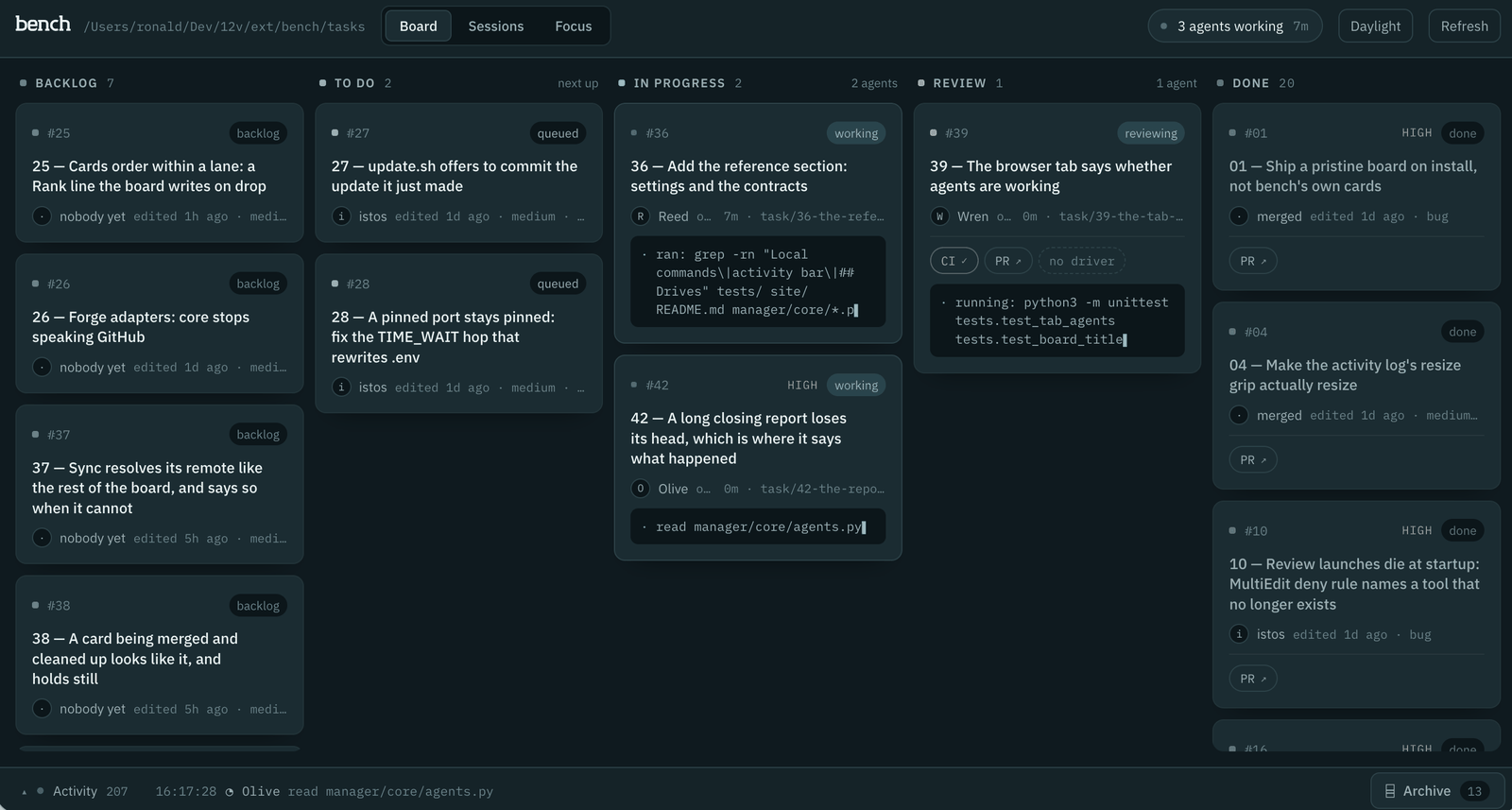
bench's own board, running on this repository. Three agents at work, each on its own branch — and every one of them stops at review.
Install into a repo
mkdir .task-manager && curl -L \
  https://github.com/12vectors/bench/releases/latest/download/bench.tar.gz \
  | tar -xz -C .task-manager
./.task-manager/start.sh        # wires the project (idempotent) and serves
No token, no clone: releases are curated artifacts that never contained bench's own cards or settings, so the board starts empty by construction.
The first run asks the two questions it cannot answer for you — solo or
team, and which agent adapter — and writes manager/local/.env from the
documented example, so every other setting is discoverable in your own
copy. What runs your tests is read off the project rather than asked
(package.json → npm test, and so on); nothing recognisable leaves
BOARD_AGENT_COMMANDS empty, and that is the key to set before an agent
can run them. Bare Enter takes the default
throughout; with no terminal (CI, a script) it asks nothing and
install.py --setup asks later.
Commit .task-manager/ into the host repo — core is vendored on purpose,
so clones work offline and updates show up in the host's own diffs.
The workflow brief ships as .task-manager/AGENTS.md — the cross-vendor
name coding agents read natively — with CLAUDE.md beside it as a one-line
compatibility pointer. Both live inside .task-manager/, so a host repo's
own root AGENTS.md is never touched.
Update
./.task-manager/update.sh              # latest release
BENCH_REF=v2 ./.task-manager/update.sh # an exact release tag
The artifact is stamped with the repo it was built from, so updating
needs no configuration; BENCH_SOURCE=<owner/repo> in
manager/local/.env overrides the stamp. Updates replace
manager/core/ and the top-level scripts wholesale and touch nothing
else — tasks, plans, reference, and everything under manager/local/
(your driver, commands, prompt overrides, settings, state) survive every
update. Then python3 .task-manager/install.py and restart the board.
If the source repo has no published release yet, update.sh says so and
changes nothing.
Working on bench itself
git clone git@github.com:12vectors/bench.git && cd bench && ./start.sh
A clone carries bench's own cards and local/ content — that is dev mode,
not an install. (Installing from a clone anyway works: install.py
clears the shipped cards on its first boot in a host repo.) Releases are
built by ./release.sh from the manifest at
manager/core/release-manifest: tag = v<VERSION>, one stable asset
name (bench.tar.gz), contents at the tarball root — the two things the
install one-liner above depends on.
The three-layer law
Core knows about tasks, worktrees, PRs and events. It knows nothing about
any particular app (drivers do: manager/local/driver/start), agent
vendor (adapters do: manager/core/adapters/), or project
(manager/local/ does).
The consequence is what makes an update safe: update.sh replaces
manager/core/ wholesale, and everything a project taught bench about
itself lives outside it. Full docs in AGENTS.md — the file
the docs site is cut from, and the one an agent working in your repo
reads; the adapter contract in
manager/core/adapters/README.md.
License
MIT.