Package Manager Guard (PMG)
Block malicious npm and pip packages before they install.
Defense in depth for the package managers you already use.
[](https://docs.safedep.io/pmg/quickstart)
[](https://safedep.io)
[](https://discord.gg/kAGEj25dCn)
[](https://goreportcard.com/report/github.com/safedep/pmg)


[](https://api.securityscorecards.dev/projects/github.com/safedep/pmg)
[](https://github.com/safedep/pmg/actions/workflows/codeql.yml)
## Why PMG?
Developers and AI coding agents install packages every day. Each `npm install` or `pip install` executes thousands of lines of code that nobody reviews.
Recent compromises in popular ecosystems:
- [**Mini Shai-Hulud**](https://safedep.io/mini-shai-hulud-strikes-again-314-npm-packages-compromised/) - 300+ popular packages compromised
- [**litellm 1.82.8**](https://safedep.io/malicious-litellm-1-82-8-analysis/) - a popular AI proxy library compromised to exfiltrate credentials
- [**telnyx 4.87.2**](https://safedep.io/malicious-telnyx-pypi-compromise/) - a legitimate telecom SDK hijacked on PyPI
- [**pino-sdk-v2**](https://safedep.io/malicious-npm-package-pino-sdk-v2-env-exfiltration/) - a typosquat package disguised as the popular pino logger
PMG intercepts every package install and checks it for malware **before** code executes. Install it once, and PMG covers every `npm install`, `pip install`, and `poetry add` after that.
> Featured in [tl;dr sec](https://tldrsec.com/p/tldr-sec-316).
## How PMG Works
PMG takes a defense in depth approach. Each install passes through the enabled protection layers before code runs, plus an audit trail after.
- **Transparent Interception** - PMG wraps `npm`, `pip`, and other package managers. Developers and AI agents use the same commands. No workflow changes.
- **Layer 1: Threat Intelligence** - PMG checks every package against [SafeDep's real-time threat intelligence](https://safedep.io) before install. Known-malicious packages never reach disk.
- **Layer 2: Policy (Dependency Cooldown)** - PMG blocks package versions published inside a configurable cooldown window, so freshly compromised versions cannot land before the ecosystem has had time to flag them.
- **Layer 3: Optional Sandbox** - When sandboxing is enabled and configured, PMG runs installs inside OS-native sandboxes (macOS Seatbelt, Linux Landlock by default, or Bubblewrap fallback) so install scripts have restricted system access even if a threat slips past the first two layers.
- **Audit Logging** - PMG logs every install (what, when, from where) for a verifiable audit trail.
## Quick Start
### 1. Install
```bash
curl -fsSL https://raw.githubusercontent.com/safedep/pmg/main/install.sh | sh
```
> See [Installation](#installation) for Homebrew, npm, and other install methods.
### 2. Setup
Wire PMG into your shell so it intercepts package managers.
```bash
pmg setup install
# Restart your terminal to apply changes
```
> **Tip:** Re-run `pmg setup install` after upgrading PMG to pick up new configuration options.
### 3. Use
Run your package managers as usual, or let your AI coding agent run them. PMG sits in the path.
```bash
npm install express
# or
pip install requests
```
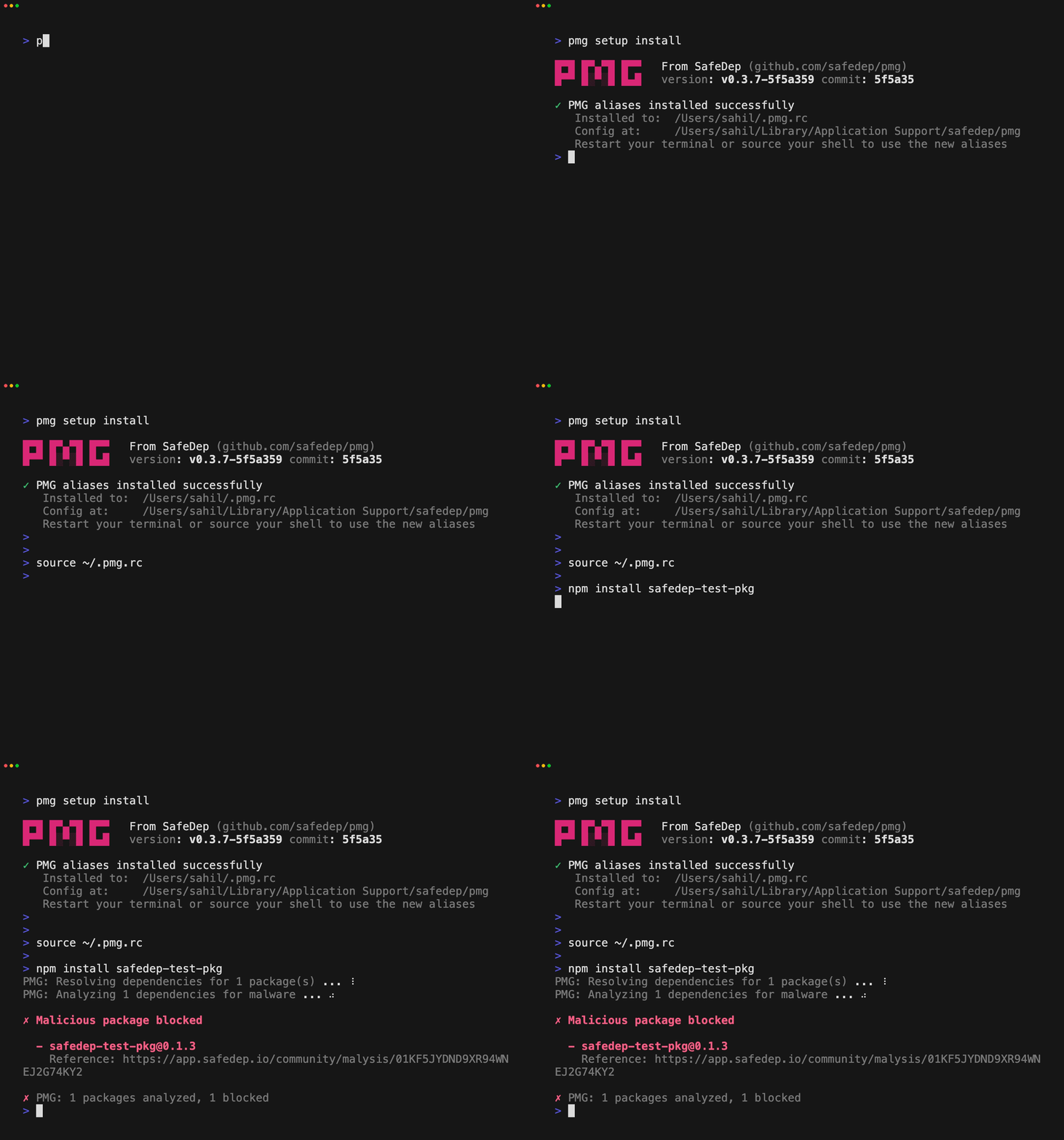
Verify PMG works by installing `safedep-test-pkg`. It's harmless, but SafeDep flags it as malicious so you can confirm the block path:
```bash
npm --prefer-online --no-cache i safedep-test-pkg@0.1.3
```
Expected output
```
✗ Malicious package blocked
- safedep-test-pkg@0.1.3
Reference: https://app.safedep.io/community/malysis/01KF5JYDND9XR94WNEJ2G74KY2
✗ PMG: 1 packages analyzed, 1 blocked
```
## Features
| Feature | Description |
| ------------------------ | ------------------------------------------------------------------------------------------------------------ |
| **AI Agent Safety Net** | Catches malicious packages installed by AI coding agents (Claude Code, Cursor, Copilot, Windsurf). |
| **Dependency Cooldown** | Blocks package versions published within a configurable time window, reducing exposure to supply chain attacks. |
| **Zero Config** | Works out of the box with sensible security defaults. |
| **Cross-Shell** | Integrates with Zsh, Bash, Fish, and more. |
## Supported Package Managers
PMG supports the tools you already use:
| Ecosystem | Tools | Command Example |
| ----------- | -------- | ------------------- |
| **Node.js** | `npm` | `npm install ` |
| | `pnpm` | `pnpm add ` |
| | `yarn` | `yarn add ` |
| | `bun` | `bun add ` |
| | `npx` | `npx ` |
| | `pnpx` | `pnpx ` |
| **Python** | `pip` | `pip install ` |
| | `poetry` | `poetry add ` |
| | `uv` | `uv add ` |
## Installation
Install Script (MacOS/Linux)
Downloads the latest release from GitHub, verifies its SHA-256 checksum, and installs to `$HOME/.local/bin` (if on `PATH`) or `/usr/local/bin`.
```bash
curl -fsSL https://raw.githubusercontent.com/safedep/pmg/main/install.sh | sh
```
Homebrew (MacOS/Linux)
```bash
brew tap safedep/tap
brew install safedep/tap/pmg
```
NPM (Cross-Platform)
```bash
npm install -g @safedep/pmg
```
> **Note:** NPM-based installs can be fragile when Node.js is managed by version managers like [`mise`](https://mise.jdx.dev/) or [`asdf`](https://asdf-vm.com/). The global `npm` bin path changes with the active Node version, so switching versions can leave `pmg` unavailable on `PATH` (or pointing to an old install). For these setups, prefer the install script or Homebrew.
Go (Build from Source)
```bash
# Ensure $(go env GOPATH)/bin is in your $PATH
go install github.com/safedep/pmg@latest
```
Binary Download
Download the latest binary for your platform from the [Releases Page](https://github.com/safedep/pmg/releases).
## GitHub Actions
Protect CI workflows with one step. PMG analyzes every `npm install`,
`pip install`, etc. in the job.
```yaml
# Consider pinning third-party Actions to a full commit SHA
- uses: actions/setup-node@v6
with:
node-version: 24
- uses: safedep/pmg@v1
- run: npm ci
```
By default you get malware blocking and dependency cooldown. Sandbox isolation
is opt-in via the `sandbox` input. Tune behavior via inputs (`paranoid`,
`sandbox`, `cooldown-days`, ...) or point
`config-file` at a YAML in the repo. See
[docs/github-action.md](docs/github-action.md) for the full reference.
## Uninstallation
Remove shell integration:
```bash
pmg setup remove
```
To also remove the PMG configuration file:
```bash
pmg setup remove --config-file
```
Then uninstall PMG itself:
```bash
# Homebrew
brew uninstall safedep/tap/pmg
# NPM
npm uninstall -g @safedep/pmg
```
## Trust and Security
PMG builds are reproducible and signed.
- **Attestations**: GitHub and npm attestations guarantee artifact integrity.
- **Verification**: You can cryptographically prove the binary matches the source code.
- See [Trusting PMG](docs/trust.md) for verification steps.
## User Guide
- [Trusted Packages Configuration](docs/trusted-packages.md)
- [Dependency Cooldown](docs/dependency-cooldown.md)
- [Proxy Mode Architecture](docs/proxy-mode.md)
- [Sandboxing Details](docs/sandbox.md)
## Support
If PMG saved you from a bad package, [star this repo](https://github.com/safedep/pmg). It helps others find it.
## Contributing
Contributions welcome. See [CONTRIBUTING.md](CONTRIBUTING.md) for build and test instructions.
## Telemetry
PMG collects anonymous usage data. To disable, either:
- Set `disable_telemetry: true` in your PMG config file, or
- Export `PMG_DISABLE_TELEMETRY=true`.