 122a8b8988
## Summary Projects v3 makes repository work shareable, discussion-aware, and easier to scan in one coherent workspace. People can copy canonical links, reopen the exact workspace tab, understand issue and pull-request context at a glance, find related channel conversations, and assign or unassign issues across Desktop and CLI. - **Unified workspace** — top-level sections sit above repository controls in one rounded workspace, with navigation positioned close to the page heading. README and Files retain branch selection; every section has a labeled icon header, and Issues and Pull Requests expose creation from a consistent right-aligned action. - **Repository management** — the repository selector is always available, including single-repository projects. Its integrated add flow lets project owners create a repository manually or select an existing repository without a separate toolbar button. - **Readable work-item lists** — issue and pull-request rows use plain-language context instead of opaque metadata. Files, commits, issues, pull requests, channels, and contributors share consistent row density and right-aligned timestamps, while deterministic fallback-avatar colors keep participants distinct on light backgrounds. Inbox pull-request metadata wraps between complete phrases and truncates long channel names instead of compressing copy into narrow columns. - **Reliable entity links** — projects, repositories, issues, pull requests, and commits have canonical `buzz://` links, preview cards, OS deep-link routing, and tab-aware navigation. Reopening the same link re-applies its destination instead of leaving the user on a locally selected tab. - **Related conversations** — repository and work-item views surface channels discussing the current entity, including participants, channel navigation, message context, and an explicit notice when discovery reaches its 500-result cap. - **Reversible issue ownership** — trusted assignment and unassignment events work across Desktop, Tauri, `buzz-sdk`, and `buzz issues`. Assignees appear in project views and the assigned inbox, while authorized users can remove assignments directly from the assignee row. Assignment state is derived chronologically from labeled Nostr notes. Issue authors and repository owners may change any assignee; other users may only assign or unassign themselves. Shared golden fixtures keep entity-link grammar and validation aligned across TypeScript and Rust. The branch also updates `webbrowser` to the patched release for RUSTSEC-2026-0257. ### Related issue N/A. ### Testing - [x] `just ci` — formatting, lint, typechecking, unit tests, and builds passed - [x] Full pre-push suite — organization, branch-skew, Desktop checks, typechecking, and tests passed on the latest push - [x] `cargo test -p buzz-cli` and focused `buzz-sdk` assignment tests passed - [x] Focused Tauri recipient-note and 500-result search-limit tests passed - [x] Desktop entity-link and issue-assignment unit tests passed - [x] Playwright smoke coverage passed for assignment, repeated entity-link navigation, repository create/select flows, section headers and actions, timestamp alignment, timeline icons, sentence-style issue/PR metadata, header spacing, avatar contrast, and Inbox metadata at stacked and side-rail breakpoints - [ ] Manual staging pass: link round-trips, Channels tab, assignment flows, and inbox routing ### Screenshots Pull requests explain who opened the request, where it lives, and which branch it comes from; fallback avatars remain visually distinct. 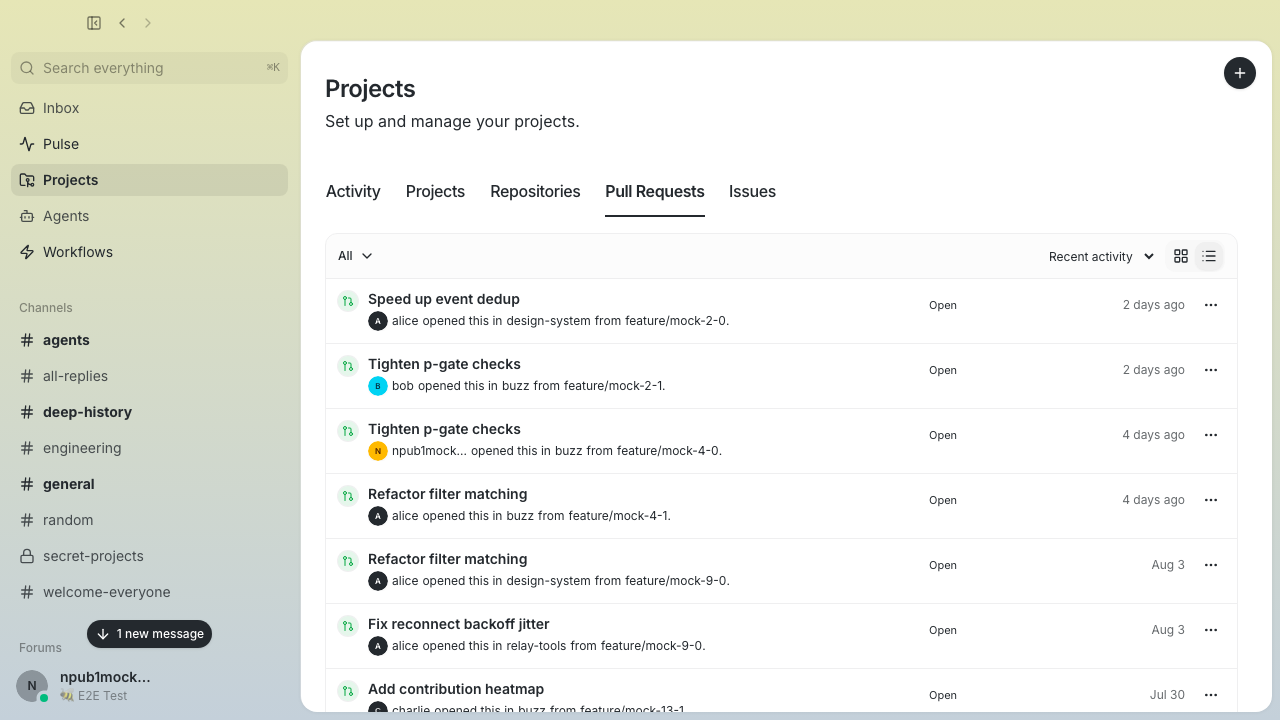 Issues use the same sentence-style hierarchy while keeping status and recency easy to scan. 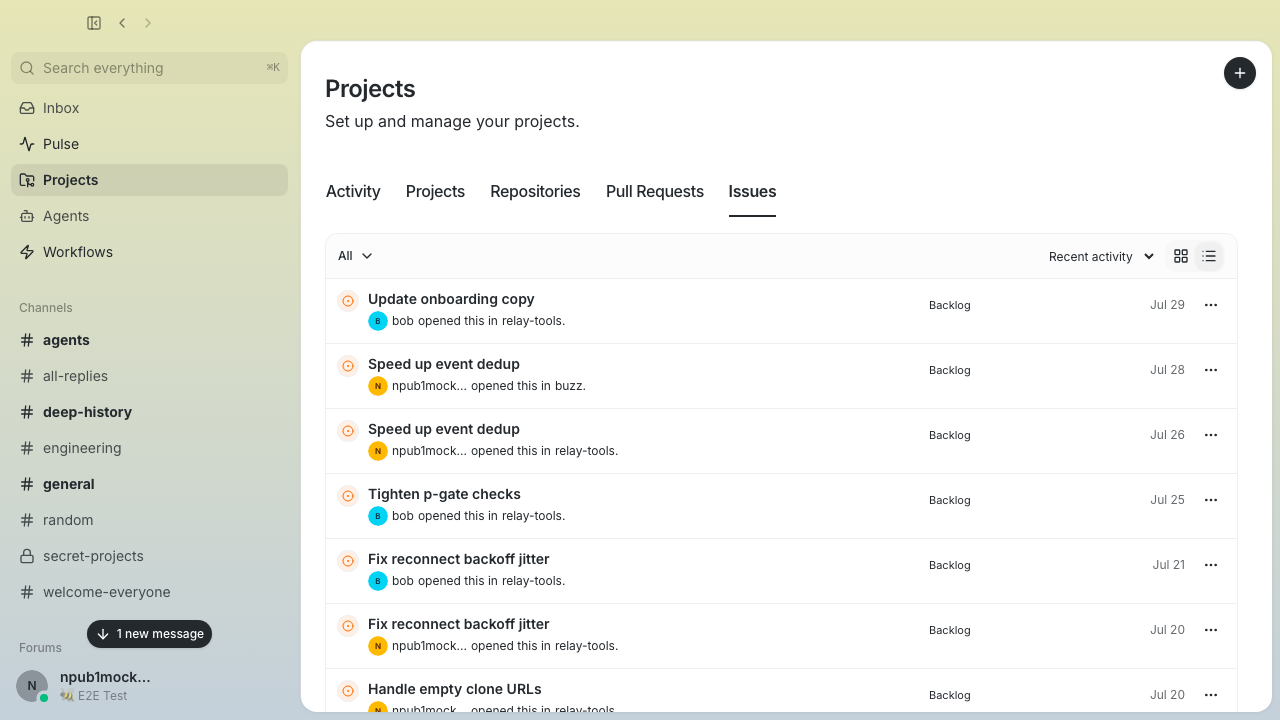 The wide Inbox detail keeps author, timestamp, and origin context readable beside its metadata rail. 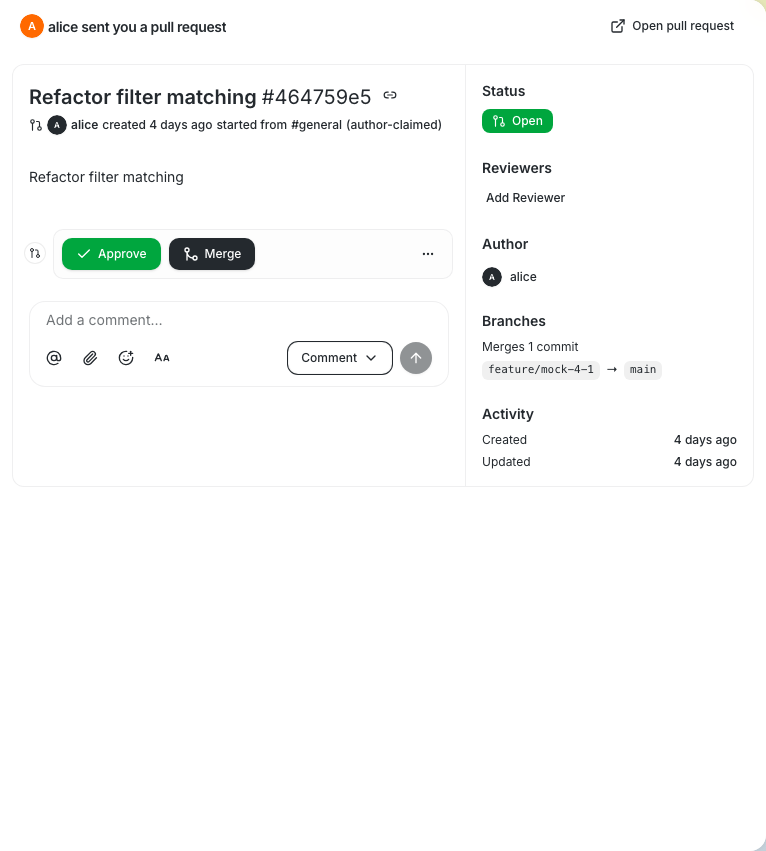 [View the complete six-state Projects v3 screenshot set](https://github.com/block/buzz/pull/5624#issuecomment-5268039672) and [the compact/wide Inbox comparison](https://github.com/block/buzz/pull/5624#issuecomment-5268614585). --- > Supersedes #5624, whose head commit accumulated permanently-queued required check suites (block-dco-check et al.) that GitHub never dispatched. History flattened into a single signed-off commit on latest main; tree verified byte-identical (`git merge-tree`) to merging the original branch into main. --------- Signed-off-by: Thomas Petersen <thomasp@squareup.com> Co-authored-by: Wintermute <3f1797424fd9ad6653a83665c660517777cd7f8c228c0d5907f49e01537f3ca5@buzz.block.builderlab.xyz>



14 KiB
Buzz Entity Links
Status: partially implemented. Done on this branch:
- Slice 0 — HTTPS relay git clone URLs (
{relay-origin}/git/<pubkey>/<repo>) render as Buzz repository preview cards in chat (desktop/src/shared/lib/linkPreview.ts). - Slice 1 —
buzz://pr|issue|repo|projectdeep links:entityLink.tsbuilders/parser, preview cards with relay title enrichment (repo and project titles resolve from their announcement events), in-timeline click navigation to/projects/$projectId. - Slice 2 — OS-level deep links: the
repo/project/pr/issuehosts indesktop/src-tauri/src/deep_link.rsemitdeep-link-entity, anduseEntityDeepLinksroutes them through the same handler as in-timeline clicks. - Slice 3 (create-command part) —
crates/buzz-cli/src/links.rs,linkoutput field onpr open/issues create/repos create/projects create, base prompt guidance, cross-language golden-format tests. - Sharing from the UI —
lib/projectShareLinks.tsmaps the Projects read models onto links, surfaced as "Copy link" in the project, repository, issue, and pull request row menus and as a copy button in the project, issue, and pull request detail headers.
Still unimplemented: link on get commands and the follow-ups in slice 4.
Problem
When a message contains a GitHub URL, the desktop client renders a rich
preview card ("GitHub · PR block/buzz #4020") below the message. Those cards
are produced entirely client-side by URL parsing in
desktop/src/shared/lib/linkPreview.ts and rendered by
desktop/src/shared/ui/link-preview-attachment.tsx.
Buzz-hosted entities have no equivalent. There is no link format at all for a Buzz repository, project, pull request, or issue:
- The only rich deep link today is
buzz://message?channel=…&id=…(desktop/src/features/messages/lib/messageLink.ts), rendered as an inline pill viaremarkMessageLinks.ts+MessageLinkPill.tsx. - OS-level deep links (
desktop/src-tauri/src/deep_link.rs,desktop/src/shared/deep-link.ts) supportconnect,join,add-community,message, andnostr-bind— no git entities. buzz pr open/buzz issues createreturn raw event ids; there is no URL in their output and no guidance in the agent base prompt (crates/buzz-acp/src/base_prompt.md) for referencing Buzz work items in chat. Agents can only say "PR up" with a hex id.- The relay-served web client only has
/repos/$repoId; no PR/issue pages.
So an agent that opens a PR on a Buzz-hosted repository cannot produce anything clickable, while the same agent opening a GitHub PR gets a card for free.
Goals
- A canonical, shareable link format for Buzz repositories, projects, pull requests, and issues.
- Rich preview cards in the desktop message timeline for those links, with parity to (and better data than) the GitHub cards — titles come from the actual Nostr events, not URL text.
- Clicking a link navigates in-app to the existing project detail views.
- CLI output includes the link so agents (and the base prompt) can emit it when announcing work.
Non-goals (v1)
- Web (browser) pages for PRs/issues — the web client has no such views yet,
so links are app-only, same as
buzz://messagetoday. - Cross-community links. Like
buzz://message, links are interpreted against the community the message was received in. Arelay=query parameter is reserved for a future cross-community version but not emitted or consumed. - Generic OpenGraph unfurling for arbitrary URLs — that is the separate
proto/rich-link-previewsprototype and stays orthogonal. - Mobile rendering. Mobile should degrade gracefully (plain link) in v1; pill/card parity is a follow-up.
Link format
Extend the existing buzz:// scheme, mirroring buzz://message:
buzz://repo?owner=<pubkey-hex>&d=<repo-dtag>[&tab=<tab>]
buzz://project?owner=<pubkey-hex>&d=<project-dtag>[&tab=<tab>]
buzz://pr?id=<event-id-hex>&owner=<pubkey-hex>&d=<repo-dtag>
buzz://issue?id=<event-id-hex>&owner=<pubkey-hex>&d=<repo-dtag>
owneris the 64-char lowercase hex pubkey of the repository/project announcement author (the NIP-34 / NIP-MP coordinate owner).dis the addressabled-tag. Forrepo/projectlinks the (owner,d) pair is the full30617:<owner>:<d>/30621:<owner>:<d>coordinate.tab(coordinate links only, optional) selects a workspace tab instead of the default readme overview:files,commits,issues,prs,contributors, orchannels. The overview has no spelling (canonical links omit the parameter), unknown values are rejected, and event links accept notab. The desktop's copy-link button emits it automatically when a non-overview tab is active, so "link to the PR list" is just the project link copied from the Pull Request tab.- For
pr/issuelinks,ididentifies the kind1618/1621event;owner+dare the routing coordinate that lets the client navigate (and render a fallback card) without an event lookup. v1 decision: the implemented parser requires all three parameters — the CLI always emits them, and accepting hint-less links would force an event lookup before any navigation. A future revision can relax this without breaking existing links.
Validation rules match the existing codebase: owner and id are
/^[a-f0-9]{64}$/; d follows addressable d-tag rules already enforced in
projectModels.ts / buzz-sdk.
HTTPS URLs
Agents naturally paste HTTPS clone URLs
({relay-origin}/git/<pubkey>/<repo>) when announcing work, so those are
recognized first — implemented on this branch. Detection keys on the
path shape (/git/ + 64-hex pubkey segment) rather than a host allow-list,
since relay hosts differ per community. The preview href is normalized to
the canonical buzz://repo?owner=…&d=… deep link (the raw transport URL is
not a browsable page), so clone-URL cards and inline clone-URL anchors get
the same in-app click navigation as explicit entity links, and both
spellings of the same repository dedupe to one card.
PRs, issues, and projects have no HTTPS page to link to (the web client has
no such routes), which is why they use the buzz:// scheme above: it is
community-relative by construction, matches the established buzz://message
precedent, and requires no new relay surface. If web views land later, the
desktop can additionally recognize those {relay-origin}/… URLs with the
same card treatment.
Rendering in chat (desktop)
Two presentations, consistent with how GitHub links and message links behave today:
- Autolinked bare URL (
<buzz://pr?…>or bare in text): render an attachment card below the message in the existingAttachmentGroup, exactly like GitHub cards. Provider labelBuzz, type labelPR/issue/repo/project. - Explicitly labeled markdown link (
[fix the tooltip](buzz://pr?…)): keep the author's label inline (same rule asresolveMessageLinkRenderTargetinmessageLink.ts), still clickable.
Card content and enrichment
Unlike GitHub (title derived from URL path only), Buzz entities live on the same relay, so the card can show real data:
| Entity | Title source | Fallback |
|---|---|---|
| PR | subject tag of the kind 1618 event |
PR <id-prefix> |
| Issue | subject tag of the kind 1621 event |
issue <id-prefix> |
| Repo | name tag of the kind 30617 event |
d-tag |
| Project | name tag of the kind 30621 event |
d-tag |
Enrichment is a single relay query by event id (PR/issue) or coordinate
(repo/project) through the existing relayClient, cached per event id.
Kind filters must always be included in the query (relay p-gate). Cards
render immediately with the fallback title and upgrade in place when the
lookup resolves — same progressive pattern as
useResolvedLinkPreviews.ts uses for Google titles.
Open/merged/closed status chips (from kind 1630–1633 status events) are
a nice-to-have and explicitly deferred to a follow-up.
New module
desktop/src/shared/lib/entityLink.ts (placed in shared/lib rather than
the projects feature so linkPreview.ts — also shared/lib — can import
it without a feature→shared boundary violation):
buildRepoLink,buildProjectLink,buildPullRequestLink,buildIssueLinkparseEntityLink(url): EntityLinkParseResult(discriminated union, same shape asparseMessageLink)isEntityLink(href)cheap pre-check for the markdown rendererisLinkableCoordinate(owner, dtag)— addressable d-tags allow a wider charset (and 1024 bytes) than the link format's[a-zA-Z0-9._-]{1,64}, so callers that build links from read models check first and hide the share affordance instead of surfacing a builder throw
Detection: extend extractSupportedLinkPreviews in linkPreview.ts with a
buzz:// pattern (new SupportedLinkPreviewKind members
buzz-pull-request, buzz-issue, buzz-repository, buzz-project), or —
if mixing schemes into the URL regex is awkward — a parallel extractor
composed in markdown.tsx. Code blocks / spoiler / image-link masking rules
are shared either way, and the existing MAX_PREVIEWS cap applies across
both sources.
Click handling and OS deep links
In-timeline click (implemented): navigate via
useAppNavigation.goProject(). The /projects/$projectId route id is the
canonical 30617:<owner>:<d> coordinate (see entityLinkProjectRouteId in
shared/lib/entityLink.ts). Route resolution on the feat/multi-repository-projects
branch (#4671) resolves this coordinate to the correct project and repository
regardless of container grouping — #4671 must merge before #4695 to avoid
unresolved routes at runtime:
pr/issue→/projects/30617:<owner>:<d>?pullRequestId=<id>(orissueId).repo→/projects/30617:<owner>:<d>.
If resolution fails (entity not visible in this community), show the same kind of toast fallback used for unresolvable message links.
OS-level (implemented): the repo / project / pr / issue hosts
in desktop/src-tauri/src/deep_link.rs validate the link's canonical form
(so a malformed link does not raise and focus the window for a navigation
that would then be declined), then emit deep-link-entity with the URL
verbatim. useEntityDeepLinks — sibling to useMessageDeepLinks.ts, mounted
in AppShell for the main window only — re-parses it with parseEntityLink
and reuses useOpenEntityLink, so a link opened from the OS lands on the
same view as one clicked in a message.
CLI (buzz-cli)
Add a link field to the JSON output of the write commands that create
linkable entities:
buzz pr open→{ event_id, accepted, message, link }buzz issues create→ samebuzz repos create→ link built from owner pubkey +d-tagbuzz projects create→ same
The builder lives in one Rust helper (e.g. crates/buzz-cli/src/links.rs)
so the format has exactly one definition on the Rust side; the TypeScript
entityLink.ts is its mirror and both are covered by shared-format tests
(golden strings asserted on both sides, like the NIP-MP fixture pattern).
buzz pr get / buzz issues get / buzz repos get also include link in
their output so agents can link to existing entities, not just ones they
just created.
Agent guidance
One addition to crates/buzz-acp/src/base_prompt.md, next to the existing
--channel rule for PR opens:
When you announce a pull request, issue, repository, or project in a channel message, include the
linkvalue from the command output as a bare URL on its own line so it renders as a preview card.
No persona changes needed — the base prompt applies to all managed agents.
Interaction with existing work
proto/rich-link-previews(generic OpenGraph cards): orthogonal. Entity links never hit the network beyond a relay event query; no overlap in code paths except the sharedAttachmentGrouprendering slot.feat/multi-repository-projects(NIP-MP): independent. Entity links reference single repositories/PRs/issues by coordinate/event id; the PR→project resolution step simply uses whatever project read models exist onmainat implementation time.
Implementation plan (suggested PR slices)
- HTTPS clone-URL repo cards (done, this branch) — recognize relay
/git/<pubkey>/<repo>URLs inlinkPreview.ts,Buzzprovider card with theBuzzMarklogo, href normalized to thebuzz://repodeep link for in-app navigation. - Link core + cards (done, this branch) —
entityLink.ts, detection inlinkPreview.ts,Buzzcard variant inlink-preview-attachment.tsx, in-timeline click navigation, relay title enrichment (withresetLinkPreviewTitleCache()wired intoresetCommunityState()). Unit tests (entityLink.test.mjs, extendedlinkPreview.test.mjs). - OS deep links (done, this branch) —
deep_link.rs+useEntityDeepLinks+deep-link.tsparity tests. - CLI + agent prompt (create commands done, this branch) —
links.rshelper,linkoutput field onpr open/issues create/repos create/projects create, base prompt paragraph, cross-language golden-format test. Still open:linkon the get commands. - Follow-ups (separate) — status chips on PR/issue cards, mobile
pill/card rendering, web PR/issue routes + HTTPS link recognition,
cross-community
relay=parameter.
Security considerations
- All identifiers are validated before use (
owner/idstrict hex-64,d-tag charset rules). Parse failures render the raw text as a plain, non-clickable string — never an anchor with an unvalidated href. - Title enrichment queries go through the already-authenticated
relayClientwith explicitkindsfilters; no new HTTP surface and no outbound fetches to third parties. - Card titles come from event tags authored by arbitrary users; they must be
rendered as text (existing card components already do this — verify no
dangerouslySetInnerHTMLin the new variant). - Deep links arriving from the OS are untrusted input; the new listener must apply the same validation as the in-timeline parser before navigating.