 122a8b8988
## Summary Projects v3 makes repository work shareable, discussion-aware, and easier to scan in one coherent workspace. People can copy canonical links, reopen the exact workspace tab, understand issue and pull-request context at a glance, find related channel conversations, and assign or unassign issues across Desktop and CLI. - **Unified workspace** — top-level sections sit above repository controls in one rounded workspace, with navigation positioned close to the page heading. README and Files retain branch selection; every section has a labeled icon header, and Issues and Pull Requests expose creation from a consistent right-aligned action. - **Repository management** — the repository selector is always available, including single-repository projects. Its integrated add flow lets project owners create a repository manually or select an existing repository without a separate toolbar button. - **Readable work-item lists** — issue and pull-request rows use plain-language context instead of opaque metadata. Files, commits, issues, pull requests, channels, and contributors share consistent row density and right-aligned timestamps, while deterministic fallback-avatar colors keep participants distinct on light backgrounds. Inbox pull-request metadata wraps between complete phrases and truncates long channel names instead of compressing copy into narrow columns. - **Reliable entity links** — projects, repositories, issues, pull requests, and commits have canonical `buzz://` links, preview cards, OS deep-link routing, and tab-aware navigation. Reopening the same link re-applies its destination instead of leaving the user on a locally selected tab. - **Related conversations** — repository and work-item views surface channels discussing the current entity, including participants, channel navigation, message context, and an explicit notice when discovery reaches its 500-result cap. - **Reversible issue ownership** — trusted assignment and unassignment events work across Desktop, Tauri, `buzz-sdk`, and `buzz issues`. Assignees appear in project views and the assigned inbox, while authorized users can remove assignments directly from the assignee row. Assignment state is derived chronologically from labeled Nostr notes. Issue authors and repository owners may change any assignee; other users may only assign or unassign themselves. Shared golden fixtures keep entity-link grammar and validation aligned across TypeScript and Rust. The branch also updates `webbrowser` to the patched release for RUSTSEC-2026-0257. ### Related issue N/A. ### Testing - [x] `just ci` — formatting, lint, typechecking, unit tests, and builds passed - [x] Full pre-push suite — organization, branch-skew, Desktop checks, typechecking, and tests passed on the latest push - [x] `cargo test -p buzz-cli` and focused `buzz-sdk` assignment tests passed - [x] Focused Tauri recipient-note and 500-result search-limit tests passed - [x] Desktop entity-link and issue-assignment unit tests passed - [x] Playwright smoke coverage passed for assignment, repeated entity-link navigation, repository create/select flows, section headers and actions, timestamp alignment, timeline icons, sentence-style issue/PR metadata, header spacing, avatar contrast, and Inbox metadata at stacked and side-rail breakpoints - [ ] Manual staging pass: link round-trips, Channels tab, assignment flows, and inbox routing ### Screenshots Pull requests explain who opened the request, where it lives, and which branch it comes from; fallback avatars remain visually distinct. 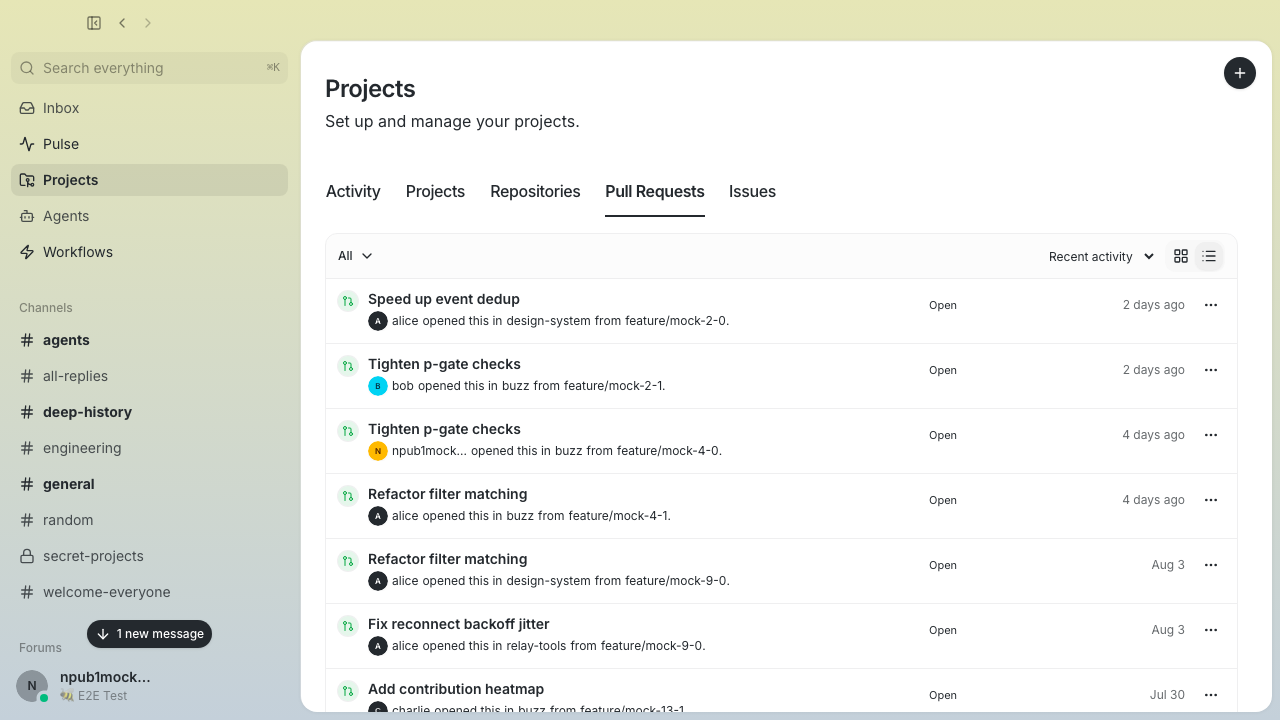 Issues use the same sentence-style hierarchy while keeping status and recency easy to scan. 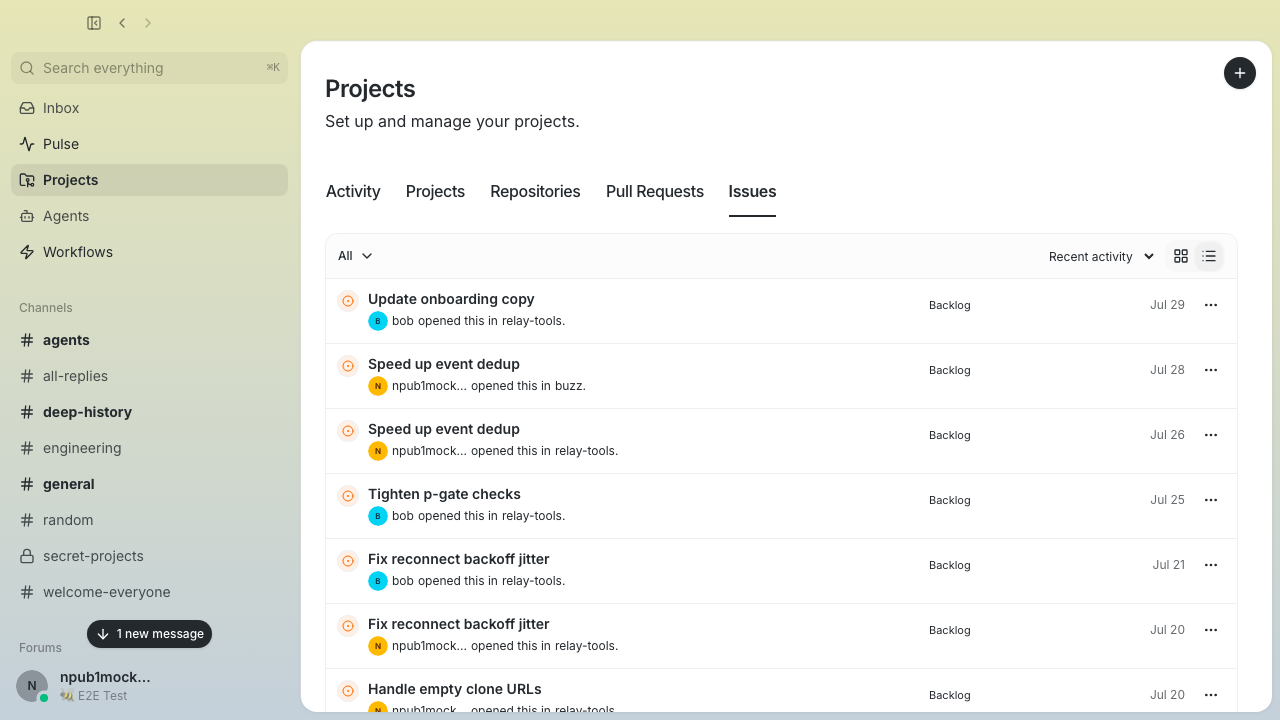 The wide Inbox detail keeps author, timestamp, and origin context readable beside its metadata rail. 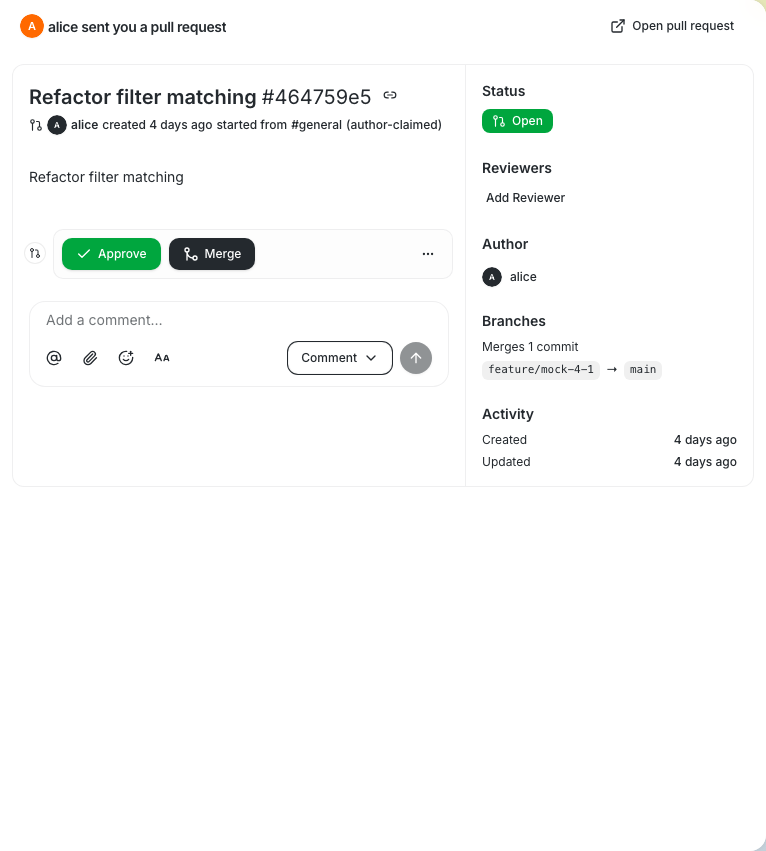 [View the complete six-state Projects v3 screenshot set](https://github.com/block/buzz/pull/5624#issuecomment-5268039672) and [the compact/wide Inbox comparison](https://github.com/block/buzz/pull/5624#issuecomment-5268614585). --- > Supersedes #5624, whose head commit accumulated permanently-queued required check suites (block-dco-check et al.) that GitHub never dispatched. History flattened into a single signed-off commit on latest main; tree verified byte-identical (`git merge-tree`) to merging the original branch into main. --------- Signed-off-by: Thomas Petersen <thomasp@squareup.com> Co-authored-by: Wintermute <3f1797424fd9ad6653a83665c660517777cd7f8c228c0d5907f49e01537f3ca5@buzz.block.builderlab.xyz>



buzz-acp
ACP harness that connects AI agents to Buzz. The harness listens for @mentions on the relay, prompts your agent, and the agent replies using the Buzz CLI.
Buzz Relay ──WS──→ buzz-acp ──stdio──→ Your Agent
                                               │
                                          Buzz CLI
                                       (send_message, etc.)
Supports any agent that speaks ACP over stdio: goose, codex (via codex-acp), and claude code (via claude-agent-acp).
Prerequisites
- A running Buzz relay (
just relaystarts Docker services automatically, or use a hosted instance) - A Nostr keypair for the agent (see Generating Keys)
Build:
cargo build --release -p buzz-acp
export PATH="$PWD/target/release:$PATH"
Generating Keys
Each agent needs a Nostr keypair — this is the agent's identity in Buzz. Use buzz-admin to generate one:
cargo run -p buzz-admin -- generate-key
This prints a public and secret key pair as hex. Save the secret key immediately — it is not stored and cannot be recovered. Set BUZZ_PRIVATE_KEY to the secret key to act as this identity.
Then register the agent's public key as a relay member so it can read and publish:
BUZZ_RELAY_PRIVATE_KEY=<relay signing key> \
  cargo run -p buzz-admin -- add-member --pubkey <agent public key>
add-member publishes a kind:13534 membership event, so the relay needs a stable signing key: set BUZZ_RELAY_PRIVATE_KEY in the relay's environment (uncomment it in .env) and restart the relay before running this.
Running multiple agents? Mint a separate keypair for each. Every agent needs its own identity.
Channels
The harness discovers channels by querying the relay with the agent's authenticated identity.
By default, the harness discovers only channels the agent is a member of (GET /api/channels?member=true). When the agent is added to a new channel, the membership notification subscription auto-subscribes to it.
Private channels require explicit membership. The relay doesn't yet have a REST/event API for managing channel members — this is a known gap. For now, use create_channel via the Buzz CLI to create new channels (the creator is automatically a member).
Quick Start (goose)
export BUZZ_PRIVATE_KEY="nsec1..."   # your agent's key (see "Generating Keys")
export BUZZ_RELAY_URL="ws://localhost:3000"
export GOOSE_MODE=auto

buzz-acp
That's it. The harness spawns goose acp, connects to the relay, discovers channels, and starts listening. When someone @mentions the agent, goose receives the message and can reply using the Buzz CLI that the harness configures automatically.
Running with Codex
codex-acp wraps OpenAI Codex in an ACP interface.
# Install the adapter (npm package — no Rust build required)
npm install -g @agentclientprotocol/codex-acp

# Run
export OPENAI_API_KEY="sk-..."   # required — use an OpenAI API key, not a ChatGPT subscription

buzz-acp
API key note:
codex-acpalways attempts a ChatGPT WebSocket login first, which logs a426 Upgrade Requirederror. This is expected and non-fatal — it falls back toOPENAI_API_KEYautomatically. SetOPENAI_API_KEYto ensure it has a working fallback.
Running with Claude Code
claude-agent-acp wraps the Claude Agent SDK in an ACP interface.
# Install the current adapter package
npm install -g @agentclientprotocol/claude-agent-acp

# Run
export ANTHROPIC_API_KEY="sk-ant-..."
export BUZZ_ACP_AGENT_COMMAND="claude-agent-acp"

buzz-acp
Older installs that still expose claude-code-acp are also supported. buzz-acp
treats both Claude ACP command names as the same zero-arg runtime.
Configuration
All configuration is via environment variables (or CLI flags — every env var has a matching flag).
Core
| Variable | Required | Default | Description |
|---|---|---|---|
BUZZ_PRIVATE_KEY |
yes | — | Agent's Nostr private key (nsec1...). Used for relay auth and agent identity. |
BUZZ_RELAY_URL |
no | ws://localhost:3000 |
Relay WebSocket URL. |
BUZZ_ACP_AGENT_COMMAND |
no | goose |
Agent binary to spawn. |
BUZZ_ACP_AGENT_ARGS |
no | acp |
Agent arguments (comma-separated). |
BUZZ_ACP_MCP_COMMAND |
no | "" (empty) |
Path to an optional MCP server binary to provide to the agent subprocess. |
BUZZ_ACP_IDLE_TIMEOUT |
no | 620 |
Idle timeout: max seconds of silence before cancelling a turn. Resets on any agent stdout activity. |
BUZZ_ACP_MAX_TURN_DURATION |
no | 7200 |
Absolute wall-clock cap per turn (safety valve). |
BUZZ_API_TOKEN |
no | — | API token (required if relay enforces token auth). |
Note: BUZZ_ACP_AGENT_ARGS splits on commas. For args with values, use: -c,key="value".
Legacy env vars: BUZZ_ACP_PRIVATE_KEY, BUZZ_ACP_API_TOKEN, and BUZZ_ACP_TURN_TIMEOUT (replaced by BUZZ_ACP_IDLE_TIMEOUT) are still accepted as fallbacks.
Parallel Agents & Heartbeat
| Flag | Env Var | Default | Description |
|---|---|---|---|
--agents |
BUZZ_ACP_AGENTS |
1 |
Number of agent subprocesses (1–32). |
--lazy-pool |
BUZZ_ACP_LAZY_POOL |
false |
Connect, subscribe, and queue accepted work before starting ACP/LLM subprocesses. The first accepted event wakes one pool initialization task; failures retry with bounded exponential backoff while work remains. |
--heartbeat-interval |
BUZZ_ACP_HEARTBEAT_INTERVAL |
0 |
Seconds between heartbeat prompts. 0 = disabled. Must be 0 or ≥10 when enabled. |
--heartbeat-prompt |
BUZZ_ACP_HEARTBEAT_PROMPT |
(built-in) | Custom heartbeat prompt text. Conflicts with --heartbeat-prompt-file. |
--heartbeat-prompt-file |
BUZZ_ACP_HEARTBEAT_PROMPT_FILE |
— | Read heartbeat prompt from a file. Conflicts with --heartbeat-prompt. |
Inbound Author Gate
Controls which authors' events the harness forwards to the agent. Events from disallowed authors are silently dropped before reaching subscription rules.
| Flag | Env Var | Default | Description |
|---|---|---|---|
--respond-to |
BUZZ_ACP_RESPOND_TO |
owner-only |
Author gate mode: owner-only, allowlist, anyone, nobody. |
--respond-to-allowlist |
BUZZ_ACP_RESPOND_TO_ALLOWLIST |
— | Comma-separated 64-char hex pubkeys (required when mode is allowlist). Owner is always implicitly included. |
Modes:
| Mode | Behavior |
|---|---|
owner-only |
Forward only events from the agent's registered owner. If no owner is set, all events are dropped until the owner is resolved. |
allowlist |
Forward events from the listed pubkeys plus the owner. |
anyone |
Forward all events (no author filtering). |
nobody |
Drop all inbound events. Agent only acts on heartbeat prompts. |
The gate applies to all inbound events — @mentions, DMs, thread replies, and any event delivered by the relay. Owner control commands are checked before the gate, so the owner can still manage the harness regardless of mode:
| Command | Effect |
|---|---|
!shutdown |
Gracefully exits the harness. |
!cancel |
Cancels the current in-flight turn for that channel, if any. |
!rotate |
Rotates the ACP session for that channel. If a turn is in-flight, it is cancelled and the channel session is invalidated when the task returns; otherwise the cached idle session is invalidated immediately. The next queued/received event starts a fresh session. |
Use !cancel to stop only the current turn; it is a no-op when the channel is idle. Use !rotate when you want the next turn in the channel to start from a fresh ACP session, even if the channel is currently idle.
Owner control commands must be kind:9 stream messages from the owner, must mention this agent with a p tag, and are consumed by the harness instead of being forwarded to the agent.
Note: The default mode is
owner-only. Agents without a registeredagent_owner_pubkeywill not respond to any events until the owner is resolved. Set--respond-to anyoneto disable the gate entirely.
Examples:
# Default: only respond to owner
buzz-acp

# Respond to a team of three users (owner always included automatically)
buzz-acp --respond-to allowlist \
  --respond-to-allowlist "abc123...64hex,def456...64hex,789abc...64hex"

# Respond to anyone (open agent)
buzz-acp --respond-to anyone

# Broadcast-only: post on heartbeat, ignore all inbound events
buzz-acp --respond-to nobody --heartbeat-interval 300
Configuration Examples
Single agent, no heartbeat (default):
buzz-acp
Four agents, no heartbeat (high-throughput event processing):
buzz-acp --agents 4
Two agents with 5-minute heartbeat:
buzz-acp --agents 2 --heartbeat-interval 300
Custom heartbeat prompt:
buzz-acp --agents 2 --heartbeat-interval 300 \
  --heartbeat-prompt "Check get_feed_actions() for pending approvals, then get_feed_mentions() for unanswered mentions. If nothing actionable, end your turn immediately."
Shared Identity
All N agents authenticate as the same Nostr bot identity — users see one bot regardless of how many agents are running. The same channel is never processed by two agents simultaneously (the queue enforces this). Cross-channel message ordering is not guaranteed when N>1.
Heartbeat Semantics
When --heartbeat-interval is set, the harness fires a prompt on an idle agent at the configured interval. Heartbeat rules:
- Lower priority than queued events — if events are pending, they are dispatched first.
- Skipped when all agents are busy — no queuing; the tick is simply dropped.
- At most one heartbeat in flight globally — the next tick is suppressed until the current one completes.
- Default prompt (when
--heartbeat-promptis not set) callsget_feed_actions()andget_feed_mentions()to surface pending work.
Heartbeat is designed for idle periods. Under sustained event load it will rarely fire — that's expected.
Choosing N
Start with N=2 for most deployments. Increase if queue depth grows under load. Each agent spawns its own MCP server subprocess, so resource usage scales approximately as N × (agent memory + MCP server memory). Maximum is 32.
Forum Channels
By default, the ACP harness subscribes to stream message kinds (9, 46010, 40007). To receive forum events, opt in with --kinds and disable the mention filter (forum posts don't @mention agents):
CLI flags:
buzz-acp --kinds 9,46010,40007,45001,45002,45003 --no-mention-filter
Or with --subscribe all:
buzz-acp --subscribe all --kinds 9,46010,40007,45001,45002,45003
Per-channel config:
[channel.CHANNEL_UUID]
kinds = [9, 46010, 40007, 45001, 45002, 45003]
require_mention = false
Forum event kinds:
- 45001 — Forum post (thread root)
- 45002 — Vote on a post or comment
- 45003 — Comment reply on a forum post
Note: Without
--no-mention-filter(orrequire_mention = false), the defaultsubscribe=mentionsmode filters events that don't @mention the agent — forum posts will be invisible.
How It Works
- Startup — Spawns N agent subprocesses (default 1), sends ACP
initializeto each, connects to the relay with NIP-42 auth. - Channel discovery — Queries the relay REST API for accessible channels, subscribes to each.
- Event loop — Listens for @mention events (kind 9 with the agent's pubkey in a
#ptag). Events queue per channel. - Prompting — When events are pending and no prompt is in flight for that channel, drains all queued events for the oldest channel into a single batched prompt via ACP
session/prompt. - Agent response — The agent processes the prompt and uses the Buzz CLI (
send_message,get_messages, etc.) to interact with Buzz. - Recovery — If the agent crashes, the harness respawns it. If the relay disconnects, the harness reconnects with a
sincefilter to avoid missing events.
Each channel has at most one prompt in flight. Multiple channels can be processed concurrently when agents > 1.
Note: On startup, the harness replays all unprocessed @mentions since the last run. Expect a burst of activity if there are stale events in the channel.
Bring Your Own Harness (BYOH)
Buzz Desktop supports registering any ACP-speaking agent tool as a selectable runtime without a PR.
How it works
Tier-1 — compiled-in runtimes (Goose, Claude Code, Codex, Buzz Agent): have auto-installers, auth probes, and first-class onboarding. Their IDs (goose, claude, codex, buzz-agent) are reserved and cannot be overridden.
Tier-2 — preset catalog (Cursor, Oh My Pi, Grok Build, OpenCode, Kimi Code, Amp, Hermes Agent, OpenClaw): static HarnessDefinition entries in desktop/src-tauri/src/managed_agents/discovery.rs (PRESET_HARNESSES). They are always present in the runtime catalog, PATH-probed for availability, not editable or deletable by the user. Displayed with bundled logos; if not installed, a docs link appears instead.
Note — OpenClaw:
openclaw acpis a Gateway-backed bridge; PATH availability shows "Available" even when the OpenClaw Gateway daemon is not running. This is expected tier-2 semantics (same class as a preset with unconfigured auth). The Gateway URL is configured viaOPENCLAW_GATEWAY_URL(or the equivalent env var from OpenClaw's docs) — set it in the agent's env vars in Edit Agent, not in the definition env (the preset definition carries no env entries). Note thatopenclaw acpexecutes tools inside the Gateway daemon, not the Desktop process, so Desktop-injectedBUZZ_*env vars do NOT reach the execution locus unless you also set them on the Gateway's own environment.
Tier-3 — user custom harnesses: JSON files in <app-data>/custom_harnesses/ that the user can create from the Settings UI or drop in directly. Each file describes one harness — no install scripts.
Custom harness JSON schema
{
  "id": "my-agent",
  "label": "My Agent",
  "command": "my-agent-bin",
  "args": ["acp"],
  "env": {
    "MY_AGENT_MODE": "acp"
  },
  "installInstructionsUrl": "https://example.com/docs",
  "installHint": "Download from example.com"
}
Fields:
id—[a-z0-9_][a-z0-9_-]*(used as the runtime picker value and file name)label— human-readable name shown in the UIcommand— the executable name or absolute path (must be non-empty)args— optional default CLI arguments (array); instance-level args override this when non-emptyenv— optional environment variables injected at spawn time (definition env is a floor; user/persona/global env overrides it; Buzz-reserved keys likeBUZZ_MANAGED_AGENTare always stripped and cannot be overridden)installInstructionsUrl/installHint— shown when the binary is not on PATH
Invalid files (bad JSON, unknown id, empty command) are skipped with a warning and do not break discovery for other entries.
Security guarantees
- No install shell commands in preset or custom definitions — only the user's own PATH is consulted.
can_auto_installis alwaysfalsefor preset and custom entries.- No user-supplied icon URLs — icons are bundled assets keyed by id in
RuntimeIcon.tsx. BUZZ_MANAGED_AGENTand other Buzz identity keys cannot be overridden byenvin a custom definition; they are stripped before merging.
Adding a preset (contributor guide)
To add a new runtime to the tier-2 gallery:
- Verify the ACP entrypoint from the vendor's own documentation — do not rely on a PR description alone. Test with the actual binary.
- Add a
HarnessDefinitionentry to thePRESET_HARNESSESslice indesktop/src-tauri/src/managed_agents/discovery.rs. Fillid,label,command,args,install_instructions_url,install_hint. Leaveenvempty unless the harness requires a specific env var to enable ACP mode. - Add the preset id to
BUILTIN_IDSindesktop/src-tauri/src/managed_agents/custom_harnesses.rsso custom JSON files cannot shadow it. - Add a bundled logo (64×64 PNG or optimised SVG) to
desktop/public/harness-logos/<id>.pngand add a corresponding entry toPRESET_LOGOSindesktop/src/features/onboarding/ui/RuntimeIcon.tsx. Record the source and license indesktop/public/harness-logos/CREDITS.md. Only bundle a mark whose upstream license permits redistribution; skipping this step is caught bypresetLogos.test.mjs, which asserts everyPRESET_HARNESSESid has a mapped logo that exists on disk. - Run
cargo test --libandjust desktop-typecheckto verify everything compiles.
The built-in BUILTIN_IDS set (goose, claude, codex, buzz-agent, and all current preset ids) is the reserved namespace; every other id is available for custom harnesses.
Using Any ACP Agent
The harness works with any agent that implements the ACP spec over stdio. The requirements are:
- Accept
initializeand return a result - Accept
session/newwithmcpServersand return asessionId - Accept
session/promptwith a text message and streamsession/updatenotifications - Return a
stopReason(end_turn,cancelled,max_tokens, etc.)
Set BUZZ_ACP_AGENT_COMMAND and BUZZ_ACP_AGENT_ARGS to point at your agent binary.
Testing
See the root TESTING.md for the full integration testing guide — automated test suites, multi-agent E2E testing via the ACP harness, and troubleshooting.
License
Apache-2.0