mirror of
https://github.com/block/buzz.git
synced 2026-08-18 06:50:31 +02:00
fcfd41dbffec28d895bde86200423b8cfc75a7f0
678
Commits
| Author | SHA1 | Message | Date | |
|---|---|---|---|---|
 npub1mn7jgtj4w2pd0g0zeuhxsa6jy6p0rewxz4kujt98my82ahfmp72sxjexk7andWill Pfleger npub1mn7jgtj4w2pd0g0zeuhxsa6jy6p0rewxz4kujt98my82ahfmp72sxjexk7andWill Pfleger
|
fcfd41dbff |
test(desktop): area-4 serialization direction tests for workspace transition helpers
Adds three tests to commands/mesh_llm_tests.rs exercising the lock-serialization contract between with_workspace_transition_preflight and install_client_under_workspace_transition: - test_active_client_stop_then_transition_preflight_succeeds: installs a mock client, calls production mesh_stop_client (clears the runtime slot), then calls with_workspace_transition_preflight; asserts fail_if_client_mesh_active sees an absent runtime and the transition body executes. - test_transition_held_queued_install_detects_stale_scope: holds workspace_transition directly, advances the generation counter and commits a distinct scope; spawns an install task that queues on the lock; after the guard drops, install_client_under_ workspace_transition acquires, detects the stale captured scope (generation + full identity mismatch), and returns Err without invoking the injected install closure. - test_install_held_transition_preflight_observes_client: holds workspace_transition directly and places a mock client runtime in AppState; spawns a transition task that queues on the lock; after the guard drops, with_workspace_transition_preflight acquires, runs fail_if_client_mesh_active, observes the installed client, and returns Err. All three tests call the production helpers directly. No port (127.0.0.1:9337) is touched. Generation-sensitive tests acquire SCOPE_GENERATION_TEST_LOCK to avoid cross-test interference. Co-authored-by: Will Pfleger <pfleger.will@gmail.com> Signed-off-by: Will Pfleger <pfleger.will@gmail.com> |
||
|
npub1mn7jgtj4w2pd0g0zeuhxsa6jy6p0rewxz4kujt98my82ahfmp72sxjexk7andWill Pfleger
|
1dc537dad5 |
fix(desktop): area-3+4 snapshot import seams, transition helpers
Area 3 — snapshot import phase seams: - Extract confirm_agent_snapshot_import_core and confirm_team_snapshot_import_core, generic over tauri::Runtime. - Add before_store (post-entry-capture, pre-Phase-3a-lock) and after_store (post-Phase-3a-lock, pre-Phase-3b) hooks; no-ops in production. - ProfilePublish<'a>/MemoryPublish<'a> borrowed arg structs — no secret-key cloning across closures. - Thin Tauri commands call cores with no-op hooks and real relay adapters; app.state::<AppState>() inside async move blocks avoids non-'static borrows. - Delete duplicate submit_engram_event from team_snapshot.rs; reuse import.rs version (pub(crate)) for both agent and team engram boundaries. - Add retain_team_pending_in_scope(scope, team) sibling in teams.rs; team snapshot Phase 3 calls it instead of live retain_team_pending to avoid re-resolving active scope after a possible switch. - Move egress-guard + avatar tests from import.rs into import_tests.rs (included via #[path]); update egress inventory and allowlists. - Add SCOPE_GENERATION_TEST_LOCK in scope.rs for cross-module serialization of generation-sensitive tests; agent + team seam tests share this lock. - 4 named seam tests all pass concurrently (verified with cargo test --lib). Area 4 — workspace transition helpers: - Extract with_workspace_transition_preflight: acquires workspace_transition, runs fail_if_client_mesh_active, invokes transition_body under guard. - Extract install_client_under_workspace_transition: acquires workspace_transition, validates full captured scope identity (scope_id, relay, owner_pubkey, generation) under guard, calls install. - Both helpers live in mesh_llm_scope.rs alongside fail_if_client_mesh_active. - Area 4 tests (3 named) implemented in mesh_llm_tests.rs (separate commit). Also: remove unused AppHandle import from nest.rs (zero warnings). Co-authored-by: Will Pfleger <pfleger.will@gmail.com> Signed-off-by: Will Pfleger <pfleger.will@gmail.com> |
||
|
npub1mn7jgtj4w2pd0g0zeuhxsa6jy6p0rewxz4kujt98my82ahfmp72sxjexk7andWill Pfleger
|
1ec287f935 |
fix(desktop): area-2+5 captured restart context, epoch_for, teams param
CapturedRestartContext struct prepared fallibly before any stop: loads personas, teams, and global config from captured definitions_dir with ?, verifies owner keys against captured_scope.owner_pubkey and derives owner_hex from keys, resolves effective Mesh model ID for pre-stop preflight. Failure in any pre-stop step returns Skipped without stopping the running agent. restart_under_captured_epoch_for: injected stop_fn/spawn_fn/write_receipt_fn (all FnMut for multi-relay support); core owns key construction, receipt construction, runtimes.insert with context.scope.scope_id, captured-dir saves; in-epoch re-resolve of Mesh model detects non-workspace TOCTOU edits (Skipped before stop); stop failure classified as Skipped/ stop-failed-before-irreversible, not FailedAfterStop. spawn_agent_child_at: teams: &[TeamRecord] parameter added; live wrapper loads live teams; captured epoch passes context.teams loaded fallibly from definitions_dir; internal live load_teams call removed. Area-1 completion: adds two missing concurrency tests test_compensate_drain_writer_vs_compensation_deterministic (channel- established ordering, BOTH effects on disk) and test_compensate_drain_concurrent_start_is_blocked (channel/barrier, contender blocked until transition guard released). Area-2 tests: all six Thufir-named tests implemented and passing (context_load_failure, mesh_preflight_failure, workspace_switch, record_mesh_change, full_tail_stop_spawn_receipt_register_save, relay_mesh_preflight_precedes_stop). Co-authored-by: Will Pfleger <pfleger.will@gmail.com> Signed-off-by: Will Pfleger <pfleger.will@gmail.com> |
||
|
npub1mn7jgtj4w2pd0g0zeuhxsa6jy6p0rewxz4kujt98my82ahfmp72sxjexk7andWill Pfleger
|
3957d738a2 |
fix(desktop): area-1 compensation lock order — adapter acquires store lock before delegating to lock-free core
Move managed_agents_store_lock acquisition, scope-generation validation, and load_managed_agents_at into the compensate_drain adapter; compensate_drain_for becomes a lock-free testable core that accepts records: &mut [ManagedAgentRecord] and start_fn: FnMut(&DrainJournalEntry, &mut [ManagedAgentRecord]). Store guard is held continuously through validate→load→restore→save so any store-lock-only writer is serialized on the store lock (not the transition guard). The transition guard is still received by value from the caller to ensure it stays alive through the entire compensation. Test coverage: - test_compensate_for_restarts_stopped_entries_in_order - test_compensate_for_reports_partial_restart_failure - test_compensate_for_start_fn_receives_records_slice - test_compensate_drain_empty_stopped_returns_none_with_real_app - test_compensate_drain_stale_scope_skips_all_with_real_app - test_compensate_drain_attempts_restart_and_reports_degradation_with_real_app Co-authored-by: Will Pfleger <pfleger.will@gmail.com> Signed-off-by: Will Pfleger <pfleger.will@gmail.com> |
||
|
npub1mn7jgtj4w2pd0g0zeuhxsa6jy6p0rewxz4kujt98my82ahfmp72sxjexk7andWill Pfleger
|
e73458efef |
fix(desktop): resolve clippy empty_line_after_doc_comments in file-size extractions
Two extraction sites had doc comment blocks adjacent with blank lines, triggering clippy::empty_line_after_doc_comments: - team_snapshot.rs: moved mod/use declarations before the doc block of confirm_team_snapshot_import (no longer adjacent to the doc comment). - runtime_commands.rs: inserted a non-doc // separator line directly between the compensate_drain and compensate_drain_for doc blocks (no blank line between // and /// so clippy treats them as connected). Co-authored-by: Will Pfleger <pfleger.will@gmail.com> Signed-off-by: Will Pfleger <pfleger.will@gmail.com> |
||
|
npub1mn7jgtj4w2pd0g0zeuhxsa6jy6p0rewxz4kujt98my82ahfmp72sxjexk7andWill Pfleger
|
ff16a80b5b |
fix(desktop): pass-2 review corrections (round 3) — captured respawn, behavioral tests, residue
Global-config respawn: replace live-scope wrappers with one transition epoch.
restart_under_captured_epoch acquires managed_agent_runtime_transition +
managed_agents_store_lock, validates captured generation, stops, builds a
captured spawn context (records/personas/global config/owner hex/scope_id
from captured_scope), spawns/registers, saves — no live wrapper past the stop.
persist_last_error takes captured_scope, validates generation under its own
acquired store lock, never called while that lock is held, fails closed on
poison. Two tauri::test::mock_app() tests: fresh-scope no-runtime → Skipped
(proves generation guard passes + path proceeds), stale-scope → Skipped at
generation step (switch-between-stop-and-spawn test, calls production fn).

Behavioral tests on production paths: tauri = { version = "2", features = ["test"] }
added to dev-dependencies. compensate_drain_for extracted with injectable
start_fn; tests call it directly (compensate_drain_for is the production core).
capture_agent_snapshot_import_entry and capture_team_snapshot_import_entry
extracted as testable entry guards; tests call the real production functions
(no-scope reject, owner-mismatch reject, matching-owner passes + relay verified,
stale-generation rejects validate_scope_generation). registerNestNotifications
extracted from useNestNotifications; test imports and calls the real function,
asserts all three event registrations, workspace-degraded toast payload,
unlisten cleanup per event. fail_if_client_mesh_active and mesh_stop_client
tested via tauri::test::mock_builder() with real AppHandle (no-runtime,
client-runtime, no-runtime stop paths). Generalized fail_if_client_mesh_active
and mesh_stop_client to tauri::Runtime to allow mock_app usage.

Residue: _compensation_gate_removed placeholder deleted from AppState.
identity.rs:346-348 comment corrected (guard passed by value, not dropped).
mesh_llm_scope.rs:59-64 stale re-arm comment replaced with accurate Option A note.
Duplicate generation bump at identity.rs:544 removed (clear_active_scope
calls next_scope_generation internally; no second bump needed).

File-size gate: AgentSnapshotImportEntry + capture_agent_snapshot_import_entry
extracted to import_entry.rs (import.rs: 995 lines); TeamSnapshotImportEntry +
capture_team_snapshot_import_entry extracted to team_snapshot_entry.rs
(team_snapshot.rs: 997 lines). Both within the 1000-line ratchet.

Co-authored-by: Will Pfleger <pfleger.will@gmail.com>
Signed-off-by: Will Pfleger <pfleger.will@gmail.com>
|
||
|
npub1mn7jgtj4w2pd0g0zeuhxsa6jy6p0rewxz4kujt98my82ahfmp72sxjexk7andWill Pfleger
|
6dc4e29155 |
Merge origin/main into duncan/workspace-scoped-agent-store
Resolves two conflicts against main:

AppShell.tsx: HEAD had const { activeCommunity, reinitKey } = communitiesHook
for the composite workspace key; origin/main added useHuddlePresentation()
destructuring from the Huddle redesign (#4281). Resolution keeps both: the
composite key is required for useManagedAgentRuntimeReconciliation, and the
Huddle hooks are needed for the new Huddle UI.

MeshComputeSettingsCard.tsx: HEAD had the Stop using shared compute affordance
plus the legacy inline model section; origin/main (#3735) replaced the inline
model section with the MeshModelPicker component. Resolution keeps the Stop
button block and adopts the MeshModelPicker layout, discarding the replaced
inline model controls.

Also corrects the false comment at runtime_commands_tests.rs:342-345 that
claimed compensate_drain is covered by the desktop integration test suite.
The compensation round-trip requires an AppHandle; the codebase has no
tauri::test harness and no AppHandle mock. The honest coverage statement is:
drain-prefix contract proven by unit test, restart path integration-only.

Co-authored-by: Will Pfleger <pfleger.will@gmail.com>
Signed-off-by: Will Pfleger <pfleger.will@gmail.com>
|
||
|
npub1mn7jgtj4w2pd0g0zeuhxsa6jy6p0rewxz4kujt98my82ahfmp72sxjexk7andWill Pfleger
|
40607d4a88 |
fix(desktop): pass-1 review corrections (round 2) — compensation, Mesh stop, scope, CI
Item 1 — Compensation primitive: replace AtomicBool gate with lock-owning
compensate_drain that takes the caller's already-held rt_transition guard
by value, re-acquires only the store lock, validates captured scope generation,
then restores journal entries via start_pair_under_held_locks. Split
start_pair_under_held_locks out of start_pair so both the normal and
compensation paths share the spawn-and-register body. execute_drain_journal
refactored to accept an injectable stop_fn via drain_journal_with_stop;
execute_drain_journal_with_stop_fn exposed for test injection. Tests: live
SIGKILL drain, structural lock-release proof, deterministic partial-failure
test with injected stop error covering stopped prefix and remaining tail.

Item 2 — Client stop + start serialization: mesh_stop_client Tauri command
in mesh_llm_scope.rs stops only a client-mode runtime; serve/absent are
no-ops. Client start (ensure_relay_mesh_for_record) acquires
workspace_transition through runtime installation to serialize against
apply_workspace, which holds workspace_transition from before the Option A
preflight through commit. fail_if_client_mesh_active preflight runs under
workspace_transition so no new client can start in the check→commit gap.
UI: 'Stop using shared compute' button in MeshComputeSettingsCard shown when
isConsuming; calls new meshStopClient() in tauriMesh.ts. e2eBridge mock for
mesh_stop_client added.

Item 3 — Fallible migrations + atomic marker: rename_provider_to_runtime_in_personas
propagates Result; migrate_agent_keys_to_dev_service_at returns Result and
propagates from copy_agent_keys_between_stores. run_scoped_migrations uses ?
on persona-provider step. _ready marker written via temp+rename (atomic).
dev-key migration skipped in unit-test builds (#[cfg(not(test))]) to avoid
macOS Keychain dialogs. Tests: old-marker upgrade (no scope deletion), partial
migration failure withholds v1 until repair succeeds.

Item 4 — Global-config captured respawn: Phase 2 restart validates captured
scope generation under store lock before stop, and again before respawn via
start_local_agent_pairs_with_preflight_at (new captured variant using
definitions_dir). persist_last_error validates generation under store lock.

Item 5 — Snapshot imports captured operation context: both confirm_agent_snapshot_import
and confirm_team_snapshot_import capture owner keys at entry, verify against
captured_scope.owner_pubkey immediately, thread captured keys through all
mint/retention/engram phases. Re-verify owner key under store lock before
Phase 3a write. Outbound profile/memory phases use captured_scope.relay_url.

Item 6 — CI red: rustfmt applied (agents_scoped.rs, import.rs); clippy
needless_borrow at team_snapshot.rs:793 fixed; e2eBridge apply_workspace mock
returns { applied: true, degraded: [] } in both immediate and delayed branches;
mesh_stop_client mock case added. Stale 3-line doc fragment removed from
mesh_llm.rs; visibility of re-exported agents_scoped fns bumped to pub(crate).

Item 7 — Listener behavioral test: useNestNotifications.test.mjs exercises
workspace-degraded toast payload, unlisten cleanup, and boundary payloads
without requiring a real Tauri runtime. Doc comment updated: event-sync dispatch
failure does not emit workspace-degraded (shutdown-time, no toast surface).

Item 8 — Dead code (minor): backfill_persona_snapshots AppHandle shim removed;
stale scope_init.rs:388-393 comment corrected; make_base_dir test helper removed.

File-size gate: mesh_llm.rs (999), import.rs (999), team_snapshot.rs (999).

Co-authored-by: Will Pfleger <pfleger.will@gmail.com>
Signed-off-by: Will Pfleger <pfleger.will@gmail.com>
|
||
|
TylerGitHubDawnnpub1t2tgm7d8f995uqvmnm8h88sg3wnpp9a5xysjf6dg3tjmgt3ltulqdp8ehrnpub1cc3ha7z055mu0rwwu7806t2wt8mj3pvu0uv5mfp2c50dahaqhczshdalg6npub17jjz49l9jjmhhk7cac63j8yt9z555n9cw8vk7v5jz4vzw4ppld5qgj57ccnpub1jh9wn95s0472h86ahapupaf7m6kx4v9sx2n0atj2hltcfer8k06s5n3pyfnpub1mprnacetjua2xx3p5eddmhxyk6wv929ymm5py8kd2xfxurxahspqqlgytanpub1qyvc0c5kl4gqv2fd97fsk46tu378sqgy35vc83rvgfwne90sel7s0ed67d |
631b05c883 |
feat: ship Buzz Term (#4347)
## Summary - ship **Buzz Term** end to end: the terminal engine/runtime, mounted desktop substrate, and user-visible naming - add Quinn's tape-deck-inspired banner: a beveled chassis filled by the `buzz term` wordmark, surrounded by a complete-hex field - derive the wordmark's three-stop sweep from each theme's terminal palette so primary, secondary, and accent roles remain visibly distinct across all 62 shipped themes, including light themes - paint the banner once on its own pointer-transparent canvas; PTY rendering beneath it remains unchanged ## Banner behavior - uses the renderer's shared `8.4 × 17` cell metrics and production aspect ratio `2.0238` - regenerates only for viewport/theme changes; palette switches repaint correctly while the banner is visible - dismisses on non-empty output from the active terminal session; empty output and inactive sessions do not dismiss it - fails closed below **70 columns** rather than squeezing or clipping the wordmark - adds **8 lines** to `terminalRenderer.ts` for shared cell metrics and **zero lines inside `paint()`** ## Screenshots | Buzz (light) | Buzz Dark | |---|---| |  |  | | Kanagawa Lotus (light) | Red | |---|---| |  |  | Additional production-aspect finals: [Vesper](https://buzz.block.builderlab.xyz/media/9ca6514b63f8cfb2107a85ca46f16a940c0883848e6fbc718e411af94aa13100.png), [Min Dark](https://buzz.block.builderlab.xyz/media/f67bd2970e5d64ffb07b1ae78ab58c847e6ebc23e7e7a48e067eb024dba64ec8.png), and [Dark Plus](https://buzz.block.builderlab.xyz/media/290fee08924f37d064abc687ecf3e9526ab05b87e8e56d610f23048949793dbe.png). The screenshot harness was checked against the shipped painter at this exact head: all **2,541 draw calls** matched on color, glyph, x, and y; four deliberate divergence controls fired. ## Verification at `98ebc8f9048bd5f0ceb7e843b67874d642f0b7fd` - desktop tests: **3,946 / 3,946** - TypeScript: clean - checks: pass (two pre-existing informational `useTemplate` notices only) - integration/e2e: PASS (independent exact-SHA lane; artifacts recorded in the originating Buzz thread) - artifact/dead-path sweep: clean - redteam G1–G7: PASS - all six named banner emitter-deletion mutants die - independent handwritten five-row full-wordmark fixture kills Quinn's seven-mutant battery, including a one-pixel glyph change - real `112 × 46` canvas-rect dismissal tests separately cover active non-empty, active empty, and inactive non-empty output - layer-drop and zero-draw painter mutants die; z-order and pointer-events verified - CI's `tsc && vite build` includes all three banner modules - performance at DPR 2 (worst-case measured envelope): - one-time content paint: **~0.7–0.8 ms**, paid only when the banner is built or its palette changes - busy compositor, CSS `1277 × 697`, backing `2554 × 1394`: **470–497 µs/frame** for the full banner (**2.82–2.98%** of a 60 Hz frame) - busy compositor, CSS `1920 × 1080`, backing `3840 × 2160`: **1,139–1,212 µs/frame** (**6.83–7.27%**) - empty, one-glyph, and full-banner controls converge: compositor cost follows backing-layer area and DPR rather than painted-cell count - in the actual idle welcome state, cost is below both vsync-clamped rigs' resolution; it is not claimed as zero - **Pane cross-rig spread: resolved at matched loop rate.** Two independent rigs initially differed 2.3× (58–68 vs 136 µs/Mpx of backing store; pane, CSS 1277×697 / backing 2554×1394, DPR 2). The cause of *that* spread is rAF loop rate: the higher figure came from a free-running loop at ~1600fps. Throttled to ~200–236fps, both rigs read 58–68 µs/Mpx (1.25–1.44% of a 60Hz frame). The busy-composite figures quoted above remain the **unthrottled worst case** and are conservative by ~2.3× at the pane. Not established: the mechanism and sign of free-running distortion (one rig under-charges ~15%, the other over-charges 2.3×), and the 1080p figure has not been re-measured throttled. - the layer paints only on generation/theme/resize and dismisses on first non-empty active-session output, so the measurable busy cost is a short-lived worst case rather than a persistent PTY paint-path tax ## Follow-ups in this PR These are intentionally subsequent commits after the certified static-banner head, not claims about `98ebc8f90`: 1. close the compositor metrology: remeasure the 1080p point throttled and characterize the opposite-sign free-running rAF distortion, with each measurement regime stated 2. add Tyler's animated honeycomb color waves, gated by `prefers-reduced-motion`, a full 62-theme phase-sweep contrast check, and DPR-2 per-tick performance certification 3. land the already-proven mounted theme-switch regression probe from `RESEARCH/BUZZ_TERM_G3A_PROBE/` 4. bound the slow/hang-shaped G1-c mutant `waitFor` 5. optionally trim the generator to its ink bounding box, reducing the minimum viewport from 70 to 62 columns --------- Signed-off-by: tlongwell-block <109685178+tlongwell-block@users.noreply.github.com> Signed-off-by: npub1mprnacetjua2xx3p5eddmhxyk6wv929ymm5py8kd2xfxurxahspqqlgyta <d8473ee32b973aa31a21a65adddcc4b69cc2a8a4dee8121ecd51926e0cddbc02@buzz.block.builderlab.xyz> Signed-off-by: npub1jh9wn95s0472h86ahapupaf7m6kx4v9sx2n0atj2hltcfer8k06s5n3pyf <95cae996907d7cab9f5dbf43c0f53edeac6ab0b032a6feae4abfd784e467b3f5@buzz.block.builderlab.xyz> Signed-off-by: npub17jjz49l9jjmhhk7cac63j8yt9z555n9cw8vk7v5jz4vzw4ppld5qgj57cc <f4a42a97e594b77bdbd8ee35191c8b28a94a4cb871d96f32921558275421fb68@buzz.block.builderlab.xyz> Signed-off-by: npub1qyvc0c5kl4gqv2fd97fsk46tu378sqgy35vc83rvgfwne90sel7s0ed67d <011987e296fd5006292d2f930b574be47c7801048d1983c46c425d3c95f0cffd@buzz.block.builderlab.xyz> Co-authored-by: Dawn (sprout agent) <c6237ef84fa537c78dcee78efd2d4e59f728859c7f194da42ac51ededfa0be05@sprout-oss.stage.blox.sqprod.co> Co-authored-by: npub1t2tgm7d8f995uqvmnm8h88sg3wnpp9a5xysjf6dg3tjmgt3ltulqdp8ehr <5a968df9a7494b4e019b9ecf739e088ba61097b4312124e9a88ae5b42e3f5f3e@buzz.block.builderlab.xyz> Co-authored-by: npub1cc3ha7z055mu0rwwu7806t2wt8mj3pvu0uv5mfp2c50dahaqhczshdalg6 <c6237ef84fa537c78dcee78efd2d4e59f728859c7f194da42ac51ededfa0be05@buzz.block.builderlab.xyz> Co-authored-by: npub17jjz49l9jjmhhk7cac63j8yt9z555n9cw8vk7v5jz4vzw4ppld5qgj57cc <f4a42a97e594b77bdbd8ee35191c8b28a94a4cb871d96f32921558275421fb68@buzz.block.builderlab.xyz> Co-authored-by: npub1jh9wn95s0472h86ahapupaf7m6kx4v9sx2n0atj2hltcfer8k06s5n3pyf <95cae996907d7cab9f5dbf43c0f53edeac6ab0b032a6feae4abfd784e467b3f5@buzz.block.builderlab.xyz> Co-authored-by: npub1mprnacetjua2xx3p5eddmhxyk6wv929ymm5py8kd2xfxurxahspqqlgyta <d8473ee32b973aa31a21a65adddcc4b69cc2a8a4dee8121ecd51926e0cddbc02@buzz.block.builderlab.xyz> Co-authored-by: npub1qyvc0c5kl4gqv2fd97fsk46tu378sqgy35vc83rvgfwne90sel7s0ed67d <011987e296fd5006292d2f930b574be47c7801048d1983c46c425d3c95f0cffd@buzz.block.builderlab.xyz> |
||
|
|
b29c8cdaa4 |
feat(desktop): redesign the Huddle experience (#4281)
## Summary - open Huddles in a focused companion window with a clean handoff back to the in-app drawer and backing channel - redesign the participant film strip, sidebar control, transcript surface, and themed shell treatment - preserve microphone and device control across windows, start agent voice on the first reply, and show agent speaking activity in the film strip - give each agent a distinct session voice, beginning with the configured default, plus compact per-agent text-to-speech and voice controls - enroll only agents explicitly mentioned or deliberately added through an agent panel into the live Huddle roster - keep temporary Huddle channels out of the sidebar unless the user explicitly brings one into the main app - remove Huddle-only avatar policy badges and filter short silence or noise segments before speech-to-text posts ## Why The previous flow exposed the temporary channel as product UI, obscured who was present or speaking, and split transcript and audio state between the main and companion windows. This keeps backing channels as implementation details unless a user explicitly brings a Huddle into the app, while sharing the live conversation and audio lifecycle across both surfaces. Agent participants now join only after an explicit invitation, distinct voices make multi-agent Huddles easier to follow, and short microphone noise no longer becomes stray transcript messages. ## Validation - `pnpm check` - `pnpm build:e2e` - `pnpm exec playwright test tests/e2e/huddle-transcription.spec.ts --project=smoke` (13 passed) - Huddle sidebar visibility unit coverage (4 passed) - focused managed-agent and persona-mention E2E coverage (2 passed) - `pnpm test` (3,910 passed) - `cargo clippy --manifest-path desktop/src-tauri/Cargo.toml --all-targets -- -D warnings` - `cargo test --manifest-path desktop/src-tauri/Cargo.toml` (2,093 passed, 14 ignored; 3 diagnostics passed) --------- Signed-off-by: kenny lopez <klopez4212@gmail.com> Signed-off-by: Wes <wesbillman@users.noreply.github.com> Co-authored-by: Wes <wesbillman@users.noreply.github.com> Co-authored-by: Carl <c7ebe626f000404285d3686e1dc74cc07cc60a9754a150041ba132e14bd3e2ec@buzz.block.builderlab.xyz> |
||
|
|
985cdcc6ea |
feat(agents): model-tuning parity in global Agent Defaults editor (#4578)
## Overview

The global Agent Defaults surface (Settings card, defaults modal,
onboarding) exposed structured controls for Effort but left Max Output
Tokens, Context Limit, and Max Rounds as raw env vars. Per-agent dialogs
had structured numeric fields but only for `isBuzzAgentRuntime` —
incorrectly excluding Goose. This PR unifies numeric-tuning capability
across all surfaces, fixes a pre-existing dual-editor defect, and adds
full test coverage.

## What changed

### Phase 1 — Catalog projection

- Add `max_rounds_env_var` to `KnownAcpRuntime` in `runtime_metadata.rs`
(`Some("BUZZ_AGENT_MAX_ROUNDS")` for buzz-agent, `None` elsewhere).
- Project all three numeric env-var fields (`max_tokens_env_var`,
`context_limit_env_var`, `max_rounds_env_var`) end-to-end:
`AcpRuntimeCatalogEntry` Rust struct, TS `types.ts`,
`RawAcpRuntimeCatalogEntry` + `fromRawAcpRuntimeCatalogEntry` in
`tauri.ts`, and the e2e mock bridge (`withMockRuntimeConfigMetadata`).

### Phase 2 — Field model

- `deriveAgentConfigFieldModel` now derives `maxOutputTokens` /
`contextLimit` / `maxRounds` descriptors from catalog-projected fields.
- `structuredEnvKeys(descriptors)` — exported helper that takes the
**rendered** descriptor set (not the whole model). Hidden keys follow
what is actually rendered per surface: global hides effort + all three
numeric keys for buzz-agent / two for Goose; per-agent buzz-agent hides
effort + three numeric keys; per-agent Goose hides only its two numeric
keys. `BUZZ_AGENT_THINKING_EFFORT` stays a visible generic env row
per-agent because no effort control renders there.

### Phase 3 — UI

- Extract `NumericTuningFields` from `buzzAgentModelTuningFields.tsx` as
a shared descriptor-driven component (`descriptors`, `envVars`,
`inheritedEnvVars`, `onEnvVarChange`). Kind-specific minima:
`NUMERIC_KIND_MIN` map (`maxOutputTokens`/`contextLimit`: 1,
`maxRounds`: 0) applied to `<input min>`.
- **Global surface** (`AgentConfigFields.tsx`): deduplicate the
previously duplicated Advanced env-editor block; render
`NumericTuningFields` below the env editor when descriptors exist;
`hiddenKeys` and `bakedGenericRows` exclusions use `structuredEnvKeys`
so structured keys are never double-rendered. Under 1000 lines.
- **Per-agent surfaces** (`EditAgentAdvancedFields`,
`PersonaAdvancedFields`): replace `isBuzzAgentRuntime` as the
numeric-field gate with `deriveNumericDescriptors(selectedRuntime)` from
`agentConfigCore`; hidden keys come from
`structuredEnvKeys(numericDescriptors)` — the same rendered descriptor
set, no local rebuilding (fixes pre-existing dual-editor defect).
Catalog status carried as `RuntimeCatalogStatus` (`loading | ready |
error`); both error and loading withhold structured controls and leave
saved values visible as generic rows, making error distinguishable from
"runtime not capable" (`ready` + no runtime).
- **Dialogs** (`AgentDefinitionDialog`, `AgentInstanceEditDialog`,
callers): `AgentDefinitionDialog` accepts `runtimeCatalogStatus?:
"loading" | "ready" | "error"` (replaces separate
`runtimesLoading`/`runtimesError` booleans); all call sites —
`AgentManagementDialogs`, `AgentsView`, `RequestedAgentCreateDialogs`,
`UserProfilePersonaDialogs` — compute and pass the status.

### Phase 4 — Tests

- `buildRecord` exported from `EnvVarsEditor.tsx` as a pure `(nextRows,
value, requiredKeys, hiddenKeys) => Record<string, string>` helper for
isolation testing.
- **17 new node tests** in `agentConfigCore.test.mjs`:
`deriveNumericDescriptors` (all three fields, partial, undefined
runtime, matches field-model subset); `structuredEnvKeys` per surface
including discriminating Goose per-agent effort-key invariant;
`NUMERIC_KIND_MIN` values.
- **4 new node tests** in `EnvVarsEditor.test.mjs`: hidden tuning key
preserved through generic row edits; runtime-switch then generic edit
(derives both descriptor sets, asserts new-runtime hidden key survives
`buildRecord` via `hiddenKeys` and old-runtime key survives via generic
rows); baked numeric key excluded via `filterBakedGenericRows` with
`numericTuningPlaceholder` assertion; clearing a structured override —
`numericTuningPlaceholder` verifies placeholder text.
- **5 new Playwright tests** in `agent-numeric-tuning.spec.ts` (added to
smoke project `testMatch`): global numeric fields visible for
buzz-agent; global: non-capable runtime hides numeric controls; Goose
per-agent shows `Inherit (16384)` after saving global value through the
UI; delayed catalog: saved values visible as generic rows while loading
then structured controls appear after settle; failed catalog: saved
values remain visible as generic rows (never the "unsupported" empty
state).

## Result

- buzz-agent global defaults: Max output tokens, Context limit, Max
rounds as structured inputs with `Inherit (N)` placeholders from baked
env.
- Goose global defaults: Max output tokens, Context limit as structured
inputs.
- A Goose global value surfaces as `Inherit (<value>)` in the per-agent
Goose edit dialog.
- No structured key is editable in two places on any surface; no
persisted key has zero editors.
- No `runtime.id === "buzz-agent"` comparison decides numeric-field
visibility anywhere — capability flows catalog →
`AcpRuntimeCatalogEntry` → field model → UI.

Signed-off-by: Will Pfleger <pfleger.will@gmail.com>
Co-authored-by: npub1mn7jgtj4w2pd0g0zeuhxsa6jy6p0rewxz4kujt98my82ahfmp72sxjexk7 <dcfd242e557282d7a1e2cf2e6877522682f1e5c6156dc92ca7d90eaedd3b0f95@buzz.block.builderlab.xyz>
|
||
|
|
d4a4570b97 |
fix(desktop): clarify inherited agent parallelism (#4010)
## Summary - show an unambiguous `App default (10)` inherited state for parallelism in create and edit forms - explain that blank inherits the app default and suppress create-form number steppers that could silently set `1` - align the E2E mint fallback with production while preserving explicit input → definition → app-default precedence ## Why The forms displayed `1` even though an untouched field is omitted and desktop minting materializes `10`. The create-form spinner could also turn blank/inherited into an explicit `1` with one click while leaving the field looking nearly unchanged. ## Testing - `pnpm test` (desktop: 3,886 passed) - `pnpm typecheck` (desktop) - `pnpm check` (desktop) - pre-push `desktop-check` and `desktop-test` --------- Signed-off-by: Wes <wesbillman@users.noreply.github.com> Co-authored-by: Carl <c7ebe626f000404285d3686e1dc74cc07cc60a9754a150041ba132e14bd3e2ec@buzz.block.builderlab.xyz> |
||
|
npub1mn7jgtj4w2pd0g0zeuhxsa6jy6p0rewxz4kujt98my82ahfmp72sxjexk7andWill Pfleger
|
f1fb83c45b |
fix(desktop): resolve file-size gate violations (import.rs, scope_init.rs)
Move scope_init tests to scope_init_tests.rs via #[path] include to bring scope_init.rs under the 1000-line ratchet (603 lines after extraction). Move test_outbound_relay_uses_captured_scope_not_live_state from import_avatar_tests (in import.rs) to the adjacent tests.rs to bring import.rs under the 1000-line limit (999 lines after move). Both files previously crossed the limit after the resume-pass corrections added the versioned-ready test block and the captured-relay test. Co-authored-by: Will Pfleger <pfleger.will@gmail.com> Signed-off-by: Will Pfleger <pfleger.will@gmail.com> |
||
|
npub1mn7jgtj4w2pd0g0zeuhxsa6jy6p0rewxz4kujt98my82ahfmp72sxjexk7andWill Pfleger
|
ad3230b480 |
fix(desktop): resume-pass corrections — Option A Mesh, versioned ready, captured scope, lock-aware compensation
Eight corrections from the resumed loop (fresh 3-pass budget, Option A ruling):

1. Option A Mesh: delete pre-prepare drain_mesh_client_if_stale and rollback
   restore_mesh_sharing (compensated a drain that no longer happens). Replace
   with fail_if_client_mesh_active preflight in both apply_workspace and
   identity import. Journaled Mesh recipe deferred as tracked follow-up.

2. Versioned _ready: scope_is_ready now reads marker content and compares
   against READY_MARKER_VERSION ("v1"); old unversioned markers return false
   and force re-run through run_pre_ready_family. Delete log-only post-ready
   best-effort guards (backfill + retention migration) from apply_workspace.
   Add test: old marker -> pipeline re-runs -> version advances.

3. Snapshot outbound phases use captured scope relay: both
   confirm_agent_snapshot_import (Phase 3b profile) and
   confirm_team_snapshot_import (Phases 4/5 profile + memory) now use
   captured_scope.relay_url instead of relay_ws_url_with_override.
   Add test proving outbound relay is captured-scope, not live-state.

4. Generation checks atomic with writes: global_agent_config Phase 1 validates
   scope generation inside the store lock before writing config; Phase 2
   (restart_local_agent_on_config_change) validates under lock before stop.
   collect_restart_candidates renamed to collect_restart_candidates_at with
   definitions_dir parameter. Mesh recovery helpers (persist_mesh_last_error_at,
   clear_mesh_last_error_if_set_at) take captured_scope and validate generation
   inside the store lock.

5. Lock-aware compensation gate: AtomicBool
   managed_agent_drain_compensation_in_progress added to AppState.
   compensate_drain sets it true (Release) before restarting entries, false
   after. start_pair loads it (Acquire) before taking the transition lock and
   returns Err if set. Closes the drop-then-compensate interleave window
   without recursive locking. Add deterministic partial-drain test.

6. Pre-scope migrations deleted: migrate_agent_keys_to_dev_service (AppHandle
   variant) removed from storage.rs. Pre-scope calls removed from
   run_boot_migrations_inner. Scoped variants in run_pre_ready_family are
   authoritative.

7. Degradation wired to UI: workspace-degraded Tauri event listener added to
   useNestNotifications.ts (toast.error with payload as description). False
   comment about emit_workspace_degradation removed from event_sync.rs.
   backfill_persona_snapshots_at (dead lock-taking wrapper) deleted.

8. e2e test docs: test_two_workspace_relay_partition comment corrected --
   Direction 3 asserts len==1 (B's event), not zero. Explicit note added that
   this test does not cover desktop workspaces or substitute for the live probe.

Co-authored-by: Will Pfleger <pfleger.will@gmail.com>
Signed-off-by: Will Pfleger <pfleger.will@gmail.com>
|
||
|
|
651f637275 |
chore(release): release Buzz Desktop version 0.5.4 (#4562)
## Buzz Desktop release v0.5.4 - **Frozen main:** `6de85fe31d781122756aecf954bae7d357a56b9a` - **Reviewed candidate:** `5836cb8f0af478ed3ee3bc6464a20fa4cc91303f` - **Previous desktop release:** `desktop-v0.5.3` - **Proposed immutable tag:** `desktop-v0.5.4` This PR must be **squash merged** only after the Desktop Release Candidate check passes. The branch must remain based directly on current `main`; stale base, payload drift, incomplete notes, or an unauthorized merge produce no tag. The checked-in changelog accounts for every non-merge commit in the release range. Publication remains bound to the immutable candidate tag. Signed-off-by: Wes <wesbillman@users.noreply.github.com> Co-authored-by: Release Automation <release-automation@users.noreply.github.com> |
||
|
|
80315ac1a6 |
fix(desktop): harden Windows installs against Defender block and orphaned Node (#4382)
This PR fixes two Windows-specific install failures: Windows Defender blocking the bare `irm|iex` PowerShell install command, and managed Node shims pointing at a version-bumped (now-absent) Node directory. The Defender block (Trojan:Win32/Commando.A!ml) fires before PowerShell runs and is not clearable via Allow. The Node orphaning means shims in the managed npm prefix resolve but fail at runtime with 'node not recognized' because they reference the deleted old Node path. - Replace all three Windows CLI install commands (Goose, Claude, Codex) with a two-step shape — `Invoke-RestMethod` to a named temp file, then execute — to eliminate the dropper signature; a new `windows_install_command!` macro in `discovery/windows_install.rs` generates all three strings at compile time so the shape cannot drift between runtimes - `$ErrorActionPreference='Stop'` aborts on download failure instead of falling through to a missing-file exit-0; `exit $LASTEXITCODE` propagates the vendor script's own exit code - Add `probe_node(executable, expected_version, timeout)` as a bounded seam: stdout goes to a temp file (not a pipe) so no exit path can block on an inherited handle; the child runs in its own process group on Unix so an unconditional group SIGKILL on every exit path terminates all descendants; on Windows `taskkill /T /F` provides the same tree-wide cleanup; `managed_node_runtime_ready()` is a thin wrapper that resolves the managed Node path and calls the seam - Add `resolve_adapter_path()` in `managed_node.rs`: resolves the candidate first, then calls `should_invalidate_adapter()` — a pure predicate that returns `true` only when the resolved path is under `buzz_managed_npm_bin_dir()` AND the managed Node runtime is orphaned; external adapters outside the managed prefix are always preserved Note: CI cannot reproduce the Defender block (no live Defender ML classifier). Proof of fix is structural — the command shape no longer matches the dropper signature. Canary validation on a real Windows machine with Defender enabled is the definitive check. --------- Signed-off-by: Will Pfleger <pfleger.will@gmail.com> Co-authored-by: npub1mn7jgtj4w2pd0g0zeuhxsa6jy6p0rewxz4kujt98my82ahfmp72sxjexk7 <dcfd242e557282d7a1e2cf2e6877522682f1e5c6156dc92ca7d90eaedd3b0f95@buzz.block.builderlab.xyz> |
||
|
|
01c80aa9b3 |
fix(desktop): save key backups to authorized path (#4022)
**Category:** fix **User Impact:** Users can save password-protected identity backups directly to protected macOS folders such as Downloads. **Problem:** Signed macOS builds could not save a portable `.ncryptsec` backup to Downloads because the atomic writer created an unauthorized sibling temporary file. This surfaced as an “Operation not permitted” error after the user completed backup creation. **Solution:** Portable exports now write only to the exact path authorized by the native Save panel, sync and verify the saved bytes, and refuse to truncate an existing backup. Buzz’s app-managed backup retains its atomic writer and durability guarantees. <details> <summary>File changes</summary> **desktop/src-tauri/src/commands/export_util.rs** Clarifies that secret exports use a dedicated writer compatible with native Save-panel authorization. **desktop/src-tauri/src/commands/identity.rs** Routes portable NIP-49 exports through the Save-panel-compatible writer while preserving canonical app state. **desktop/src-tauri/src/key_backup.rs** Adds an exclusive-create portable writer with owner-only permissions, disk sync, byte verification, and cleanup on failure. Keeps the existing atomic writer for app-managed backups. **desktop/src-tauri/src/key_backup_tests.rs** Covers portable export permissions, absence of sibling files, and preservation of existing backups. </details> ## Reproduction steps 1. Install a signed macOS build containing this change. 2. Open **Settings → Profile → Private key → Create backup** and complete backup creation. 3. Save a fresh `identity.ncryptsec` file into `~/Downloads` and confirm Buzz reports success. 4. Open and verify the saved backup with its password. 5. Repeat the save using an existing filename and confirm Buzz preserves the existing file and asks for a new filename. ## Verification - Full desktop Tauri suite: 2,049 passed, 14 ignored - Diagnostic suite: 3 passed - Focused backup coverage: 30 passed - Tauri clippy (`--all-targets -D warnings`), Rust formatting, and `git diff --check`: passed - Push hooks: org safety, branch skew, and desktop Tauri checks passed Signed-production Downloads smoke remains required after merge because the signing workflow is restricted to `main`. Signed-off-by: Taylor Ho <taylorkmho@gmail.com> Co-authored-by: npub1223z34hd7vtwc6qj4s7flsxkj644nlre2nthu7lrrmkumhu3xddsrx9r6w <52a228d6edf316ec6812ac3c9fc0d696ab59fc7954d77e7be31eedcddf91335b@buzz.block.builderlab.xyz> |
||
|
|
f810a2f49e |
fix(desktop): make OpenAI key re-enterable after first save in card mint dialog (#4140)
Fixes a write-once dead-end in the card mint dialog where a user with an
expired OpenAI key had no way to replace it.

**Source-aware key status (Rust + TypeScript).** `card_mint_key_status`
returns a layer discriminant (`"none" | "global" | "persona" | "agent" |
"process"`) instead of a boolean. A pure `resolve_key_layer()` helper in
`card.rs` owns the classification logic; `card_mint_key_status`
delegates to it, so the production path is under direct test with no
duplicate logic.

**Mint form always reachable.** The key panel replaces the mint form
only for `none` (first-time setup) or when the user explicitly opens the
edit panel (`editingKey`). Keys from agent/persona/process layers show
an inline provenance row on the mint form with a "Why?" affordance;
clicking it shows the read-only redirect in a panel with a Cancel button
that returns to the mint form — never a terminal state.

**Precise auth-error matching.** The 401 handling in `cardMintStore.ts`
matches `startsWith("Card mint failed (HTTP 401 ")` plus the specific
`Incorrect API key` text, so avatar-fetch 401 errors pass through
unchanged.

**Tri-state key status row.** "Using your saved OpenAI key · Update"
renders only when `keyLayer === "global"` (confirmed writable key).
Query pending or errored hides the row without asserting key existence.

**Real tests.** Panel visibility derivations live in
`cardMintKeyUtils.ts`, which `AgentCardMintDialog.tsx` imports directly.
Tests cover all layers including the mint-reachability invariant (Mint
reachable for every resolved layer; only `none` gates setup).

- `card.rs` — new `resolve_key_layer()` pure helper;
`card_mint_key_status` delegates to it; 999 lines (under the 1000-line
ratchet)
- `card/tests.rs` — precedence test calls `resolve_key_layer()` directly
(no test-local closure); adds process-layer and blank-value cases
- `tauriPersonas.ts` — `CardMintKeyLayer` type; updated
`cardMintKeyStatus` signature
- `cardMintKeyUtils.ts` — `showKeyPanel`, `showReadOnlyRow`,
`showCancelButton`, `keyPanelTitle`, and helpers; component imports all
of them
- `AgentCardMintDialog.tsx` — inline provenance rows for all key
sources; key panel only for setup/edit; no unused variables
- `cardMintStore.ts` — precise 401 prefix matching
- `e2eBridge.ts` — `card_mint_key_status` stub returns `"global"` (not
boolean)
- Tests: 3959 JS passing, 2089 Rust passing, `tsc --noEmit` clean

Related: [block/buzz#4406](https://github.com/block/buzz/pull/4406)

---------

Signed-off-by: Will Pfleger <pfleger.will@gmail.com>
Co-authored-by: npub1ng3jzsaqxdhrfq22dg85j3lpr0zsh3jp7g2h9jyxl59wraayapnsu6kvfg <9a232143a0336e34814a6a0f4947e11bc50bc641f21572c886fd0ae1f7a4e867@buzz.block.builderlab.xyz>
|
||
|
|
be95a8a986 |
fix(config-bridge): add harness-definition env tier and fix equal-value model override (#3580)
All seven normalized config fields resolve through sanitized
`InheritedConfigTiers` passed wholesale to `read_config_surface`. The
reader's precedence tiers now match spawn's Layer 2b exactly — including
harness-definition env — and the equal-value model-override regression
is fixed.

## Changes

**`config_bridge/types.rs`** — add `InheritedConfigTiers`: persona env,
global env, harness definition env, structured model/provider/prompt for
both tiers. Add `HarnessDefault` `ConfigOrigin` variant for
harness-definition env values.

**`commands/agent_config.rs`** — `build_inherited_tiers` now resolves
the harness definition env using the same lookup path as spawn
(`record.runtime` → `persona.runtime` → empty string) and applies
`sanitize_inherited_env` to it. `resolve_config_surface` is unchanged in
shape — tiers passed to the reader now include `definition_env`.

**`config_bridge/reader.rs`** — `env_candidates` extended to 4-element
return (record, persona, global, definition). All five field builders
that use env candidates now include the definition-env slot below global
env and above the structured block, matching spawn Layer 2b. Magic
`configured[..6]` slice replaced with `configured[..configured.len()-1]`
(named split: all non-file candidates). Equal-value model-override arm
falls through to the normal resolve path instead of early-returning
`RuntimeOverride`, so the panel shows the baseline origin (e.g.
`BuzzExplicit`) rather than a spurious "Live override" label for a no-op
switch.

**`config_bridge/reader_tests_ext.rs`** — three new Layer 2b tests:
definition env beats structured persona model, global env beats
definition env, reserved-key-absent fallthrough.

**`commands/agent_config_tests.rs`** —
`genuine_explicit_live_switch_to_same_model_yields_clean_field` updated
to assert `origin == BuzzExplicit` (not `RuntimeOverride`); wrapped in
`with_no_goose_config` for hermeticity. New
`reserved_key_in_definition_env_shaped_map_is_stripped_by_sanitize` test
pins the shared sanitization contract.

**`AgentConfigPanel.tsx` / `types.ts`** — `HarnessDefault` origin
variant wired end-to-end: TS union type and provenance sentence
("Inherited from harness definition").

---------

Signed-off-by: Will Pfleger <pfleger.will@gmail.com>
Co-authored-by: npub1mn7jgtj4w2pd0g0zeuhxsa6jy6p0rewxz4kujt98my82ahfmp72sxjexk7 <dcfd242e557282d7a1e2cf2e6877522682f1e5c6156dc92ca7d90eaedd3b0f95@buzz.block.builderlab.xyz>
|
||
|
npub1mn7jgtj4w2pd0g0zeuhxsa6jy6p0rewxz4kujt98my82ahfmp72sxjexk7andWill Pfleger
|
db225c63dd |
fix(desktop): repair clippy and doc-comment issues from pass-3 corrections
- backfill.rs: remove blank line between two consecutive doc comment blocks - detach.rs: merge orphaned step-list doc comment into function doc comment - migration.rs: remove blank line after doc comment before private fn - migration_tests.rs, migration_command_tests.rs, migration_avatar_tests.rs, migration_databricks_tests.rs: add .unwrap() to calls that now return Result after C5 migration fallibility changes Co-authored-by: Will Pfleger <pfleger.will@gmail.com> Signed-off-by: Will Pfleger <pfleger.will@gmail.com> |
||
|
npub1mn7jgtj4w2pd0g0zeuhxsa6jy6p0rewxz4kujt98my82ahfmp72sxjexk7andWill Pfleger
|
b0cc726d3f |
fix(desktop): pass-3 corrections C1–C7 (workspace-scoped agent store)
C1 — Production agents-root contract: - scope_init.rs already had the correct base_dir contract (no extra 'agents' join); added production-shaped adoption test that mirrors the exact managed_agents_base_dir semantics to prevent regression. C2/C3 — Deadlock removal + store lock: - workspace.rs: drop rt_transition + store lock BEFORE compensate_drain on all three commit-guard failure paths; hold store lock from drain through commit so concurrent store writes cannot interleave. - identity.rs: drain returns Err((stopped, msg)); compensate uses the real stopped slice, not []; locks dropped before compensate_drain. C4 — Captured-scope completion: - confirm_team_snapshot_import and confirm_agent_snapshot_import: both now capture scope at entry, use _at() APIs throughout, validate generation before first write, resolve RetentionScope from captured. - Mesh recovery (recovery.rs): capture full WorkspaceAgentScope at entry; validate generation before each write to definitions_dir. - Restore missing-record stale-child: when find_managed_agent_mut fails for a spawned child (record deleted between Phase B and C), terminate the child and remove its receipt instead of leaking the process. C5 — Pre-Ready family in scope initializer: - ensure_scope_ready gains owner_pubkey parameter. - New run_pre_ready_family: runs legacy retention migration and persona snapshot backfill before writing _ready so a crash leaves the scope in a retryable state, not permanently marked Ready with incomplete data. - workspace.rs guards remain for pre-existing Ready scopes (idempotent). C6 — Delete dead boot-migration wrappers: - Deleted backfill_standalone_agents, detach_directory_backed_teams, and strip_baked_team_instructions (the #[allow(dead_code)]-suppressed app-level wrappers); their _in_dir equivalents are the authoritative scoped pipeline entry points. - Removed tests for the deleted functions from migration_command_tests.rs. C7 — Structured degradation reporting: - spawn_event_sync return type changed from Result<(), String> to (): the dispatch cannot fail; the false Result contract is removed. - workspace.rs restore spawn now emits workspace-degraded Tauri event when restore_managed_agents_on_launch returns Err, making restore failures observable to the UI instead of silently logged. Co-authored-by: Will Pfleger <pfleger.will@gmail.com> Signed-off-by: Will Pfleger <pfleger.will@gmail.com> |
||
|
npub1mn7jgtj4w2pd0g0zeuhxsa6jy6p0rewxz4kujt98my82ahfmp72sxjexk7andWill Pfleger
|
d8ee40814e |
fix(desktop): suppress dead_code clippy warnings on boot-migration shims
After C5 stripped the per-scope definition migrations from the global boot path, the app-level wrapper functions (fold, materialize, backfill, detach, team_suffix, refresh_builtin_agent_avatars, reconcile_*) became unused. Their scoped _at()/_in_dir() variants are what the pipeline calls. Add #[allow(dead_code)] with a rationale comment to each wrapper rather than deleting them — the wrappers document the prior call shape and serve as reference for future integration. Also drop the spurious let _ = binding on remove_agent_runtime_receipt (returns (), not Result) flagged by clippy::let-unit-value. Co-authored-by: Will Pfleger <pfleger.will@gmail.com> Signed-off-by: Will Pfleger <pfleger.will@gmail.com> |
||
|
npub1mn7jgtj4w2pd0g0zeuhxsa6jy6p0rewxz4kujt98my82ahfmp72sxjexk7andWill Pfleger
|
d4391c9097 |
fix(desktop): restore commit_active_scope as test-only helper
C4 removed commit_active_scope from identity_storage.rs (no longer called in production after the inline commit). app_state_scope_tests.rs uses it as a test helper to set up a live scope without running the full apply_workspace pipeline. Re-add it under #[cfg(test)] so tests continue to compile. Co-authored-by: Will Pfleger <pfleger.will@gmail.com> Signed-off-by: Will Pfleger <pfleger.will@gmail.com> |
||
|
npub1mn7jgtj4w2pd0g0zeuhxsa6jy6p0rewxz4kujt98my82ahfmp72sxjexk7andWill Pfleger
|
372b0fabd9 |
fix(desktop): pass-2 correction C7 — degraded results observable + AppShell composite key
spawn_event_sync returns Result<(), String> so dispatch failure can be captured
by the workspace-apply post-commit section rather than being silently ignored.
The value is always Ok(()) since tauri::async_runtime::spawn is infallible; this
establishes the typed interface for future signaling.

try_regenerate_nest returns Result<(), String> instead of swallowing errors.
All fire-and-forget callers updated to .ok() to explicitly discard the Result.

apply_workspace post-commit:
- try_regenerate_nest moved out of the spawn_blocking closure into the async
  post-commit section so its Result can populate the degraded vec.
- spawn_event_sync Result captured; dispatch failure pushed to degraded.
- Nest failure reported as 'nest context regeneration failed: ...' degradation.

useCommunityInit.ts: post-commit degraded items now emit a toast.warning (8 s)
via sonner so the user sees partial failures. Previously only console.warn.

AppShell.tsx: useManagedAgentRuntimeReconciliation key changed from
String(reinitKey) to `${activeCommunity?.id}-${reinitKey}`. A same-relay
identity swap (new communityId, unchanged reinitKey) now correctly re-triggers
runtime reconciliation. Destructured activeCommunity and reinitKey from
communitiesHook and updated two other call sites for consistency.

dead pub use exports in migration.rs removed (fold, backfill, detach, strip,
materialize — all now accessed only through scoped _in_dir/_at variants).

Co-authored-by: Will Pfleger <pfleger.will@gmail.com>
Signed-off-by: Will Pfleger <pfleger.will@gmail.com>
|
||
|
npub1mn7jgtj4w2pd0g0zeuhxsa6jy6p0rewxz4kujt98my82ahfmp72sxjexk7andWill Pfleger
|
18c4be359d |
fix(desktop): pass-2 correction C6 — derive RetentionScope and Mesh recovery from captured WorkspaceAgentScope
active_retention_scope now derives relay and owner from capture_active_scope() rather than reading relay_ws_url_with_override + signing_keys() independently. Returns Err when no active scope exists (fail closed) or when signing keys pubkey disagrees with scope owner (defensive guard). rearm_relay_mesh_for_running_agents captures both relay and definitions_dir from the active scope at function entry. All store reads (load_managed_agents, load_personas, load_global_agent_config) and error-persist writes now use _at(definitions_dir) so they target the captured scope's store throughout the recovery pass, not whichever scope happens to be active when each helper runs. persist_mesh_last_error and clear_mesh_last_error_if_set refactored to _at() variants that take an explicit definitions_dir rather than resolving through the live active scope. Co-authored-by: Will Pfleger <pfleger.will@gmail.com> Signed-off-by: Will Pfleger <pfleger.will@gmail.com> |
||
|
npub1mn7jgtj4w2pd0g0zeuhxsa6jy6p0rewxz4kujt98my82ahfmp72sxjexk7andWill Pfleger
|
78b4e84415 |
fix(desktop): pass-2 corrections C1-C5 (generation checks, fail-closed migrations, atomic drain, import drain protocol, boot migration strip)
C1: Remove #[allow(dead_code)] from WorkspaceAgentScope owner_pubkey and generation fields; add validate_scope_generation() production helper; restore Phase B uses captured scope relay (not live relay_ws_url_with_override); Phase C validates generation before acquiring store lock and terminates stale-spawn children. C2: run_scoped_migrations returns Result<(), String> propagating first failure; ensure_scope_ready withholds _ready on Err; added Step 10 JSON validation gate; fixed crash-resume test fixture to use valid JSON; added migration-failure test that verifies no _ready on corrupt input, then repair+retry writes _ready. C3: (Already committed as 3325363bc.) Transition lock held continuously from drain through commit. C4: drain_managed_agent_runtimes_for_import returns Result<Vec<DrainJournalEntry>>; import_identity acquires managed_agent_runtime_transition lock for live-active path; drain failure compensates and returns Err before identity persist; persist failure compensates stopped entries and returns Err; removed commit_active_scope from identity_storage.rs. C5: run_boot_migrations_inner stripped of all definition-touching steps (now in scoped pipeline); backfill_persona_snapshots_at added and called in prepare stage; legacy retention migration moved to prepare stage; try_regenerate_nest removed from lib.rs boot (now post-commit in workspace.rs); managed_agent_restore_pending field and write removed from AppState and lib.rs. Co-authored-by: Will Pfleger <pfleger.will@gmail.com> Signed-off-by: Will Pfleger <pfleger.will@gmail.com> |
||
|
npub1mn7jgtj4w2pd0g0zeuhxsa6jy6p0rewxz4kujt98my82ahfmp72sxjexk7andWill Pfleger
|
3325363bc7 |
fix(desktop): hold transition lock continuously from drain through commit (C3)
Lock architecture fix: `managed_agent_runtime_transition` is now held from journal creation through the end of the commit swap so no concurrent start/reconcile can insert a runtime in the gap between drain and scope publication. All fallible commit guards (relay_url_override, keys, active_agent_scope) are acquired BEFORE any field is mutated. A lock-poison failure after drain runs compensation and returns `applied: false` — never a half-committed state. The prior code dropped the transition guard at the end of the drain block (inner scope) while the adjacent comment claimed "the commit below also holds it" — the comment was false. Removes that false claim. Co-authored-by: Will Pfleger <pfleger.will@gmail.com> Signed-off-by: Will Pfleger <pfleger.will@gmail.com> |
||
|
npub1mn7jgtj4w2pd0g0zeuhxsa6jy6p0rewxz4kujt98my82ahfmp72sxjexk7andWill Pfleger
|
27370bc46f |
fix(desktop): resolve clippy dead_code and lint warnings from push gate
Co-authored-by: Will Pfleger <pfleger.will@gmail.com> Signed-off-by: Will Pfleger <pfleger.will@gmail.com> |
||
|
npub1mn7jgtj4w2pd0g0zeuhxsa6jy6p0rewxz4kujt98my82ahfmp72sxjexk7andWill Pfleger
|
370de88dac |
chore(desktop): trim file-size ratchet violations to pass desktop-check
Nine files were over the gate limit after the workspace-scoped store implementation. Trims/extractions to get all under limit: - app_state_tests.rs: move scope lifecycle tests to app_state_scope_tests.rs - app_state.rs: move pending_owned_channels methods to identity_storage.rs - AppShell.tsx: inline reconciliation key as String(reinitKey) (1 line vs 3) - tauri.ts: type alias ApplyWorkspaceResult + biome-ignore format to keep the applyCommunity body under the limit - runtime.rs: restructure scope capture to save a net line - storage.rs: trim doc comments on _at variants to single-liners - mesh_llm.rs: make scope_impl pub(crate) mod; fold scope relay capture inside check_mesh_runtime_relay_scope; remove verbose comments - migration.rs: extract scoped migration helpers to migration_scope.rs via include!(); trim SHARED_AGENT_FILES/DIRS block comments - migration_tests.rs: trim explanatory comments to save net 33 lines Co-authored-by: Will Pfleger <pfleger.will@gmail.com> Signed-off-by: Will Pfleger <pfleger.will@gmail.com> |
||
|
npub1mn7jgtj4w2pd0g0zeuhxsa6jy6p0rewxz4kujt98my82ahfmp72sxjexk7andWill Pfleger
|
e1234a26a3 |
test(desktop): Phase 4 scope lifecycle, crash-boundary, and Mesh relay tests
Add 13 missing Phase 4 unit tests covering the full v4 test matrix: Scope model (scope.rs): - test_generation_staleness_detected_after_scope_change — stale-commit detection: captured generation G diverges from current after a switch - test_scope_switch_a_to_b_to_a_advances_generation — A→B→A round-trip produces strictly increasing generations; relay fields correct at each step - test_rapid_scope_switch_a_b_c_all_stale_after_c — rapid A→B→C: both A and B stale relative to C; counter order A < B < C - test_switch_during_restore_detected_by_generation_check — mid-flight switch detected by generation check without spawning threads Identity/scope lifecycle (app_state_tests.rs): - test_import_before_first_apply_leaves_scope_none — import when scope=None does not derive/claim any scope; only bumps generation - test_live_import_with_active_scope_clears_scope_and_bumps_generation — live import clears scope and advances generation; commands fail closed - test_fallback_relay_never_claims_during_identity_import — identity import operations (clear + bump) never touch the filesystem claim ledger - test_prepare_failure_leaves_old_scope_intact — old scope unchanged when commit_active_scope is never called (prepare error path) - test_inactive_runtime_exit_after_scope_cleared_is_safe — scope=None after clear is safe for runtime-exit observers Crash boundaries (scope_init.rs): - test_crash_after_claim_before_staging_resumes_correctly — fallback claim exists, no staging: full staged install runs, legacy adopted - test_crash_during_staging_copy_is_cleaned_on_retry — stale staging with partial content is cleaned; final file comes from legacy source - test_crash_after_staging_manifest_before_rename_resumes_correctly — staging with manifest but no rename: cleaned and re-run - test_crash_after_rename_before_ready_resumes_migrations — target exists with manifest but no _ready: skip re-staging, resume migrations, preserve post-crash writes Also fixes ensure_scope_ready to implement the plan's "installed-but-not-Ready resumes migrations" contract: when the target directory already has a manifest (rename completed), skip install_staged and go straight to migrations + ready marker, preserving any post-crash inbound/interactive writes. Mesh relay-scope (mesh_llm_tests.rs): - test_serve_pinned_relay_mismatch_fails_closed — relay mismatch detection + fail-closed error prefix verified against the exact code path - test_client_relay_mismatch_is_not_fail_closed — client mismatch falls through (treat as absent), not the serve fail-closed error - test_watchdog_scope_relay_check_uses_normalized_comparison — relay normalization consistency including trailing-slash and whitespace edge cases All 2138 tests pass (was 2125). Co-authored-by: Will Pfleger <pfleger.will@gmail.com> Signed-off-by: Will Pfleger <pfleger.will@gmail.com> |
||
|
npub1mn7jgtj4w2pd0g0zeuhxsa6jy6p0rewxz4kujt98my82ahfmp72sxjexk7andWill Pfleger
|
8a35f5ed2b |
test(desktop): Phase 4 drain journal unit tests and execute_drain_journal extraction
Extract execute_drain_journal() as a pure inner function that takes the runtime HashMap directly — no AppHandle needed — enabling deterministic unit testing of the drain/compensate logic without a Tauri mock app. Move the test block from runtime_commands.rs to the sibling runtime_commands_tests.rs (following the storage_tests.rs pattern) to keep the main file under the 1000-line size gate. New tests: - test_drain_empty_map_returns_success - test_drain_exited_process_counts_as_stopped_and_clears_map - test_drain_scope_id_propagates_from_runtime_starting - test_drain_missing_key_treated_as_already_stopped - test_drain_cleanup_fn_called_for_each_stopped_entry - test_workspace_apply_result_drain_failed_returns_applied_false - test_workspace_apply_result_degradation_accumulates All 2125 existing tests continue to pass. Co-authored-by: Will Pfleger <pfleger.will@gmail.com> Signed-off-by: Will Pfleger <pfleger.will@gmail.com> |
||
|
npub1mn7jgtj4w2pd0g0zeuhxsa6jy6p0rewxz4kujt98my82ahfmp72sxjexk7andWill Pfleger
|
6eec536799 |
fix(desktop): update runtime test helper to pass scope_id to starting()
ManagedAgentPairRuntime::starting() now takes a scope_id argument. Update the test helper that constructs a fake PairRuntime to pass None. Co-authored-by: Will Pfleger <pfleger.will@gmail.com> Signed-off-by: Will Pfleger <pfleger.will@gmail.com> |
||
|
npub1mn7jgtj4w2pd0g0zeuhxsa6jy6p0rewxz4kujt98my82ahfmp72sxjexk7andWill Pfleger
|
00a3381902 |
feat(desktop): implement Phase 3 runtime ownership + Mesh scope rules
Phase 3 of workspace-scoped agent store:

3a: reconcile_managed_agent_runtimes loses its `communities` parameter.
    The backend derives the sole target relay from the captured active scope;
    cross-scope fan-out is no longer representable at the API level.
    - runtime_commands.rs: capture active scope relay; remove communities Vec
    - runtime_types.rs: remove ManagedAgentCommunityTarget struct
    - tauriManagedAgents.ts: reconcileManagedAgentRuntimes() takes no args
    - managedAgentRuntimeHooks.ts: bootstrapManagedAgentRuntimePairs calls
      parameterless reconcile; drop communities list construction
    - useManagedAgentRuntimeReconciliation.ts: rewritten to track a single
      activeCommunityKey instead of per-relay state; simplified retry logic
    - AppShell.tsx: pass `${activeCommunity?.id}-${reinitKey}` as the key

3b: Mesh relay-match reuse rule + fail-closed serve preflight + watchdog.
    - mesh_llm.rs: ensure_relay_mesh_for_record captures scope relay at entry;
      a live runtime is only reused when its relay matches the scope relay;
      serve-mode mismatch fails closed with a precise 'Share Compute is
      currently pinned to <relay>' error; client-mode mismatch falls through
      to re-arm; drain_mesh_client_if_stale drains a client whose relay
      differs from the incoming workspace relay (Layer-1 async, non-fatal).
    - recovery.rs: rearm_relay_mesh_for_running_agents captures one scope per
      pass; Live early-return only taken on relay match; serve-mode Live
      mismatch skips the pass (machine-level pinning).
    - personas.rs: add scoped load_personas_at / save_personas_at variants.

3c: Drain journal + compensation + apply_workspace rewrite.
    - runtime_commands.rs: DrainJournalEntry struct, drain_scope_runtimes
      (snapshot journal + stop all live runtimes, returns stopped/remaining/
      first_error), compensate_drain (restart exactly the stopped entries).
    - workspace.rs: apply_workspace return type changed from () to
      WorkspaceApplyResult. Layer-1 async drains the Mesh client before
      spawn_blocking. Drain stage acquires managed_agent_runtime_transition,
      calls drain_scope_runtimes; on failure calls compensate_drain and
      returns applied:false. Per-transition restore replaces the launch-only
      managed_agent_restore_pending one-shot. Post-commit failures (event
      sync, restore) surface as degraded entries on WorkspaceApplyResult.

3d: Scope-tagged runtime map entries.
    - runtime_types.rs: ManagedAgentPairRuntime gains scope_id: Option<String>
    - starting() constructor takes scope_id; captured from active scope at
      spawn time in runtime_commands.rs, restore.rs, and runtime.rs.
Co-authored-by: Will Pfleger <pfleger.will@gmail.com>
Signed-off-by: Will Pfleger <pfleger.will@gmail.com>
|
||
|
npub1mn7jgtj4w2pd0g0zeuhxsa6jy6p0rewxz4kujt98my82ahfmp72sxjexk7andWill Pfleger
|
b795ed6c79 |
feat(desktop): implement ordered per-scope migration pipeline and scoped dev-sync
Completes Phase 2 of the workspace-scoped agent store: - scope_init.rs: replace the run_scoped_migrations no-op with the full ordered migration pipeline (fold, strip, refresh-avatars, backfill, detach, reconcile-names, reconcile-mcp, databricks-v1-to-v2, materialize) running against the scope directory after staged install. Ordering mirrors migration.rs::run_boot_migrations_inner's load-bearing order. - migration submodules: expose fold_personas_in_dir, strip_baked_team_ instructions_in_dir, backfill_standalone_agents_in_dir, detach_directory_ backed_teams_in_dir, materialize_runtimes_in_file as pub(crate) - migration.rs: add _at(definitions_dir) wrapper functions for reconcile_ provider_mcp_commands, reconcile_databricks_v1_to_v2, refresh_builtin_ agent_avatars, reconcile_legacy_command_names, materialize_agent_runtimes re-export the dir-level helpers under the crate's migration module - SHARED_AGENT_FILES: emptied; legacy unscoped files no longer symlinked across worktrees (they live under agents/scopes/ now) - SHARED_AGENT_DIRS: add agents/scopes so all scoped stores are shared across dev worktrees without requiring knowledge of the dynamic scope ID - migration_tests.rs: rewrite 8 sync tests to match the new SHARED_AGENT_DIRS layout; add scope-dir-based write-through and seed-up tests All 2118 tests pass. Co-authored-by: Will Pfleger <pfleger.will@gmail.com> Signed-off-by: Will Pfleger <pfleger.will@gmail.com> |
||
|
npub1mn7jgtj4w2pd0g0zeuhxsa6jy6p0rewxz4kujt98my82ahfmp72sxjexk7andWill Pfleger
|
e6aa269814 |
feat(desktop): scope initialization state machine with canonical claim ledger
Implements the Phase 2 scope initialization pipeline: - scope_init.rs: staged directory install with durable manifest (AdoptedLegacy | LegacyClaimedByOther | FreshNoLegacy), atomic rename, separate _ready marker, crash-safe restart semantics - Canonical family claim ledger: reads retention.db's retention_migrations table first (pre-existing claims win); falls back to agents/legacy-claim.json when no retention.db exists - Legacy adoption: copies managed-agents.json, teams.json, global-agent-config.json, and personas.json (when present) into a sibling ._staging directory, then renames atomically - apply_workspace: Prepare stage now calls ensure_scope_ready before the Layer-2 commit epoch; a failed prepare leaves the old scope active and untouched - 6 new unit tests cover FreshNoLegacy, AdoptedLegacy, second-scope LegacyClaimedByOther, idempotent re-init, staging cleanup on retry, and retention.db claim taking precedence over first-activation order All 2118 tests pass. Co-authored-by: Will Pfleger <pfleger.will@gmail.com> Signed-off-by: Will Pfleger <pfleger.will@gmail.com> |
||
|
npub1mn7jgtj4w2pd0g0zeuhxsa6jy6p0rewxz4kujt98my82ahfmp72sxjexk7andWill Pfleger
|
6cb0a4aac7 |
feat(desktop): scope-stable restore, shutdown, and runtime list
Convert restore.rs, shutdown.rs, and list_managed_agent_runtimes to use a single captured workspace scope per logical operation rather than re-resolving the active scope on every load/save call. restore.rs: - backfill_persona_snapshots captures scope at entry; uses load_managed_agents_at / save_managed_agents_at / load_personas_at throughout the single store-lock epoch. - restore_managed_agents_on_launch captures scope at function entry and clones definitions_dir; all three phases (A: collect, B: spawn, C: write-back) use the same captured path, preventing a concurrent workspace switch from writing Phase C results into the wrong scope. - persist_restore_error receives definitions_dir explicitly. - Both functions return Err (with a clear message) when no scope is active, keeping the fail-closed invariant. shutdown.rs: - When no workspace scope is active (boot before apply_workspace, or after import_identity cleared the scope) skip load_managed_agents and drain only from the in-memory runtime map. Prevents the shutdown path from panicking with 'no active workspace scope'. - record_idx: Option<usize> on AgentToStop distinguishes runtimes with a backing record from those drained without one. - save_managed_agents only called when records were actually loaded. runtime_commands.rs: - list_managed_agent_runtimes captures scope at function entry and uses load_personas_at / load_global_agent_config_at / load_managed_agents_at / save_managed_agents_at so all reads in one poll see the same scope, even if a workspace switch races between the pre-lock and in-lock loads. Co-authored-by: Will Pfleger <pfleger.will@gmail.com> Signed-off-by: Will Pfleger <pfleger.will@gmail.com> |
||
|
npub1mn7jgtj4w2pd0g0zeuhxsa6jy6p0rewxz4kujt98my82ahfmp72sxjexk7andWill Pfleger
|
80a68775d5 |
feat(desktop): wire fail-closed scope seam + import_identity scope semantics
Three storage chokepoints (managed_agents_store_path, teams_store_path, global_config_path) now route through capture_active_scope() and fail with a clear error when no workspace scope is active. There is no fallback to the legacy unscoped root — returning a legacy path would recreate split-brain storage. apply_workspace acquires the workspace_transition lock (Layer 1 async serialization) before entering spawn_blocking so scope transitions are serialized against concurrent import_identity calls. import_identity implements both scope modes per v4 plan: - No-active-scope path (recovery/onboarding): persist identity, clear scope, bump generation. No scope is derived or claimed; the next apply_workspace performs adoption. - Live-active path (membership-denied flow): drain managed-agent runtimes (delegates to shutdown_managed_agents), persist identity, clear scope, bump generation. Drain failures are logged but non-fatal; the frontend's re-apply restores agents. Both paths bump the scope generation so in-flight operations see a new generation and abort their commits. The fallback relay can never claim legacy data — claims are only written inside apply_workspace's prepare stage. All 2112 tests pass. Co-authored-by: Will Pfleger <pfleger.will@gmail.com> Signed-off-by: Will Pfleger <pfleger.will@gmail.com> |
||
|
npub1mn7jgtj4w2pd0g0zeuhxsa6jy6p0rewxz4kujt98my82ahfmp72sxjexk7andWill Pfleger
|
108a31e9c1 |
feat(desktop): add scoped _at() storage APIs and retarget event-sync chokepoints
## Scoped storage APIs Add path-based `_at(definitions_dir)` variants alongside every `app: &AppHandle` storage chokepoint. These are the primary API for long-running operations that have captured a `WorkspaceAgentScope` at their entry point: - `storage.rs`: `load_agent_store_at`, `load_managed_agents_at`, `load_agent_definitions_at`, `save_managed_agents_at`, `save_agent_definitions_at`, `managed_agents_store_path_at`; the internal `write_agent_store` now delegates to `write_agent_store_to_path` which is shared with the new scoped write path. - `teams.rs`: `teams_store_path_at`, `load_teams_at`, `save_teams_at`. - `global_config/mod.rs`: `global_config_path_at`, `load_global_agent_config_at`, `save_global_agent_config_at`; the load path is factored into `load_global_agent_config_from_path`. ## AppState scope helpers - `capture_active_scope()` — snapshot of current `Option<WorkspaceAgentScope>`. Callers crossing `.await` or thread boundaries capture at entry. - `commit_active_scope(scope)` — infallible commit-stage setter (Layer 2). - `clear_active_scope()` — clear + generation bump for identity import drain and prepare-stage rollback. ## Event-sync retarget `run_event_sync`, `spawn_event_sync`, `migrate_personas_to_events`, `migrate_teams_to_events`, and `reconcile_agents_to_events` all gain a `definitions_dir: &Path` / `PathBuf` parameter. They no longer resolve the base dir from `AppHandle` — the caller passes the scoped definitions dir directly, closing the bypass that read from the legacy unscoped root. ## apply_workspace scope commit After applying relay + keys, `apply_workspace` derives a `WorkspaceAgentScope` from the effective (relay, owner) pair and commits it via `commit_active_scope`. The immediately following `spawn_event_sync` call reads the committed scope via `capture_active_scope()`, so event sync for this apply uses the scoped definitions dir. A legacy-root fallback is preserved during the Phase 1→2 transition period for pre-apply boot callers. Co-authored-by: Will Pfleger <pfleger.will@gmail.com> Signed-off-by: Will Pfleger <pfleger.will@gmail.com> |
||
|
npub1mn7jgtj4w2pd0g0zeuhxsa6jy6p0rewxz4kujt98my82ahfmp72sxjexk7andWill Pfleger
|
7fe049359c |
feat(desktop): add workspace-scoped agent definition store scope model
Introduce the `WorkspaceAgentScope` type and the scaffolding for a
four-stage workspace transition state machine (Phase 1 foundation).

## Scope model (managed_agents/scope.rs)

- `WorkspaceAgentScope { scope_id, relay_url, owner_pubkey, definitions_dir,
  generation }` — the single scope authority for a workspace's agent
  definition store. Immutable; callers capture one scope at operation
  entry and thread it through `_at(scope)` APIs.
- `derive_scope_id(relay_url, owner_pubkey)` — the canonical sha256
  derivation, byte-identical to the retention DB derivation. Both
  subsystems now go through one shared helper so "same scope" can never
  disagree between definitions and retention.
- `next_scope_generation()` / `current_scope_generation()` — global
  monotonic counter incremented on every scope change or identity-import
  clear. Long-running operations read at entry and revalidate before
  commit; a stale commit aborts.
- `WorkspaceApplyResult { applied, degraded }` — typed result for the
  four-stage transition machine (prepare / drain / commit / post-commit).
- Scoped layout: `agents/scopes/<scope_id>/{managed-agents.json,
  teams.json, global-agent-config.json}`.

## AppState additions (app_state.rs)

- `identity_mutation: AsyncMutex<()>` (was `Mutex<()>`) — Layer 1 async
  lock; callers may `.await` while holding it. Converted so the workspace
  transition machine can hold it across awaits without blocking the
  executor.
- `workspace_transition: AsyncMutex<()>` — serializes workspace
  transitions (`apply_workspace` and live identity import). Lock order:
  identity_mutation → workspace_transition → Mesh rearm → mesh_llm_runtime.
- `active_agent_scope: Mutex<Option<WorkspaceAgentScope>>` — `None` from
  boot until the first successful `apply_workspace`. Every agent command
  fails closed on `None`; there is NO fallback to the legacy unscoped root.

## Retention parity (retention.rs)

- `scoped_retention_db_path` now delegates to `derive_scope_id` instead
  of inlining its own sha256, making the hash provably identical.
- `scope_for_arrival` / `arrival_retention_scope` extended to match on
  both relay AND owner pubkey. An in-flight old-owner event on the same
  relay can no longer land in the new owner's active store after an
  identity switch.

## Inbound reconcile (commands/personas/inbound.rs)

- Both `arrival_retention_scope` call sites pass the event's pubkey as
  the owner dimension, closing the identity-switch cross-contamination gap.

## Caller updates

- `identity.rs`: three `identity_mutation.lock().map_err()` callers
  converted to `.blocking_lock()` (Tokio async mutex's sync-context
  variant, safe from `spawn_blocking` threads).
- `identity_key_backup_tests.rs`: test thread mirror updated to match.

Co-authored-by: Will Pfleger <pfleger.will@gmail.com>
Signed-off-by: Will Pfleger <pfleger.will@gmail.com>
|
||
|
|
318fbf896e |
fix(security): bump nostr crates for RUSTSEC-2026-0225..0232 + default sprig image to published digest (#4392)
## What Two changes, both fallout/follow-up from #4289 landing: ### 1. Fix the Security job failing on main (lockfile-only) Eight RUSTSEC advisories published today against the nostr stack turned `cargo-deny check` advisories red on main ([failing run](https://github.com/block/buzz/actions/runs/30761611723/job/91533106673)). Not introduced by #4289 — the advisories landed upstream and any push to main today would have tripped them. - **RUSTSEC-2026-0225..0230** → `nostr` 0.44.6 → **0.44.7** (Debug output exposing NIP-46/NIP-60 credentials; wallet parsers accepting unauthenticated events; NIP-44/NIP-04/NIP-98 resource exhaustion; NIP-50 empty-filter panic) - **RUSTSEC-2026-0231..0232** → `nostr-relay-pool` 0.44.2 (root) / 0.44.1 (tauri) → **0.44.3** (auth-challenge memory exhaustion; processing of unverified relay events) Both workspace lockfiles bumped (`Cargo.lock`, `desktop/src-tauri/Cargo.lock`). No manifest changes. ### 2. Default the desktop GUI's sprig image to the published `ghcr.io/block/buzz-sprig` The first main-push after #4289 published the image publicly (package created 18:44Z, visibility `public`). The `config_schema()`'s `image` property now carries a `default`: ``` ghcr.io/block/buzz-sprig:sha-6530b58@sha256:17facfc7608d8ddb33bc056c9aaba1098f4ef6abe5655702fbfd7584d1f74d76 ``` **Why tag+digest, not tag:** the backend deliberately rejects tag-only references — the pod runs with the agent's nsec and tags are mutable pointers (`image.rs` §Image). The tag+digest form keeps the human-traceable `sha-6530b58` while the digest does the pinning; `image::parse` already normalizes it to the tagless canonical form, so create-intent fingerprints are identical to the bare-digest spelling. The digest is the **multi-arch manifest-list digest** (amd64+arm64), resolved via `docker buildx imagetools inspect`. **This is a UI prefill, not a baked fallback:** `image` stays in the schema's `required` list, an empty value still fails closed with a named field, and the desktop submits the value explicitly in `provider_config` (the `WhereToRunSection` probe seeds `providerConfig` from schema defaults) — so deploy fingerprints never depend on compiled-in provider state, and the spec's §K8s pod-reconciliation concern about baked-default divergence is not engaged. Module prose that said "no published image exists yet" is updated to match reality. No desktop code changes needed: the form already prefills from `properties[*].default` and submits seeded defaults. ## Testing - `cargo-deny check` at head: **advisories ok, bans ok, licenses ok, sources ok** (was: advisories FAILED) - `cargo test -p buzz-backend-kubernetes`: **158 passed** (154 lib + 4 wire), including new `schema_default_image_round_trips_through_parse` pinning the constant + its normalization, and the wire `info` test now asserting the default is present in the provider's real stdout response - Live provider probe: `{"op":"info"}` against the built binary returns the default in `config_schema.properties.image.default` with `required` unchanged (`["namespace","image"]`) - Full workspace test suite via pre-push hook: green (earlier direct `cargo test --workspace` run: sole failure was `api::mesh_demo::demo_join_forwarded_arm_round_trips_echo`, the documented pre-existing main flake — unrelated, fails on base) - Image existence verified against GHCR: `docker buildx imagetools inspect ghcr.io/block/buzz-sprig:sha-6530b58` resolves to the pinned manifest-list digest with linux/amd64 + linux/arm64 manifests --------- Signed-off-by: npub1qyvc0c5kl4gqv2fd97fsk46tu378sqgy35vc83rvgfwne90sel7s0ed67d <011987e296fd5006292d2f930b574be47c7801048d1983c46c425d3c95f0cffd@buzz.block.builderlab.xyz> Co-authored-by: npub1qyvc0c5kl4gqv2fd97fsk46tu378sqgy35vc83rvgfwne90sel7s0ed67d <011987e296fd5006292d2f930b574be47c7801048d1983c46c425d3c95f0cffd@buzz.block.builderlab.xyz> |
||
|
|
f86cfc7369 |
fix(desktop): back/forward via keyboard chords, mouse X1/X2 buttons, and swipe gestures (#3778)
## Problem Two related gaps in global back/forward navigation. Fixes #3775. 1. The keyboard shortcuts almost never fire in real use — users fall back to clicking the toolbar chevrons and assume the shortcuts don't exist. 2. On macOS, mouse back/forward buttons (X1/X2) and horizontal swipe gestures do nothing, although they navigate in every browser and in Slack. **Duplicate check:** searched open PRs and issues — none found beyond #3775 (filed alongside this fix). #3078 / #3377 are next/previous-*channel* navigation, a different feature. ## Root causes **Keyboard:** `useBackForwardControls`'s keydown handler bailed whenever the event target was editable — but `useComposerAutofocus` deliberately focuses the message composer (a ProseMirror contenteditable) on mount and on every channel switch. In steady state focus almost always lives in the composer, so the chords were silently swallowed. Invisible to CI because `navigation.spec.ts` only ever clicked the `global-back` / `global-forward` buttons, never pressed the keys. **Mouse/swipe:** on macOS, WKWebView never delivers X1/X2 button events or swipe gestures to the page (Safari handles them natively in the app layer, not in page JS), and Buzz had no native handler. ## Fix ### Keyboard chords (web layer) Match the existing platform chord regardless of the event target and drop the editable-target guard: - `⌘[` / `⌘]` have no text-editing semantics in macOS text fields, and the TipTap/StarterKit editor config binds no `Mod-[` / `Mod-]` shortcuts (checked `useRichTextEditor.ts` — list indentation is Tab/Shift-Tab). - `preventDefault()` keeps the chord out of the editor — asserted in the e2e test. This matches browsers and Slack, where back/forward chords work while a text field is focused. Chord matching is extracted into a pure helper, `app/navigation/backForwardChords.ts`, so it can be unit tested; behavior (bindings, modifier exclusivity, `code`-based matching for non-US layouts) is unchanged. ### macOS mouse buttons and swipe gestures (native layer) An NSEvent local monitor in `mouse_nav.rs` catches what the webview can't see and emits a `mouse-nav` Tauri event to the main window (`emit_to`, so navigation stays scoped if multi-window ever lands) that the frontend acts on. Two AppKit event shapes map to navigation: - `otherMouseUp` with button 3/4 — mice whose X1/X2 buttons arrive as plain button events. These are swallowed after emitting so nothing downstream double-handles them. - `swipe` with a horizontal delta — AppKit's page-swipe gesture (`swipeWithEvent:`): `deltaX > 0` back, `deltaX < 0` forward. Sent by mouse drivers that synthesize a page-swipe gesture for the back/forward buttons instead of button-3/4 events (the hardware this was verified on). Stock Apple trackpad and Magic Mouse swipes arrive as phased scroll-wheel events instead, which this PR does not handle — that path (`ScrollWheel` + `trackSwipeEventWithOptions:`, which also needs scroll-edge detection) is deferred to a follow-up. Swipes are passed through (swallowing mid-gesture events could confuse AppKit gesture tracking). The swipe path was verified end to end on hardware whose back/forward buttons emit only swipe gestures, never button-3/4 events — an instrumented event monitor confirmed the events arrive as `NSEventType::Swipe` with `deltaX ±1`, and navigation worked after mapping them. ## Tests - **13 unit tests** for the web-side chord matcher (`backForwardChords.test.mjs`): supported chords, modifier exclusivity, `code` fallback, and preservation of line-editing shortcuts. - **6 Rust unit tests** for the native mapping helpers (`mouse_nav.rs`): button 3/4 directions, other buttons ignored, swipe delta sign → direction, zero-delta (gesture-begin) ignored. - **e2e regression case** in `navigation.spec.ts`: presses the platform chord *while the composer is focused* — the missing coverage. Verified it fails against the pre-fix implementation and passes with the fix. - Full desktop unit suite: 3832/3832 pass. Full Rust suite (`cargo test`, buzz-desktop): 1888 passed / 0 failed. `pnpm typecheck`, `biome check`, `pnpm check`, `cargo fmt --check`, `cargo clippy`: clean (no new warnings). - Full Playwright e2e: 958 passed; 6 failures are relay-infrastructure tests (live relay seeding / relay state seam) that fail identically without this change — `navigation.spec.ts` is fully green. ## Manual test 1. Open a channel, then another (composer autofocuses on each switch). 2. `⌘[` — returns to the previous channel; `⌘]` — forward again. Typing `[` / `]` in the composer inserts normally. 3. Mouse back/forward buttons navigate the same way, from anywhere in the window (verified on macOS on hardware using both event shapes). ## Update — 2026-07-31 Removed the redundant DOM mouse-button handler after verifying it was unnecessary. The native macOS path remains unchanged and was revalidated manually. --------- Signed-off-by: npub1yvnq5equak5errqpku8stskushny9wsvt0fc2ywcpwt79yslwaqswe7tse <23260a641ceda9918c01b70f05c2dc85e642ba0c5bd38511d80b97e2921f7741@buzz.block.builderlab.xyz> Signed-off-by: Matheus Iser <matheusiser@squareup.com> Signed-off-by: Will Pfleger <pfleger.will@gmail.com> Co-authored-by: npub1yvnq5equak5errqpku8stskushny9wsvt0fc2ywcpwt79yslwaqswe7tse <23260a641ceda9918c01b70f05c2dc85e642ba0c5bd38511d80b97e2921f7741@buzz.block.builderlab.xyz> Co-authored-by: npub1mn7jgtj4w2pd0g0zeuhxsa6jy6p0rewxz4kujt98my82ahfmp72sxjexk7 <dcfd242e557282d7a1e2cf2e6877522682f1e5c6156dc92ca7d90eaedd3b0f95@buzz.block.builderlab.xyz> Co-authored-by: Will Pfleger <pfleger.will@gmail.com> |
||
|
TylerGitHubnpub1mprnacetjua2xx3p5eddmhxyk6wv929ymm5py8kd2xfxurxahspqqlgytanpub17jjz49l9jjmhhk7cac63j8yt9z555n9cw8vk7v5jz4vzw4ppld5qgj57ccnpub1qyvc0c5kl4gqv2fd97fsk46tu378sqgy35vc83rvgfwne90sel7s0ed67dDawnnpub1jh9wn95s0472h86ahapupaf7m6kx4v9sx2n0atj2hltcfer8k06s5n3pyfnpub1t2tgm7d8f995uqvmnm8h88sg3wnpp9a5xysjf6dg3tjmgt3ltulqdp8ehr |
6530b58a61 |
feat(k8s): Kubernetes backend plugin + desktop deploy path (#4289)
# Kubernetes backend plugin (crates/buzz-backend-kubernetes) + desktop deploy path Implements docs/remote-agents.md (merged @ |
||
|
|
3ade48d503 |
fix(desktop): point Oh My Pi preset at omp.sh (#3516)
## Summary Points the Oh My Pi preset at the `omp.sh` installation page instead of the GitHub repository. The project serves its current installer from `omp.sh/install.sh`. ### Related issue Extracted from the maintainer request in #3111. I found no matching open pull request in a final duplicate check. ### Testing `https://omp.sh/` returned HTTP 200 with the installation page. `https://omp.sh/install.sh` resolved to the current installer and returned HTTP 200. `cargo test --manifest-path desktop/src-tauri/Cargo.toml preset_entry -- --nocapture` passed 5 tests. `just ci` passed. This changes metadata only, so screenshots do not apply. Signed-off-by: Shreyash Vengurlekar <262980978+kiranmagic7@users.noreply.github.com> Co-authored-by: Shreyash Vengurlekar <262980978+kiranmagic7@users.noreply.github.com> |
||
|
|
fa1a5b1a79 |
fix(mesh): stop restarting a busy or loading shared-compute node (#3909)
## Problem Sharing compute with a large model (e.g. `gemma-4-26B`) put the desktop app into a **restart loop**: toggle Share → app appears to "download" / stall → the whole app restarts → repeat. Small models (E4B) were unaffected, which made it look model-specific and flaky. It is not model-specific and not flaky. It is a **false-positive liveness check**. ## Root cause (proven by black-box measurement) A `serve` node's OpenAI ingress (`:9337`) serializes **all** HTTP — including the `/v1/models` liveness probe — behind the current in-flight inference. It is *also* HTTP-unresponsive during model load and package-layer download. In every one of those phases the node is alive and progressing, but it cannot answer an HTTP probe. Measured on a standalone `gemma-4-26B` node (randomized ~30k-token prompt, cache-miss): | during one ~30s inference | result | |---|---| | concurrent `GET /v1/models` | **27.0s**, then 200 | | concurrent small `/chat/completions` | **28.8s**, then 200 | | `tcp_connect(:9337)` throughout | **~0ms** | Both HTTP calls simply queued behind the turn; TCP kept accepting instantly. A probe with any timeout shorter than the turn reads the node as dead. Buzz then acted on that false "dead" reading in two places, **both restart paths added in #2823**: 1. **Ingress watchdog** — after 2 consecutive `/v1/models` timeouts, evicts the node; for a serve node eviction means `app.request_restart()`. Two dead probes landing inside a prefill window → restart loop. 2. **Start / restore paths** — on a `wait_for_mesh_inference` timeout, `stop()` the node and (fresh start) `request_restart()` the app "to guarantee cleanup" — even though the node was still loading weights or downloading layers. This is the exact line in the incident log: `started node failed inference readiness … Buzz is restarting`. ## Fix Treat a **bound TCP port as alive**. Death has exactly one unambiguous signal: a *closed* port. - **Watchdog** (`recovery.rs`): only `PortClosed` may evict. A bound-but-HTTP-unresponsive `Unhealthy` port is never evicted, at any probe streak or urgency. Closed-port eviction is unchanged. - **Start / restore** (`commands/mesh_llm.rs`): install the runtime **before** probing readiness (so it is always tracked by `AppState` and can never be orphaned — which is what the restart was guarding against), and on a readiness timeout **leave it warming up** instead of stopping/restarting. Launch-restoration stays disarmed until real inference is confirmed, so a genuinely broken start is retried next launch rather than silently disabling Share Compute. ### What this deliberately does *not* do Detecting a node that is bound-but-internally-wedged needs a liveness signal that bypasses the inference lock. There is none today, so this fix cannot distinguish "wedged" from "busy" and errs toward not restarting. That gap is a mesh-llm bug, filed upstream: **Mesh-LLM/mesh-llm#1126** (lock-free `/live`+`/ready` on the ingress). A follow-up here can consume it once it lands. ## Tests - Watchdog never evicts a bound/busy port at any probe streak or urgency (the regression). - Closed-port eviction still fires (dead listener still reclaimed). - Black-box: a listener that accepts TCP then stalls HTTP classifies as `Unhealthy`, not `PortClosed`. - **Mutation-proven**: reverting the eviction rule to the old count-based logic fails the busy-node test. `cargo test` (desktop, `--features mesh-llm`) green, fmt + clippy clean. ## Not covered here The intermittent nature means I could not force the live loop deterministically on a warm machine; the proof is the measured serialization + the mutation-proven unit/black-box tests. Live behaviour (app no longer restarts while a 26B node loads/serves) still merits a manual check before merge. --------- Signed-off-by: Michael Neale <michael.neale@gmail.com> Co-authored-by: Michael Neale <michael.neale@gmail.com> |
||
|
|
eb049ddf81 |
feat(desktop): Agent Trading Cards — mintable agent-snapshot card PNGs with optional NIP-44 lock (#3278)
## Agent Trading Cards "Create Agent Card" action in the agent panel that mints an AI-generated trading card PNG which **is** the agent: the card carries the `buzz_agent_snapshot` tEXt chunk and is drag-in importable like any snapshot PNG. ### What's in here - **Mint pipeline (Rust):** one OpenAI Responses call — `gpt-5.6-sol` as card designer with `gpt-image-2` via the `image_generation` tool (~2–3 min). New `mint_agent_card` / `save_agent_card` commands; preview with reroll; save or send as `.agent.png` with round-trip verification before any bytes leave the app. - **Snapshot/chunk work stays in Rust,** reusing the existing encoder/decoder seams (byte-compat golden vector proves the plain path is identical to the pre-envelope encoder for placeholder, PNG-injection, and JPEG-transcode paths). - **Locked cards (NIP-44):** optional `buzz-agent-snapshot-encrypted` envelope encrypted to the (owner, agent) pair. `parse_canonical_pubkey` performs lift-x curve validation before any API spend; wrong-key decrypt returns a fixed refusal; the plain decoder refuses locked cards. - **Guardrails:** 10 MiB ceiling on final bytes, memory structurally `none` in the snapshot, full-manifest import disclosure, API-key hygiene via env layering (record > persona > global > process), fail-early validation ordering (all key/lock/NIP-44-cap checks before Responses spend). - **Import side:** full-manifest disclosure dialog, locked-card import disclosure, bounded avatar fetch. ### Review Code reviewed by Wren across the full arc; final locked-card cross-review **APPROVED 9/9/9** at exactly this head (`64f819dc8`), with independent same-SHA verification: Rust lib 1,843/1,843, clippy `--all-targets -D warnings`, desktop file-size gate. ### Live-mint evidence (real API, shipping seams, this SHA) - **Plain (Honey):** 188s, 1500x2250, 5,101,503 bytes (< 10 MiB); decoded manifest == built manifest; memory=none. - **Locked (Fizz):** 176s, 4,670,184 bytes; owner-key and agent-key decrypt both verified via logical manifest compare; wrong-key refusal exact; plain decoder refuses. - **Live finding:** built-in agents' ~171 KB inline avatars exceed the NIP-44 65,535-byte plaintext cap and the fail-early guard fires before API spend — clean error path, noted as a UX follow-up for large-avatar agents choosing lock. Full evidence (cards + dialog screenshots) posted in the originating thread. --------- Signed-off-by: Tyler Longwell <tlongwell@block.xyz> Signed-off-by: npub12gtutshhh76rx0jx697f32f9tffd4hhp3hx58fp4x6u4uemkm7sqf8f757 <5217c5c2f7bfb4333e46d17c98a9255a52dadee18dcd43a43536b95e6776dfa0@buzz.block.builderlab.xyz> Signed-off-by: npub1qyvc0c5kl4gqv2fd97fsk46tu378sqgy35vc83rvgfwne90sel7s0ed67d <011987e296fd5006292d2f930b574be47c7801048d1983c46c425d3c95f0cffd@buzz.block.builderlab.xyz> Co-authored-by: npub1qyvc0c5kl4gqv2fd97fsk46tu378sqgy35vc83rvgfwne90sel7s0ed67d <011987e296fd5006292d2f930b574be47c7801048d1983c46c425d3c95f0cffd@buzz.block.builderlab.xyz> Co-authored-by: Tyler Longwell <tlongwell@block.xyz> Co-authored-by: npub12gtutshhh76rx0jx697f32f9tffd4hhp3hx58fp4x6u4uemkm7sqf8f757 <5217c5c2f7bfb4333e46d17c98a9255a52dadee18dcd43a43536b95e6776dfa0@buzz.block.builderlab.xyz> |
||
|
|
3a96acea09 |
chore(release): release Buzz Desktop version 0.5.3 (#3972)
## Buzz Desktop release v0.5.3 - **Frozen main:** `54c8ef30a9bb9c59a4415a8a7ee84c7c5454b48a` - **Reviewed candidate:** `d0c06978bbf494ded6fe1a55d69d810ae9b65863` - **Previous desktop release:** `v0.5.2` - **Proposed immutable tag:** `desktop-v0.5.3` This PR must be **squash merged** only after the Desktop Release Candidate check passes. The branch must remain based directly on current ; stale base, payload drift, incomplete notes, or an unauthorized merge produce no tag. The checked-in changelog accounts for every non-merge commit in the release range. Publication remains bound to the immutable candidate tag. Signed-off-by: Wes <wesbillman@users.noreply.github.com> Co-authored-by: Release Automation <release-automation@users.noreply.github.com> |
||
|
WesandGitHub
|
bb34bc4d98 |
Revert "chore(release): release Buzz Desktop version 0.5.3" (#3960)
Reverts block/buzz#3944 |
||
|
WesandRelease Automation
|
d12b3d6a79 |
chore(release): release Buzz Desktop version 0.5.3
Co-authored-by: Release Automation <release-automation@users.noreply.github.com> Signed-off-by: Wes <wesbillman@users.noreply.github.com> |
||
|
|
c104eecfb3 |
feat(desktop): import local Pocket voices (#3259)
## Context Pocket TTS currently offers bundled reference voices. People also need a local, private way to add a voice without sending audio to a cloud service. ## Summary Add a Pocket voice import flow to Voice settings. Buzz opens the native file picker, decodes common audio formats in the reusable `buzz-voice` crate, canonicalizes the selected audio, stores it under a content-derived identity in app data, selects it, and lets the user delete it later. ## Changes - Accept WAV, M4A, MP3, FLAC, OGG, and AIFF files between 2 and 30 seconds, including multichannel sources. - Decode and downmix accepted audio to canonical mono 32 kHz PCM16 WAV before hashing and storage. - Store imported voices behind stable `pocket:imported:<sha256>` identities and content-addressed files. - Keep absolute file paths inside the native process and expose only voice metadata to React. - Include imported voices in Pocket preview and live huddle playback. - Add Add voice and delete controls while preserving the bundled Pocket voice catalog. - Fall back to Mary when the selected imported voice is deleted. - Keep durable import, selection, and deletion successful when a live TTS worker acknowledgement is delayed. - Preserve bundled voices when optional import metadata is unreadable and keep failed deletion retryable. ## Related issue None found. ## Testing Production decoding was exercised with WAV, M4A with AAC, MP3, FLAC, OGG Vorbis, and AIFF fixtures. Each format canonicalized to mono 32 kHz PCM16 WAV. Manual validation in the combined daily-driver build covered native-picker import, Preview, live-huddle playback, deletion, and Mary fallback. ## Screenshots The Voice settings card preserves the bundled Pocket catalog and adds the local Add voice action. 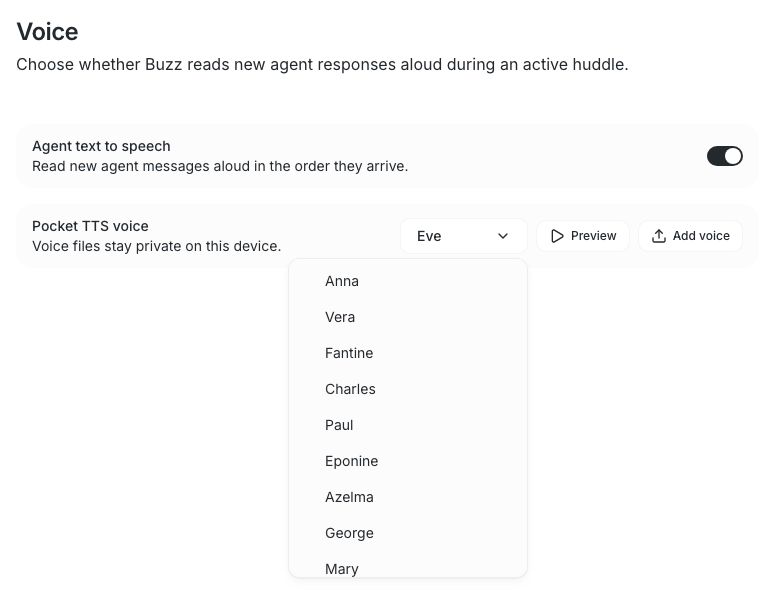 ## Reviewer-reproducible examples Create common-format fixtures and run them through the production importer: ```bash . ./bin/activate-hermit fixtures="$(mktemp -d)" ffmpeg -hide_banner -loglevel error -f lavfi -i "sine=frequency=220:duration=3" -ac 2 -ar 44100 "$fixtures/voice.wav" ffmpeg -hide_banner -loglevel error -i "$fixtures/voice.wav" -c:a aac "$fixtures/voice.m4a" ffmpeg -hide_banner -loglevel error -i "$fixtures/voice.wav" "$fixtures/voice.mp3" ffmpeg -hide_banner -loglevel error -i "$fixtures/voice.wav" "$fixtures/voice.flac" ffmpeg -hide_banner -loglevel error -i "$fixtures/voice.wav" -c:a libvorbis "$fixtures/voice.ogg" ffmpeg -hide_banner -loglevel error -i "$fixtures/voice.wav" -c:a pcm_s16be "$fixtures/voice.aiff" BUZZ_VOICE_IMPORT_TEST_DIR="$fixtures" \ cargo test -p buzz-voice imports_common_audio_format_fixtures -- --ignored --nocapture ``` Exercise import persistence, synthesis, deletion, and bundled-voice fallback with an installed Pocket model: ```bash BUZZ_POCKET_MODEL_DIR=/path/to/pocket-model-bundle \ cargo test -p buzz-voice --test pocket_import_audio \ objective_import_synthesis_delete_and_mary_fallback \ -- --ignored --nocapture ``` Exercise the native-picker boundary, selection, preview dispatch, deletion, cancellation, and invalid-file states: ```bash cd desktop pnpm build:e2e pnpm exec playwright test tests/e2e/voice-settings.spec.ts --project=smoke ``` --------- Signed-off-by: John Tennant <jtennant@block.xyz> Signed-off-by: John Tennant <johnmatthewtennant@gmail.com> Signed-off-by: John Tennant <jtennant@squareup.com> Signed-off-by: npub1qyvc0c5kl4gqv2fd97fsk46tu378sqgy35vc83rvgfwne90sel7s0ed67d <011987e296fd5006292d2f930b574be47c7801048d1983c46c425d3c95f0cffd@buzz.block.builderlab.xyz> Signed-off-by: npub12gtutshhh76rx0jx697f32f9tffd4hhp3hx58fp4x6u4uemkm7sqf8f757 <5217c5c2f7bfb4333e46d17c98a9255a52dadee18dcd43a43536b95e6776dfa0@buzz.block.builderlab.xyz> Co-authored-by: John Tennant <jtennant@block.xyz> Co-authored-by: npub1qyvc0c5kl4gqv2fd97fsk46tu378sqgy35vc83rvgfwne90sel7s0ed67d <011987e296fd5006292d2f930b574be47c7801048d1983c46c425d3c95f0cffd@buzz.block.builderlab.xyz> Co-authored-by: npub12gtutshhh76rx0jx697f32f9tffd4hhp3hx58fp4x6u4uemkm7sqf8f757 <5217c5c2f7bfb4333e46d17c98a9255a52dadee18dcd43a43536b95e6776dfa0@buzz.block.builderlab.xyz> |
||
|
|
61ba9dfaa0 |
refactor(voice): extract reusable Pocket primitives + Pocket voice settings (relands #2467 + #3208) (#3910)
Relands **#2467** (extract `buzz-voice` crate) and **#3208** (Pocket
voice settings) onto main, after #3266 and #3180 merged.
## Why a fresh PR
The repo is squash-only with delete-branch-on-merge. Squashing #3266
deleted `jtennant/pocket-tts-2026-04`, which was #2467's base — GitHub
auto-closed #2467 and it cannot be reopened. Squash merges also sever
ancestry, so GitHub's natural merge-base reports phantom conflicts for
the whole remaining stack.
## Content provenance
- Byte-identical to the blessed `jt/buzz-voice-refactor` branch
(`93029c577`, tree `6729e0eff` — reviewed by Dawn (#2467) and Max
(#3208) at exact heads) **except** the three files where #3180 and #3208
genuinely interact.
- Three-file resolution (union of both sides):
- `huddle/mod.rs` — #3180's pipeline re-exports + #3208's
`agent_tts_routing` imports.
- `huddle/state.rs` — `reset_preserving_generation` preserves both
`huddle_generation` (#3180) and `tts_enabled` (#3208); test sets merged
into one `tests` module.
- `desktop/src/testing/e2eBridge.ts` — both switch arms kept; no
duplicate case labels.
## Verification at
|


