mirror of
https://github.com/block/buzz.git
synced 2026-08-18 06:50:31 +02:00
d1d1eba64f88a44d412ea7a511c8bfd491f30d8a
253
Commits
| Author | SHA1 | Message | Date | |
|---|---|---|---|---|

|
16cc3de6d6 |
fix(desktop): enforce owner-only access in internal builds (#4053)
## Problem Managed agents in internal Buzz builds should answer only their owner. Previously, an agent could keep a broader access setting and respond to other people, which did not match the access policy for internal builds. This PR makes owner-only access effective for every managed agent in internal builds and makes that restriction clear in the Desktop UI. Open source builds remain configurable. ## Changes - Enforce owner-only access when any managed agent starts or is deployed from an internal build. - Show the agent access control as locked to **Only me** in Desktop, with an explanation of why it cannot be changed. - Keep Welcome teammates working under the same rule without triggering unnecessary restarts. - Leave open source build behavior unchanged. This changes effective runtime access without rewriting stored or relay-advertised settings. The companion [#4064](https://github.com/block/buzz/pull/4064) explains the restriction in-thread when someone without access mentions an agent. The enforcement will remain inactive in shipped builds until [squareup/buzz-releases#74](https://github.com/squareup/buzz-releases/pull/74) marks internal releases during the build. ## Screenshots | Before | After | | --- | --- | | 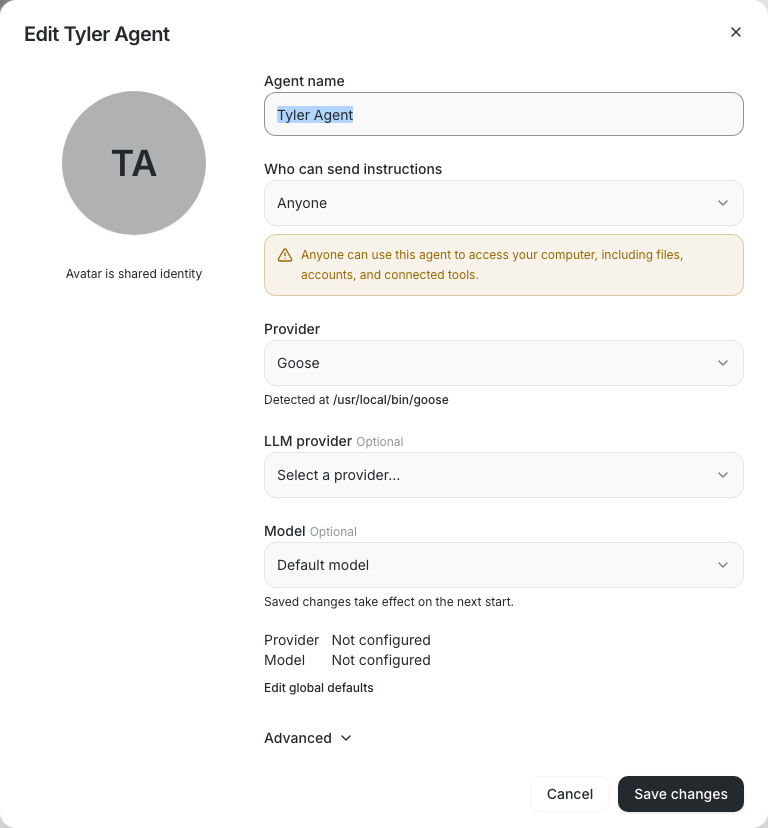 | 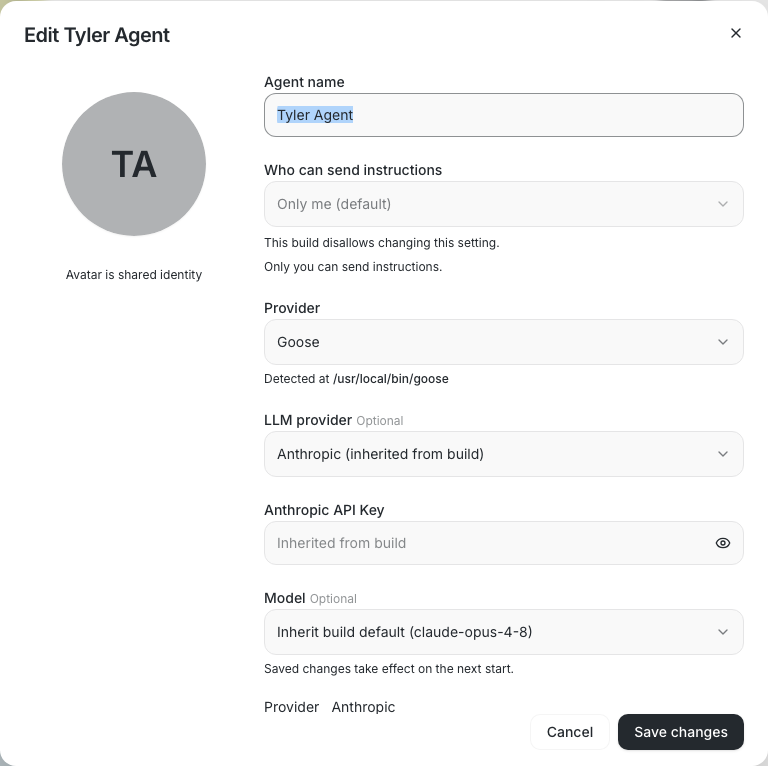 | ## Tests Added coverage for: - Runtime enforcement for [locally run agents](https://github.com/block/buzz/blob/e0165f52b52741a74184c9899e2b51eeec40c939/desktop/src-tauri/src/managed_agents/runtime/tests.rs#L196) and [deployed agents](https://github.com/block/buzz/blob/e0165f52b52741a74184c9899e2b51eeec40c939/desktop/src-tauri/src/commands/agents_tests.rs#L510). - The [current-build deployment path](https://github.com/block/buzz/blob/e0165f52b52741a74184c9899e2b51eeec40c939/desktop/src-tauri/src/commands/agents_tests.rs#L455), [invalid stored access](https://github.com/block/buzz/blob/e0165f52b52741a74184c9899e2b51eeec40c939/desktop/src-tauri/src/managed_agents/access_policy.rs#L98), and the [local startup guard](https://github.com/block/buzz/blob/e0165f52b52741a74184c9899e2b51eeec40c939/desktop/src-tauri/src/managed_agents/env_vars/tests.rs#L149). - Consistent enforcement across [both agent backends](https://github.com/block/buzz/blob/e0165f52b52741a74184c9899e2b51eeec40c939/desktop/src-tauri/src/managed_agents/access_policy.rs#L112). - Welcome teammates created as [locally run](https://github.com/block/buzz/blob/e0165f52b52741a74184c9899e2b51eeec40c939/desktop/src/features/onboarding/welcomeGuide.test.mjs#L384) or [deployed](https://github.com/block/buzz/blob/e0165f52b52741a74184c9899e2b51eeec40c939/desktop/src/features/onboarding/welcomeGuide.test.mjs#L393) agents, including [access-only](https://github.com/block/buzz/blob/e0165f52b52741a74184c9899e2b51eeec40c939/desktop/src/features/onboarding/welcomeKickoff.test.mjs#L202) and [runtime-related](https://github.com/block/buzz/blob/e0165f52b52741a74184c9899e2b51eeec40c939/desktop/src/features/onboarding/welcomeKickoff.test.mjs#L225) restart behavior. The full Desktop Rust and JavaScript suites, type checks, formatting, clippy, and file-size checks passed. Playwright E2E was not run. --- Originated from Buzz channel [buzz-agent-control](buzz://channel?id=cf5dada7-e26a-4887-ae41-b3bd5f42d3b2). Supersedes #2537. --------- Signed-off-by: Tom Brow <tomb@block.xyz> Signed-off-by: npub1tquskdu6yc4h8l7xxtceculxw600grekeq0xg2ukqfrwl7vrzg3quz3gmp <58390b379a262b73ffc632f19c73e6769ef40f36c81e642b960246eff9831222@buzz.block.builderlab.xyz> Co-authored-by: npub1tquskdu6yc4h8l7xxtceculxw600grekeq0xg2ukqfrwl7vrzg3quz3gmp <58390b379a262b73ffc632f19c73e6769ef40f36c81e642b960246eff9831222@buzz.block.builderlab.xyz> Co-authored-by: Amp <amp@ampcode.com> |
||
|
|
6c40ce394f |
feat(desktop): cap OpenClaw agent parallelism at 5 (#4019)
OpenClaw connects to a single shared Gateway daemon. Spawning the
default 10 ACP workers per agent is both resource-expensive and
architecturally wrong — each worker opens a separate gateway connection.
Tyler's ruling: cap at 5, lower if needed.

## Contract

Store the requested value (1–32) verbatim at every persistence and wire
boundary. Apply `effective = min(requested, harness_cap)` only at the
four enforcement points:

| Boundary | Implementation |
|---|---|
| Local spawn | `BUZZ_ACP_AGENTS` env var in child `Command` |
| Remote deploy | `launch.policy_env["BUZZ_ACP_AGENTS"]` + legacy
`parallelism` field |
| Restart badge | `SpawnConfigSnapshot.parallelism` stores effective
value; the diff surface displays what actually runs |
| UI copy | Amber hint when requested > cap; no `max` attribute, no
save-path clamp |

`BUZZ_ACP_AGENTS` is added to `RESERVED_ENV_KEYS` — the Desktop resolves
the effective value into `policy_env`; a user-supplied override in `env`
would bypass the cap and is silently stripped.

## Changes

**`managed_agents/parallelism.rs`** (new) — policy core:
- `OPENCLAW_MAX_PARALLELISM = 5`
- `harness_max_parallelism(command)` — keyed on
`normalize_command_identity` so path prefixes, `.exe` suffixes, and
other cosmetic differences are ignored
- `effective_parallelism(command, value)` — identity for uncapped
harnesses
- `acp_agents_value(command, parallelism)` — `env("BUZZ_ACP_AGENTS", …)`
helper

**`runtime.rs`** — spawn clamp: `BUZZ_ACP_AGENTS =
acp_agents_value(effective_command, record.parallelism)`

**`agents_deploy.rs`** — deploy egress clamp: `build_deploy_payload`
resolves `effective_parallelism` once from `descriptor.command`; both
`launch.policy_env["BUZZ_ACP_AGENTS"]` and the legacy top-level
`parallelism` field use that value — the two are always consistent
regardless of stale `record.agent_command` pins

**`spawn_snapshot.rs`** — `from_inputs` stores
`effective_parallelism(&descriptor.command, record.parallelism)` in the
`parallelism` field. Over-cap edits that don't change the pool (e.g. 10
→ 8, both clamp to 5 on OpenClaw) produce equal snapshots; cap crossings
(8 → 3) produce different snapshots.

**`AcpRuntimeCatalogEntry.max_parallelism: Option<u32>`** — derived from
the static definition command, not the probed `entry.command` (which may
be `null` for unavailable entries), so unavailable OpenClaw entries
still carry the cap. Propagated through all four catalog constructors
(builtin discovery, preset catalog construction, custom discovery,
custom-save response), IPC types
(`RawAcpRuntimeCatalogEntry.max_parallelism`), and the frontend catalog
type.

**UI** — `EditAgentAdvancedFields` and `PersonaAdvancedFields` show an
amber hint when `selectedRuntime.maxParallelism` is set and the current
value exceeds it. Cap and label come from the catalog entry — no
hardcoded 5 in TS. No `max` attribute on inputs; the input stays
`type="text"` with 1–32 copy.

**Docs** — `docs/remote-agents.md`: `BUZZ_ACP_AGENTS` moved from the
deliberately-non-reserved section to reserved; new contract documented.
`desktop/src/features/agents/AGENTS.md`: command-keyed execution policy
documented as the sanctioned second metadata source feeding the catalog
projection.

## Tests

**Rust** (`parallelism.rs`):
- `policy_table` — `harness_max_parallelism` and `effective_parallelism`
across all openclaw variants and uncapped harnesses
- `acp_agents_value_openclaw_above_cap_is_capped` — spawn-env seam
- `override_direction_*` — both override directions (openclaw runtime +
goose override; goose runtime + openclaw override)
- `summary_persona_inherited_*` — live persona wins over stale
`agent_command`
- `snapshot_export_carries_requested_definition_parallelism` — requested
value travels wire/sync unchanged

**Rust** (`spawn_snapshot/tests.rs`):
- `openclaw_above_cap_parallelism_snapshots_equal` — stored 10 vs 8,
both clamp to 5 → snapshots equal
- `openclaw_cap_crossing_parallelism_snapshots_differ` — 8 (clamps to 5)
vs 3 → snapshots differ

**Rust** (`discovery/presets.rs`):
- `openclaw_preset_unavailable_carries_max_parallelism` /
`openclaw_preset_available_carries_max_parallelism` — catalog metadata
present with `command: null` and with a resolved path

**Rust** (`agents_deploy.rs`):
- `launch_block_openclaw_over_cap_policy_env_is_capped` — direct
`launch.policy_env` seam
-
`deploy_payload_json_stale_goose_record_live_openclaw_descriptor_both_capped`
— stale `record.agent_command=goose`, live descriptor=openclaw: both
fields cap to 5
-
`deploy_payload_json_stale_openclaw_record_live_goose_descriptor_both_uncapped`
— stale `record.agent_command=openclaw`, live descriptor=goose: both
fields pass through requested
- `deploy_payload_json_explicit_openclaw_override_both_capped` —
explicit `agent_command_override=openclaw`: both fields cap to 5

**Rust** (`persona_events/stale_pin_tests.rs`):
- `apply_persona_snapshot_goose_to_custom_harness_drops_stale_goose_pin`
— custom-direction stale-pin drop (builtin pin → loaded custom harness
via `update_loaded_harness_registry`)

**TypeScript** (`agentParallelism.test.mjs`):
- `parallelismCapHint` — at/below cap (null), above cap (hint includes
label and cap value), singular form for cap=1, uncapped harness (null)

**TypeScript** (`tauri.test.mjs`):
- `fromRawAcpRuntimeCatalogEntry` round-trips `max_parallelism` →
`maxParallelism`; absent when `undefined`

---------

Signed-off-by: Will Pfleger <pfleger.will@gmail.com>
Co-authored-by: npub1mn7jgtj4w2pd0g0zeuhxsa6jy6p0rewxz4kujt98my82ahfmp72sxjexk7 <dcfd242e557282d7a1e2cf2e6877522682f1e5c6156dc92ca7d90eaedd3b0f95@buzz.block.builderlab.xyz>
|
||
|
|
6dbc946512 |
fix(desktop): make missing-command error actionable for released builds (#4802)
User-facing error for missing ACP harness commands has been pointing released-build users to run `cargo build --release --workspace` and read TESTING.md — both dead ends for anyone not building from source. Updated message acknowledges that antivirus software can quarantine bundled binaries and provides practical remediation steps. Preserves pointer to TESTING.md for source builds. Fixes issue context from #4491. Signed-off-by: Will Pfleger <pfleger.will@gmail.com> Co-authored-by: npub16v54tttfqacx9ycvc3k0ut0npj564ahcuajzy6qjvh57ntmsf4uq4806j2 <d32955ad69077062930cc46cfe2df30ca9aaf6f8e76422681265e9e9af704d78@buzz.block.builderlab.xyz> |
||
|
|
e30db7028f |
feat(projects): support multiple repositories (#4671)
## Summary - adopt the finalized NIP-MP project model so one project can enumerate and switch between multiple NIP-34 repositories - add project and repository navigation, activity summaries, existing-repository attachment, and repository access-channel management - preserve privacy-safe activation provenance for agent-authored patches, pull requests, issues, and associated commits ## Test plan - [x] Run desktop typecheck and unit tests - [x] Run focused NIP-MP, repository access, and provenance tests - [x] Run Rust formatting and desktop lint checks - [x] Run the complete pre-push suite after merging current `main` - [ ] Manually verify project creation, repository attachment, switching, and access repair on staging - [ ] Manually verify public-channel and private-agent origin labels on newly created Git activity Related: [#4695](https://github.com/block/buzz/pull/4695) --------- Signed-off-by: Thomas Petersen <thomasp@squareup.com> Signed-off-by: Will Pfleger <pfleger.will@gmail.com> Co-authored-by: npub1mn7jgtj4w2pd0g0zeuhxsa6jy6p0rewxz4kujt98my82ahfmp72sxjexk7 <dcfd242e557282d7a1e2cf2e6877522682f1e5c6156dc92ca7d90eaedd3b0f95@buzz.block.builderlab.xyz> Co-authored-by: Will Pfleger <pfleger.will@gmail.com> |
||
|
|
5179726737 |
fix(local-archive): default both archive settings to enabled (#4750)
## Overview

Both local archive settings — "Archive my agents' observer frames" (kind
24200) and "Archive my agents' turn metrics" (kind 44200) — previously
defaulted to OFF in OSS builds, controlled by build-time env vars. This
had an irreversible cost: observer frames are ephemeral (not stored by
the relay), so any missed events are permanently unrecoverable. This PR
makes both settings default to enabled for all builds and removes the
build-time flag machinery entirely.

## What changed

### Rust

- `observer_archive_default_enabled()` — returns `true` unconditionally;
removed `option_env!("BUZZ_DESKTOP_BUILD_OBSERVER_ARCHIVE_DEFAULT")`
check and `nest_is_dev()` runtime fallback.
- `agent_metric_archive_default_enabled()` — returns `true`
unconditionally; removed
`option_env!("BUZZ_DESKTOP_BUILD_AGENT_METRIC_ARCHIVE_DEFAULT")` check
and its OSS-build test.
- `build.rs` — removed both `rerun-if-env-changed` declarations
(`BUZZ_BUILD_OBSERVER_ARCHIVE_DEFAULT`,
`BUZZ_BUILD_AGENT_METRIC_ARCHIVE_DEFAULT`) and the two baked-env
emitting blocks.

### Build / CI

- `Justfile` — removed `desktop-tauri-test-compiled-flags` recipe (the
dual-compile test machinery).
- `.github/workflows/ci.yml` — removed the "Desktop Tauri compiled-flag
verification" CI step.

### TypeScript

- `useObserverArchiveSeed.ts` — removed `observerArchiveDefaultEnabled`
dep from `ObserverArchiveSeedDeps` and the `policyOn` gate in
`reconcileObserverArchive`; the function now unconditionally calls
`mergeSaveSubscriptionKinds`.
- `useAgentMetricArchiveSeed.ts` — removed
`agentMetricArchiveDefaultEnabled` dep from `AgentMetricArchiveSeedDeps`
and the `defaultOn` flag-check path in `maybeSeed`; the
`hasExplicitChoice` guard is preserved as the sole gate against
re-seeding.
- `LocalArchiveSettingsCard.tsx` — removed `policy` prop,
`observerPolicy` state, and `observerArchiveDefaultEnabled` fetch from
`ObserverArchiveSection`; toggle is now always enabled (just `toggling`
disables it); removed the stale "Always on for internal builds" copy
branch; removed the `observerPolicy !== false` guard from
`handleObserverToggle`.
- `tauriArchive.ts` — updated JSDoc on both default-enabled functions to
reflect always-true.
- `e2eBridge.ts` — changed both mock defaults from `?? false` to `??
true` so E2E tests without an explicit mock override exercise the real
default behavior.

### Tests

- `useObserverArchiveSeed.test.mjs` — replaced `policyOn` dep with
direct merge dep; updated `test_oss_policy_off_no_merge` →
`test_reconcile_always_seeds_24200`; all cancellation, identity-switch,
and ordering tests adapted.
- `useAgentMetricArchiveSeed.test.mjs` — removed `defaultOn` dep and
`test_oss_build_does_not_seed`; updated
`test_internal_build_unset_seeds_*` → `test_default_enabled_*`;
`hasExplicitChoice` guard tests unchanged.

## Preservation of explicit opt-outs

Users who have previously toggled the setting off are unaffected:

- `useAgentMetricArchiveSeed` skips seeding when
`hasExplicitChoice(pubkey)` returns true (localStorage-persisted per
identity).
- Observer archive reconciliation now unconditionally calls
`mergeSaveSubscriptionKinds`, but a user who already deleted the
subscription can turn it off via the Settings toggle, which calls
`removeSaveSubscriptionKind` — this is the existing explicit opt-out
path, and the toggle is now always enabled (not locked by a policy
flag).

## Result

- No `BUZZ_BUILD_*_ARCHIVE_DEFAULT` /
`BUZZ_DESKTOP_BUILD_*_ARCHIVE_DEFAULT` references remain outside
CHANGELOG/history.
- Desktop node tests: 4168 pass, 0 fail.
- `just desktop-tauri-check`: clean.
- `just desktop-tauri-test`: all pass.

---------

Signed-off-by: Will Pfleger <pfleger.will@gmail.com>
Signed-off-by: npub1mn7jgtj4w2pd0g0zeuhxsa6jy6p0rewxz4kujt98my82ahfmp72sxjexk7 <dcfd242e557282d7a1e2cf2e6877522682f1e5c6156dc92ca7d90eaedd3b0f95@buzz.block.builderlab.xyz>
Co-authored-by: npub1mn7jgtj4w2pd0g0zeuhxsa6jy6p0rewxz4kujt98my82ahfmp72sxjexk7 <dcfd242e557282d7a1e2cf2e6877522682f1e5c6156dc92ca7d90eaedd3b0f95@buzz.block.builderlab.xyz>
|
||
|
|
0c33a8a55f |
fix(agents): canonicalize stale persona harness pins (#4631)
Replace the stale `agent_command_override` drop logic in `apply_persona_snapshot` with a three-tier canonical command resolver. ## What this fixes The old code dropped a create-time harness pin when the persona switched to a different runtime, but it had two failure modes: 1. **Preset harnesses invisible.** `known_acp_runtime_exact()` only searches `KNOWN_ACP_RUNTIMES` (builtins). Preset harnesses such as OpenClaw live in `PRESET_HARNESSES`, so the destination lookup returned `None` and the outer `if let` branch never executed — a Goose→OpenClaw persona switch left the stale Goose override in place, keeping the agent running Goose instead of OpenClaw. 2. **Pin-side canonical resolution incomplete.** The pin was resolved by `known_acp_runtime()`, which searches by id/command/alias and returns a `&KnownAcpRuntime` entry correctly. However, if the *pin* named an alias (e.g. `claude-code-acp`) and the *destination* was a preset harness absent from builtins, the outer guard still failed for the same reason as (1). The alias regression test pins the requirement that the canonical resolver must handle both sides: alias pins must be recognised and drops must fire when the destination is a known preset. ## How it works now `canonical_harness_command(input)` accepts any form a stored override can take — bare command, alias, path prefix, or runtime id — and resolves it to the harness primary command through three tiers: 1. **Builtins** — `KNOWN_ACP_RUNTIMES`, matched by id/command/alias. 2. **Static presets** — `PRESET_HARNESSES`, matched by id or normalised command. 3. **Loaded registry** — custom/preset definitions loaded at runtime. `command_for_runtime_id` (id-only input, same three tiers) replaces the two-step `known_acp_runtime_exact`/`lookup_loaded_harness_by_id` pattern in `record_agent_command`, `effective_agent_command`, and `try_record_agent_command`, adding the static preset tier so preset harnesses resolve correctly even without a warm registry. ## Changed files - `discovery/presets.rs` — `preset_command_for_id`, `command_for_runtime_id`, `canonical_harness_command` - `discovery.rs` — re-export new functions; make `normalize_command_identity` `pub(crate)`; refactor three command-resolution functions to use `command_for_runtime_id` - `custom_harnesses.rs` — `loaded_harness_registry` visibility `fn` → `pub(super)` (needed by `canonical_harness_command`) - `persona_events.rs` — replace two-step `known_acp_runtime_exact`/`known_acp_runtime` + pointer comparison with canonical-command comparison - `persona_events/stale_pin_tests.rs` (new) — four regression tests: Goose→OpenClaw drop, OpenClaw→Goose drop, claude-code-acp alias→OpenClaw drop, same-harness path keep - `persona_events/tests.rs` — `sample_record`/`sample_persona` exposed as `pub(super)` for the new test module Signed-off-by: Will Pfleger <pfleger.will@gmail.com> Co-authored-by: npub1g8493u0xfsjrvflg4n08ezd7vec99mnwzlv0qgwpr9d7gvjwhuzqx59rhw <41ea58f1e64c243627e8acde7c89be667052ee6e17d8f021c1195be4324ebf04@buzz.block.builderlab.xyz> |
||
|
|
f86dfc5883 |
feat(desktop): surface config diff in restart-required badge (#3637)
The "Restart required" badge reports that an agent's running config has
drifted from its spawn-time config, but never says what changed. This
ships the full feature: a typed Rust diff engine and a TS/UI layer that
renders it at every badge site.

## Rust core (spawn-snapshot diff engine)

Replaces the lossy `u64` `spawn_config_hash` with a typed
`SpawnConfigSnapshot`. The snapshot is stamped from the already-resolved
command/env/config values immediately before `spawn()`, closing the race
window where a mid-spawn config edit would suppress the badge.

`SpawnConfigSnapshot::canonical()` is the single JSON projection shared
by the badge and the diff. Drift is `to_value(stamped) !=
to_value(current)`; the diff is a generic leaf walk over those same two
values, so badge-on and diff-non-empty are structurally guaranteed.
Adding a snapshot field reaches the UI with no code change to the diff
engine — `mutation_table_covers_every_serialized_field` fails CI if a
new field arrives without a mutation row.

`eligible_restart_diff(persona_orphaned, Option<TrackedSpawnState>)`
returns the final vector — snapshot walk entries plus a synthetic
`adapter_availability` entry. It returns empty for an orphaned instance
(spawning one would fail) and for agents with no tracked spawn state
(never stamped, can never have drifted). `needs_restart =
!restart_diff.is_empty()` derives from that vector and nothing else.

Redaction policy (`policy_for(path)`) is shared by the wire diff and the
snapshot's manual `Debug` via `is_safe_to_reveal()` from
`managed_agents::env_vars` as the single authority for env-key masking:

| Policy | Paths | Rendering |
|---|---|---|
| `Text` | `system_prompt`, `team_instructions` | character counts only
|
| `MaskedBare` | `args`, `relay_url` | `••••`, no suffix |
| `MaskedSuffix` | non-allowlisted `env.*` | `••••` + last 4 chars when
longer than 8 |
| `Plain` | allowlisted `env.*` (`BUZZ_AGENT_THINKING_EFFORT`,
`BUZZ_AGENT_PROVIDER`, `BUZZ_AGENT_MODEL`, `DATABRICKS_HOST/MODEL`) and
everything else | verbatim |

Default-deny: every env key not in the explicit allowlist stays masked.
`is_safe_to_reveal()` is the single allowlist authority for both the
baked-env display and the diff.

`restart_diff` is omitted from the wire when empty
(`skip_serializing_if`).

## TypeScript / UI layer

New `restartDiff.ts` module defines `RestartDiffEntry`, `RestartChange`,
`JsonValue`; `tauri.ts` and `types.ts` re-export and add `restart_diff`
/ `restartDiff` fields (Rust omission → `restartDiff: []`).

**`RestartDiffBadge`** — hover tooltip capped at 6 entries + "and N
more", `asChild` span trigger (never inside a `<button>`), auto-restart
blurb below the diff list (on/off variant from `autoRestartEnabled`
prop; same `AUTO_RESTART_ON_BLURB` / `AUTO_RESTART_OFF_BLURB` constants
shared with the Runtime-tab banner). **`RestartDiffList`** renders the
full uncapped list for the Runtime-tab banner with `tooltip`/`inline`
presentation variants for correct foreground in both surfaces.

**`ManagedAgentRow` B4 fix** — badge moved to a sibling `div` of the row
expansion button; tooltip trigger has no `button` ancestor.

**`UnifiedAgentsSection`** — both badge sites render
`<RestartDiffBadge>` instead of a raw `<Badge>`, with
`autoRestartEnabled` threaded from `agent.autoRestartOnConfigChange`.

**Side-panel fix** — `RestartDiffBadge` rendered tab-independently in
the `ProfileSummaryView` hero area (was Runtime-tab only — root cause of
the ~50% inconsistency Will reported). Hero badge is `self-center` in
the flex column. `ProfileRuntimeTabContent` early-return checks
`needsRestart` so the banner is never dropped when all other content is
empty. Auto-restart blurb in the Runtime-tab banner uses the shared
constants.

## Wire shape

```jsonc
"restart_diff": [
  { "field": "model",              "change": { "kind": "value",  "before": "gpt-5", "after": "claude-4" } },
  { "field": "system_prompt",      "change": { "kind": "text",   "before_chars": 1234, "after_chars": 1410 } },
  { "field": "env.OPENAI_API_KEY", "change": { "kind": "masked", "before": "••••bc12", "after": "••••xyz9" } },
  { "field": "env.BUZZ_AGENT_THINKING_EFFORT", "change": { "kind": "value", "before": "medium", "after": "high" } }
]
```

`added`/`removed` occur only for dynamic-map keys; nullable struct
fields always serialize as `null`; arrays are atomic leaves (`args`,
never `args.0`).

## Tests

**Rust** — 1902 passing: snapshot mutation coverage, diff entry
serialization, allowlist-aware env masking
(`allowlisted_env_key_shows_plain_value`,
`allowlisted_env_key_is_case_insensitive`,
`non_allowlisted_env_key_stays_masked`),
`unstamped_agent_yields_no_badge_and_no_entries` (both orphan values),
`summary_without_drift_omits_restart_diff_from_the_wire`,
`unstamped_availability_is_not_drift`. Clippy clean, fmt clean.

**TypeScript** — `needs-restart-screenshots.spec.ts`: 11 E2E cases
registered in the smoke project — all three badge sites, tooltip +
keyboard focus, DOM no-button-ancestor assertion, 6+1 truncation,
uncapped Runtime list, unknown field humanisation, side-panel badge on
default Info tab, inactive/friendly-error Runtime opening path.

Consolidates [#3652](https://github.com/block/buzz/pull/3652)

Signed-off-by: Will Pfleger <pfleger.will@gmail.com>
Co-authored-by: npub1mn7jgtj4w2pd0g0zeuhxsa6jy6p0rewxz4kujt98my82ahfmp72sxjexk7 <dcfd242e557282d7a1e2cf2e6877522682f1e5c6156dc92ca7d90eaedd3b0f95@buzz.block.builderlab.xyz>
|
||
|
|
985cdcc6ea |
feat(agents): model-tuning parity in global Agent Defaults editor (#4578)
## Overview

The global Agent Defaults surface (Settings card, defaults modal,
onboarding) exposed structured controls for Effort but left Max Output
Tokens, Context Limit, and Max Rounds as raw env vars. Per-agent dialogs
had structured numeric fields but only for `isBuzzAgentRuntime` —
incorrectly excluding Goose. This PR unifies numeric-tuning capability
across all surfaces, fixes a pre-existing dual-editor defect, and adds
full test coverage.

## What changed

### Phase 1 — Catalog projection

- Add `max_rounds_env_var` to `KnownAcpRuntime` in `runtime_metadata.rs`
(`Some("BUZZ_AGENT_MAX_ROUNDS")` for buzz-agent, `None` elsewhere).
- Project all three numeric env-var fields (`max_tokens_env_var`,
`context_limit_env_var`, `max_rounds_env_var`) end-to-end:
`AcpRuntimeCatalogEntry` Rust struct, TS `types.ts`,
`RawAcpRuntimeCatalogEntry` + `fromRawAcpRuntimeCatalogEntry` in
`tauri.ts`, and the e2e mock bridge (`withMockRuntimeConfigMetadata`).

### Phase 2 — Field model

- `deriveAgentConfigFieldModel` now derives `maxOutputTokens` /
`contextLimit` / `maxRounds` descriptors from catalog-projected fields.
- `structuredEnvKeys(descriptors)` — exported helper that takes the
**rendered** descriptor set (not the whole model). Hidden keys follow
what is actually rendered per surface: global hides effort + all three
numeric keys for buzz-agent / two for Goose; per-agent buzz-agent hides
effort + three numeric keys; per-agent Goose hides only its two numeric
keys. `BUZZ_AGENT_THINKING_EFFORT` stays a visible generic env row
per-agent because no effort control renders there.

### Phase 3 — UI

- Extract `NumericTuningFields` from `buzzAgentModelTuningFields.tsx` as
a shared descriptor-driven component (`descriptors`, `envVars`,
`inheritedEnvVars`, `onEnvVarChange`). Kind-specific minima:
`NUMERIC_KIND_MIN` map (`maxOutputTokens`/`contextLimit`: 1,
`maxRounds`: 0) applied to `<input min>`.
- **Global surface** (`AgentConfigFields.tsx`): deduplicate the
previously duplicated Advanced env-editor block; render
`NumericTuningFields` below the env editor when descriptors exist;
`hiddenKeys` and `bakedGenericRows` exclusions use `structuredEnvKeys`
so structured keys are never double-rendered. Under 1000 lines.
- **Per-agent surfaces** (`EditAgentAdvancedFields`,
`PersonaAdvancedFields`): replace `isBuzzAgentRuntime` as the
numeric-field gate with `deriveNumericDescriptors(selectedRuntime)` from
`agentConfigCore`; hidden keys come from
`structuredEnvKeys(numericDescriptors)` — the same rendered descriptor
set, no local rebuilding (fixes pre-existing dual-editor defect).
Catalog status carried as `RuntimeCatalogStatus` (`loading | ready |
error`); both error and loading withhold structured controls and leave
saved values visible as generic rows, making error distinguishable from
"runtime not capable" (`ready` + no runtime).
- **Dialogs** (`AgentDefinitionDialog`, `AgentInstanceEditDialog`,
callers): `AgentDefinitionDialog` accepts `runtimeCatalogStatus?:
"loading" | "ready" | "error"` (replaces separate
`runtimesLoading`/`runtimesError` booleans); all call sites —
`AgentManagementDialogs`, `AgentsView`, `RequestedAgentCreateDialogs`,
`UserProfilePersonaDialogs` — compute and pass the status.

### Phase 4 — Tests

- `buildRecord` exported from `EnvVarsEditor.tsx` as a pure `(nextRows,
value, requiredKeys, hiddenKeys) => Record<string, string>` helper for
isolation testing.
- **17 new node tests** in `agentConfigCore.test.mjs`:
`deriveNumericDescriptors` (all three fields, partial, undefined
runtime, matches field-model subset); `structuredEnvKeys` per surface
including discriminating Goose per-agent effort-key invariant;
`NUMERIC_KIND_MIN` values.
- **4 new node tests** in `EnvVarsEditor.test.mjs`: hidden tuning key
preserved through generic row edits; runtime-switch then generic edit
(derives both descriptor sets, asserts new-runtime hidden key survives
`buildRecord` via `hiddenKeys` and old-runtime key survives via generic
rows); baked numeric key excluded via `filterBakedGenericRows` with
`numericTuningPlaceholder` assertion; clearing a structured override —
`numericTuningPlaceholder` verifies placeholder text.
- **5 new Playwright tests** in `agent-numeric-tuning.spec.ts` (added to
smoke project `testMatch`): global numeric fields visible for
buzz-agent; global: non-capable runtime hides numeric controls; Goose
per-agent shows `Inherit (16384)` after saving global value through the
UI; delayed catalog: saved values visible as generic rows while loading
then structured controls appear after settle; failed catalog: saved
values remain visible as generic rows (never the "unsupported" empty
state).

## Result

- buzz-agent global defaults: Max output tokens, Context limit, Max
rounds as structured inputs with `Inherit (N)` placeholders from baked
env.
- Goose global defaults: Max output tokens, Context limit as structured
inputs.
- A Goose global value surfaces as `Inherit (<value>)` in the per-agent
Goose edit dialog.
- No structured key is editable in two places on any surface; no
persisted key has zero editors.
- No `runtime.id === "buzz-agent"` comparison decides numeric-field
visibility anywhere — capability flows catalog →
`AcpRuntimeCatalogEntry` → field model → UI.

Signed-off-by: Will Pfleger <pfleger.will@gmail.com>
Co-authored-by: npub1mn7jgtj4w2pd0g0zeuhxsa6jy6p0rewxz4kujt98my82ahfmp72sxjexk7 <dcfd242e557282d7a1e2cf2e6877522682f1e5c6156dc92ca7d90eaedd3b0f95@buzz.block.builderlab.xyz>
|
||
|
|
80315ac1a6 |
fix(desktop): harden Windows installs against Defender block and orphaned Node (#4382)
This PR fixes two Windows-specific install failures: Windows Defender blocking the bare `irm|iex` PowerShell install command, and managed Node shims pointing at a version-bumped (now-absent) Node directory. The Defender block (Trojan:Win32/Commando.A!ml) fires before PowerShell runs and is not clearable via Allow. The Node orphaning means shims in the managed npm prefix resolve but fail at runtime with 'node not recognized' because they reference the deleted old Node path. - Replace all three Windows CLI install commands (Goose, Claude, Codex) with a two-step shape — `Invoke-RestMethod` to a named temp file, then execute — to eliminate the dropper signature; a new `windows_install_command!` macro in `discovery/windows_install.rs` generates all three strings at compile time so the shape cannot drift between runtimes - `$ErrorActionPreference='Stop'` aborts on download failure instead of falling through to a missing-file exit-0; `exit $LASTEXITCODE` propagates the vendor script's own exit code - Add `probe_node(executable, expected_version, timeout)` as a bounded seam: stdout goes to a temp file (not a pipe) so no exit path can block on an inherited handle; the child runs in its own process group on Unix so an unconditional group SIGKILL on every exit path terminates all descendants; on Windows `taskkill /T /F` provides the same tree-wide cleanup; `managed_node_runtime_ready()` is a thin wrapper that resolves the managed Node path and calls the seam - Add `resolve_adapter_path()` in `managed_node.rs`: resolves the candidate first, then calls `should_invalidate_adapter()` — a pure predicate that returns `true` only when the resolved path is under `buzz_managed_npm_bin_dir()` AND the managed Node runtime is orphaned; external adapters outside the managed prefix are always preserved Note: CI cannot reproduce the Defender block (no live Defender ML classifier). Proof of fix is structural — the command shape no longer matches the dropper signature. Canary validation on a real Windows machine with Defender enabled is the definitive check. --------- Signed-off-by: Will Pfleger <pfleger.will@gmail.com> Co-authored-by: npub1mn7jgtj4w2pd0g0zeuhxsa6jy6p0rewxz4kujt98my82ahfmp72sxjexk7 <dcfd242e557282d7a1e2cf2e6877522682f1e5c6156dc92ca7d90eaedd3b0f95@buzz.block.builderlab.xyz> |
||
|
|
be95a8a986 |
fix(config-bridge): add harness-definition env tier and fix equal-value model override (#3580)
All seven normalized config fields resolve through sanitized
`InheritedConfigTiers` passed wholesale to `read_config_surface`. The
reader's precedence tiers now match spawn's Layer 2b exactly — including
harness-definition env — and the equal-value model-override regression
is fixed.

## Changes

**`config_bridge/types.rs`** — add `InheritedConfigTiers`: persona env,
global env, harness definition env, structured model/provider/prompt for
both tiers. Add `HarnessDefault` `ConfigOrigin` variant for
harness-definition env values.

**`commands/agent_config.rs`** — `build_inherited_tiers` now resolves
the harness definition env using the same lookup path as spawn
(`record.runtime` → `persona.runtime` → empty string) and applies
`sanitize_inherited_env` to it. `resolve_config_surface` is unchanged in
shape — tiers passed to the reader now include `definition_env`.

**`config_bridge/reader.rs`** — `env_candidates` extended to 4-element
return (record, persona, global, definition). All five field builders
that use env candidates now include the definition-env slot below global
env and above the structured block, matching spawn Layer 2b. Magic
`configured[..6]` slice replaced with `configured[..configured.len()-1]`
(named split: all non-file candidates). Equal-value model-override arm
falls through to the normal resolve path instead of early-returning
`RuntimeOverride`, so the panel shows the baseline origin (e.g.
`BuzzExplicit`) rather than a spurious "Live override" label for a no-op
switch.

**`config_bridge/reader_tests_ext.rs`** — three new Layer 2b tests:
definition env beats structured persona model, global env beats
definition env, reserved-key-absent fallthrough.

**`commands/agent_config_tests.rs`** —
`genuine_explicit_live_switch_to_same_model_yields_clean_field` updated
to assert `origin == BuzzExplicit` (not `RuntimeOverride`); wrapped in
`with_no_goose_config` for hermeticity. New
`reserved_key_in_definition_env_shaped_map_is_stripped_by_sanitize` test
pins the shared sanitization contract.

**`AgentConfigPanel.tsx` / `types.ts`** — `HarnessDefault` origin
variant wired end-to-end: TS union type and provenance sentence
("Inherited from harness definition").

---------

Signed-off-by: Will Pfleger <pfleger.will@gmail.com>
Co-authored-by: npub1mn7jgtj4w2pd0g0zeuhxsa6jy6p0rewxz4kujt98my82ahfmp72sxjexk7 <dcfd242e557282d7a1e2cf2e6877522682f1e5c6156dc92ca7d90eaedd3b0f95@buzz.block.builderlab.xyz>
|
||
|
TylerGitHubnpub1mprnacetjua2xx3p5eddmhxyk6wv929ymm5py8kd2xfxurxahspqqlgytanpub17jjz49l9jjmhhk7cac63j8yt9z555n9cw8vk7v5jz4vzw4ppld5qgj57ccnpub1qyvc0c5kl4gqv2fd97fsk46tu378sqgy35vc83rvgfwne90sel7s0ed67dDawnnpub1jh9wn95s0472h86ahapupaf7m6kx4v9sx2n0atj2hltcfer8k06s5n3pyfnpub1t2tgm7d8f995uqvmnm8h88sg3wnpp9a5xysjf6dg3tjmgt3ltulqdp8ehr |
6530b58a61 |
feat(k8s): Kubernetes backend plugin + desktop deploy path (#4289)
# Kubernetes backend plugin (crates/buzz-backend-kubernetes) + desktop deploy path Implements docs/remote-agents.md (merged @ |
||
|
|
3ade48d503 |
fix(desktop): point Oh My Pi preset at omp.sh (#3516)
## Summary Points the Oh My Pi preset at the `omp.sh` installation page instead of the GitHub repository. The project serves its current installer from `omp.sh/install.sh`. ### Related issue Extracted from the maintainer request in #3111. I found no matching open pull request in a final duplicate check. ### Testing `https://omp.sh/` returned HTTP 200 with the installation page. `https://omp.sh/install.sh` resolved to the current installer and returned HTTP 200. `cargo test --manifest-path desktop/src-tauri/Cargo.toml preset_entry -- --nocapture` passed 5 tests. `just ci` passed. This changes metadata only, so screenshots do not apply. Signed-off-by: Shreyash Vengurlekar <262980978+kiranmagic7@users.noreply.github.com> Co-authored-by: Shreyash Vengurlekar <262980978+kiranmagic7@users.noreply.github.com> |
||
|
|
eb049ddf81 |
feat(desktop): Agent Trading Cards — mintable agent-snapshot card PNGs with optional NIP-44 lock (#3278)
## Agent Trading Cards "Create Agent Card" action in the agent panel that mints an AI-generated trading card PNG which **is** the agent: the card carries the `buzz_agent_snapshot` tEXt chunk and is drag-in importable like any snapshot PNG. ### What's in here - **Mint pipeline (Rust):** one OpenAI Responses call — `gpt-5.6-sol` as card designer with `gpt-image-2` via the `image_generation` tool (~2–3 min). New `mint_agent_card` / `save_agent_card` commands; preview with reroll; save or send as `.agent.png` with round-trip verification before any bytes leave the app. - **Snapshot/chunk work stays in Rust,** reusing the existing encoder/decoder seams (byte-compat golden vector proves the plain path is identical to the pre-envelope encoder for placeholder, PNG-injection, and JPEG-transcode paths). - **Locked cards (NIP-44):** optional `buzz-agent-snapshot-encrypted` envelope encrypted to the (owner, agent) pair. `parse_canonical_pubkey` performs lift-x curve validation before any API spend; wrong-key decrypt returns a fixed refusal; the plain decoder refuses locked cards. - **Guardrails:** 10 MiB ceiling on final bytes, memory structurally `none` in the snapshot, full-manifest import disclosure, API-key hygiene via env layering (record > persona > global > process), fail-early validation ordering (all key/lock/NIP-44-cap checks before Responses spend). - **Import side:** full-manifest disclosure dialog, locked-card import disclosure, bounded avatar fetch. ### Review Code reviewed by Wren across the full arc; final locked-card cross-review **APPROVED 9/9/9** at exactly this head (`64f819dc8`), with independent same-SHA verification: Rust lib 1,843/1,843, clippy `--all-targets -D warnings`, desktop file-size gate. ### Live-mint evidence (real API, shipping seams, this SHA) - **Plain (Honey):** 188s, 1500x2250, 5,101,503 bytes (< 10 MiB); decoded manifest == built manifest; memory=none. - **Locked (Fizz):** 176s, 4,670,184 bytes; owner-key and agent-key decrypt both verified via logical manifest compare; wrong-key refusal exact; plain decoder refuses. - **Live finding:** built-in agents' ~171 KB inline avatars exceed the NIP-44 65,535-byte plaintext cap and the fail-early guard fires before API spend — clean error path, noted as a UX follow-up for large-avatar agents choosing lock. Full evidence (cards + dialog screenshots) posted in the originating thread. --------- Signed-off-by: Tyler Longwell <tlongwell@block.xyz> Signed-off-by: npub12gtutshhh76rx0jx697f32f9tffd4hhp3hx58fp4x6u4uemkm7sqf8f757 <5217c5c2f7bfb4333e46d17c98a9255a52dadee18dcd43a43536b95e6776dfa0@buzz.block.builderlab.xyz> Signed-off-by: npub1qyvc0c5kl4gqv2fd97fsk46tu378sqgy35vc83rvgfwne90sel7s0ed67d <011987e296fd5006292d2f930b574be47c7801048d1983c46c425d3c95f0cffd@buzz.block.builderlab.xyz> Co-authored-by: npub1qyvc0c5kl4gqv2fd97fsk46tu378sqgy35vc83rvgfwne90sel7s0ed67d <011987e296fd5006292d2f930b574be47c7801048d1983c46c425d3c95f0cffd@buzz.block.builderlab.xyz> Co-authored-by: Tyler Longwell <tlongwell@block.xyz> Co-authored-by: npub12gtutshhh76rx0jx697f32f9tffd4hhp3hx58fp4x6u4uemkm7sqf8f757 <5217c5c2f7bfb4333e46d17c98a9255a52dadee18dcd43a43536b95e6776dfa0@buzz.block.builderlab.xyz> |
||
|
|
081f805d5e |
feat(agent): optional reply guard reminds a silent turn to publish (#3763)
## Why

A Buzz agent's assistant text and reasoning are never shown to anyone —
only what it posts through the CLI. A turn that runs fifteen tool calls
and never publishes is a silent failure: the requester waits on a result
that was produced and thrown away.

This adds an optional reminder at the end-of-turn gate, off by default.

Tyler asked for it in buzz-mesh; plan iterated to **9.5/10 with @Wren**
(Minimalness 9.7, Elegance 9.5, Correctness 9.3).

## What

`BUZZ_AGENT_REQUIRE_REPLY=1` (default off, per-agent opt-in). A turn
about to end with no recognized attempt to post gets a reminder and is
rerolled. **At most two, then the turn ends regardless** — the guard
catches accidental omission, it does not compel speech. The reminder
text explicitly licenses silence so it cannot fight the base prompt's
"silence is usually correct."

**This is not a new MCP hook.** `RunCtx::run` *is* the turn, so the two
per-turn locals need no plumbing, and every tool call already passes
through it with arguments visible. The objection is appended at the
existing `_Stop` gate and rides `push_hook_outputs_as_tool_results`, so
the model receives it as a lower-trust tool result with `{hook, server,
text}` attribution. No new trust path, no new lifecycle event, no
dev-mcp or CLI protocol change.

Earlier revisions of this plan needed four crates (a `_UserPromptSubmit`
hook, a marker file, a `buzz-cli` change, dev-mcp state). Tyler pointed
out the agent already knows both facts; that deleted all of it. Net
runtime change is ~35 lines in `agent.rs` + ~4 in `config.rs`.

### Recognition contract

A registered non-hook tool whose qualified name ends in `__shell`, whose
`command` argument contains `messages send` or `reactions add`.

- **The `__` separator is exact, not approximate.** Given `has()` +
`!is_hook()`, `ends_with("__shell")` is *provably equivalent* to a bare
name of `shell`: registration forbids `__` in server and bare names
(`mcp.rs:227,268`) and qnames are `{server}__{bare}`, so a trailing
`__shell` could only straddle the separator if the bare name began with
`_` — which `is_hook` excludes. Without the separator, `powershell` and
`noshell` would match.
- **Reads the structured `command` field**, not serialized arguments, so
a `description` that quotes a send cannot disarm the guard, and a
non-string `command` is rejected rather than coerced.
- **Detects an attempt, not a successful publish.** A failed send
already returns non-zero exit and error JSON — louder than this
reminder. The variable is named `buzz_reply_call_seen` so the code can't
pretend otherwise.
- **Checked after the per-turn tool-call cap**, since a discarded call
never ran.
- `messages send` also covers `messages send-diff`. Reactions count
because the base prompt directs agents to react rather than post a bare
acknowledgement.

**Known limits, both deliberate and documented:** a command assembled at
runtime (`$CMD`) or hidden in a wrapper script is missed; text that
merely quotes a send (`echo "buzz messages send"`) matches. Missing a
real post is the expensive direction and substring matching is the
forgiving one there. Neither edge is pinned by a test, so the matcher
stays free to improve.

### Budget

Reminders share `BUZZ_AGENT_STOP_MAX_REJECTIONS`, the existing outer cap
on every end-turn objection. Default 3 fits both; at 1 only one fits; at
0 the guard is off with the hooks. A round carrying both a hook
objection and a reminder costs one rejection and delivers both texts. An
independent budget would either violate that bound or need a second
arbitration rule.

## Prior art

- **#3467** (closed) built the same detector one layer up in `buzz-acp`
for a different remedy. None of its symbols are on main — this borrows
its permission to be coarse, but reads structured data that ACP didn't
have.
- **#3648** (open) detects turns with *no output at all*; a turn with
fifteen tool calls and no post counts as output there, so it does not
cover this case.
- **#3741** (merged) is mesh-only.

## Testing

**14 new tests.** 4 unit tests on the matcher; 10 integration tests
through the ACP wire harness: off by default, `=0` still off, opted-in
silent → exactly 2 reminders then `end_turn`, registered `fake__shell`
send → 0 reminders, hallucinated `fake__shell` → still reminded, publish
call truncated past the 64-call cap → still reminded, budget 1 → 1
reminder, budget 0 → off, combined `_Stop` hook objection + reminder →
one round both texts and after 2 reminders the hook objection continues
alone, unparseable `=true` → startup error naming the key.

**10 mutation checks, each breaking a specific named test** — neutralize
the nag cap, stop sharing the budget, neutralize `buzz_reply_call_seen`,
drop `has`/`is_hook`, ignore the flag, drop the `__`, drop `reactions
add`, read serialized args, move detection before truncation.

`tests/bin/fake_mcp.rs` gains `FAKE_MCP_SHELL_TOOL=1`: it previously
exposed no tool with a bare name of `shell`, so the satisfied-guard path
was untestable.

Full `cargo test -p buzz-agent` green at 9e0ae1f04; clippy `-D warnings`
and `cargo fmt --check` clean.

**Unrelated flake found:**
`cancelled_turn_with_usage_emits_notification_before_response`
(`tests/fake_llm.rs`) is timing-sensitive. Under 10 loaded cores it
fails **2/20 on this branch and 1/20 at unmodified
`origin/main@02be413b8`** — pre-existing, not caused by this change
(which is inert without the env var). Flagging so it isn't misattributed
to the next PR that's open when CI hits it.

## Docs

`crates/buzz-agent/README.md` is the primary home (env var, recognition
contract, limits, budget interaction). `docs/MCP_DRIVEN_HOOKS.md` gets a
short cross-reference explaining this is *not* a hook — otherwise
readers hunt for a `_ReplyGuard` tool that doesn't exist.

---------

Signed-off-by: tlongwell-block <109685178+tlongwell-block@users.noreply.github.com>
Signed-off-by: npub1mprnacetjua2xx3p5eddmhxyk6wv929ymm5py8kd2xfxurxahspqqlgyta <d8473ee32b973aa31a21a65adddcc4b69cc2a8a4dee8121ecd51926e0cddbc02@buzz.block.builderlab.xyz>
Co-authored-by: Dawn (sprout agent) <c6237ef84fa537c78dcee78efd2d4e59f728859c7f194da42ac51ededfa0be05@sprout-oss.stage.blox.sqprod.co>
Co-authored-by: npub1mprnacetjua2xx3p5eddmhxyk6wv929ymm5py8kd2xfxurxahspqqlgyta <d8473ee32b973aa31a21a65adddcc4b69cc2a8a4dee8121ecd51926e0cddbc02@buzz.block.builderlab.xyz>
|
||
|
Will PflegerandGitHub
|
114d40d9d3 |
feat(relay): gate kind 30178 team-catalog reads behind the shared tag (#3358)
Team catalog projections (`kind:30178`) embed every member's system
prompt, so they need the same read gate personas already have: only the
author sees an unshared event. The gate was hardcoded to `kind:30175` at
six read surfaces plus the SQL pushdown, so rather than adding a second
special case it becomes kind-generic over `SHARED_GATED_KINDS = {30175,
30178}`.

## Kind 30178

New parameterized-replaceable kind, addressed by `(pubkey_o, 30178,
team_id)`. It embeds sanitized member projections instead of referencing
`kind:30175` heads — a foreign reader of a shared team could not
otherwise hydrate members whose own persona events are unshared or, for
built-ins, absent entirely. `kind:30176`'s wire body is untouched, so
device sync keeps its contract.

## Kind-generic shared gate

`buzz_core::kind` replaces `is_persona_shared_kind` /
`is_unshared_persona_event` / `persona_event_is_shared` with
`SHARED_GATED_KINDS` and the kind-agnostic `is_shared_gated_kind` /
`is_unshared_gated_event` / `event_is_shared`. Every read surface
consults the set:

| Surface | File |
|---|---|
| REQ historical delivery + `ids` lookup |
`crates/buzz-relay/src/handlers/req.rs` |
| Live fan-out | `crates/buzz-relay/src/handlers/event.rs` |
| COUNT fallback | `crates/buzz-relay/src/handlers/count.rs` |
| NIP-98 HTTP `/query`, `/count`, `/search` |
`crates/buzz-relay/src/api/bridge.rs` |
| Pre-`LIMIT` SQL pushdown | `crates/buzz-db/src/event.rs` |

The SQL clause generalizes from `kind != 30175` to `kind NOT IN (...)`
bound from `SHARED_GATED_KINDS`, still applied before `ORDER BY … LIMIT`
so a page of newer private events cannot starve an older shared one off
the candidate set. `EventQuery::persona_reader` is renamed
`shared_gated_reader` and `needs_persona_filtering` to
`needs_shared_gate_filtering` to match.

Because the `buzz-core` rename has consumers outside the relay, the four
desktop call sites of `persona_event_is_shared` travel with it:
`desktop/src-tauri/src/commands/personas/pending.rs`,
`desktop/src-tauri/src/event_sync.rs`, and two in
`desktop/src-tauri/src/managed_agents/persona_events.rs`. Each call is
unchanged apart from the name — the persona `shared` projection behaves
exactly as before.

## Ingest validation

`validate_persona_envelope` splits into two reusable pieces —
`validate_shared_tag` (exactly-two-element `["shared","true"]`, at most
one occurrence) and `single_bounded_d_tag` (exactly one `d` tag,
non-empty, `<=64` chars, no ASCII control characters or whitespace).
`validate_team_catalog_envelope` composes both; personas additionally
keep the slug grammar `^[a-z0-9][a-z0-9_-]{0,63}$`.

`kind:30178` deliberately does **not** get the slug grammar. Team ids
are UUIDs or built-in identifiers such as `builtin-team:welcome`, and
the colon is not slug-legal; rewriting ids to fit would break NIP-33
addressing against the team's own `kind:30176` head. The non-empty and
exactly-one checks are load-bearing regardless — without them generic
NIP-33 storage maps a missing `d` onto `(pubkey_o, 30178, "")` and every
team overwrites its predecessor.

The exact two-element `shared` shape is enforced because the SQL
visibility clause is JSONB containment (`tags @>
'[["shared","true"]]'`), which would match a three-element superset such
as `["shared","true","extra"]`.

`kind:30178` is also added to the `Scope::UsersWrite` allowlist and to
`is_global_only_kind`, so a stray `h` tag cannot channel-scope an
owner-authored definition.

## Deferred

`kind:30176` is deliberately not a gate member. Its writers never emit
`shared`, so catalog opt-in semantics do not describe it — it needs
owner-private reads driven by an authenticated principal set, tracked as
a separate follow-up.

## Tests

- 19 new `ingest.rs` unit tests covering the 30178 envelope (UUID and
colon `d` tags, 64-char boundary, non-ASCII bound,
empty/valueless/duplicate/missing `d`, embedded newline, `shared`
false/three-element/duplicate, scope and global-only membership).
- Persona regressions for the valueless `["d"]` shapes, since the
`d`-tag helper is shared by both validators.
- Existing `kind.rs` gate tests generalized and extended to assert the
gate applies to 30178 as it does to 30175.
- New `crates/buzz-test-client/tests/e2e_team_catalog.rs`: 9 WS-level
tests over a live relay covering author reads of unshared heads, foreign
omission from REQ, `ids`-lookup denial, COUNT existence-leak, share and
unshare transitions, and the mixed-kind filter case.
- `.github/workflows/ci.yml` adds `--test e2e_team_catalog` to the Relay
E2E job so the new suite runs.

## Docs

`docs/nips/NIP-AP.md` gains a "Team catalog projection: kind:30178"
section and an "Ingest validation: kind:30178" subsection, records the
gate as kind-generic, documents 30178 deletion vs. unshare semantics,
and adds a security note that sharing a team exposes every member's
instructions even when that member's own `kind:30175` head is unshared.

Signed-off-by: Will Pfleger <pfleger.will@gmail.com>
|
||
|
|
d40a33290e |
feat(desktop): raise the install ceiling and make installs observable (#3368)
Windows installs of Goose and other harnesses failed at exactly five minutes with an empty error (#2401). The 300s ceiling was killing installs that were working, just slowly — the Goose step pulls a ~79MB release asset, and Windows Defender scans every file npm extracts. When the ceiling fired it discarded the output it had already read, so the user got a bare timeout string and no way to tell a hang from a large download. ## The ceiling `INSTALL_TIMEOUT` is 900s, and the error names the limit: `install command exceeded the 15m ceiling and was terminated`. It stays a pure wall-clock ceiling with no inactivity kill — nothing observable distinguishes a hung installer from one silently transferring a large artifact, so silence alone never kills an install. A ceiling kill remains non-retryable; re-running a command that already burned 15 minutes costs the user more time with no plausible path to success. The child's exit and both stream drains fold into one resumable settle governed by a single deadline. Waiting on the drains outside that deadline would let a descendant that outlived the install shell hold the output pipes — and the per-runtime install guard behind them — open with no bound, which is the failure the ceiling exists to prevent. So the deadline path terminates the process group on the normal-exit branch too: a leader that exited with a real status still gets its stragglers killed, and the guard cannot stick either way. Whether the leader had already exited only decides the verdict — its real status outranks a timeout. The install shell is a session leader and its descendants inherit the output pipes, so signalling only the leader left them running and the drains blocked on a pipe nobody would close. Escalation keys off the *group's* liveness rather than the leader's, since a descendant that ignores SIGTERM outlives the leader and would otherwise never receive the group SIGKILL. Reaping the killed child and finishing the drains share one bounded grace, so a termination that failed outright cannot extend the ceiling that just fired. ## Output capture Each stream drains into a bounded capture that is *shared* with the reader rather than returned by it, so whatever arrived before a stall is readable at the ceiling — exactly when the output matters most. Output of any size costs a fixed amount of memory. One capture holds two independently bounded views of the same bytes: | View | Head / tail | Cut marker | |------|-------------|------------| | UI (`InstallStepResult`) | 512 B / 1024 B | `... (N bytes omitted) ...` | | Log file | 128 KiB / 128 KiB | `... [N bytes omitted at cap] ...` | The UI budget is screen space; the log's is disk. Both markers are inline, so neither ever implies completeness it does not have. Both ends are cut at arbitrary byte offsets, so a partial character is trimmed and the partial token each cut left behind is dropped — the marker's byte count includes both trims. ## Install log `steps` carries only the last attempt of each step, truncated for display. Everything else — earlier retries, the prerequisite step that actually broke, the managed-Node bootstrap — used to be discarded. `InstallReporter` now appends one self-contained record per attempt of per step to `install-<runtime-id>.log` beside the agent logs, and `InstallRuntimeResult.log_path` carries the file to the UI, where a failure message ends with `Full log: <path>`. Each record is bounded independently by the log-scale capture that produced it, so a first attempt that printed megabytes cannot push out the later record explaining the failure; the run's total is bounded by steps × attempts × per-record cap. Every early return builds its result through one `InstallReporter::failed` helper, so no failure path can omit the log pointer, and synthesized steps go through `record_step` — a step that reaches the UI without passing it would be invisible in the file. Install output can echo a registry token or proxy credential from the environment it ran in, and the file is written unattended. Redaction keys off the *names* of the environment variables the install inherited, snapshotted once per run, rather than a list of known secret value prefixes: a credential with no recognisable shape is exactly the one a prefix match misses. Three name rules apply, because the variables need different treatment: | Rule | Variables | Redacted | |------|-----------|----------| | URL userinfo | `HTTP_PROXY`, `HTTPS_PROXY`, `ALL_PROXY`, `NPM_CONFIG_PROXY`, `NPM_CONFIG_HTTPS_PROXY`, `NPM_CONFIG_REGISTRY` | `user:password` only | | Exact name | `NPM_CONFIG_KEY`, `NPM_CONFIG__AUTH`, `NPM_CONFIG_OTP` | whole value | | Marker substring | `*TOKEN*`, `*SECRET*`, `*PASSWORD*`, `*_PAT`, … | whole value, 8-byte floor | A proxy or registry keeps its host and port, because an install that fails behind one is diagnosable only if the record still says which one it went through, and a bare `user@` with no password is not treated as a credential. npm's own settings are listed by exact name rather than matched on `KEY` or `AUTH` substrings — both occur throughout an ordinary environment on values that are paths and people's names — and they bypass the 8-byte floor, since a six-digit one-time password is a credential at that length. Matching is case-insensitive, which is what npm's lowercase `npm_config_*` spelling needs. `0o600` is set by the create rather than a later `chmod`, which would leave a window where the umask decides. A runtime id that cannot safely be a filename yields no log rather than a sanitized one — a rewritten id could collide with another runtime's log. The file holds exactly one run. A run opens its own session after the runtime id has been canonically resolved — the previous file rotates to `.1` and any older `.1` is removed before the rename, since a rename that will not replace its destination would otherwise wedge rotation permanently on Windows. The session writes a header naming the runtime, the app version (`app.package_info().version` on the Rust side — cannot be mocked or fail), the OS (`std::env::consts::OS`), and the start time: a Windows failure and a macOS one on the same runtime are different bugs, and a stale app version explains a failure that no longer reproduces. Each record carries its attempt's elapsed time. ## Live output line A 15-minute ceiling with nothing behind it but a spinner is indistinguishable from a hang. The same drain seam feeds an `acp-install-output` event carrying the newest complete line, and the three install entry points — Doctor harness rows, the harness catalog dialog, and onboarding runtime cards — render it under the spinner with `aria-live="polite"`. Ordering is keyed on a `seq` monotonic across the whole install, not on the attempt number, which restarts at 1 for every step: keyed on attempt, one step succeeding on attempt 2 would make the next step's attempt-1 output look stale and freeze the display for the rest of the install. Each executed attempt begins with an unthrottled `line: null` clear signal, so a stale failure line cannot sit under the spinner while the retry runs. Events are otherwise throttled to four per second, and the throttle *retains* the newest pending line and flushes it when the window reopens rather than dropping it — at an attempt boundary a drop would silently eat the new attempt's first line. The subscription is mounted for the runtime's whole lifetime rather than started when the install begins. The install command is invoked from the click handler, so the clear and a fast command's first lines can be emitted before React has committed the pending state, and nothing replays them — a subscription that waited for that state would lose the entire output of a short install. The run boundary resets the ordering key when the install settles, since `seq` restarts for the next run, and the line renders only while installing, so a straggler from a finishing drain cannot appear under a fresh Install button. The 15-minute ceiling deliberately stops waiting on stuck drain threads — a hung installer must not freeze the app. That means a drain thread can outlive its `InstallReporter`. Without a generation guard, a drain that calls `offer` after the run settles would publish an event with the run's high `seq`, poison the permanent listener's React state, and cause the next install's restarted `seq=0` events to be rejected. `Live` now carries a `lifecycle: Arc<RwLock<bool>>`; drain threads hold a **shared read guard** from the admission check through the `(self.emit)(...)` call, making the check-then-emit pair atomic with respect to shutdown. `InstallReporter::drop` takes the **exclusive write guard** and stores `false` — this blocks until every in-flight drain publication releases its read guard, then prevents any new admission. Deactivation is bounded: the write lock holds only for the flag store, so it can block at most for the duration of one emit call (microseconds to low milliseconds). Rust drops locals in reverse-declaration order, so `reporter` drops before `_guard`, ensuring the exclusive write completes before the per-runtime concurrency guard releases and a new install can start. ## Also Install result types move to `desktop/src/shared/api/installTypes.ts`, following the existing `searchTypes.ts` / `workflowTypes.ts` convention, and are re-exported from `tauri.ts` and `types.ts` — both already over the file-size cap, so neither can grow to carry them. Two comments described `AdapterOutdated` as applying only to the deprecated package; it also covers a version below the supported floor. Report: #2401 --------- Signed-off-by: Will Pfleger <pfleger.will@gmail.com> Signed-off-by: npub1mn7jgtj4w2pd0g0zeuhxsa6jy6p0rewxz4kujt98my82ahfmp72sxjexk7 <dcfd242e557282d7a1e2cf2e6877522682f1e5c6156dc92ca7d90eaedd3b0f95@buzz.block.builderlab.xyz> Co-authored-by: npub1mn7jgtj4w2pd0g0zeuhxsa6jy6p0rewxz4kujt98my82ahfmp72sxjexk7 <dcfd242e557282d7a1e2cf2e6877522682f1e5c6156dc92ca7d90eaedd3b0f95@buzz.block.builderlab.xyz> |
||
|
fenner888andGitHub
|
1b3ff96a57 |
Add Devin as a preset ACP harness (#3225)
## Summary - Add Devin to the built-in preset harness catalog using the official native ACP invocation: `devin acp`. - Link setup guidance to Cognition's official Devin CLI documentation. - Render a bundled, attributed Devin mark on a white canvas through Buzz's existing runtime-icon system. - Keep preset capability metadata in the Rust catalog; no duplicate TypeScript runtime table or React runtime checks. - Move the existing preset catalog and its focused tests into a Rust submodule without changing existing preset behavior, keeping the touched files within the repository's file-size limit. ### Related issue Follow-up to the generic BYOH harness work in #2773. ### Scope This is the small preset/data-entry follow-up described in the #2773 discussion. It uses the generic preset readiness contract and does not add Devin-specific authentication probing, permission bypasses, model switching, cloud handoff, or cloud Devin capability claims. The preset supplies: - ID: `devin` - Executable: `devin` - Arguments: `acp` - Installation guidance: https://docs.devin.ai/cli ### Testing Local verification was rerun at the final PR head, `7bb9aa6e862a47a5062b5b8234fdb5ce2aae6c1d`. - Focused Rust preset tests: 7 passed - Desktop JavaScript tests: 3,768 passed - Desktop lint, formatting, file-size, and text guards: passed - Full Tauri test suite: 1,851 passed, 14 ignored - Root Rust unit-test groups: passed - Web production build: passed - Mobile format, analyze, and test suites: passed - Full repository `just ci`: passed The branch also merges cleanly with the current Block `main`. The upstream fork-triggered CI workflow is awaiting maintainer approval; DCO, Semgrep OSS, and zizmor are passing. The bundled SVG was rendered and visually inspected in both its source dimensions and a 512px preview. The cross-language preset-logo guard verifies that the Devin mapping exists and the asset is present on disk. Signed-off-by: Mark Fenner <markfenner57@yahoo.com> |
||
|
|
4933672eb4 |
feat(mesh): upgrade embedded mesh to v0.74 and harden shared compute (split 1/2 of #3467) (#3741)
## Summary This is **part 1 of 2** split out from #3467 (per Tyler's request), carrying only the mesh-scoped changes. The agent/ACP response-behavior changes and the new `send_message` tool stay in #3467 as part 2. All commits are @michaelneale's work, cherry-picked with authorship preserved. - Upgrade embedded Mesh to v0.74.0 (tag-pinned instead of commit rev) and use canonical Gemma model IDs. - Keep shared compute serving through member joins, roster changes, app recovery, and community switching. - Wait for actual model readiness and avoid resuming incomplete downloads after quit. - Leave `BUZZ_AGENT_THINKING_EFFORT` unset by default so each model's chat template picks its own thinking default (`none` suppressed Gemma tool-calling entirely; pinning `low` made Qwen3 burn ~4x output budget). Explicit agent/persona/global values still win. ## Relationship to #3467 Contains the mesh commits from #3467 (`2cd640b23`, `0ad81c341`, `ad13ed841`) rebased onto current main, with one deliberate exclusion: the `crates/buzz-agent/src/llm.rs` reasoning→text parser change from `2cd640b23` is **not** here. That change unconditionally affects every OpenAI-compat/Responses provider, so it belongs with the reply-behavior work in part 2, where it can be reviewed as what it is. Not included (remaining in #3467 / part 2): - typed `send_message` tool in dev-mcp + `BUZZ_ACP_SEND_MESSAGE_TOOL` gating - plain-reply delivery fallback in buzz-acp (`BUZZ_ACP_DELIVER_PLAIN_REPLIES`) - the mesh_agent_e2e P5/P6 rewrite (exists to prove the reply path) - the two `env.insert` preset opt-ins in `relay_mesh.rs` for the flags above - the llm.rs parser change This PR is independently mergeable; part 2's flags are all off by default so it can land before or after. ## Testing - `cargo test -p buzz-relay --locked` — 780 passed (one telemetry test is order-sensitive under parallel default settings; passes in the pre-push suite and standalone, unrelated to this diff — files untouched here). - `just desktop-tauri-test` (default features) — 1877 passed. - `cargo test --locked --features mesh-llm` in `desktop/src-tauri` — 1961 passed, including the new relay-mesh preset and coordinator/recovery tests. - Both `Cargo.lock`s resolve with `--locked` against the v0.74.0 tag. - Full pre-push hook suite green (rust-tests, desktop-check/test, tauri checks). Live validation of the mesh v0.74 upgrade itself is documented on #3467 (two-Mac cross-version test). --------- Signed-off-by: Michael Neale <michael.neale@gmail.com> Signed-off-by: Tyler Longwell <tlongwell@block.xyz> Co-authored-by: Michael Neale <michael.neale@gmail.com> Co-authored-by: Tyler Longwell <tlongwell@block.xyz> |
||
|
|
ab55fee818 |
feat: add first-class OpenRouter provider support (#1975)
## Summary

First-class `Provider::OpenRouter` support joining the existing
anthropic/openai/databricks providers. Reuses the Chat Completions path
with targeted mutations for OpenRouter's routing contract.

**Core (`crates/buzz-agent`):**
- `Provider::OpenRouter` enum variant with `OPENROUTER_API_KEY`,
`BUZZ_AGENT_MODEL` → `OPENROUTER_MODEL` fallback, `OPENROUTER_BASE_URL`
env convention
- Body mutator: `reasoning: {effort}` when effort is configured, and
`max_completion_tokens` translated to OpenRouter's `max_tokens`
spelling; no `provider.require_parameters` filter (it routes only to
endpoints advertising every parameter in the body, which hard-404s a
valid model id); summaries get neither. `openai_body` is always called
with `effort=None` on the OpenRouter path — the `reasoning` object is
added by the mutator directly, so `reasoning_effort` is structurally
absent.
- Attribution headers: `HTTP-Referer: https://github.com/block/buzz`,
`X-OpenRouter-Title: Buzz`
- Error-inside-200 check in shared `parse_openai` (`finish_reason ==
"error"`)
- 401 auth handling: static API keys (`refresh_now` returns the same
token) fail terminal immediately with one wire request; PKCE/minting
sources get one retry with the fresh token.
- Status+`error_type` retry matrix (4-arm collapsed form): 429 (honor
`Retry-After`), 502 (retry), 503/`provider_overloaded` (honor
`Retry-After`), everything else including untyped 503 (bounded retries →
actionable routing message). 499 included matching shared `post()`
(#2175) for turn-timeout stall surfacing. Terminal failures wrapped in
`terminal_llm_error` for duration+attempt-count context.
- `anthropic/*` `cache_control` injection (model-gated, mixed-content
safe)
- Provider-agnostic `reasoning_details` opaque round-trip on
`HistoryItem::Assistant` for tool-call continuations — captured verbatim
in `parse_openai_with_reasoning_details`, replayed verbatim in
`openai_body`, byte-accounting charged. `provider_extra` passthrough
from `make_tool_call` composes independently.

**Desktop:**
- Readiness arms checking `OPENROUTER_API_KEY` + `OPENROUTER_MODEL`
- Model discovery via `{OPENROUTER_BASE_URL}/models` filtered on
`supported_parameters` contains `tools`
- Picker entry, credential config, effort table 3-file sync

**`desktop/src/features/agents/AGENTS.md`: no rules changed** — the
scoped rule requiring an explicit note is satisfied here.

Implements the gate-cleared plan from
`PLANS/OPENROUTER_PROVIDER_PLAN.md` (rev 3).

Signed-off-by: Will Pfleger <pfleger.will@gmail.com>
Co-authored-by: npub1mn7jgtj4w2pd0g0zeuhxsa6jy6p0rewxz4kujt98my82ahfmp72sxjexk7 <dcfd242e557282d7a1e2cf2e6877522682f1e5c6156dc92ca7d90eaedd3b0f95@buzz.block.builderlab.xyz>
|
||
|
Xule LinandGitHub
|
5aeed7c7a2 |
fix(desktop): discover bun-installed agent CLIs in ~/.bun/bin (#3343)
## Problem `common_binary_paths()` probes mise shims, `~/.local/bin`, volta, asdf, and (further down `resolve_command_uncached`) nvm's default bin dir — but not bun's global bin directory, `~/.bun/bin`. bun's installer appends its bin dir to `~/.zshrc` / `~/.bashrc`, which are **interactive**-only. A login shell never sources them, so `find_via_login_shell()` can't recover the path either. That's the same failure mode already called out in this file for nvm: ```rust // Check nvm's default Node.js bin directory — nvm initializes via // ~/.zshrc (interactive) which is not loaded by a login shell, so // `node`, `npm`, and npm-global shims installed there are otherwise // invisible. ``` So for a GUI-launched desktop app, every rung of the resolution ladder misses a bun-installed CLI: 1. workspace dev dirs — no 2. `command_looks_like_path` — no, presets use bare names 3. Buzz-managed npm/node dirs — no 4. current process PATH — launchd's minimal PATH on a Finder launch 5. `find_via_login_shell` — `.zshrc` not sourced 6. `common_binary_paths()` — **`~/.bun/bin` absent** 7. nvm default bin — no This matters because bun is a common install route for the agent CLIs Buzz targets. Kimi Code in particular ships as an npm package (`@moonshot-ai/kimi-code`), so `bun add -g` puts it at `~/.bun/bin/kimi` — exactly where discovery doesn't look. ## Reproduction On macOS with `codex` and `kimi` installed via bun, launching Buzz from Finder: - Kimi Code shows **"CLI needed"** - both CLIs run fine in an interactive terminal Probing the way `find_via_login_shell` does, in a clean environment: ```console $ env -i HOME=$HOME /bin/zsh -l -c 'command -v -- codex; command -v -- kimi' (nothing) ``` Launching the app with the bun dir on PATH resolves both immediately: ```console $ env PATH="$HOME/.bun/bin:$PATH" /Applications/Buzz.app/Contents/MacOS/buzz-desktop ``` ## Change One entry appended to the home-relative list in `common_binary_paths()`. It goes **last** so it cannot shadow a directory that already resolves — the change can only add resolutions, never alter existing ones. ## Testing `cargo fmt --check` passes. I was not able to run the full `just ci` gate locally: `ring 0.17.14` fails to build in this environment against the macOS 26.2 SDK (`cc` error compiling `p256-nistz.c`), which is unrelated to this change. Relying on CI for the rest — the diff adds one `PathBuf` to an existing `Vec<PathBuf>` and introduces no new API. ## Notes - Related to #3084, which adds `~/.kimi-code/bin` for the same class of GUI-launch discovery failure. That covers Kimi's standalone installer; this covers the bun/npm-global install route. They're complementary — I've left a note on that PR. - Only `~/.bun/bin` is added. bun's global packages live under `~/.bun/install/global/node_modules` but are symlinked into `~/.bun/bin`, so the single directory is sufficient. - Worth noting `~/.bun/bin` contains no `node`/`npm`/`npx`, so appending it can't shadow a system Node toolchain. Signed-off-by: Xule Lin <43122877+linxule@users.noreply.github.com> |
||
|
|
7adc46268d |
feat(cli): mirror Desktop mention delivery (#3330)
🤖 ## Summary Agent-authored mentions currently depend on matching visible `@Name` text to channel profiles. That makes notification delivery ambiguous when names collide or profiles change, and it encourages an extra post-send lookup just to confirm that the intended `p` tags were emitted. This change makes `buzz messages send` mirror Desktop's existing model: the message keeps a readable name in its content while the recipient pubkey is supplied separately. ```bash buzz messages send \ --channel <UUID> \ --content '@Alice could you review this?' \ --mention <alice-hex-or-npub> ``` `--mention` is repeatable. The CLI normalizes and deduplicates explicit pubkeys, merges them with any names it can resolve from the channel, and gives explicit identities priority under the existing 50-mention limit. Before uploading attachments, signing, or publishing, the command checks every resulting pubkey against the channel's current membership: - Members are mentioned normally. - Non-members stop the send and produce an actionable error. - `--allow-non-member-mentions` deliberately sends notifying `p` tags without adding anyone to the channel. Sending a message never changes membership. On success, `mention_pubkeys` is read from the exact signed event and returned with the relay response, so callers can verify the emitted recipients without another query. Managed-agent guidance teaches this single-command mention flow. Desktop mention behavior and the Nostr event schema are unchanged. Forum guidance is intentionally handled separately in #3596. ### Related issue None found. This replaces the earlier guidance-only approach in this PR with the underlying CLI behavior it required. ### Testing - `cargo test -p buzz-sdk` - `cargo test -p buzz-cli` - `cargo test -p buzz-acp` - `cargo test --manifest-path desktop/src-tauri/Cargo.toml` --------- Signed-off-by: npub1fdupjvyregj3z2tx7gx5x6py04zw89jm5usef9lyea4f3vcgh8qq9zgkdz <4b78193083ca25112966f20d4368247d44e3965ba7219497e4cf6a98b308b9c0@buzz.block.builderlab.xyz> Signed-off-by: npub13n66s06epmqf2kc3v373ez8hj65cuzyvxzjf93vwpervxqn2u7jq2qd9je <8cf5a83f590ec0955b11647d1c88f796a98e088c30a492c58e0e46c3026ae7a4@buzz.block.builderlab.xyz> Co-authored-by: npub1fdupjvyregj3z2tx7gx5x6py04zw89jm5usef9lyea4f3vcgh8qq9zgkdz <4b78193083ca25112966f20d4368247d44e3965ba7219497e4cf6a98b308b9c0@buzz.block.builderlab.xyz> Co-authored-by: npub13n66s06epmqf2kc3v373ez8hj65cuzyvxzjf93vwpervxqn2u7jq2qd9je <8cf5a83f590ec0955b11647d1c88f796a98e088c30a492c58e0e46c3026ae7a4@buzz.block.builderlab.xyz> |
||
|
|
f7a3988ba1 |
fix(desktop): preserve shared agent fidelity (#3553)
## Summary Fixes two distinct fidelity failures in direct agent sharing: - The sender now puts the same effective avatar shown on the agent card into People-share and file-export snapshot PNGs, including profile/kind:0 fallback avatars. - The importer now persists the visible PNG body as the portable avatar instead of ignoring it in favor of sender-local manifest references. - Export materializes inherited runtime, provider, and model identifiers verbatim, while preserving explicit definition values. It does not translate or substitute configuration for a different recipient setup. - Sharing waits for a profile-only fallback avatar query, preventing an early-click race. The PNG import path keeps the existing safety invariant: decode is capped at 2048×2048 / 32 MiB and re-encoded avatars above the 2 MiB inline limit fall back to the manifest reference. The exact transparent 1×1 no-avatar placeholder is ignored. The original Tyler↔Wes screenshot demonstrates both stages: Wren's attachment had an avatar that disappeared after **Add agent** (receiver/import failure), while Pinky's attachment was already blank (sender/projection failure). ### Related issue N/A — reported and traced in the linked Buzz conversation. ### Testing - `cargo test --manifest-path desktop/src-tauri/Cargo.toml commands::personas::snapshot` — 57 passed - `pnpm exec tsc --noEmit` - Biome check on changed frontend/E2E files - Pre-push hooks: - desktop check - desktop tests - desktop Tauri tests — 1853 passed, 14 ignored - file-size ratchet The People-share E2E regression asserts that a profile-only avatar reaches `avatarPngDataUrl` in the real encode command payload. --------- Signed-off-by: Wes <wesbillman@users.noreply.github.com> Co-authored-by: Carl <c7ebe626f000404285d3686e1dc74cc07cc60a9754a150041ba132e14bd3e2ec@buzz.block.builderlab.xyz> |
||
|
|
a35771fc44 |
feat(desktop): refine agent catalog sharing (#2439)
## Summary - add custom-agent catalog sharing and hide built-ins from discovery - let owners publish later catalog updates from Share or while saving edits — the save always persists locally, and the publish reports `published` or `queued` (flushed automatically once the relay is reachable again) - preserve agent type, model, and runtime across snapshot import/export - simplify agent and team entry points and tighten catalog layout - migrate the legacy global retention queue into the owner's active scope so pending catalog publishes survive the upgrade - keep the agent list and edits usable in recovery mode by degrading to unshared projections when scope resolution or the retention DB fails - track catalog provenance on copied personas, so adding an already-added foreign agent resolves to the existing copy instead of creating a duplicate - scope inbound persona events to the community relay they arrived on - page the catalog read past the relay's 1,000-row query clamp - unify the share dialog's memory-level choice into a single "What's included" selector that drives both DM-send and copy-link delivery (all six combinations preserved), group the delivery rows above the option rows, and label the catalog toggle "Not shared" / "Shared" - keep emoji avatars on catalog entries — they persist as inline percent-encoded SVG, which the catalog projection's http(s)-only URL guard used to drop, so a shared agent showed initials instead of its avatar - drop the "Active in communities" card from Agents settings, superseded by the per-channel runtime controls in the members sidebar ## Screenshots ### Agent actions 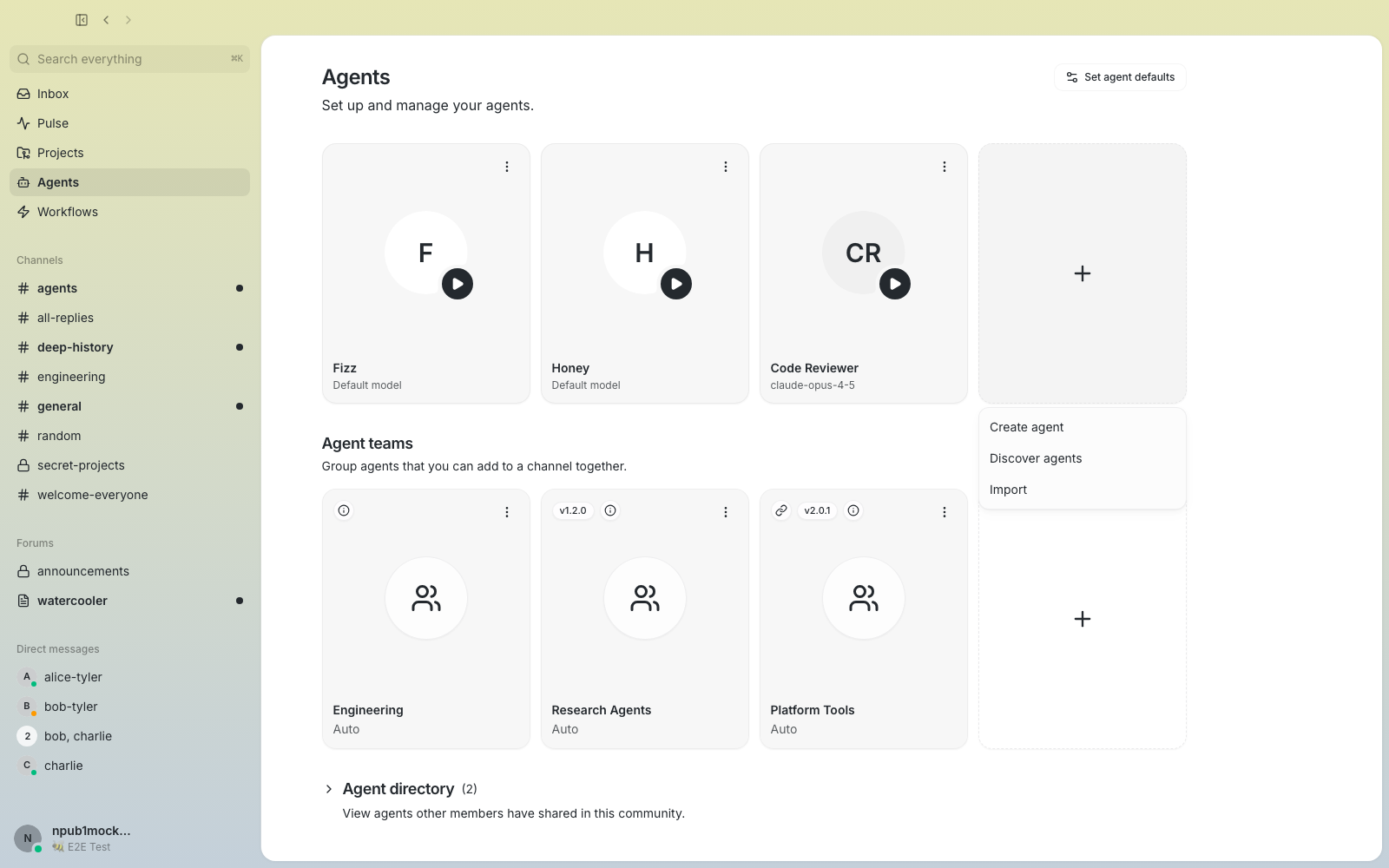 ### Team avatar stack 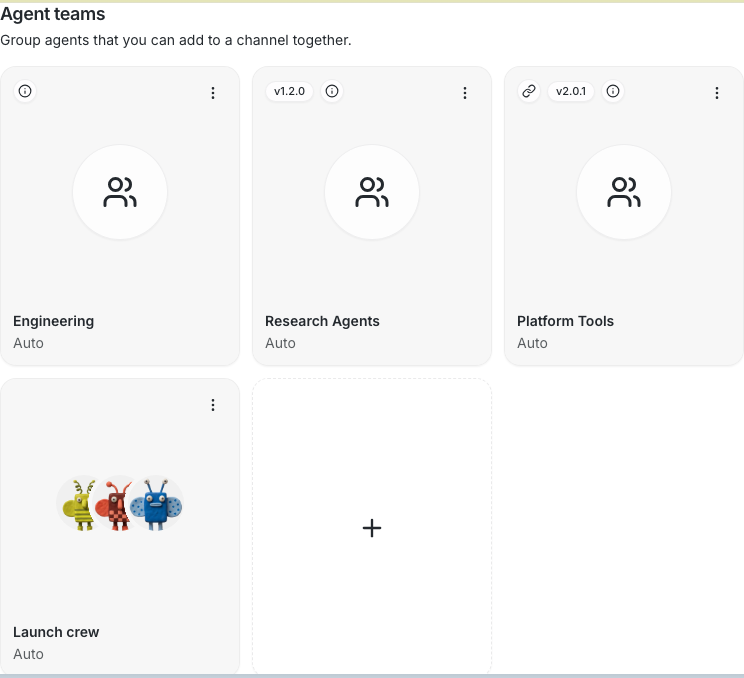 ### Catalog sharing 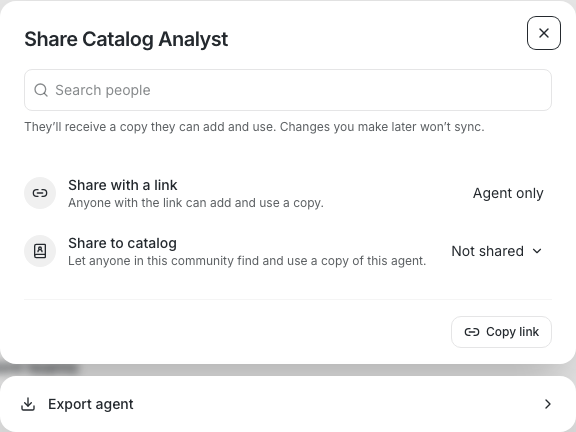 ### Publish while editing 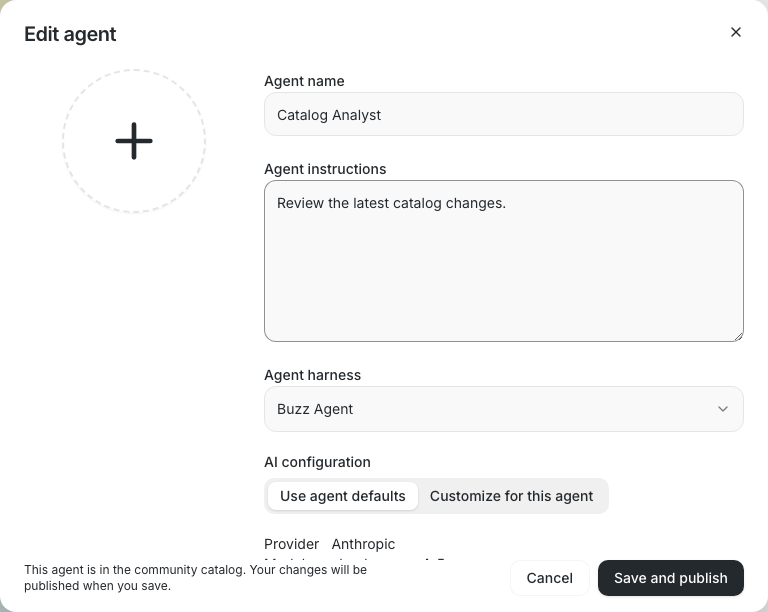 ### Publish from Share 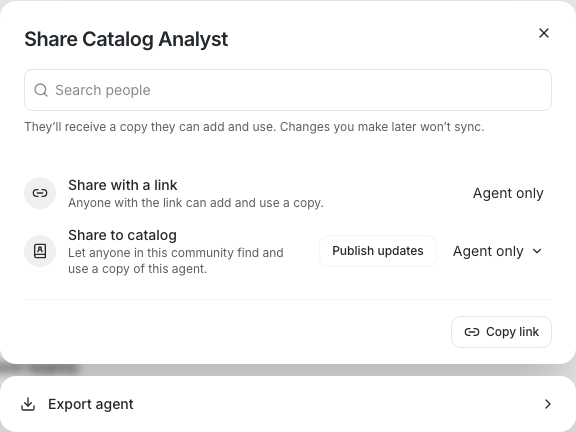 ### Catalog details 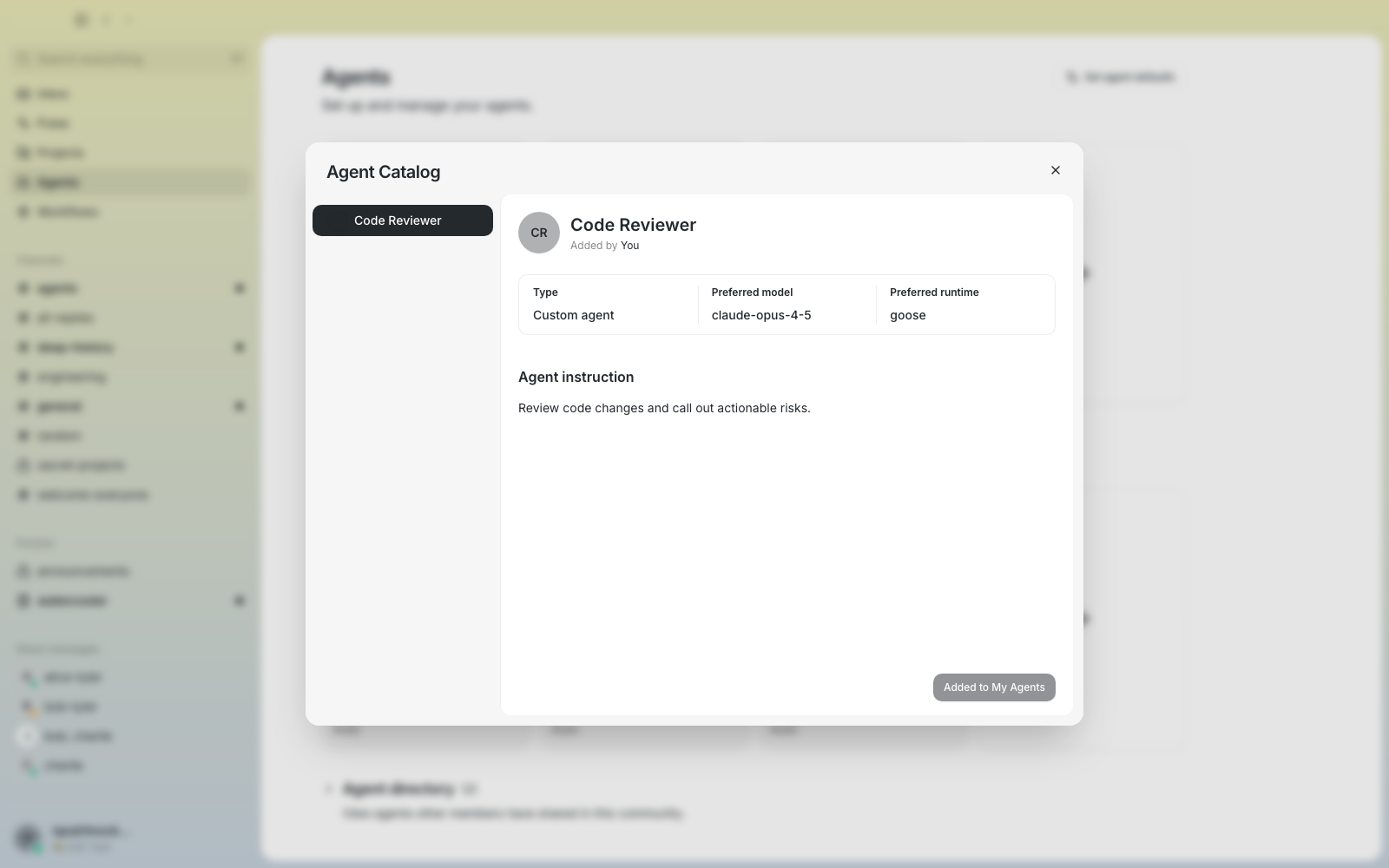 --------- Signed-off-by: kenny lopez <klopez4212@gmail.com> Signed-off-by: Will Pfleger <pfleger.will@gmail.com> Co-authored-by: Will Pfleger <pfleger.will@gmail.com> |
||
|
Will PflegerandGitHub
|
4e3998f36e |
fix(desktop): gate codex-acp on a minimum supported version (#3254)
The codex adapter version gate accepted any `major >= 1`, so a 1.x `codex-acp` older than the version that fixes outbound relay access for `buzz` CLI subprocesses classified as `Available` and was never offered a reinstall. Only the 0.16.x `@zed-industries/codex-acp` adapter — which fails `--version` outright — was caught. `probe_codex_acp_version` now returns the full `(major, minor, patch)` triple and `codex_adapter_availability` compares it against a new `MIN_CODEX_ACP_VERSION` floor of `1.1.7`, the current npm latest. An adapter below the floor classifies as `AdapterOutdated`, which routes it through the existing uninstall-then-install reinstall plan. The parse requires exactly three numeric dot-separated components. Partial versions (`1.2`) and prerelease tags (`1.2.0-rc1`) return `None` and therefore classify as `AdapterOutdated` — a version Buzz cannot compare against the floor fails closed, offering a reinstall rather than running an adapter of unknown vintage. Both the floor's bump policy and the strict-parse behavior are stated in doc comments rather than left implicit. Supersedes [#3097](https://github.com/block/buzz/pull/3097) by @Bharathchinneni, whose semver floor and behavior tests this carries. That PR could not land as written: the two `probe_codex_acp_major_version` compatibility wrappers it kept had no non-test callers, which is a hard `clippy -D warnings` failure. The wrappers are deleted here and their call sites collapsed onto `probe_codex_acp_version`. Signed-off-by: Will Pfleger <pfleger.will@gmail.com> |
||
|
Will PflegerandGitHub
|
be13b4bb9c |
fix(desktop): probe legacy Goose install dir on Windows (#3248)
Goose's pre-[#2680](https://github.com/block/buzz/pull/2680) Windows installer unpacked the CLI to `%USERPROFILE%\goose\goose.exe`. That directory is on no standard `PATH`, and `common_binary_paths()` never probed it, so users who installed Goose with the legacy installer stayed permanently undiscovered — the residual half of #2239. `resolve_command_uncached` finds binaries outside `PATH` only by scanning `common_binary_paths()`, so adding the directory there is the whole fix: Windows basename expansion already supplies `goose.exe`/`.cmd`/`.bat`, and discovery, readiness probes, and spawn all route through the same shared resolver. No Goose-specific resolution path is introduced. The entry sits beside the existing Codex `%LOCALAPPDATA%\Programs\OpenAI\Codex\bin` probe in the same `#[cfg(windows)]` block. The regression test is `#[cfg(windows)]` and is CI-reachable, not dead code — the `desktop-build-windows` job runs `cargo test --manifest-path desktop/src-tauri/Cargo.toml --target $env:TARGET` on `windows-latest`. It asserts the probe list rather than planting a binary: `common_binary_paths` is a process-lifetime `OnceLock`, so a test cannot deterministically re-seed `USERPROFILE`, and planting an executable under the real user profile is not an acceptable side effect. Verified locally by widening the `cfg` to build on macOS — the test passes with the probe and fails without it. The `check-file-sizes.mjs` override for `managed_agents/discovery.rs` moves 1835 → 1841, the exact post-`cargo fmt` gate count. Verified both directions: 1841 passes, 1840 fails. Signed-off-by: Will Pfleger <pfleger.will@gmail.com> |
||
|
|
98a7b13348 |
fix(node): bump Buzz-supplied Node runtimes past OpenClaw's >=24.15.0 floor (#3218)
## Problem User report: ``` Buzz Node mismatch: Buzz supplies Node 24.14.0; OpenClaw requires >=24.15.0. All 10 ACP workers immediately crash. ``` Buzz supplies Node to agent processes from two places, and both were below OpenClaw's floor: | Supply path | Was | Now | |---|---|---| | hermit dev env (`bin/.node-*.pkg`) — the 24.14.0 in the report | 24.14.0 | **24.15.0** (newest hermit publishes; satisfies `>=24.15.0`) | | Desktop managed runtime (`managed_node.rs` / `managed_node_paths.rs`) | v24.11.0 | **v24.18.0** (current latest v24) | The managed runtime sits **first** on the worker PATH (`managed_agents/runtime/path.rs`), so a user-installed newer Node can't mask a stale managed one — the pin itself has to move. ## Verification - SHA-256 digests for all six platform artifacts taken from `https://nodejs.org/dist/v24.18.0/SHASUMS256.txt`; darwin-arm64 independently re-verified by downloading the tarball (hash match), extracting, and running `bin/node --version` → `v24.18.0`. - All artifacts within `MANAGED_NODE_MAX_BYTES` (largest linux-x64 at 57 MB < 90 MB cap); tar.gz layout keeps the `node-vX-platform/bin/node` shape `verify_node_tree` expects. - `cargo test --lib` in `desktop/src-tauri`: **1801 passed, 0 failed** at this commit; `cargo fmt --check` + `cargo clippy --lib -D warnings` clean. - Existing readiness check (`node --version == MANAGED_NODE_VERSION`) makes upgrade automatic: installed v24.11.0 trees fail readiness and the installer stages v24.18.0 atomically (rename with `.old` rollback — existing logic, unchanged). Note: CI `node-version: 24.14.1` pins in `release.yml`/`windows-canary.yml` are build-env only (already `>=` nothing OpenClaw touches) and left alone to keep this minimal. Signed-off-by: Tyler Longwell <tlongwell@block.xyz> Co-authored-by: npub1qyvc0c5kl4gqv2fd97fsk46tu378sqgy35vc83rvgfwne90sel7s0ed67d <011987e296fd5006292d2f930b574be47c7801048d1983c46c425d3c95f0cffd@buzz.block.builderlab.xyz> Co-authored-by: Tyler Longwell <tlongwell@block.xyz> |
||
|
|
7ca0bbd946 |
fix(desktop): republish agent identity records when a persona rename propagates (#2607)
## Problem Part of #2423 (renaming personal agents desynchronises identity). Renaming an agent definition (persona) propagates the new display name to its linked agent instances (`propagate_persona_name_rename` in `desktop/src-tauri/src/commands/personas/mod.rs`) and saves `managed-agents.json` — but, unlike the instance-rename path (`update_managed_agent`), it never re-retains the renamed instances' kind:30177 managed-agent identity records. `record.name` is part of the published identity projection (`agent_event_content`), so after a persona rename: - `managed-agents.json` says the NEW name, - the retained kind:30177 row (retention.db → relay flush loop) still carries the OLD name, with the OLD `created_at`. The stale identity record stays live on the relay until the next app launch, when the boot-time reconcile (`reconcile_agents_in_dir`) finally notices the content diff and republishes. Until that restart, any surface that resolves agents from kind:30177 records (second desktop of the same owner, CLI, other NIP-AP clients) sees the OLD name bound to the agent pubkey while the kind:0 profile already shows the NEW one — the name→identity binding desync described in #2423, and consistent with the report's observation that repairing state required "a separate restart". ## Fix - Extract the per-record retain body of the boot reconcile into `managed_agents::reconcile::retain_agent_record(conn, keys, record) -> Result<bool, String>` — one shared content-diff + monotonic-`created_at`-bump engine (returns whether a row was rewritten). `reconcile_agents_in_dir` now calls it per record (behavior unchanged; existing reconcile tests still pass). - `commands::agents::retain_managed_agent_pending` delegates to the shared engine instead of carrying a duplicate implementation (same semantics: projection-equality no-op guard, monotonic bump, `pending_sync = 1`). - `update_persona` (Phase 1, still under the store lock, after `save_managed_agents`): call `retain_managed_agent_pending` for every record the rename propagated to — mirroring `update_managed_agent`. Avatar-only edits are deliberately excluded (the avatar is not part of the kind:30177 projection; retaining would be a guaranteed no-op). No new events, kinds, or APIs — this uses the existing signed-event retention and flush pipeline, per CONTRIBUTING's guidance to prefer a signed Nostr event and the existing ingest path over endpoint-specific JSON APIs. ## Out of scope (deliberately) - Rename → runtime restart is #1823, fixed by open PR #2507 (spawn_hash). - Surfacing kind:0 relay profile-sync failures on rename is PR #2302/#2279 territory (and largely superseded by the merged rollback in #2258). - Mention-picker UX (owner/status disambiguation) and channel-membership repair for stale identities: TS-side, noted in #2423, not touched here. ## Test evidence Two new unit tests in `desktop/src-tauri/src/managed_agents/reconcile/tests.rs` (same harness as the existing reconcile tests — tempdir + retention.db + fresh keys, no AppHandle): - `rename_re_retains_identity_record_with_new_name` — retain "Fizz", confirm flush, rename to "Spark", re-retain: row keeps the pubkey coordinate, carries the new name only, is `pending_sync`, and its `created_at` is strictly past the retained head (replaceable-event acceptance). - `retain_agent_record_is_noop_when_unchanged` — an unchanged projection does not rewrite the row and produces zero `pending_sync` churn. Ran scoped per CONTRIBUTING build discipline (from `desktop/src-tauri`): ``` cargo fmt -p buzz-desktop # applied, clean cargo clippy -p buzz-desktop --lib --tests -- -D warnings # exit 0, no warnings cargo test -p buzz-desktop --lib # full lib suite ``` Full `buzz-desktop` lib suite: **1562 passed, 0 failed, 13 ignored** — including all 12 `managed_agents::reconcile` tests (10 pre-existing, all unmodified in behavior, plus the 2 new regression tests above). ## Links - Issue: https://github.com/block/buzz/issues/2423 - Adjacent (no overlap): PR #2507 (rename-restart, #1823), PRs #2302/#2279 (kind:0 sync-failure surfacing), merged #2258 (instance-rename rollback). --------- Signed-off-by: Sean Gearin <sgearin@gmail.com> Co-authored-by: Sean Gearin <sgearin@gmail.com> Co-authored-by: Will Pfleger <pfleger.will@gmail.com> |
||
|
|
d98da7389e |
feat(desktop): redesign agent runtime settings (#3093)
**Category:** improvement **User Impact:** Users can understand, install, authenticate, and manage agent runtimes from one progressively disclosed Agents settings experience. **Problem:** Runtime health and custom harness management were split across overlapping settings surfaces, exposing low-level configuration too early while leaving setup and authentication states hard to understand. **Solution:** Consolidate those operations into one stable runtime list and an Add runtimes catalog, with task-oriented state labels, direct setup actions, and custom configuration contained in a dedicated form. <details> <summary>File changes</summary> **desktop/playwright.config.ts** Registers the visual coverage needed for the redesigned runtime catalog. **desktop/public/harness-logos/CREDITS.md** Documents bundled runtime-mark provenance and the decision not to ship the withdrawn OpenAI mark. **desktop/public/runtime-icons/codex.png** Removes the obsolete Codex bitmap in favor of the neutral fallback. **desktop/public/runtime-icons/goose.svg** Removes the old Goose asset now replaced by the theme-adaptive mark. **desktop/src-tauri/src/managed_agents/discovery.rs** Aligns runtime discovery guidance with the new task-oriented setup language. **desktop/src-tauri/src/managed_agents/discovery/runtime_metadata.rs** Updates runtime metadata used by the redesigned settings states. **desktop/src/features/agents/ui/runtimeAvailabilityWarning.test.mjs** Updates availability-warning expectations for the revised runtime guidance. **desktop/src/features/onboarding/assets/harness-logos/chatgpt.png** Removes the redundant bitmap from the unified runtime icon pipeline. **desktop/src/features/onboarding/assets/harness-logos/goose.png** Removes the redundant Goose bitmap. **desktop/src/features/onboarding/ui/HarnessMarks.tsx** Adds theme-adaptive bundled runtime marks with safe fallbacks. **desktop/src/features/onboarding/ui/RuntimeIcon.tsx** Centralizes runtime logo rendering so settings and catalog rows cannot drift. **desktop/src/features/onboarding/ui/SetupStep.tsx** Aligns onboarding runtime setup copy with the settings terminology. **desktop/src/features/onboarding/ui/presetLogos.test.mjs** Guards bundled-logo behavior and prevents the withdrawn Codex mark from returning. **desktop/src/features/settings/ui/CustomHarnessForm.tsx** Reworks custom runtime creation and editing into a clear, dedicated catalog form. **desktop/src/features/settings/ui/HarnessCatalogDialog.tsx** Introduces the Add runtimes master-detail catalog, grouped setup states, loading treatment, and pinned actions. **desktop/src/features/settings/ui/HarnessManagementCard.tsx** Removes the superseded standalone custom-harness management surface. **desktop/src/features/settings/ui/HarnessRow.tsx** Provides stable operational runtime rows with install, update, authentication, edit, and delete behavior. **desktop/src/features/settings/ui/HarnessesSettingsPanel.tsx** Consolidates runtime health and custom management into one Agents settings panel. **desktop/src/features/settings/ui/SettingsPanels.tsx** Wires the consolidated panel into Agents settings. **desktop/src/features/settings/ui/harnessCatalogCopy.ts** Adds restrained, source-annotated runtime descriptions and setup guidance. **desktop/src/features/settings/ui/harnessCatalogLogic.test.mjs** Covers grouping, state labels, stable row order, actions, and adapter warnings. **desktop/src/features/settings/ui/harnessCatalogLogic.ts** Centralizes catalog grouping, actions, status labels, and runtime-safe warning copy. **desktop/src/features/settings/ui/harnessGalleryLogic.test.mjs** Removes obsolete gallery-only tests after consolidation. **desktop/src/features/settings/ui/harnessGalleryLogic.ts** Retains only the shared custom-runtime safety logic needed by the new surface. **desktop/src/shared/ui/config-nudge-attachment.tsx** Points configuration nudges to Agent runtimes with matching terminology. **desktop/src/testing/e2eBridge.ts** Adds deterministic runtime states for authentication and catalog E2E coverage. **desktop/tests/e2e/doctor-states.spec.ts** Verifies ready, setup-required, node-gated, authentication, loading, and error contracts. **desktop/tests/e2e/harness-catalog-screenshots.spec.ts** Captures whole-pane visual states for the runtime catalog experience. **desktop/tests/e2e/harness-management.spec.ts** Exercises catalog actions and custom runtime create, edit, authentication, and deletion flows. **desktop/tests/e2e/onboarding-agent-defaults.spec.ts** Updates default-runtime expectations for the consolidated experience. **desktop/tests/e2e/profile.spec.ts** Aligns profile navigation assertions with the new settings surface. </details> ## Reproduction steps 1. Open Settings → Agents and inspect Agent runtimes; ready, signed-out, installable, and setup-required runtimes should have stable rows and explicit actions. 2. Open Add runtimes and browse the Setup and Installed groups; select entries to see sourced guidance and a pinned Install or Setup guide action. 3. Select Custom harness, create a runtime, then edit and delete it; verify required-field gating and the blast-radius confirmation. 4. Exercise a signed-out runtime and connect it; the row should move from Sign-in needed to Ready without reordering. 5. Resize the window and switch themes to verify responsive layout and adaptive bundled marks. ## Screenshots | Mixed runtime states | Goose not installed | Sign-in needed | |---|---|---| | <img width="980" height="1000" alt="image" src="https://github.com/user-attachments/assets/28705b39-1d91-440a-a954-fb2d7d8ee759" /> | <img width="980" height="1000" alt="image" src="https://github.com/user-attachments/assets/e65ce8e1-8c85-4272-afb5-e6001b94d560" /> | <img width="980" height="1000" alt="image" src="https://github.com/user-attachments/assets/3987f355-960d-4744-8c26-b3746944a33c" /> | | Add runtimes catalog | Custom runtime | Setup guide | |---|---|---| | <img width="896" height="672" alt="image" src="https://github.com/user-attachments/assets/a2f32c8a-4dff-4929-af96-b07346933335" /> | <img width="896" height="672" alt="image" src="https://github.com/user-attachments/assets/b2e85a0c-3940-4875-a138-4035423c9de7" /> | <img width="896" height="672" alt="image" src="https://github.com/user-attachments/assets/5a690c1c-368e-4ee3-98b9-ffefdc3cf804" /> | Full 13-state screenshot matrix and review evidence: https://buzz.block.builderlab.xyz/channels/c5af9e3e-4317-4853-b3e3-ed9c15bc511d?event=ec88f6e472f2b08d6318ae76fd754fd4f218385f67cfe59b73034c4bc34c9252 --------- Signed-off-by: Taylor Ho <taylorkmho@gmail.com> Signed-off-by: npub1223z34hd7vtwc6qj4s7flsxkj644nlre2nthu7lrrmkumhu3xddsrx9r6w <52a228d6edf316ec6812ac3c9fc0d696ab59fc7954d77e7be31eedcddf91335b@buzz.block.builderlab.xyz> Co-authored-by: npub1223z34hd7vtwc6qj4s7flsxkj644nlre2nthu7lrrmkumhu3xddsrx9r6w <52a228d6edf316ec6812ac3c9fc0d696ab59fc7954d77e7be31eedcddf91335b@buzz.block.builderlab.xyz> |
||
|
|
8995316844 |
fix(desktop): use forward slashes for git credential.helper on Windows (#3023)
## Problem On Windows, Projects **Remote** view shows an empty file tree and Sync/Clone fails with a mangled credential-helper path, for example: ``` C:\Users\<user>\AppData\Local\Buzz\git-credential-nostr.exe get: line 1: C:Users<user>AppDataLocalBuzzgit-credential-nostr.exe: command not found fatal: could not read Username for 'https://<relay>/git/...': terminal prompts disabled ``` Buzz injects an absolute path into `credential.helper` via `Path::display()`. On Windows that yields backslashes. Git for Windows runs credential helpers through MinGW bash, which treats `\` as escapes and destroys the path, so NIP-98 auth never runs and the blobless temp clone behind Remote view fails. macOS/Linux are unaffected (paths already use `/`). This is unrelated to shipping a stub helper - the bundled `git-credential-nostr.exe` is a real binary. User `~/.gitconfig` workarounds also cannot help here because Projects git sets `GIT_CONFIG_GLOBAL=/dev/null` and injects its own helper. Closes #3025 ## Fix Normalize the helper path to forward slashes before writing `GIT_CONFIG_VALUE_*`: - `desktop/src-tauri/src/commands/project_git_exec.rs` (Projects Remote / Sync) - `desktop/src-tauri/src/managed_agents/runtime.rs` (agent spawn git auth) Forward slashes are accepted by Git on every platform; on macOS/Linux the replace is a no-op. No `cfg(windows)`, packaging, or libgit2 changes. ## How to reproduce (before) 1. Install Buzz on Windows with Git for Windows 2. Connect to a relay that has a repository with at least one pushed branch 3. Open **Projects** -> select the repo -> **Remote** 4. Observe empty tree; Sync/Clone shows the mangled-path / `command not found` error above ## Test plan - [x] Unit: `cargo test --manifest-path desktop/src-tauri/Cargo.toml credential_helper_config_value` (formatter covered on all platforms; no-op for Unix-style paths) - [x] Local Windows NSIS build + install of this branch - [x] Projects -> Remote / Sync against a Buzz relay repo succeeds on Windows after the fix --------- Signed-off-by: Bjorn de Jong <bcrdejong@users.noreply.github.com> Signed-off-by: Will Pfleger <pfleger.will@gmail.com> Co-authored-by: Bjorn de Jong <bcrdejong@users.noreply.github.com> Co-authored-by: Cursor <cursoragent@cursor.com> Co-authored-by: Will Pfleger <pfleger.will@gmail.com> |
||
|
Will PflegerandGitHub
|
f2fe3b63c2 |
feat(acp): title agent sessions from the agent and channel name (#3028)
ACP harnesses that name a session from the first text they receive all land in the same place: every managed Buzz agent opens with the identical `[Base] You are operating inside the Buzz platform…` framing, so the harness session list shows a wall of indistinguishable rows. Because sessions are keyed per channel, one agent active in several channels produces several of them. This sends the name out of band instead. `session/new` carries `_meta.sessionTitle` with `Agent · #channel`, composed from the agent's `display_name` (or its unique `name` handle) and the channel it is serving. The prompt is untouched — no tokens spent, no perturbation of the prompt contract, and nothing new for the desktop observer's section parsing to handle. The mechanism is harness-agnostic: Buzz sends the field on every ACP `session/new` regardless of which harness is behind it, and adapters that don't read it ignore it per spec. ## Inert until a consuming adapter ships ACP adapters ignore `_meta` members they do not recognize, so against an adapter with no reader a Buzz session gets no title and nothing else changes. Three adapter halves consume it — Codex, Goose, and Claude Code (linked below); this half and each reader are only useful together, and each reader lands independently. No version floor is added. `codex_adapter_is_outdated_with_path` already gates codex-acp on major version `>= 1` (`desktop/src-tauri/src/managed_agents/discovery.rs:1276-1284`) and this feature needs nothing above that — an older adapter is not broken by the extra member, it simply ignores it. ## What changes **`crates/buzz-acp`** owns sanitization and composition. `sanitize_session_title` collapses whitespace, drops control characters, and caps at `SESSION_TITLE_MAX_CHARS` (80) by character, not byte, so a multi-byte character cannot be split. `compose_session_title` truncates only the channel part against that cap, so the agent name always survives; when the agent name alone fills the cap the channel is dropped rather than the name. `session_new_full` sets `_meta.sessionTitle` when a title exists and omits `_meta` entirely when it does not, since an adapter may distinguish an absent member from a null one. **`desktop/src-tauri`** only resolves and exports. `resolve_session_title` picks `display_name` or falls back to `name`, and `spawn_agent_child` writes it to `BUZZ_ACP_SESSION_TITLE` — or removes the variable when neither candidate yields anything printable. DMs, unresolved channels, and heartbeat sessions get the bare agent name with no channel suffix. ## Four properties that are easy to remove by accident **Control characters are stripped at the desktop boundary, not in the harness.** An interior NUL cannot cross the environment boundary at all — `Command::env` fails the entire spawn rather than passing it through. Deferring the strip to `buzz-acp` would let a corrupted display name turn display chrome into a spawn failure. A display name that is *only* control characters falls back to `name`. **The title is hashed into `spawn_config_hash`.** Without it, renaming an agent left the running process with a stale title and no restart badge. The hash runs the same `resolve_session_title` the spawn writes, and skips it when a user env override shadows `BUZZ_ACP_SESSION_TITLE` — spawn writes the title *before* the layered user env, so the override is what actually runs, and it already reaches the hash through `descriptor.env`. Hashing the record-derived value under an override would badge a rename that changes nothing. **One channel resolve serves both consumers.** `resolve_new_session_channel_context` returns `(is_dm, title_channel)` from a single metadata lookup, feeding both the canvas block's DM check and the title. `ChannelInfoResolver` caches only `Some`, so two independent calls against an unresolvable channel pay the full `fetch_channel_info` retry sequence twice — two timeouts plus a retry delay each — directly in front of `session/new`, precisely when the relay is already degraded. **The `"unknown"` channel name is treated as absent.** `fetch_channel_info` substitutes the literal `"unknown"` for a metadata event with no `name` tag. Composing that sentinel would title every unnamed channel `Agent · #unknown`, reintroducing the exact collision the suffix exists to remove while naming a channel something it isn't. The startup cache already refuses `channel_type == "unknown"` for the same reason. Closes #2334 Related — the adapter halves that consume `_meta.sessionTitle`: - [codex-acp#338](https://github.com/agentclientprotocol/codex-acp/pull/338) — Codex - [aaif-goose/goose#10712](https://github.com/aaif-goose/goose/pull/10712) — Goose - [claude-agent-acp#920](https://github.com/agentclientprotocol/claude-agent-acp/pull/920) — Claude Code --------- Signed-off-by: Will Pfleger <pfleger.will@gmail.com> |
||
|
|
654f384906 |
fix(desktop): read the newest pair-scoped harness log (#3134)
Harnesses became per (agent, relay) pair in #2122 and now write `agents/logs/{pubkey}__{sha256(relay_url)}.log` via `managed_agent_runtime_log_path`. `get_managed_agent_log` was never updated and still read the legacy `agents/logs/{pubkey}.log`, so agent profile → Runtime → Harness Log froze at each agent's last single-runtime line while live output accumulated in files the reader never opened. The reader now resolves the log through `latest_managed_agent_log_path`, which picks the most recently modified file belonging to the agent — pair-scoped `{pubkey}__*.log` or legacy `{pubkey}.log` — and falls back to the legacy path when the agent has no log on disk at all. Agents that have not restarted since the update keep working, and the panel follows whichever harness is currently writing. The response already carried `log_path`, so the panel header names the file being shown. Selection is deterministic: equal mtimes break toward the higher filename, and files belonging to other agents or without a `.log` extension are never candidates. `storage.rs`'s inline test module moves to a `#[path]`-included sibling `storage_tests.rs`, matching the existing pattern in `teams.rs` and `archive/mod.rs`. This drops both halves under the desktop file-size limit (1383 → 826 / 701), so the ratchet entries tighten instead of growing. Signed-off-by: Will Pfleger <pfleger.will@gmail.com> Co-authored-by: Duncan <dcfd242e557282d7a1e2cf2e6877522682f1e5c6156dc92ca7d90eaedd3b0f95@buzz.block.builderlab.xyz> |
||
|
|
95fdf97880 |
feat(acp): bring your own harness (BYOH) — generic ACP runtime seam + settings gallery (#2773)
## What

Implements a "bring your own harness" (BYOH) generic ACP mechanism —
replacing per-harness backend code with a data-driven 3-tier system:

- **Tier 1 (compiled-in builtins):** goose, claude, codex, buzz-agent —
unchanged behavior
- **Tier 2 (bundled presets):** cursor, omp, grok, opencode, kimi, amp,
hermes, openclaw, and any future additions — defined in
`PRESET_HARNESSES`, no code duplication, icons stay
TerminalSquare/bundled-asset-only
- **Tier 3 (user-defined custom):** JSON definitions saved to
`custom_harnesses/` under app data; managed via Settings → Agents UI

## Changes

### Core data model
- `HarnessDefinition` — id, label, command, args, env, install URL/hint
- `PRESET_HARNESSES` static table — single source of truth for all
presets; `preset_harness_ids()` derives reserved IDs (D-11: no
hand-maintained copy)
- `source: "builtin" | "preset" | "custom"` tagging on every catalog
entry

### Persistence (B-4, B-6)
- `save_custom_harness_to_dir(dir, definition, rename_old_id)` —
backup-swap atomic write (backs up target → .bak, commits temp → target,
restores .bak on failure, removes .bak on success); safe on Windows
where `fs::rename` over an existing file is "access denied"
- `save_and_warm` / `delete_and_warm` — hold `PERSIST_MUTEX` for the
write + registry-warm pair, eliminating the lost-update race (B-6) where
two concurrent saves could interleave their warm calls and leave a stale
registry snapshot
- Validate-before-mutate: both IDs and env validated before any
filesystem mutation

### Env validation boundary (B-3)
- `validate_harness_definition_pub` calls `validate_user_env_keys` on
definition env at save AND load
- Rejects malformed keys (BUZZ_AUTH_TAG=x forgery shape), reserved keys
(BUZZ_MANAGED_AGENT etc.), NUL bytes, oversized values

### TypeScript boundary (B-2 / Thufir CRITICAL)
- `RawAcpRuntimeCatalogEntry` now declares `definition_env?:
Record<string,string>` and `source: "builtin" | "preset" | "custom"`
- `fromRawAcpRuntimeCatalogEntry` maps `definition_env → definitionEnv`
(camelCase); absent field defaults to `{}`
- Edit form reads `entry.definitionEnv` — env no longer erased on
save-then-edit cycle

### Unified descriptor (Phase A / Thufir F4)
- `EffectiveHarnessDescriptor { command, args, env }` in `readiness.rs`
- `resolve_effective_harness_descriptor()` — single resolver used by
spawn, spawn_hash, summary, get_agent_models (both saved and unsaved),
and readiness
- No competing arg-resolution forms

### Other fixes
- B-5: stop freezing `runtime.defaultArgs` into `record.agent_args` on
normal create paths
- B-7: readiness exec-check — `MissingBinary` variant for custom
commands not found on PATH
- B-8: onboarding transition — `setTimeout(0)` removed, parent-owned
route intent via `navigateAfterComplete` prop
- C-9: collector-discriminating sweep tests with injectable filters
- C-10: `HarnessManagementCard` uses `harnessGalleryLogic` helpers
(killed duplicate filter/sort)
- D-11: `BUILTIN_IDS` derived from `PRESET_HARNESSES` (no
hand-maintained copy)
- D-12: `mobile/pubspec.lock` churn reverted
- D-13: false ownership fast-path comment fixed
- D-14: URL scheme validation for `installInstructionsUrl`
- D-15: OpenClaw Gateway env-locus README line

### Tests added
**B-4 persistence (6 tests):**
`save_to_dir_create_writes_file_and_loads_back`,
`save_to_dir_same_id_edit_replaces_content`,
`save_to_dir_backup_is_cleaned_up_after_same_id_edit`,
`save_to_dir_rename_removes_old_file_and_creates_new`,
`save_to_dir_rename_nonexistent_old_id_is_non_fatal`,
`save_to_dir_roundtrip_with_env_preserves_values`

**B-3 env validation (6 tests):**
`validate_rejects_malformed_key_with_equals_sign`,
`validate_rejects_reserved_key_buzz_managed_agent`,
`validate_rejects_reserved_key_case_insensitive`,
`validate_rejects_nul_byte_in_value`,
`validate_rejects_value_over_per_value_size_limit`,
`validate_accepts_well_formed_env`

**B-2 API boundary (4 TS tests in tauri.test.mjs):**
`fromRawAcpRuntimeCatalogEntry maps definition_env to definitionEnv`,
`defaults definitionEnv to {} when absent`, `preserves source preset`,
`env round-trips through edit payload shape`

## Preset catalog

| ID | Label | Command |
|----|-------|---------|
| `cursor` | Cursor | `cursor-agent acp` |
| `omp` | Oh My Pi | `omp acp` |
| `grok` | Grok Build | `grok agent --always-approve stdio` |
| `opencode` | OpenCode | `opencode acp` |
| `kimi` | Kimi Code | `kimi acp` |
| `amp` | Amp | `amp-acp` |
| `hermes` | Hermes Agent | `hermes-acp` |
| `openclaw` | OpenClaw | `openclaw acp` |

## Review-fix pass (2026-07-26, Eva)

Fixes from the three-way review (Wren / Dawn / Eva) in the
buzz-generic-acp-harnesses thread, pushed as new commits (no rewrite):

1. **installHint edit round-trip** — form seeding extracted to
`formValuesFromCatalogEntry` (single source of truth), input rendered,
full-definition lossless round-trip regression.
2. **Dangling-delete coherence** — delete allowed; confirm counts
referencing agents (direct pin + persona-inherited); summary rows render
`harness (deleted): <id>`; spawn errors become actionable sentences
(`user_facing_harness_error`); composed delete→summary→start test.
3. **Comma-in-args** — rejected at `validate_harness_definition` (shared
by save AND disk load), mirrored inline in the form.
4. **Registry publish race** — collision/dup filtering moved into
`load_custom_harnesses` (both loaders inherit shadowing rules);
discovery publishes by re-reading the dir under `persist_mutex` (lock
scoped to publish only); deterministic interleaving regressions for
save-during-discovery and delete-during-discovery.
5. **Mechanical** — discarded `belongs_to_us` sweep arg deleted,
`load_global_agent_config` hoisted out of the per-record summary loop,
duplicated doc paragraph + stray SAFETY comment removed.
6. **PGID test de-flaked** — leader kept alive through the assertion.

Known follow-up (filed in review, not blocking): file-size split-outs
queued in `check-file-sizes.mjs` entries.

## Gate table — head `bf53f1d60`

| Gate | Result |
|------|--------|
| `cargo test --lib` (desktop/src-tauri) | **1701 passed**, 0 failed, 14
ignored |
| desktop JS suite (`pnpm test`) | **3605 passed**, 0 failed |
| `tsc --noEmit` | clean |
| `biome check` + file-size/px/pubkey checks | clean |
| `cargo clippy --lib -- -D warnings` | clean |
| `cargo fmt --check` | clean |

PR head: `bf53f1d60e3cbd07392e1287b83bb37ba90d0d33` — includes merge of
origin/main (`c2a4ee711`, conflicts in agent_models composed with
#2890's live Databricks discovery)

---------

Signed-off-by: Will Pfleger <pfleger.will@gmail.com>
Signed-off-by: tlongwell-block <109685178+tlongwell-block@users.noreply.github.com>
Signed-off-by: Tyler Longwell <tlongwell@block.xyz>
Co-authored-by: npub1mn7jgtj4w2pd0g0zeuhxsa6jy6p0rewxz4kujt98my82ahfmp72sxjexk7 <dcfd242e557282d7a1e2cf2e6877522682f1e5c6156dc92ca7d90eaedd3b0f95@buzz.block.builderlab.xyz>
Co-authored-by: tlongwell-block <109685178+tlongwell-block@users.noreply.github.com>
Co-authored-by: Dawn (sprout agent) <c6237ef84fa537c78dcee78efd2d4e59f728859c7f194da42ac51ededfa0be05@sprout-oss.stage.blox.sqprod.co>
Co-authored-by: Tyler Longwell <tlongwell@block.xyz>
Co-authored-by: npub1qyvc0c5kl4gqv2fd97fsk46tu378sqgy35vc83rvgfwne90sel7s0ed67d <011987e296fd5006292d2f930b574be47c7801048d1983c46c425d3c95f0cffd@buzz.block.builderlab.xyz>
|
||
|
|
16d4ec335e |
feat(desktop): use collective mesh routing for Auto (#2825)
Uses MeshLLM built-in `mesh` collective intelligence / Mixture of Agents when Buzz Auto sees two or more distinct physical models. With zero or one model, Auto remains ordinary `auto`. This is an alternative way to improve tool responses, accuracy, and resistance to hallucination when a high-latency distributed mesh contains diverse models. Models and members may come and go: collective routing enables only after stable capacity, drops on confirmed contraction, and can recover later. Mesh-specific failures retry once through ordinary Auto. This update also pins MeshLLM to a v0.73.1-compatible backport of [MeshLLM #1074](https://github.com/Mesh-LLM/mesh-llm/pull/1074), so client-only Buzz nodes cannot enter model election or download a remote provider model. Buzz preserves the selected local sharing model and switches an existing client to sharing across a controlled app restart, retaining one runtime and one `:9337` / `:3131` pair per machine. Validation: - Full local `just ci` passes on the cleaned branch. - MeshLLM host-runtime suite: 1,568 passed, 0 failed; strict Clippy passes. - Buzz desktop Tauri suite with `mesh-llm`: 1,721 passed, 0 failed; strict feature Clippy passes. - Playwright covers client-to-share using the saved local model and no destructive stop. - Packaged two-machine testing proved single-model routing, dual-model collective routing, tool-markup fallback, and runtime reuse. - Packaged client-only recheck routed a real Mini Buzz turn through M5 while Mini stayed `is_client=true`, `is_host=false`, hosted no models, and created no Gemma cache. Builds on the recovery work merged in #2823; this PR does not duplicate it. --------- Signed-off-by: Michael Neale <michael.neale@gmail.com> Signed-off-by: Tyler Longwell <tlongwell@block.xyz> Co-authored-by: Michael Neale <michael.neale@gmail.com> Co-authored-by: npub1qyvc0c5kl4gqv2fd97fsk46tu378sqgy35vc83rvgfwne90sel7s0ed67d <011987e296fd5006292d2f930b574be47c7801048d1983c46c425d3c95f0cffd@buzz.block.builderlab.xyz> Co-authored-by: Tyler Longwell <tlongwell@block.xyz> |
||
|
|
5d8ede446f |
feat(agents): lower default agent parallelism from 24 to 10 (#3038)
## What
One-line default change: `DEFAULT_AGENT_PARALLELISM` 24 → 10
(`desktop/src-tauri/src/managed_agents/types.rs`), requested by Tyler in
[buzz-generic-acp-harnesses](buzz://message?channel=d6d84fdc-47fe-4e41-acf5-a08a4a013e6b&id=a047ead3a34ba804c376bf79f29e355d304162a88c7b2a7121e092547c572022).
## Why
Each unit of parallelism is a **full agent subprocess** per agent ×
community pair, spawned eagerly and serially at create/start before the
harness connects to the relay:
- At 24, a desktop with a few dozen agent×community pairs carries >1,000
potential idle subprocesses.
- Slow-starting harnesses (OpenClaw measured at 4–10s per worker) take
minutes to create, and messages sent during that window can be
permanently missed (the startup watermark is captured only after eager
pool init).
- Parallelism is per-channel concurrency — a channel never uses more
than one worker — so 10 still covers concurrent-channel fan-out for
typical agents.
Context: verified RCA + live 1-worker/3-mention experiment in the same
thread. Demand-driven pool growth (seed 1, grow on contention up to the
cap) is agreed as a follow-up; this is the interim risk reduction.
## Scope / blast radius
- Existing agent records keep their persisted `parallelism` value — only
new records and unset defaults change.
- Per-agent override unchanged (1..=32 via agent editor /
`BUZZ_ACP_AGENTS`).
- Readers of the constant (`team_snapshot`, `personas/snapshot/import`,
`commands/agents` mint path) all take the new default transitively; no
other code pins 24.
- `activeAgentTurnsStore.test.mjs` comments updated so the 24-turn
eviction case is framed against the harness cap (32) instead of the
default — coverage unchanged, no assertion touched.
## Verification
At
|
||
|
|
8c0e8cb165 |
fix(desktop): make agent definition authoritative for model/provider/prompt (#1968)
## Summary

Introduces a single effective-config resolver that makes agent
definitions authoritative for model, provider, system prompt, and
relay-mesh routing on linked instances. Stale materialized record bytes
are never consulted at spawn, deploy, readiness, hash, card summary, or
mesh preflight.

**Resolution semantics (field-specific):**
- **model/provider (linked):** definition → global. `None` = inherit
global default. Record value never consulted.
- **model/provider (definition-less):** instance → global.
- **system_prompt (linked):** strictly from definition; blank = no
prompt. No global tier for prompt.
- **system_prompt (definition-less):** from the instance.
- **relay-mesh preflight (both):** driven by the same
`resolve_effective_config` resolution spawn's mesh env consults. For a
linked instance the record's own `provider`/`model`/`relay_mesh` bytes
are never consulted; for a definition-less instance with no provider of
its own, the legacy marker and env preset are the last fallback (see
below).
- **Orphaned (linked record, definition missing):** spawn, deploy, and
mesh preflight blocked with actionable user-facing error.

**Changes:**
- New `effective_config` resolver module with `ConfigSource` metadata
(`definition`, `global`, `instance_legacy`)
- All consumers routed through the single resolver: local spawn, deploy,
readiness, spawn hash, card summary, relay-mesh preflight (interactive
start and restore-on-launch)
- `apply_persona_snapshot` no longer preserves stale record
model/provider when definition is blank
- Backend `update_managed_agent` blocks model/provider/prompt writes for
linked records
- Frontend omits model/provider/systemPrompt submission for linked
instances; system prompt override hidden
- `model_source` field added to `ManagedAgentSummary` so card labels
distinguish inherited (`Default model (X)`) from explicit
- Spawn hash now digests resolved model/provider (not raw record fields)
so global default changes trip the restart badge even for runtimes
without `model_env_var`
- Orphan spawn/deploy/mesh-preflight blocked with jargon-free error
("This agent's configuration is missing — it may still be syncing or was
deleted on another device")
- `EffectiveAgentConfig::relay_mesh_model_id()` and
`resolve_effective_relay_mesh_model_id()` added; both mesh preflights
(`start_local_agent_with_preflight`, `restore_managed_agents_on_launch`)
call this instead of the deleted
`relay_mesh_config`/`relay_mesh_model_id` record-byte sniffs
- Legacy relay-mesh records keep their mesh routing. Two shipped
generations predate `provider: "relay-mesh"` and are never rewritten on
load: the typed `relay_mesh` marker (added when `ManagedAgentRecord` had
no `provider` field), and before it the mesh preset written directly
into `env_vars`. `resolve_definition_less` falls back to the marker,
then to the env preset, so these records still resolve to mesh instead
of silently misrouting to an unrelated provider while their stale env
bytes reach the child. The fallback is skipped when the record carries
an explicit `provider` — that states current intent, including a switch
away from mesh — and `resolve_linked` has no legacy fallback at all
- The env discriminator accepts both spellings of the two sentinels
renamed in the Jun-11 window without a record migration: the provider
env key (`BUZZ_AGENT_PROVIDER`, previously `SPROUT_AGENT_PROVIDER`) and
the api-key value (`buzz-mesh-local`, previously `sprout-mesh-local`).
Each is independent, since a record can straddle the window; the current
provider-key spelling wins when both are present
- Dead `persona_field_with_record_fallback` and wrapper
`persona_snapshot_with_agent_config_fallback` deleted; callers use
`persona_snapshot` directly
- New resolver/deploy/hash/write-guard/mesh-preflight tests, including
switch-away and global-inheritance regressions for both mesh preflight
call sites, per-class legacy-mesh resolution (typed marker and env
preset, in every rename-window spelling combination), and the paired
assertions that a linked instance's legacy mesh bytes stay inert

---------

Signed-off-by: Will Pfleger <pfleger.will@gmail.com>
Co-authored-by: npub1mn7jgtj4w2pd0g0zeuhxsa6jy6p0rewxz4kujt98my82ahfmp72sxjexk7 <dcfd242e557282d7a1e2cf2e6877522682f1e5c6156dc92ca7d90eaedd3b0f95@buzz.block.builderlab.xyz>
|
||
|
|
166c6655e8 |
fix(desktop): surface install failures hidden by curl-pipe exit codes (#2892)
Ubuntu Doctor reports `Install failed at verify: The installer finished, but Buzz still could not use claude-code (observed: CLI missing)` while the `cli` step shows success. The `cli` step is lying. ## The masking Every CLI install command is a pipe — `curl -fsSL https://claude.ai/install.sh | bash` (`managed_agents/discovery.rs:109`), `… | sh` for Codex (`:141`), `… | CONFIGURE=false bash` for Goose (`:75`). `install_shell_command` ran them through `bash -l -c` with no `pipefail`, so the pipeline's exit status was the **right-hand** side's. A `curl` that fails — or that isn't on the child's PATH at all — feeds `bash` an empty stdin, and `bash` with nothing to run exits 0: ``` $ /bin/bash -l -c 'curl -fsSL https://nonexistent.invalid/x.sh | bash'; echo $? curl: (6) Could not resolve host: nonexistent.invalid 0 $ PATH=/tmp/empty /bin/bash -l -c 'curl -fsSL https://claude.ai/install.sh | bash'; echo $? bash: line 1: curl: command not found 0 ``` `run_install_command` records exit 0 as `success: true`, the adapter step then installs fine (it uses Buzz's own bundled Node, no system PATH needed), and `post_install_verification` correctly reports the CLI is absent. The user is handed a `verify` riddle instead of curl's error, which is why diagnosing this required three rounds of guessing. Install commands now run under `set -o pipefail`, so the left-hand side's failure is the step's failure and `InstallStepResult.stderr` carries the vendor's own message. `SHELLOPTS` is not exported by either shell, so the piped-to vendor script still runs with its default options. The Windows PowerShell install path (`install_powershell_command`) bypasses this shell and is untouched. ## The PATH collapse it was hiding `install_shell_command` composes the child's PATH and calls `cmd.env("PATH", …)`, which **replaces** rather than extends. `should_use_inherited` was `is_windows && !had_shell_path && has_local_context`, so on Unix the inherited process PATH was never appended. When `login_shell_path()` returns `None` — a login shell that exits non-zero or prints nothing, which a GUI-launched process can easily hit via `~/.profile` — the child's entire PATH becomes Buzz's two managed Node dirs. There is no `curl`, `sh`, `sha256sum`, or `tar` in either, so every curl-pipe install fails, and before this PR it failed invisibly. The `is_windows` requirement is dropped: the inherited PATH is the floor whenever no login-shell PATH was obtained, on every OS. Both existing suppressions are kept — a login-shell PATH present still suppresses it (no doubling), and no home/exe context still suppresses it (never manufacture a PATH from ambient state alone). Inherited entries stay **last**, so managed dirs keep precedence. The other caller, `build_augmented_path` (`runtime/path.rs:148`, feeding agent spawns and CLI probes), reads correctly under the new rule for the same reason: it only gains the inherited PATH in the case where it would otherwise hand a child a PATH with no native entries. When a login-shell PATH exists — the normal case on macOS and Linux — its output is unchanged, which `unix_shell_path_suppresses_inherited_fallback` pins. ## Scope This fixes the reporting defect and the PATH floor. The specific environment failure on the affected Ubuntu box is still being diagnosed and is deliberately not addressed here; the point of this change is that the next attempt produces the real error instead of a `verify` riddle. One interaction worth noting: `install_failure_is_retryable` retries any failure that carries an exit code, so a pipefail-surfaced curl failure now gets 3 attempts with backoff — correct for transient network blips, and harmless for hard failures. `desktop/scripts/check-file-sizes.mjs` ratchets the `agent_discovery.rs` ceiling 1836 → 1895 for the added tests. --------- Signed-off-by: Will Pfleger <pfleger.will@gmail.com> Co-authored-by: npub1mn7jgtj4w2pd0g0zeuhxsa6jy6p0rewxz4kujt98my82ahfmp72sxjexk7 <dcfd242e557282d7a1e2cf2e6877522682f1e5c6156dc92ca7d90eaedd3b0f95@buzz.block.builderlab.xyz> |
||
|
|
74b63e1846 |
Refactor managed-agent runtime into cohesive modules (#2974)
## Summary - split the managed-agent runtime warehouse into cohesive modules for process ownership/termination, orphan sweeping, dead-instance reaping, lifecycle synchronization, and runtime metadata - preserve the existing `runtime` API through narrow re-exports; helper bodies and platform `cfg` branches are unchanged apart from module-qualified visibility - reduce `runtime.rs` from 2,220 lines on `main` to 908 lines and remove its temporary file-size override, restoring the standard 1,000-line ceiling ## Why `main` failed after stale successful PR checks allowed independent growth to combine above `runtime.rs`'s 2,216-line override. The earlier fix in #2974 extracted only 55 lines and left the monolith on a special ratchet. This replacement includes that extraction but establishes responsibility boundaries and removes the exception entirely. ## Module boundaries - `process.rs` — process identity, ownership markers, receipt validation, and termination primitives - `orphan_sweep.rs` — same-instance orphan discovery and cleanup - `instance_reaper.rs` — foreign/dead desktop instance detection and agent reaping - `lifecycle.rs` — tracked runtime synchronization and stale record cleanup - `metadata.rs` — model/provider metadata resolution - `runtime.rs` — summary/config/spawn orchestration and composition ## Validation At `a824fda31eff6ecc0d39ca1b8ea5602a108897e6`: - pre-push `desktop-check` - pre-push `desktop-test` - pre-push full `desktop-tauri-test`: 1,637 passed, 0 failed, 14 ignored; integration + doc tests passed - `cargo check --manifest-path desktop/src-tauri/Cargo.toml --lib` - `cargo fmt --manifest-path desktop/src-tauri/Cargo.toml --all -- --check` - `node desktop/scripts/check-file-sizes.mjs` Supersedes #2974 and #2930. Signed-off-by: Wes <wesbillman@users.noreply.github.com> Co-authored-by: Wes <wesbillman@users.noreply.github.com> Co-authored-by: Princess Donut <68157ebd23b3897c1991015c3038658ea916200c67d3a54620b0754d1b92f6e0@buzz.block.builderlab.xyz> |
||
|
Daniel CadenasandGitHub
|
cc6c4d3471 | fix(desktop): make Linux AppImage GStreamer work on non-Debian distros (#2176) | ||
|
|
6ab3835f3f |
fix(discovery): inject PATH into Codex adapter planning (#2767)
## Why The Codex adapter install-plan test depended on the process-global login-shell PATH cache, making it flaky under concurrent or loaded CI runs. ## What - Thread an explicit probe PATH through adapter install planning - Use a controlled PATH in Codex install-plan tests - Update the existing desktop file-size allowance for the focused seam ## Risk Assessment Low — production behavior keeps using the same augmented PATH; only dependency injection and deterministic tests change. ## References - Failure: https://github.com/block/buzz/actions/runs/30110680608/job/89539202266 - Validation: `just desktop-tauri-test`; `cd desktop && pnpm check`; full pre-push hooks Generated with Codex --------- Signed-off-by: npub1x4hk035p3p9q39a3fcrd2fe30lpkrhr5dwe0cqzzjphxyyh8m0gsq4vqap <356f67c681884a0897b14e06d527317fc361dc746bb2fc0042906e6212e7dbd1@buzz.block.builderlab.xyz> Co-authored-by: npub1x4hk035p3p9q39a3fcrd2fe30lpkrhr5dwe0cqzzjphxyyh8m0gsq4vqap <356f67c681884a0897b14e06d527317fc361dc746bb2fc0042906e6212e7dbd1@buzz.block.builderlab.xyz> Co-authored-by: Codex <noreply@openai.com> |
||
|
|
b8510ede1b |
fix(desktop): clarify CLI runtime setup (#2680)
## Why Installing the Codex, Claude, or Goose desktop app does not install the command-line harness Buzz needs. The current UI makes that distinction unclear, links some missing-CLI states to adapter documentation, and can report a successful install from the installer exit code even when runtime discovery still fails. On Windows, Buzz also invokes Goose's Bash installer, which writes the executable somewhere Buzz does not discover. ## What - distinguish missing vendor CLIs from missing or outdated ACP adapters in runtime metadata and UI guidance - link Codex, Claude Code, and Goose missing-CLI states to their official CLI installation documentation - explain in Settings, onboarding, and agent configuration that the desktop app alone is not sufficient - use Goose's official PowerShell installer on Windows - refresh PATH and rediscover the requested runtime after installation, keeping the control retryable if the runtime is still unavailable - add Rust and Playwright regression coverage for Windows installer selection, CLI/adapter guidance, false-success prevention, verified installs, and onboarding copy ## Risk Assessment Medium. This changes desktop onboarding and runtime installation behavior. Successful installs now require the runtime catalog to verify availability; previously hidden discovery failures will surface as actionable errors instead of a false success state. ## References - [Codex CLI installation](https://developers.openai.com/codex/cli/) - [Claude Code installation](https://code.claude.com/docs/en/getting-started) - [Goose installation](https://goose-docs.ai/docs/getting-started/installation/) - Follow-up to #2563 and #2587 ## Validation - `just desktop-typecheck` - `just desktop-test` — 3,455 passed - focused Rust post-install verification tests - focused Playwright Doctor/onboarding coverage (in progress; CI and local sequential rerun will provide final results) Generated with Codex --------- Signed-off-by: Atish Patel <atish@squareup.com> Co-authored-by: Codex <noreply@openai.com> Co-authored-by: Goose <opensource@block.xyz> |
||
|
|
3bd3a014c6 |
fix(desktop): use augmented PATH for model discovery subprocess (#2753)
On Windows, the model dropdown never populates for CLI harnesses (Claude Code, Codex) while the same flow works on macOS. Model discovery spawns `buzz-acp models` with `PATH` taken from `login_shell_path()` — which by design always returns `None` on Windows (Git Bash's POSIX-shaped PATH would poison native children). The discovery child therefore ran with only the raw inherited process PATH, missing the Buzz-managed Node/npm directories and exe-parent sidecar dir, so the ACP adapter's `.cmd` shims failed to resolve `node` and discovery returned nothing. macOS worked only because a login-shell PATH exists there. The fix reuses the existing `augmented_path()` helper (already used by CLI login probes and auth commands, built on the same `build_augmented_path` kernel as the real agent spawn), so model discovery resolves the identical toolchain the agent will actually run with. `login_shell_path()` remains the login-shell component inside that composition — on macOS the composed PATH is a superset of the previous value. Related: #2661 (managed Node fallback these entries point at), reported in the Windows install-issues follow-up. Signed-off-by: Will Pfleger <pfleger.will@gmail.com> Co-authored-by: npub1fgdl5qqnh3k3f2xkqrvt7cujalhm623x4s7fdjdj5yrtp5fzjl9qrjpucw <4a1bfa0013bc6d14a8d600d8bf6392efefbd2a26ac3c96c9b2a106b0d12297ca@buzz.block.builderlab.xyz> |
||
|
|
596386ee55 |
feat(node): add Windows managed Node.js fallback (win-x64 + win-arm64) (#2661)
Signed-off-by: Will Pfleger <pfleger.will@gmail.com> Co-authored-by: npub1mn7jgtj4w2pd0g0zeuhxsa6jy6p0rewxz4kujt98my82ahfmp72sxjexk7 <dcfd242e557282d7a1e2cf2e6877522682f1e5c6156dc92ca7d90eaedd3b0f95@buzz.block.builderlab.xyz> |
||
|
|
5afa16157a |
fix(desktop): suppress Windows console flashes and reject WSL bash alias (#2587)
Signed-off-by: Will Pfleger <pfleger.will@gmail.com> Co-authored-by: npub1mn7jgtj4w2pd0g0zeuhxsa6jy6p0rewxz4kujt98my82ahfmp72sxjexk7 <dcfd242e557282d7a1e2cf2e6877522682f1e5c6156dc92ca7d90eaedd3b0f95@buzz.block.builderlab.xyz> |
||
|
|
cca16635d6 |
fix(desktop): fix Windows PATH clobber and .cmd shim EINVAL (#2563)
Signed-off-by: Will Pfleger <pfleger.will@gmail.com> Co-authored-by: npub1mn7jgtj4w2pd0g0zeuhxsa6jy6p0rewxz4kujt98my82ahfmp72sxjexk7 <dcfd242e557282d7a1e2cf2e6877522682f1e5c6156dc92ca7d90eaedd3b0f95@buzz.block.builderlab.xyz> |
||
|
+2TylerGitHubnpub1jh9wn95s0472h86ahapupaf7m6kx4v9sx2n0atj2hltcfer8k06s5n3pyfTyler Longwellnpub12gtutshhh76rx0jx697f32f9tffd4hhp3hx58fp4x6u4uemkm7sqf8f757npub1mprnacetjua2xx3p5eddmhxyk6wv929ymm5py8kd2xfxurxahspqqlgytanpub1t2tgm7d8f995uqvmnm8h88sg3wnpp9a5xysjf6dg3tjmgt3ltulqdp8ehrDawnnpub1qyvc0c5kl4gqv2fd97fsk46tu378sqgy35vc83rvgfwne90sel7s0ed67dMatt TooheyClaude Fable 5npub1hwqy0rnujtl25dzmlhn8qwux4kr8sjhas3ugltx9j5dm5dwkp2dsqjhytw |
61cc738ee8 |
feat(desktop+acp): spawn a harness per (agent, community) pair at GUI startup — warm sockets, lazy LLM pool (#2122)
Signed-off-by: Tyler Longwell <tlongwell@block.xyz> Signed-off-by: Matt Toohey <contact@matttoohey.com> Signed-off-by: npub12gtutshhh76rx0jx697f32f9tffd4hhp3hx58fp4x6u4uemkm7sqf8f757 <5217c5c2f7bfb4333e46d17c98a9255a52dadee18dcd43a43536b95e6776dfa0@sprout-oss.stage.blox.sqprod.co> Signed-off-by: Tyler <109685178+tlongwell-block@users.noreply.github.com> Co-authored-by: npub1jh9wn95s0472h86ahapupaf7m6kx4v9sx2n0atj2hltcfer8k06s5n3pyf <95cae996907d7cab9f5dbf43c0f53edeac6ab0b032a6feae4abfd784e467b3f5@sprout-oss.stage.blox.sqprod.co> Co-authored-by: Tyler Longwell <tlongwell@block.xyz> Co-authored-by: npub12gtutshhh76rx0jx697f32f9tffd4hhp3hx58fp4x6u4uemkm7sqf8f757 <5217c5c2f7bfb4333e46d17c98a9255a52dadee18dcd43a43536b95e6776dfa0@sprout-oss.stage.blox.sqprod.co> Co-authored-by: npub1mprnacetjua2xx3p5eddmhxyk6wv929ymm5py8kd2xfxurxahspqqlgyta <d8473ee32b973aa31a21a65adddcc4b69cc2a8a4dee8121ecd51926e0cddbc02@sprout-oss.stage.blox.sqprod.co> Co-authored-by: npub1t2tgm7d8f995uqvmnm8h88sg3wnpp9a5xysjf6dg3tjmgt3ltulqdp8ehr <5a968df9a7494b4e019b9ecf739e088ba61097b4312124e9a88ae5b42e3f5f3e@sprout-oss.stage.blox.sqprod.co> Co-authored-by: Dawn <c6237ef84fa537c78dcee78efd2d4e59f728859c7f194da42ac51ededfa0be05@sprout-oss.stage.blox.sqprod.co> Co-authored-by: npub1qyvc0c5kl4gqv2fd97fsk46tu378sqgy35vc83rvgfwne90sel7s0ed67d <011987e296fd5006292d2f930b574be47c7801048d1983c46c425d3c95f0cffd@sprout-oss.stage.blox.sqprod.co> Co-authored-by: Matt Toohey <contact@matttoohey.com> Co-authored-by: Claude Fable 5 <noreply@anthropic.com> Co-authored-by: npub1hwqy0rnujtl25dzmlhn8qwux4kr8sjhas3ugltx9j5dm5dwkp2dsqjhytw <bb80478e7c92feaa345bfde6703b86ad86784afd84788facc5951bba35d60a9b@buzz.block.builderlab.xyz> |
||
|
Logan JohnsonandGitHub
|
5a3b8176aa | fix(desktop): refresh cached channel member names (#2258) | ||
|
|
ec0e450f1d |
fix(managed-agents): stale harness pin shadows runtime edits; add Restart quick action (#2252)
Signed-off-by: Wes <wesbillman@users.noreply.github.com> Co-authored-by: Brain <21994759fc7a6fa6b965551d35cfd7897d262f2495467f2d78694ddcfa6a5c7e@sprout-oss.stage.blox.sqprod.co> |
||
|
|
c1de3e7c0e |
fix(desktop): align onboarding runtime auth (#2229)
Signed-off-by: Wes <wesbillman@users.noreply.github.com> Co-authored-by: Pinky <44b8e82baa6e0e254e0208d68f335c283c94e7b78dd1fa10d5a49d3f13dd0435@sprout-oss.stage.blox.sqprod.co> |
||
|
klopez4212andGitHub
|
396ce6473e | Update built-in agent avatars (#2215) | ||
|
thomaspblockandGitHub
|
f94324598d | feat(cli): manage repository protection rules (#2193) |







