**Category:** improvement
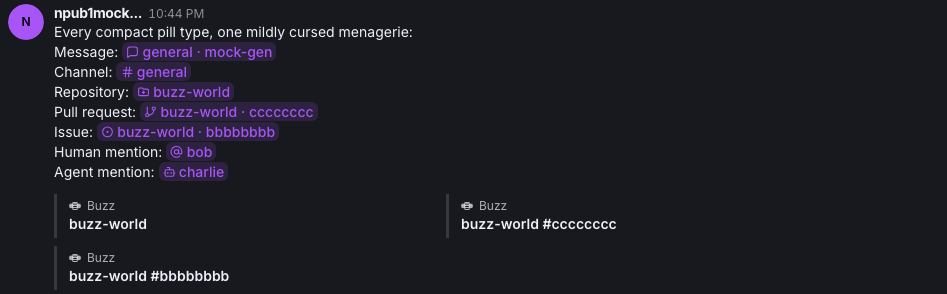
**User Impact:** Buzz channel, message, repository, pull request, and
issue links now open reliably and display recognizable context in the
desktop app.
**Problem:** Buzz links could appear as raw or ambiguous URLs, and
navigation links received during startup or community transitions could
be dropped before the UI was ready. Repository and issue shares in
particular required hover context to understand at a glance.
**Solution:** Queue desktop channel/message navigation until the UI is
ready, then render bare Buzz permalinks as icon-prefixed chips with
concise entity context while preserving user-authored Markdown labels as
ordinary links.
<details>
<summary>File changes</summary>
**desktop/src-tauri/src/deep_link.rs**
Adds validated channel-link parsing and a deduplicated, acknowledged
queue so navigation survives frontend startup.
**desktop/src-tauri/src/lib.rs**
Registers the pending-navigation state and commands with the desktop
application.
**desktop/src/features/communities/useCommunityInit.ts**
Resets queued navigation safely across community boundaries without
leaking stale destinations.
**desktop/src/features/messages/lib/channelLink.test.mjs**
Covers valid, malformed, and canonical channel permalink forms.
**desktop/src/features/messages/lib/channelLink.ts**
Defines strict parsing and detection for `buzz://channel/<uuid>` links.
**desktop/src/features/messages/lib/composerMessageLinkNode.test.mjs**
Extends composer-node coverage for normalized Buzz link content.
**desktop/src/features/messages/lib/composerMessageLinkNode.ts**
Keeps composer link-node handling aligned with the expanded Buzz link
surface.
**desktop/src/features/messages/lib/remarkChannelDeepLinks.test.mjs**
Verifies bare channel URLs become renderable deep-link nodes without
touching code.
**desktop/src/features/messages/lib/remarkChannelDeepLinks.ts**
Transforms eligible bare channel links into dedicated Markdown nodes.
**desktop/src/features/messages/lib/remarkEntityLinks.test.mjs**
Covers bare repository, pull-request, and issue detection and code-span
exclusions.
**desktop/src/features/messages/lib/remarkEntityLinks.ts**
Adds dedicated Markdown nodes for bare Buzz project entities.
**desktop/src/shared/deep-link.test.mjs**
Exercises queued navigation, acknowledgement, serialization, and
community-switch behavior.
**desktop/src/shared/deep-link.ts**
Serializes pending deep-link drains and acknowledges destinations only
after successful navigation.
**desktop/src/shared/styles/globals/markdown.css**
Aligns permalink icon geometry and spacing with agent mention chips.
**desktop/src/shared/ui/markdown.test.mjs**
Adds integration coverage for every permalink chip, authored labels,
fallbacks, icons, and static rendering.
**desktop/src/shared/ui/markdown.tsx**
Routes channel and entity nodes through the shared presentation path
while preserving authored link text.
**desktop/src/shared/ui/markdown/BuzzLinkChip.tsx**
Introduces the shared interactive/static permalink chip and
authored-label inline-link components.
**desktop/src/shared/ui/markdown/ChannelDeepLink.tsx**
Renders channel shares and references with Hash icons, names, and
shortened-ID fallbacks.
**desktop/src/shared/ui/markdown/MessageLinkPill.tsx**
Renders ordinary message shares with message icons and channel/message
context while retaining sent-from-thread behavior.
**desktop/src/shared/ui/markdown/entityLinks.tsx**
Maps repositories, pull requests, and issues to Projects-aligned icons
and contextual labels.
**desktop/src/shared/ui/markdown/nodeCache.ts**
Includes entity-link rendering in cached Markdown node handling.
**desktop/src/shared/ui/markdown/utils.ts**
Allows validated channel links through the Buzz URL transform.
**desktop/src/shared/useMessageDeepLinks.ts**
Drains queued navigation links safely and clears them during teardown.
**desktop/src/testing/e2eBridge.ts**
Extends the mock bridge with pending-navigation command behavior.
**desktop/tests/e2e/community-rail.spec.ts**
Verifies queued links do not cross community boundaries.
**desktop/tests/e2e/navigation.spec.ts**
Covers channel/message deep-link navigation during startup and active
sessions.
**desktop/tests/helpers/bridge.ts**
Adds reusable deep-link mock state and acknowledgement helpers.
</details>
## Reproduction steps
1. Run the desktop app and open a channel containing bare
`buzz://channel`, `buzz://message`, `buzz://repo`, `buzz://pr`, and
`buzz://issue` URLs.
2. Confirm each bare URL renders as one cohesive chip with a type icon,
a useful name or shortened identifier, and no duplicated channel `#`
character.
3. Add an authored Markdown link such as `[design
discussion](buzz://issue?...)` and confirm the supplied label remains an
ordinary link rather than becoming a chip.
4. Select channel and message links and confirm they navigate correctly
in warm and cold-start states.
## Screenshots / demos
Houston dark theme with custom purple accent (`#a855f7`), captured from
rebased visual implementation `ad411cc06`; current head `0aafa144f` only
adjusts E2E expectations for the visible mention-label behavior shown
here.
**Composer — channel, message, repository, pull request, and issue
pills**

**Message list — channel, message, repository, pull request, and issue
pills**
---------
Signed-off-by: Taylor Ho <taylorkmho@gmail.com>
Signed-off-by: Carl <acda9e433d19dcd0e6b6840f7f4b98f3a56f1fab98049d444c087019e6d36560@buzz.block.builderlab.xyz>
Co-authored-by: Carl <acda9e433d19dcd0e6b6840f7f4b98f3a56f1fab98049d444c087019e6d36560@buzz.block.builderlab.xyz>
Desktop input latency regressed sharply for users on v0.5.9 and worsened
on latest main: multi-second stalls when clicking back into the app,
slow fresh boots, intermittent lockups, and scroll/mouse degradation.
Reverting to `119a84897` (pre-0.5.9) was confirmed to resolve it,
isolating the regression to that range. Profiling a live production
renderer plus a commit-level audit of the range found three independent,
additive causes — fixed here — plus a long-standing `get_channels` cost
that made every remaining refetch expensive, also addressed here.

## 1. Focus-return refetch storm (`refetchOnWindowFocus`)

#5490 wired TanStack's `focusManager` to app focus and flipped ~20 query
sites to `refetchOnWindowFocus: true`. A focus return after >60s away
fires them all within milliseconds — and a click into an unfocused
window *is* a focus return, so the burst runs before the click is
processed. That is the "click into the composer, wait 5 seconds"
symptom, and it also explains why mouse input feels worse than keyboard
(clicks arrive with focus transitions; typing happens while already
focused). A 5-second `sample` of a live production renderer caught a
single window activity-state transition consuming ~1.25s of main-thread
time, dominated by `JSON.parse` in the focus listener's microtask drain.

#5535 already established the fix pattern but applied it to only two
families (channels, home-feed). This PR extends the same 5-minute
`staleTime` discipline to the remaining families: pulse (×5), workflows
(×4), agents (×4), forum (×2), presence, user-status, custom-emoji,
channel-templates, and the persona catalog. Polling cadences and
push-invalidation paths are untouched — interval refetches and
`invalidateQueries` both bypass `staleTime`, so live-update behavior is
unchanged. Each gated family exports its focus-refetch policy as an
options object that the production hook spreads into `useQuery`, and a
`focusRefetchPolicy.test.mjs` drives a `QueryObserver` with that same
production object — locking the policy behaviorally (fresh focus return
→ 0 fetches; stale → refetch) and failing if a hook's
`staleTime`/`refetchOnWindowFocus` wiring drifts.

Four families deliberately keep tighter freshness, all surfaces where
the 5-minute gate would suppress the only refresh path and none of which
feed the app-wide storm: `repo-sync-status` keeps its fresh focus
refetch (its inline comment documents the "committed in a terminal,
switched back to the app" flow as intended); the workflow-runs list
stale-gates at 10s because a remotely-started run has no push
invalidation and its conditional 1s poll is off while the cache shows no
active runs; the workflow list queries (`useChannelWorkflowsQuery` and
the all-channels aggregate) stale-gate at 10s because they have no poll
and no relay subscription, and mutation-driven invalidation only covers
this renderer — remote workflow creates/edits/deletes surface only via
focus refetch; and the managed-agent log stale-gates at one poll tick
(30s) so returning to a live agent log refreshes immediately. Run
approvals keep the 5-minute gate under
`RUN_APPROVALS_FOCUS_STALE_TIME_MS` — their focused 10s poll already
covers freshness.

## 2. Synchronous localStorage sweep on the boot/focus path

#5453's stale-cache sweep synchronously `getItem` + `JSON.parse`s every
whitelisted localStorage entry on the main thread (multi-MB on seasoned
profiles), scheduled with a `requestIdleCallback` timeout of 1.5s that
guaranteed it landed mid-boot, and re-armed on every hidden→visible
transition — stacking it onto the exact moment the focus storm fires.
#5454's `trimSelfProfileCaches()` additionally scanned every
localStorage key on every `writeSelfProfileCache()` call (which fires
per relay self-profile delivery at boot).

Now: the first sweep waits `BOOT_SWEEP_FLOOR_MS` (30s) after startup,
the scan is time-sliced across idle callbacks, and the visibility
trigger is removed — boot-delayed plus hourly still covers the 14-day
TTL contract. The sliced sweep re-checks staleness immediately before
each removal (a key rewritten fresh mid-sweep survives), isolates
per-key storage errors so one bad entry can't strand the rest of the
snapshot, defers oversized values once rather than parsing them on a
zero-budget slice, guarantees forward progress on timeout-fired
callbacks, and cancels its scheduled slice when stopped. The profile
trim keeps a lazily-initialized memoized key count so the common
under-cap write is O(1); the full parse scan runs only when the count
exceeds a cap, resyncs if external deletions made it stale, and a failed
scan skips the trim instead of aborting the write. Sweep semantics
(rules, TTLs, eviction) are unchanged, and tests cover the scheduling,
slice-progress, error-isolation, defer-once, and trim short-circuit
behaviors.

## 3. The macOS window was never opaque

#5478's glass appearance is correctly opt-in at the CSS layer, but the
compositor cost was baked in deeper than its native `on_webview_ready`
transparency call: the main window is declared `"transparent": true` in
`tauri.conf.json` (added for the original glass work in #1671), which
makes tao call `NSWindow.setOpaque(false)` at creation and resolve every
later `set_background_color(None)` to `clearColor` — and no runtime
`setOpaque(true)` path exists through tauri, while wry's runtime
background setter can only force the WKWebView's `drawsBackground` off,
never back on. So "restore the platform default" was unreachable: every
launch, glass or not, ran with a non-opaque NSWindow, defeating
WindowServer's opaque-window compositing fast path and forcing full
window compositing every frame — compounded by the existing
`backdrop-blur` chrome overlapping the scrolling timeline. This matches
the compositor-shaped symptoms (scroll and pointer input degrading
first).

The window is now created opaque (`"transparent": false`) and the
NSWindow layer is never made transparent at runtime. Glass never needed
a transparent window: behind-window `NSVisualEffectView` vibrancy
renders inside opaque windows (this is how Finder and Notes draw vibrant
sidebars); it only requires a transparent WKWebView canvas, which the
`set_window_vibrancy` enable path already establishes at runtime
(`macos-private-api` compiles that in independent of the window flag).
Enabling glass installs the vibrancy layer and then makes only the
webview canvas see-through; disabling clears the vibrancy layer — the
canvas may stay non-drawing afterwards (wry's flag is one-way at
runtime), which is harmless because glass-off CSS paints fully opaque
above an always-opaque NSWindow. The boot-path first-frame backing
writes touch only the NSWindow backing color and are therefore inert to
glass state regardless of how they order against the `ThemeProvider`'s
vibrancy call on a persisted-glass-on cold boot. Glass-off users (the
default) get an end-to-end opaque window from boot for the first time.

## 4. `get_channels`: serial round-trips and a multi-MB payload on every
refetch

The stale gates in (1) cut refetch frequency; this cuts the cost of the
refetches that legitimately remain (boot, and focus returns after more
than 5 minutes away — previously still a multi-second stall).
`get_channels` made ~8 fully serial relay round-trips (~3.2–3.6s at
1,100+ channels), then shipped the full `ChannelInfo` list — including
every channel's member pubkeys — across IPC, where the renderer's
`JSON.parse` of the multi-MB payload froze the main thread (the ~1.25s
stall captured in the live sample).

- **Concurrent stages**: the membership chain, the open-channel
directory scan, and the hidden-DM snapshot run concurrently, as do the
member-count and last-message queries that follow. The critical path
drops from ~8 sequential round-trips to 2 phases. Filters, limits,
pagination, and merge semantics are unchanged.
- **Not-modified short-circuit**: the command now takes a
client-supplied content hash (FNV-1a 64 over the channel list,
canonicalized by id and excluding `last_message_at`) and omits the
channel list from the response when nothing else changed. Last-message
timestamps — which change on nearly every message anywhere — ship as a
small separate map that the client overlays onto its cached list with
reference preservation, so React Query's structural sharing also skips
downstream re-renders. On a typical refocus the renderer parses
kilobytes instead of megabytes. The hash is stored in the query cache
itself, tying its lifecycle to the data it describes so a community
switch can never leak a stale hash.

The E2E mock bridge speaks the new payload shape — including the
complete `last_messages` map the client treats as authoritative — and
hash canonicalization plus overlay reference-preservation are
unit-tested on both sides.

---------

Signed-off-by: Will Pfleger <pfleger.will@gmail.com>
## Why

The Inbox mixed overlapping feed categories with personal work queues,
so **All** was not actually comprehensive and several filters did not
make it clear why an item appeared. Threads and DMs could produce one
row per event instead of one row per conversation, drafts were hidden
until selected, and reminders appeared through multiple competing
presentations.

This refactor makes the **Inbox** a focused, conversation-oriented place
to catch up on work relevant to you. It is intentionally not a mirror of
every unread event in every channel.

## What changed

- Keep the destination named **Inbox** and use the standard Lucide bell
icon.
- Refocus **All** on DMs, mentions, thread replies, needs-action items,
replies from agents the user owns or controls, due reminders, and active
drafts.
- Exclude generic top-level channel traffic and updates from agents the
user does not own or control.
- Group each thread or DM into one row, sorted by latest activity.
- Resume an unread conversation at its oldest unread message while
opening the full thread or DM in the detail pane.
- Reuse the existing **New** divider at the unread boundary.
- Make the detail title a direct link to the canonical conversation.
- Give Reminders and Drafts the same list/detail interaction and
location metadata as conversation rows.
- Separate Reminders and Drafts from message filters with a subtle
divider, without adding another labeled section.
- Put reminder and draft counts beside their corresponding filter labels
instead of on the generic filter button.
- Preserve the selected conversation when switching filters if it
remains valid; otherwise select a valid replacement without flashing
stale detail.
- Use filter-specific empty states and rename the options toggle to
**Show unread only**.
- Ship the focused behavior directly. The earlier experiment gate,
Custom view, and default-view controls have been removed from this PR to
keep the first pass focused.

## Filter model

| Filter | What appears |
| --- | --- |
| **All** | One row per personally relevant conversation, plus due
reminders and active drafts. Includes DMs, mentions, thread replies,
explicit needs-action items, and replies from agents the current user
owns or controls. Excludes generic top-level channel traffic, other
agents' updates, and reminders that are not due yet. |
| **Mentions** | Conversations containing a direct mention. Each
conversation appears once and opens with full context. |
| **Threads** | Conventional threaded replies, grouped to one row per
thread. Broadcast replies are not treated as conventional thread
replies. |
| **Needs action** | Feed items explicitly classified as requiring
action. |
| **Agents** | Conversations whose representative response was authored
by an agent the current user owns or controls, including top-level DM
responses. If a human replies afterward, the conversation leaves this
filter until an owned agent responds again. |
| **Reminders** | All pending reminders, including upcoming reminders
that stay out of **All** until they are due. |
| **Drafts** | Active drafts, ordered by their last real edit time. |

## Grouping, ordering, and state

- A thread or DM creates one Inbox row rather than one row per event.
- An unread conversation resumes at its oldest unread message so
intervening context is not skipped.
- Conversation rows still sort by their latest activity.
- The detail pane opens the full available conversation and shows the
shared **New** divider before the first unread message.
- Upcoming reminders appear only in **Reminders**.
- When a reminder becomes due, it enters **All** at its trigger time. If
its source conversation is already represented, the reminder state
merges into that row instead of creating a duplicate; otherwise it
appears as a standalone reminder row.
- A due reminder can enrich a row in another relative filter when that
conversation already qualifies for the filter. Reminder lifecycle
remains separate from message read state.
- Drafts appear in **All** by their last real edit time. Opening an
unchanged draft does not move it to the top.
- Reminder and draft rows show their location as `In #channel` or `In DM
with <name>`.
- **Show unread only** hides reminder and draft work queues because they
do not share message unread semantics.

## Removed or narrowed

- **Remove the old Activity filter.** It overlapped with All while still
omitting items All now includes.
- **Narrow Agents.** It no longer gathers every agent participating in a
shared thread or subsequent human follow-ups.
- **Remove duplicate reminder presentations.** The aggregate
pending-reminders jump and duplicate generic feed rows are replaced by
one list/detail model.
- **Remove Custom and default-view settings from this pass.** They added
considerable state and UI before the core model had been validated.
- **Do not add section labels for Reminders and Drafts.** A divider
communicates the distinction without creating another hierarchy in the
menu.

## Risk assessment

Medium implementation risk because this changes composition, grouping,
ordering, read behavior, and personal queues in a primary desktop view.
The implementation is scoped to the desktop UI and its local feed
projection; it does not change relay schemas or public APIs.

## Testing

- Desktop formatting, lint, file-size, text-size, and TypeScript checks
passed.
- Desktop unit suite: **3,663 passed, 0 failed**.
- Desktop E2E production build passed.
- Playwright smoke coverage across every spec touching this surface
(`channels`, `smoke`, `profile`, `project-inbox`, `community-rail`,
`integration`, `drafts-screenshots`): **118 passed, 0 failed**.
- Full Playwright smoke project: **732 passed, 1 skipped**. Three local
failures were investigated and cleared — `community-rail` keyboard
reorder passed on re-run (flaky), while `relay-reconnect:97` and
`video-attachment:223` are untouched by this commit (the only change to
shared `tests/helpers/bridge.ts` is a comment) and pass in CI.
- Unit coverage includes focused All matching, owned-agent filtering,
conversation grouping, oldest-unread selection, selection stability,
chronological reminder/draft composition, trigger-time reminder
ordering, and duplicate reminder suppression.

## Update: July 27, 2026

The naming decision is settled: the surface stays **Inbox**. An earlier
pass in this branch had renamed it to **Activity**; that rename has been
reverted in `9c00d2d6e`, which is naming-only and changes no behavior.

The revert covers file names, component/hook/type/constant identifiers,
the sidebar label and tooltip, the `Inbox options` and `Filter inbox:`
aria-labels, and the corresponding test names, test ids, and fixture
ids.

Three things were deliberately left as `activity`:

- **The feed API contract** — the `activity` / `agent_activity`
categories, the `feed.activity` and `feed.agentActivity` keys, and the
`types=` query parameter. These are the server's names, not the
surface's.
- **Plain-noun usage** — empty states such as "No activity yet", plus
`latestActivityAt` and `PROJECT_ACTIVITY_KINDS`.
- **Pre-existing agent, project, and profile activity code**, which
refers to a different concept entirely.

The earlier experiment-gate approach has also been dropped, so
`tests/helpers/bridge.ts` no longer claims that an Activity preview
feature exists — `preview-features.json` has no such entry and the seed
helper enables every desktop feature.

Generated with Codex

---------

Signed-off-by: Clay Delk <clay.delk@gmail.com>
Co-authored-by: Claude Opus 5 (1M context) <noreply@anthropic.com>


