**Category:** improvement
**User Impact:** Users can scan what each workflow does and trigger,
edit, duplicate, enable, disable, or delete it directly from the
library.
**Problem:** The workflow list buried common actions and did not expose
each automation's trigger-to-action shape at a glance.
**Solution:** Add a responsive workflow library with a persistent create
tile, compact trigger/action diagrams, prominent workflow titles with
supporting descriptions, and shared card actions while preserving
existing detail, editor, and run-history entry points. Card toggles
refresh both list and open-detail caches so status and definition stay
consistent.
<details>
<summary>File changes</summary>
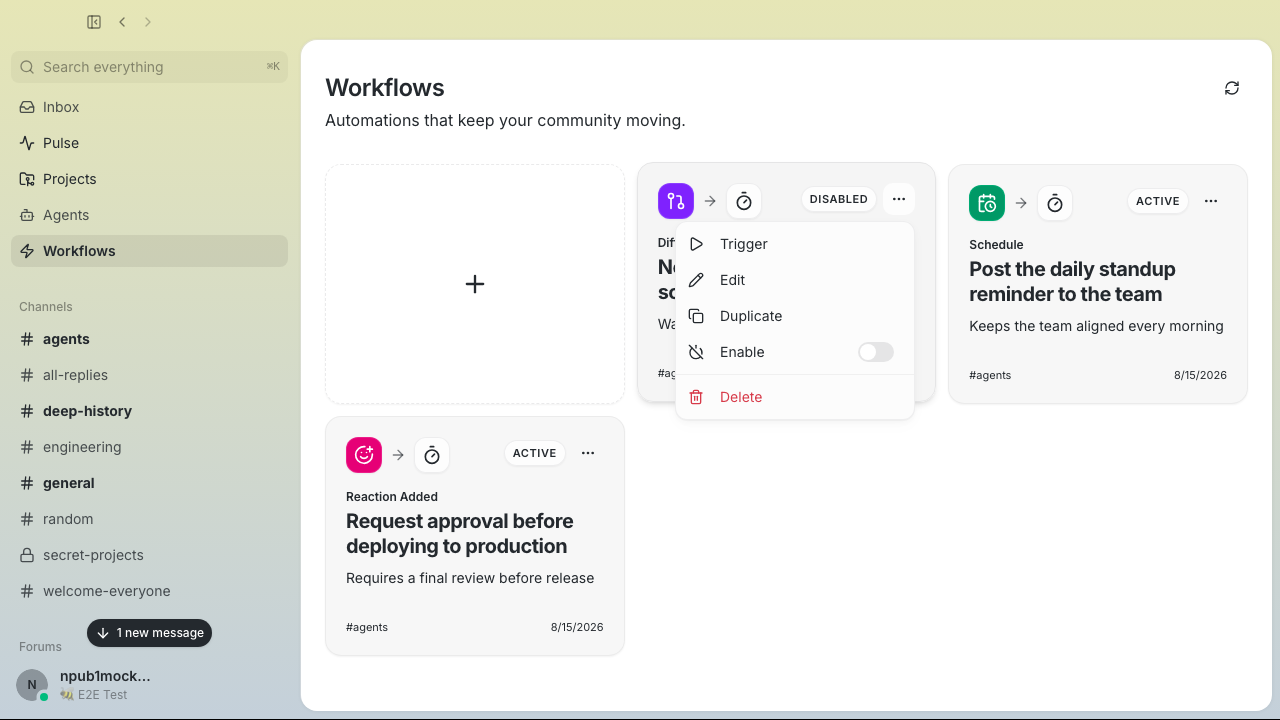
**desktop/src/features/workflows/ui/WorkflowActionsMenu.tsx**
Adds a shared card menu for trigger, edit, duplicate, enable/disable,
and delete actions.
**desktop/src/features/workflows/ui/WorkflowCard.tsx**
Reworks cards around the prototype's visual hierarchy: color-coded
trigger, action flow, sentence-case eyebrow, prominent title, supporting
description, status, channel, and update date without a footer clock
icon.
**desktop/src/features/workflows/ui/WorkflowsView.tsx**
Adds the responsive grid, create tile, mutation wiring, and list/detail
cache invalidation. Container breakpoints keep cards two-across at
medium widths and three-across in the 1280px desktop layout.
**desktop/src/features/workflows/ui/workflowDefinition.ts**
Adds immutable enabled-state updates plus narrow trigger and
first-action readers used only to select card icons.
**desktop/src/features/workflows/ui/workflowDefinition.test.mjs**
Covers neutral icon selection, enabled-state immutability, and status
presentation.
**desktop/tests/e2e/workflows.spec.ts**
Covers the create tile, title/description hierarchy, selected-card
enable/disable consistency, and deterministic narrow/medium/wide
captures while retaining existing action coverage.
</details>
## Reproduction steps
1. Open **Workflows** and confirm the create tile stays first as cards
flow from one to three columns with available width.
2. Confirm each card shows a sentence-case trigger eyebrow, prominent
workflow title, supporting description when present, status, channel,
and update date without a clock icon.
3. Open a card's overflow menu and trigger, edit, duplicate,
enable/disable, or delete the workflow.
4. Leave the detail panel open while toggling and confirm its badge and
JSON definition update with the card.
## Screenshots
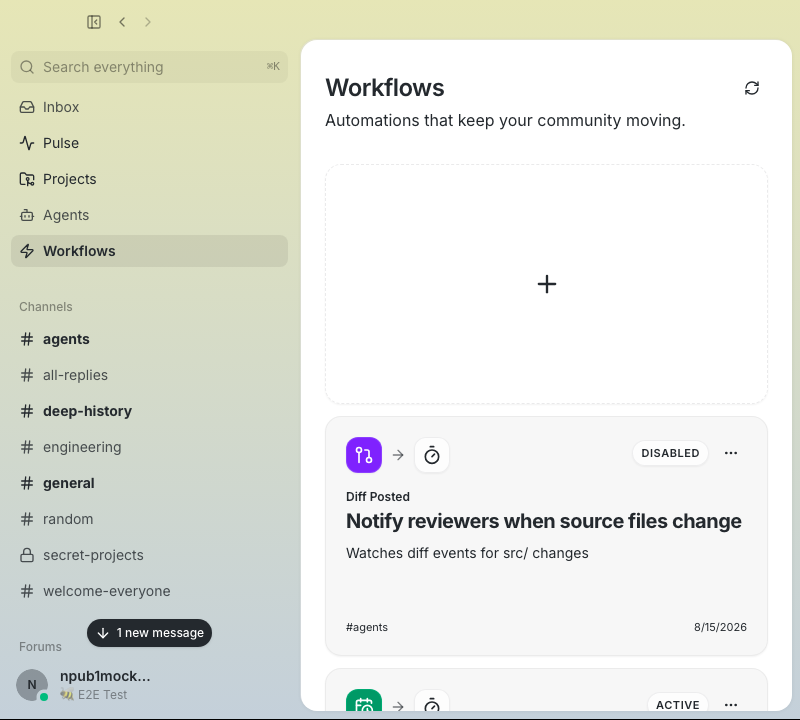
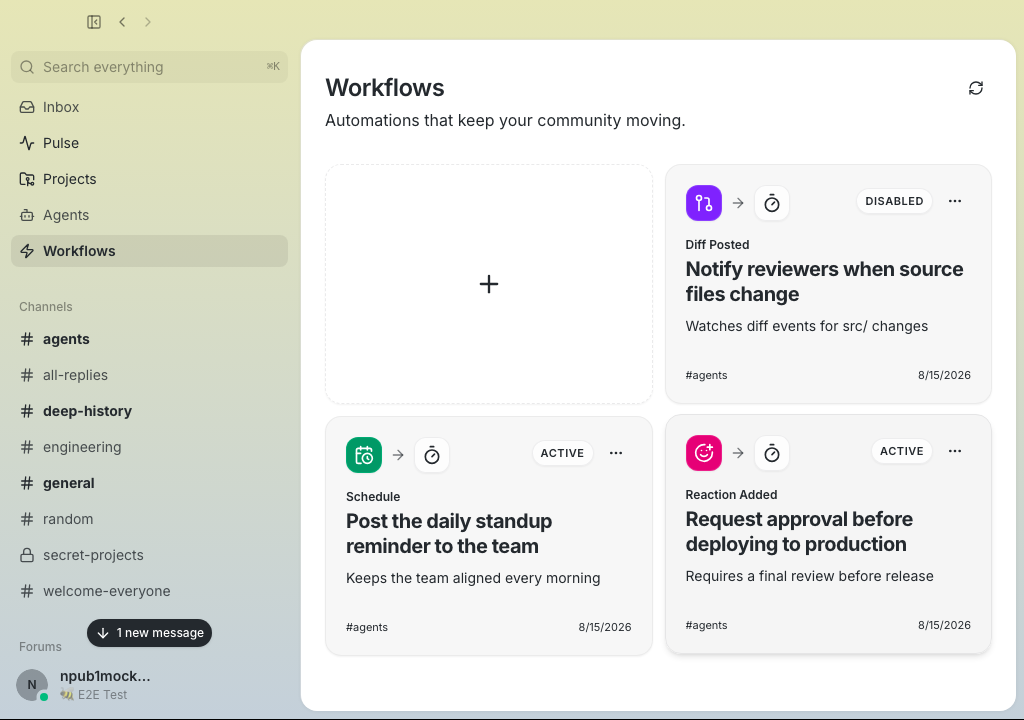
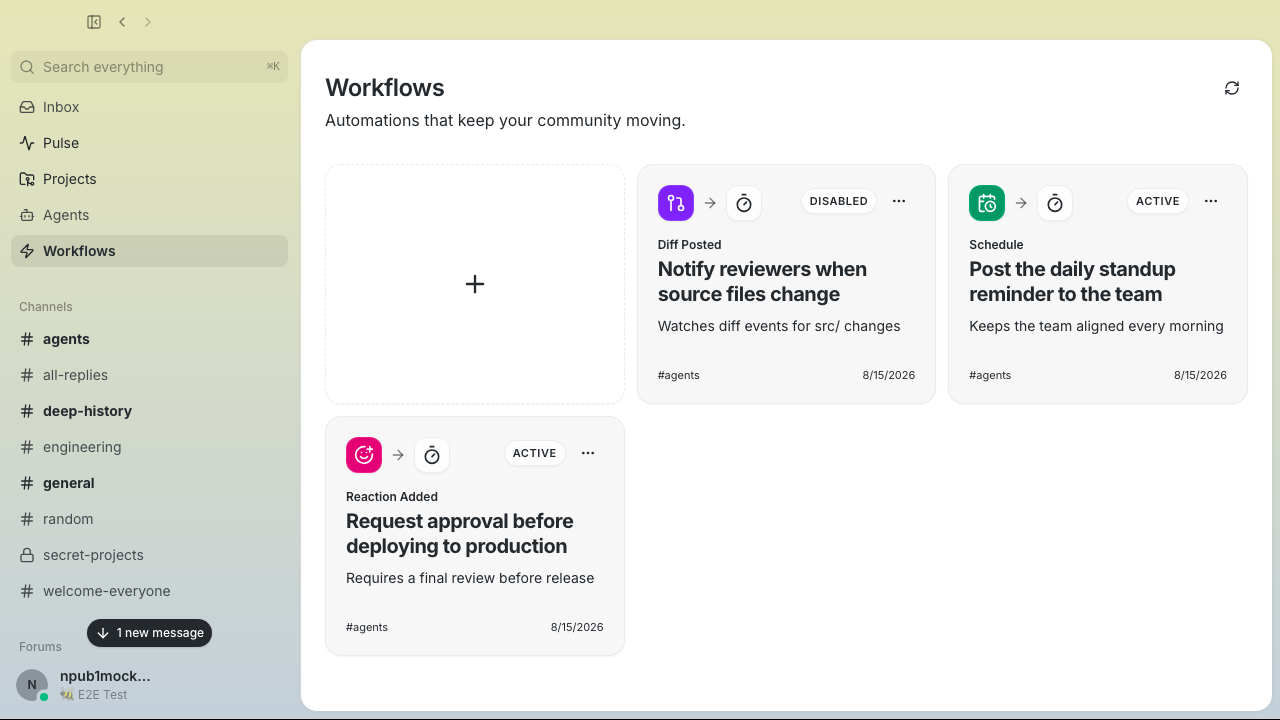
Real built E2E UI with representative workflow data at three viewport
sizes.
### Narrow — 800 × 720
### Medium — 1024 × 720
### Wide — 1280 × 720
### Card actions
---------
Signed-off-by: Taylor Ho <taylorkmho@gmail.com>
## Summary
Projects v3 makes repository work shareable, discussion-aware, and
easier to scan in one coherent workspace. People can copy canonical
links, reopen the exact workspace tab, understand issue and pull-request
context at a glance, find related channel conversations, and assign or
unassign issues across Desktop and CLI.
- **Unified workspace** — top-level sections sit above repository
controls in one rounded workspace, with navigation positioned close to
the page heading. README and Files retain branch selection; every
section has a labeled icon header, and Issues and Pull Requests expose
creation from a consistent right-aligned action.
- **Repository management** — the repository selector is always
available, including single-repository projects. Its integrated add flow
lets project owners create a repository manually or select an existing
repository without a separate toolbar button.
- **Readable work-item lists** — issue and pull-request rows use
plain-language context instead of opaque metadata. Files, commits,
issues, pull requests, channels, and contributors share consistent row
density and right-aligned timestamps, while deterministic
fallback-avatar colors keep participants distinct on light backgrounds.
Inbox pull-request metadata wraps between complete phrases and truncates
long channel names instead of compressing copy into narrow columns.
- **Reliable entity links** — projects, repositories, issues, pull
requests, and commits have canonical `buzz://` links, preview cards, OS
deep-link routing, and tab-aware navigation. Reopening the same link
re-applies its destination instead of leaving the user on a locally
selected tab.
- **Related conversations** — repository and work-item views surface
channels discussing the current entity, including participants, channel
navigation, message context, and an explicit notice when discovery
reaches its 500-result cap.
- **Reversible issue ownership** — trusted assignment and unassignment
events work across Desktop, Tauri, `buzz-sdk`, and `buzz issues`.
Assignees appear in project views and the assigned inbox, while
authorized users can remove assignments directly from the assignee row.
Assignment state is derived chronologically from labeled Nostr notes.
Issue authors and repository owners may change any assignee; other users
may only assign or unassign themselves. Shared golden fixtures keep
entity-link grammar and validation aligned across TypeScript and Rust.
The branch also updates `webbrowser` to the patched release for
RUSTSEC-2026-0257.
### Related issue
N/A.
### Testing
- [x] `just ci` — formatting, lint, typechecking, unit tests, and builds
passed
- [x] Full pre-push suite — organization, branch-skew, Desktop checks,
typechecking, and tests passed on the latest push
- [x] `cargo test -p buzz-cli` and focused `buzz-sdk` assignment tests
passed
- [x] Focused Tauri recipient-note and 500-result search-limit tests
passed
- [x] Desktop entity-link and issue-assignment unit tests passed
- [x] Playwright smoke coverage passed for assignment, repeated
entity-link navigation, repository create/select flows, section headers
and actions, timestamp alignment, timeline icons, sentence-style
issue/PR metadata, header spacing, avatar contrast, and Inbox metadata
at stacked and side-rail breakpoints
- [ ] Manual staging pass: link round-trips, Channels tab, assignment
flows, and inbox routing
### Screenshots
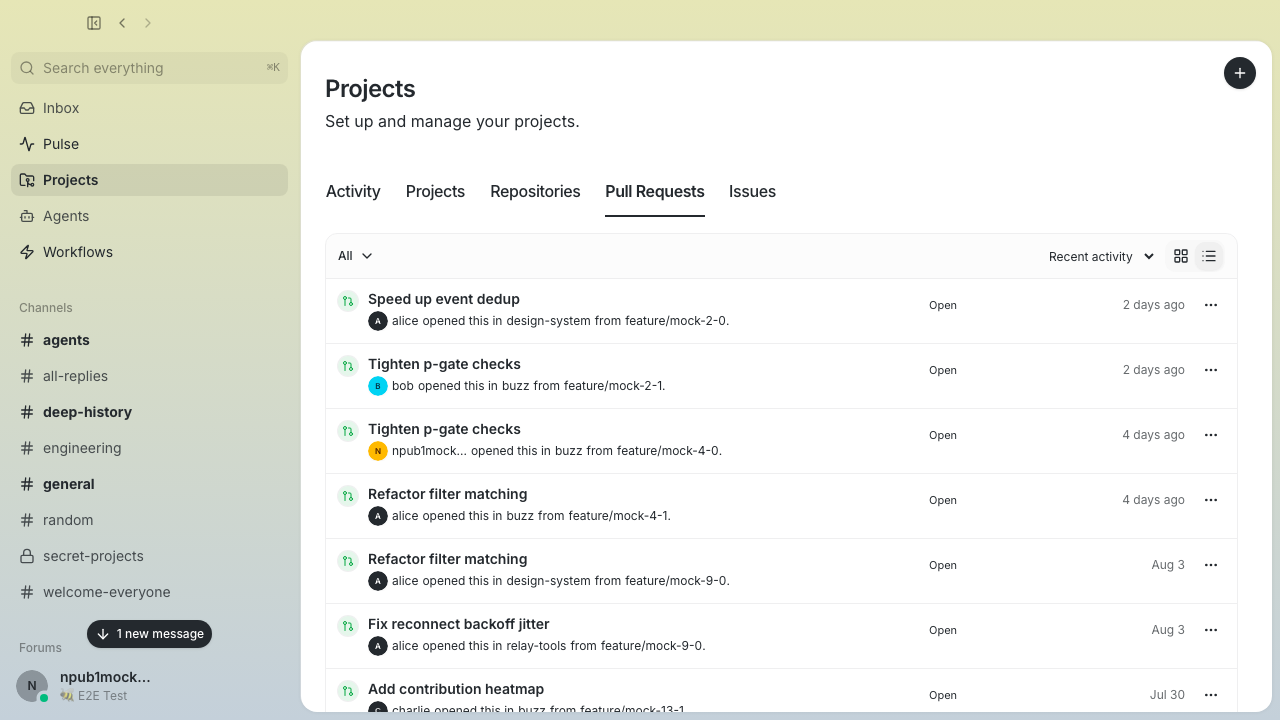
Pull requests explain who opened the request, where it lives, and which
branch it comes from; fallback avatars remain visually distinct.
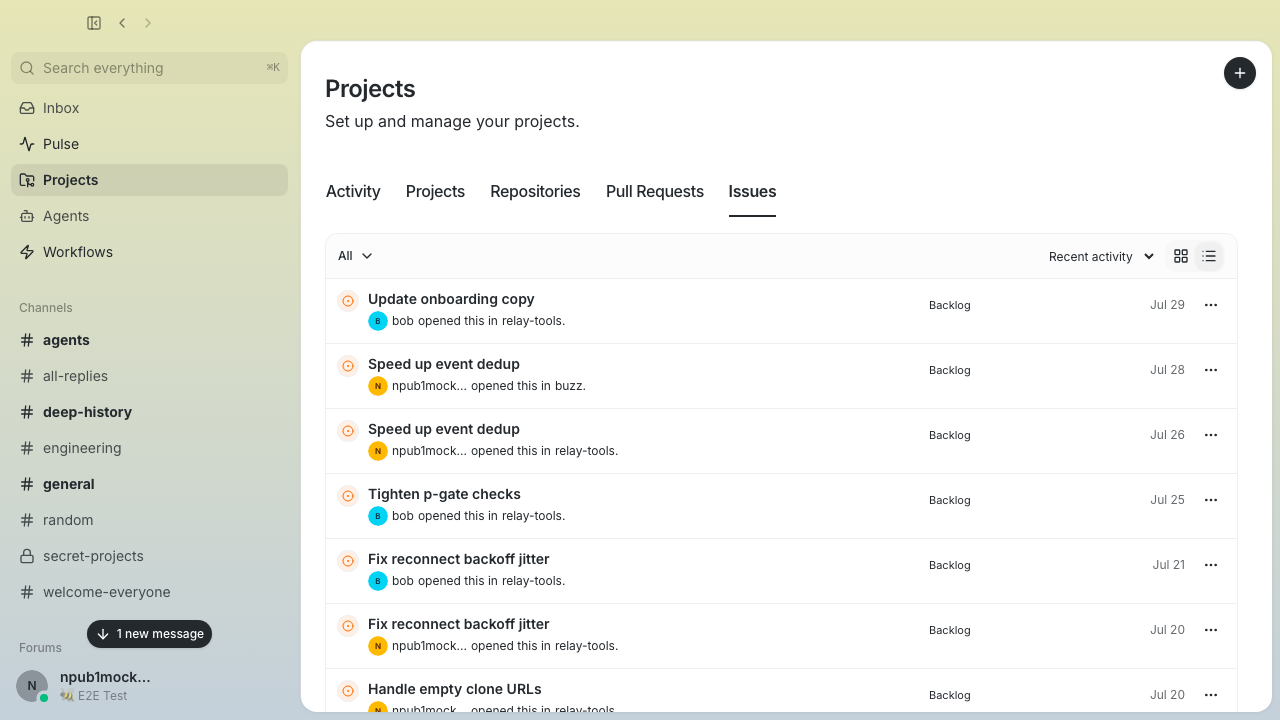
Issues use the same sentence-style hierarchy while keeping status and
recency easy to scan.
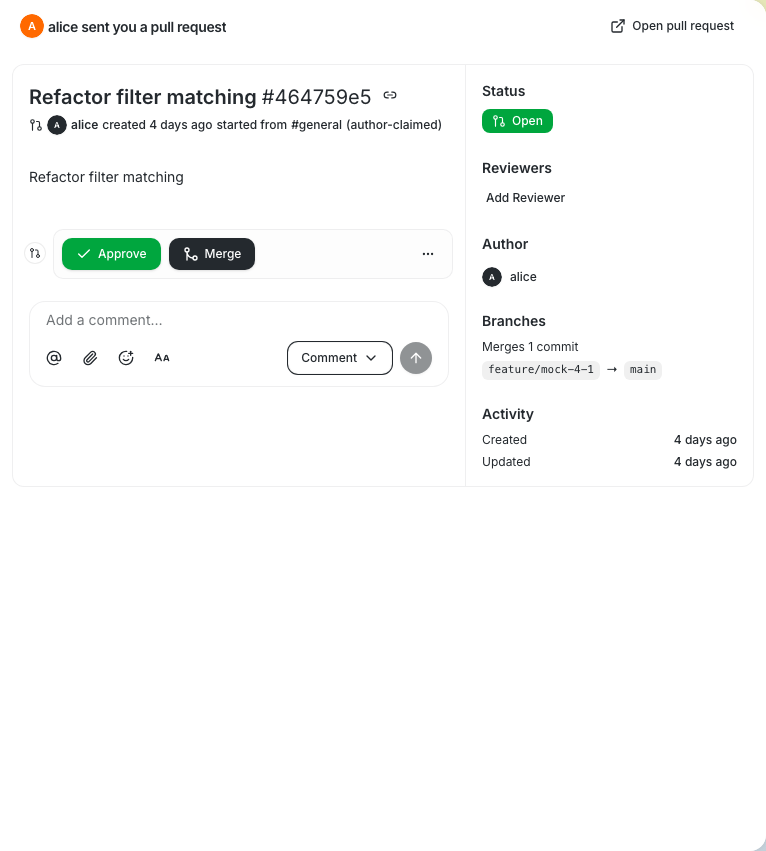
The wide Inbox detail keeps author, timestamp, and origin context
readable beside its metadata rail.
[View the complete six-state Projects v3 screenshot
set](https://github.com/block/buzz/pull/5624#issuecomment-5268039672)
and [the compact/wide Inbox
comparison](https://github.com/block/buzz/pull/5624#issuecomment-5268614585).
---
> Supersedes #5624, whose head commit accumulated permanently-queued
required check suites (block-dco-check et al.) that GitHub never
dispatched. History flattened into a single signed-off commit on latest
main; tree verified byte-identical (`git merge-tree`) to merging the
original branch into main.
---------
Signed-off-by: Thomas Petersen <thomasp@squareup.com>
Co-authored-by: Wintermute <3f1797424fd9ad6653a83665c660517777cd7f8c228c0d5907f49e01537f3ca5@buzz.block.builderlab.xyz>
## What users saw
`buzz messages send` silently removed an explicitly supplied
self-mention. The caller passed `--mention <sender-pubkey>` and received
`accepted:true`, but the signed event had no matching `p` tag and
`mention_pubkeys` was empty.
## Why it happened
`nostr` 0.44 strips `p` tags matching the signer's pubkey by default.
The codebase already opts out with `.allow_self_tagging()` for identity
archive and unarchive requests, but the message and forum builders that
accept mentions did not. The library therefore removed the tag during
signing after the CLI had validated the explicit mention.
## What changed
Added `.allow_self_tagging()` to all three event builders that accept
mention tags:
- `build_message` (kind 9)
- `build_forum_post` (kind 45001)
- `build_forum_comment` (kind 45003)
An explicit mention now survives signing even when it matches the
sender.
## How this was tested
Added one regression test per builder. Each test signs with the same key
included in the mention list and asserts that the resulting event
preserves the self-referential `p` tag.
Validation at `cd0f30bca`:
```text
./bin/cargo fmt --all -- --check
cargo test -p buzz-sdk --lib
cargo test -p buzz-cli --lib
cargo clippy -p buzz-sdk -p buzz-cli --all-targets -- -D warnings
```
All 257 `buzz-sdk` tests and all 321 `buzz-cli` tests passed, and
formatting and strict Clippy checks completed successfully.
## Scope and non-goals
- Does not change mention validation, deduplication, or channel-member
checks.
- Does not change `normalize_mention_pubkeys`, which is not used by the
messages-send path.
- Does not add a dropped-mentions output field because the explicit tags
are now preserved.
Closes#4906.
---------
Signed-off-by: Brad Groux <bradgroux@hotmail.com>
Signed-off-by: npub17q2gdupkvswvk5kprwc7plergm4gn295uw6fe4mjyjv53ahuhtnq02jd3f <f01486f036641ccb52c11bb1e0ff2346ea89a8b4e3b49cd772249948f6fcbae6@digitalmeld.communities.buzz.xyz>
Signed-off-by: Brad Groux <3053586+BradGroux@users.noreply.github.com>
Signed-off-by: Wes <wesbillman@users.noreply.github.com>
Co-authored-by: npub17q2gdupkvswvk5kprwc7plergm4gn295uw6fe4mjyjv53ahuhtnq02jd3f <f01486f036641ccb52c11bb1e0ff2346ea89a8b4e3b49cd772249948f6fcbae6@digitalmeld.communities.buzz.xyz>
Co-authored-by: Wes <wesbillman@users.noreply.github.com>
Co-authored-by: Carl <c7ebe626f000404285d3686e1dc74cc07cc60a9754a150041ba132e14bd3e2ec@buzz.block.builderlab.xyz>
**Category:** fix
**User Impact:** Custom emoji with valid 64-character names can now be
used as reactions without errors.

**Problem:** Buzz accepted 64-character custom emoji names during
registration, but rejected them as reactions after the required
surrounding colons made the payload 66 characters. Validation also
differed between desktop, SDK, relay, and storage boundaries.

<img width="554" height="47" alt="image"
src="https://github.com/user-attachments/assets/4013452f-210e-4dd3-9003-f45ff3b28dc8"
/>

**Solution:** Keep the product limit at 64 ASCII characters for custom
emoji names, enforce it consistently when emoji sets are registered, and
allow only valid matching custom reaction payloads up to 66 characters.
Widen the reaction projection to preserve the wrapped payload while
retaining the existing 64-character limit for ordinary reactions.

<details>
<summary>File changes</summary>

**crates/buzz-sdk/src/builders.rs**
Defines the shared custom emoji boundaries and covers accepted
64-character and rejected 65-character shortcodes.

**crates/buzz-relay/src/handlers/ingest.rs**
Validates emoji-set shortcodes and permits 66-character reactions only
when they are valid colon-wrapped custom emoji with a matching tag.

**crates/buzz-db/src/event.rs**
Adds storage regression coverage for maximum-length custom emoji
reactions.

**crates/buzz-db/src/migration.rs**
Verifies the reaction column migration is applied correctly.

**desktop/src/shared/api/customEmoji.ts**
Enforces the existing 64-character shortcode maximum during desktop
normalization and registration/import.

**desktop/src/shared/api/customEmoji.test.mjs**
Covers the desktop shortcode boundary.

**migrations/0027_long_reaction_payloads.sql**
Widens stored reaction payloads to 66 characters for the two required
surrounding colons.

**schema/schema.sql**
Keeps the desired schema aligned with the migration.

</details>

## Reproduction Steps

1. Register or import a custom emoji whose ASCII shortcode is exactly 64
characters.
2. Select that emoji as a reaction to a message.
3. Confirm the reaction publishes, persists, and renders without an
error.
4. Attempt to register a 65-character shortcode and confirm it is
rejected.
5. Publish an ordinary or malformed reaction over 64 characters and
confirm the relay rejects it.

## Verification

- `cargo test -p buzz-sdk`: 243 passed
- `cargo test -p buzz-db`: 94 passed, 152 Postgres-required tests
ignored
- `pnpm test` in `desktop`: 3,859 passed
- `cargo test -p buzz-relay`: 795 passed, 9 existing
Postgres-unavailable failures, 35 ignored; new reaction boundary tests
pass directly
- `cargo fmt --all -- --check`
- `git diff --check`

Originating Buzz channel: `f2ec9671-d78e-4cde-894c-9f4c458c7f1f`

---------

Signed-off-by: Taylor Ho <taylorkmho@gmail.com>
Co-authored-by: npub1223z34hd7vtwc6qj4s7flsxkj644nlre2nthu7lrrmkumhu3xddsrx9r6w <52a228d6edf316ec6812ac3c9fc0d696ab59fc7954d77e7be31eedcddf91335b@buzz.block.builderlab.xyz>
## Summary

The desktop client renders a persistent user status (NIP-38 kind:30315,
`d:general`) as the status line on profiles, but the CLI had no way to
set it — only ephemeral presence (`set-presence`, kind:20001).
Integrations that want a scriptable, durable status line (for example a
now-playing music bridge that shows the current TIDAL track on a
profile) had no entry point.

## Screenshots

<img width="1455" height="960" alt="1"
src="https://github.com/user-attachments/assets/f1669ec6-212b-4f6e-ad53-07df9aacffc9"
/>
<img width="1455" height="960" alt="2"
src="https://github.com/user-attachments/assets/5bf70f47-e5b5-4eb0-a426-b5f1ef90d2ec"
/>


This adds:

```bash
buzz users set-status --text "Working on the relay" --emoji "🔧"
buzz users set-status --text "" --emoji "🎶"   # intentional emoji-only status
buzz users set-status --clear                  # removes the status
```

- Signs and submits the replaceable kind:30315 event via the HTTP bridge
(no WS needed — unlike presence, user status is a stored event).
- Uses the `d:general` coordinate the desktop client already reads for
the profile status line, and the same `emoji` tag shape
`SetStatusDialog` publishes.
- Event construction lives in `buzz_sdk::build_user_status()`, keyed off
`buzz_core::kind::KIND_USER_STATUS`, so the CLI command is a thin
sign/submit wrapper. Text and emoji are trimmed; a blank emoji is
omitted rather than emitted as an empty tag.
- Clearing is the explicit `--clear` flag, mutually exclusive with
`--text`/`--emoji`. It publishes an empty-content event carrying only
`d:general`, which the desktop treats as no status. `--text ""` with an
`--emoji` is an emoji-only status, not a clear.

---------

Signed-off-by: Kagan Yaldizkaya <kagan@squareup.com>
Signed-off-by: Will Pfleger <pfleger.will@gmail.com>
Co-authored-by: Will Pfleger <pfleger.will@gmail.com>







