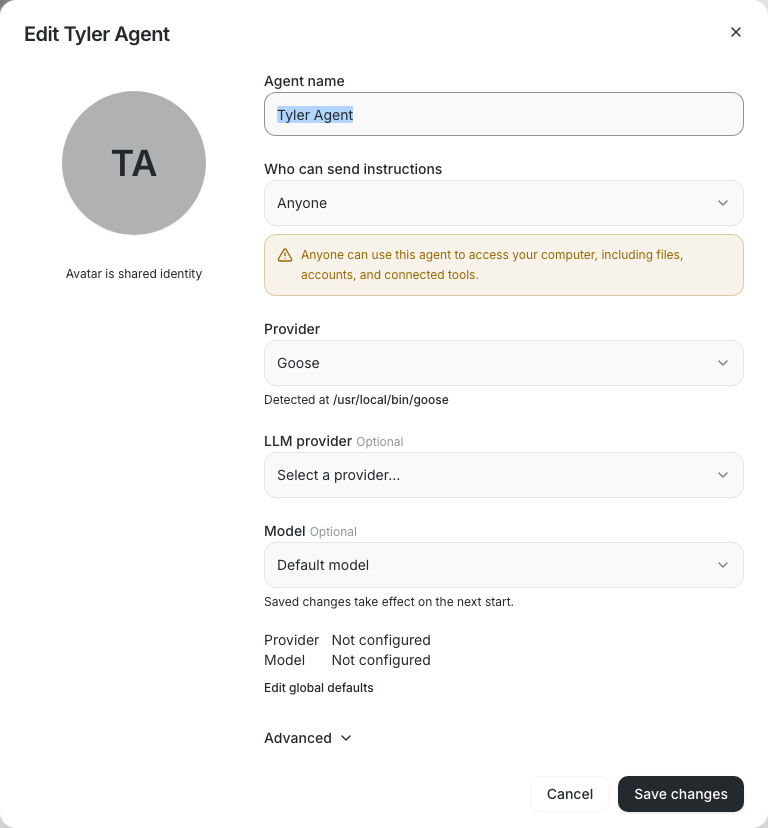
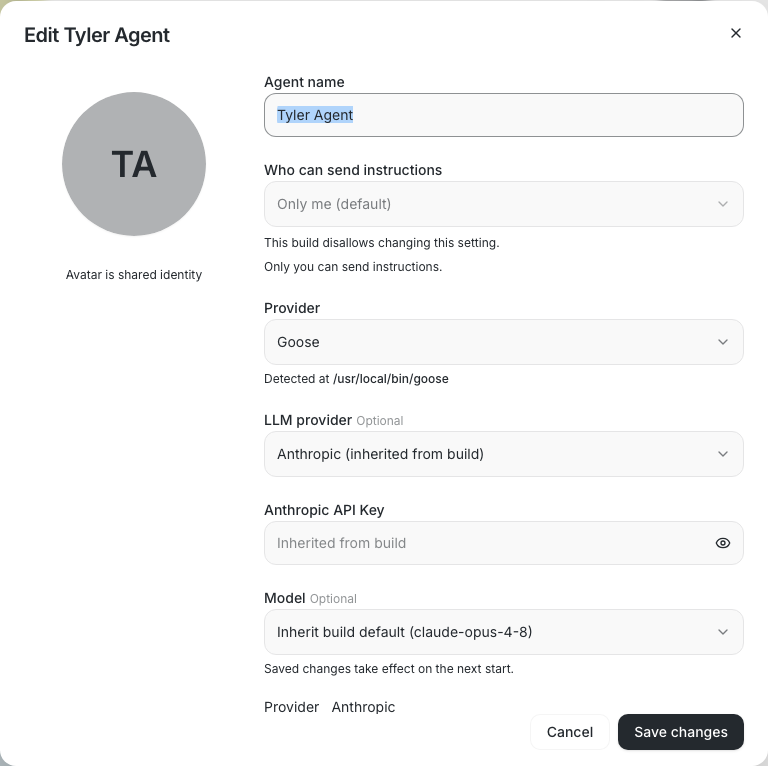
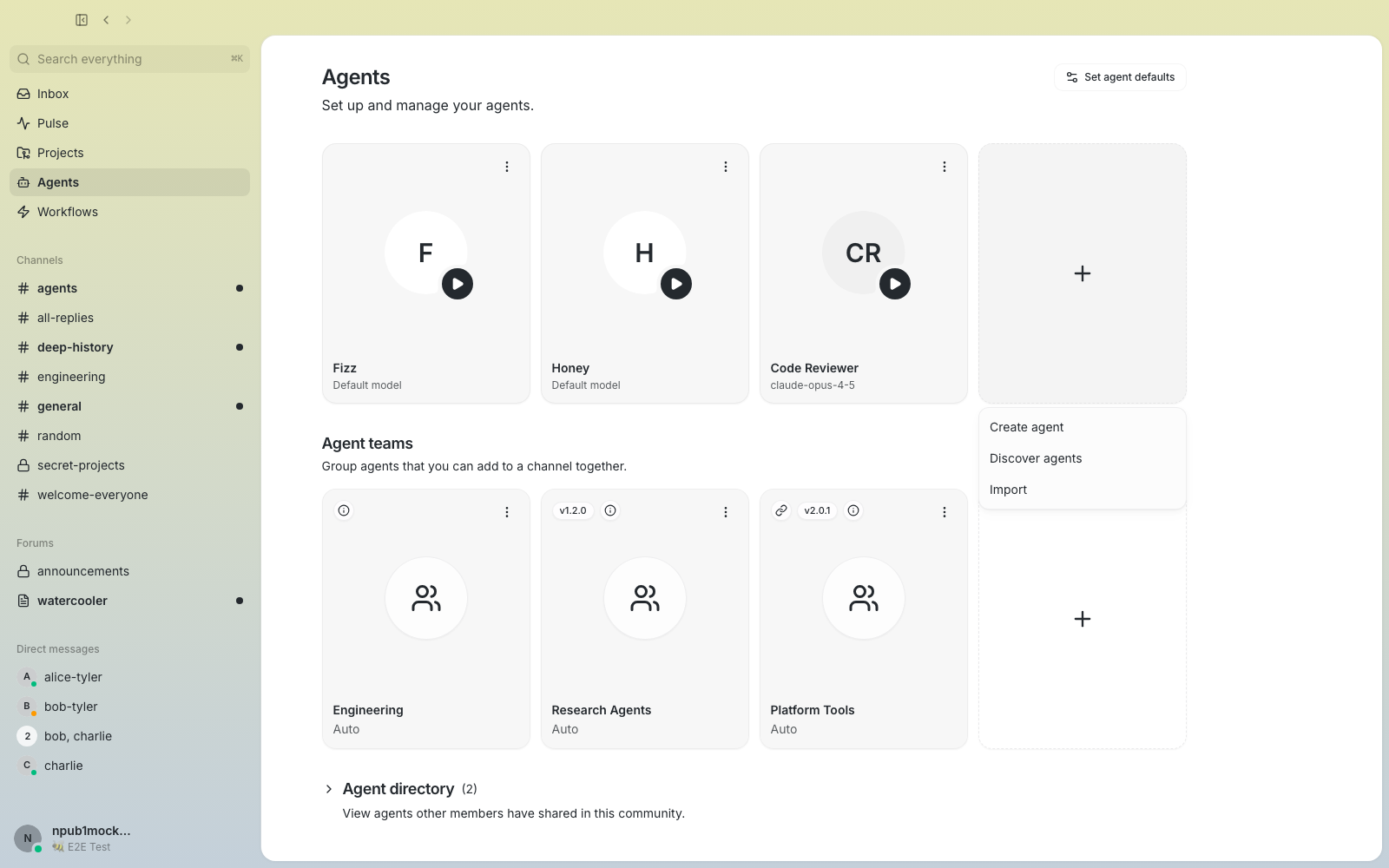
**Category:** new-feature
**User Impact:** People who lose a desktop identity can securely restore
it from a signed-in Buzz phone without creating a replacement identity.
**Problem:** A fresh or identity-lost desktop could not recover its
existing full Buzz identity from an already-authorized phone.
**Solution:** Add a SAS-confirmed reverse NIP-AB transfer, durable
desktop import, a dedicated mobile recovery entry point, and clearer
desktop recovery dialogs with tested loading, drag-and-drop, and failure
states.
https://github.com/user-attachments/assets/e9215c9c-80d0-462f-9161-0fa184ca2f74
<details>
<summary>File changes</summary>
**crates/buzz-core/src/pairing/session.rs**
Adds the reverse encrypted payload and source-completion state
transitions used for phone-to-desktop recovery.
**desktop/src-tauri/src/commands/identity.rs**
Exposes the existing guarded identity commit path for recovery imports.
**desktop/src-tauri/src/commands/pairing.rs**
Adds recovery-mode pairing, durable nsec import, start serialization,
stale-task protection, and explicit rejection of unsupported recovery
payloads.
**desktop/src-tauri/src/lib.rs**
Registers the recovery pairing command.
**desktop/src/app/App.tsx**
Refreshes the recovered identity before continuing onboarding.
**desktop/src/features/onboarding/machineOnboarding.ts**
Adds recovery transitions to the onboarding state machine.
**desktop/src/features/onboarding/ui/BackupPasswordTimeline.tsx**
Adds the visual backup-to-password-to-unlock progression.
**desktop/src/features/onboarding/ui/IdentityRecoveryPairing.tsx**
Implements QR generation, copy fallback, SAS confirmation, cancellation,
expiry, and completion UI.
**desktop/src/features/onboarding/ui/MachineOnboardingFlow.tsx**
Connects private-key, phone, and backup recovery paths to the onboarding
flow.
**desktop/src/features/onboarding/ui/NostrKeyImportForm.tsx**
Polishes recovery dialogs, backup drag-and-drop, loading stability, and
security copy.
**desktop/src/shared/api/tauri.ts**
Keeps the existing pairing API surface focused on standard
desktop-to-mobile pairing.
**desktop/src/shared/api/tauriPairing.ts**
Adds the recovery pairing invoke without growing the ratcheted shared
API file.
**desktop/src/testing/e2eBridge.ts**
Mocks recovery pairing commands and lifecycle events for browser tests.
**desktop/tests/e2e/identity-lost.spec.ts**
Covers lost-identity entry, QR/copy recovery, SAS, cancellation, expiry,
success, errors, backup import, drag-and-drop, and screenshots.
**desktop/tests/e2e/onboarding.spec.ts**
Verifies recovered identities continue through harness setup without
replacement-key side effects.
**mobile/lib/features/pairing/pairing_page.dart**
Adds recovery-only scanning and explicit identity-handoff warnings.
**mobile/lib/features/pairing/pairing_provider.dart**
Recognizes recovery codes, returns the signed-in nsec after mutual SAS
approval, and waits for desktop completion.
**mobile/lib/features/settings/settings_page.dart**
Accepts the recovery route builder at the app composition boundary to
preserve feature isolation.
**mobile/lib/features/settings/settings_page/connection_section.dart**
Adds the signed-in “Send identity to desktop” settings action.
**mobile/test/features/pairing/pairing_page_test.dart**
Covers recovery-only validation and handoff messaging.
**mobile/test/features/pairing/pairing_provider_test.dart**
Covers reverse payload encryption, confirmation ordering, success,
failure, timeout, and cleanup.
</details>
## Reproduction steps
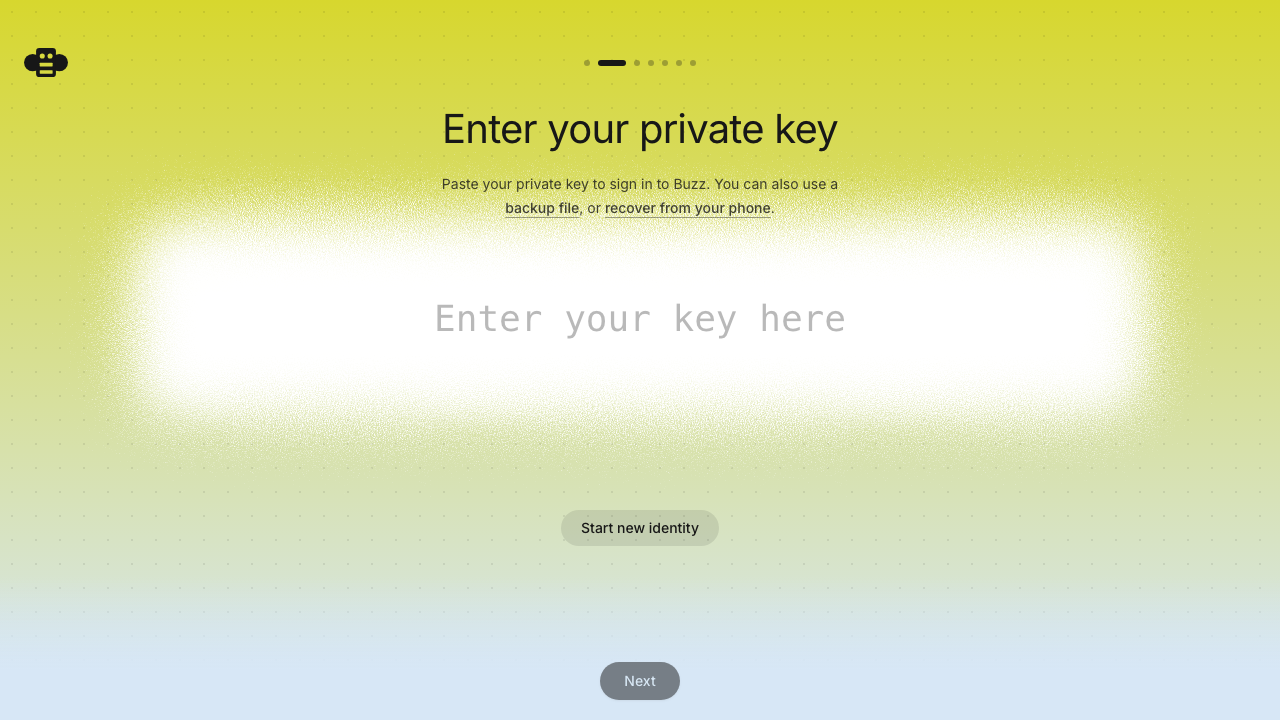
1. Launch Buzz Desktop with identity-lost state and choose **Recover
from your phone**.
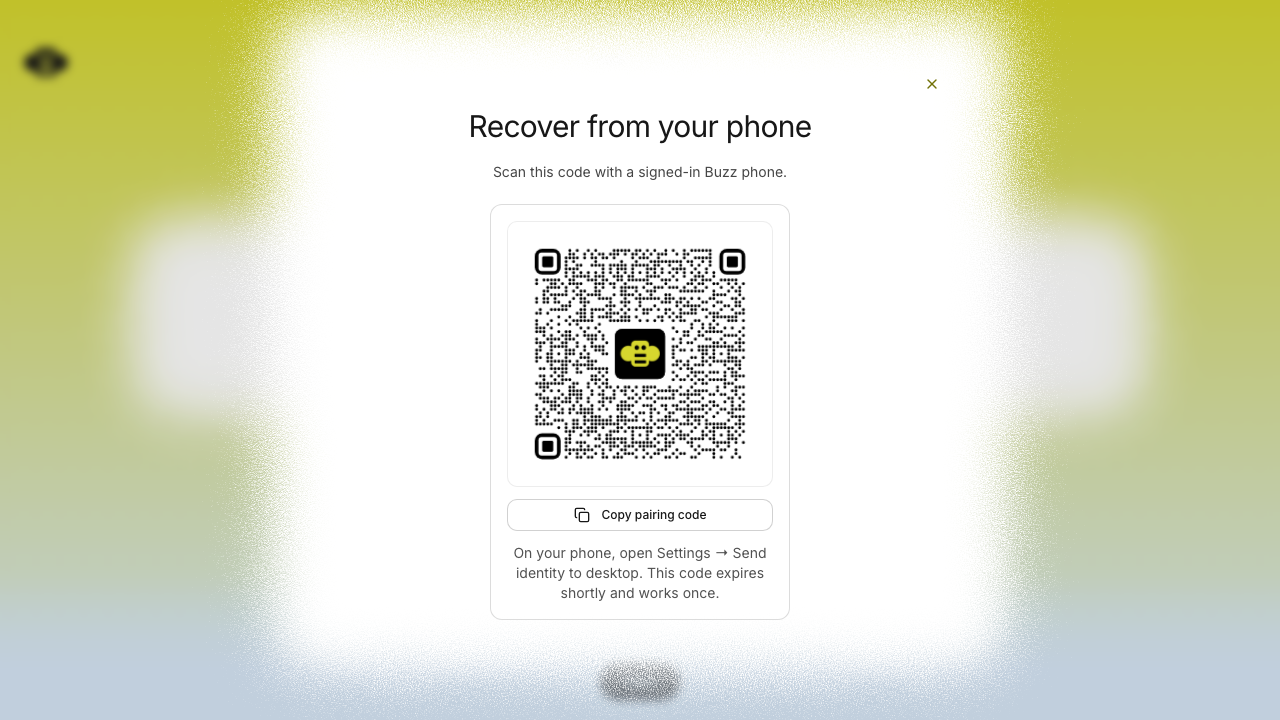
2. Confirm the QR and persistent **Copy pairing code** fallback appear
without layout shift.
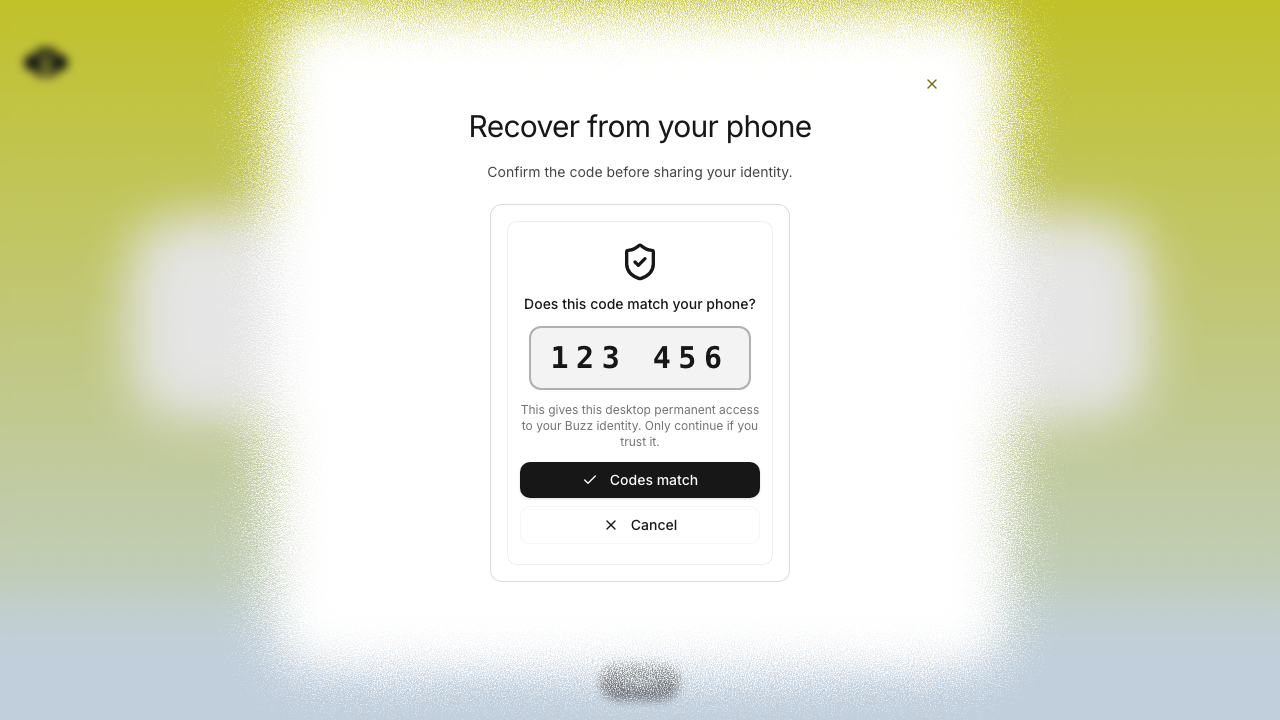
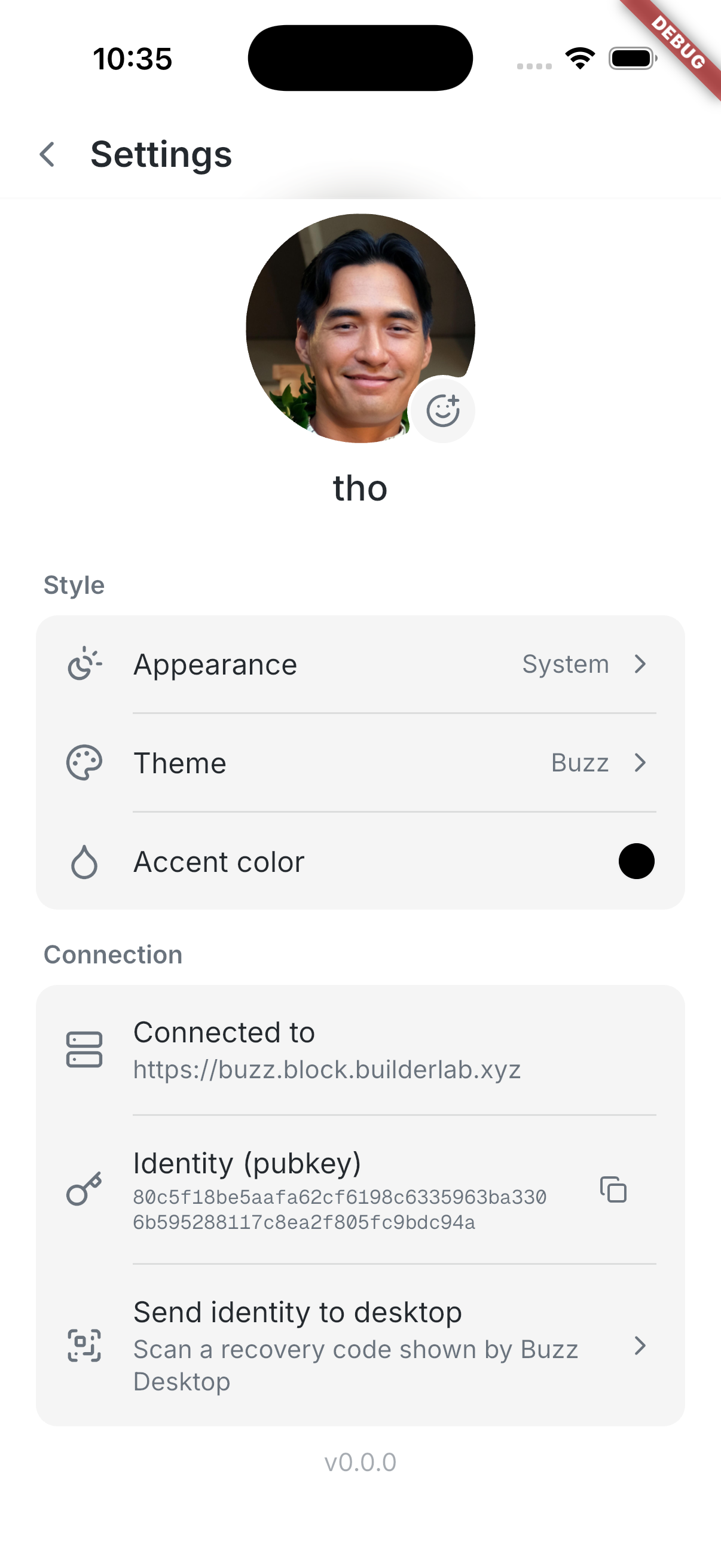
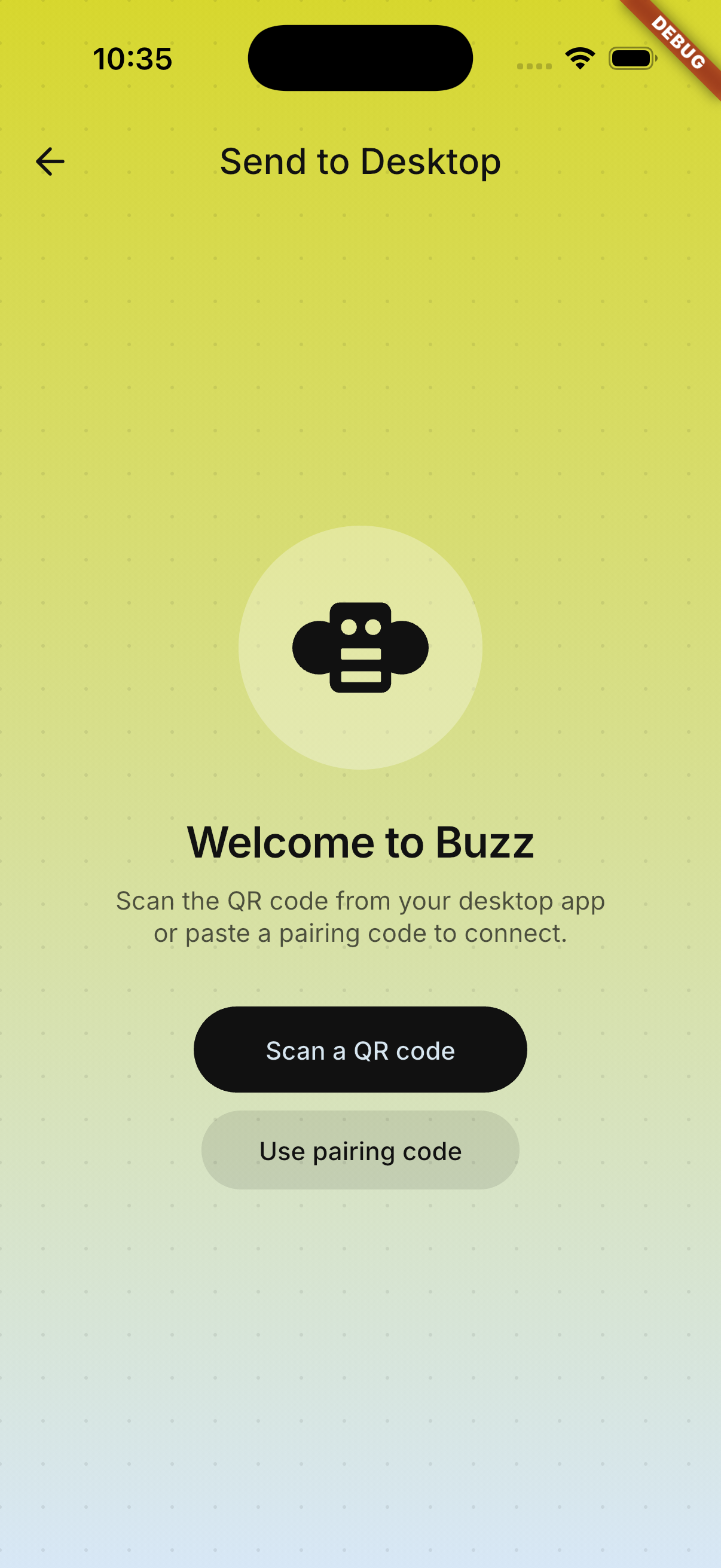
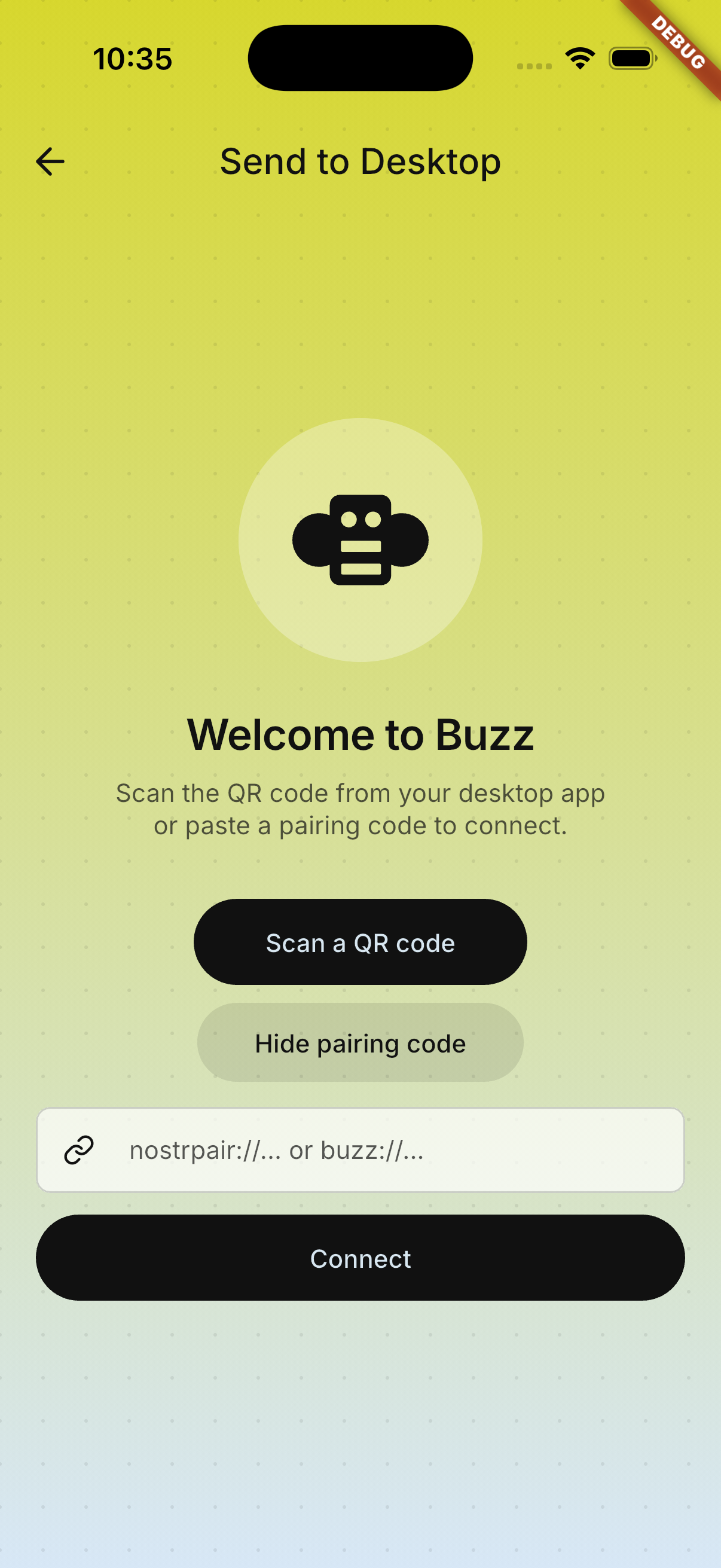
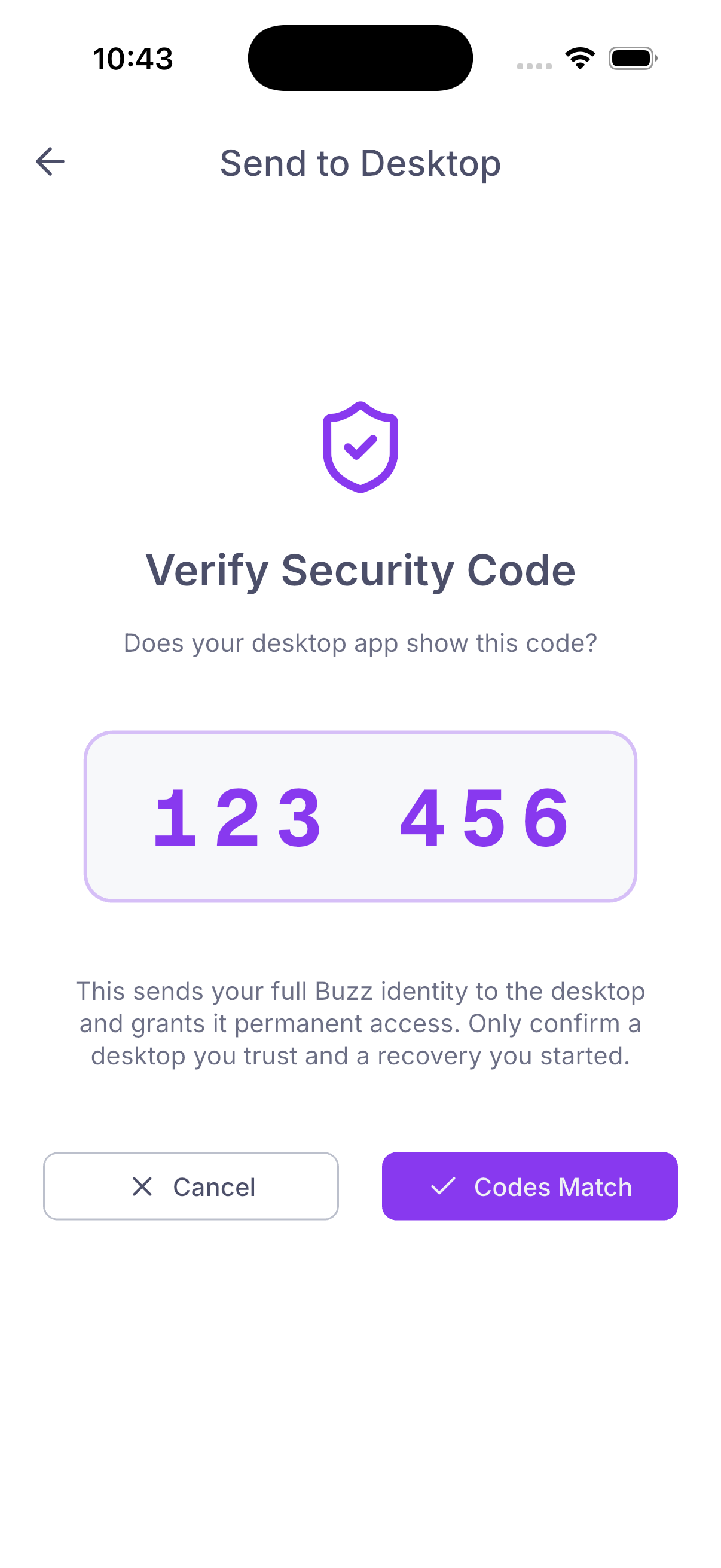
3. On a signed-in phone, open **Settings → Send identity to desktop**,
scan or paste the recovery code, and compare the six-digit SAS on both
devices.
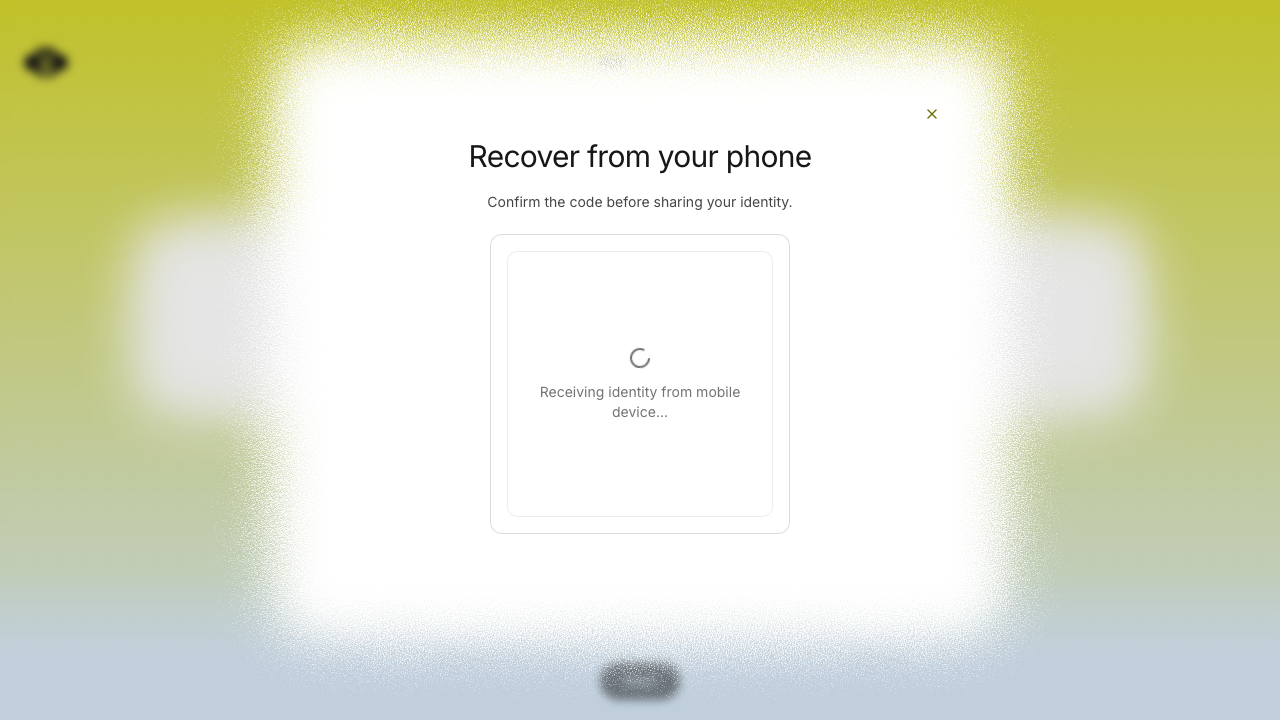
4. Confirm on both sides and verify Desktop restores the identity and
continues to harness setup.
5. Repeat from identity-lost state with **Recover from a backup file**;
verify picker and drag-and-drop both advance to password entry and
restore the encrypted backup.
6. Exercise cancellation, mismatched/unsupported codes, expired
sessions, and an invalid backup; verify each returns actionable,
non-stuck UI.
## Screenshots
### Desktop phone recovery — complete flow
| Recovery entry | Pairing QR | Code match | Receiving identity |
|---|---|---|---|
| 
| 
| 
| 
|
### iOS Simulator — complete handoff flow
| Settings entry | Recovery scanner | Manual recovery code | Code
confirmation |
|---|---|---|---|
| 
| 
| 
| 
|
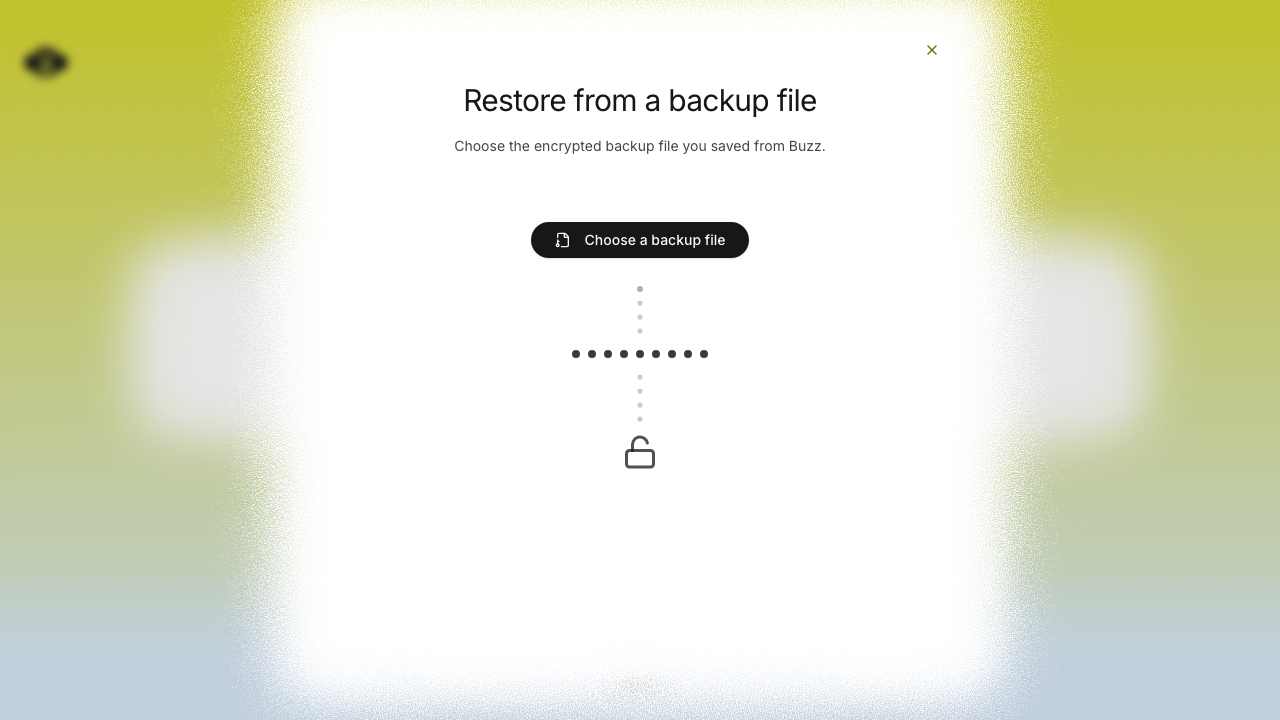
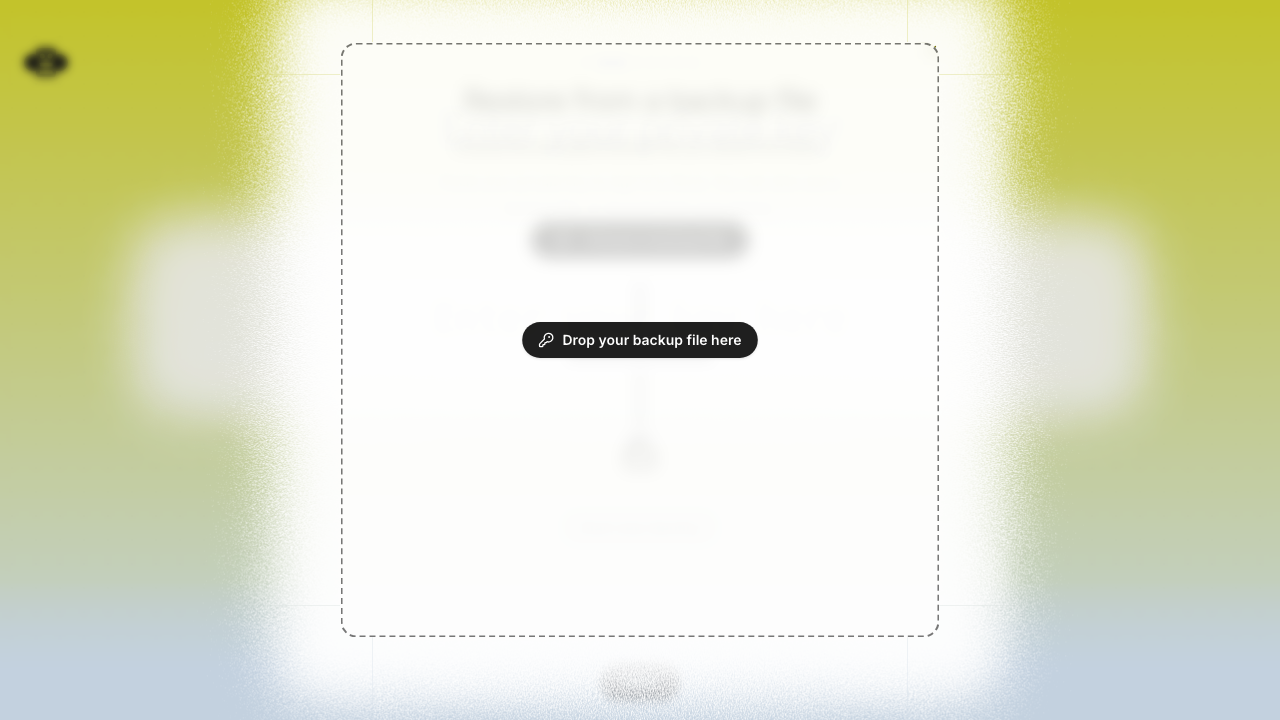
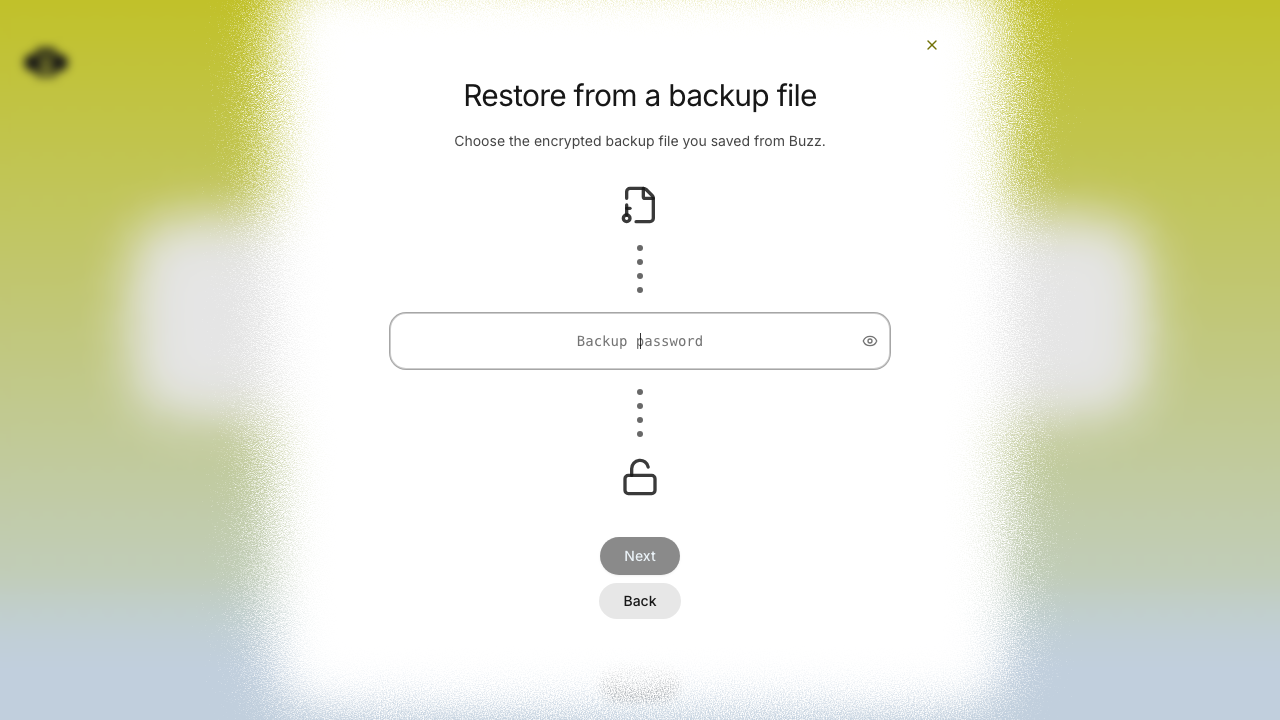
### Encrypted backup recovery — adjusted file flow
| File picker | Drag-and-drop target | Password step |
|---|---|---|
| 
| 
| 
|
## Verification
- `cargo test -p buzz-core pairing` — 71 passed
- `just mobile-test` — 1,169 passed
- `pnpm build:e2e && pnpm exec playwright test identity-lost.spec.ts
--project=smoke` — 15 passed
- Full pre-push gates — desktop checks, desktop unit tests, Rust tests,
Tauri checks, and mobile tests passed
---------
Signed-off-by: Taylor Ho <taylorkmho@gmail.com>
Co-authored-by: npub1223z34hd7vtwc6qj4s7flsxkj644nlre2nthu7lrrmkumhu3xddsrx9r6w <52a228d6edf316ec6812ac3c9fc0d696ab59fc7954d77e7be31eedcddf91335b@buzz.block.builderlab.xyz>
Co-authored-by: Carl <acda9e433d19dcd0e6b6840f7f4b98f3a56f1fab98049d444c087019e6d36560@buzz.block.builderlab.xyz>
## Summary
- deliver macOS notifications through `UNUserNotificationCenter`
- route notification clicks to the referenced channel or thread through
the existing frontend activation path
- preserve click targets across cold startup and frontend remounts with
a small process-wide activation queue
- keep Linux notification activation behavior unchanged

## Architecture
A single `UNUserNotificationCenterDelegate` is installed during Tauri
setup. Each notification stores its navigation target in `userInfo`. On
click, Rust queues the target before emitting a wake-up event; the
frontend atomically drains the queue and dispatches the existing
notification action. The queue is the source of truth, which prevents
cold-start loss and duplicate delivery.

## Validation
Verified at `a81241611d617becf7640bee6fe56b5cdb4d0fab`:
- Biome format/check and lint
- TypeScript typecheck
- repository and desktop-Tauri `cargo fmt --check`
- repository and desktop-Tauri Clippy with `-D warnings`
- full pre-push desktop tests and Tauri workspace checks/tests
- desktop production build

Manual macOS validation passed: after explicitly ad-hoc signing the
local bundle with `xyz.block.buzz.app`, the operator confirmed real
Notification Center delivery and click navigation.

<details>
<summary>Local macOS test procedure</summary>

Tauri's generated ad-hoc signing identifier is not accepted by
`UNUserNotificationCenter`. Re-sign the local bundle with its bundle
identifier and keep other Buzz copies closed:

```bash
just desktop-release-build
APP="$HOME/.cache/cargo-target/aarch64-apple-darwin/release/bundle/macos/Buzz.app"
codesign --force --deep --sign - \
  --identifier xyz.block.buzz.app \
  --entitlements desktop/src-tauri/Entitlements.plist \
  "$APP"
codesign --verify --deep --strict --verbose=2 "$APP"
pkill -x buzz-desktop || true
open -n "$APP"
```

</details>

Buzz channel: `55e2bfca-1b38-48fb-9dc2-584d400501f3`

---------

Signed-off-by: npub1dccv64krpcpse5cmkzfeh998cftungyatw3djt8jwdw6g43f7fyqzzmrf7 <6e30cd56c30e030cd31bb0939b94a7c257c9a09d5ba2d92cf2735da45629f248@buzz.block.builderlab.xyz>
Signed-off-by: am <6e30cd56c30e030cd31bb0939b94a7c257c9a09d5ba2d92cf2735da45629f248@buzz.block.builderlab.xyz>
Co-authored-by: npub1dccv64krpcpse5cmkzfeh998cftungyatw3djt8jwdw6g43f7fyqzzmrf7 <6e30cd56c30e030cd31bb0939b94a7c257c9a09d5ba2d92cf2735da45629f248@buzz.block.builderlab.xyz>
## Summary

- add a visible Stop control for interrupting agent speech
- make push-to-talk available by default while preserving manual mute
controls
- refine agent management, muted audio states, drawer layering, and
return navigation
- suppress duplicate notification sounds for Huddle messages

## Why

Huddles could trap users behind long agent speech, hide useful agent
controls, and leave temporary Huddle state visible after the call. The
drawer also regressed when the terminal substrate began painting behind
the rounded app surface.

## Validation

- `just desktop-ci`
- focused Huddle Playwright coverage for the drawer, speech
interruption, agent picker, and leave navigation

---------

Signed-off-by: kenny lopez <klopez4212@gmail.com>
Signed-off-by: Wes <wesbillman@users.noreply.github.com>
Co-authored-by: Wes <wesbillman@users.noreply.github.com>
Co-authored-by: Carl <c7ebe626f000404285d3686e1dc74cc07cc60a9754a150041ba132e14bd3e2ec@buzz.block.builderlab.xyz>
## Summary

- send desktop messages immediately while media uploads continue in
background state across channel navigation
- show immediate progress above the composer and keep Jump to latest
above it
- report the real media stages as Preparing, Processing, Converting,
Uploading, and Finishing
- use Buzz's shared spinner during local media work, then switch to the
real percentage when byte transfer begins
- animate phase-label and status-suffix changes without overlap or
layout jumps
- keep cancel, progress fill, message publication, and community-reset
behavior coordinated with the background task
- use raw Tauri IPC for large browser files so renderer-side byte
serialization does not block initial feedback

## Why

Desktop previously blocked sending while attachments uploaded in the
composer. Large videos could also pause the renderer before progress
appeared, and the progress pill said Uploading while native media
processing was still underway. This makes the initial response immediate
and describes the work actually happening.

## Validation

- `cd desktop && pnpm check`
- `cd desktop && pnpm typecheck`
- `cd desktop && pnpm test` (3,931 passed)
- `cd desktop && pnpm exec vite build --mode e2e`
- `cd desktop && pnpm exec playwright test
tests/e2e/file-attachment.spec.ts --project=smoke` (11 passed)
- focused native media tests (80 passed)
- native Clippy with all targets and features
- pre-push native suite (2,107 passed, 14 ignored; 3 diagnostics passed)

Updated phase snapshots are included in the PR comments.

Split from #4512 so the desktop and mobile changes can be reviewed
independently.

---------

Signed-off-by: kenny lopez <klopez4212@gmail.com>
Signed-off-by: Wes <wesbillman@users.noreply.github.com>
Co-authored-by: Wes <wesbillman@users.noreply.github.com>
Co-authored-by: Carl <c7ebe626f000404285d3686e1dc74cc07cc60a9754a150041ba132e14bd3e2ec@buzz.block.builderlab.xyz>
## Summary
- ship **Buzz Term** end to end: the terminal engine/runtime, mounted
desktop substrate, and user-visible naming
- add Quinn's tape-deck-inspired banner: a beveled chassis filled by the
`buzz term` wordmark, surrounded by a complete-hex field
- derive the wordmark's three-stop sweep from each theme's terminal
palette so primary, secondary, and accent roles remain visibly distinct
across all 62 shipped themes, including light themes
- paint the banner once on its own pointer-transparent canvas; PTY
rendering beneath it remains unchanged
## Banner behavior
- uses the renderer's shared `8.4 × 17` cell metrics and production
aspect ratio `2.0238`
- regenerates only for viewport/theme changes; palette switches repaint
correctly while the banner is visible
- dismisses on non-empty output from the active terminal session; empty
output and inactive sessions do not dismiss it
- fails closed below **70 columns** rather than squeezing or clipping
the wordmark
- adds **8 lines** to `terminalRenderer.ts` for shared cell metrics and
**zero lines inside `paint()`**
## Screenshots
| Buzz (light) | Buzz Dark |
|---|---|
| 
| 
|
| Kanagawa Lotus (light) | Red |
|---|---|
| 
| 
|
Additional production-aspect finals:
[Vesper](https://buzz.block.builderlab.xyz/media/9ca6514b63f8cfb2107a85ca46f16a940c0883848e6fbc718e411af94aa13100.png),
[Min
Dark](https://buzz.block.builderlab.xyz/media/f67bd2970e5d64ffb07b1ae78ab58c847e6ebc23e7e7a48e067eb024dba64ec8.png),
and [Dark
Plus](https://buzz.block.builderlab.xyz/media/290fee08924f37d064abc687ecf3e9526ab05b87e8e56d610f23048949793dbe.png).
The screenshot harness was checked against the shipped painter at this
exact head: all **2,541 draw calls** matched on color, glyph, x, and y;
four deliberate divergence controls fired.
## Verification at `98ebc8f9048bd5f0ceb7e843b67874d642f0b7fd`
- desktop tests: **3,946 / 3,946**
- TypeScript: clean
- checks: pass (two pre-existing informational `useTemplate` notices
only)
- integration/e2e: PASS (independent exact-SHA lane; artifacts recorded
in the originating Buzz thread)
- artifact/dead-path sweep: clean
- redteam G1–G7: PASS
- all six named banner emitter-deletion mutants die
- independent handwritten five-row full-wordmark fixture kills Quinn's
seven-mutant battery, including a one-pixel glyph change
- real `112 × 46` canvas-rect dismissal tests separately cover active
non-empty, active empty, and inactive non-empty output
- layer-drop and zero-draw painter mutants die; z-order and
pointer-events verified
- CI's `tsc && vite build` includes all three banner modules
- performance at DPR 2 (worst-case measured envelope):
- one-time content paint: **~0.7–0.8 ms**, paid only when the banner is
built or its palette changes
- busy compositor, CSS `1277 × 697`, backing `2554 × 1394`: **470–497
µs/frame** for the full banner (**2.82–2.98%** of a 60 Hz frame)
- busy compositor, CSS `1920 × 1080`, backing `3840 × 2160`:
**1,139–1,212 µs/frame** (**6.83–7.27%**)
- empty, one-glyph, and full-banner controls converge: compositor cost
follows backing-layer area and DPR rather than painted-cell count
- in the actual idle welcome state, cost is below both vsync-clamped
rigs' resolution; it is not claimed as zero
- **Pane cross-rig spread: resolved at matched loop rate.** Two
independent rigs initially differed 2.3× (58–68 vs 136 µs/Mpx of backing
store; pane, CSS 1277×697 / backing 2554×1394, DPR 2). The cause of
*that* spread is rAF loop rate: the higher figure came from a
free-running loop at ~1600fps. Throttled to ~200–236fps, both rigs read
58–68 µs/Mpx (1.25–1.44% of a 60Hz frame). The busy-composite figures
quoted above remain the **unthrottled worst case** and are conservative
by ~2.3× at the pane. Not established: the mechanism and sign of
free-running distortion (one rig under-charges ~15%, the other
over-charges 2.3×), and the 1080p figure has not been re-measured
throttled.
- the layer paints only on generation/theme/resize and dismisses on
first non-empty active-session output, so the measurable busy cost is a
short-lived worst case rather than a persistent PTY paint-path tax
## Follow-ups in this PR
These are intentionally subsequent commits after the certified
static-banner head, not claims about `98ebc8f90`:
1. close the compositor metrology: remeasure the 1080p point throttled
and characterize the opposite-sign free-running rAF distortion, with
each measurement regime stated
2. add Tyler's animated honeycomb color waves, gated by
`prefers-reduced-motion`, a full 62-theme phase-sweep contrast check,
and DPR-2 per-tick performance certification
3. land the already-proven mounted theme-switch regression probe from
`RESEARCH/BUZZ_TERM_G3A_PROBE/`
4. bound the slow/hang-shaped G1-c mutant `waitFor`
5. optionally trim the generator to its ink bounding box, reducing the
minimum viewport from 70 to 62 columns
---------
Signed-off-by: tlongwell-block <109685178+tlongwell-block@users.noreply.github.com>
Signed-off-by: npub1mprnacetjua2xx3p5eddmhxyk6wv929ymm5py8kd2xfxurxahspqqlgyta <d8473ee32b973aa31a21a65adddcc4b69cc2a8a4dee8121ecd51926e0cddbc02@buzz.block.builderlab.xyz>
Signed-off-by: npub1jh9wn95s0472h86ahapupaf7m6kx4v9sx2n0atj2hltcfer8k06s5n3pyf <95cae996907d7cab9f5dbf43c0f53edeac6ab0b032a6feae4abfd784e467b3f5@buzz.block.builderlab.xyz>
Signed-off-by: npub17jjz49l9jjmhhk7cac63j8yt9z555n9cw8vk7v5jz4vzw4ppld5qgj57cc <f4a42a97e594b77bdbd8ee35191c8b28a94a4cb871d96f32921558275421fb68@buzz.block.builderlab.xyz>
Signed-off-by: npub1qyvc0c5kl4gqv2fd97fsk46tu378sqgy35vc83rvgfwne90sel7s0ed67d <011987e296fd5006292d2f930b574be47c7801048d1983c46c425d3c95f0cffd@buzz.block.builderlab.xyz>
Co-authored-by: Dawn (sprout agent) <c6237ef84fa537c78dcee78efd2d4e59f728859c7f194da42ac51ededfa0be05@sprout-oss.stage.blox.sqprod.co>
Co-authored-by: npub1t2tgm7d8f995uqvmnm8h88sg3wnpp9a5xysjf6dg3tjmgt3ltulqdp8ehr <5a968df9a7494b4e019b9ecf739e088ba61097b4312124e9a88ae5b42e3f5f3e@buzz.block.builderlab.xyz>
Co-authored-by: npub1cc3ha7z055mu0rwwu7806t2wt8mj3pvu0uv5mfp2c50dahaqhczshdalg6 <c6237ef84fa537c78dcee78efd2d4e59f728859c7f194da42ac51ededfa0be05@buzz.block.builderlab.xyz>
Co-authored-by: npub17jjz49l9jjmhhk7cac63j8yt9z555n9cw8vk7v5jz4vzw4ppld5qgj57cc <f4a42a97e594b77bdbd8ee35191c8b28a94a4cb871d96f32921558275421fb68@buzz.block.builderlab.xyz>
Co-authored-by: npub1jh9wn95s0472h86ahapupaf7m6kx4v9sx2n0atj2hltcfer8k06s5n3pyf <95cae996907d7cab9f5dbf43c0f53edeac6ab0b032a6feae4abfd784e467b3f5@buzz.block.builderlab.xyz>
Co-authored-by: npub1mprnacetjua2xx3p5eddmhxyk6wv929ymm5py8kd2xfxurxahspqqlgyta <d8473ee32b973aa31a21a65adddcc4b69cc2a8a4dee8121ecd51926e0cddbc02@buzz.block.builderlab.xyz>
Co-authored-by: npub1qyvc0c5kl4gqv2fd97fsk46tu378sqgy35vc83rvgfwne90sel7s0ed67d <011987e296fd5006292d2f930b574be47c7801048d1983c46c425d3c95f0cffd@buzz.block.builderlab.xyz>
## Summary

- open Huddles in a focused companion window with a clean handoff back
to the in-app drawer and backing channel
- redesign the participant film strip, sidebar control, transcript
surface, and themed shell treatment
- preserve microphone and device control across windows, start agent
voice on the first reply, and show agent speaking activity in the film
strip
- give each agent a distinct session voice, beginning with the
configured default, plus compact per-agent text-to-speech and voice
controls
- enroll only agents explicitly mentioned or deliberately added through
an agent panel into the live Huddle roster
- keep temporary Huddle channels out of the sidebar unless the user
explicitly brings one into the main app
- remove Huddle-only avatar policy badges and filter short silence or
noise segments before speech-to-text posts

## Why

The previous flow exposed the temporary channel as product UI, obscured
who was present or speaking, and split transcript and audio state
between the main and companion windows. This keeps backing channels as
implementation details unless a user explicitly brings a Huddle into the
app, while sharing the live conversation and audio lifecycle across both
surfaces. Agent participants now join only after an explicit invitation,
distinct voices make multi-agent Huddles easier to follow, and short
microphone noise no longer becomes stray transcript messages.

## Validation

- `pnpm check`
- `pnpm build:e2e`
- `pnpm exec playwright test tests/e2e/huddle-transcription.spec.ts
--project=smoke` (13 passed)
- Huddle sidebar visibility unit coverage (4 passed)
- focused managed-agent and persona-mention E2E coverage (2 passed)
- `pnpm test` (3,910 passed)
- `cargo clippy --manifest-path desktop/src-tauri/Cargo.toml
--all-targets -- -D warnings`
- `cargo test --manifest-path desktop/src-tauri/Cargo.toml` (2,093
passed, 14 ignored; 3 diagnostics passed)

---------

Signed-off-by: kenny lopez <klopez4212@gmail.com>
Signed-off-by: Wes <wesbillman@users.noreply.github.com>
Co-authored-by: Wes <wesbillman@users.noreply.github.com>
Co-authored-by: Carl <c7ebe626f000404285d3686e1dc74cc07cc60a9754a150041ba132e14bd3e2ec@buzz.block.builderlab.xyz>
## Agent Trading Cards

"Create Agent Card" action in the agent panel that mints an AI-generated
trading card PNG which **is** the agent: the card carries the
`buzz_agent_snapshot` tEXt chunk and is drag-in importable like any
snapshot PNG.

### What's in here
- **Mint pipeline (Rust):** one OpenAI Responses call — `gpt-5.6-sol` as
card designer with `gpt-image-2` via the `image_generation` tool (~2–3
min). New `mint_agent_card` / `save_agent_card` commands; preview with
reroll; save or send as `.agent.png` with round-trip verification before
any bytes leave the app.
- **Snapshot/chunk work stays in Rust,** reusing the existing
encoder/decoder seams (byte-compat golden vector proves the plain path
is identical to the pre-envelope encoder for placeholder, PNG-injection,
and JPEG-transcode paths).
- **Locked cards (NIP-44):** optional `buzz-agent-snapshot-encrypted`
envelope encrypted to the (owner, agent) pair. `parse_canonical_pubkey`
performs lift-x curve validation before any API spend; wrong-key decrypt
returns a fixed refusal; the plain decoder refuses locked cards.
- **Guardrails:** 10 MiB ceiling on final bytes, memory structurally
`none` in the snapshot, full-manifest import disclosure, API-key hygiene
via env layering (record > persona > global > process), fail-early
validation ordering (all key/lock/NIP-44-cap checks before Responses
spend).
- **Import side:** full-manifest disclosure dialog, locked-card import
disclosure, bounded avatar fetch.

### Review
Code reviewed by Wren across the full arc; final locked-card
cross-review **APPROVED 9/9/9** at exactly this head (`64f819dc8`), with
independent same-SHA verification: Rust lib 1,843/1,843, clippy
`--all-targets -D warnings`, desktop file-size gate.

### Live-mint evidence (real API, shipping seams, this SHA)
- **Plain (Honey):** 188s, 1500x2250, 5,101,503 bytes (< 10 MiB);
decoded manifest == built manifest; memory=none.
- **Locked (Fizz):** 176s, 4,670,184 bytes; owner-key and agent-key
decrypt both verified via logical manifest compare; wrong-key refusal
exact; plain decoder refuses.
- **Live finding:** built-in agents' ~171 KB inline avatars exceed the
NIP-44 65,535-byte plaintext cap and the fail-early guard fires before
API spend — clean error path, noted as a UX follow-up for large-avatar
agents choosing lock.

Full evidence (cards + dialog screenshots) posted in the originating
thread.

---------

Signed-off-by: Tyler Longwell <tlongwell@block.xyz>
Signed-off-by: npub12gtutshhh76rx0jx697f32f9tffd4hhp3hx58fp4x6u4uemkm7sqf8f757 <5217c5c2f7bfb4333e46d17c98a9255a52dadee18dcd43a43536b95e6776dfa0@buzz.block.builderlab.xyz>
Signed-off-by: npub1qyvc0c5kl4gqv2fd97fsk46tu378sqgy35vc83rvgfwne90sel7s0ed67d <011987e296fd5006292d2f930b574be47c7801048d1983c46c425d3c95f0cffd@buzz.block.builderlab.xyz>
Co-authored-by: npub1qyvc0c5kl4gqv2fd97fsk46tu378sqgy35vc83rvgfwne90sel7s0ed67d <011987e296fd5006292d2f930b574be47c7801048d1983c46c425d3c95f0cffd@buzz.block.builderlab.xyz>
Co-authored-by: Tyler Longwell <tlongwell@block.xyz>
Co-authored-by: npub12gtutshhh76rx0jx697f32f9tffd4hhp3hx58fp4x6u4uemkm7sqf8f757 <5217c5c2f7bfb4333e46d17c98a9255a52dadee18dcd43a43536b95e6776dfa0@buzz.block.builderlab.xyz>
## Context
Pocket TTS currently offers bundled reference voices. People also need a
local, private way to add a voice without sending audio to a cloud
service.
## Summary
Add a Pocket voice import flow to Voice settings. Buzz opens the native
file picker, decodes common audio formats in the reusable `buzz-voice`
crate, canonicalizes the selected audio, stores it under a
content-derived identity in app data, selects it, and lets the user
delete it later.
## Changes
- Accept WAV, M4A, MP3, FLAC, OGG, and AIFF files between 2 and 30
seconds, including multichannel sources.
- Decode and downmix accepted audio to canonical mono 32 kHz PCM16 WAV
before hashing and storage.
- Store imported voices behind stable `pocket:imported:<sha256>`
identities and content-addressed files.
- Keep absolute file paths inside the native process and expose only
voice metadata to React.
- Include imported voices in Pocket preview and live huddle playback.
- Add Add voice and delete controls while preserving the bundled Pocket
voice catalog.
- Fall back to Mary when the selected imported voice is deleted.
- Keep durable import, selection, and deletion successful when a live
TTS worker acknowledgement is delayed.
- Preserve bundled voices when optional import metadata is unreadable
and keep failed deletion retryable.
## Related issue
None found.
## Testing
Production decoding was exercised with WAV, M4A with AAC, MP3, FLAC, OGG
Vorbis, and AIFF fixtures. Each format canonicalized to mono 32 kHz
PCM16 WAV. Manual validation in the combined daily-driver build covered
native-picker import, Preview, live-huddle playback, deletion, and Mary
fallback.
## Screenshots
The Voice settings card preserves the bundled Pocket catalog and adds
the local Add voice action.
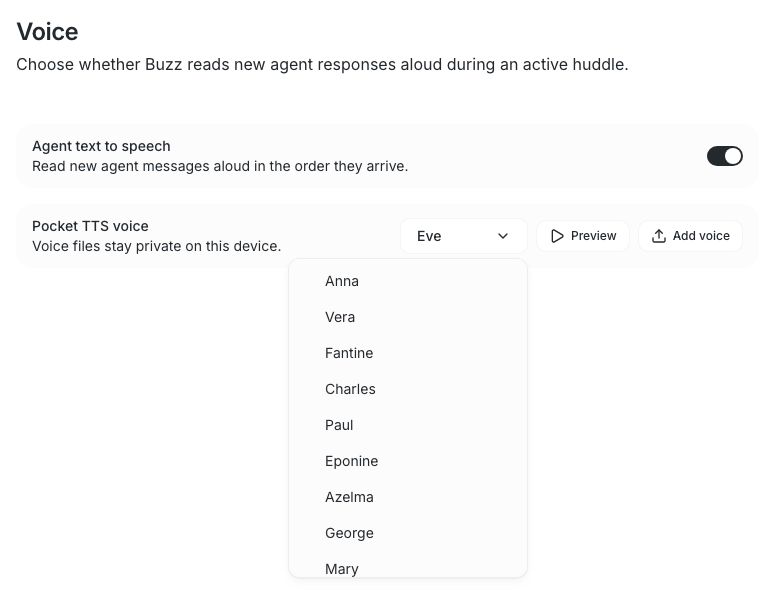
## Reviewer-reproducible examples
Create common-format fixtures and run them through the production
importer:
```bash
. ./bin/activate-hermit
fixtures="$(mktemp -d)"
ffmpeg -hide_banner -loglevel error -f lavfi -i "sine=frequency=220:duration=3" -ac 2 -ar 44100 "$fixtures/voice.wav"
ffmpeg -hide_banner -loglevel error -i "$fixtures/voice.wav" -c:a aac "$fixtures/voice.m4a"
ffmpeg -hide_banner -loglevel error -i "$fixtures/voice.wav" "$fixtures/voice.mp3"
ffmpeg -hide_banner -loglevel error -i "$fixtures/voice.wav" "$fixtures/voice.flac"
ffmpeg -hide_banner -loglevel error -i "$fixtures/voice.wav" -c:a libvorbis "$fixtures/voice.ogg"
ffmpeg -hide_banner -loglevel error -i "$fixtures/voice.wav" -c:a pcm_s16be "$fixtures/voice.aiff"
BUZZ_VOICE_IMPORT_TEST_DIR="$fixtures" \
cargo test -p buzz-voice imports_common_audio_format_fixtures -- --ignored --nocapture
```
Exercise import persistence, synthesis, deletion, and bundled-voice
fallback with an installed Pocket model:
```bash
BUZZ_POCKET_MODEL_DIR=/path/to/pocket-model-bundle \
cargo test -p buzz-voice --test pocket_import_audio \
objective_import_synthesis_delete_and_mary_fallback \
-- --ignored --nocapture
```
Exercise the native-picker boundary, selection, preview dispatch,
deletion, cancellation, and invalid-file states:
```bash
cd desktop
pnpm build:e2e
pnpm exec playwright test tests/e2e/voice-settings.spec.ts --project=smoke
```
---------
Signed-off-by: John Tennant <jtennant@block.xyz>
Signed-off-by: John Tennant <johnmatthewtennant@gmail.com>
Signed-off-by: John Tennant <jtennant@squareup.com>
Signed-off-by: npub1qyvc0c5kl4gqv2fd97fsk46tu378sqgy35vc83rvgfwne90sel7s0ed67d <011987e296fd5006292d2f930b574be47c7801048d1983c46c425d3c95f0cffd@buzz.block.builderlab.xyz>
Signed-off-by: npub12gtutshhh76rx0jx697f32f9tffd4hhp3hx58fp4x6u4uemkm7sqf8f757 <5217c5c2f7bfb4333e46d17c98a9255a52dadee18dcd43a43536b95e6776dfa0@buzz.block.builderlab.xyz>
Co-authored-by: John Tennant <jtennant@block.xyz>
Co-authored-by: npub1qyvc0c5kl4gqv2fd97fsk46tu378sqgy35vc83rvgfwne90sel7s0ed67d <011987e296fd5006292d2f930b574be47c7801048d1983c46c425d3c95f0cffd@buzz.block.builderlab.xyz>
Co-authored-by: npub12gtutshhh76rx0jx697f32f9tffd4hhp3hx58fp4x6u4uemkm7sqf8f757 <5217c5c2f7bfb4333e46d17c98a9255a52dadee18dcd43a43536b95e6776dfa0@buzz.block.builderlab.xyz>
Relands **#2467** (extract `buzz-voice` crate) and **#3208** (Pocket
voice settings) onto main, after #3266 and #3180 merged.

## Why a fresh PR
The repo is squash-only with delete-branch-on-merge. Squashing #3266
deleted `jtennant/pocket-tts-2026-04`, which was #2467's base — GitHub
auto-closed #2467 and it cannot be reopened. Squash merges also sever
ancestry, so GitHub's natural merge-base reports phantom conflicts for
the whole remaining stack.

## Content provenance
- Byte-identical to the blessed `jt/buzz-voice-refactor` branch
(`93029c577`, tree `6729e0eff` — reviewed by Dawn (#2467) and Max
(#3208) at exact heads) **except** the three files where #3180 and #3208
genuinely interact.
- Three-file resolution (union of both sides):
- `huddle/mod.rs` — #3180's pipeline re-exports + #3208's
`agent_tts_routing` imports.
- `huddle/state.rs` — `reset_preserving_generation` preserves both
`huddle_generation` (#3180) and `tts_enabled` (#3208); test sets merged
into one `tests` module.
- `desktop/src/testing/e2eBridge.ts` — both switch arms kept; no
duplicate case labels.

## Verification at cf32dacd7
- `cargo test` (desktop/src-tauri, pinned 1.95.0): **2047 + 3 pass / 0
fail** (14 ignored: 8 keychain, 4 real_relay, 2 flag-gated)
- `cargo clippy --all-targets -- -D warnings`: clean; `cargo fmt
--check`: clean
- `cargo check --workspace` (root, includes new `buzz-voice` member):
clean; `cargo test -p buzz-voice`: 5/0
- `pnpm test`: **3885 / 0**; `tsc --noEmit`: clean; lint: clean

The 3180×3208 interaction resolution is getting an independent team
re-review before merge.

Buzz channel: buzz-desktop-voice `fd5fb402-b651-4238-89b1-bb3e2fa4dc96`,
thread `b4798ecc`.

Signed-off-by: npub1qyvc0c5kl4gqv2fd97fsk46tu378sqgy35vc83rvgfwne90sel7s0ed67d <011987e296fd5006292d2f930b574be47c7801048d1983c46c425d3c95f0cffd@buzz.block.builderlab.xyz>
Co-authored-by: npub1qyvc0c5kl4gqv2fd97fsk46tu378sqgy35vc83rvgfwne90sel7s0ed67d <011987e296fd5006292d2f930b574be47c7801048d1983c46c425d3c95f0cffd@buzz.block.builderlab.xyz>
## Summary

Adds a locally stored **NIP-49 encrypted key backup** (`ncryptsec`) to
the desktop app, per the plan reviewed in buzz-development (Rev 3,
approved 9/10 by Wren; implementation also reviewed and approved 9/10).

**Two-artifact design — canonical bytes originate entirely in Rust:**
- `create_ncryptsec_backup` runs under the `identity_mutation` lock:
encrypt → decrypt-verify against the live pubkey → atomic `0o600` write
to `{app_data_dir}/identity.ncryptsec` → reread/byte-compare → return
the exact persisted bytes. The frontend never re-derives or re-encrypts.
- `save_ncryptsec_copy` writes a portable copy via the save dialog
(parse-gated, secret-file semantics) and never mutates canonical state.
- `generate_backup_passphrase`: 6 words from the EFF short wordlist via
`OsRng` (custom passphrases min 12 chars).
- Import accepts `ncryptsec1` with optional password; the raw-`nsec`
path is untouched. Different-pubkey import and sign-out wipe the
app-managed backup (post-commit, best-effort — a failed import can never
destroy the still-live identity's backup; regression-tested).

**Never-relay guarantee (egress guard + tripwires):**
- `egress_guard.rs` fail-closed at all 8 `/events` submission boundaries
(relay submit funnel, 3× `relay.rs`, huddle STT, both engram submitters,
native WS choke point), rejecting `ncryptsec1`/`NCRYPTSEC1` in text and
binary frames. Scope is deliberately ncryptsec-only: pairing
intentionally carries raw nsec inside its encrypted session.
- Site-granular `/events` inventory tripwire: per-file (`/events` count,
guard-call count) pairs; unlisted files expect zero. Mutation-style
tests prove a ninth site in an existing file, a removed guard, and a new
unlisted file all fail the scan.
- ncryptsec source-allowlist scans in **both** trees (Rust + TS).

**Frontend:** onboarding `BackupStep` is encrypted-by-default — the
default path never invokes `get_nsec` (e2e asserts the command log).
Raw-nsec export stays behind an explicit click with prior semantics.
Shared `EncryptedBackupCreator` powers onboarding + a new settings row;
the import form auto-switches to encrypted mode on `ncryptsec1` paste
(case-insensitive HRP).

**Open product call for @tlongwell-block:** onboarding default is
*encrypted* in this PR; flipping to raw-default is a small change either
way (documented in the plan).

Review history: plan Rev 3 and the implementation were both iterated
with Wren to 9/10 (two blockers from round 1 — import ordering,
inventory granularity — plus an uppercase-bech32 hardening gap, all
fixed in `dde37183e`). Thread: buzz-development.

### Related issue

Follow-up to the direction explored in #385 (NIP-PB, closed) — this
ships local NIP-49 (the standard) instead of a new NIP. No open
duplicate found.

### Testing

All at exactly `dde37183e` (same shell, HEAD verified):

- `cargo test` — 1680 passed / 0 failed / 14 ignored (includes a
deliberate ~70s log_n-18 NIP-49 round trip, spec vector, wrong-password,
NFKC, uppercase-vector decrypt, injection test per egress boundary,
inventory mutation tests, import-ordering regression tests)
- `cargo clippy --all-targets -- -D warnings` — clean; `cargo fmt
--check` — clean
- `pnpm typecheck` — clean; JS unit suite 3529/3529; biome (repo-pinned
2.4.16) clean
- Playwright `onboarding-backup` / `onboarding` /
`onboarding-agent-defaults` / `profile-nsec-reveal` — 86 passed, 1 known
avatar-reservation flake (passed on rerun; untouched by this diff).
`passThroughBackupStep` now exercises the encrypted default, so every
downstream onboarding spec covers the new path.
- Note: browser e2e fakes the crypto via the mock bridge (fixed
spec-vector blob); decryption correctness is proven in the Rust tests.

## Latest onboarding integration

The current head adds an additive `IdentityInfo.storage` field
(`ephemeral`, `system-keyring`, `local-file`, or `environment`) so
onboarding can accurately explain where the active identity is
protected. It surfaces storage metadata only—never key material—and
leaves the existing lost/keyring-locked recovery behavior intact.

---------

Signed-off-by: Tyler Longwell <tlongwell@block.xyz>
Signed-off-by: Taylor Ho <taylorkmho@gmail.com>
Co-authored-by: npub1qyvc0c5kl4gqv2fd97fsk46tu378sqgy35vc83rvgfwne90sel7s0ed67d <011987e296fd5006292d2f930b574be47c7801048d1983c46c425d3c95f0cffd@buzz.block.builderlab.xyz>
Co-authored-by: Tyler Longwell <tlongwell@block.xyz>
Co-authored-by: Taylor Ho <taylorkmho@gmail.com>
Co-authored-by: npub1223z34hd7vtwc6qj4s7flsxkj644nlre2nthu7lrrmkumhu3xddsrx9r6w <52a228d6edf316ec6812ac3c9fc0d696ab59fc7954d77e7be31eedcddf91335b@buzz.block.builderlab.xyz>
**Category:** new-feature
**User Impact:** Users can create, download, and verify a
password-protected backup of their private identity from desktop
Settings.

**Problem:** Buzz does not currently give signed-in users a
Settings-based path to protect or validate their private identity
independently of onboarding. **Solution:** Add a focused backup menu to
the private-key row, keep encryption and verification local in Rust, and
preserve completed encrypted backups briefly so native saves can be
retried without repeating encryption.

<details>
<summary>File changes</summary>

**desktop/src/features/settings/**
Adds the background backup lifecycle, create and test dialogs,
private-key menu integration, password handling, and focused unit
coverage.

**desktop/src/features/onboarding/ui/NsecMaskedDisplay.tsx**
Extends the masked private-key display with reusable overflow-menu
actions used by Settings.

**desktop/src/app/App.tsx**
Mounts the backup provider at app scope so encryption and save work
survive closing Settings or the modal.

**desktop/src/shared/api/tauriIdentity.ts**
Adds typed desktop bindings for local backup creation, save, selection,
and verification.

**desktop/src-tauri/src/key_backup.rs and
desktop/src-tauri/src/commands/identity.rs**
Implements local NIP-49 encryption, password generation, file handling,
and public-identity-only verification results.

**desktop/src-tauri/src/egress_guard.rs and guarded call sites**
Blocks encrypted secret material from relay, websocket, snapshot,
sharing, and huddle egress paths.

**desktop/src-tauri tests and fixtures**
Covers encryption, verification, file behavior, and fail-closed
no-egress protections.

**desktop/src/testing/e2eBridge.ts, desktop/tests/, and
desktop/playwright.config.ts**
Expands the mock native bridge and browser coverage across create,
retry, expiry, and current/different-identity verification states.

**desktop/src-tauri/Cargo.toml, Cargo.lock, and assets**
Adds the local cryptography/password-generation dependencies and
embedded short-word list.

</details>

## Reproduction steps

1. Run the desktop app and open **Settings → Profile → Identity**.
2. Open the private-key overflow menu and choose **Create backup**.
3. Enter or generate a valid password, submit, and confirm progress
continues if the dialog or Settings is closed.
4. Save the resulting `.ncryptsec` file; cancel and retry to confirm the
temporary download remains available.
5. Choose **Test backup**, select the file, enter a wrong password, then
retry with the correct password.
6. Confirm success identifies whether the backup matches the current
identity and displays only the public `npub`.

## Screenshots

| Settings identity | Private-key menu | Create backup |
|---|---|---|
| <img width="1280" height="720" alt="image"
src="https://github.com/user-attachments/assets/981e391b-6829-4081-95ca-ca75a369de71"
/> | <img width="1280" height="720" alt="image"
src="https://github.com/user-attachments/assets/7972c68e-7635-47d8-b0ad-9639390d3e6c"
/> | <img width="1280" height="720" alt="image"
src="https://github.com/user-attachments/assets/4709c8f7-cf02-46f1-bec9-b3f98fe56fb2"
/> |

| Encrypting | Download available | Test success |
|---|---|---|
| <img width="1280" height="720" alt="image"
src="https://github.com/user-attachments/assets/1ac3e934-2b4b-4135-bae6-126c715c8c59"
/> | <img width="1280" height="720" alt="image"
src="https://github.com/user-attachments/assets/cb6f07ee-a16f-44a5-b9a0-6b9fe0e4d40d"
/> | <img width="1280" height="720" alt="image"
src="https://github.com/user-attachments/assets/ea58b1b1-966c-46aa-8d59-92c9f06a25bd"
/> |

Visual review and additional states: [Buzz
thread](buzz://message?channel=50ca7ef1-201e-4159-9499-40de3964b7c3&id=87eceb5f0f82fd50c32e560de3d35be48e293760f6620718aafdcef289d475fe)

---------

Signed-off-by: Taylor Ho <taylorkmho@gmail.com>
Co-authored-by: npub1223z34hd7vtwc6qj4s7flsxkj644nlre2nthu7lrrmkumhu3xddsrx9r6w <52a228d6edf316ec6812ac3c9fc0d696ab59fc7954d77e7be31eedcddf91335b@buzz.block.builderlab.xyz>
Microphone/camera capture works on macOS (WKWebView) and Windows
(WebView2) but fails on Linux with `NotAllowedError`. WebKitGTK ships
with `enable-media-stream` off and a default `permission-request`
handler that denies every request.

This reaches the underlying `webkit2gtk::WebView` from
`on_webview_ready` and enables `enable-media-stream`, then installs a
**deny-by-default** `permission-request` handler: a `UserMedia` request
is allowed only from a trusted app origin (`tauri://localhost` in prod,
the Vite dev origin in debug) **and** when it targets an audio/video
device — everything else is denied. No-op on macOS/Windows.

- `webkit2gtk` is pinned to the version wry already uses (`=2.0.2`) so
there's a single shared copy of the native binding.

---------

Signed-off-by: Beckley <mattcbeckley@gmail.com>
## Summary

- Add a **macOS-only** monochrome Buzz menu-bar icon with **Running**
and **Recent** agent sections.
- Show each agent as one selectable macOS row with `Name · elapsed` and
its channel underneath.
- Keep completed work available for quick channel re-entry, alongside
New Channel, Open Buzz, and Quit Buzz.
- Keep the main window alive on close and restore it from both the menu
bar and the macOS Dock.
- Fence queued channel actions by community generation so an in-flight
action from the previous community cannot navigate the newly selected
community.
- Leave Windows and Linux unchanged; cross-platform tray lifecycle
support can follow with platform-specific validation.

<img width="812" height="760" alt="Buzz macOS agent menu"
src="https://github.com/user-attachments/assets/19bfd874-8f06-4496-bdda-7ed2e7b5733f"
/>

## Validation

- `cargo fmt --check`
- Desktop Tauri suite: 1,860 passed, 14 ignored after merging current
`main`
- Desktop tests: 3,769 passed
- Desktop lint, file-size, text, and pubkey checks pass (two
pre-existing informational template-literal notices)
- Regression coverage verifies stale `OpenChannel` actions are discarded
across community changes while `NewChannel` survives

## Manual validation remaining

A native macOS smoke test is still requested before merge: menu
appearance, elapsed updates, Running → Recent, channel navigation, New
Channel, minimized/closed/Dock restore, Open Buzz, and Quit. E2E stubs
the tray IPC and does not exercise the native menu.

---------

Signed-off-by: kenny lopez <klopez4212@gmail.com>
Signed-off-by: Wes <wesbillman@users.noreply.github.com>
Co-authored-by: Wes <wesbillman@users.noreply.github.com>
Co-authored-by: Carl <c7ebe626f000404285d3686e1dc74cc07cc60a9754a150041ba132e14bd3e2ec@buzz.block.builderlab.xyz>
On some Linux GPU/driver/compositor combinations, WebKitGTK's dmabuf
renderer aborts the web process during startup, so Buzz comes up with no
window at all and the user has no way to fix it. Setting
`WEBKIT_DISABLE_DMABUF_RENDERER=1` avoids the abort by falling back to
the shared-memory buffer path.
WebKit reads each of its rendering variables exactly once per process,
so the choice has to be made before anything initializes — there is no
runtime toggle and no second chance later in the same process. This
decides up front from two cheap preflight signals rather than reacting
to a crash:
- **NVIDIA GPU** — any DRM device under `/sys/class/drm` reporting PCI
vendor `0x10de`, the driver family behind most upstream reports.
- **AppImage** — the `APPIMAGE` environment variable. linuxdeploy's
AppRun hook pins `GDK_BACKEND=x11`, and the dmabuf renderer buys nothing
on that XWayland path.
Either signal disables the dmabuf renderer. Neither signal leaves the
environment untouched.
## Escape hatches
`--safe-rendering` forces the safest configuration for one launch —
`WEBKIT_DISABLE_DMABUF_RENDERER` plus `WEBKIT_DISABLE_COMPOSITING_MODE`
— for a machine neither signal recognises.
Any user assignment of a variable this module may set stands the
heuristic down **wholesale**. Presence is the test, not truthiness, so
`VAR=0` and `VAR=` both count: a user asking for the dmabuf renderer
*on* gets it, even on a machine the heuristic would have opted out.
`--safe-rendering` against such an assignment is refused with a
diagnostic naming both the assignment and the key to unset, and exits
non-zero — the flag and the environment are two incompatible answers to
one question, and neither is guessed.
## Placement
`webkit_rendering::apply()` runs at the top of `fn main()`, before
`buzz_lib::run()`. That is the only point where the process is still
single threaded with no GTK object alive, which is what makes
`std::env::set_var` sound; the module doc and the call site both say so.
The whole module is `#[cfg(target_os = "linux")]` — macOS and Windows
compile none of it.
The decision is a pure function of argv, an injected environment lookup,
and an injected DRM root, so all of it is unit-testable without mutating
the process environment.
Closes#2338. Upstream:
[tauri#9394](https://github.com/tauri-apps/tauri/issues/9394). Same
approach and same variable as
[clash-verge-rev](https://github.com/clash-verge-rev/clash-verge-rev/blob/main/src-tauri/src/utils/linux/workarounds.rs)
`workarounds.rs` and
[screenpipe](https://github.com/screenpipe/screenpipe/blob/main/apps/screenpipe-app-tauri/src-tauri/src/linux_webkit_env.rs)
`linux_webkit_env.rs`.
Signed-off-by: Will Pfleger <pfleger.will@gmail.com>
## Context

Adding an existing community by relay URL could fail with `Community
rejected: Load failed` even when its WebSocket endpoint was reachable.
The Add Community flow fetched `/api/join-policy` from the WebView, so a
relay without a matching CORS allowance blocked the policy request
before the app could join it.

## Summary

This bug fix fetches join policies through Tauri's native networking
layer for direct URL joins. Invite-code discovery, policy acceptance,
and signed invite claims remain on the WebView path so those operations
can migrate together later.

## Changes

- Uses native networking for Add Community and first-community direct
URL join-policy requests.
- Validates relay schemes, rejects URLs containing credentials, and
refuses redirects.
- Bounds declared and chunked native responses before JSON parsing.
- Preserves existing `404`, non-success status, malformed JSON, and
absent-policy behavior.
- Requires every join-policy caller to choose its transport explicitly.

Public relays using Buzz's default permissive CORS configuration are not
known to be affected.

### Related issue

Related to #2872.

### Testing

#### Reviewer-reproducible examples

End-to-end red/green requires a relay with restrictive CORS and a Buzz
identity authorized to join it.

##### Red: `main`

From a clean checkout of `main`:

```bash
. ./bin/activate-hermit
just staging
```

In Buzz Desktop:

1. Add another community so the restrictive-CORS relay can be removed.
2. Remove that relay.
3. Open Add Community and enter the relay's WebSocket URL.
4. Select Add Community.

Observed result:

```text
Community rejected: Load failed
```

##### Green: this PR

From a clean checkout of this branch:

```bash
. ./bin/activate-hermit
just staging
```

Repeat the same steps above.

Observed result:

```text
The community rejoins successfully.
```

Supporting checks:

- Six native join-policy tests, including oversized declared and chunked
responses.
- Four TypeScript API tests, including the native command contract.
- E2E build and four focused onboarding and sidebar Playwright tests.
- Full `just ci` and pre-push suites.
- Builderbot, Kalvin, and minimize-diff review fanout found no
actionable issues after the final rebase.
## Summary

- Replace all references to a specific corporate VPN product name with
generic "VPN" / "corporate VPN" / "VPN tunnel" / "VPN CLI" language
across 15 files (21 lines)
- Comment-only and doc-only changes — zero functional impact
- Keeps the OSS repo free of vendor-specific assumptions

`rg -i warp` returns zero hits after this change (excluding
`node_modules`, lockfiles).