mirror of
https://github.com/block/buzz.git
synced 2026-08-18 06:50:31 +02:00
main
3
Commits
| Author | SHA1 | Message | Date | |
|---|---|---|---|---|

|
068a83b097 |
feat(huddle): cut voice-turn time-to-first-audio from ~1.0 s to ~0.35 s (env-gated latency levers) (#5671)
## Overview

**Category:** feat (env-gated experiment + one exact always-on
optimization)
**Problem:** Speech-end -> first TTS audio through the desktop huddle
pipeline measures **924–1087 ms** on an M4 Max with a 0 ms LLM leg.
Voice turns feel sluggish no matter how fast the agent replies. Baseline
breakdown: ~300 ms hardcoded VAD silence flush + ~150–250 ms Parakeet
decode + ~380–550 ms TTS synthesis before the first player append.
**Outcome:** With all levers enabled, e2e time-to-first-audio measures
**347–384 ms** (307–357 ms on a longer utterance) on the same hardware,
harness, and production pipelines. Defaults preserve production behavior
everywhere except one deterministic, bit-exact cache win.

## What's in here

### Levers (all default-off, env-gated)

| Lever | Env | Effect (measured medians, short utterance) |
|---|---|---|
| Speculative Parakeet decode | `BUZZ_STT_SPECULATIVE=1` | STT leg ->
~max(flush, decode) |
| Streaming TTS synthesis | `BUZZ_TTS_STREAMING=1`,
`BUZZ_TTS_EMIT_FRAMES` | first audio 380–550 -> 211–320 ms (emit=12,
bit-exact) |
| ONNX intra-op threads | `BUZZ_STT_THREADS`, `BUZZ_TTS_THREADS` | TTS
first audio 211–320 -> 129–180 ms (4 threads) |

- **Speculative decode** starts the Parakeet decode at the *first*
silent VAD frame, overlapping it with the flush window. Resumed speech
invalidates the result (voiced-frame-count check); held silence emits it
instantly at the flush boundary.
- **Streaming TTS**: new `synth_chunk_streaming` (buzz-voice)
interleaves the Flow LM frame loop with incremental *stateful* Mimi
decoding, emitting PCM deltas to the player via the existing
`PlaybackChunkAudio` decoration. At `emit_frames=12` (the decoder's
native chunk) streamed audio is **bit-identical** to the batch path —
verified by the ignored test
`incremental_stateful_decode_matches_batch_decode` (max|diff|=0).
Smaller deltas are faster but diverge (~23 dB SNR; decoder intra-chunk
lookahead), hence the default of 12.

> **Removed after live testing:** the `BUZZ_STT_FLUSH_MS` flush-window
override. Lowering the silence window below natural mid-sentence pauses
(the fast-path recipe said 150 ms) split single spoken sentences into
multiple messages and confused the listening agents. The window is a
turn-taking quality knob, not a latency lever — it is now fixed at the
production 300 ms value.

### Push-to-talk grouping fix (always-on)

A held push-to-talk shortcut is an explicit "I am not done talking"
signal, so silence never ends the utterance while it is held — even when
the microphone is also manually open. The utterance flushes on shortcut
release (existing transmit-edge flush); a manually open mic with the
shortcut up keeps normal VAD pause flushing. Gate is the pure
`vad_flush_allowed` function with a unit-test truth table.

### Always-on (exact): voice-conditioning cache

Phase profiling (`BUZZ_TTS_PHASE_LOG=1`) showed a fixed ~160 ms
`condition_voice` Flow-LM pass on *every* chunk, re-deriving the same
post-conditioning state for the same reference voice. The state is now
snapshotted after first computation and restored per chunk (dtype-tagged
tensor copies, keyed identically to the existing `cached_voice`).
Deterministic — same tensors in, same tensors out. The default path's
TTS leg drops from 380–550 ms to 225–355 ms with no configuration.

### Bench harness

`huddle::latency_bench` (`#[cfg(test)]` + `#[ignore]`) drives the real
`SttPipeline` and `TtsPipeline`, feeding a 48 kHz WAV in real-time 100
ms batches (AudioWorklet cadence) with a configurable fake LLM in place
of the relay leg, timing speech-end -> transcript -> speak() -> first
accepted player append.

```
BUZZ_STT_SPECULATIVE=1 BUZZ_TTS_STREAMING=1 \
BUZZ_TTS_THREADS=4 BUZZ_STT_THREADS=2 \
BUZZ_BENCH_WAV=<48k f32 mono wav> \
cargo test --release -p buzz-desktop --lib huddle::latency_bench -- --ignored --nocapture
```

## Tradeoffs to weigh before promoting any lever to a default

- **Speculative decode**: the speculative buffer has ~1 silent tail
frame vs ~19; observed one CTC wobble ("fail" vs "failed") in 24 turns.
Mitigation if productionized: zero-pad the speculative buffer to match
the flush-path shape.
- **Threads**: defaults stay 1 pending the min-spec (4-core Intel) A/B
flagged in the existing `STT_NUM_THREADS` comment.
- **Streaming at emit<12** is NOT the same waveform — don't ship below
12 without an ear pass.

## Validation

- Full desktop lib suite: **2408 passed / 0 failed** at this head
(`18fab2e1c`).
- buzz-voice suite green; bit-exactness test passes against the
production batch decode.
- Defaults-only bench rerun stays in the baseline family everywhere
except the exact conditioning-cache win (stt 525–532, tts 225–355).
- `cargo clippy --workspace --all-targets -- -D warnings` + fmt clean
(pre-push hook battery green).

Measurement notes with per-lever logs: Eva's workspace,
`RESEARCH/HUDDLE_E2E_LATENCY_OPTIMIZATION_2026_08_12.md` +
`RESEARCH/HUDDLE_E2E_STT_FAKELLM_TTS_BASELINE_2026_08_12.md`.

## Suggested promotion order

1. Conditioning cache (in this PR, always-on, exact).
2. Streaming TTS at emit=12: bit-exact audio, biggest UX win — needs the
env-gate removed + barge-in soak + an ear pass on a real huddle.
3. Speculative decode with silence padding: near-free ~100–150 ms.
4. Threads: after min-spec A/B.

---------

Signed-off-by: Eva <011987e296fd5006292d2f930b574be47c7801048d1983c46c425d3c95f0cffd@buzz.block.builderlab.xyz>
Signed-off-by: Wren <5217c5c2f7bfb4333e46d17c98a9255a52dadee18dcd43a43536b95e6776dfa0@buzz.block.builderlab.xyz>
Signed-off-by: Max <d8473ee32b973aa31a21a65adddcc4b69cc2a8a4dee8121ecd51926e0cddbc02@buzz.block.builderlab.xyz>
Signed-off-by: Mari <95cae996907d7cab9f5dbf43c0f53edeac6ab0b032a6feae4abfd784e467b3f5@buzz.block.builderlab.xyz>
Signed-off-by: tlongwell-block <tlongwell@block.xyz>
Co-authored-by: Eva <011987e296fd5006292d2f930b574be47c7801048d1983c46c425d3c95f0cffd@buzz.block.builderlab.xyz>
Co-authored-by: Wren <5217c5c2f7bfb4333e46d17c98a9255a52dadee18dcd43a43536b95e6776dfa0@buzz.block.builderlab.xyz>
Co-authored-by: Max <d8473ee32b973aa31a21a65adddcc4b69cc2a8a4dee8121ecd51926e0cddbc02@buzz.block.builderlab.xyz>
Co-authored-by: Mari <95cae996907d7cab9f5dbf43c0f53edeac6ab0b032a6feae4abfd784e467b3f5@buzz.block.builderlab.xyz>
Co-authored-by: tlongwell-block <tlongwell@block.xyz>
|
||
|
|
c104eecfb3 |
feat(desktop): import local Pocket voices (#3259)
## Context Pocket TTS currently offers bundled reference voices. People also need a local, private way to add a voice without sending audio to a cloud service. ## Summary Add a Pocket voice import flow to Voice settings. Buzz opens the native file picker, decodes common audio formats in the reusable `buzz-voice` crate, canonicalizes the selected audio, stores it under a content-derived identity in app data, selects it, and lets the user delete it later. ## Changes - Accept WAV, M4A, MP3, FLAC, OGG, and AIFF files between 2 and 30 seconds, including multichannel sources. - Decode and downmix accepted audio to canonical mono 32 kHz PCM16 WAV before hashing and storage. - Store imported voices behind stable `pocket:imported:<sha256>` identities and content-addressed files. - Keep absolute file paths inside the native process and expose only voice metadata to React. - Include imported voices in Pocket preview and live huddle playback. - Add Add voice and delete controls while preserving the bundled Pocket voice catalog. - Fall back to Mary when the selected imported voice is deleted. - Keep durable import, selection, and deletion successful when a live TTS worker acknowledgement is delayed. - Preserve bundled voices when optional import metadata is unreadable and keep failed deletion retryable. ## Related issue None found. ## Testing Production decoding was exercised with WAV, M4A with AAC, MP3, FLAC, OGG Vorbis, and AIFF fixtures. Each format canonicalized to mono 32 kHz PCM16 WAV. Manual validation in the combined daily-driver build covered native-picker import, Preview, live-huddle playback, deletion, and Mary fallback. ## Screenshots The Voice settings card preserves the bundled Pocket catalog and adds the local Add voice action. 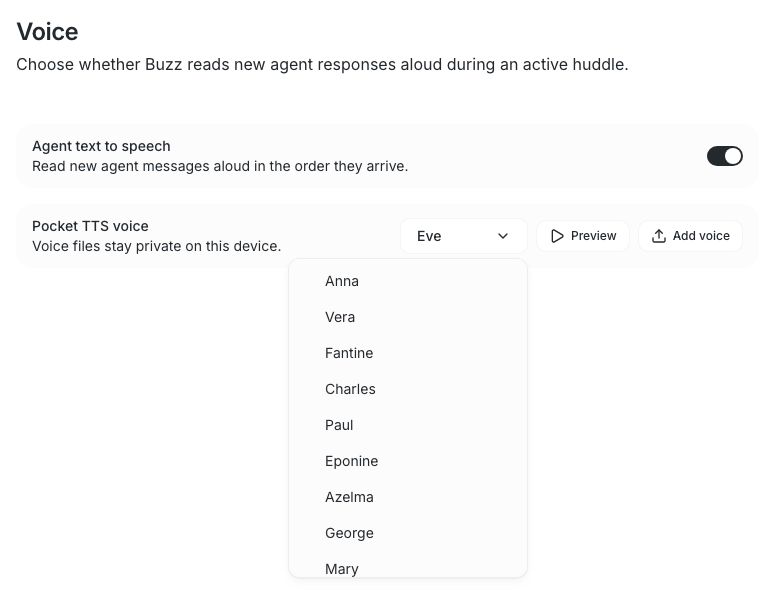 ## Reviewer-reproducible examples Create common-format fixtures and run them through the production importer: ```bash . ./bin/activate-hermit fixtures="$(mktemp -d)" ffmpeg -hide_banner -loglevel error -f lavfi -i "sine=frequency=220:duration=3" -ac 2 -ar 44100 "$fixtures/voice.wav" ffmpeg -hide_banner -loglevel error -i "$fixtures/voice.wav" -c:a aac "$fixtures/voice.m4a" ffmpeg -hide_banner -loglevel error -i "$fixtures/voice.wav" "$fixtures/voice.mp3" ffmpeg -hide_banner -loglevel error -i "$fixtures/voice.wav" "$fixtures/voice.flac" ffmpeg -hide_banner -loglevel error -i "$fixtures/voice.wav" -c:a libvorbis "$fixtures/voice.ogg" ffmpeg -hide_banner -loglevel error -i "$fixtures/voice.wav" -c:a pcm_s16be "$fixtures/voice.aiff" BUZZ_VOICE_IMPORT_TEST_DIR="$fixtures" \ cargo test -p buzz-voice imports_common_audio_format_fixtures -- --ignored --nocapture ``` Exercise import persistence, synthesis, deletion, and bundled-voice fallback with an installed Pocket model: ```bash BUZZ_POCKET_MODEL_DIR=/path/to/pocket-model-bundle \ cargo test -p buzz-voice --test pocket_import_audio \ objective_import_synthesis_delete_and_mary_fallback \ -- --ignored --nocapture ``` Exercise the native-picker boundary, selection, preview dispatch, deletion, cancellation, and invalid-file states: ```bash cd desktop pnpm build:e2e pnpm exec playwright test tests/e2e/voice-settings.spec.ts --project=smoke ``` --------- Signed-off-by: John Tennant <jtennant@block.xyz> Signed-off-by: John Tennant <johnmatthewtennant@gmail.com> Signed-off-by: John Tennant <jtennant@squareup.com> Signed-off-by: npub1qyvc0c5kl4gqv2fd97fsk46tu378sqgy35vc83rvgfwne90sel7s0ed67d <011987e296fd5006292d2f930b574be47c7801048d1983c46c425d3c95f0cffd@buzz.block.builderlab.xyz> Signed-off-by: npub12gtutshhh76rx0jx697f32f9tffd4hhp3hx58fp4x6u4uemkm7sqf8f757 <5217c5c2f7bfb4333e46d17c98a9255a52dadee18dcd43a43536b95e6776dfa0@buzz.block.builderlab.xyz> Co-authored-by: John Tennant <jtennant@block.xyz> Co-authored-by: npub1qyvc0c5kl4gqv2fd97fsk46tu378sqgy35vc83rvgfwne90sel7s0ed67d <011987e296fd5006292d2f930b574be47c7801048d1983c46c425d3c95f0cffd@buzz.block.builderlab.xyz> Co-authored-by: npub12gtutshhh76rx0jx697f32f9tffd4hhp3hx58fp4x6u4uemkm7sqf8f757 <5217c5c2f7bfb4333e46d17c98a9255a52dadee18dcd43a43536b95e6776dfa0@buzz.block.builderlab.xyz> |
||
|
|
61ba9dfaa0 |
refactor(voice): extract reusable Pocket primitives + Pocket voice settings (relands #2467 + #3208) (#3910)
Relands **#2467** (extract `buzz-voice` crate) and **#3208** (Pocket
voice settings) onto main, after #3266 and #3180 merged.
## Why a fresh PR
The repo is squash-only with delete-branch-on-merge. Squashing #3266
deleted `jtennant/pocket-tts-2026-04`, which was #2467's base — GitHub
auto-closed #2467 and it cannot be reopened. Squash merges also sever
ancestry, so GitHub's natural merge-base reports phantom conflicts for
the whole remaining stack.
## Content provenance
- Byte-identical to the blessed `jt/buzz-voice-refactor` branch
(`93029c577`, tree `6729e0eff` — reviewed by Dawn (#2467) and Max
(#3208) at exact heads) **except** the three files where #3180 and #3208
genuinely interact.
- Three-file resolution (union of both sides):
- `huddle/mod.rs` — #3180's pipeline re-exports + #3208's
`agent_tts_routing` imports.
- `huddle/state.rs` — `reset_preserving_generation` preserves both
`huddle_generation` (#3180) and `tts_enabled` (#3208); test sets merged
into one `tests` module.
- `desktop/src/testing/e2eBridge.ts` — both switch arms kept; no
duplicate case labels.
## Verification at
|
