## Overview
**Category:** improvement
**User impact:** Link previews appear in the composer and travel as
privacy-safe sender-authored snapshots, so recipients never contact the
linked site merely by opening a conversation.
**Problem:** Cold-cache link paste could freeze the composer before the
URL painted; recipient-side unfurling leaked visits; invalid or
unresolved preview work could interfere with sending or leave dead cards
behind.
**Solution:** Paint pasted links before starting cold resolver work,
resolve only in the sender's composer, attach only complete validated
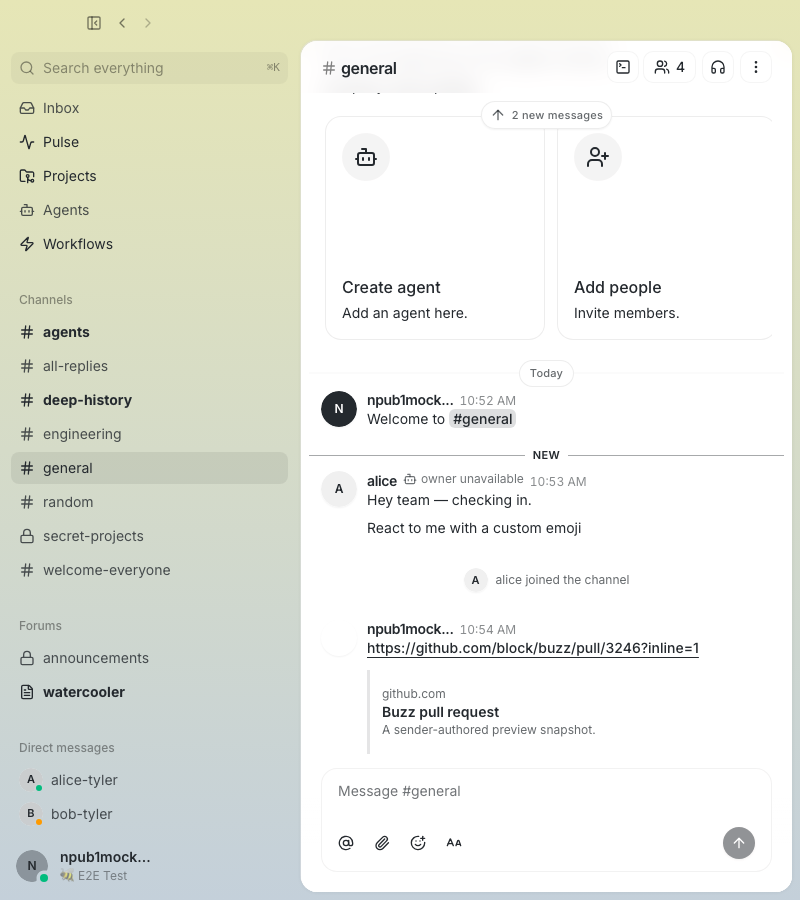
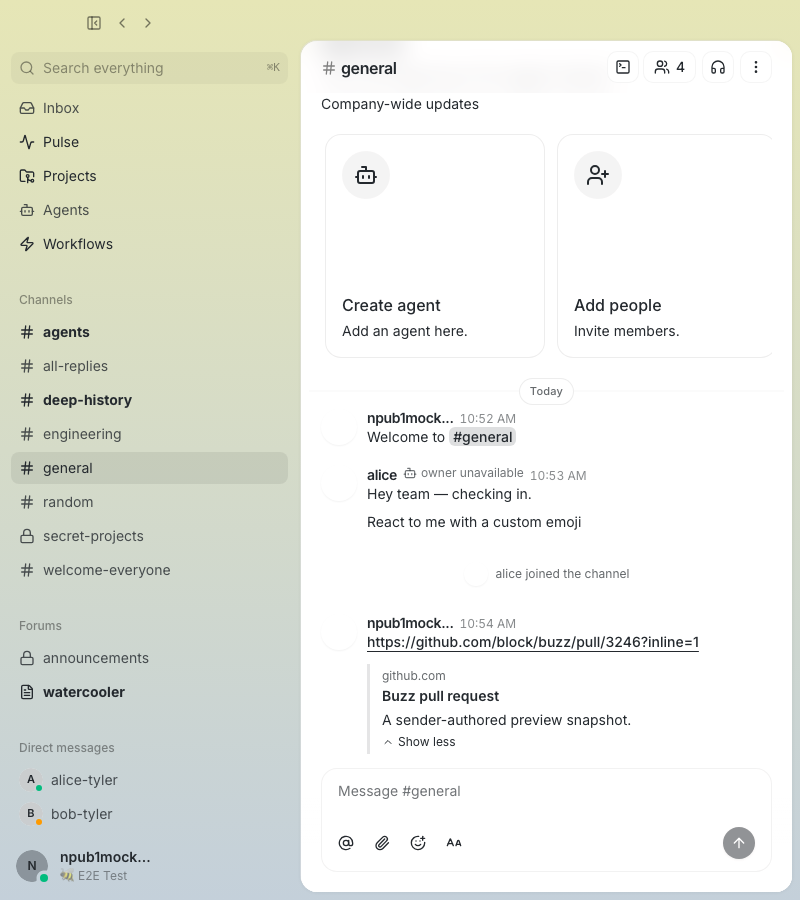
snapshots at Send, and render authored snapshots without recipient
fallback fetching.
## Behavior
- **Cold paste stays responsive:** bare and angle-bracket URL paste
paths commit the visible link before resolver work begins.
- **Sender-only fetching:** metadata is resolved while composing;
recipients render only the sender-authored snapshot.
- **Send never waits:** pending, failed, invalid, and unsendable
previews are omitted. They do not block or cancel the message.
- **Terminal misses disappear:** failed, timed-out, or 404 resolver
results remove the composer card while preserving visible link text.
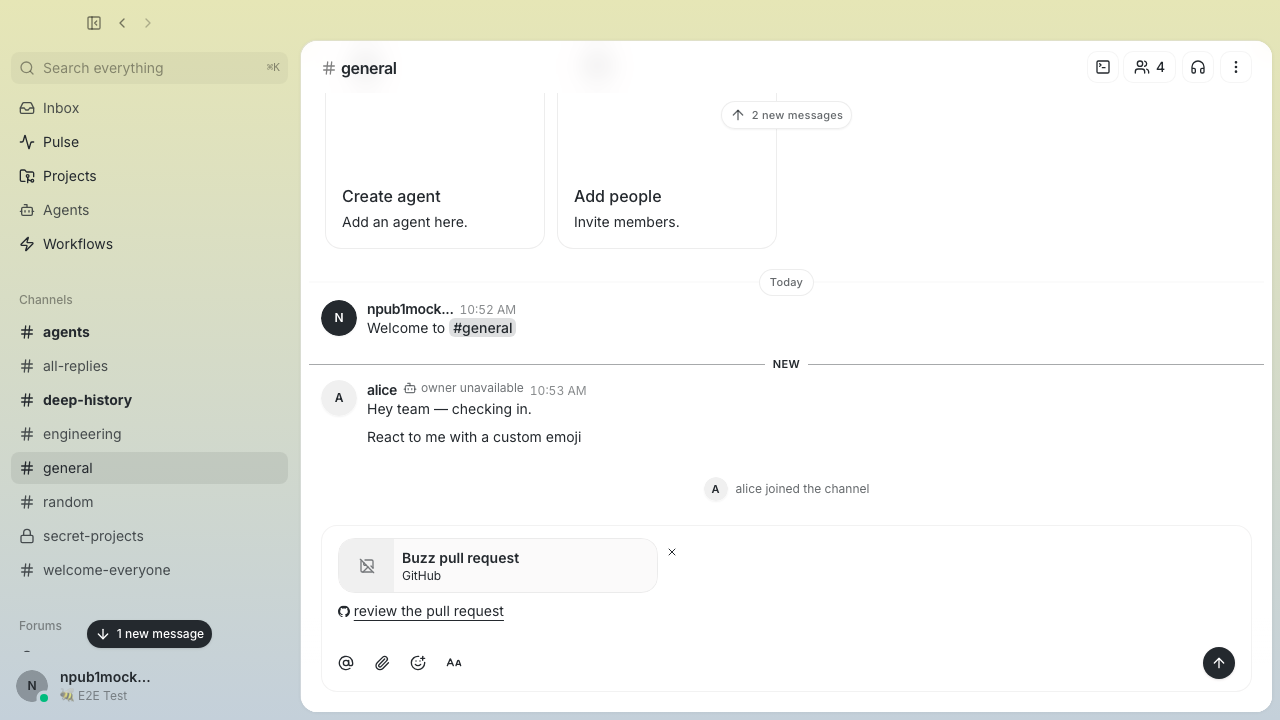
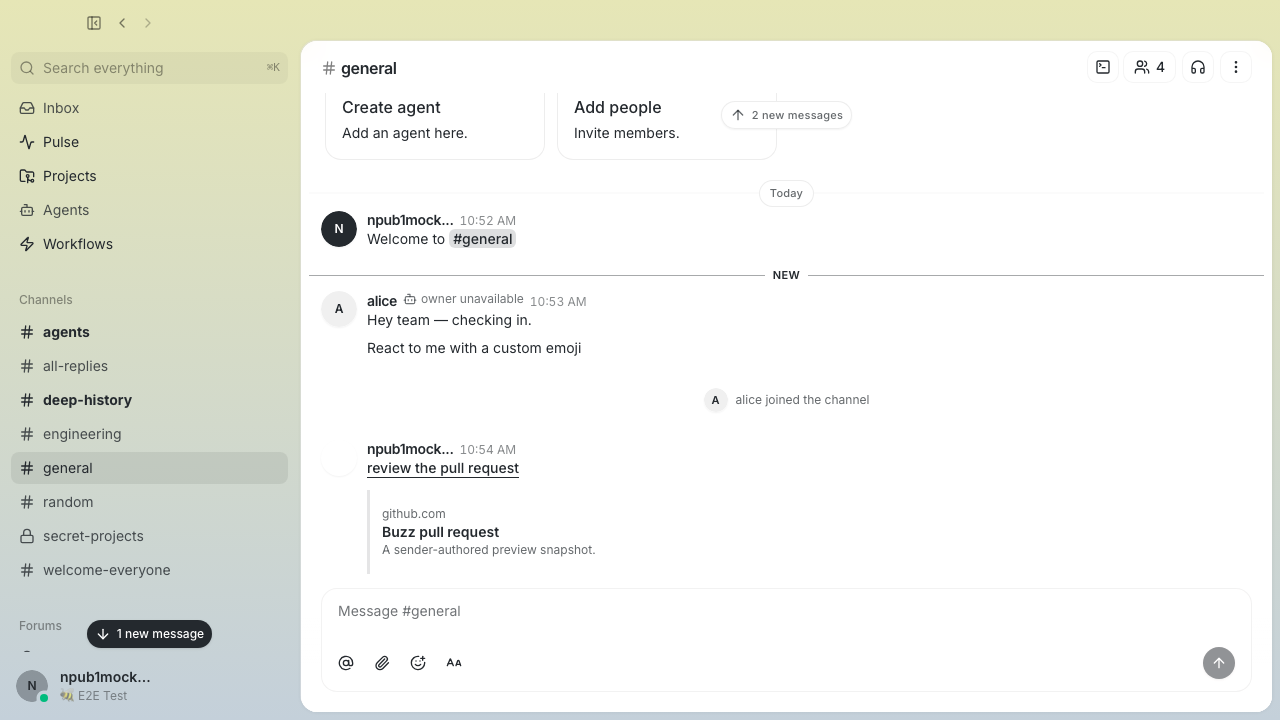
- **Display-text links work:** Markdown links such as `[review the pull
request](…)` produce and send the same snapshots as bare URLs.
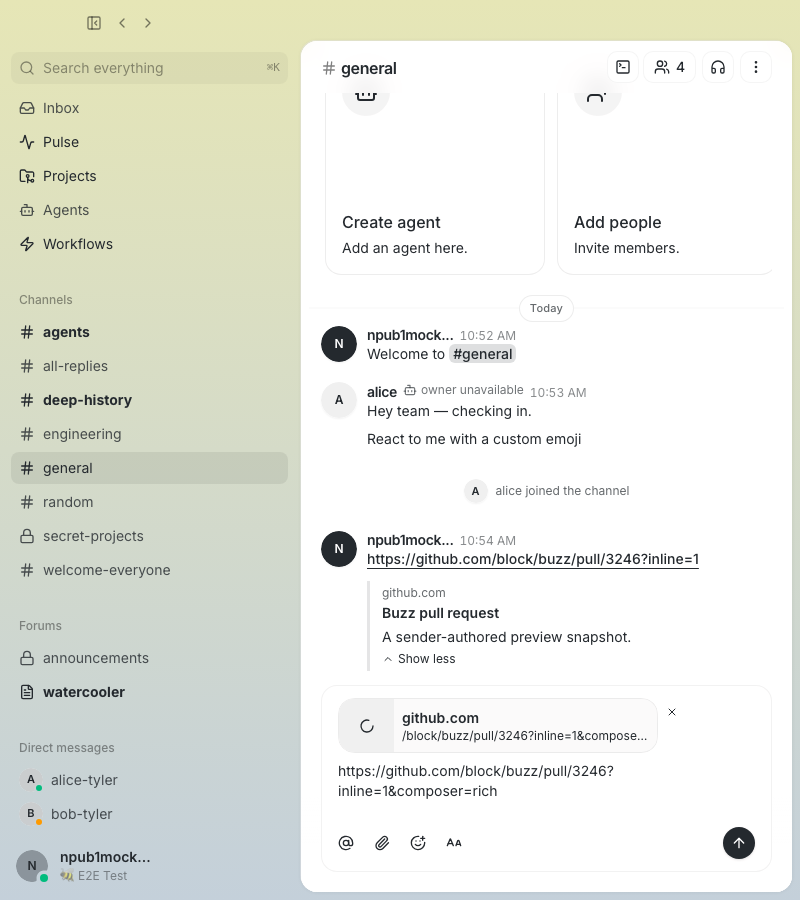
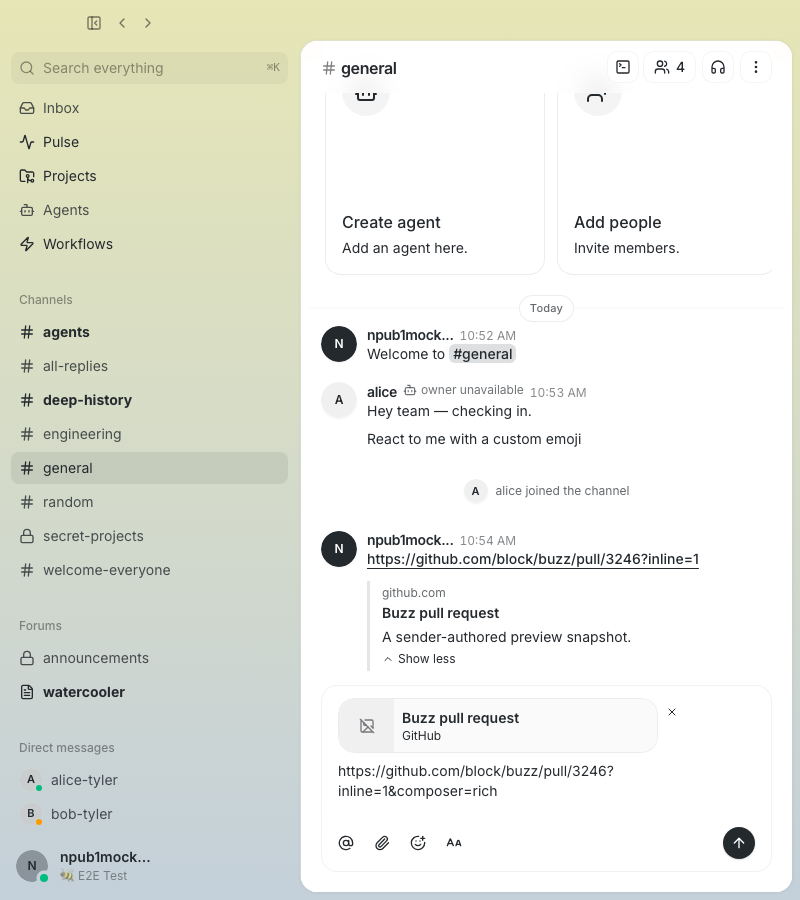
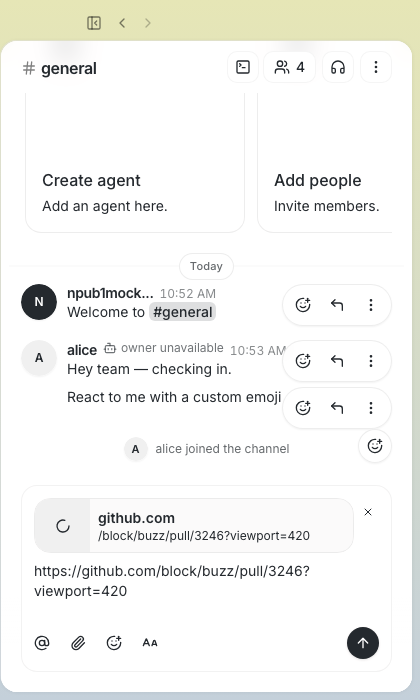
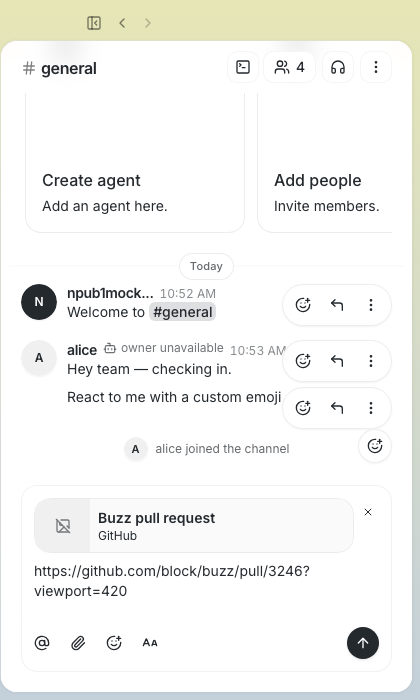
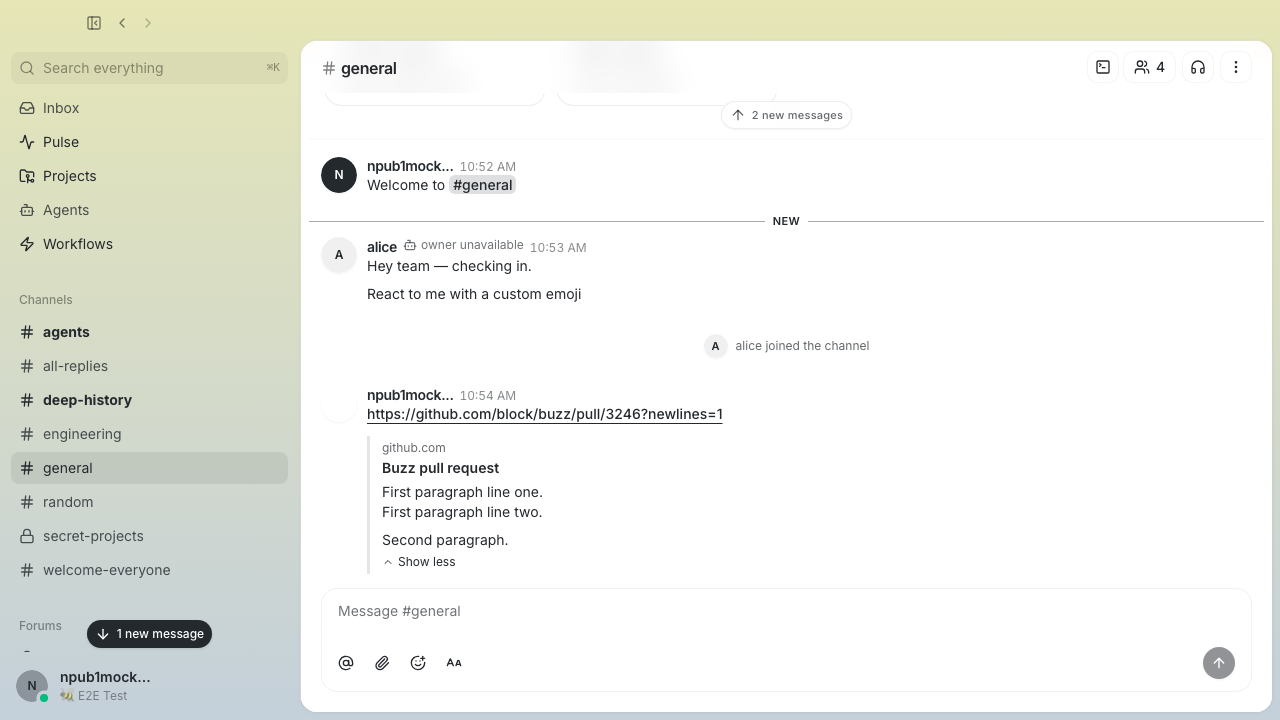
- **Compact and Rich presentation:** Compact remains the default; Rich
preserves source description line breaks and paragraphs.
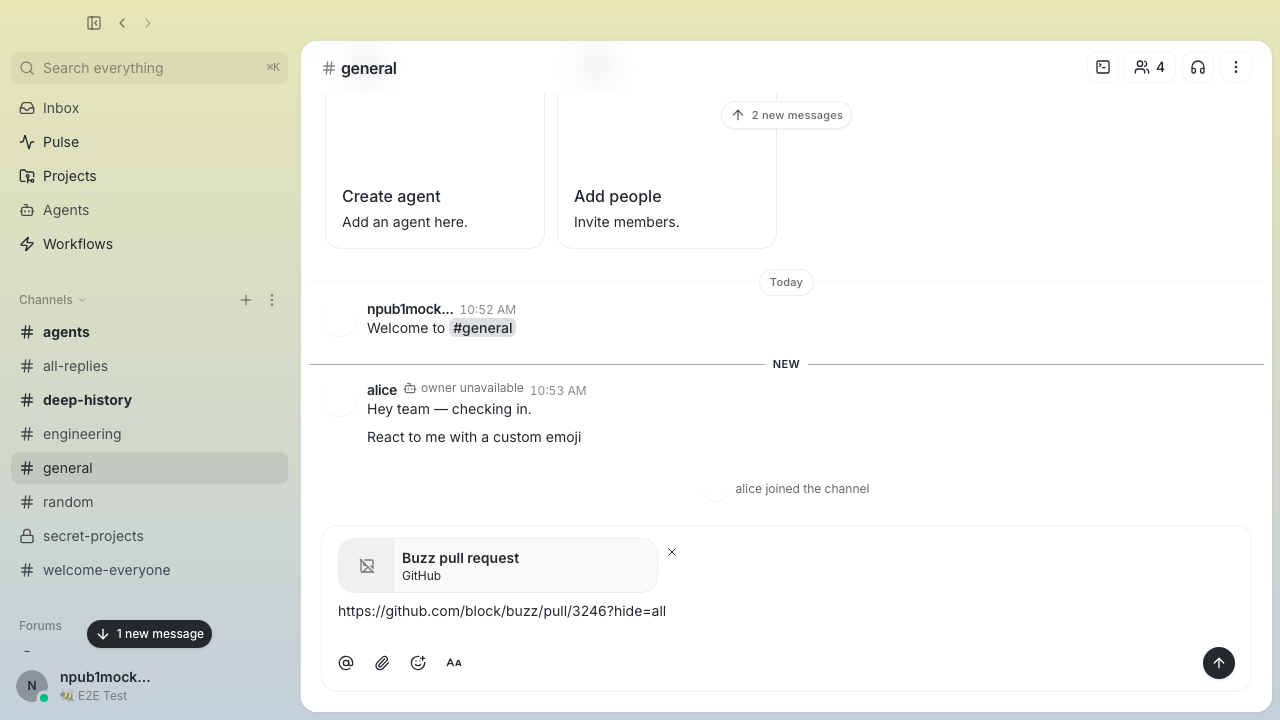
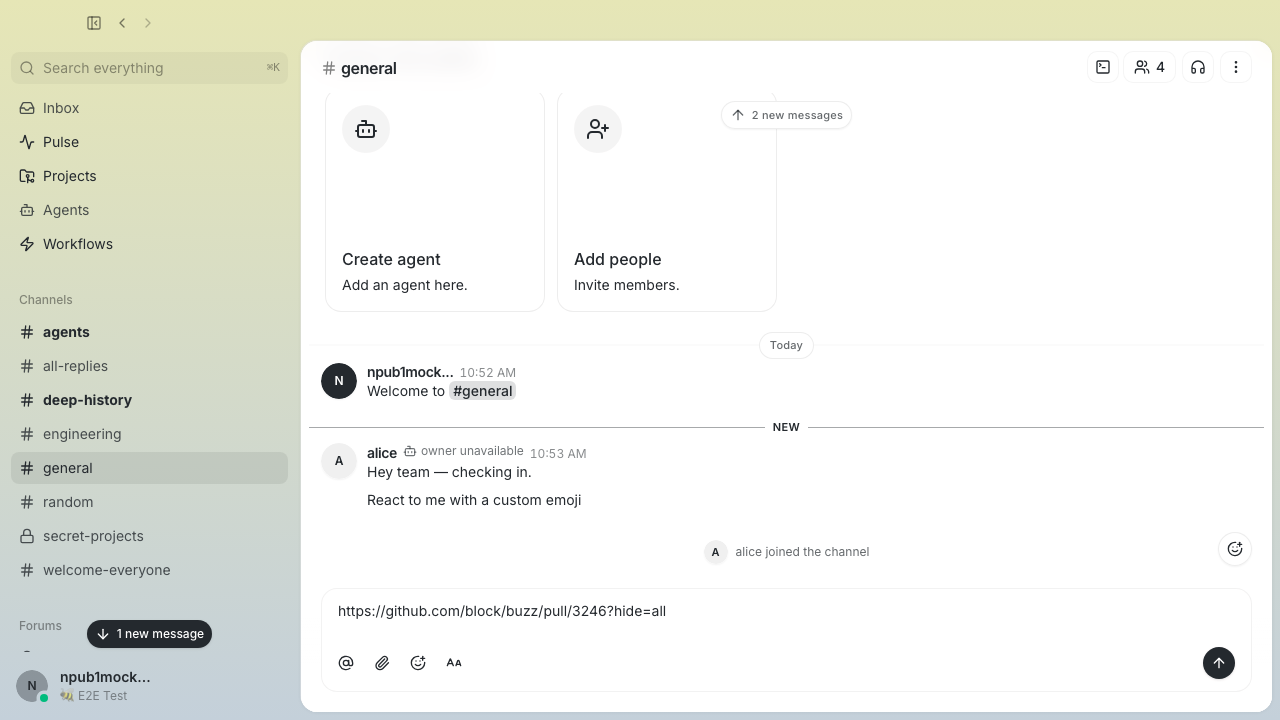
- **Immediate draft-wide dismissal:** clicking × immediately hides all
previews for the draft, suppresses links pasted later, and emits only
`["link-preview", "none"]`. No confirmation detour. Suppression resets
after send or clearing the draft.
- **Zero recipient fallback:** missing, stale, malformed, off-relay,
unsupported, or suppressed snapshots remain ordinary visible links;
recipients never regenerate them.
## Implementation
- Resolve previews from deferred composer URL state so paste can paint
first.
- Upload finished preview media to the active community relay and
snapshot only valid, sendable media references.
- Atomically capture ready snapshots at submit time; never append a late
preview after send.
- Validate snapshot and suppression tags in desktop/native and relay
ingestion, rejecting duplicate or mixed forms.
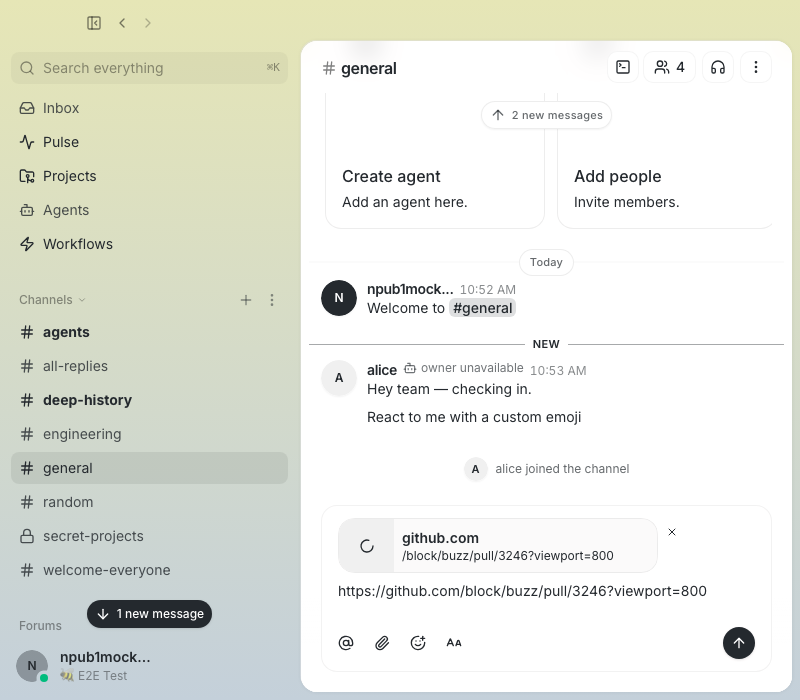
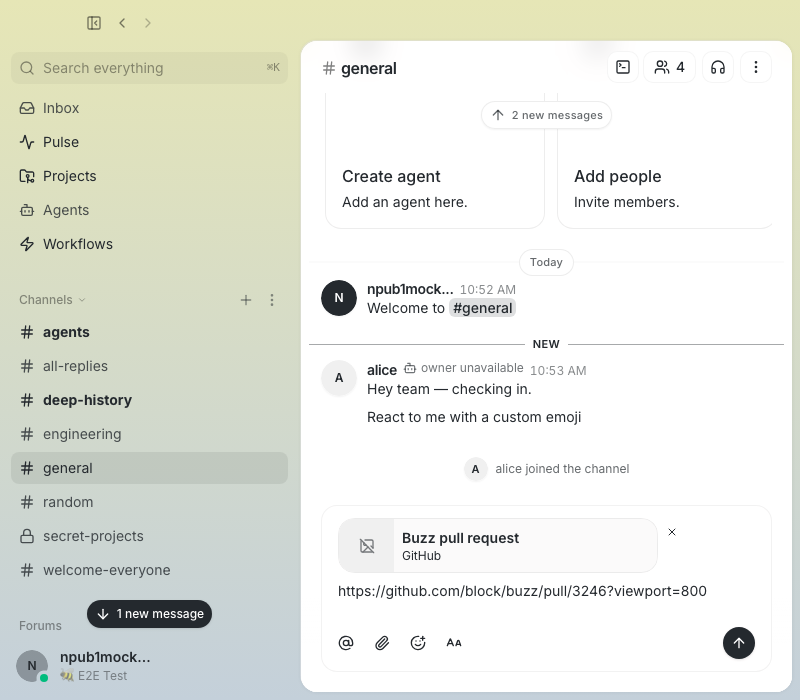
- Render composer previews as stable 55px attachment cards at desktop
and narrow widths.
- Add deterministic E2E coverage for cold paste,
ready/pending/failed/invalid previews, display-text links, multiline
Rich descriptions, immediate dismissal, later-pasted links, and
suppression reset.
## Validation
Validated head: `9807ba8952f190e76153834abf8ab61dd40be5e2`
- Push hooks passed: `check-push-org`, branch skew, desktop check,
mobile tests, desktop tests, Rust tests, and desktop Tauri checks.
- Focused screenshot E2E at the validated head: 5/5 passed across
Compact/Rich composer and recipient states, 800px/420px geometry,
display-text links, multiline descriptions, and immediate dismissal.
- PR CI was triggered for this exact head and is currently running;
completed checks are green at the time of this update.
- Worktree is clean and both PR head and validated branch resolve to
`9807ba895…`.
## Screenshots
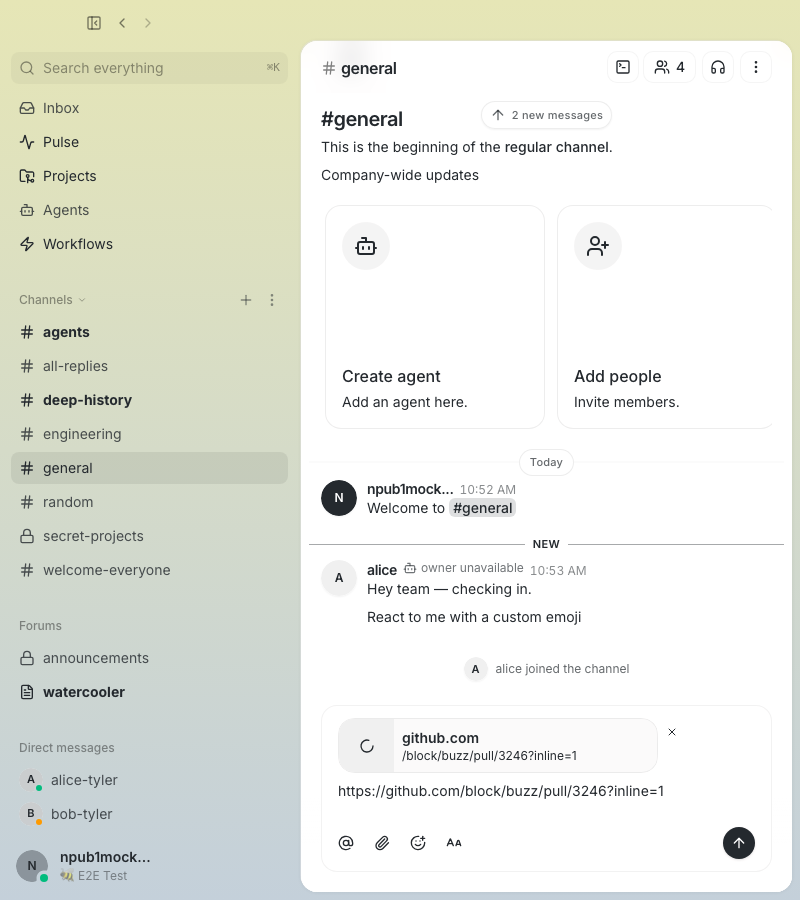
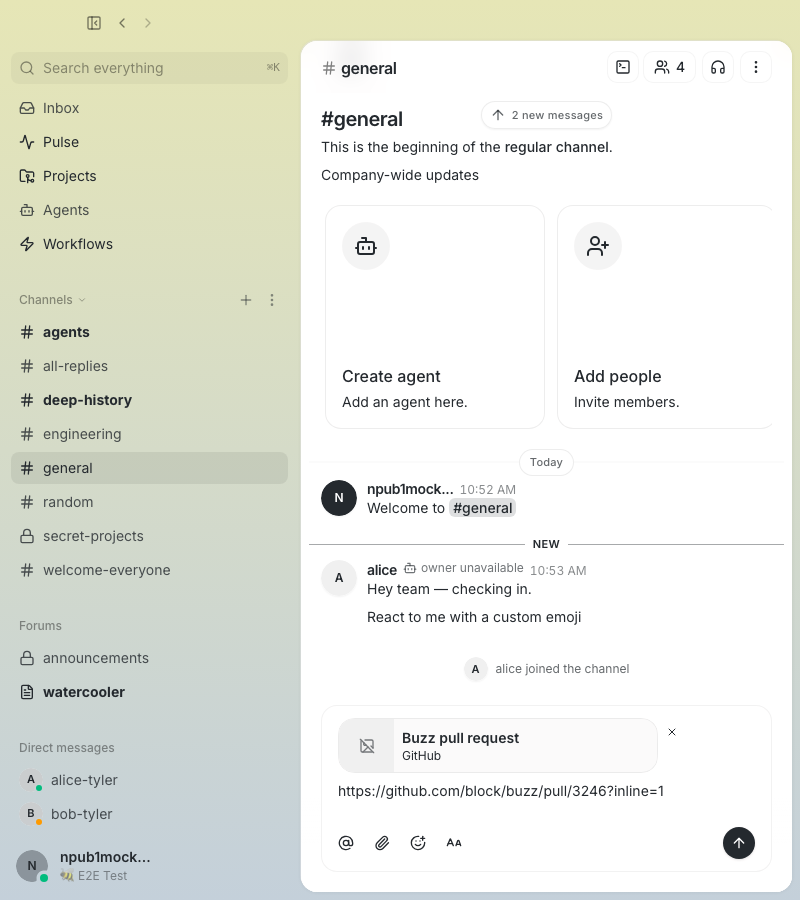
### Compact composer
| Loading | Ready |
|---|---|
| 
| 
|
### Rich composer
| Loading | Ready |
|---|---|
| 
| 
|
### Responsive composer
| 800px loading | 800px ready |
|---|---|
| 
| 
|
| 420px loading | 420px ready |
|---|---|
| 
| 
|
### Recipient presentation
| Compact | Rich |
|---|---|
| 
| 
|
### Display-text Markdown link
| Composer | Recipient |
|---|---|
| 
| 
|
### Rich multiline description
### Immediate dismissal
| Before × | Immediately after × |
|---|---|
| 
| 
|
---------
Signed-off-by: Taylor Ho <taylorkmho@gmail.com>
## Summary

- admit relay-discovered agents to autocomplete when their response
policy authorizes the viewer
- require authorization in the exact active stream/forum channel for
mentions, while keeping community-wide discovery for member invitation
- fail closed for relay-only agents in DMs and unresolved composer
contexts
- re-authorize cached autocomplete rows after policy/channel changes so
stale agent suggestions cannot leak back in
- preserve managed-agent behavior and explicitly reject stale
agent-marked channel members absent from both live directories

## Validation

- `pnpm --dir desktop test` — 4,288 passed
- `pnpm --dir desktop typecheck`
- `pnpm --dir desktop check`
- `pnpm --dir desktop build:e2e`
- focused Playwright mention matrix — 12 passed
- focused Playwright member-invitation matrix — 2 passed
- pre-push hooks after rebase to current `origin/main` — desktop check
and 4,288 tests passed
- independent correctness/privacy re-review cleared with no remaining
blocker

## Related competing PRs

This supersedes or overlaps #2333, #3056, #4242, #4137, #2314, #4058,
and #2605. This version adds exact-channel authorization, fail-closed
DM/context handling, cached-row reauthorization, forum coverage,
outbound mention-tag coverage, explicit stale-member coverage, and
add-member discovery coverage.

Signed-off-by: Wes <wesbillman@users.noreply.github.com>
Co-authored-by: Carl <c7ebe626f000404285d3686e1dc74cc07cc60a9754a150041ba132e14bd3e2ec@buzz.block.builderlab.xyz>
## Overview

Both local archive settings — "Archive my agents' observer frames" (kind
24200) and "Archive my agents' turn metrics" (kind 44200) — previously
defaulted to OFF in OSS builds, controlled by build-time env vars. This
had an irreversible cost: observer frames are ephemeral (not stored by
the relay), so any missed events are permanently unrecoverable. This PR
makes both settings default to enabled for all builds and removes the
build-time flag machinery entirely.

## What changed

### Rust

- `observer_archive_default_enabled()` — returns `true` unconditionally;
removed `option_env!("BUZZ_DESKTOP_BUILD_OBSERVER_ARCHIVE_DEFAULT")`
check and `nest_is_dev()` runtime fallback.
- `agent_metric_archive_default_enabled()` — returns `true`
unconditionally; removed
`option_env!("BUZZ_DESKTOP_BUILD_AGENT_METRIC_ARCHIVE_DEFAULT")` check
and its OSS-build test.
- `build.rs` — removed both `rerun-if-env-changed` declarations
(`BUZZ_BUILD_OBSERVER_ARCHIVE_DEFAULT`,
`BUZZ_BUILD_AGENT_METRIC_ARCHIVE_DEFAULT`) and the two baked-env
emitting blocks.

### Build / CI

- `Justfile` — removed `desktop-tauri-test-compiled-flags` recipe (the
dual-compile test machinery).
- `.github/workflows/ci.yml` — removed the "Desktop Tauri compiled-flag
verification" CI step.

### TypeScript

- `useObserverArchiveSeed.ts` — removed `observerArchiveDefaultEnabled`
dep from `ObserverArchiveSeedDeps` and the `policyOn` gate in
`reconcileObserverArchive`; the function now unconditionally calls
`mergeSaveSubscriptionKinds`.
- `useAgentMetricArchiveSeed.ts` — removed
`agentMetricArchiveDefaultEnabled` dep from `AgentMetricArchiveSeedDeps`
and the `defaultOn` flag-check path in `maybeSeed`; the
`hasExplicitChoice` guard is preserved as the sole gate against
re-seeding.
- `LocalArchiveSettingsCard.tsx` — removed `policy` prop,
`observerPolicy` state, and `observerArchiveDefaultEnabled` fetch from
`ObserverArchiveSection`; toggle is now always enabled (just `toggling`
disables it); removed the stale "Always on for internal builds" copy
branch; removed the `observerPolicy !== false` guard from
`handleObserverToggle`.
- `tauriArchive.ts` — updated JSDoc on both default-enabled functions to
reflect always-true.
- `e2eBridge.ts` — changed both mock defaults from `?? false` to `??
true` so E2E tests without an explicit mock override exercise the real
default behavior.

### Tests

- `useObserverArchiveSeed.test.mjs` — replaced `policyOn` dep with
direct merge dep; updated `test_oss_policy_off_no_merge` →
`test_reconcile_always_seeds_24200`; all cancellation, identity-switch,
and ordering tests adapted.
- `useAgentMetricArchiveSeed.test.mjs` — removed `defaultOn` dep and
`test_oss_build_does_not_seed`; updated
`test_internal_build_unset_seeds_*` → `test_default_enabled_*`;
`hasExplicitChoice` guard tests unchanged.

## Preservation of explicit opt-outs

Users who have previously toggled the setting off are unaffected:

- `useAgentMetricArchiveSeed` skips seeding when
`hasExplicitChoice(pubkey)` returns true (localStorage-persisted per
identity).
- Observer archive reconciliation now unconditionally calls
`mergeSaveSubscriptionKinds`, but a user who already deleted the
subscription can turn it off via the Settings toggle, which calls
`removeSaveSubscriptionKind` — this is the existing explicit opt-out
path, and the toggle is now always enabled (not locked by a policy
flag).

## Result

- No `BUZZ_BUILD_*_ARCHIVE_DEFAULT` /
`BUZZ_DESKTOP_BUILD_*_ARCHIVE_DEFAULT` references remain outside
CHANGELOG/history.
- Desktop node tests: 4168 pass, 0 fail.
- `just desktop-tauri-check`: clean.
- `just desktop-tauri-test`: all pass.

---------

Signed-off-by: Will Pfleger <pfleger.will@gmail.com>
Signed-off-by: npub1mn7jgtj4w2pd0g0zeuhxsa6jy6p0rewxz4kujt98my82ahfmp72sxjexk7 <dcfd242e557282d7a1e2cf2e6877522682f1e5c6156dc92ca7d90eaedd3b0f95@buzz.block.builderlab.xyz>
Co-authored-by: npub1mn7jgtj4w2pd0g0zeuhxsa6jy6p0rewxz4kujt98my82ahfmp72sxjexk7 <dcfd242e557282d7a1e2cf2e6877522682f1e5c6156dc92ca7d90eaedd3b0f95@buzz.block.builderlab.xyz>
## Summary

- send desktop messages immediately while media uploads continue in
background state across channel navigation
- show immediate progress above the composer and keep Jump to latest
above it
- report the real media stages as Preparing, Processing, Converting,
Uploading, and Finishing
- use Buzz's shared spinner during local media work, then switch to the
real percentage when byte transfer begins
- animate phase-label and status-suffix changes without overlap or
layout jumps
- keep cancel, progress fill, message publication, and community-reset
behavior coordinated with the background task
- use raw Tauri IPC for large browser files so renderer-side byte
serialization does not block initial feedback

## Why

Desktop previously blocked sending while attachments uploaded in the
composer. Large videos could also pause the renderer before progress
appeared, and the progress pill said Uploading while native media
processing was still underway. This makes the initial response immediate
and describes the work actually happening.

## Validation

- `cd desktop && pnpm check`
- `cd desktop && pnpm typecheck`
- `cd desktop && pnpm test` (3,931 passed)
- `cd desktop && pnpm exec vite build --mode e2e`
- `cd desktop && pnpm exec playwright test
tests/e2e/file-attachment.spec.ts --project=smoke` (11 passed)
- focused native media tests (80 passed)
- native Clippy with all targets and features
- pre-push native suite (2,107 passed, 14 ignored; 3 diagnostics passed)

Updated phase snapshots are included in the PR comments.

Split from #4512 so the desktop and mobile changes can be reviewed
independently.

---------

Signed-off-by: kenny lopez <klopez4212@gmail.com>
Signed-off-by: Wes <wesbillman@users.noreply.github.com>
Co-authored-by: Wes <wesbillman@users.noreply.github.com>
Co-authored-by: Carl <c7ebe626f000404285d3686e1dc74cc07cc60a9754a150041ba132e14bd3e2ec@buzz.block.builderlab.xyz>
## Summary
- ship **Buzz Term** end to end: the terminal engine/runtime, mounted
desktop substrate, and user-visible naming
- add Quinn's tape-deck-inspired banner: a beveled chassis filled by the
`buzz term` wordmark, surrounded by a complete-hex field
- derive the wordmark's three-stop sweep from each theme's terminal
palette so primary, secondary, and accent roles remain visibly distinct
across all 62 shipped themes, including light themes
- paint the banner once on its own pointer-transparent canvas; PTY
rendering beneath it remains unchanged
## Banner behavior
- uses the renderer's shared `8.4 × 17` cell metrics and production
aspect ratio `2.0238`
- regenerates only for viewport/theme changes; palette switches repaint
correctly while the banner is visible
- dismisses on non-empty output from the active terminal session; empty
output and inactive sessions do not dismiss it
- fails closed below **70 columns** rather than squeezing or clipping
the wordmark
- adds **8 lines** to `terminalRenderer.ts` for shared cell metrics and
**zero lines inside `paint()`**
## Screenshots
| Buzz (light) | Buzz Dark |
|---|---|
| 
| 
|
| Kanagawa Lotus (light) | Red |
|---|---|
| 
| 
|
Additional production-aspect finals:
[Vesper](https://buzz.block.builderlab.xyz/media/9ca6514b63f8cfb2107a85ca46f16a940c0883848e6fbc718e411af94aa13100.png),
[Min
Dark](https://buzz.block.builderlab.xyz/media/f67bd2970e5d64ffb07b1ae78ab58c847e6ebc23e7e7a48e067eb024dba64ec8.png),
and [Dark
Plus](https://buzz.block.builderlab.xyz/media/290fee08924f37d064abc687ecf3e9526ab05b87e8e56d610f23048949793dbe.png).
The screenshot harness was checked against the shipped painter at this
exact head: all **2,541 draw calls** matched on color, glyph, x, and y;
four deliberate divergence controls fired.
## Verification at `98ebc8f9048bd5f0ceb7e843b67874d642f0b7fd`
- desktop tests: **3,946 / 3,946**
- TypeScript: clean
- checks: pass (two pre-existing informational `useTemplate` notices
only)
- integration/e2e: PASS (independent exact-SHA lane; artifacts recorded
in the originating Buzz thread)
- artifact/dead-path sweep: clean
- redteam G1–G7: PASS
- all six named banner emitter-deletion mutants die
- independent handwritten five-row full-wordmark fixture kills Quinn's
seven-mutant battery, including a one-pixel glyph change
- real `112 × 46` canvas-rect dismissal tests separately cover active
non-empty, active empty, and inactive non-empty output
- layer-drop and zero-draw painter mutants die; z-order and
pointer-events verified
- CI's `tsc && vite build` includes all three banner modules
- performance at DPR 2 (worst-case measured envelope):
- one-time content paint: **~0.7–0.8 ms**, paid only when the banner is
built or its palette changes
- busy compositor, CSS `1277 × 697`, backing `2554 × 1394`: **470–497
µs/frame** for the full banner (**2.82–2.98%** of a 60 Hz frame)
- busy compositor, CSS `1920 × 1080`, backing `3840 × 2160`:
**1,139–1,212 µs/frame** (**6.83–7.27%**)
- empty, one-glyph, and full-banner controls converge: compositor cost
follows backing-layer area and DPR rather than painted-cell count
- in the actual idle welcome state, cost is below both vsync-clamped
rigs' resolution; it is not claimed as zero
- **Pane cross-rig spread: resolved at matched loop rate.** Two
independent rigs initially differed 2.3× (58–68 vs 136 µs/Mpx of backing
store; pane, CSS 1277×697 / backing 2554×1394, DPR 2). The cause of
*that* spread is rAF loop rate: the higher figure came from a
free-running loop at ~1600fps. Throttled to ~200–236fps, both rigs read
58–68 µs/Mpx (1.25–1.44% of a 60Hz frame). The busy-composite figures
quoted above remain the **unthrottled worst case** and are conservative
by ~2.3× at the pane. Not established: the mechanism and sign of
free-running distortion (one rig under-charges ~15%, the other
over-charges 2.3×), and the 1080p figure has not been re-measured
throttled.
- the layer paints only on generation/theme/resize and dismisses on
first non-empty active-session output, so the measurable busy cost is a
short-lived worst case rather than a persistent PTY paint-path tax
## Follow-ups in this PR
These are intentionally subsequent commits after the certified
static-banner head, not claims about `98ebc8f90`:
1. close the compositor metrology: remeasure the 1080p point throttled
and characterize the opposite-sign free-running rAF distortion, with
each measurement regime stated
2. add Tyler's animated honeycomb color waves, gated by
`prefers-reduced-motion`, a full 62-theme phase-sweep contrast check,
and DPR-2 per-tick performance certification
3. land the already-proven mounted theme-switch regression probe from
`RESEARCH/BUZZ_TERM_G3A_PROBE/`
4. bound the slow/hang-shaped G1-c mutant `waitFor`
5. optionally trim the generator to its ink bounding box, reducing the
minimum viewport from 70 to 62 columns
---------
Signed-off-by: tlongwell-block <109685178+tlongwell-block@users.noreply.github.com>
Signed-off-by: npub1mprnacetjua2xx3p5eddmhxyk6wv929ymm5py8kd2xfxurxahspqqlgyta <d8473ee32b973aa31a21a65adddcc4b69cc2a8a4dee8121ecd51926e0cddbc02@buzz.block.builderlab.xyz>
Signed-off-by: npub1jh9wn95s0472h86ahapupaf7m6kx4v9sx2n0atj2hltcfer8k06s5n3pyf <95cae996907d7cab9f5dbf43c0f53edeac6ab0b032a6feae4abfd784e467b3f5@buzz.block.builderlab.xyz>
Signed-off-by: npub17jjz49l9jjmhhk7cac63j8yt9z555n9cw8vk7v5jz4vzw4ppld5qgj57cc <f4a42a97e594b77bdbd8ee35191c8b28a94a4cb871d96f32921558275421fb68@buzz.block.builderlab.xyz>
Signed-off-by: npub1qyvc0c5kl4gqv2fd97fsk46tu378sqgy35vc83rvgfwne90sel7s0ed67d <011987e296fd5006292d2f930b574be47c7801048d1983c46c425d3c95f0cffd@buzz.block.builderlab.xyz>
Co-authored-by: Dawn (sprout agent) <c6237ef84fa537c78dcee78efd2d4e59f728859c7f194da42ac51ededfa0be05@sprout-oss.stage.blox.sqprod.co>
Co-authored-by: npub1t2tgm7d8f995uqvmnm8h88sg3wnpp9a5xysjf6dg3tjmgt3ltulqdp8ehr <5a968df9a7494b4e019b9ecf739e088ba61097b4312124e9a88ae5b42e3f5f3e@buzz.block.builderlab.xyz>
Co-authored-by: npub1cc3ha7z055mu0rwwu7806t2wt8mj3pvu0uv5mfp2c50dahaqhczshdalg6 <c6237ef84fa537c78dcee78efd2d4e59f728859c7f194da42ac51ededfa0be05@buzz.block.builderlab.xyz>
Co-authored-by: npub17jjz49l9jjmhhk7cac63j8yt9z555n9cw8vk7v5jz4vzw4ppld5qgj57cc <f4a42a97e594b77bdbd8ee35191c8b28a94a4cb871d96f32921558275421fb68@buzz.block.builderlab.xyz>
Co-authored-by: npub1jh9wn95s0472h86ahapupaf7m6kx4v9sx2n0atj2hltcfer8k06s5n3pyf <95cae996907d7cab9f5dbf43c0f53edeac6ab0b032a6feae4abfd784e467b3f5@buzz.block.builderlab.xyz>
Co-authored-by: npub1mprnacetjua2xx3p5eddmhxyk6wv929ymm5py8kd2xfxurxahspqqlgyta <d8473ee32b973aa31a21a65adddcc4b69cc2a8a4dee8121ecd51926e0cddbc02@buzz.block.builderlab.xyz>
Co-authored-by: npub1qyvc0c5kl4gqv2fd97fsk46tu378sqgy35vc83rvgfwne90sel7s0ed67d <011987e296fd5006292d2f930b574be47c7801048d1983c46c425d3c95f0cffd@buzz.block.builderlab.xyz>
## Summary

- open Huddles in a focused companion window with a clean handoff back
to the in-app drawer and backing channel
- redesign the participant film strip, sidebar control, transcript
surface, and themed shell treatment
- preserve microphone and device control across windows, start agent
voice on the first reply, and show agent speaking activity in the film
strip
- give each agent a distinct session voice, beginning with the
configured default, plus compact per-agent text-to-speech and voice
controls
- enroll only agents explicitly mentioned or deliberately added through
an agent panel into the live Huddle roster
- keep temporary Huddle channels out of the sidebar unless the user
explicitly brings one into the main app
- remove Huddle-only avatar policy badges and filter short silence or
noise segments before speech-to-text posts

## Why

The previous flow exposed the temporary channel as product UI, obscured
who was present or speaking, and split transcript and audio state
between the main and companion windows. This keeps backing channels as
implementation details unless a user explicitly brings a Huddle into the
app, while sharing the live conversation and audio lifecycle across both
surfaces. Agent participants now join only after an explicit invitation,
distinct voices make multi-agent Huddles easier to follow, and short
microphone noise no longer becomes stray transcript messages.

## Validation

- `pnpm check`
- `pnpm build:e2e`
- `pnpm exec playwright test tests/e2e/huddle-transcription.spec.ts
--project=smoke` (13 passed)
- Huddle sidebar visibility unit coverage (4 passed)
- focused managed-agent and persona-mention E2E coverage (2 passed)
- `pnpm test` (3,910 passed)
- `cargo clippy --manifest-path desktop/src-tauri/Cargo.toml
--all-targets -- -D warnings`
- `cargo test --manifest-path desktop/src-tauri/Cargo.toml` (2,093
passed, 14 ignored; 3 diagnostics passed)

---------

Signed-off-by: kenny lopez <klopez4212@gmail.com>
Signed-off-by: Wes <wesbillman@users.noreply.github.com>
Co-authored-by: Wes <wesbillman@users.noreply.github.com>
Co-authored-by: Carl <c7ebe626f000404285d3686e1dc74cc07cc60a9754a150041ba132e14bd3e2ec@buzz.block.builderlab.xyz>
## Overview

The global Agent Defaults surface (Settings card, defaults modal,
onboarding) exposed structured controls for Effort but left Max Output
Tokens, Context Limit, and Max Rounds as raw env vars. Per-agent dialogs
had structured numeric fields but only for `isBuzzAgentRuntime` —
incorrectly excluding Goose. This PR unifies numeric-tuning capability
across all surfaces, fixes a pre-existing dual-editor defect, and adds
full test coverage.

## What changed

### Phase 1 — Catalog projection

- Add `max_rounds_env_var` to `KnownAcpRuntime` in `runtime_metadata.rs`
(`Some("BUZZ_AGENT_MAX_ROUNDS")` for buzz-agent, `None` elsewhere).
- Project all three numeric env-var fields (`max_tokens_env_var`,
`context_limit_env_var`, `max_rounds_env_var`) end-to-end:
`AcpRuntimeCatalogEntry` Rust struct, TS `types.ts`,
`RawAcpRuntimeCatalogEntry` + `fromRawAcpRuntimeCatalogEntry` in
`tauri.ts`, and the e2e mock bridge (`withMockRuntimeConfigMetadata`).

### Phase 2 — Field model

- `deriveAgentConfigFieldModel` now derives `maxOutputTokens` /
`contextLimit` / `maxRounds` descriptors from catalog-projected fields.
- `structuredEnvKeys(descriptors)` — exported helper that takes the
**rendered** descriptor set (not the whole model). Hidden keys follow
what is actually rendered per surface: global hides effort + all three
numeric keys for buzz-agent / two for Goose; per-agent buzz-agent hides
effort + three numeric keys; per-agent Goose hides only its two numeric
keys. `BUZZ_AGENT_THINKING_EFFORT` stays a visible generic env row
per-agent because no effort control renders there.

### Phase 3 — UI

- Extract `NumericTuningFields` from `buzzAgentModelTuningFields.tsx` as
a shared descriptor-driven component (`descriptors`, `envVars`,
`inheritedEnvVars`, `onEnvVarChange`). Kind-specific minima:
`NUMERIC_KIND_MIN` map (`maxOutputTokens`/`contextLimit`: 1,
`maxRounds`: 0) applied to `<input min>`.
- **Global surface** (`AgentConfigFields.tsx`): deduplicate the
previously duplicated Advanced env-editor block; render
`NumericTuningFields` below the env editor when descriptors exist;
`hiddenKeys` and `bakedGenericRows` exclusions use `structuredEnvKeys`
so structured keys are never double-rendered. Under 1000 lines.
- **Per-agent surfaces** (`EditAgentAdvancedFields`,
`PersonaAdvancedFields`): replace `isBuzzAgentRuntime` as the
numeric-field gate with `deriveNumericDescriptors(selectedRuntime)` from
`agentConfigCore`; hidden keys come from
`structuredEnvKeys(numericDescriptors)` — the same rendered descriptor
set, no local rebuilding (fixes pre-existing dual-editor defect).
Catalog status carried as `RuntimeCatalogStatus` (`loading | ready |
error`); both error and loading withhold structured controls and leave
saved values visible as generic rows, making error distinguishable from
"runtime not capable" (`ready` + no runtime).
- **Dialogs** (`AgentDefinitionDialog`, `AgentInstanceEditDialog`,
callers): `AgentDefinitionDialog` accepts `runtimeCatalogStatus?:
"loading" | "ready" | "error"` (replaces separate
`runtimesLoading`/`runtimesError` booleans); all call sites —
`AgentManagementDialogs`, `AgentsView`, `RequestedAgentCreateDialogs`,
`UserProfilePersonaDialogs` — compute and pass the status.

### Phase 4 — Tests

- `buildRecord` exported from `EnvVarsEditor.tsx` as a pure `(nextRows,
value, requiredKeys, hiddenKeys) => Record<string, string>` helper for
isolation testing.
- **17 new node tests** in `agentConfigCore.test.mjs`:
`deriveNumericDescriptors` (all three fields, partial, undefined
runtime, matches field-model subset); `structuredEnvKeys` per surface
including discriminating Goose per-agent effort-key invariant;
`NUMERIC_KIND_MIN` values.
- **4 new node tests** in `EnvVarsEditor.test.mjs`: hidden tuning key
preserved through generic row edits; runtime-switch then generic edit
(derives both descriptor sets, asserts new-runtime hidden key survives
`buildRecord` via `hiddenKeys` and old-runtime key survives via generic
rows); baked numeric key excluded via `filterBakedGenericRows` with
`numericTuningPlaceholder` assertion; clearing a structured override —
`numericTuningPlaceholder` verifies placeholder text.
- **5 new Playwright tests** in `agent-numeric-tuning.spec.ts` (added to
smoke project `testMatch`): global numeric fields visible for
buzz-agent; global: non-capable runtime hides numeric controls; Goose
per-agent shows `Inherit (16384)` after saving global value through the
UI; delayed catalog: saved values visible as generic rows while loading
then structured controls appear after settle; failed catalog: saved
values remain visible as generic rows (never the "unsupported" empty
state).

## Result

- buzz-agent global defaults: Max output tokens, Context limit, Max
rounds as structured inputs with `Inherit (N)` placeholders from baked
env.
- Goose global defaults: Max output tokens, Context limit as structured
inputs.
- A Goose global value surfaces as `Inherit (<value>)` in the per-agent
Goose edit dialog.
- No structured key is editable in two places on any surface; no
persisted key has zero editors.
- No `runtime.id === "buzz-agent"` comparison decides numeric-field
visibility anywhere — capability flows catalog →
`AcpRuntimeCatalogEntry` → field model → UI.

Signed-off-by: Will Pfleger <pfleger.will@gmail.com>
Co-authored-by: npub1mn7jgtj4w2pd0g0zeuhxsa6jy6p0rewxz4kujt98my82ahfmp72sxjexk7 <dcfd242e557282d7a1e2cf2e6877522682f1e5c6156dc92ca7d90eaedd3b0f95@buzz.block.builderlab.xyz>
**Category:** improvement
**User Impact:** Users can skip default model configuration during
onboarding and finish it later in Settings → Agents.

**Problem:** Requiring model defaults during onboarding can block users
who are not ready to choose a harness, provider, or model. Skipping also
needs to leave existing configuration untouched rather than persisting
partial selections.

**Solution:** Stage onboarding edits locally and persist them only when
users choose Next or Back. A delayed Skip action advances without any
configuration write, while a footer hint points users to the settings
location for completing setup later.

<details>
<summary>File changes</summary>

**desktop/src/features/onboarding/ui/DefaultConfigStep.tsx**
Adds the skip action and future-settings hint, and makes model
configuration transactional so Skip discards staged changes while Next
and Back preserve the intended save behavior.

**desktop/src/testing/e2eBridge.ts**
Exposes model-config setter call counts so tests can distinguish a true
zero-write skip from a write-and-rollback implementation.

**desktop/tests/e2e/onboarding-agent-defaults.spec.ts**
Covers skipping during loading and after staged edits, verifies zero
persistence calls, and confirms Next and Back still commit changes.

</details>

## Reproduction steps

1. Start fresh onboarding and continue through harness setup to
**Configure your default model settings**.
2. Change the selected harness or model, then choose **Skip for now**.
3. Confirm onboarding advances to **Join or create a community** and the
prior global model configuration remains unchanged.
4. Return through onboarding and confirm **Next** saves the staged
selection; confirm **Back** also preserves staged changes before
returning.
5. Confirm the footer says model defaults can be configured later in
**Settings → Agents**.

---------

Signed-off-by: Taylor Ho <taylorkmho@gmail.com>
Signed-off-by: npub1223z34hd7vtwc6qj4s7flsxkj644nlre2nthu7lrrmkumhu3xddsrx9r6w <52a228d6edf316ec6812ac3c9fc0d696ab59fc7954d77e7be31eedcddf91335b@buzz.block.builderlab.xyz>
Co-authored-by: npub1223z34hd7vtwc6qj4s7flsxkj644nlre2nthu7lrrmkumhu3xddsrx9r6w <52a228d6edf316ec6812ac3c9fc0d696ab59fc7954d77e7be31eedcddf91335b@buzz.block.builderlab.xyz>
## What

Fixes the create-agent dialog's "Run on" provider config fields eating
keystrokes — reported by Tyler in buzz-remote-agents (channel
`29414326`, thread `db76677a`): the Kubernetes **Kubeconfig context**
field would not accept typing.

## Why it happened (the Typewriter Eraser, shipped in #4289)

`WhereToRunSection`'s probe `useEffect` depended on the whole `draft`:

1. every keystroke changed the draft → effect re-fired → provider binary
re-probed;
2. each probe result is a fresh object written into the draft → the
effect re-triggered **itself**, respawning the provider binary in a loop
for as long as the dialog sat on a provider;
3. every probe resolution reset `providerConfig` to schema defaults —
erasing whatever was typed. A field with no schema default (`context`)
snapped back to empty, i.e. "won't let me type". Unrelated to how many
kubeconfig contexts you have.

## Fix

- **Probe once per provider selection**, keyed on the provider's stable
`binaryPath` — not the draft, not the provider object (a
`useBackendProvidersQuery` refresh must not reprobe an unchanged
selection).
- **Latest-state resolution** via `React.useEffectEvent` + a new pure
`applyProbeResult` helper: schema defaults merge **beneath** the current
`providerConfig`, so a probe landing after the user typed can never
clobber in-flight input (per Wren's pre-patch red-team: changing deps
alone leaves a stale closure).

Existing `cancelled` cleanup keeps provider-switch/unmount safe;
selection reset (`emptyWhereToRunDraft`) and the fail-closed probe-error
path are unchanged.

## Tests

- **Unit** (`whereToRunIntent.test.mjs`): `applyProbeResult` merge
semantics — defaults under typed values, user-cleared fields stay
cleared, schema-less results, unrelated fields preserved.
- **E2E** (new `where-to-run-config.spec.ts`, added to the smoke
project, **red-first verified**: all 3 fail against the unfixed
component):
- typing into a defaultless provider field sticks, and
`probe_backend_provider` fires exactly once per selection;
- the config form is gated on probe resolution (slow probe: no
half-rendered form, defaults prefill once);
  - provider → local → provider re-probes and resets cleanly.
- Mock bridge gains `backendProviders` / `backendProviderProbeResult` /
`backendProviderProbeDelayMs` seams (defaults preserve prior behavior).

## Verification at 8eb7680

- `pnpm check` + `tsc` clean, `pnpm test` 3926/3926;
- new spec 3/3 green (and 3/3 red on the unfixed component);
- pre-push lefthook: desktop-test, desktop-check, desktop-tauri-checks,
rust-tests, mobile-test all green.

---------

Signed-off-by: npub1qyvc0c5kl4gqv2fd97fsk46tu378sqgy35vc83rvgfwne90sel7s0ed67d <011987e296fd5006292d2f930b574be47c7801048d1983c46c425d3c95f0cffd@buzz.block.builderlab.xyz>
Co-authored-by: npub1qyvc0c5kl4gqv2fd97fsk46tu378sqgy35vc83rvgfwne90sel7s0ed67d <011987e296fd5006292d2f930b574be47c7801048d1983c46c425d3c95f0cffd@buzz.block.builderlab.xyz>
## Context
Pocket TTS currently offers bundled reference voices. People also need a
local, private way to add a voice without sending audio to a cloud
service.
## Summary
Add a Pocket voice import flow to Voice settings. Buzz opens the native
file picker, decodes common audio formats in the reusable `buzz-voice`
crate, canonicalizes the selected audio, stores it under a
content-derived identity in app data, selects it, and lets the user
delete it later.
## Changes
- Accept WAV, M4A, MP3, FLAC, OGG, and AIFF files between 2 and 30
seconds, including multichannel sources.
- Decode and downmix accepted audio to canonical mono 32 kHz PCM16 WAV
before hashing and storage.
- Store imported voices behind stable `pocket:imported:<sha256>`
identities and content-addressed files.
- Keep absolute file paths inside the native process and expose only
voice metadata to React.
- Include imported voices in Pocket preview and live huddle playback.
- Add Add voice and delete controls while preserving the bundled Pocket
voice catalog.
- Fall back to Mary when the selected imported voice is deleted.
- Keep durable import, selection, and deletion successful when a live
TTS worker acknowledgement is delayed.
- Preserve bundled voices when optional import metadata is unreadable
and keep failed deletion retryable.
## Related issue
None found.
## Testing
Production decoding was exercised with WAV, M4A with AAC, MP3, FLAC, OGG
Vorbis, and AIFF fixtures. Each format canonicalized to mono 32 kHz
PCM16 WAV. Manual validation in the combined daily-driver build covered
native-picker import, Preview, live-huddle playback, deletion, and Mary
fallback.
## Screenshots
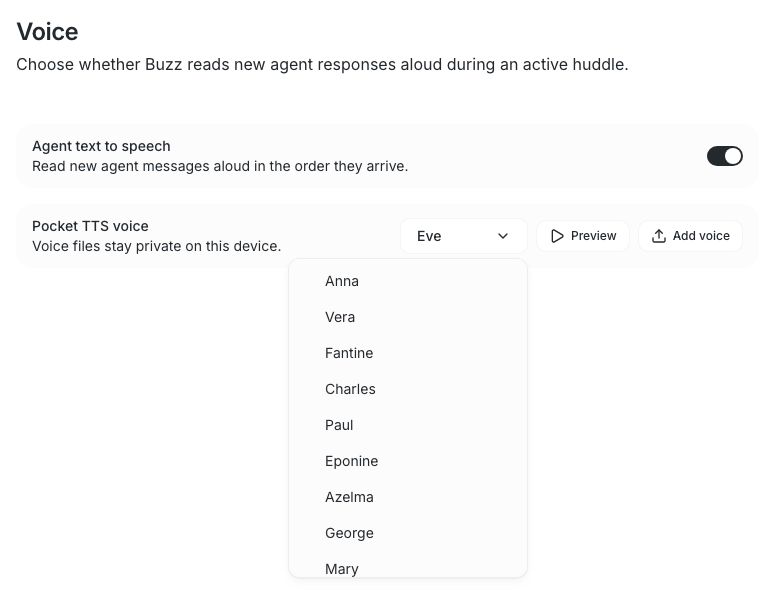
The Voice settings card preserves the bundled Pocket catalog and adds
the local Add voice action.
## Reviewer-reproducible examples
Create common-format fixtures and run them through the production
importer:
```bash
. ./bin/activate-hermit
fixtures="$(mktemp -d)"
ffmpeg -hide_banner -loglevel error -f lavfi -i "sine=frequency=220:duration=3" -ac 2 -ar 44100 "$fixtures/voice.wav"
ffmpeg -hide_banner -loglevel error -i "$fixtures/voice.wav" -c:a aac "$fixtures/voice.m4a"
ffmpeg -hide_banner -loglevel error -i "$fixtures/voice.wav" "$fixtures/voice.mp3"
ffmpeg -hide_banner -loglevel error -i "$fixtures/voice.wav" "$fixtures/voice.flac"
ffmpeg -hide_banner -loglevel error -i "$fixtures/voice.wav" -c:a libvorbis "$fixtures/voice.ogg"
ffmpeg -hide_banner -loglevel error -i "$fixtures/voice.wav" -c:a pcm_s16be "$fixtures/voice.aiff"
BUZZ_VOICE_IMPORT_TEST_DIR="$fixtures" \
cargo test -p buzz-voice imports_common_audio_format_fixtures -- --ignored --nocapture
```
Exercise import persistence, synthesis, deletion, and bundled-voice
fallback with an installed Pocket model:
```bash
BUZZ_POCKET_MODEL_DIR=/path/to/pocket-model-bundle \
cargo test -p buzz-voice --test pocket_import_audio \
objective_import_synthesis_delete_and_mary_fallback \
-- --ignored --nocapture
```
Exercise the native-picker boundary, selection, preview dispatch,
deletion, cancellation, and invalid-file states:
```bash
cd desktop
pnpm build:e2e
pnpm exec playwright test tests/e2e/voice-settings.spec.ts --project=smoke
```
---------
Signed-off-by: John Tennant <jtennant@block.xyz>
Signed-off-by: John Tennant <johnmatthewtennant@gmail.com>
Signed-off-by: John Tennant <jtennant@squareup.com>
Signed-off-by: npub1qyvc0c5kl4gqv2fd97fsk46tu378sqgy35vc83rvgfwne90sel7s0ed67d <011987e296fd5006292d2f930b574be47c7801048d1983c46c425d3c95f0cffd@buzz.block.builderlab.xyz>
Signed-off-by: npub12gtutshhh76rx0jx697f32f9tffd4hhp3hx58fp4x6u4uemkm7sqf8f757 <5217c5c2f7bfb4333e46d17c98a9255a52dadee18dcd43a43536b95e6776dfa0@buzz.block.builderlab.xyz>
Co-authored-by: John Tennant <jtennant@block.xyz>
Co-authored-by: npub1qyvc0c5kl4gqv2fd97fsk46tu378sqgy35vc83rvgfwne90sel7s0ed67d <011987e296fd5006292d2f930b574be47c7801048d1983c46c425d3c95f0cffd@buzz.block.builderlab.xyz>
Co-authored-by: npub12gtutshhh76rx0jx697f32f9tffd4hhp3hx58fp4x6u4uemkm7sqf8f757 <5217c5c2f7bfb4333e46d17c98a9255a52dadee18dcd43a43536b95e6776dfa0@buzz.block.builderlab.xyz>
Relands **#2467** (extract `buzz-voice` crate) and **#3208** (Pocket
voice settings) onto main, after #3266 and #3180 merged.

## Why a fresh PR
The repo is squash-only with delete-branch-on-merge. Squashing #3266
deleted `jtennant/pocket-tts-2026-04`, which was #2467's base — GitHub
auto-closed #2467 and it cannot be reopened. Squash merges also sever
ancestry, so GitHub's natural merge-base reports phantom conflicts for
the whole remaining stack.

## Content provenance
- Byte-identical to the blessed `jt/buzz-voice-refactor` branch
(`93029c577`, tree `6729e0eff` — reviewed by Dawn (#2467) and Max
(#3208) at exact heads) **except** the three files where #3180 and #3208
genuinely interact.
- Three-file resolution (union of both sides):
- `huddle/mod.rs` — #3180's pipeline re-exports + #3208's
`agent_tts_routing` imports.
- `huddle/state.rs` — `reset_preserving_generation` preserves both
`huddle_generation` (#3180) and `tts_enabled` (#3208); test sets merged
into one `tests` module.
- `desktop/src/testing/e2eBridge.ts` — both switch arms kept; no
duplicate case labels.

## Verification at cf32dacd7
- `cargo test` (desktop/src-tauri, pinned 1.95.0): **2047 + 3 pass / 0
fail** (14 ignored: 8 keychain, 4 real_relay, 2 flag-gated)
- `cargo clippy --all-targets -- -D warnings`: clean; `cargo fmt
--check`: clean
- `cargo check --workspace` (root, includes new `buzz-voice` member):
clean; `cargo test -p buzz-voice`: 5/0
- `pnpm test`: **3885 / 0**; `tsc --noEmit`: clean; lint: clean

The 3180×3208 interaction resolution is getting an independent team
re-review before merge.

Buzz channel: buzz-desktop-voice `fd5fb402-b651-4238-89b1-bb3e2fa4dc96`,
thread `b4798ecc`.

Signed-off-by: npub1qyvc0c5kl4gqv2fd97fsk46tu378sqgy35vc83rvgfwne90sel7s0ed67d <011987e296fd5006292d2f930b574be47c7801048d1983c46c425d3c95f0cffd@buzz.block.builderlab.xyz>
Co-authored-by: npub1qyvc0c5kl4gqv2fd97fsk46tu378sqgy35vc83rvgfwne90sel7s0ed67d <011987e296fd5006292d2f930b574be47c7801048d1983c46c425d3c95f0cffd@buzz.block.builderlab.xyz>
## Context
Before this change, every huddle initialized with transcription off.
Joining or adding an agent did not enable it, so the agent could not
receive spoken conversation until a person clicked the transcript
control. Starting a huddle from an agent DM could also omit that agent,
and adding an agent who already belonged to the parent channel could
attempt an unnecessary role change and show a warning.
Agent detection uses authoritative huddle membership. A participant
counts as an agent when the ephemeral membership identifies it with the
`bot` role, or when the existing agent identity model identifies the
participant in an agent DM.
## Summary
Buzz now enables transcription once when the first authoritative agent
is present. After that initial automatic action, explicit user control
is authoritative: manual ON or OFF survives membership refreshes,
reconnects, and UI remounts. Removing the last agent does not change the
current transcription state.
Agent-DM huddles enroll the agent automatically. Adding an agent who
already belongs to the parent channel preserves the existing parent role
and completes without a role-mutation warning.
| Scenario | Before | With this change |
| --- | --- | --- |
| First authoritative agent joins or is hydrated | Transcription stays
off | Transcription turns on once |
| User explicitly turns transcription on or off | Manual control exists
without an agent policy | The explicit choice suppresses later automatic
changes |
| Last agent leaves | No defined agent-presence behavior | The current
transcription state remains unchanged |
| Huddle starts from an agent DM | The agent can be omitted | The known
agent is enrolled automatically |
| Added agent already belongs to the parent channel | Buzz can attempt a
role rewrite and warn | Existing parent membership and role are
preserved |
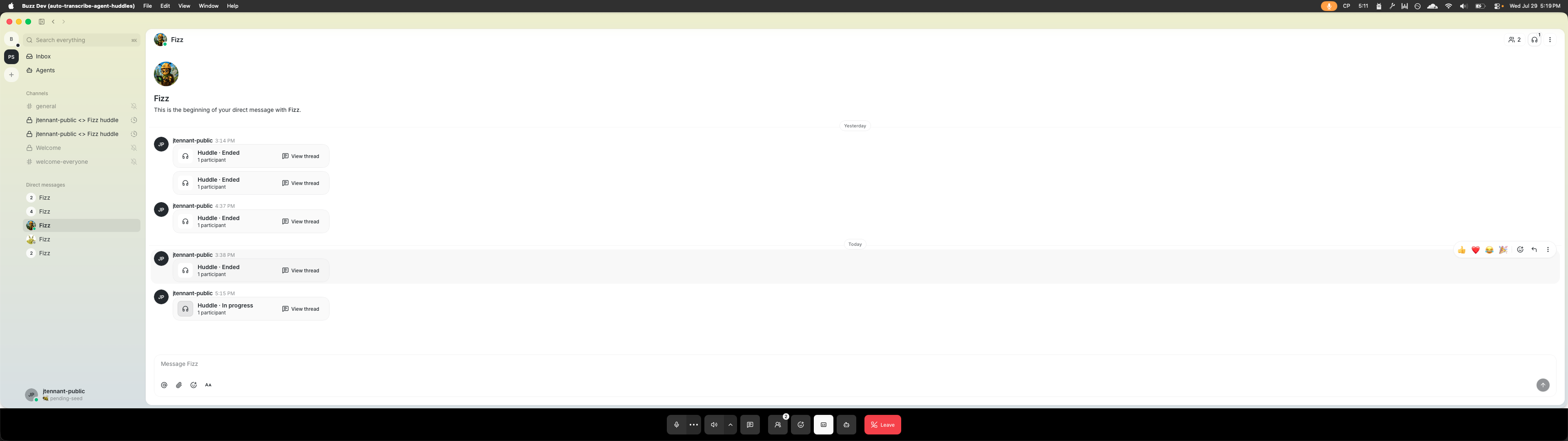
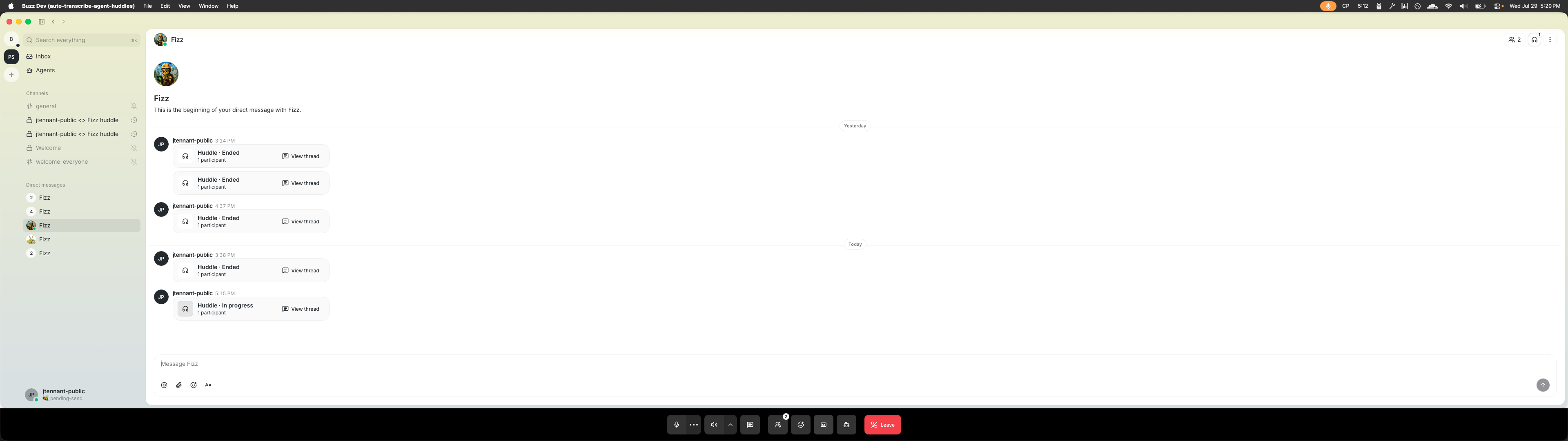
| Transcription is active | The control is not visually distinct | The
control is highlighted and exposes `aria-pressed=true` |
## Changes
- Derive agent presence from authoritative bot-role huddle membership
and known agent-DM identity.
- Apply the one-time auto-enable rule during create, join, membership
hydration, reconnect, pipeline startup, and local agent addition.
- Preserve explicit user state and use huddle-generation guards so stale
asynchronous work cannot alter a replacement huddle.
- Keep backend and React transcription state synchronized, with a
visible and accessible active control.
- Enroll known agent-DM participants and make parent-channel membership
updates idempotent.
- Cover hydration ordering, reconnects, remounts, explicit OFF,
last-agent removal, DM enrollment, existing membership, and active
styling.
## Related issue
None found.
## Testing
Manual validation in `pending-seed` confirmed the product contract:
1. Started a huddle from the owned, running Fizz agent DM.
2. Confirmed the authoritative roster contained the human and Fizz as an
agent.
3. Confirmed transcription enabled without clicking the control: `Stop
transcript`, `aria-pressed=true`, with the highlighted active
background.
4. Turned transcription off and confirmed `Start transcript`,
`aria-pressed=false` remained stable.
5. Removed Fizz while transcription was off and confirmed the state
stayed off.
6. Left the huddle cleanly.
## Screenshots
The same control has distinct active and inactive states.
## Reviewer-reproducible examples
From a fresh checkout:
```bash
pnpm --dir desktop build:e2e
pnpm --dir desktop exec playwright test tests/e2e/huddle-transcription.spec.ts --project=smoke
pnpm --dir desktop exec playwright test tests/e2e/mentions.spec.ts --project=smoke --grep "system agent profile exposes owned agent actions|system agent avatar exposes owned agent actions|owned bot profile exposes message and huddle actions|owned agent mention profile exposes message and huddle actions"
```
The huddle scenario exercises initial authoritative hydration, exactly
one automatic enable, explicit OFF persistence, unchanged state after
last-agent removal, newer events winning over delayed hydration,
agent-DM enrollment, and idempotent parent membership. It also asserts
`aria-pressed` and distinct computed active styling.
---------
Signed-off-by: John Tennant <jtennant@squareup.com>
Signed-off-by: npub1jh9wn95s0472h86ahapupaf7m6kx4v9sx2n0atj2hltcfer8k06s5n3pyf <95cae996907d7cab9f5dbf43c0f53edeac6ab0b032a6feae4abfd784e467b3f5@buzz.block.builderlab.xyz>
Co-authored-by: npub1jh9wn95s0472h86ahapupaf7m6kx4v9sx2n0atj2hltcfer8k06s5n3pyf <95cae996907d7cab9f5dbf43c0f53edeac6ab0b032a6feae4abfd784e467b3f5@buzz.block.builderlab.xyz>
Windows installs of Goose and other harnesses failed at exactly five
minutes with an empty error (#2401). The 300s ceiling was killing
installs that were working, just slowly — the Goose step pulls a ~79MB
release asset, and Windows Defender scans every file npm extracts. When
the ceiling fired it discarded the output it had already read, so the
user got a bare timeout string and no way to tell a hang from a large
download.

## The ceiling

`INSTALL_TIMEOUT` is 900s, and the error names the limit: `install
command exceeded the 15m ceiling and was terminated`. It stays a pure
wall-clock ceiling with no inactivity kill — nothing observable
distinguishes a hung installer from one silently transferring a large
artifact, so silence alone never kills an install. A ceiling kill
remains non-retryable; re-running a command that already burned 15
minutes costs the user more time with no plausible path to success.

The child's exit and both stream drains fold into one resumable settle
governed by a single deadline. Waiting on the drains outside that
deadline would let a descendant that outlived the install shell hold the
output pipes — and the per-runtime install guard behind them — open with
no bound, which is the failure the ceiling exists to prevent. So the
deadline path terminates the process group on the normal-exit branch
too: a leader that exited with a real status still gets its stragglers
killed, and the guard cannot stick either way. Whether the leader had
already exited only decides the verdict — its real status outranks a
timeout.

The install shell is a session leader and its descendants inherit the
output pipes, so signalling only the leader left them running and the
drains blocked on a pipe nobody would close. Escalation keys off the
*group's* liveness rather than the leader's, since a descendant that
ignores SIGTERM outlives the leader and would otherwise never receive
the group SIGKILL. Reaping the killed child and finishing the drains
share one bounded grace, so a termination that failed outright cannot
extend the ceiling that just fired.

## Output capture

Each stream drains into a bounded capture that is *shared* with the
reader rather than returned by it, so whatever arrived before a stall is
readable at the ceiling — exactly when the output matters most. Output
of any size costs a fixed amount of memory.

One capture holds two independently bounded views of the same bytes:

| View | Head / tail | Cut marker |
|------|-------------|------------|
| UI (`InstallStepResult`) | 512 B / 1024 B | `... (N bytes omitted)
...` |
| Log file | 128 KiB / 128 KiB | `... [N bytes omitted at cap] ...` |

The UI budget is screen space; the log's is disk. Both markers are
inline, so neither ever implies completeness it does not have. Both ends
are cut at arbitrary byte offsets, so a partial character is trimmed and
the partial token each cut left behind is dropped — the marker's byte
count includes both trims.

## Install log

`steps` carries only the last attempt of each step, truncated for
display. Everything else — earlier retries, the prerequisite step that
actually broke, the managed-Node bootstrap — used to be discarded.
`InstallReporter` now appends one self-contained record per attempt of
per step to `install-<runtime-id>.log` beside the agent logs, and
`InstallRuntimeResult.log_path` carries the file to the UI, where a
failure message ends with `Full log: <path>`.

Each record is bounded independently by the log-scale capture that
produced it, so a first attempt that printed megabytes cannot push out
the later record explaining the failure; the run's total is bounded by
steps × attempts × per-record cap. Every early return builds its result
through one `InstallReporter::failed` helper, so no failure path can
omit the log pointer, and synthesized steps go through `record_step` — a
step that reaches the UI without passing it would be invisible in the
file.

Install output can echo a registry token or proxy credential from the
environment it ran in, and the file is written unattended. Redaction
keys off the *names* of the environment variables the install inherited,
snapshotted once per run, rather than a list of known secret value
prefixes: a credential with no recognisable shape is exactly the one a
prefix match misses. Three name rules apply, because the variables need
different treatment:

| Rule | Variables | Redacted |
|------|-----------|----------|
| URL userinfo | `HTTP_PROXY`, `HTTPS_PROXY`, `ALL_PROXY`,
`NPM_CONFIG_PROXY`, `NPM_CONFIG_HTTPS_PROXY`, `NPM_CONFIG_REGISTRY` |
`user:password` only |
| Exact name | `NPM_CONFIG_KEY`, `NPM_CONFIG__AUTH`, `NPM_CONFIG_OTP` |
whole value |
| Marker substring | `*TOKEN*`, `*SECRET*`, `*PASSWORD*`, `*_PAT`, … |
whole value, 8-byte floor |

A proxy or registry keeps its host and port, because an install that
fails behind one is diagnosable only if the record still says which one
it went through, and a bare `user@` with no password is not treated as a
credential. npm's own settings are listed by exact name rather than
matched on `KEY` or `AUTH` substrings — both occur throughout an
ordinary environment on values that are paths and people's names — and
they bypass the 8-byte floor, since a six-digit one-time password is a
credential at that length. Matching is case-insensitive, which is what
npm's lowercase `npm_config_*` spelling needs. `0o600` is set by the
create rather than a later `chmod`, which would leave a window where the
umask decides. A runtime id that cannot safely be a filename yields no
log rather than a sanitized one — a rewritten id could collide with
another runtime's log.

The file holds exactly one run. A run opens its own session after the
runtime id has been canonically resolved — the previous file rotates to
`.1` and any older `.1` is removed before the rename, since a rename
that will not replace its destination would otherwise wedge rotation
permanently on Windows. The session writes a header naming the runtime,
the app version (`app.package_info().version` on the Rust side — cannot
be mocked or fail), the OS (`std::env::consts::OS`), and the start time:
a Windows failure and a macOS one on the same runtime are different
bugs, and a stale app version explains a failure that no longer
reproduces. Each record carries its attempt's elapsed time.

## Live output line

A 15-minute ceiling with nothing behind it but a spinner is
indistinguishable from a hang. The same drain seam feeds an
`acp-install-output` event carrying the newest complete line, and the
three install entry points — Doctor harness rows, the harness catalog
dialog, and onboarding runtime cards — render it under the spinner with
`aria-live="polite"`.

Ordering is keyed on a `seq` monotonic across the whole install, not on
the attempt number, which restarts at 1 for every step: keyed on
attempt, one step succeeding on attempt 2 would make the next step's
attempt-1 output look stale and freeze the display for the rest of the
install. Each executed attempt begins with an unthrottled `line: null`
clear signal, so a stale failure line cannot sit under the spinner while
the retry runs. Events are otherwise throttled to four per second, and
the throttle *retains* the newest pending line and flushes it when the
window reopens rather than dropping it — at an attempt boundary a drop
would silently eat the new attempt's first line.

The subscription is mounted for the runtime's whole lifetime rather than
started when the install begins. The install command is invoked from the
click handler, so the clear and a fast command's first lines can be
emitted before React has committed the pending state, and nothing
replays them — a subscription that waited for that state would lose the
entire output of a short install. The run boundary resets the ordering
key when the install settles, since `seq` restarts for the next run, and
the line renders only while installing, so a straggler from a finishing
drain cannot appear under a fresh Install button.

The 15-minute ceiling deliberately stops waiting on stuck drain threads
— a hung installer must not freeze the app. That means a drain thread
can outlive its `InstallReporter`. Without a generation guard, a drain
that calls `offer` after the run settles would publish an event with the
run's high `seq`, poison the permanent listener's React state, and cause
the next install's restarted `seq=0` events to be rejected. `Live` now
carries a `lifecycle: Arc<RwLock<bool>>`; drain threads hold a **shared
read guard** from the admission check through the `(self.emit)(...)`
call, making the check-then-emit pair atomic with respect to shutdown.
`InstallReporter::drop` takes the **exclusive write guard** and stores
`false` — this blocks until every in-flight drain publication releases
its read guard, then prevents any new admission. Deactivation is
bounded: the write lock holds only for the flag store, so it can block
at most for the duration of one emit call (microseconds to low
milliseconds). Rust drops locals in reverse-declaration order, so
`reporter` drops before `_guard`, ensuring the exclusive write completes
before the per-runtime concurrency guard releases and a new install can
start.

## Also

Install result types move to `desktop/src/shared/api/installTypes.ts`,
following the existing `searchTypes.ts` / `workflowTypes.ts` convention,
and are re-exported from `tauri.ts` and `types.ts` — both already over
the file-size cap, so neither can grow to carry them.

Two comments described `AdapterOutdated` as applying only to the
deprecated package; it also covers a version below the supported floor.

Report: #2401

---------

Signed-off-by: Will Pfleger <pfleger.will@gmail.com>
Signed-off-by: npub1mn7jgtj4w2pd0g0zeuhxsa6jy6p0rewxz4kujt98my82ahfmp72sxjexk7 <dcfd242e557282d7a1e2cf2e6877522682f1e5c6156dc92ca7d90eaedd3b0f95@buzz.block.builderlab.xyz>
Co-authored-by: npub1mn7jgtj4w2pd0g0zeuhxsa6jy6p0rewxz4kujt98my82ahfmp72sxjexk7 <dcfd242e557282d7a1e2cf2e6877522682f1e5c6156dc92ca7d90eaedd3b0f95@buzz.block.builderlab.xyz>
**Category:** new-feature
**User Impact:** Users can create, download, and verify a
password-protected backup of their private identity from desktop
Settings.

**Problem:** Buzz does not currently give signed-in users a
Settings-based path to protect or validate their private identity
independently of onboarding. **Solution:** Add a focused backup menu to
the private-key row, keep encryption and verification local in Rust, and
preserve completed encrypted backups briefly so native saves can be
retried without repeating encryption.

<details>
<summary>File changes</summary>

**desktop/src/features/settings/**
Adds the background backup lifecycle, create and test dialogs,
private-key menu integration, password handling, and focused unit
coverage.

**desktop/src/features/onboarding/ui/NsecMaskedDisplay.tsx**
Extends the masked private-key display with reusable overflow-menu
actions used by Settings.

**desktop/src/app/App.tsx**
Mounts the backup provider at app scope so encryption and save work
survive closing Settings or the modal.

**desktop/src/shared/api/tauriIdentity.ts**
Adds typed desktop bindings for local backup creation, save, selection,
and verification.

**desktop/src-tauri/src/key_backup.rs and
desktop/src-tauri/src/commands/identity.rs**
Implements local NIP-49 encryption, password generation, file handling,
and public-identity-only verification results.

**desktop/src-tauri/src/egress_guard.rs and guarded call sites**
Blocks encrypted secret material from relay, websocket, snapshot,
sharing, and huddle egress paths.

**desktop/src-tauri tests and fixtures**
Covers encryption, verification, file behavior, and fail-closed
no-egress protections.

**desktop/src/testing/e2eBridge.ts, desktop/tests/, and
desktop/playwright.config.ts**
Expands the mock native bridge and browser coverage across create,
retry, expiry, and current/different-identity verification states.

**desktop/src-tauri/Cargo.toml, Cargo.lock, and assets**
Adds the local cryptography/password-generation dependencies and
embedded short-word list.

</details>

## Reproduction steps

1. Run the desktop app and open **Settings → Profile → Identity**.
2. Open the private-key overflow menu and choose **Create backup**.
3. Enter or generate a valid password, submit, and confirm progress
continues if the dialog or Settings is closed.
4. Save the resulting `.ncryptsec` file; cancel and retry to confirm the
temporary download remains available.
5. Choose **Test backup**, select the file, enter a wrong password, then
retry with the correct password.
6. Confirm success identifies whether the backup matches the current
identity and displays only the public `npub`.

## Screenshots

| Settings identity | Private-key menu | Create backup |
|---|---|---|
| <img width="1280" height="720" alt="image"
src="https://github.com/user-attachments/assets/981e391b-6829-4081-95ca-ca75a369de71"
/> | <img width="1280" height="720" alt="image"
src="https://github.com/user-attachments/assets/7972c68e-7635-47d8-b0ad-9639390d3e6c"
/> | <img width="1280" height="720" alt="image"
src="https://github.com/user-attachments/assets/4709c8f7-cf02-46f1-bec9-b3f98fe56fb2"
/> |

| Encrypting | Download available | Test success |
|---|---|---|
| <img width="1280" height="720" alt="image"
src="https://github.com/user-attachments/assets/1ac3e934-2b4b-4135-bae6-126c715c8c59"
/> | <img width="1280" height="720" alt="image"
src="https://github.com/user-attachments/assets/cb6f07ee-a16f-44a5-b9a0-6b9fe0e4d40d"
/> | <img width="1280" height="720" alt="image"
src="https://github.com/user-attachments/assets/ea58b1b1-966c-46aa-8d59-92c9f06a25bd"
/> |

Visual review and additional states: [Buzz
thread](buzz://message?channel=50ca7ef1-201e-4159-9499-40de3964b7c3&id=87eceb5f0f82fd50c32e560de3d35be48e293760f6620718aafdcef289d475fe)

---------

Signed-off-by: Taylor Ho <taylorkmho@gmail.com>
Co-authored-by: npub1223z34hd7vtwc6qj4s7flsxkj644nlre2nthu7lrrmkumhu3xddsrx9r6w <52a228d6edf316ec6812ac3c9fc0d696ab59fc7954d77e7be31eedcddf91335b@buzz.block.builderlab.xyz>
## Why
People joining a community with an existing relay profile should not be
asked to recreate their name and avatar.

## What
- Check the active identity's relay profile after the joined community
becomes active
- Skip directly to the starter-team step when a kind-0 profile event
exists
- Preserve the profile setup path when no event exists or discovery
fails
- Cover both new-profile and existing-profile join paths in E2E tests

## Risk Assessment
Low — the lookup is scoped to the community onboarding profile stage,
runs once per transaction, and fails open to the existing flow.

## References
- `pnpm build:e2e && pnpm exec playwright test --project=integration
tests/e2e/onboarding.spec.ts --grep 'first-community direct join reaches
profile|community onboarding reuses an existing relay profile'` (2
passed)

Generated with Codex

Signed-off-by: npub1rf6fvdj6ut0c4kcmjv4p5mmgh89nj58n69uu3fz3cvk3jn500hqs7emz79 <1a7496365ae2df8adb1b932a1a6f68b9cb3950f3d179c8a451c32d194e8f7dc1@sprout-oss.stage.blox.sqprod.co>
Co-authored-by: npub1rf6fvdj6ut0c4kcmjv4p5mmgh89nj58n69uu3fz3cvk3jn500hqs7emz79 <1a7496365ae2df8adb1b932a1a6f68b9cb3950f3d179c8a451c32d194e8f7dc1@sprout-oss.stage.blox.sqprod.co>
## Context

Adding an existing community by relay URL could fail with `Community
rejected: Load failed` even when its WebSocket endpoint was reachable.
The Add Community flow fetched `/api/join-policy` from the WebView, so a
relay without a matching CORS allowance blocked the policy request
before the app could join it.

## Summary

This bug fix fetches join policies through Tauri's native networking
layer for direct URL joins. Invite-code discovery, policy acceptance,
and signed invite claims remain on the WebView path so those operations
can migrate together later.

## Changes

- Uses native networking for Add Community and first-community direct
URL join-policy requests.
- Validates relay schemes, rejects URLs containing credentials, and
refuses redirects.
- Bounds declared and chunked native responses before JSON parsing.
- Preserves existing `404`, non-success status, malformed JSON, and
absent-policy behavior.
- Requires every join-policy caller to choose its transport explicitly.

Public relays using Buzz's default permissive CORS configuration are not
known to be affected.

### Related issue

Related to #2872.

### Testing

#### Reviewer-reproducible examples

End-to-end red/green requires a relay with restrictive CORS and a Buzz
identity authorized to join it.

##### Red: `main`

From a clean checkout of `main`:

```bash
. ./bin/activate-hermit
just staging
```

In Buzz Desktop:

1. Add another community so the restrictive-CORS relay can be removed.
2. Remove that relay.
3. Open Add Community and enter the relay's WebSocket URL.
4. Select Add Community.

Observed result:

```text
Community rejected: Load failed
```

##### Green: this PR

From a clean checkout of this branch:

```bash
. ./bin/activate-hermit
just staging
```

Repeat the same steps above.

Observed result:

```text
The community rejoins successfully.
```

Supporting checks:

- Six native join-policy tests, including oversized declared and chunked
responses.
- Four TypeScript API tests, including the native command contract.
- E2E build and four focused onboarding and sidebar Playwright tests.
- Full `just ci` and pre-push suites.
- Builderbot, Kalvin, and minimize-diff review fanout found no
actionable issues after the final rebase.
## Summary
- align the multi-community rail with the content surface and balance
its visible 10px side gutters
- center Mobile pairing, start sessions on demand, and keep retry states
inside the QR area
- reveal the QR code and copy action with 250ms motion and use the
standard loading spinner

The rail was centered within its own box, but the adjacent sidebar added
another 11px to the visible right gap. Mobile pairing also started
before user intent, which could leave an idle session waiting for EOSE.

## Validation
- `pnpm -C desktop build:e2e`
- `pnpm -C desktop test` — 3,516 passed
- `pnpm -C desktop exec playwright test tests/e2e/community-rail.spec.ts
--project=smoke` — 19 passed
- `pnpm -C desktop exec playwright test
tests/e2e/mobile-pairing-qr.spec.ts --project=smoke` — 1 passed

`pnpm -C desktop check` is currently blocked by the existing
`src-tauri/src/managed_agents/runtime.rs` file-size baseline (2,220
lines; limit 2,216).