Windows installs of Goose and other harnesses failed at exactly five
minutes with an empty error (#2401). The 300s ceiling was killing
installs that were working, just slowly — the Goose step pulls a ~79MB
release asset, and Windows Defender scans every file npm extracts. When
the ceiling fired it discarded the output it had already read, so the
user got a bare timeout string and no way to tell a hang from a large
download.

## The ceiling

`INSTALL_TIMEOUT` is 900s, and the error names the limit: `install
command exceeded the 15m ceiling and was terminated`. It stays a pure
wall-clock ceiling with no inactivity kill — nothing observable
distinguishes a hung installer from one silently transferring a large
artifact, so silence alone never kills an install. A ceiling kill
remains non-retryable; re-running a command that already burned 15
minutes costs the user more time with no plausible path to success.

The child's exit and both stream drains fold into one resumable settle
governed by a single deadline. Waiting on the drains outside that
deadline would let a descendant that outlived the install shell hold the
output pipes — and the per-runtime install guard behind them — open with
no bound, which is the failure the ceiling exists to prevent. So the
deadline path terminates the process group on the normal-exit branch
too: a leader that exited with a real status still gets its stragglers
killed, and the guard cannot stick either way. Whether the leader had
already exited only decides the verdict — its real status outranks a
timeout.

The install shell is a session leader and its descendants inherit the
output pipes, so signalling only the leader left them running and the
drains blocked on a pipe nobody would close. Escalation keys off the
*group's* liveness rather than the leader's, since a descendant that
ignores SIGTERM outlives the leader and would otherwise never receive
the group SIGKILL. Reaping the killed child and finishing the drains
share one bounded grace, so a termination that failed outright cannot
extend the ceiling that just fired.

## Output capture

Each stream drains into a bounded capture that is *shared* with the
reader rather than returned by it, so whatever arrived before a stall is
readable at the ceiling — exactly when the output matters most. Output
of any size costs a fixed amount of memory.

One capture holds two independently bounded views of the same bytes:

| View | Head / tail | Cut marker |
|------|-------------|------------|
| UI (`InstallStepResult`) | 512 B / 1024 B | `... (N bytes omitted)
...` |
| Log file | 128 KiB / 128 KiB | `... [N bytes omitted at cap] ...` |

The UI budget is screen space; the log's is disk. Both markers are
inline, so neither ever implies completeness it does not have. Both ends
are cut at arbitrary byte offsets, so a partial character is trimmed and
the partial token each cut left behind is dropped — the marker's byte
count includes both trims.

## Install log

`steps` carries only the last attempt of each step, truncated for
display. Everything else — earlier retries, the prerequisite step that
actually broke, the managed-Node bootstrap — used to be discarded.
`InstallReporter` now appends one self-contained record per attempt of
per step to `install-<runtime-id>.log` beside the agent logs, and
`InstallRuntimeResult.log_path` carries the file to the UI, where a
failure message ends with `Full log: <path>`.

Each record is bounded independently by the log-scale capture that
produced it, so a first attempt that printed megabytes cannot push out
the later record explaining the failure; the run's total is bounded by
steps × attempts × per-record cap. Every early return builds its result
through one `InstallReporter::failed` helper, so no failure path can
omit the log pointer, and synthesized steps go through `record_step` — a
step that reaches the UI without passing it would be invisible in the
file.

Install output can echo a registry token or proxy credential from the
environment it ran in, and the file is written unattended. Redaction
keys off the *names* of the environment variables the install inherited,
snapshotted once per run, rather than a list of known secret value
prefixes: a credential with no recognisable shape is exactly the one a
prefix match misses. Three name rules apply, because the variables need
different treatment:

| Rule | Variables | Redacted |
|------|-----------|----------|
| URL userinfo | `HTTP_PROXY`, `HTTPS_PROXY`, `ALL_PROXY`,
`NPM_CONFIG_PROXY`, `NPM_CONFIG_HTTPS_PROXY`, `NPM_CONFIG_REGISTRY` |
`user:password` only |
| Exact name | `NPM_CONFIG_KEY`, `NPM_CONFIG__AUTH`, `NPM_CONFIG_OTP` |
whole value |
| Marker substring | `*TOKEN*`, `*SECRET*`, `*PASSWORD*`, `*_PAT`, … |
whole value, 8-byte floor |

A proxy or registry keeps its host and port, because an install that
fails behind one is diagnosable only if the record still says which one
it went through, and a bare `user@` with no password is not treated as a
credential. npm's own settings are listed by exact name rather than
matched on `KEY` or `AUTH` substrings — both occur throughout an
ordinary environment on values that are paths and people's names — and
they bypass the 8-byte floor, since a six-digit one-time password is a
credential at that length. Matching is case-insensitive, which is what
npm's lowercase `npm_config_*` spelling needs. `0o600` is set by the
create rather than a later `chmod`, which would leave a window where the
umask decides. A runtime id that cannot safely be a filename yields no
log rather than a sanitized one — a rewritten id could collide with
another runtime's log.

The file holds exactly one run. A run opens its own session after the
runtime id has been canonically resolved — the previous file rotates to
`.1` and any older `.1` is removed before the rename, since a rename
that will not replace its destination would otherwise wedge rotation
permanently on Windows. The session writes a header naming the runtime,
the app version (`app.package_info().version` on the Rust side — cannot
be mocked or fail), the OS (`std::env::consts::OS`), and the start time:
a Windows failure and a macOS one on the same runtime are different
bugs, and a stale app version explains a failure that no longer
reproduces. Each record carries its attempt's elapsed time.

## Live output line

A 15-minute ceiling with nothing behind it but a spinner is
indistinguishable from a hang. The same drain seam feeds an
`acp-install-output` event carrying the newest complete line, and the
three install entry points — Doctor harness rows, the harness catalog
dialog, and onboarding runtime cards — render it under the spinner with
`aria-live="polite"`.

Ordering is keyed on a `seq` monotonic across the whole install, not on
the attempt number, which restarts at 1 for every step: keyed on
attempt, one step succeeding on attempt 2 would make the next step's
attempt-1 output look stale and freeze the display for the rest of the
install. Each executed attempt begins with an unthrottled `line: null`
clear signal, so a stale failure line cannot sit under the spinner while
the retry runs. Events are otherwise throttled to four per second, and
the throttle *retains* the newest pending line and flushes it when the
window reopens rather than dropping it — at an attempt boundary a drop
would silently eat the new attempt's first line.

The subscription is mounted for the runtime's whole lifetime rather than
started when the install begins. The install command is invoked from the
click handler, so the clear and a fast command's first lines can be
emitted before React has committed the pending state, and nothing
replays them — a subscription that waited for that state would lose the
entire output of a short install. The run boundary resets the ordering
key when the install settles, since `seq` restarts for the next run, and
the line renders only while installing, so a straggler from a finishing
drain cannot appear under a fresh Install button.

The 15-minute ceiling deliberately stops waiting on stuck drain threads
— a hung installer must not freeze the app. That means a drain thread
can outlive its `InstallReporter`. Without a generation guard, a drain
that calls `offer` after the run settles would publish an event with the
run's high `seq`, poison the permanent listener's React state, and cause
the next install's restarted `seq=0` events to be rejected. `Live` now
carries a `lifecycle: Arc<RwLock<bool>>`; drain threads hold a **shared
read guard** from the admission check through the `(self.emit)(...)`
call, making the check-then-emit pair atomic with respect to shutdown.
`InstallReporter::drop` takes the **exclusive write guard** and stores
`false` — this blocks until every in-flight drain publication releases
its read guard, then prevents any new admission. Deactivation is
bounded: the write lock holds only for the flag store, so it can block
at most for the duration of one emit call (microseconds to low
milliseconds). Rust drops locals in reverse-declaration order, so
`reporter` drops before `_guard`, ensuring the exclusive write completes
before the per-runtime concurrency guard releases and a new install can
start.

## Also

Install result types move to `desktop/src/shared/api/installTypes.ts`,
following the existing `searchTypes.ts` / `workflowTypes.ts` convention,
and are re-exported from `tauri.ts` and `types.ts` — both already over
the file-size cap, so neither can grow to carry them.

Two comments described `AdapterOutdated` as applying only to the
deprecated package; it also covers a version below the supported floor.

Report: #2401

---------

Signed-off-by: Will Pfleger <pfleger.will@gmail.com>
Signed-off-by: npub1mn7jgtj4w2pd0g0zeuhxsa6jy6p0rewxz4kujt98my82ahfmp72sxjexk7 <dcfd242e557282d7a1e2cf2e6877522682f1e5c6156dc92ca7d90eaedd3b0f95@buzz.block.builderlab.xyz>
Co-authored-by: npub1mn7jgtj4w2pd0g0zeuhxsa6jy6p0rewxz4kujt98my82ahfmp72sxjexk7 <dcfd242e557282d7a1e2cf2e6877522682f1e5c6156dc92ca7d90eaedd3b0f95@buzz.block.builderlab.xyz>
**Category:** new-feature
**User Impact:** Users can create, download, and verify a
password-protected backup of their private identity from desktop
Settings.

**Problem:** Buzz does not currently give signed-in users a
Settings-based path to protect or validate their private identity
independently of onboarding. **Solution:** Add a focused backup menu to
the private-key row, keep encryption and verification local in Rust, and
preserve completed encrypted backups briefly so native saves can be
retried without repeating encryption.

<details>
<summary>File changes</summary>

**desktop/src/features/settings/**
Adds the background backup lifecycle, create and test dialogs,
private-key menu integration, password handling, and focused unit
coverage.

**desktop/src/features/onboarding/ui/NsecMaskedDisplay.tsx**
Extends the masked private-key display with reusable overflow-menu
actions used by Settings.

**desktop/src/app/App.tsx**
Mounts the backup provider at app scope so encryption and save work
survive closing Settings or the modal.

**desktop/src/shared/api/tauriIdentity.ts**
Adds typed desktop bindings for local backup creation, save, selection,
and verification.

**desktop/src-tauri/src/key_backup.rs and
desktop/src-tauri/src/commands/identity.rs**
Implements local NIP-49 encryption, password generation, file handling,
and public-identity-only verification results.

**desktop/src-tauri/src/egress_guard.rs and guarded call sites**
Blocks encrypted secret material from relay, websocket, snapshot,
sharing, and huddle egress paths.

**desktop/src-tauri tests and fixtures**
Covers encryption, verification, file behavior, and fail-closed
no-egress protections.

**desktop/src/testing/e2eBridge.ts, desktop/tests/, and
desktop/playwright.config.ts**
Expands the mock native bridge and browser coverage across create,
retry, expiry, and current/different-identity verification states.

**desktop/src-tauri/Cargo.toml, Cargo.lock, and assets**
Adds the local cryptography/password-generation dependencies and
embedded short-word list.

</details>

## Reproduction steps

1. Run the desktop app and open **Settings → Profile → Identity**.
2. Open the private-key overflow menu and choose **Create backup**.
3. Enter or generate a valid password, submit, and confirm progress
continues if the dialog or Settings is closed.
4. Save the resulting `.ncryptsec` file; cancel and retry to confirm the
temporary download remains available.
5. Choose **Test backup**, select the file, enter a wrong password, then
retry with the correct password.
6. Confirm success identifies whether the backup matches the current
identity and displays only the public `npub`.

## Screenshots

| Settings identity | Private-key menu | Create backup |
|---|---|---|
| <img width="1280" height="720" alt="image"
src="https://github.com/user-attachments/assets/981e391b-6829-4081-95ca-ca75a369de71"
/> | <img width="1280" height="720" alt="image"
src="https://github.com/user-attachments/assets/7972c68e-7635-47d8-b0ad-9639390d3e6c"
/> | <img width="1280" height="720" alt="image"
src="https://github.com/user-attachments/assets/4709c8f7-cf02-46f1-bec9-b3f98fe56fb2"
/> |

| Encrypting | Download available | Test success |
|---|---|---|
| <img width="1280" height="720" alt="image"
src="https://github.com/user-attachments/assets/1ac3e934-2b4b-4135-bae6-126c715c8c59"
/> | <img width="1280" height="720" alt="image"
src="https://github.com/user-attachments/assets/cb6f07ee-a16f-44a5-b9a0-6b9fe0e4d40d"
/> | <img width="1280" height="720" alt="image"
src="https://github.com/user-attachments/assets/ea58b1b1-966c-46aa-8d59-92c9f06a25bd"
/> |

Visual review and additional states: [Buzz
thread](buzz://message?channel=50ca7ef1-201e-4159-9499-40de3964b7c3&id=87eceb5f0f82fd50c32e560de3d35be48e293760f6620718aafdcef289d475fe)

---------

Signed-off-by: Taylor Ho <taylorkmho@gmail.com>
Co-authored-by: npub1223z34hd7vtwc6qj4s7flsxkj644nlre2nthu7lrrmkumhu3xddsrx9r6w <52a228d6edf316ec6812ac3c9fc0d696ab59fc7954d77e7be31eedcddf91335b@buzz.block.builderlab.xyz>
## Why
People joining a community with an existing relay profile should not be
asked to recreate their name and avatar.

## What
- Check the active identity's relay profile after the joined community
becomes active
- Skip directly to the starter-team step when a kind-0 profile event
exists
- Preserve the profile setup path when no event exists or discovery
fails
- Cover both new-profile and existing-profile join paths in E2E tests

## Risk Assessment
Low — the lookup is scoped to the community onboarding profile stage,
runs once per transaction, and fails open to the existing flow.

## References
- `pnpm build:e2e && pnpm exec playwright test --project=integration
tests/e2e/onboarding.spec.ts --grep 'first-community direct join reaches
profile|community onboarding reuses an existing relay profile'` (2
passed)

Generated with Codex

Signed-off-by: npub1rf6fvdj6ut0c4kcmjv4p5mmgh89nj58n69uu3fz3cvk3jn500hqs7emz79 <1a7496365ae2df8adb1b932a1a6f68b9cb3950f3d179c8a451c32d194e8f7dc1@sprout-oss.stage.blox.sqprod.co>
Co-authored-by: npub1rf6fvdj6ut0c4kcmjv4p5mmgh89nj58n69uu3fz3cvk3jn500hqs7emz79 <1a7496365ae2df8adb1b932a1a6f68b9cb3950f3d179c8a451c32d194e8f7dc1@sprout-oss.stage.blox.sqprod.co>
## Context

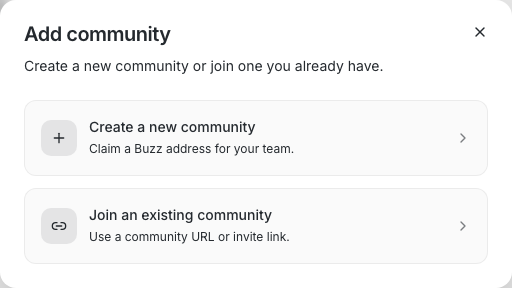
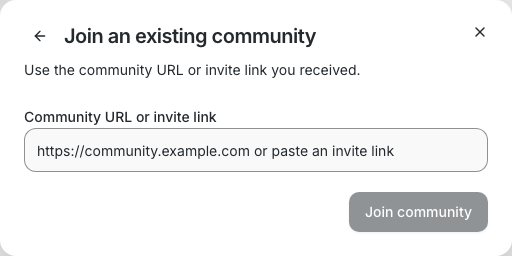
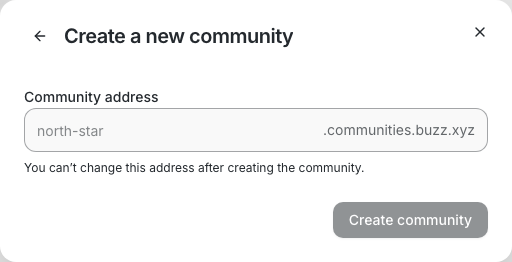
Adding an existing community by relay URL could fail with `Community
rejected: Load failed` even when its WebSocket endpoint was reachable.
The Add Community flow fetched `/api/join-policy` from the WebView, so a
relay without a matching CORS allowance blocked the policy request
before the app could join it.

## Summary

This bug fix fetches join policies through Tauri's native networking
layer for direct URL joins. Invite-code discovery, policy acceptance,
and signed invite claims remain on the WebView path so those operations
can migrate together later.

## Changes

- Uses native networking for Add Community and first-community direct
URL join-policy requests.
- Validates relay schemes, rejects URLs containing credentials, and
refuses redirects.
- Bounds declared and chunked native responses before JSON parsing.
- Preserves existing `404`, non-success status, malformed JSON, and
absent-policy behavior.
- Requires every join-policy caller to choose its transport explicitly.

Public relays using Buzz's default permissive CORS configuration are not
known to be affected.

### Related issue

Related to #2872.

### Testing

#### Reviewer-reproducible examples

End-to-end red/green requires a relay with restrictive CORS and a Buzz
identity authorized to join it.

##### Red: `main`

From a clean checkout of `main`:

```bash
. ./bin/activate-hermit
just staging
```

In Buzz Desktop:

1. Add another community so the restrictive-CORS relay can be removed.
2. Remove that relay.
3. Open Add Community and enter the relay's WebSocket URL.
4. Select Add Community.

Observed result:

```text
Community rejected: Load failed
```

##### Green: this PR

From a clean checkout of this branch:

```bash
. ./bin/activate-hermit
just staging
```

Repeat the same steps above.

Observed result:

```text
The community rejoins successfully.
```

Supporting checks:

- Six native join-policy tests, including oversized declared and chunked
responses.
- Four TypeScript API tests, including the native command contract.
- E2E build and four focused onboarding and sidebar Playwright tests.
- Full `just ci` and pre-push suites.
- Builderbot, Kalvin, and minimize-diff review fanout found no
actionable issues after the final rebase.
## Summary
- align the multi-community rail with the content surface and balance
its visible 10px side gutters
- center Mobile pairing, start sessions on demand, and keep retry states
inside the QR area
- reveal the QR code and copy action with 250ms motion and use the
standard loading spinner

The rail was centered within its own box, but the adjacent sidebar added
another 11px to the visible right gap. Mobile pairing also started
before user intent, which could leave an idle session waiting for EOSE.

## Validation
- `pnpm -C desktop build:e2e`
- `pnpm -C desktop test` — 3,516 passed
- `pnpm -C desktop exec playwright test tests/e2e/community-rail.spec.ts
--project=smoke` — 19 passed
- `pnpm -C desktop exec playwright test
tests/e2e/mobile-pairing-qr.spec.ts --project=smoke` — 1 passed

`pnpm -C desktop check` is currently blocked by the existing
`src-tauri/src/managed_agents/runtime.rs` file-size baseline (2,220
lines; limit 2,216).