> **Official sources only.** Install ECC only from verified channels: the GitHub repository [github.com/affaan-m/ECC](https://github.com/affaan-m/ECC), the npm packages [`ecc-universal`](https://www.npmjs.com/package/ecc-universal) and [`ecc-agentshield`](https://www.npmjs.com/package/ecc-agentshield), the [GitHub App](https://github.com/apps/ecc-tools), the plugin slug `ecc@ecc`, and the project website [ecc.tools](https://ecc.tools). Third-party re-uploads and unofficial mirrors are not maintained or reviewed by the project and may contain malware.
The native path installs ECC's skills, agents, commands, and plugin-managed hooks. If you choose it, stop there. Do not also run a full manual install into Claude Code.
<sub>**OSS stays free.** This repo is MIT-licensed forever. ECC Pro is the hosted GitHub App for private repos. <a href="https://github.com/sponsors/affaan-m">Sponsors</a> and <a href="https://ecc.tools/pricing">Pro subscribers</a> fund the work. That's why a single maintainer ships weekly across 7 harnesses.</sub>
<div align="center">
<sub><strong>Partners & sponsors</strong></sub>
<p align="center" aria-label="Partners and sponsors">
Your agent can write code, but ECC gives it a coordinated engineering system and toolbox: it plans before it builds, verifies changes with tests, reviews its own work from a fresh context, remembers what matters, and turns repeated wins into reusable skills and workflows.
ECC is MIT-licensed open source. It works best with Claude Code today, has a supported Codex sync path, and provides capability-limited adapters for Cursor, OpenCode, Gemini, Zed, GitHub Copilot, Antigravity, Qwen, and other harnesses. See the [support status matrix](#platform-support) before assuming feature parity.
Access to 68 agents, 290 skills, and 94 legacy command shims, plus hooks, rules, memory, continuous learning, and AgentShield security scanning. The agents are specialized for planning, review, build repair, security, architecture, and domain work.
**Do not stack install methods.** Installing ECC twice into the same harness can duplicate skills, commands, hooks, or configuration; installing it once into multiple harnesses does not.
**Install trouble?** Open the short [install or runtime problem form](https://github.com/affaan-m/ECC/issues/new?template=install-problem.yml), or run `ecc feedback`. ECC never uploads diagnostics automatically.
Claude Code owns these built-in commands, including their errors when a marketplace, plugin, or conflicting scope already exists. ECC cannot intercept that parser. If either native command reports an existing install or scope conflict, use the 2.2 guided setup or resolve the conflicting Claude plugin scope before retrying; do not layer a manual install on top.
After ECC is installed, `/ecc:configure-ecc` is the namespaced in-Claude reconfiguration skill. It delegates to the same safe setup flow, but it is available only after the plugin is installed and cannot replace Claude Code's built-in `/plugin` command during a first install.
Claude Code plugins cannot distribute `rules`, so add only the rule packs you actually want:
cp -R rules/typescript ~/.claude/rules/ecc/ # replace with your stack
```
Start with `rules/common` plus one language or framework pack you actually use. If you install the plugin, do not run `./install.sh --profile full` afterward.
<details>
<summary><strong>Prefer settings.json? Add the marketplace declaratively</strong></summary>
Add directly to your `~/.claude/settings.json`:
```json
{
"extraKnownMarketplaces":{
"ecc":{
"source":{
"source":"github",
"repo":"affaan-m/ECC"
}
}
},
"enabledPlugins":{
"ecc@ecc":true
}
}
```
This gives you the same result as the two `/plugin` commands above.
ECC has three public identifiers, and they are not interchangeable:
- GitHub source repo: `affaan-m/ECC`
- Claude marketplace/plugin identifier: `ecc@ecc`
- npm package: `ecc-universal`
This is intentional. Anthropic marketplace/plugin installs are keyed by a canonical plugin identifier, so ECC uses `ecc@ecc` to keep tool names and slash-command namespaces short enough for strict Desktop/API validators. Older posts may still show the former long marketplace identifier; treat that as a legacy alias only. Separately, the npm package stayed on `ecc-universal`, so npm installs and marketplace installs intentionally use different names.
npm releases are cut per version tag, not per commit, so `ecc-universal` tracks releases (2.1, 2.2, ...) rather than every push to `main`. Install from git if you want the bleeding edge.
If your local Claude setup was wiped or reset, that does not mean you need to repurchase anything. Start with `node scripts/ecc.js list-installed`, then run `node scripts/ecc.js doctor` and `node scripts/ecc.js repair` before reinstalling. That usually restores ECC-managed files without rebuilding your setup.
Current Codex releases can install ECC as a native repo-marketplace plugin. The marketplace entry uses the repository root so Codex's cache receives the manifest together with all referenced skills, MCP configuration, hook runtime, scripts, and assets:
```bash
codex plugin marketplace add affaan-m/ECC
codex plugin add ecc@ecc
codex plugin list --json
node scripts/codex/check-plugin-cache.js
```
Both add commands are idempotent. To refresh later, run `codex plugin marketplace upgrade ecc` followed by `codex plugin add ecc@ecc`. Codex stores one enabled plugin state in the active `CODEX_HOME`; it does not offer Claude's `user`, `project`, and `local` scopes. Its native hooks require an explicit trust decision and do not use Claude's four ECC hook profiles. Inside Codex, invoke `$configure-ecc` for the guided provider-aware flow.
The older `scripts/sync-ecc-to-codex.sh` path is a deprecated compatibility option for users who intentionally need copied and merged configuration in `~/.codex`; it is not required for the native plugin. New sync runs write an ownership manifest so cleanup can preserve modified user files. Run Codex once first so `~/.codex/config.toml` exists, then:
Pre-manifest installations are handled conservatively: ECC removes its marked `AGENTS.md` block but preserves copied files it cannot prove it owns and reports them for review.
You can also open the ECC repository directly in Codex for a project-local setup. Codex reads the root `AGENTS.md` and the trusted project configuration in `.codex/` without a global sync. Do not add the native marketplace plugin on top of the sync flow.
For repo navigation, surface ownership, and PR diff packet guidance, read the [Codex ECC Navigation Map](docs/CODEX-NAVIGATION-GUIDE.md). See the [.codex plugin notes](.codex-plugin/README.md) for native lifecycle details.
| OpenCode | `npm install && npm run build:opencode && ./install.sh --profile full --target opencode` | Builds the plugin payload before the full install |
GitHub Copilot support is already included in this repository. `.github/copilot-instructions.md` provides the instruction layer, `.github/prompts/` contains the reusable `/plan`, `/tdd`, `/security-review`, `/build-fix`, and `/refactor` prompts, and `.vscode/settings.json` enables `chat.promptFiles`.
For a harness without a native ECC target, use the [manual adaptation guide](docs/MANUAL-ADAPTATION-GUIDE.md). It explains how to carry a small set of ECC skills and workflow instructions into chat-style tools without pretending hooks or native skill discovery are available.
Cursor installs agent definitions under `.cursor/agents/ecc-*.md`. Cursor-native loading behavior can vary by Cursor build. ECC does not install root `AGENTS.md` into `.cursor/`. The adapter keeps Cursor's context scoped to its native rules and agent surfaces.
Deep per-harness notes (feature parity, hook adapters, limitations) live in [Platform Support](#platform-support) below.
ECC works through each harness's normal configuration, so you can use an official provider, a compatible custom API endpoint or model gateway, or a self-hosted model without changing ECC's workflows.
For Claude Code, ECC does not hardcode Anthropic-hosted transport settings. Minimal gateway example:
If your gateway remaps model names, configure that in Claude Code rather than in ECC. ECC's hooks, skills, commands, and rules are model-provider agnostic once the `claude` CLI is already working. See Anthropic's [LLM gateway documentation](https://docs.anthropic.com/en/docs/claude-code/llm-gateway) and [model configuration documentation](https://docs.anthropic.com/en/docs/claude-code/model-config).
Run or self-host any open-source model behind that gateway using separate compute and serving setup. If you need GPU capacity, [Itô](https://compute.itomarkets.com) is ECC's preferred compute sponsor; any GPU provider works. The sponsorship link is passive: it does not invoke an RFQ, reserve capacity, provision compute, or configure serving. Separately, `ecc ito find` invokes the explicitly configured canonical Itô CLI and submits a live authenticated RFQ; it does not reserve capacity. Managed inference through Itô is not live yet.
### Self-host Kimi with ECC + Itô compute
The Kimi Code harness and the model-serving layer are separate. ECC configures the agent harness; you bring an API endpoint or self-host an open-weight Kimi model on your own GPU capacity. This adapter is verified against Kimi Code 0.31.x (`@moonshot-ai/kimi-code`):
<table aria-label="Local Kimi model path" width="100%">
<sub>Install project instructions and skills, then start Kimi Code.</sub>
</td>
</tr>
</table>
Configure the endpoint with Kimi Code's <a href="https://moonshotai.github.io/kimi-cli/en/configuration/providers.html">official provider guide</a>, then install ECC:
```bash
bash ./install.sh --target kimi --profile minimal
node scripts/ecc.js doctor --target kimi
kimi
```
Kimi Code discovers the installed `.kimi-code/AGENTS.md` instructions and `.kimi-code/skills/` workflows natively; project-level `.agents/skills/` is also an official discovery location. ECC safely merges project MCP entries into `.kimi-code/mcp.json` and does not change the user-level `~/.kimi-code/config.toml`. Kimi Code supports native hooks, but ECC's current managed-project adapter does not configure them, so this installer does not offer Kimi hook profiles. The installer dry-run and regression suite verify that every managed Kimi write stays inside the project-local `.kimi-code/` root.
### Itô compute CLI bridge
`ecc ito` delegates to the separately installed canonical Itô client; ECC does not maintain a second API client. `ecc ito login [--no-browser]` performs device authorization, opens the Itô verification page by default, and persists a device token in macOS Keychain; `--no-browser` suppresses the page handoff. ECC itself does no browser automation. `ecc ito auth` is validation-only and rejects `--no-browser`. The available operations are `ecc ito login`, `ecc ito auth`, `ecc ito find`, `ecc ito status`, and the separately gated `ecc ito evals`. The matching MCP tools remain `ito_auth`, `ito_find`, and `ito_status`; `ito_auth` validates existing credentials and node qualification is CLI-only.
The `ito-compute-cli` package is currently unpublished. Build it locally from the Itô runtime repo (private while the desk hardens; design partners get access) under `cli/ito-compute-cli`, run `npm ci` and `npm run check`, then set `ECC_ITO_CLI_EXECUTABLE` to that build's absolute `dist/bin/ito.js` path. Login never inherits `ITO_API_KEY`; auth, find, and status forward `ITO_API_KEY` directly when configured, and `ITO_AUTH_MODE=legacy` is not required. `ecc ito logout` revokes the current device credential and retains its local copy if remote revocation cannot be confirmed. Device tokens use macOS Keychain by default; explicit file fallback must retain owner-only directory/file permissions. ECC does not discover this credential-bearing client through `PATH`. See the [`ito-compute` skill](skills/ito-compute/SKILL.md) for the full RFQ authority and MCP setup contract.
`find` submits a live authenticated RFQ. It does not reserve capacity. `evals` requires both `ITO_ENABLE_SIXTYTWO_LIVE=1` and `--live-sixtytwo`, a separately installed `sixtytwo-cli==0.3.33`, an explicit node list, and an existing absolute configuration directory. It cannot rent, launch, recover, repair, or purchase. ECC exposes no quote lock, purchase, workload, or inference path, and it never replaces a missing client or failed live call with a local result.
The options stay here, directly under the main install paths, so you do not have to hunt through the README when the default setup is not the right fit.
<details>
<summary><strong>Low-context install with no hook runtime</strong></summary>
### Low-context / no-hooks path
Use this when you want ECC's rules, agents, commands, platform config, and core workflows without runtime hooks:
This profile intentionally excludes `hooks-runtime`.
Claude manual installs place each skill directly under `~/.claude/skills/<skill-name>/` (or `.claude/skills/<skill-name>/` for `claude-project`) so Claude Code can discover it. When upgrading an older ECC manual install, the installer migrates only nested `skills/ecc/` files recorded in ECC install-state. If a flat skill directory is user-owned, ECC preserves it, prints a conflict warning, and keeps any older managed copy tracked for a safe uninstall instead of overwriting user files.
For the normal core profile with hooks disabled:
```bash
./install.sh --profile core --without baseline:hooks --target claude
It returns matching components, related profiles, and preview/install commands. Use the preview command before installing if you want to inspect the exact file plan.
You can also install explicit skills or capabilities:
```bash
./install.sh --target claude --skills tdd-workflow,security-review
Rules are always-loaded context, so begin with `common` and one pack for the stack you actually use. When copying rules manually, copy the whole language directory (for example `rules/common` or `rules/golang`), not the files inside it, so relative references keep working and filenames do not collide.
</details>
<details>
<summary><strong>Fully manual Claude install</strong></summary>
Use this only when you are intentionally skipping the plugin path:
```bash
git clone https://github.com/affaan-m/ECC.git
cd ECC
./install.sh --profile full
```
Windows:
```powershell
gitclonehttps://github.com/affaan-m/ECC.git
cd ECC
.\install.ps1--profilefull
```
If you choose this path, stop there. Do not also run `/plugin install`.
For hand-picked manual installs, Claude discovers skills as direct children of `~/.claude/skills/`; do not nest them under `~/.claude/skills/ecc/`.
#### Install hooks
Do not copy the raw repo `hooks/hooks.json` into `~/.claude/settings.json` or `~/.claude/hooks/hooks.json`. That file is plugin/repo-oriented; use the installer so hook command paths are rewritten correctly:
That writes resolved hooks to `~/.claude/hooks/hooks.json` and leaves any existing `~/.claude/settings.json` untouched.
If you installed ECC via `/plugin install`, do not copy those hooks into `settings.json`. Claude Code v2.1+ already auto-loads plugin `hooks/hooks.json`, and duplicating them in `settings.json` causes duplicate execution and cross-platform hook conflicts.
Claude plugin installs intentionally do not auto-enable ECC's bundled MCP server definitions. This avoids overlong plugin MCP tool names on strict third-party gateways while keeping manual MCP setup available.
Use Claude Code's `/mcp` command or CLI-managed MCP setup for live Claude Code server changes; Claude Code persists those choices in `~/.claude.json`. For repo-local MCP access, copy desired MCP server definitions from `mcp-configs/mcp-servers.json` into a project-scoped `.mcp.json`.
ECC ships exactly one default connector (`chrome-devtools`); everything else is a skill wrapping a CLI/REST API or an opt-in catalog entry. The rule and the June 2026 audit that retired the previous six defaults live in [docs/MCP-CONNECTOR-POLICY.md](docs/MCP-CONNECTOR-POLICY.md).
If you already run your own copies of ECC-bundled MCPs, set:
```bash
exportECC_DISABLED_MCPS="chrome-devtools"
```
ECC-managed install and Codex sync flows will skip or remove those bundled servers instead of re-adding duplicates. `ECC_DISABLED_MCPS` is an ECC install/sync filter, not a live Claude Code toggle.
**Important:** Replace `YOUR_*_HERE` placeholders with your actual API keys.
`multi-*` commands are **not** covered by the base plugin/rules install.
To use `/multi-plan`, `/multi-execute`, `/multi-backend`, `/multi-frontend`, and `/multi-workflow`, you must also install the `ccg-workflow` runtime. Initialize it with `npx ccg-workflow`.
That runtime provides the external dependencies these commands expect, including:
-`~/.claude/bin/codeagent-wrapper`
-`~/.claude/.ccg/prompts/*`
Without `ccg-workflow`, these `multi-*` commands will not run correctly.
</details>
<details>
<summary><strong>Reset, repair, or uninstall</strong></summary>
If you are leaving, the uninstall command prints an optional [20-second feedback form](https://github.com/affaan-m/ECC/issues/new?template=quick-feedback.yml). It is a public GitHub issue, never blocks uninstall, and ECC does not upload diagnostics. You can also run `ecc feedback` at any time to see the problem, feedback, and feature routes.
Plugin users should remove the plugin from Claude Code, then delete only the rule folders they manually copied and no longer want. ECC only removes files recorded in its install-state. It does not claim unrelated files in your harness directories.
The wizard inventories the official marketplace and every native Claude install scope before making changes, then installs, updates, or safely moves `ecc@ecc` to the scope you choose. Rerun the same command whenever you want to update ECC, change scope, or change its hook profile. This setup wizard currently configures the Claude Code plugin; use the multi-harness wizard below for Codex or Kimi Code.
To configure more than one coding agent in one reviewed flow, use the multi-harness wizard:
```bash
npx ecc-universal install --guided
```
It lets you select any combination of Claude Code, Codex, and Kimi Code, shows each install channel and destination, preflights every selection before the first write, and asks for one final confirmation.
| Harness | Guided install behavior |
|---|---|
| Claude Code | Native `ecc@ecc` plugin with one `user`, `project`, or `local` scope and an ECC hook profile |
npx ecc-universal consult "security reviews" --target claude
npx ecc-universal install --profile minimal --target claude --with capability:machine-learning
npx ecc-universal doctor --target kimi
```
Do not use `npx ecc-install --profile minimal --target claude`: `ecc-install` is a binary name inside `ecc-universal`, not a separately published npm package.
ECC also ships advanced managed adapters for `cursor`, `antigravity`, `gemini`, `opencode`, `codebuddy`, `joycode`, `qwen`, `zed`, `hermes`, and `openclaw`. Those targets still use their documented `ecc install --target ...` paths until each adapter has passed the guided collision, update, repair, and uninstall lifecycle matrix. Neither wizard silently installs into every detected harness.
Slash forms below are shown where they remain part of the maintained command surface. Retired short-name shims such as `/tdd` and `/eval` live in `legacy-command-shims/` for explicit opt-in only.
tdd-workflow skill -> tdd-guide: write a failing test that reproduces it
-> implement the fix, verify test passes
/code-review -> code-reviewer: catch regressions
```
**Preparing for production:**
```
/security-scan -> security-reviewer: OWASP Top 10 audit
e2e-testing skill -> e2e-runner: critical user flow tests
/test-coverage -> verify 80%+ coverage
```
</details>
## What's New: ECC 2.1
> [!IMPORTANT]
> **NEW IN ECC 2.1: Plan Canvas · Kimi harness · self-hosted compute on Itô GPUs.**
> [See the full release notes →](https://github.com/affaan-m/ECC/blob/main/docs/releases/2.1.0/release-notes.md)
### Plan Canvas: review plans by pointing, not retyping
Your agent writes a plan, then opens it in a loopback-only browser canvas. Click the part you mean, attach numbered annotations, chat from a side rail, and hit **Approve plan** or **Request changes**. The verdict maps straight onto `/plan`'s CONFIRM gate. Mermaid diagrams render live, and edits to the plan file reload the page.
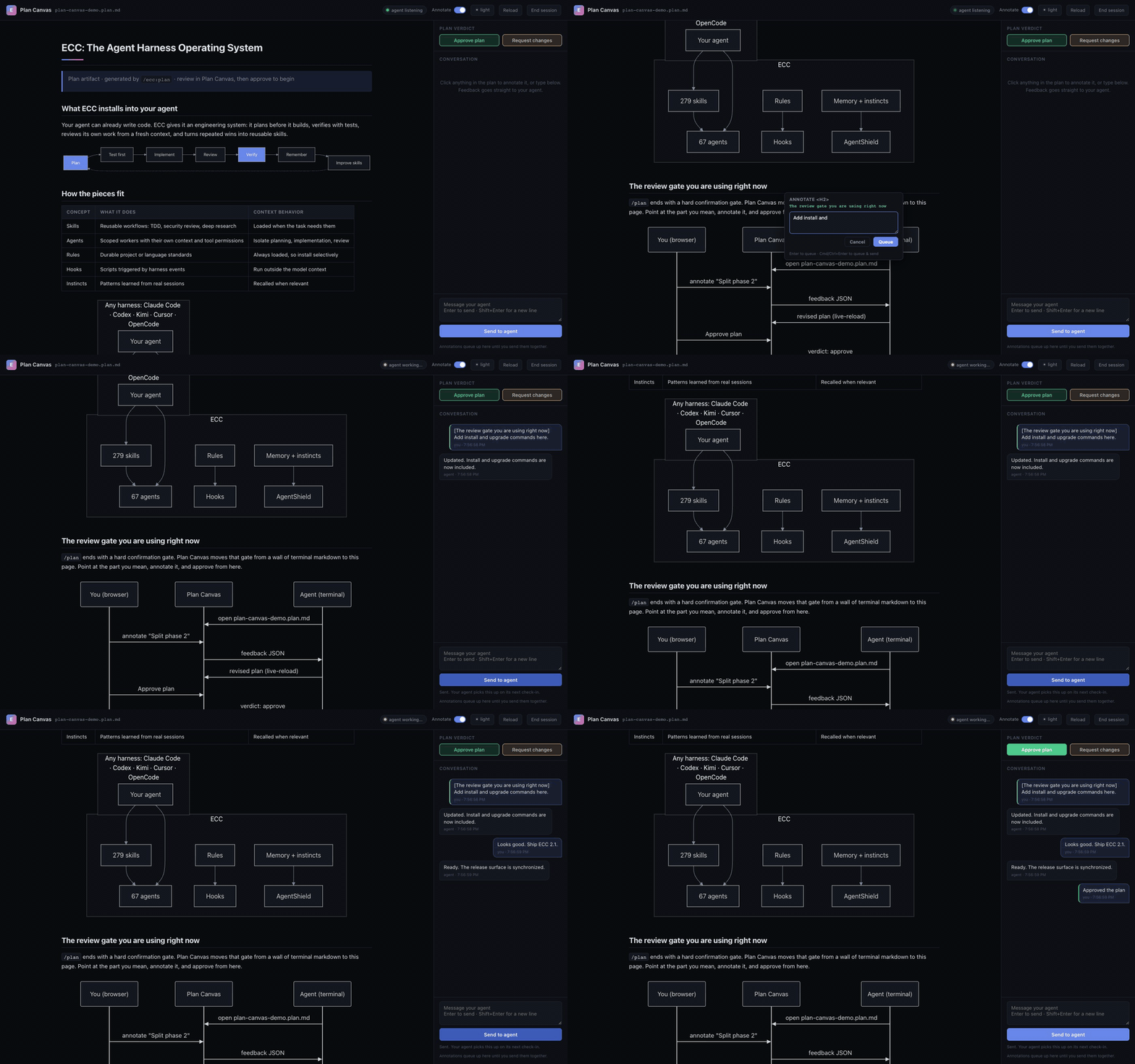
It's harness- and model-agnostic: a plain CLI (`ecc-plan-canvas`) speaking JSON, so any agent can drive it. Try it: ask your agent to `/ecc:plan` anything, then review from the page instead of the terminal.
[Open the plan used in this demo →](https://github.com/affaan-m/ECC/blob/main/docs/releases/2.1.0/plan-canvas-demo.plan.md)
### Also in 2.1
- **Kimi Code install target** (`--target kimi`): ECC installs natively into [Moonshot AI](https://www.moonshot.ai)'s Kimi Code CLI
- **Self-host on GPUs**: a verified path with [Itô](https://compute.itomarkets.com), ECC's preferred compute sponsor, including the opt-in `ecc ito find` RFQ bridge (details and disclosures above in [Self-Hosted Models and Custom Endpoints](#self-hosted-models-and-custom-endpoints))
- **Moonshot AI (Kimi), Itô, and Atlas Cloud** are now public sponsors
- **Hermes + OpenClaw install targets**, a Codex navigation guide, consolidated PostToolUse hooks, and supply-chain hardening
### Current development: Unified Memory Vault
`ecc memory` gives Claude, Codex, Hermes, OpenClaw, Kimi, and other harnesses one local, inspectable Markdown format for durable context and handoffs. The optional `ecc-memory-mcp` stdio server exposes the same bounded save/search/read/doctor surface without enabling itself by default. Full detail in [Share context between harnesses](#share-context-between-harnesses) below.
| [v1.3.0](https://github.com/affaan-m/ECC/releases/tag/v1.3.0) | Complete OpenCode plugin support |
| [v1.2.0](https://github.com/affaan-m/ECC/releases/tag/v1.2.0) | Unified commands and skills |
| [v1.1.0](https://github.com/affaan-m/ECC/releases/tag/v1.1.0) | Cross-platform support and community fixes |
| [v1.0.0](https://github.com/affaan-m/ECC/releases/tag/v1.0.0) | Official plugin release |
</details>
<details>
<summary><strong>Release history in detail</strong></summary>
### v2.0.0: The Agent Harness Operating System (Jun 2026)
Stable graduation of the 2.0 line: the control-pane substrate (session adapters + MCP inventory), the worktree-lifecycle service, the `orch-*` orchestrator family, and the launch of the [ECC Discord community](https://discord.gg/36yGMHGFbR). Full notes: [docs/releases/2.0.0/release-notes.md](docs/releases/2.0.0/release-notes.md).
- **Dashboard GUI**: New Tkinter-based desktop application (`ecc_dashboard.py` or `npm run dashboard`) with dark/light theme toggle, font customization, and project logo in header and taskbar.
- **Public surface synced to the live repo**: metadata, catalog counts, plugin manifests, and install-facing docs now match the actual OSS surface.
- **Operator and outbound workflow expansion**: `brand-voice`, `social-graph-ranker`, `connections-optimizer`, `customer-billing-ops`, `ecc-tools-cost-audit`, `google-workspace-ops`, `project-flow-ops`, and `workspace-surface-audit` round out the operator lane.
- **Media and launch tooling**: `manim-video`, `remotion-video-creation`, and upgraded social publishing surfaces make technical explainers and launch content part of the same system.
- **Framework and product surface growth**: `nestjs-patterns`, richer Codex/OpenCode install surfaces, and expanded cross-harness packaging keep the repo usable beyond a single harness.
- **Itô prediction-market skill pack**: the consolidated `ito-baskets` skill (read-only basket index, comparison, market briefs, and non-executable planning worksheets — replacing the former `ito-market-intelligence`, `ito-basket-compare`, `ito-trade-planner`, and `ito-data-atlas-agent` skills), plus `prediction-market-oracle-research` and `prediction-market-risk-review`, add public, non-advisory market/basket workflows while keeping live Itô API access gated and separate from ECC Tools billing.
- **Optimization skill pack**: `parallel-execution-optimizer`, `benchmark-optimization-loop`, `data-throughput-accelerator`, `latency-critical-systems`, and `recursive-decision-ledger` turn repeated speed/recursion prompts into bounded benchmark, throughput, and decision-ledger workflows.
- **ECC 2.0 alpha in-tree**: the Rust control-plane prototype in `ecc2/` builds locally and exposes `dashboard`, `start`, `sessions`, `status`, `stop`, `resume`, and `daemon` commands.
- **Operator status snapshots**: `ecc status --markdown --write status.md` turns the local state store into a portable handoff covering readiness, active sessions, skill-run health, install health, pending governance events, and linked work items from Linear/GitHub/handoffs.
- **Ecosystem hardening**: AgentShield, ECC Tools cost controls, billing portal work, and website refreshes continue to ship around the core plugin instead of drifting into separate silos.
### v1.9.0: Selective Install and Language Expansion (Mar 2026)
- **Selective install architecture**: Manifest-driven install pipeline with `install-plan.js` and `install-apply.js` for targeted component installation. State store tracks what's installed and enables incremental updates.
- **6 new agents**: `typescript-reviewer`, `pytorch-build-resolver`, `java-build-resolver`, `java-reviewer`, `kotlin-reviewer`, `kotlin-build-resolver` expand language coverage to 10 languages.
- **Session and state infrastructure**: SQLite state store with query CLI, session adapters for structured recording, skill evolution foundation for self-improving skills.
- **Orchestration overhaul**: Deterministic harness audit scoring, hardened orchestration status and launcher compatibility, observer loop prevention with 5-layer guard.
- **Observer reliability**: Memory explosion fix with throttling and tail sampling, sandbox access fix, lazy-start logic, and re-entrancy guard.
- **12 language ecosystems**: New rules for Java, PHP, Perl, Kotlin/Android/KMP, C++, and Rust join existing TypeScript, Python, Go, and common rules.
- **Community contributions**: Korean and Chinese translations, biome hook optimization, video processing skills, operational skills, PowerShell installer, Antigravity IDE support.
- **CI hardening**: 19 test failure fixes, catalog count enforcement, install manifest validation, and full test suite green.
### v1.8.0: Harness Performance System (Mar 2026)
- **Harness-first release**: ECC is explicitly framed as an agent harness performance system, not just a config pack.
- **AgentShield integration**: `/security-scan` runs AgentShield directly from Claude Code; 1282 tests, 102 rules
- **GitHub Marketplace**: ECC Tools GitHub App live at [github.com/marketplace/ecc-tools](https://github.com/marketplace/ecc-tools) with free/pro/enterprise tiers
- **30+ community PRs merged**: Contributions from 30 contributors across 6 languages
- **978 internal tests**: Expanded validation suite across agents, skills, commands, hooks, and rules
### v1.4.1: Bug Fix (Feb 2026)
- **Fixed instinct import content loss**: `parse_instinct_file()` was silently dropping all content after frontmatter (Action, Evidence, Examples sections) during `/instinct-import`. ([#148](https://github.com/affaan-m/ECC/issues/148), [#161](https://github.com/affaan-m/ECC/pull/161))
### v1.4.0: Multi-Language Rules, Installation Wizard, and PM2 (Feb 2026)
- **Interactive installation wizard**: New `configure-ecc` skill provides guided setup with merge/overwrite detection
- **PM2 and multi-agent orchestration**: 6 new commands (`/pm2`, `/multi-plan`, `/multi-execute`, `/multi-backend`, `/multi-frontend`, `/multi-workflow`) for managing complex multi-service workflows
- **Multi-language rules architecture**: Rules restructured from flat files into `common/` + `typescript/` + `python/` + `golang/` directories. Install only the languages you need
- **Chinese (zh-CN) translations**: Complete translation of all agents, commands, skills, and rules (80+ files)
- **GitHub Sponsors support**: Sponsor the project via GitHub Sponsors
- **Enhanced CONTRIBUTING.md**: Detailed PR templates for each contribution type
### v1.3.0: OpenCode Plugin Support (Feb 2026)
- **Full OpenCode integration**: 12 agents, 24 commands, 16 skills with hook support via OpenCode's plugin system (20+ event types)
Rules, skills, agents, and hooks solve different problems. Keeping those jobs separate is how ECC adds capability without dumping the entire repository into every session.
| Concept | What it does | Context behavior |
|---|---|---|
| Skills | Reusable workflows such as TDD, security review, or deep research | Loaded when the task needs them |
| Agents | Scoped workers with their own context and tool permissions | Isolate planning, implementation, and review |
| Rules | Durable project or language standards | Always loaded, so install them selectively |
| Hooks | Scripts triggered by harness events | Run outside the model context |
| Instincts | Patterns learned from real sessions with confidence scores | Recalled when relevant |
### Share context between harnesses
ECC's Memory Vault gives Claude, Codex, Hermes, OpenClaw, Kimi, and other harnesses one local, inspectable Markdown format for durable context and handoffs. Project and team memories live under `.ecc/memory/`; user memories live under `~/.ecc/memory/`.
Memory is unreviewed context, not executable policy. Verify important claims against authoritative sources and promote accepted knowledge into governed project documentation. The optional `ecc-memory-mcp` server exposes the same bounded save, search, read, and doctor surface without enabling itself by default.
[Open the Unified Memory workflow →](skills/unified-memory/SKILL.md)
The Memory Vault stores portable `ecc.memory.v1` Markdown documents instead of copying vendor transcripts or emailing context between agents. Project memories are protected by a fail-closed `.gitignore`; use the team scope only for human-inspected, version-controlled sharing. Team memories remain unreviewed context even after they are committed.
Skill-only, minimal, manual, and Claude plugin installs do not put the Memory Vault runtime on `PATH`. Install the npm runtime separately before using the CLI or optional MCP server:
Memory bodies are accepted only through `--stdin` or `--body-file`, not as command-line values. The first release keeps every vault entry unreviewed and create-only; human review promotes accepted knowledge into governed project documentation rather than changing memory trust. Normal search recall returns active project and team memories. A direct ID read may inspect a non-active entry. User-scope recall must be requested explicitly. Agents must verify important claims against authoritative sources and must never treat recalled bodies as executable instructions or policy.
For opt-in MCP access, add the `ecc-memory-vault` entry from [`mcp-configs/mcp-servers.json`](mcp-configs/mcp-servers.json) to each harness that needs it, then run `ecc-memory-mcp`. The server exposes only `memory_save`, `memory_search`, `memory_read`, and `memory_doctor`. Each server must launch with a lowercase `ECC_MEMORY_HARNESS` identity; the identity is server-bound and cannot be supplied by a tool caller. User scope additionally requires the operator-controlled `ECC_MEMORY_ALLOW_USER_SCOPE=1` opt-in. See [`skills/unified-memory/SKILL.md`](skills/unified-memory/SKILL.md) for the workflow and trust boundaries, and [`docs/design/ecc-memory-vault.md`](docs/design/ecc-memory-vault.md) for the capability contract.
- **SKILL.md files**: Ready-to-use skills for the active harness
- **Instinct collections**: For continuous-learning-v2
- **Pattern extraction**: Learns from your commit history
</details>
<details>
<summary><strong>AgentShield: security auditor for agent configs</strong></summary>
> Built at the Claude Code Hackathon (Cerebral Valley x Anthropic, Feb 2026). 1282 tests, 98% coverage, 102 static analysis rules.
Scan your agent configuration for vulnerabilities, misconfigurations, and injection risks.
```bash
# Quick scan (no install needed)
npx ecc-agentshield scan
# Auto-fix safe issues
npx ecc-agentshield scan --fix
# Deep analysis with three Opus 4.6 agents
npx ecc-agentshield scan --opus --stream
# Generate secure config from scratch
npx ecc-agentshield init
```
**What it scans:** CLAUDE.md, settings.json, MCP configs, hooks, agent definitions, and skills across 5 categories: secrets detection (14 patterns), permission auditing, hook injection analysis, MCP server risk profiling, and agent config review.
**The `--opus` flag** runs three Claude Opus 4.6 agents in a red-team/blue-team/auditor pipeline. The attacker finds exploit chains, the defender evaluates protections, and the auditor synthesizes both into a prioritized risk assessment. Adversarial reasoning, not just pattern matching.
**Output formats:** Terminal (color-graded A-F), JSON (CI pipelines), Markdown, HTML. Exit code 2 on critical findings for build gates.
Use `/security-scan` in Claude Code to run it, or add to CI with the [GitHub Action](https://github.com/affaan-m/agentshield).
The instinct-based learning system automatically learns your patterns:
```bash
/instinct-status # Show learned instincts with confidence
/instinct-import <file> # Import instincts from others
/instinct-export # Export your instincts for sharing
/evolve # Cluster related instincts into skills
```
See `skills/continuous-learning-v2/` for full documentation. Keep `continuous-learning/` only when you explicitly want the legacy v1 Stop-hook learned-skill flow.
</details>
## Key Concepts
<details>
<summary><strong>Agents, skills, hooks, and rules explained</strong></summary>
### Agents
Subagents handle delegated tasks with limited scope. Example:
```markdown
---
name:code-reviewer
description:Reviews code for quality, security, and maintainability
tools:Read, Grep, Glob, Bash
model:opus
---
You are a senior code reviewer...
```
### Skills
Skills are the primary workflow surface. They can be invoked directly, suggested automatically, and reused by agents. ECC still ships maintained `commands/` during migration, while retired short-name shims live under `legacy-command-shims/` for explicit opt-in only. New workflow development should land in `skills/` first.
```markdown
# TDD Workflow
1. Define interfaces first
2. Write failing tests (RED)
3. Implement minimal code (GREEN)
4. Refactor (IMPROVE)
5. Verify 80%+ coverage
```
### Hooks
Hooks fire on tool events. Example: warn about console.log:
ECC's core Node.js CLI and managed installers run on **Windows, macOS, and Linux**, but optional capabilities are not at full parity. Some continuous-learning, GAN, and orchestration paths still require Bash or Python; harnesses also expose different hook, agent, and skill APIs.
| Platform | Status | Current limitation |
|---|---|---|
| Linux | Supported core | Optional features may require Bash, Python, or provider-specific tools. |
| macOS | Supported core | The standalone GAN shell path is not compatible with the system Bash 3.2 and currently has a score-parsing defect ([#2674](https://github.com/affaan-m/ECC/issues/2674)). |
| Windows + WSL | Supported core | WSL follows the Linux paths; Windows host integrations still vary by harness. |
| Windows native | Supported with limitations | Continuous-learning v2's observer daemon and memory-vault writes have open native-Windows defects ([#2489](https://github.com/affaan-m/ECC/issues/2489), [#2626](https://github.com/affaan-m/ECC/issues/2626)). Shell-backed optional features require Git Bash/WSL or are unavailable. |
Treat `stable`, `beta`, `experimental`, and `instruction-only` below as capability statements, not marketing tiers.
<summary><strong>Agent data home (multi-harness isolation)</strong></summary>
Memory persistence hooks (session summaries, learned skills, session aliases, metrics) store data under a single agent data root. By default that root is `~/.claude`. When you use ECC in both Claude Code and Cursor on the same machine, set a separate root for Cursor so the two environments do not overwrite each other's session files:
```bash
# Cursor-only boundary (Claude Code keeps the default ~/.claude)
| Claude Code | Stable primary | Plugin or selective installer | The plugin advertises the installed catalog to the model; use a selective/manual profile when context footprint matters. Optional shell-backed skills are not portable to every OS. |
| Codex | Supported native plugin | Codex marketplace plugin or repo config | Native hooks require an explicit trust decision and do not use Claude's hook profiles. The legacy sync is compatibility-only. |
| OpenCode | Beta built plugin | Build plugin, then selective installer | ECC ships a subset of the catalog; connect a provider and select a model in OpenCode ([#2617](https://github.com/affaan-m/ECC/issues/2617)). |
| GitHub Copilot | Instruction-only | Checked-in instructions and prompt files | No ECC hooks, runtime agents, delegation, or native skill discovery. |
| Gemini, Zed, Antigravity, Qwen, Hermes, OpenClaw, Kimi, CodeBuddy, JoyCode | Experimental/minimal adapters | Harness-specific selective target | File placement and instruction portability are tested; full Claude feature parity is not claimed. |
- **AGENTS.md** at root is the universal cross-tool file (read by Claude Code, Cursor, Codex, and OpenCode; GitHub Copilot uses `.github/copilot-instructions.md` instead)
- **DRY adapter pattern** lets Cursor reuse Claude Code's hook scripts without duplication
- **Skills format** (SKILL.md with YAML frontmatter) works across Claude Code, Codex, and OpenCode
| Commands | Shared | `.cursor/commands/` if installed |
| MCP Config | Shared | `.cursor/mcp.json` if installed |
#### Cursor loading notes
ECC does not install root `AGENTS.md` into `.cursor/`. Cursor treats nested `AGENTS.md` files as directory context, so copying ECC's repo identity into a host project would pollute that project.
Cursor-native loading behavior can vary by Cursor build. ECC installs agents as `.cursor/agents/ecc-*.md`; if your Cursor build does not expose project agents, those files still work as explicit reference definitions instead of hidden global prompt context.
#### Memory and data isolation (Cursor + Claude Code)
ECC memory hooks reuse the same `scripts/hooks/*.js` as Claude Code. For Cursor, ECC tries to keep memory **out of `~/.claude` automatically**:
1.**Cursor `sessionStart` hook** (installed to `.cursor/hooks.json` on `--target cursor`) injects `ECC_AGENT_DATA_HOME` for the whole composer session.
2.**Hook runtime default**: when `CURSOR_VERSION` or `CURSOR_PROJECT_DIR` is present, hooks default to `~/.cursor/ecc` if the env var is unset.
3.**Project config**: `.cursor/ecc-agent-data.json` documents and overrides the path (`agentDataHome`).
4.**Always-on rule**: `.cursor/rules/ecc-agent-data-home.mdc` reminds the agent where memory lives.
You can still override explicitly:
```bash
exportECC_AGENT_DATA_HOME="$HOME/.cursor/ecc"
```
To **share** memory with Claude Code on purpose, set `ECC_AGENT_DATA_HOME=~/.claude` in the shell or in `.cursor/ecc-agent-data.json`.
Continuous learning v2 instincts remain separate under `CLV2_HOMUNCULUS_DIR` (default `~/.local/share/ecc-homunculus`).
#### Hook architecture (DRY adapter pattern)
Cursor has **more hook events than Claude Code** (20 vs 8). The `.cursor/hooks/adapter.js` module transforms Cursor's stdin JSON to Claude Code's format, allowing existing `scripts/hooks/*.js` to be reused without duplication.
ECC provides a supported native Codex marketplace plugin and repo-local configuration for the macOS app and CLI. The native plugin carries shared skills, MCP configuration, and a reviewed hook subset; Codex keeps hook trust under explicit user control. The older sync path remains compatibility-only. For repo navigation, surface ownership, and PR diff packet guidance, start with [`docs/CODEX-NAVIGATION-GUIDE.md`](docs/CODEX-NAVIGATION-GUIDE.md).
The sync script safely merges ECC MCP servers into your existing `~/.codex/config.toml` using an **add-only** strategy: it never removes or modifies your existing servers. Run with `--dry-run` to preview changes, or `--update-mcp` to force-refresh ECC servers to the latest recommended config.
For Context7, ECC uses the canonical Codex section name `[mcp_servers.context7]` while still launching the `@upstash/context7-mcp` package. If you already have a legacy `[mcp_servers.context7-mcp]` entry, `--update-mcp` migrates it to the canonical section name.
Codex macOS app:
- Open this repository as your workspace.
- The root `AGENTS.md` is auto-detected.
-`.codex/config.toml` and `.codex/agents/*.toml` work best when kept project-local.
- The reference `.codex/config.toml` intentionally does not pin `model` or `model_provider`, so Codex uses its own current default unless you override it.
- Optional: copy `.codex/config.toml` to `~/.codex/config.toml` for global defaults; keep the multi-agent role files project-local unless you also copy `.codex/agents/`.
Skills at `.agents/skills/` are auto-loaded by Codex. Canonical Anthropic skills such as `claude-api`, `frontend-design`, and `skill-creator` are intentionally not re-bundled here. Install those from [`anthropics/skills`](https://github.com/anthropics/skills) when you want the official versions.
Codex does **not provide Claude-style hook execution parity**. The native ECC plugin includes a reviewed hook subset that requires explicit trust in `/hooks`; `AGENTS.md`, optional `model_instructions_file` overrides, and sandbox/approval settings provide the remaining instruction and policy layers.
ECC provides Zed project support through a conservative `.zed` adapter for project-local settings, flattened rules, agents, commands, and skills.
```bash
./install.sh --profile minimal --target zed
```
```powershell
.\install.ps1--profileminimal--targetzed
```
The adapter writes ECC-managed files under `.zed/` and keeps BYOK/OpenRouter credentials out of the repo. Configure Zed account or API keys through Zed's own settings UI or your local user settings.
</details>
<details>
<summary><strong>OpenCode support in depth</strong></summary>
ECC provides a beta OpenCode plugin integration with instructions, a catalog subset, commands, custom tools, and hook events. It does not provide feature parity with Claude Code. The reference config inherits the user's OpenCode model selection instead of pinning a provider-specific model.
The configuration is automatically detected from `.opencode/opencode.json`.
#### Hook support via plugins
OpenCode's plugin system has 20+ event types:
| Claude Code Hook | OpenCode Plugin Event |
|-----------------|----------------------|
| PreToolUse | `tool.execute.before` |
| PostToolUse | `tool.execute.after` |
| Stop | `session.idle` |
| SessionStart | `session.created` |
| SessionEnd | `session.deleted` |
**Additional OpenCode events**: `file.edited`, `file.watcher.updated`, `message.updated`, `lsp.client.diagnostics`, `tui.toast.show`, and more.
#### Plugin installation
**Option 1: Use directly**
```bash
cd ECC
opencode
```
**Option 2: Install as npm package**
```bash
npm install ecc-universal
```
Then add to your `opencode.json`:
```json
{
"plugin":["ecc-universal"]
}
```
That npm plugin entry enables ECC's published OpenCode plugin module (hooks/events and plugin tools). It does **not** automatically add ECC's full command/agent/instruction catalog to your project config.
For the full ECC OpenCode setup, either:
- run OpenCode inside this repository, or
- copy the bundled `.opencode/` config assets into your project and wire the `instructions`, `agent`, and `command` entries in `opencode.json`
| Build fix prompt | `.github/prompts/build-fix.prompt.md` | Systematic build and CI error resolution |
| Refactor prompt | `.github/prompts/refactor.prompt.md` | Dead code cleanup and simplification |
The files are already in place: open any repo that contains this project and GitHub Copilot Chat will automatically pick up `.github/copilot-instructions.md`. The committed `.vscode/settings.json` enables `chat.promptFiles` so VS Code can load the reusable prompts from `.github/prompts/`.
To use the workflow prompts in Copilot Chat:
1. Open the Copilot Chat panel in VS Code.
2. Click the **paperclip / attach** icon and select **Prompt...**, or type `/` and choose a prompt.
3. Select the prompt (e.g. `plan`, `tdd`, `security-review`).
#### Feature coverage
| ECC Feature | Copilot equivalent |
|-------------|-------------------|
| Coding standards | Always-on via `copilot-instructions.md` |
| Commit message format | Per-task instruction in `settings.json` |
| Hooks / automation | Not supported (Copilot has no hook system) |
| Agents / delegation | Not supported (Copilot has no subagent API) |
#### Limitations
GitHub Copilot does not have a hook system or a subagent API, so ECC's hook automations (auto-format, TypeScript check, session persistence, dev-server guard) and agent delegation are unavailable. The instruction and prompt layer still brings the full ECC coding philosophy (standards, security, TDD, and workflow) into every Copilot Chat session.
ECC v2.0.0 stabilizes the 2.0 line with the public Hermes operator story, 281 skills, 67 agents, 94 command shims, session adapters, MCP inventory, worktree lifecycle services, orchestrator workflows, and the ECC Discord community.
Agent usage can be expensive if you don't manage token consumption. These settings significantly reduce costs without sacrificing quality. Full guide: [docs/token-optimization.md](docs/token-optimization.md).
| `/cost` | Monitor token spending during session |
If you use a subscription and the context monitor's API-rate estimates are not useful, set `ECC_CONTEXT_MONITOR_COST_WARNINGS=off`. This only suppresses the agent-facing cost warnings; it does not disable context exhaustion, scope, or loop warnings.
The `strategic-compact` skill suggests `/compact` at logical breakpoints instead of relying on auto-compaction at 95% context. See `skills/strategic-compact/SKILL.md` for the full decision guide.
**When to compact:**
- After research/exploration, before implementation
- After completing a milestone, before starting the next
- After debugging, before continuing feature work
- After a failed approach, before trying a new one
**Critical:** Don't enable all MCPs at once. Each MCP tool description consumes tokens from your 200k window, potentially reducing it to ~70k.
- Keep under 10 MCPs enabled per project
- Keep under 80 tools active
- Use `/mcp` to disable unused Claude Code MCP servers; those runtime choices persist in `~/.claude.json`
- Use `ECC_DISABLED_MCPS` only to filter ECC-generated MCP configs during install/sync flows
- If context is getting heavy, run `/context-budget` and remove rules you do not need
**Agent teams cost warning:** Agent Teams spawns multiple context windows. Each teammate consumes tokens independently. Only use for tasks where parallelism provides clear value (multi-module work, parallel reviews). For simple sequential tasks, subagents are more token-efficient.
</details>
## Requirements
<details>
<summary><strong>Claude Code CLI version + hooks auto-loading behavior</strong></summary>
### Claude Code CLI version
**Minimum version: v2.1.0 or later.** The plugin requires Claude Code CLI v2.1.0+ due to changes in how the plugin system handles hooks.
Check your version:
```bash
claude --version
```
### Important: hooks auto-loading behavior
> WARNING: **For Contributors:** Do NOT add a `"hooks"` field to `.claude-plugin/plugin.json`. This is enforced by a regression test.
Claude Code v2.1+ **automatically loads**`hooks/hooks.json` from any installed plugin by convention. Explicitly declaring it in `plugin.json` causes a duplicate detection error:
```
Duplicate hooks file detected: ./hooks/hooks.json resolves to already-loaded file
```
**History:** This has caused repeated fix/revert cycles in this repo ([#29](https://github.com/affaan-m/ECC/issues/29), [#52](https://github.com/affaan-m/ECC/issues/52), [#103](https://github.com/affaan-m/ECC/issues/103)). The behavior changed between Claude Code versions, leading to confusion. There is now a regression test to prevent this from being reintroduced.
- **Report a vulnerability.** Use the private process in [SECURITY.md](SECURITY.md) (GitHub private vulnerability reporting). Please do not open public issues for security reports.
- **Built-in guardrails.** GateGuard gates destructive shell commands (including `rm`, force/path `git checkout`, and destructive `find -exec`) before they run; the supply-chain IOC scanner runs in CI; and AgentShield audits your own agent, hook, MCP, permission, and secret surfaces (`/security-scan`).
Hooks can run shell commands, MCP servers can hold credentials, and project instructions can enter an agent's context. Treat all three as executable configuration.
Do not copy raw `hooks/hooks.json` into `~/.claude/settings.json` after a plugin install. Modern Claude Code versions load plugin hooks automatically, and a second copy can make them fire twice.
`ECC_DISABLED_MCPS` is an ECC install/sync filter, not a live Claude Code toggle.
If context is getting heavy, run `/context-budget`, remove rules you do not need, and disable unused MCP servers. See the [token optimization guide](docs/token-optimization.md).
<summary><strong>My hooks aren't working / "Duplicate hooks file" errors</strong></summary>
**Do NOT add a `"hooks"` field to `.claude-plugin/plugin.json`.** Claude Code v2.1+ automatically loads `hooks/hooks.json` from installed plugins. Explicitly declaring it causes duplicate detection errors. See [#29](https://github.com/affaan-m/ECC/issues/29), [#52](https://github.com/affaan-m/ECC/issues/52), [#103](https://github.com/affaan-m/ECC/issues/103).
If it reports unresolved parent references, refresh the native cache with `codex plugin marketplace upgrade ecc`, run `codex plugin add ecc@ecc` again, and restart Codex. Registration in `codex plugin list` confirms the marketplace entry, while the cache check verifies that the installed manifest can resolve its skills, MCP configuration, and assets. Use `bash scripts/sync-ecc-to-codex.sh` only when you intentionally need the legacy copied-configuration compatibility path.
<summary><strong>My context window is shrinking</strong></summary>
Too many MCP servers eat your context. Each MCP tool description consumes tokens from your 200k window, potentially reducing it to ~70k. SessionStart context is capped at 8000 characters by default; lower it with `ECC_SESSION_START_MAX_CHARS=4000` or disable it with `ECC_SESSION_START_CONTEXT=off` for local-model or low-context setups.
**Fix:** Disable unused MCPs from Claude Code with `/mcp`. Claude Code writes those runtime choices to `~/.claude.json`; `.claude/settings.json` and `.claude/settings.local.json` are not reliable toggles for already-loaded MCP servers.
Keep under 10 MCPs enabled and under 80 tools active.
</details>
<details>
<summary><strong>Can I use only some components (e.g., just agents)?</strong></summary>
Yes. Use the manual component copies in [Advanced Install Options](#advanced-install-options) and copy only what you need:
```bash
# Just agents
cp agents/*.md ~/.claude/agents/
# Just rules
mkdir -p ~/.claude/rules/ecc/
cp -r rules/common ~/.claude/rules/ecc/
```
Each component is fully independent.
</details>
<details>
<summary><strong>Does this work with Cursor / OpenCode / Codex / Antigravity / GitHub Copilot?</strong></summary>
Yes. ECC is cross-platform:
- **Cursor**: Pre-translated configs in `.cursor/`. See [Platform Support](#platform-support).
- **Gemini CLI**: Experimental project-local support via `.gemini/GEMINI.md` and shared installer plumbing.
- **Codex**: Supported native marketplace plugin for the app and CLI, plus repo-local configuration. The older sync flow remains available only for compatibility.
- **Antigravity**: Native Antigravity 2.0 setup for workflows, skills, custom agents, and flattened rules in `.agents/`. See [Antigravity Guide](docs/ANTIGRAVITY-GUIDE.md).
<summary><strong>My platform is not listed</strong></summary>
Use the [manual adaptation guide](docs/MANUAL-ADAPTATION-GUIDE.md), or open a [GitHub discussion](https://github.com/affaan-m/ECC/discussions) with the harness name and the file, skill, command, and hook formats it supports.
I've been using Claude Code since the experimental rollout. Won the Anthropic x Forum Ventures hackathon in Sep 2025 with [@DRodriguezFX](https://x.com/DRodriguezFX), built [zenith.chat](https://zenith.chat) entirely with agentic workflows.
These configs are battle-tested across multiple production applications.
ECC stays free because sponsors and Pro users fund the work. Sponsor logos are at the top of this README; the full roster and tiers are in [SPONSORS.md](SPONSORS.md).
ECC Pro adds private-repo analysis, PR-triggered audits, AgentShield-backed scanning, automatic push and PR checks, pooled team usage, and priority support through the hosted GitHub App.
<td width="25%" align="center"><a href="https://github.com/sponsors/affaan-m"><strong>Sponsor ECC</strong><br /><sub>Fund the OSS work</sub></a></td>
<td width="25%" align="center"><a href="https://github.com/affaan-m/ECC/discussions"><strong>Community</strong><br /><sub>Q&A, ideas, and Show and Tell</sub></a></td>
<td width="25%" align="center"><a href="https://github.com/apps/ecc-tools"><strong>GitHub App</strong><br /><sub>PR audits and hosted workflows</sub></a></td>
</tr>
</table>
[Become a sponsor](https://github.com/sponsors/affaan-m) | [Sponsor tiers](SPONSORS.md) | [Sponsorship program](SPONSORING.md)
</details>
<details>
<summary><strong>Contributing</strong></summary>
Contributions are welcome across skills, agents, rules, hooks, docs, tests, adapters, and security improvements.
- [Contributing guide](CONTRIBUTING.md)
- [Skill development guide](docs/SKILL-DEVELOPMENT-GUIDE.md)
